BRAIN DEVELOPMENT
AND RESEARCH
ECD 110
Early Childhood Growth and Development
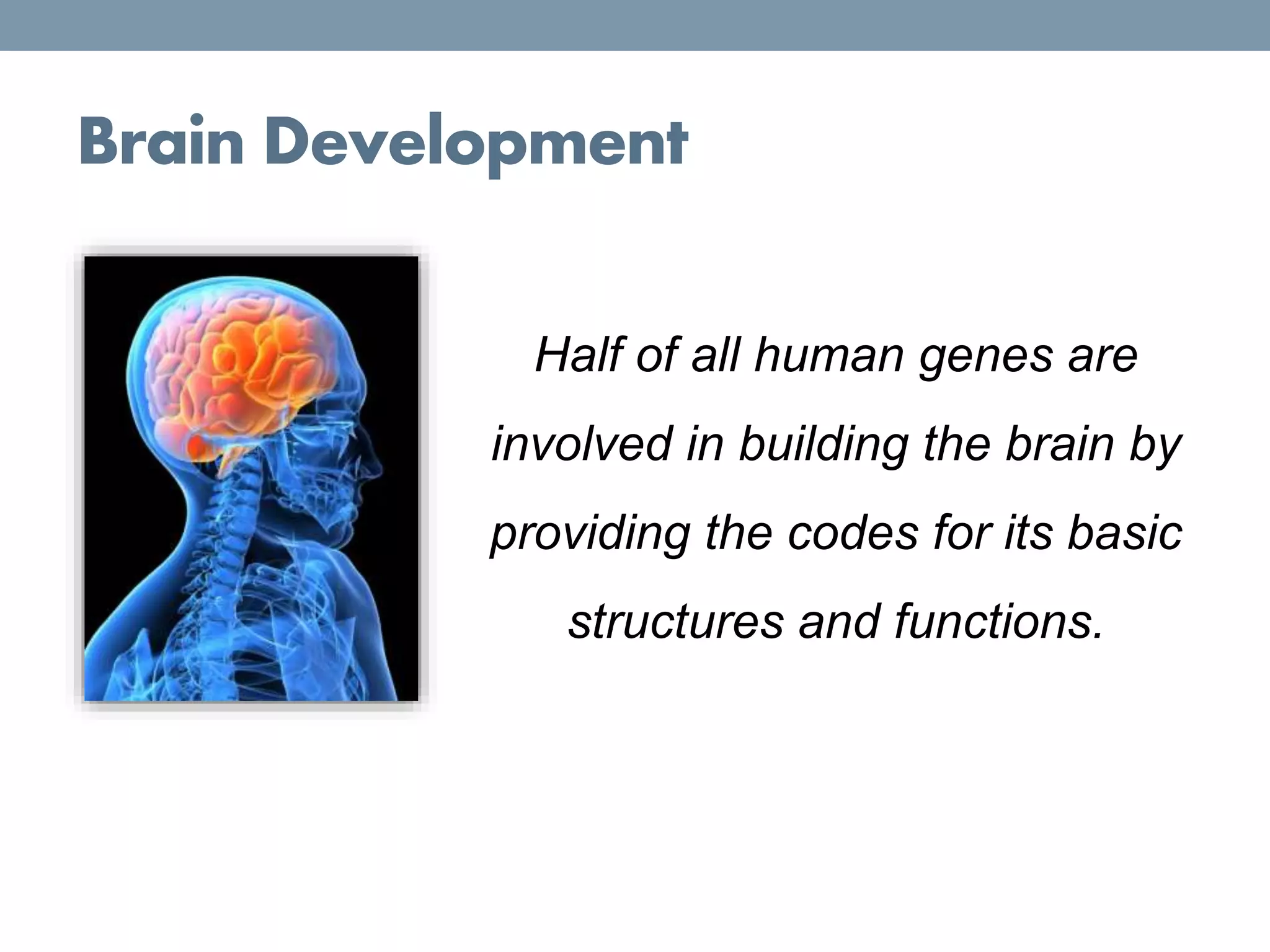
Half of all human genes are
involved in building the brain by
providing the codes for its basic
structures and functions.
Brain Development
Early Brain Development
Formation and Migration of Neurons
• The brain is built of cells called neurons
• Neurons are the communication system of the brain
• A neuron’s job is to make connections with other
neurons, constantly exchanging information
• A baby is born with 100 billion neurons
Early Brain Development
Formation and Migration of Neurons
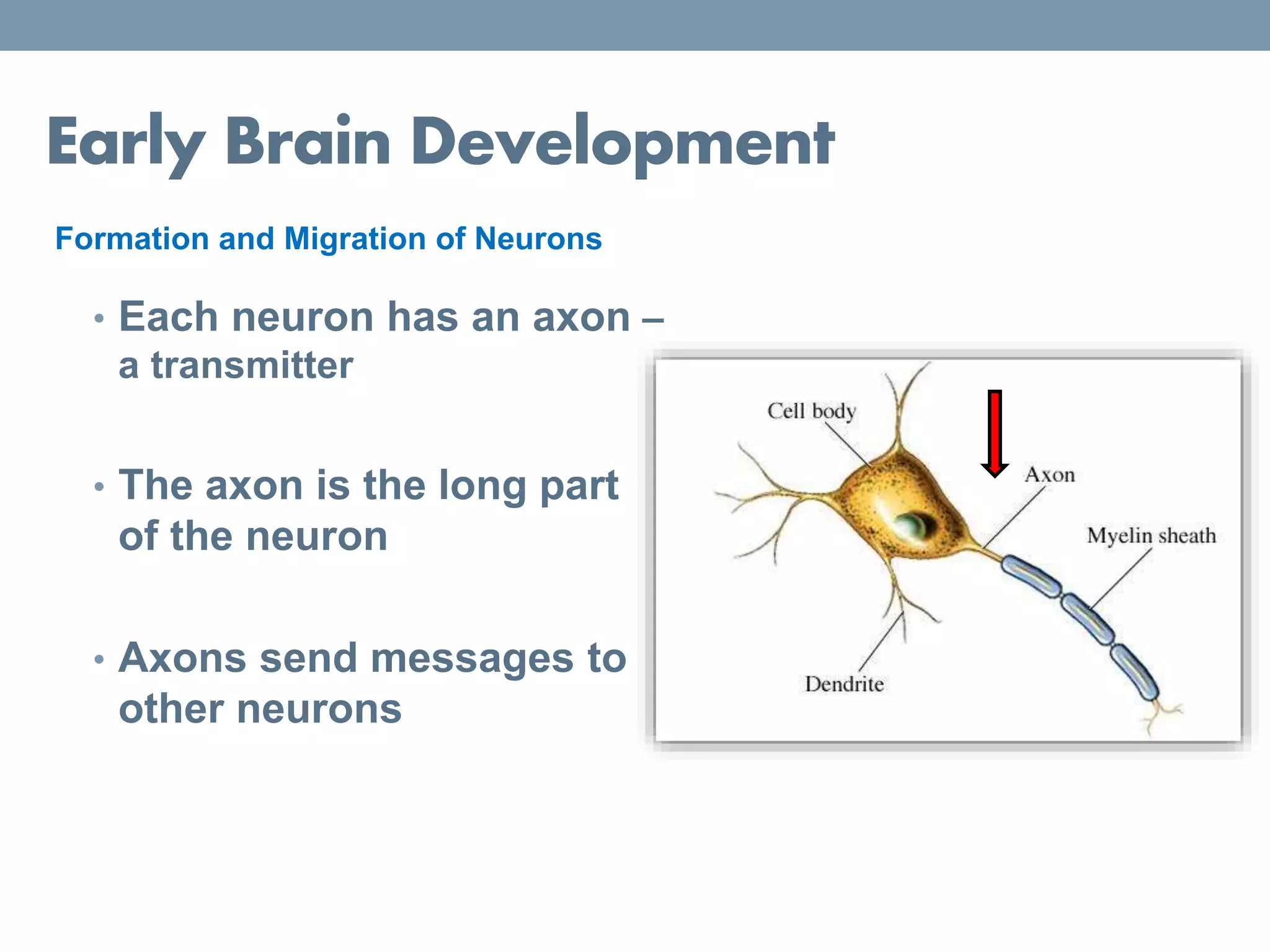
• Each neuron has an axon –
a transmitter
• The axon is the long part
of the neuron
• Axons send messages to
other neurons
Early Brain Development
Formation and Migration of Neurons
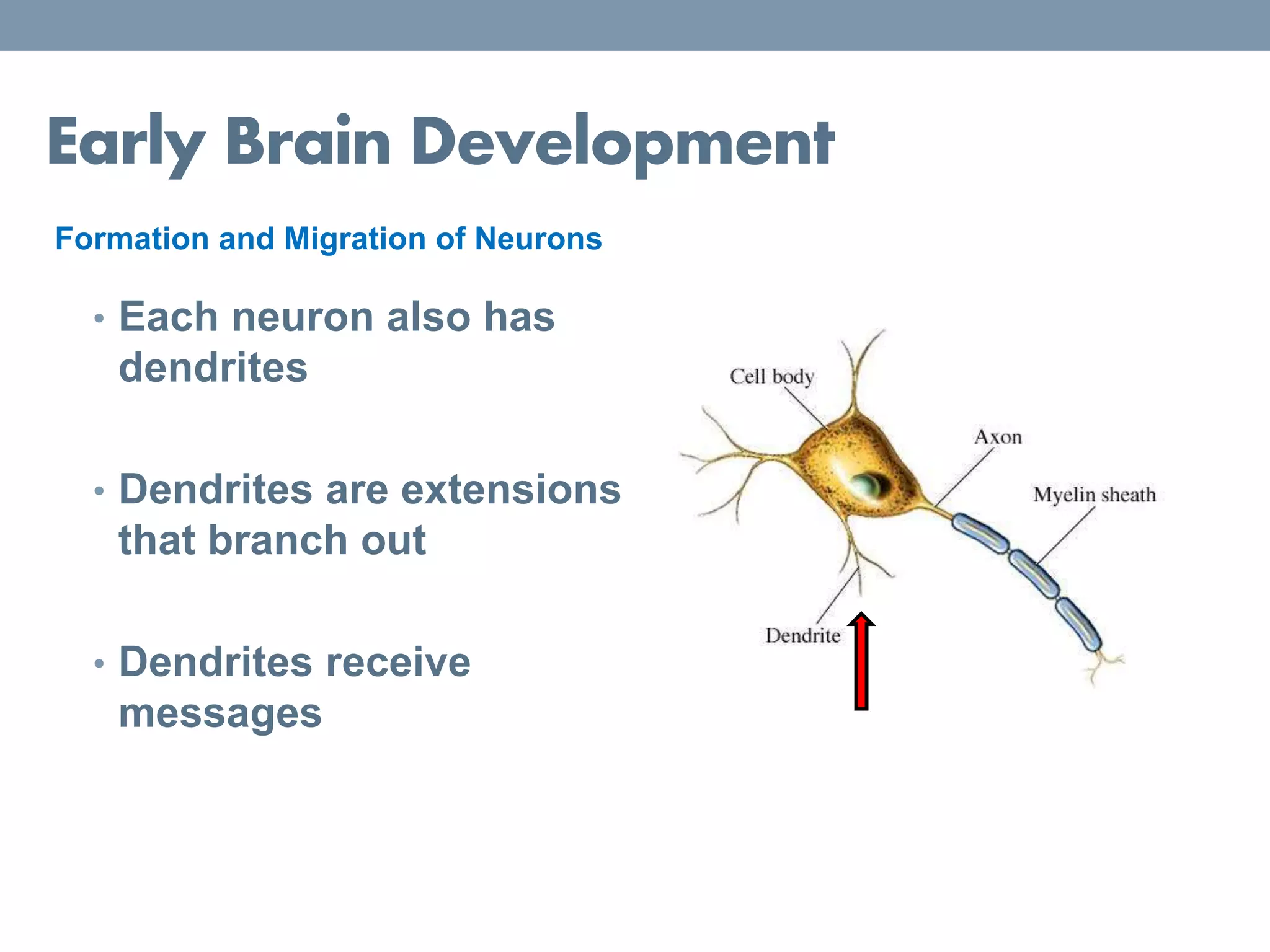
• Each neuron also has
dendrites
• Dendrites are extensions
that branch out
• Dendrites receive
messages
Early Brain Development
Formation and
Migration of Neurons
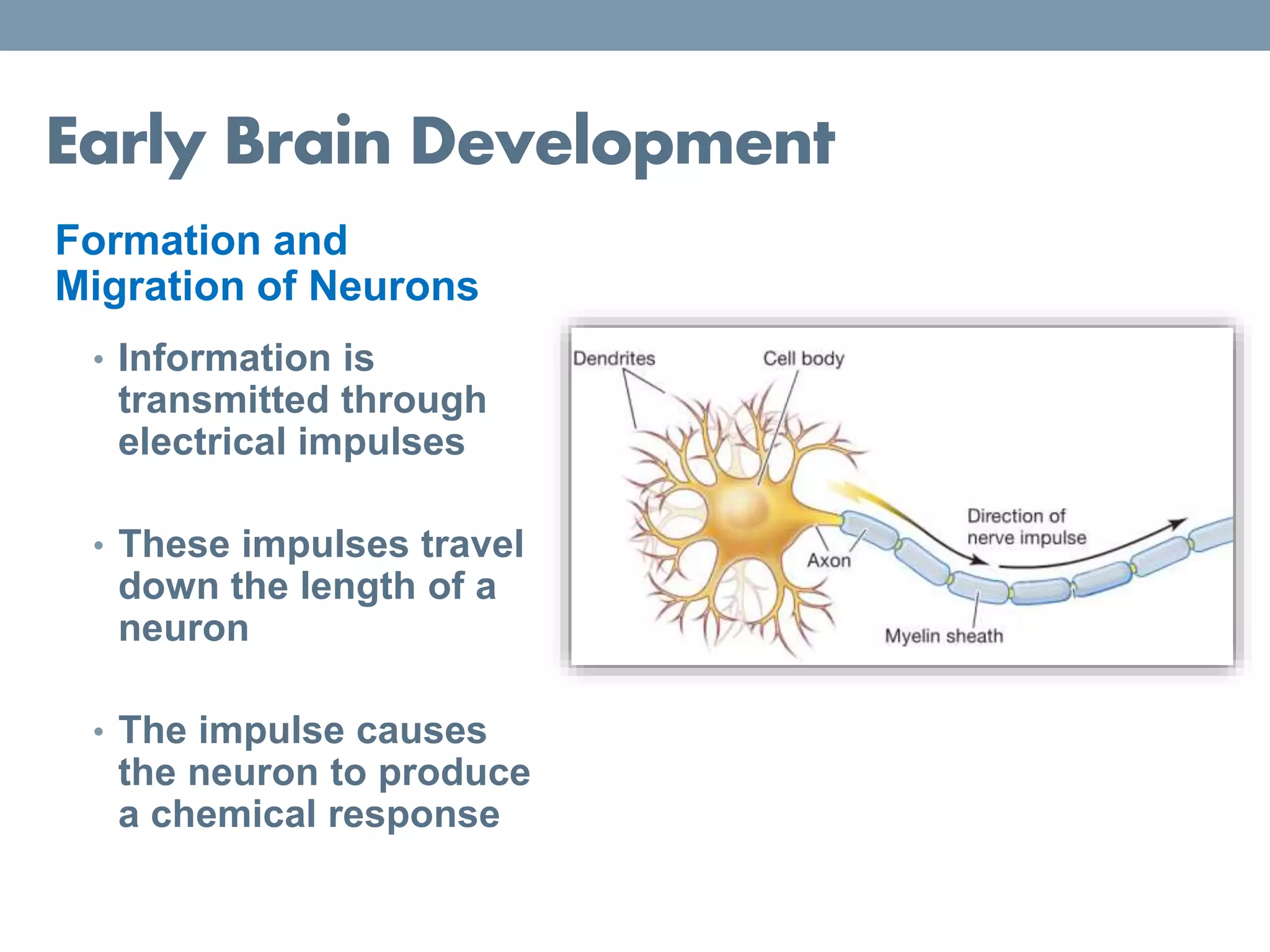
• Information is
transmitted through
electrical impulses
• These impulses travel
down the length of a
neuron
• The impulse causes
the neuron to produce
a chemical response
Early Experiences and
Brain Development
• Babies respond to sensory information in the womb
and create synaptic connections
• By 1 year brain is 70% of adult size, by 3 years – 90%
• Synapses become strong through repeated exposure
to meaningful experiences
Early Brain Development
Formation and Migration of Neurons
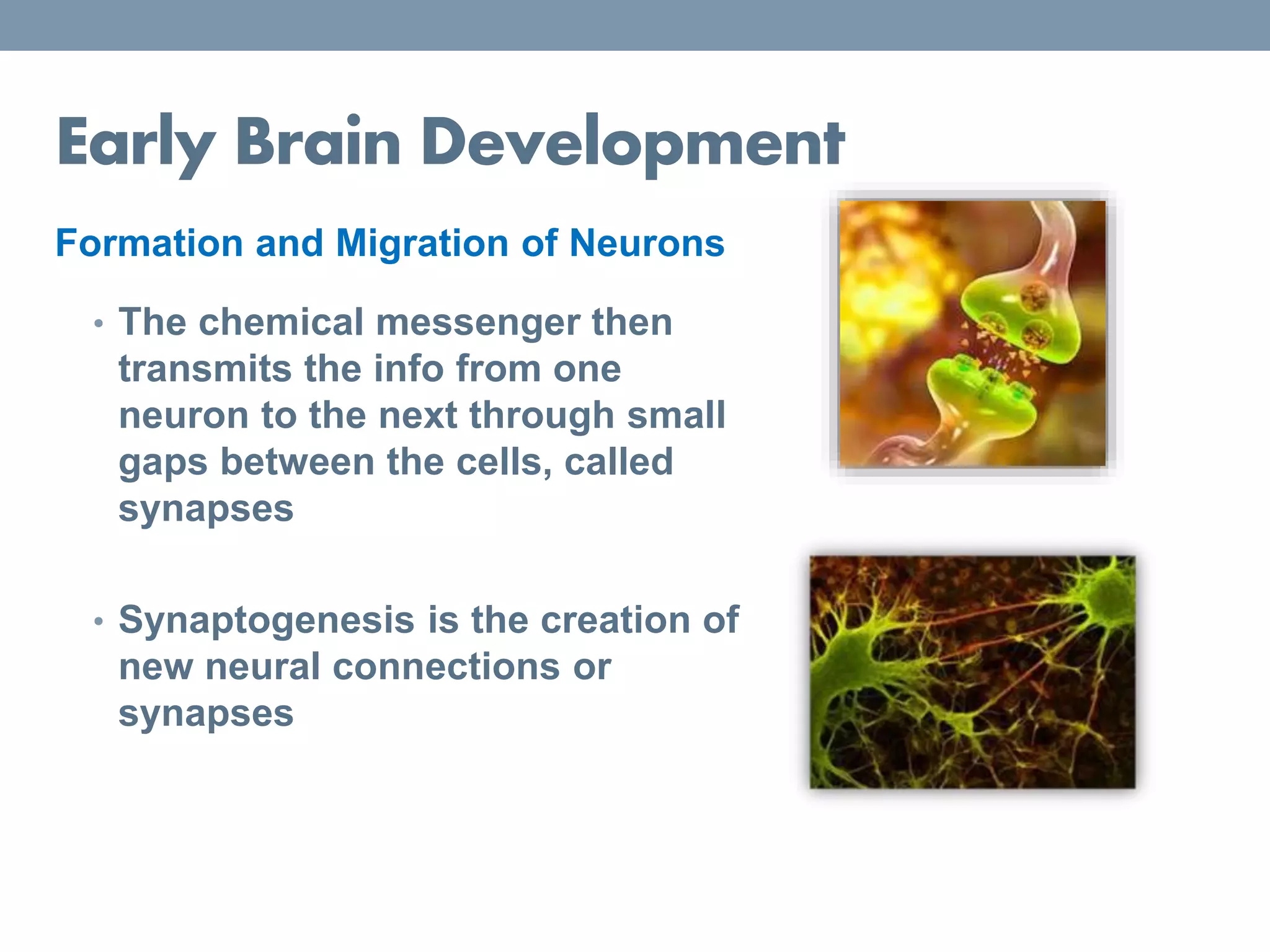
• The chemical messenger then
transmits the info from one
neuron to the next through small
gaps between the cells, called
synapses
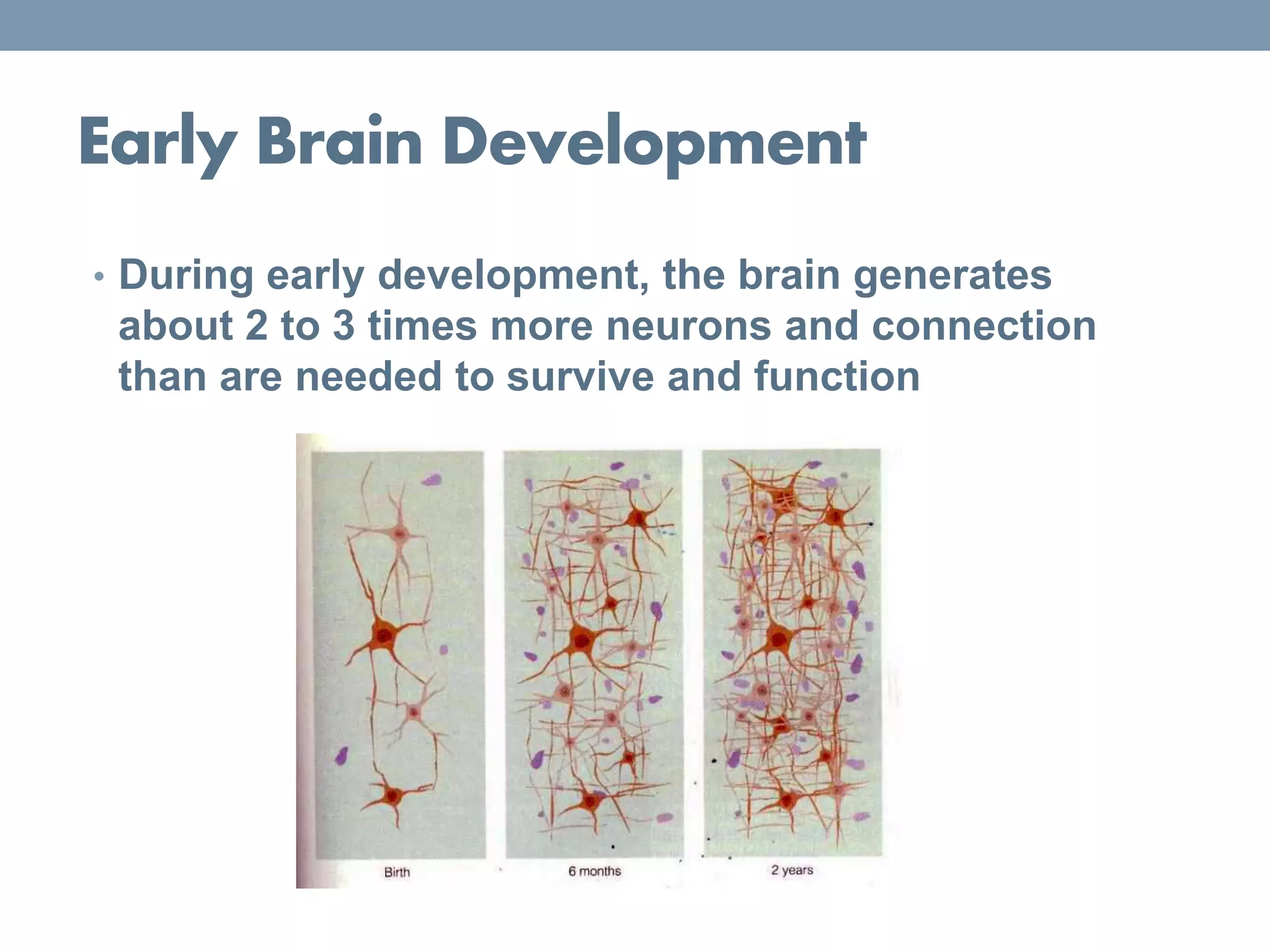
• Synaptogenesis is the creation of
new neural connections or
synapses
The Importance of Myelination
• Myelination consists of smooth
layers of fatty proteins that sheath
the neuron
• Electrical impulses travel 3x faster
• During prenatal development
myelination occurs along the spinal
cord
The most dramatic
myelination occurs
before 2 years of age
Early Brain Development
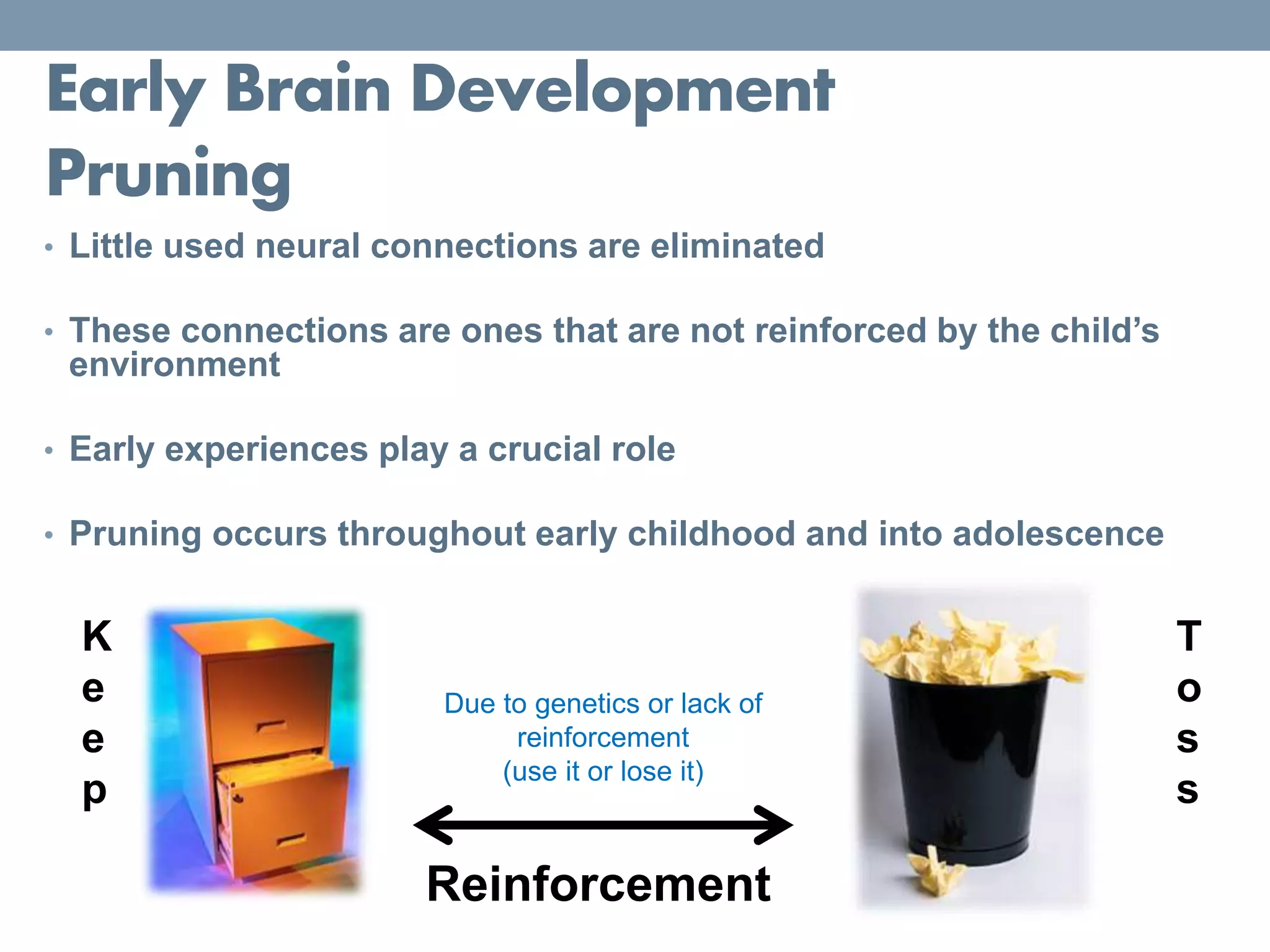
• During early development, the brain generates
about 2 to 3 times more neurons and connection
than are needed to survive and function
Early Brain Development
Pruning
• Little used neural connections are eliminated
• These connections are ones that are not reinforced by the child’s
environment
• Early experiences play a crucial role
• Pruning occurs throughout early childhood and into adolescence
Due to genetics or lack of
reinforcement
(use it or lose it)
K
e
e
p
T
o
s
s
Reinforcement
Brain Development – Cerebral Cortex
• Left Hemisphere
• Language processing
• Develops rapidly around the
age of 2
• Right Hemisphere
• Spatial relationship
• Rapid development around the
age of 4 or 5
• This is the largest part of the brain
• Controls higher thought process
• Last part of the brain to finish growing
• Easily influenced by the environment
Hi! Hey!
Brain Development – Cerebral Cortex
• Left Hemisphere
• Logic
• Reason (facts)
• Objective
• Verbal
• Self-oriented
• Categorical
• Detail focused
• Memory
• Purposefulness
• Words of Songs
• Mathematics
• Forms strategy
• Order
• Safe
• Acknowledges
• Right Hemisphere
• Intuition
• Emotions
• Subjective
• Visual
• Group-oriented
• Relational
• Whole picture focused
• Creative
• Playfulness
• Tune of Songs
• Arts (motor skill)
• Forms possibilities
• Imagination
• Risk taking
• Appreciates
Infant Brain Development
• By the time a baby is born, the brain controls
important survival functions…
• Breathing
• Swallowing
• Sucking
• Heartbeat
• Sensory areas develop early
• Smell
• Taste
• Touch
• Sight
• Hearing
Infant Brain Development
Brain Plasticity
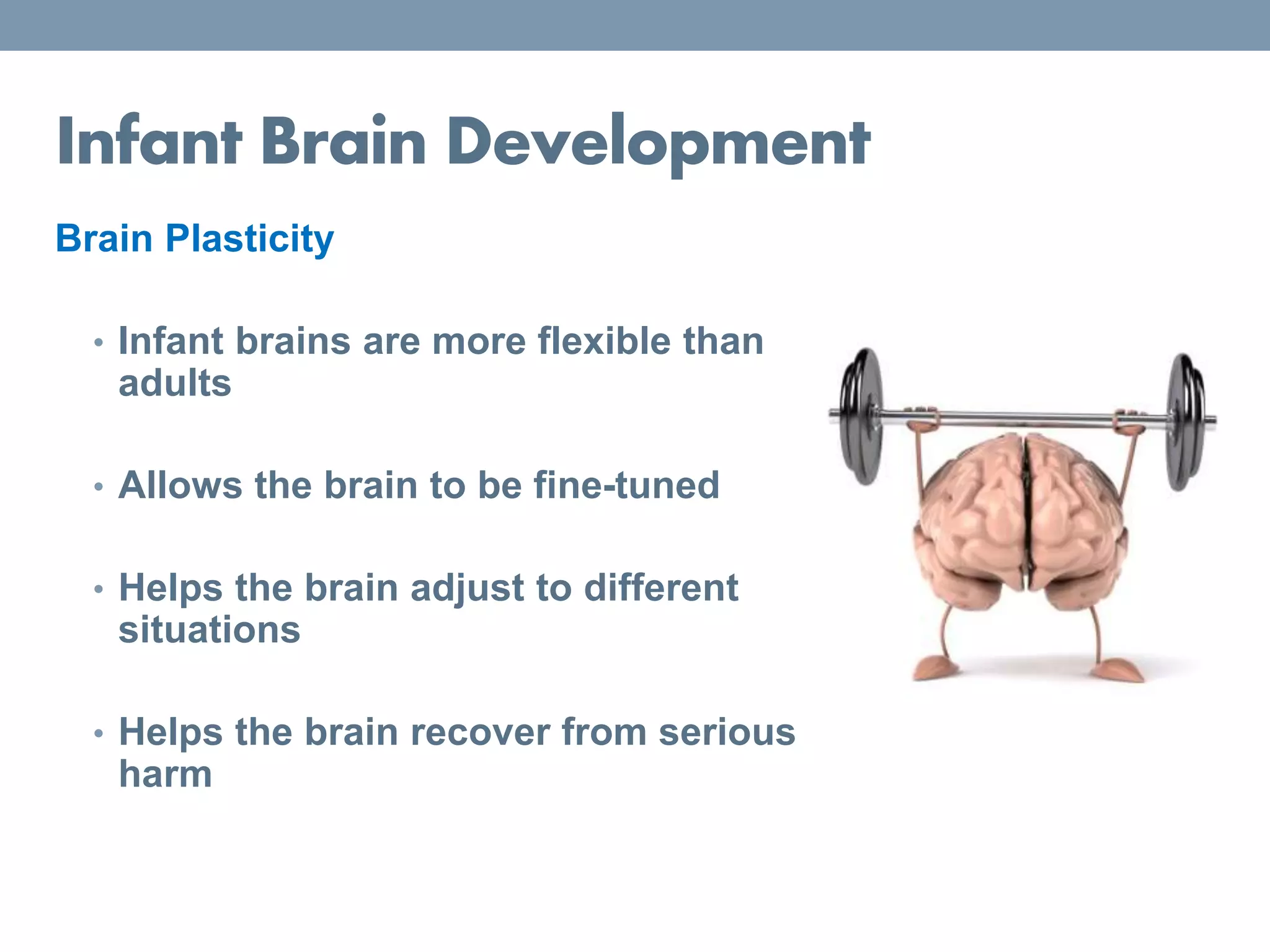
• Infant brains are more flexible than
adults
• Allows the brain to be fine-tuned
• Helps the brain adjust to different
situations
• Helps the brain recover from serious
harm
Brain Development
Environmental Effects
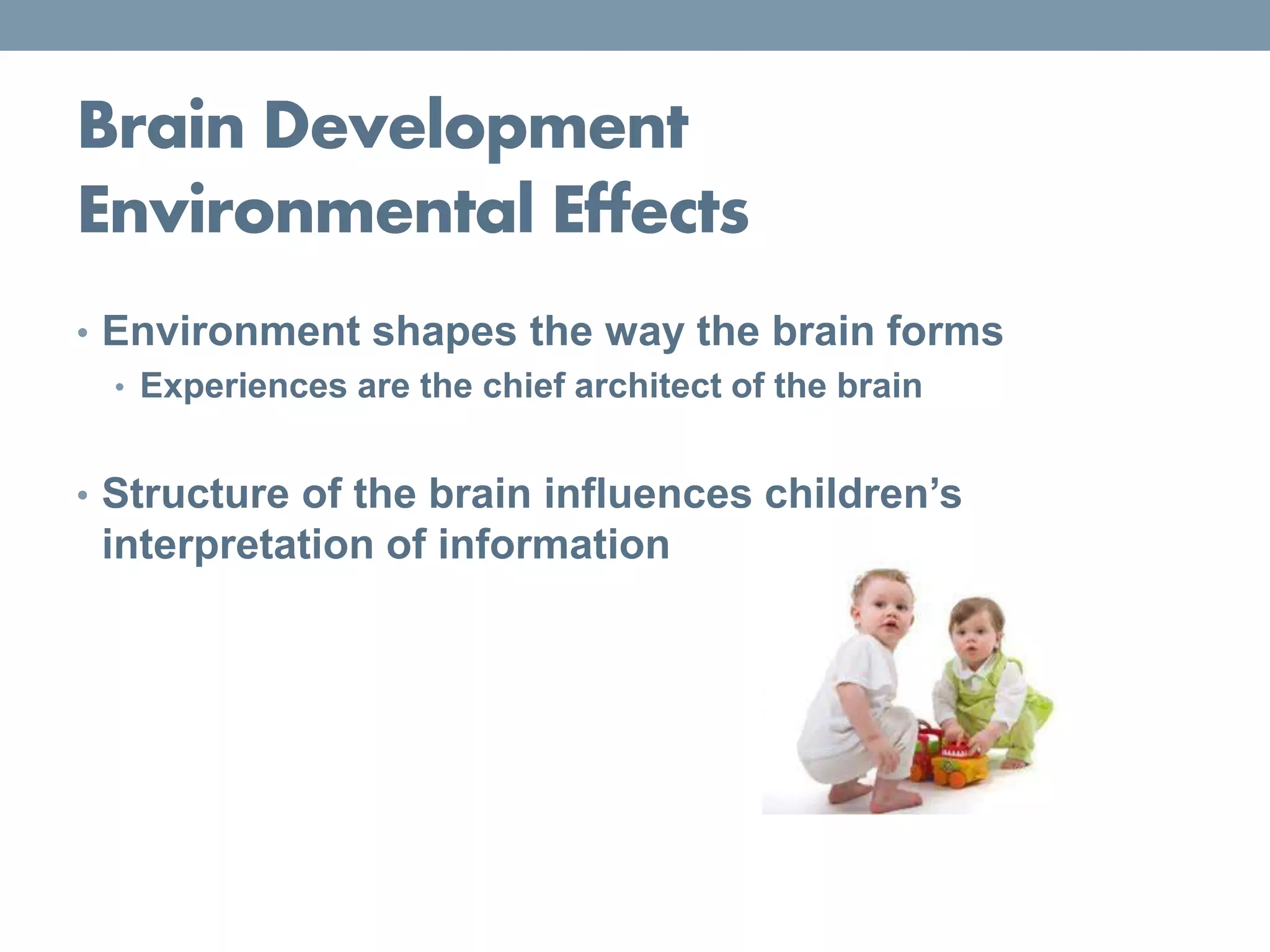
• Environment shapes the way the brain forms
• Experiences are the chief architect of the brain
• Structure of the brain influences children’s
interpretation of information
Brain Development
Environmental Effects
EXPERIENCE - EXPECTANT
• Development will not
happen unless a particular
experience occurs during
this critical period
EXPERIENCE - DEPENDENT
• Environmental inputs
actively contribute to
brain structure
• Experiences are not highly
typical
• Can be positive or
negative
Two types of
environmental influences
Brain Development
Environmental Effects
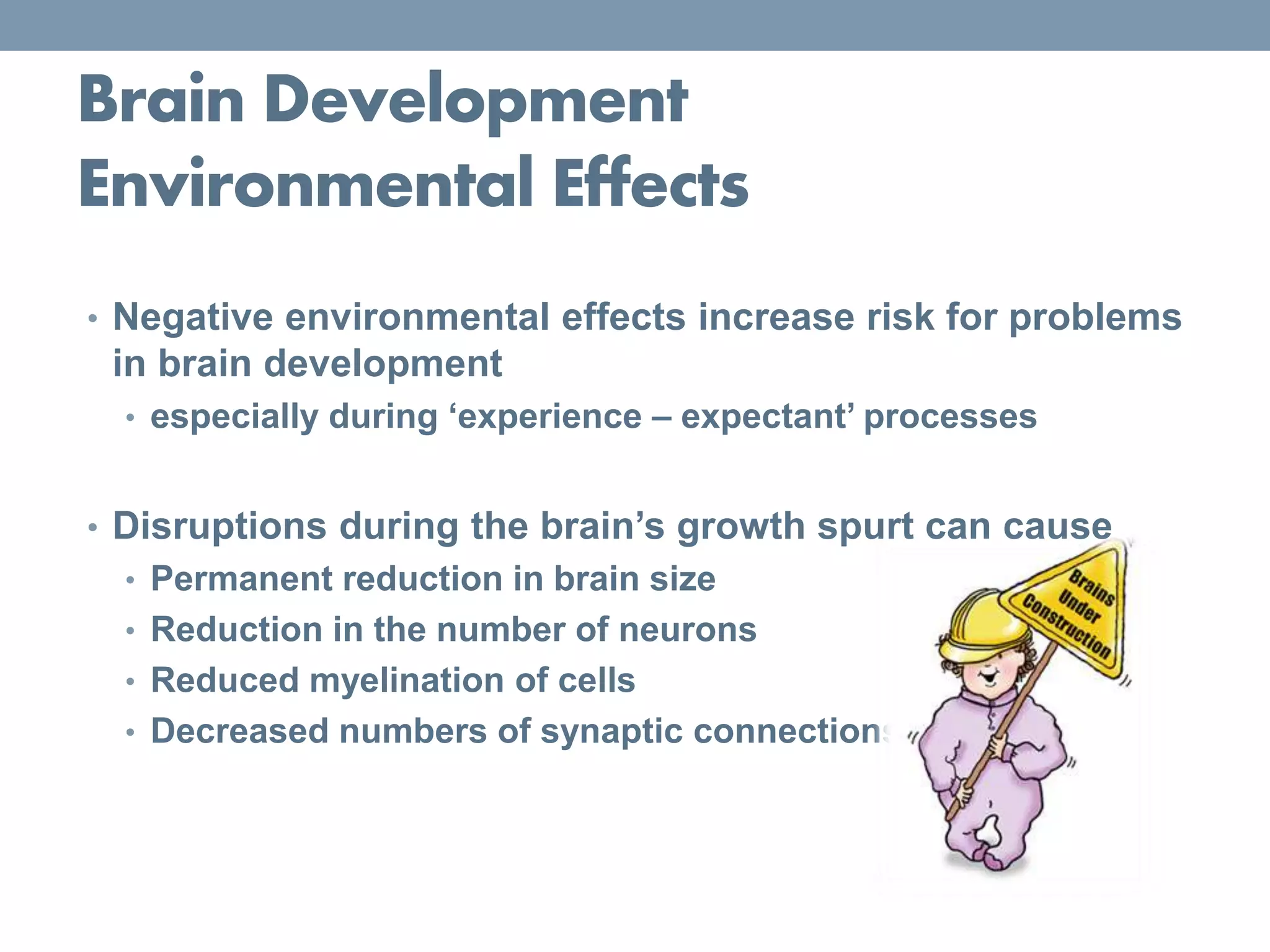
• Negative environmental effects increase risk for problems
in brain development
• especially during ‘experience – expectant’ processes
• Disruptions during the brain’s growth spurt can cause
• Permanent reduction in brain size
• Reduction in the number of neurons
• Reduced myelination of cells
• Decreased numbers of synaptic connections
Stress and Brain Development
• Chronic stress changes the brain structure
• Diminishes attention, impulse control, fine motor control,
sleep
• Constant state of hyperarousal
• Extreme deprivation = smaller brains
Stress and Brain Development
• Increased production of hormones: adrenaline, cortisol,
and norepinephrine
• When these hormones are excessively high for long
periods of time, they become toxic to the brain
• Every event is perceived as a life-or-death situation
• Even neutral situations are perceived as threatening
Toxic Stress
“The result may be a child who has great difficulty
functioning when presented with the world of kindness,
nurturing, and stimulation. It is an unfamiliar world to him;
his brain has not developed the pathways and memories to
adapt to this new world”
(CWIG, 2001).

Brain PP

  • 1.
    BRAIN DEVELOPMENT AND RESEARCH ECD110 Early Childhood Growth and Development
  • 2.
    Half of allhuman genes are involved in building the brain by providing the codes for its basic structures and functions. Brain Development
  • 3.
    Early Brain Development Formationand Migration of Neurons • The brain is built of cells called neurons • Neurons are the communication system of the brain • A neuron’s job is to make connections with other neurons, constantly exchanging information • A baby is born with 100 billion neurons
  • 4.
    Early Brain Development Formationand Migration of Neurons • Each neuron has an axon – a transmitter • The axon is the long part of the neuron • Axons send messages to other neurons
  • 5.
    Early Brain Development Formationand Migration of Neurons • Each neuron also has dendrites • Dendrites are extensions that branch out • Dendrites receive messages
  • 6.
    Early Brain Development Formationand Migration of Neurons • Information is transmitted through electrical impulses • These impulses travel down the length of a neuron • The impulse causes the neuron to produce a chemical response
  • 7.
    Early Experiences and BrainDevelopment • Babies respond to sensory information in the womb and create synaptic connections • By 1 year brain is 70% of adult size, by 3 years – 90% • Synapses become strong through repeated exposure to meaningful experiences
  • 8.
    Early Brain Development Formationand Migration of Neurons • The chemical messenger then transmits the info from one neuron to the next through small gaps between the cells, called synapses • Synaptogenesis is the creation of new neural connections or synapses
  • 9.
    The Importance ofMyelination • Myelination consists of smooth layers of fatty proteins that sheath the neuron • Electrical impulses travel 3x faster • During prenatal development myelination occurs along the spinal cord The most dramatic myelination occurs before 2 years of age
  • 10.
    Early Brain Development •During early development, the brain generates about 2 to 3 times more neurons and connection than are needed to survive and function
  • 11.
    Early Brain Development Pruning •Little used neural connections are eliminated • These connections are ones that are not reinforced by the child’s environment • Early experiences play a crucial role • Pruning occurs throughout early childhood and into adolescence Due to genetics or lack of reinforcement (use it or lose it) K e e p T o s s Reinforcement
  • 12.
    Brain Development –Cerebral Cortex • Left Hemisphere • Language processing • Develops rapidly around the age of 2 • Right Hemisphere • Spatial relationship • Rapid development around the age of 4 or 5 • This is the largest part of the brain • Controls higher thought process • Last part of the brain to finish growing • Easily influenced by the environment Hi! Hey!
  • 13.
    Brain Development –Cerebral Cortex • Left Hemisphere • Logic • Reason (facts) • Objective • Verbal • Self-oriented • Categorical • Detail focused • Memory • Purposefulness • Words of Songs • Mathematics • Forms strategy • Order • Safe • Acknowledges • Right Hemisphere • Intuition • Emotions • Subjective • Visual • Group-oriented • Relational • Whole picture focused • Creative • Playfulness • Tune of Songs • Arts (motor skill) • Forms possibilities • Imagination • Risk taking • Appreciates
  • 14.
    Infant Brain Development •By the time a baby is born, the brain controls important survival functions… • Breathing • Swallowing • Sucking • Heartbeat • Sensory areas develop early • Smell • Taste • Touch • Sight • Hearing
  • 15.
    Infant Brain Development BrainPlasticity • Infant brains are more flexible than adults • Allows the brain to be fine-tuned • Helps the brain adjust to different situations • Helps the brain recover from serious harm
  • 16.
    Brain Development Environmental Effects •Environment shapes the way the brain forms • Experiences are the chief architect of the brain • Structure of the brain influences children’s interpretation of information
  • 17.
    Brain Development Environmental Effects EXPERIENCE- EXPECTANT • Development will not happen unless a particular experience occurs during this critical period EXPERIENCE - DEPENDENT • Environmental inputs actively contribute to brain structure • Experiences are not highly typical • Can be positive or negative Two types of environmental influences
  • 18.
    Brain Development Environmental Effects •Negative environmental effects increase risk for problems in brain development • especially during ‘experience – expectant’ processes • Disruptions during the brain’s growth spurt can cause • Permanent reduction in brain size • Reduction in the number of neurons • Reduced myelination of cells • Decreased numbers of synaptic connections
  • 19.
    Stress and BrainDevelopment • Chronic stress changes the brain structure • Diminishes attention, impulse control, fine motor control, sleep • Constant state of hyperarousal • Extreme deprivation = smaller brains
  • 20.
    Stress and BrainDevelopment • Increased production of hormones: adrenaline, cortisol, and norepinephrine • When these hormones are excessively high for long periods of time, they become toxic to the brain • Every event is perceived as a life-or-death situation • Even neutral situations are perceived as threatening
  • 21.
    Toxic Stress “The resultmay be a child who has great difficulty functioning when presented with the world of kindness, nurturing, and stimulation. It is an unfamiliar world to him; his brain has not developed the pathways and memories to adapt to this new world” (CWIG, 2001).

Editor's Notes

  • #14 These are skills that continue to develops as the child grows older
  • #18 Experience – Expectant – example: overproduction of synapses happen when infants are handled, talked to, and looked at – common experiences for most infants. Not being handled, held, talked to would be unusual and would contribute to an atypical brain dev. Experience-Dependent - Positive: exposed to many varied experiences, zoos, museums, libraries, plays. Becomes a very “enriched” environment Negative – a child is abused they develop a different “wiring” to read emotions, expect the worst when others are angry, or have a conditioned response
  • #19 Damage or disruptions of brain development during the early years can increase the likelihood of problems later in life, such as: difficulties in school, inability to handle stress, poor motor or sensory functions ** prenatal through the 3years old are the most critical for brain development