INDUSTRIAL REVOLUTION
EVOLUTION OF
ORGANIZATIONAL
BEHAVIOUR
 Period : 18th to 19th century
 First started in England
 Major changes in agriculture, transportation and technology
 Deep effect on socio economic and cultural conditions
 Spread across the United States and the rest of the world
Industrial Revolution
How it started ?
 Agrarian and handicraft economy to industry and machine manufacturing
 Driving force - inventions and innovations
 Adam Smith – specialization and division of labour
Major inventions
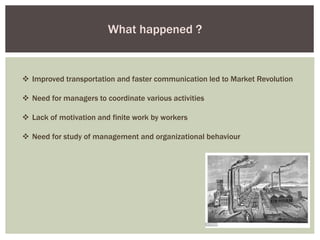
 Improved transportation and faster communication led to Market Revolution
 Need for managers to coordinate various activities
 Lack of motivation and finite work by workers
 Need for study of management and organizational behaviour
What happened ?
Persons responsible for this evolution
Robert Owen 1771 – 1858
• A young welsh factory owner (1800). One of the first to
emphasize the human needs of employees.
• Refused to employ young children.
• Taught his workers cleanliness and temperance and
improved their working conditions.
• Father of Personnel Management.
• Founders of Utopian socialism.
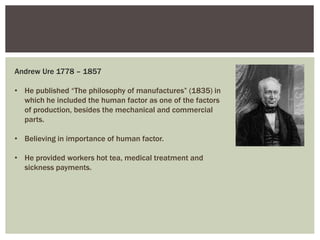
Andrew Ure 1778 – 1857
• He published “The philosophy of manufactures” (1835) in
which he included the human factor as one of the factors
of production, besides the mechanical and commercial
parts.
• Believing in importance of human factor.
• He provided workers hot tea, medical treatment and
sickness payments.
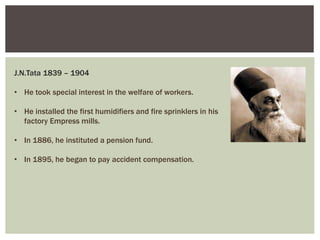
J.N.Tata 1839 – 1904
• He took special interest in the welfare of workers.
• He installed the first humidifiers and fire sprinklers in his
factory Empress mills.
• In 1886, he instituted a pension fund.
• In 1895, he began to pay accident compensation.
Economies based on large-scale industry, mechanized
manufacturing and factory system.
Paved a way for different management theories.
Ideas of Owen, Ure and Tata were not very much accepted and
were seen as just a do-good approach rather than a genuine
recognition of the importance of people at work.
Conclusion
Thank you

industrial revolution|organisational behaviour

  • 1.
  • 2.
     Period :18th to 19th century  First started in England  Major changes in agriculture, transportation and technology  Deep effect on socio economic and cultural conditions  Spread across the United States and the rest of the world Industrial Revolution
  • 3.
    How it started?  Agrarian and handicraft economy to industry and machine manufacturing  Driving force - inventions and innovations  Adam Smith – specialization and division of labour
  • 4.
  • 5.
     Improved transportationand faster communication led to Market Revolution  Need for managers to coordinate various activities  Lack of motivation and finite work by workers  Need for study of management and organizational behaviour What happened ?
  • 6.
    Persons responsible forthis evolution Robert Owen 1771 – 1858 • A young welsh factory owner (1800). One of the first to emphasize the human needs of employees. • Refused to employ young children. • Taught his workers cleanliness and temperance and improved their working conditions. • Father of Personnel Management. • Founders of Utopian socialism.
  • 7.
    Andrew Ure 1778– 1857 • He published “The philosophy of manufactures” (1835) in which he included the human factor as one of the factors of production, besides the mechanical and commercial parts. • Believing in importance of human factor. • He provided workers hot tea, medical treatment and sickness payments.
  • 8.
    J.N.Tata 1839 –1904 • He took special interest in the welfare of workers. • He installed the first humidifiers and fire sprinklers in his factory Empress mills. • In 1886, he instituted a pension fund. • In 1895, he began to pay accident compensation.
  • 9.
    Economies based onlarge-scale industry, mechanized manufacturing and factory system. Paved a way for different management theories. Ideas of Owen, Ure and Tata were not very much accepted and were seen as just a do-good approach rather than a genuine recognition of the importance of people at work. Conclusion
  • 10.