SIMARAN SHAHEEN
Asst. Prof.
GBAMS, Mirzapur
INDUSTRIAL RELATIONS
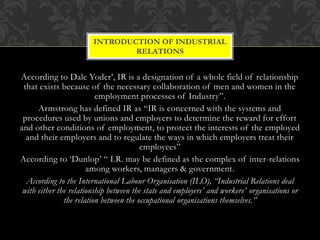
According to Dale Yoder’, IR is a designation of a whole field of relationship
that exists because of the necessary collaboration of men and women in the
employment processes of Industry”.
Armstrong has defined IR as “IR is concerned with the systems and
procedures used by unions and employers to determine the reward for effort
and other conditions of employment, to protect the interests of the employed
and their employers and to regulate the ways in which employers treat their
employees”
According to ‘Dunlop’ “ I.R. may be defined as the complex of inter-relations
among workers, managers & government.
According to the International Labour Organisation (ILO), “Industrial Relations deal
with either the relationship between the state and employers’ and workers’ organisations or
the relation between the occupational organisations themselves.”
INTRODUCTION OF INDUSTRIAL
RELATIONS
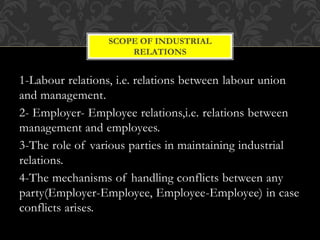
1-Labour relations, i.e. relations between labour union
and management.
2- Employer- Employee relations,i.e. relations between
management and employees.
3-The role of various parties in maintaining industrial
relations.
4-The mechanisms of handling conflicts between any
party(Employer-Employee, Employee-Employee) in case
conflicts arises.
SCOPE OF INDUSTRIAL
RELATIONS
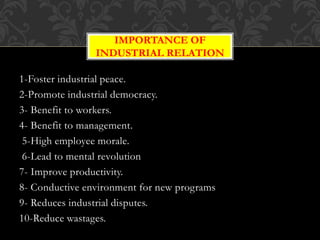
1-Foster industrial peace.
2-Promote industrial democracy.
3- Benefit to workers.
4- Benefit to management.
5-High employee morale.
6-Lead to mental revolution
7- Improve productivity.
8- Conductive environment for new programs
9- Reduces industrial disputes.
10-Reduce wastages.
IMPORTANCE OF
INDUSTRIAL RELATION
1-Establish and foster sound relationship between workers and management
by safeguarding their interests.
2-Avoid industrial conflicts and strikes by developing mutuality among the
interests of concerned parties.
3-Keep, as far as possible, the Industrial Disputes such as, strikes, lockouts at
bay by enhancing the harmony among the parties and Organization.
4-Provide an opportunity to the workers to participate in management and
decision making process.
5- Raise productivity in the organization to curb the employee turnover and
absenteeism.
6- To improve the bargaining capacity of the workers through trade unions.
7- To ensure discipline in the organization and in the industry.
OBJECTIVES OF INDUSTRIAL
RELATION
8- Improvement of economic conditions of workers.
9-To safeguard the interests of the labor and the management by preventing
one of the players from getting a strong hold over the other.
10-To develop & Secure mutual understanding & good relationships among
all the players in the industrial set-up.
11-To maintain industrial peace & harmony by preventing industrial conflicts.
12- To improve the standard of living of the average worker by providing
basic and standard amenities.
13-To increase productivity by minimizing industrial conflicts and maintaining
harmonious industrial relations.
14-- To provide a basic framework for the management & the employees to
resolve their differences.
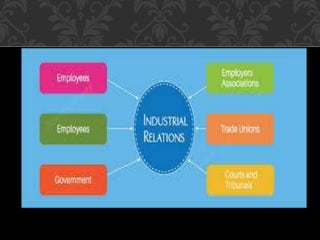
1. The employer,
2. Workman,
3. Union,
4. Government, and
5. The Consumer
FACTORS OF INDUSTRIAL
RELATIONS
According to psychologists, the problems of industrial relations are
attributable to the differences in the perceptions of labour and management.
Both parties tend to look at factors influencing their relations – i.e. wages,
benefits, working conditions etc. – in different ways. Dissatisfaction with pay,
benefits, services, conditions of work compel workers to turn aggressive and
resort to strikes, gheraos etc.
Employers adopt rigid postures and draw the shutters down when they find
the regulatory framework to be restrictive, workers to be highly demanding
and market forces to be unmanageable. Apart from economic issues, motives
such as the need to gain prestige, power, status, recognition also compel
people to go in different directions, sacrificing the broader organisational
interests.
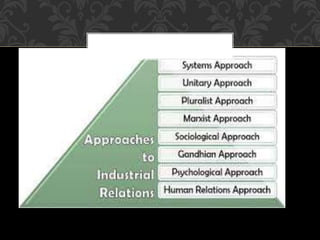
PSYCHOLOGICAL APPROACH:
A number of sociological factors such as the value system, customs, and
traditions affect the relations between labour and management. Problems such
as urban congestion, chronic shortage of affordable dwelling units, convenient
transportation system, pollution, disintegration of joint family system, etc.,
add misery to the lives of workers.
Accepted societal norms, traditions and customs are pushed to the wall in
such a scenario. Culture pollution sets in, rubbing workers the wrong way.
Such sociological changes impact industrial life significantly, forcing parties to
assess, analyse and find solutions to conflictful situations on a continuous
basis.
SOCIOLOGICAL APPROACH:
The unitary approach is based on the strong argument that there is only one
source of authority i.e., the management, which owns and controls the
dynamics of decision making in issues relating to negotiation and bargaining.
Under unitary approach, industrial relations are grounded in mutual co-
operation, individual treatment, team-work, and shared goals.
Under this approach, mutual cooperation, team spirit and shared goals play a
significant role. Any conflict is seen as a result of a temporary aberration
resulting from poor management. Direct negotiation with workers is
encouraged. This approach is criticised as a tool for seducing workers away
from unionism/socialism. It is also criticised as manipulation and exploitation.
UNITARY APPROACH
This approach perceives organisation as a coalition of competing
interest between management and different groups, trade unions as
legitimate representative of employee’s interests and stability in
Industrial Relation as the product of concessions and compromises
between management and workers. Unions, therefore balance the
power between management and employees. Therefore, strong
unions are desirable and necessary.
The pluralistic approach totally departs from the unitary approach and
assumes that the organization is composed of individuals who form distinct
groups with their own set of aims, objectives, leadership styles, and value
propositions.
According to pluralists, industrial conflict is inevitable and it needs to be
contained within the social mechanism of collective bargaining, conciliation,
and arbitration.
PLURALISTIC APPROACH
This approach also regards conflict between employers and employees inevitable.
Marxists consider conflict as a product of the capitalistic society – the gap between
“Haves and Have Not’s”. Trade Unions focus on improving the position of workers
but workers’ participation in management, cooperative work culture etc., are not
acceptable to the Marxists.
Also known as the ‘Radical Perspective’, the Marxist approach is based on the
proposition that the economic activities of production, manufacturing, and
distribution are majorly governed by the objective of profit. Marxists, like the
pluralists, regard conflict between employers and employees as inevitable.
The Marxist approach argues that for social change to take place, class conflict is
required. Social change initiates strong reactions from the worker class and bridges
the gap between the economically settled owners of factors of production and the
economically dependent worker class. This approach views pluralism as unreal and
considers industrial disputes and class conflicts as inevitable for the circular
functioning of an industry.
MARXIST APPROACH
According to the human relations approach, individuals are motivated by a
variety of social and psychological factors, not just earnings. Human
behaviour is influenced by feelings, sentiments, and attitudes. Informal work
groups play an important role in shaping the attitudes and performance of
individual workers. People do not like the idea of being treated as machines.
To reduce friction and conflict in the workplace, managers need to possess
effective social skills.
They must explain why a particular job is important, allow workers to partici-
pate in work processes fully, encourage work groups to flourish and try their
best to keep workers happy. Economic and non-economic rewards must be
used to meet the physiological and psychological requirements of workers
from time to time. Every attempt must be made to integrate the individual
objectives with overall organisational objectives to avoid conflict and
controversy in industrial life.
HUMAN RELATIONS APPROACH:
According to V.V. Giri (Former President of India), collective bargaining and
joint negotiations be used to settle disputes between labour and management.
Outside interference must be avoided at all costs while resolving differences
between the parties. Trade unions should use voluntary arbitration in place of
compulsory adjudication to resolve disputes.
Giri observed that ‘there should be a bipartite machinery in every industry and
every unit of the industry to settle differences from time to time with active
encouragement of government. Outside interference should not encroach
upon industrial peace’.
GIRI APPROACH:
Mahatma Gandhi’s views on industrial relation are based on his fundamental
principles of truth, non- possession. Under the principle of non-violence and
truth, Gandhi meant a peaceful co-existence of capital and labour. Trusteeship
implies cooperation between capital and labour.
According to him, employers should not regard themselves as sole owners of
mills and factories of which they may be the legal owners. They should regard
themselves only as trustees, or co-owners. He also appealed to the workers to
behave as trustees, not to regard the mill and machinery as belonging to the
exploiting agents but to regard them as their own, protect them and put to the
best use they can.
GANDHIAN APPROACH
INDUSTRIAL RELATIONS ( Definition, Scope, Objectives, Approaches)

INDUSTRIAL RELATIONS ( Definition, Scope, Objectives, Approaches)

  • 1.
    SIMARAN SHAHEEN Asst. Prof. GBAMS,Mirzapur INDUSTRIAL RELATIONS
  • 2.
    According to DaleYoder’, IR is a designation of a whole field of relationship that exists because of the necessary collaboration of men and women in the employment processes of Industry”. Armstrong has defined IR as “IR is concerned with the systems and procedures used by unions and employers to determine the reward for effort and other conditions of employment, to protect the interests of the employed and their employers and to regulate the ways in which employers treat their employees” According to ‘Dunlop’ “ I.R. may be defined as the complex of inter-relations among workers, managers & government. According to the International Labour Organisation (ILO), “Industrial Relations deal with either the relationship between the state and employers’ and workers’ organisations or the relation between the occupational organisations themselves.” INTRODUCTION OF INDUSTRIAL RELATIONS
  • 4.
    1-Labour relations, i.e.relations between labour union and management. 2- Employer- Employee relations,i.e. relations between management and employees. 3-The role of various parties in maintaining industrial relations. 4-The mechanisms of handling conflicts between any party(Employer-Employee, Employee-Employee) in case conflicts arises. SCOPE OF INDUSTRIAL RELATIONS
  • 5.
    1-Foster industrial peace. 2-Promoteindustrial democracy. 3- Benefit to workers. 4- Benefit to management. 5-High employee morale. 6-Lead to mental revolution 7- Improve productivity. 8- Conductive environment for new programs 9- Reduces industrial disputes. 10-Reduce wastages. IMPORTANCE OF INDUSTRIAL RELATION
  • 6.
    1-Establish and fostersound relationship between workers and management by safeguarding their interests. 2-Avoid industrial conflicts and strikes by developing mutuality among the interests of concerned parties. 3-Keep, as far as possible, the Industrial Disputes such as, strikes, lockouts at bay by enhancing the harmony among the parties and Organization. 4-Provide an opportunity to the workers to participate in management and decision making process. 5- Raise productivity in the organization to curb the employee turnover and absenteeism. 6- To improve the bargaining capacity of the workers through trade unions. 7- To ensure discipline in the organization and in the industry. OBJECTIVES OF INDUSTRIAL RELATION
  • 7.
    8- Improvement ofeconomic conditions of workers. 9-To safeguard the interests of the labor and the management by preventing one of the players from getting a strong hold over the other. 10-To develop & Secure mutual understanding & good relationships among all the players in the industrial set-up. 11-To maintain industrial peace & harmony by preventing industrial conflicts. 12- To improve the standard of living of the average worker by providing basic and standard amenities. 13-To increase productivity by minimizing industrial conflicts and maintaining harmonious industrial relations. 14-- To provide a basic framework for the management & the employees to resolve their differences.
  • 8.
    1. The employer, 2.Workman, 3. Union, 4. Government, and 5. The Consumer FACTORS OF INDUSTRIAL RELATIONS
  • 10.
    According to psychologists,the problems of industrial relations are attributable to the differences in the perceptions of labour and management. Both parties tend to look at factors influencing their relations – i.e. wages, benefits, working conditions etc. – in different ways. Dissatisfaction with pay, benefits, services, conditions of work compel workers to turn aggressive and resort to strikes, gheraos etc. Employers adopt rigid postures and draw the shutters down when they find the regulatory framework to be restrictive, workers to be highly demanding and market forces to be unmanageable. Apart from economic issues, motives such as the need to gain prestige, power, status, recognition also compel people to go in different directions, sacrificing the broader organisational interests. PSYCHOLOGICAL APPROACH:
  • 11.
    A number ofsociological factors such as the value system, customs, and traditions affect the relations between labour and management. Problems such as urban congestion, chronic shortage of affordable dwelling units, convenient transportation system, pollution, disintegration of joint family system, etc., add misery to the lives of workers. Accepted societal norms, traditions and customs are pushed to the wall in such a scenario. Culture pollution sets in, rubbing workers the wrong way. Such sociological changes impact industrial life significantly, forcing parties to assess, analyse and find solutions to conflictful situations on a continuous basis. SOCIOLOGICAL APPROACH:
  • 12.
    The unitary approachis based on the strong argument that there is only one source of authority i.e., the management, which owns and controls the dynamics of decision making in issues relating to negotiation and bargaining. Under unitary approach, industrial relations are grounded in mutual co- operation, individual treatment, team-work, and shared goals. Under this approach, mutual cooperation, team spirit and shared goals play a significant role. Any conflict is seen as a result of a temporary aberration resulting from poor management. Direct negotiation with workers is encouraged. This approach is criticised as a tool for seducing workers away from unionism/socialism. It is also criticised as manipulation and exploitation. UNITARY APPROACH
  • 13.
    This approach perceivesorganisation as a coalition of competing interest between management and different groups, trade unions as legitimate representative of employee’s interests and stability in Industrial Relation as the product of concessions and compromises between management and workers. Unions, therefore balance the power between management and employees. Therefore, strong unions are desirable and necessary. The pluralistic approach totally departs from the unitary approach and assumes that the organization is composed of individuals who form distinct groups with their own set of aims, objectives, leadership styles, and value propositions. According to pluralists, industrial conflict is inevitable and it needs to be contained within the social mechanism of collective bargaining, conciliation, and arbitration. PLURALISTIC APPROACH
  • 14.
    This approach alsoregards conflict between employers and employees inevitable. Marxists consider conflict as a product of the capitalistic society – the gap between “Haves and Have Not’s”. Trade Unions focus on improving the position of workers but workers’ participation in management, cooperative work culture etc., are not acceptable to the Marxists. Also known as the ‘Radical Perspective’, the Marxist approach is based on the proposition that the economic activities of production, manufacturing, and distribution are majorly governed by the objective of profit. Marxists, like the pluralists, regard conflict between employers and employees as inevitable. The Marxist approach argues that for social change to take place, class conflict is required. Social change initiates strong reactions from the worker class and bridges the gap between the economically settled owners of factors of production and the economically dependent worker class. This approach views pluralism as unreal and considers industrial disputes and class conflicts as inevitable for the circular functioning of an industry. MARXIST APPROACH
  • 15.
    According to thehuman relations approach, individuals are motivated by a variety of social and psychological factors, not just earnings. Human behaviour is influenced by feelings, sentiments, and attitudes. Informal work groups play an important role in shaping the attitudes and performance of individual workers. People do not like the idea of being treated as machines. To reduce friction and conflict in the workplace, managers need to possess effective social skills. They must explain why a particular job is important, allow workers to partici- pate in work processes fully, encourage work groups to flourish and try their best to keep workers happy. Economic and non-economic rewards must be used to meet the physiological and psychological requirements of workers from time to time. Every attempt must be made to integrate the individual objectives with overall organisational objectives to avoid conflict and controversy in industrial life. HUMAN RELATIONS APPROACH:
  • 16.
    According to V.V.Giri (Former President of India), collective bargaining and joint negotiations be used to settle disputes between labour and management. Outside interference must be avoided at all costs while resolving differences between the parties. Trade unions should use voluntary arbitration in place of compulsory adjudication to resolve disputes. Giri observed that ‘there should be a bipartite machinery in every industry and every unit of the industry to settle differences from time to time with active encouragement of government. Outside interference should not encroach upon industrial peace’. GIRI APPROACH:
  • 17.
    Mahatma Gandhi’s viewson industrial relation are based on his fundamental principles of truth, non- possession. Under the principle of non-violence and truth, Gandhi meant a peaceful co-existence of capital and labour. Trusteeship implies cooperation between capital and labour. According to him, employers should not regard themselves as sole owners of mills and factories of which they may be the legal owners. They should regard themselves only as trustees, or co-owners. He also appealed to the workers to behave as trustees, not to regard the mill and machinery as belonging to the exploiting agents but to regard them as their own, protect them and put to the best use they can. GANDHIAN APPROACH