Compiler Design
 Group Name : Ethernet
 Topic Name : Compiler Design
 Group Member : 152-15-6232 ( Md. Touhidur Rahman )
152-15-6236 (Sree Joyanto Chandro Barmon)
152-15-6237( Tusher Chandra Ghosh)
Index
• Introduction
• Definition
• How it’s work
• Resources
• Question Session
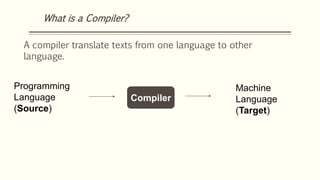
What is a Compiler?
A compiler translate texts from one language to other
language.
Programming
Language
(Source)
Compiler
Machine
Language
(Target)
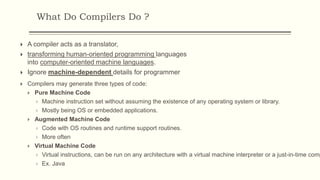
 A compiler acts as a translator,
 transforming human-oriented programming languages
into computer-oriented machine languages.
 Ignore machine-dependent details for programmer
What Do Compilers Do ?
 Compilers may generate three types of code:
 Pure Machine Code
 Machine instruction set without assuming the existence of any operating system or library.
 Mostly being OS or embedded applications.
 Augmented Machine Code
 Code with OS routines and runtime support routines.
 More often
 Virtual Machine Code
 Virtual instructions, can be run on any architecture with a virtual machine interpreter or a just-in-time comp
 Ex. Java
A Language Processing System
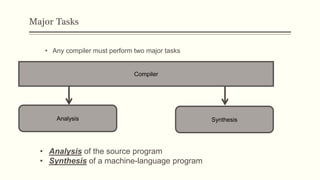
Major Tasks
• Any compiler must perform two major tasks
Compiler
Analysis Synthesis
• Analysis of the source program
• Synthesis of a machine-language program
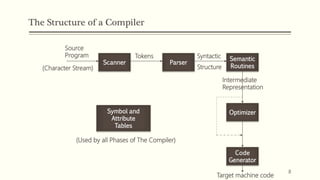
The Structure of a Compiler
8
Scanner Parser
Semantic
Routines
Code
Generator
Optimizer
Source
Program Tokens Syntactic
Structure
Symbol and
Attribute
Tables
(Used by all Phases of The Compiler)
(Character Stream)
Intermediate
Representation
Target machine code
The Structure of a Compiler
9
Scanner Parser
Semantic
Routines
Code
Generator
Optimizer
Source
Program Tokens Syntactic
Structure
Symbol and
Attribute
Tables
(Used by all
Phases of
The Compiler)
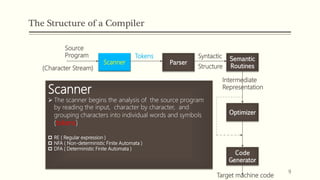
Scanner
 The scanner begins the analysis of the source program
by reading the input, character by character, and
grouping characters into individual words and symbols
(tokens)
 RE ( Regular expression )
 NFA ( Non-deterministic Finite Automata )
 DFA ( Deterministic Finite Automata )
(Character Stream)
Intermediate
Representation
Target machine code
The Structure of a Compiler
10
Scanner Parser
Semantic
Routines
Code
Generator
Optimizer
Source
Program Tokens Syntactic
Structure
Symbol and
Attribute
Tables
(Used by all
Phases of
The Compiler)
Parser
 Given a formal syntax specification (typically as a context-
free grammar [CFG] ), the parse reads tokens and groups
them into units as specified by the productions of the
CFG being used.
 As syntactic structure is recognized, the parser either calls
corresponding semantic routines directly or builds a
syntax tree.
 CFG ( Context-Free Grammar )
 GAA ( Grammar Analysis Algorithms )
(Character Stream)
Intermediate
Representation
Target machine code
The Structure of a Compiler
11
Scanner Parser
Semantic
Routines
Code
Generator
Optimizer
Source
Program
(Character Stream)
Tokens Syntactic
Structure
Intermediate
Representation
Symbol and
Attribute
Tables
(Used by all
Phases of
The Compiler)
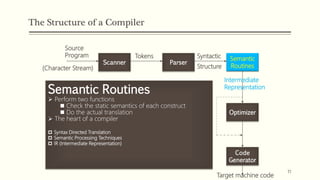
Semantic Routines
 Perform two functions
 Check the static semantics of each construct
 Do the actual translation
 The heart of a compiler
 Syntax Directed Translation
 Semantic Processing Techniques
 IR (Intermediate Representation)
Target machine code
The Structure of a Compiler
12
Scanner Parser
Semantic
Routines
Code
Generator
Optimizer
Source
Program Tokens Syntactic
Structure
Symbol and
Attribute
Tables
(Used by all
Phases of
The Compiler)
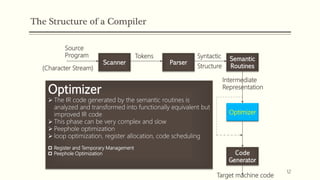
Optimizer
 The IR code generated by the semantic routines is
analyzed and transformed into functionally equivalent but
improved IR code
 This phase can be very complex and slow
 Peephole optimization
 loop optimization, register allocation, code scheduling
 Register and Temporary Management
 Peephole Optimization
(Character Stream)
Intermediate
Representation
Target machine code
The Structure of a Compiler
13
Source
Program
(Character Stream)
Scanner
Tokens
Parser
Syntactic
Structure
Semantic
Routines
Intermediate
Representation
Optimizer
Code
Generator
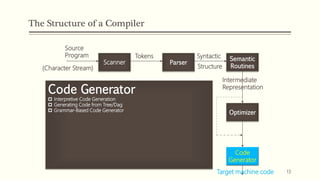
Code Generator
 Interpretive Code Generation
 Generating Code from Tree/Dag
 Grammar-Based Code Generator
Target machine code
The Structure of a Compiler (Example)
14
Scanner
[Lexical Analyzer]
Parser
[Syntax Analyzer]
Semantic Process
[Semantic analyzer]
Code Generator
[Intermediate Code Generator]
Code Optimizer
Tokens
Parse tree
Abstract Syntax Tree Attributes
Non-optimized Intermediate Code
Optimized Intermediate Code
Code Generator
Target machine code
LDF R2,id3
MULF R2,R2,#60.0
LDF R1,id2
ADDF R1,R1,R2
MOVF id1,R1
What is NFA and DFA
What is NFA?
 An NFA is a Nondeterministic Finite
Automaton. Nondeterministic means it
can transition to, and be in, multiple
states at once
What is DFA?
 A DFA is a Deterministic Finite
Automaton. Deterministic means that it
can only be in, and transition to, one
state at a time
Formal Definition of Nondeterministic Finite Automata.
 An NFA is a five-tuple: N = (S, ∑, δ, S0, F)
 A Finite set of state (S)
 A Set of input symbol (∑)
 A Transition Function (δ)
 The initial/starting state, S0
 A Set of final state F
Regular Expression:
State a b
1 {1,2} {1}
2 ϕ {3}
3 ϕ {4}
4 ϕ ϕ
(a|b)* abb
An NFA can easily implemented using a transition table
Now we convert the following NFA to DFA
State a b
{1} {1,2} {1}
{1,2} {1,2} {1,3}
{1,3} {1,2} {1,4}
{1,4} {1,2} {1}
Transition Table for DFA
Difference Between NFA and DFA
 NFA
 Multiple states Transition at once
 Operator Zero or More
 DFA
 only one state transition in DFA.
 Operator One or More
Resources
www.wikipedia.org
www.Google.com
www.tutorialspoint.com
www.slideshare.net
Presentation compiler design

Presentation compiler design

  • 1.
  • 2.
     Group Name: Ethernet  Topic Name : Compiler Design  Group Member : 152-15-6232 ( Md. Touhidur Rahman ) 152-15-6236 (Sree Joyanto Chandro Barmon) 152-15-6237( Tusher Chandra Ghosh)
  • 3.
    Index • Introduction • Definition •How it’s work • Resources • Question Session
  • 4.
    What is aCompiler? A compiler translate texts from one language to other language. Programming Language (Source) Compiler Machine Language (Target)
  • 5.
     A compileracts as a translator,  transforming human-oriented programming languages into computer-oriented machine languages.  Ignore machine-dependent details for programmer What Do Compilers Do ?  Compilers may generate three types of code:  Pure Machine Code  Machine instruction set without assuming the existence of any operating system or library.  Mostly being OS or embedded applications.  Augmented Machine Code  Code with OS routines and runtime support routines.  More often  Virtual Machine Code  Virtual instructions, can be run on any architecture with a virtual machine interpreter or a just-in-time comp  Ex. Java
  • 6.
  • 7.
    Major Tasks • Anycompiler must perform two major tasks Compiler Analysis Synthesis • Analysis of the source program • Synthesis of a machine-language program
  • 8.
    The Structure ofa Compiler 8 Scanner Parser Semantic Routines Code Generator Optimizer Source Program Tokens Syntactic Structure Symbol and Attribute Tables (Used by all Phases of The Compiler) (Character Stream) Intermediate Representation Target machine code
  • 9.
    The Structure ofa Compiler 9 Scanner Parser Semantic Routines Code Generator Optimizer Source Program Tokens Syntactic Structure Symbol and Attribute Tables (Used by all Phases of The Compiler) Scanner  The scanner begins the analysis of the source program by reading the input, character by character, and grouping characters into individual words and symbols (tokens)  RE ( Regular expression )  NFA ( Non-deterministic Finite Automata )  DFA ( Deterministic Finite Automata ) (Character Stream) Intermediate Representation Target machine code
  • 10.
    The Structure ofa Compiler 10 Scanner Parser Semantic Routines Code Generator Optimizer Source Program Tokens Syntactic Structure Symbol and Attribute Tables (Used by all Phases of The Compiler) Parser  Given a formal syntax specification (typically as a context- free grammar [CFG] ), the parse reads tokens and groups them into units as specified by the productions of the CFG being used.  As syntactic structure is recognized, the parser either calls corresponding semantic routines directly or builds a syntax tree.  CFG ( Context-Free Grammar )  GAA ( Grammar Analysis Algorithms ) (Character Stream) Intermediate Representation Target machine code
  • 11.
    The Structure ofa Compiler 11 Scanner Parser Semantic Routines Code Generator Optimizer Source Program (Character Stream) Tokens Syntactic Structure Intermediate Representation Symbol and Attribute Tables (Used by all Phases of The Compiler) Semantic Routines  Perform two functions  Check the static semantics of each construct  Do the actual translation  The heart of a compiler  Syntax Directed Translation  Semantic Processing Techniques  IR (Intermediate Representation) Target machine code
  • 12.
    The Structure ofa Compiler 12 Scanner Parser Semantic Routines Code Generator Optimizer Source Program Tokens Syntactic Structure Symbol and Attribute Tables (Used by all Phases of The Compiler) Optimizer  The IR code generated by the semantic routines is analyzed and transformed into functionally equivalent but improved IR code  This phase can be very complex and slow  Peephole optimization  loop optimization, register allocation, code scheduling  Register and Temporary Management  Peephole Optimization (Character Stream) Intermediate Representation Target machine code
  • 13.
    The Structure ofa Compiler 13 Source Program (Character Stream) Scanner Tokens Parser Syntactic Structure Semantic Routines Intermediate Representation Optimizer Code Generator Code Generator  Interpretive Code Generation  Generating Code from Tree/Dag  Grammar-Based Code Generator Target machine code
  • 14.
    The Structure ofa Compiler (Example) 14 Scanner [Lexical Analyzer] Parser [Syntax Analyzer] Semantic Process [Semantic analyzer] Code Generator [Intermediate Code Generator] Code Optimizer Tokens Parse tree Abstract Syntax Tree Attributes Non-optimized Intermediate Code Optimized Intermediate Code Code Generator Target machine code LDF R2,id3 MULF R2,R2,#60.0 LDF R1,id2 ADDF R1,R1,R2 MOVF id1,R1
  • 15.
    What is NFAand DFA What is NFA?  An NFA is a Nondeterministic Finite Automaton. Nondeterministic means it can transition to, and be in, multiple states at once What is DFA?  A DFA is a Deterministic Finite Automaton. Deterministic means that it can only be in, and transition to, one state at a time
  • 16.
    Formal Definition ofNondeterministic Finite Automata.  An NFA is a five-tuple: N = (S, ∑, δ, S0, F)  A Finite set of state (S)  A Set of input symbol (∑)  A Transition Function (δ)  The initial/starting state, S0  A Set of final state F
  • 17.
    Regular Expression: State ab 1 {1,2} {1} 2 ϕ {3} 3 ϕ {4} 4 ϕ ϕ (a|b)* abb An NFA can easily implemented using a transition table
  • 18.
    Now we convertthe following NFA to DFA State a b {1} {1,2} {1} {1,2} {1,2} {1,3} {1,3} {1,2} {1,4} {1,4} {1,2} {1} Transition Table for DFA
  • 19.
    Difference Between NFAand DFA  NFA  Multiple states Transition at once  Operator Zero or More  DFA  only one state transition in DFA.  Operator One or More
  • 20.

Editor's Notes

  • #2 NOTE: To change the image on this slide, select the picture and delete it. Then click the Pictures icon in the placeholder to insert your own image.