SCIENTIFIC
MANAGEMENT
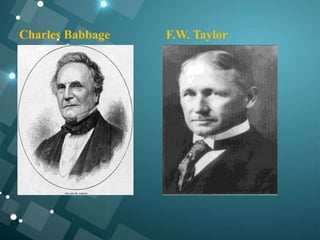
Charles Babbage F.W. Taylor
MEANING
It is the art of knowing exactly what is to be
done and how it is to be done.
DEFINITIONS
F.W. Taylor – “ It is the art knowing exactly what do you want
men to do and then seeing they do it in the best and cheapest
way.”
Peter F. Drucker – “Its core is the organised study of work, the
analysis of work into its simplest elements and the systematic
improvement of worker’s performance of each elements.”
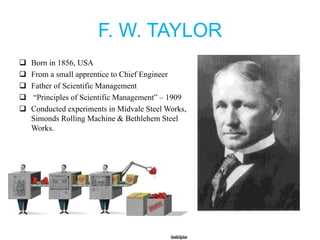
F. W. TAYLOR
 Born in 1856, USA
 From a small apprentice to Chief Engineer
 Father of Scientific Management
 “Principles of Scientific Management” – 1909
 Conducted experiments in Midvale Steel Works,
Simonds Rolling Machine & Bethlehem Steel
Works.
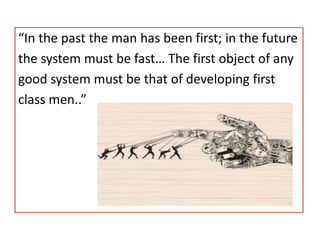
“In the past the man has been first; in the future
the system must be fast… The first object of any
good system must be that of developing first
class men..”
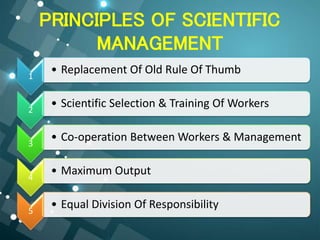
PRINCIPLES OF SCIENTIFIC
MANAGEMENT
1
• Replacement Of Old Rule Of Thumb
2
• Scientific Selection & Training Of Workers
3
• Co-operation Between Workers & Management
4
• Maximum Output
5
• Equal Division Of Responsibility
Replacement Of Old Rule Of
Thumb
Adoption of scientific approach in managerial decision making
Rule of thumb – based on practice and past experience
Scientific Selection And Training Of
Workers
Selection procedure are done scientifically
Co-operation Between Workers
And Management
Work should be carried out by individuals in co-operation with each other
based on mutual trust, confidence and self belonging.
Maximum Output
Maximum output in place of restricted output
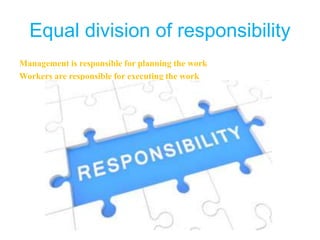
Equal division of responsibility
Management is responsible for planning the work
Workers are responsible for executing the work
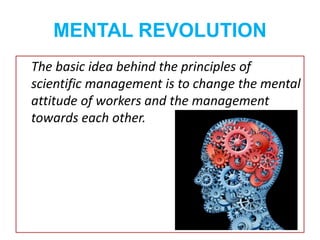
MENTAL REVOLUTION
The basic idea behind the principles of
scientific management is to change the mental
attitude of workers and the management
towards each other.
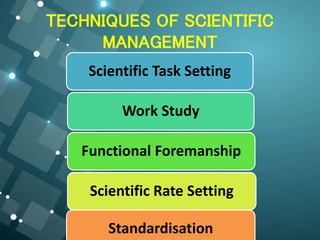
TECHNIQUES OF SCIENTIFIC
MANAGEMENT
Scientific Task Setting
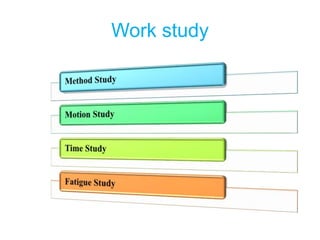
Work Study
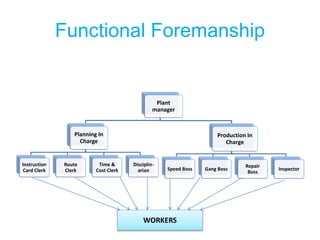
Functional Foremanship
Scientific Rate Setting
Standardisation
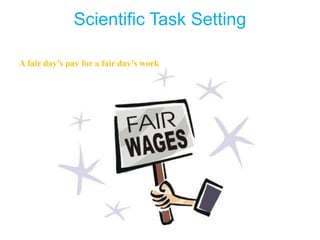
Scientific Task Setting
A fair day’s pay for a fair day’s work
Work study
Functional Foremanship
Plant
manager
Planning In
Charge
Instruction
Card Clerk
Route
Clerk
Time &
Cost Clerk
Disciplin-
arian
Production In
Charge
Speed Boss Gang Boss
Repair
Boss
Inspector
WORKERS
Scientific Rate Setting
Differential piece rate system
Standardisation
Setting standard in every phase of business
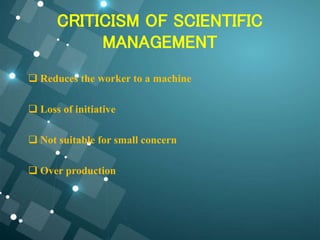
CRITICISM OF SCIENTIFIC
MANAGEMENT
 Reduces the worker to a machine
 Loss of initiative
 Not suitable for small concern
 Over production
Scientific Management

Scientific Management