
SCIENTIFIC
MANAGEMENT
Presentation By:-
Pawan Singh Raikhola
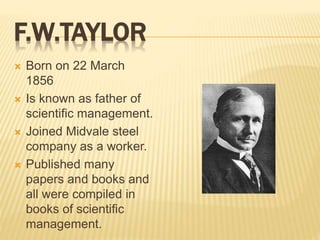
F.W.TAYLOR
 Born on 22 March
1856
 Is known as father of
scientific management.
 Joined Midvale steel
company as a worker.
 Published many
papers and books and
all were compiled in
books of scientific
management.
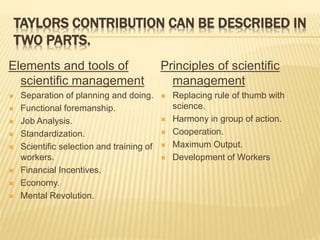
TAYLORS CONTRIBUTION CAN BE DESCRIBED IN
TWO PARTS.
Elements and tools of
scientific management
 Separation of planning and doing.
 Functional foremanship.
 Job Analysis.
 Standardization.
 Scientific selection and training of
workers.
 Financial Incentives.
 Economy.
 Mental Revolution.
Principles of scientific
management
 Replacing rule of thumb with
science.
 Harmony in group of action.
 Cooperation.
 Maximum Output.
 Development of Workers
1.Seperation of planning and doing:-
Taylor emphasized the separation of planning aspect from actual doing
of work. Before Taylors Scientific Management, worker used to plan
about how he had to work and what necessary instruments are
required for that.
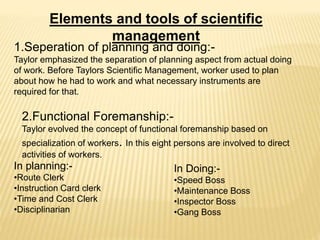
2.Functional Foremanship:-
Taylor evolved the concept of functional foremanship based on
specialization of workers. In this eight persons are involved to direct
activities of workers.
In planning:-
•Route Clerk
•Instruction Card clerk
•Time and Cost Clerk
•Disciplinarian
In Doing:-
•Speed Boss
•Maintenance Boss
•Inspector Boss
•Gang Boss
Elements and tools of scientific
management
3.Job Analysis:-
Job analysis was undertaken to find out the best way of doing the things.
Can be determined by :-
Time Study.
Motion Study.
Fatigue Study .
4.Standardisation:-
It should be maintained in respect of instrument and tools, period of
work , amount of work, cost of production etc.
5.Scientific selection and training of workers:-
In this he said workers should be selected on the basis of their
education , work experience , aptitude, physical strength etc.
6.Financial Incentives:-
According to this the one who produces more would get more rate and
the one who produces less would get less rate.
7.Economy:-
Economy was the basic factor by which Taylor clarified by giving
examples that how resources are wasted by not following scientific
management.
8.Mental Revolution:-
Scientific Management depends on mutual cooperation b/w
management and workers. For this co-operation , there should be
mental change in both parties from conflict to co-operation.
Principles of Scientific Management
1.Replacing rule of thumb with science:-
Taylor emphasized that in scientific Management, organized
knowledge should be applied. The use of Scientific Method denotes
precision in determining any aspect of work.
2.Harmony in group of action:-
Taylor has emphasized that attempts should be made to obtain
harmony rather than discord.
3.Cooperation:-
Scientific management involves achieving co-operation rather than
chaotic –individualism . It is based on co-operation and mutual
confidence.
4.Maximum output:-
Taylor hated inefficiency and deliberate curtailment of production . His
concern was with the large size of productivity.
5.Development of workers:-
In Scientific Management all workers should be developed to the
fullest extent possible.
LIMITATIONS OF SCIENTIFIC MANAGEMENT:-
1.There were many of the followers of taylor who took
aggressive mechanical view of production and sidelined
human aspect at the workplace. This created aggressive
attitude among the workers.
2.The work used to be performed under close and strict
supervision based on authoritarian approach. Workers were
not allowed to raise their voice even for genuine grievances.
3.There was lack of scientific standardization of work and
whatever standards used to be set by the management ,the
workers had to follow strictly.
4.The most crucial element which was under contention was
the differential peace rate system. The workers even the
efficient ones and their unions, oppose this system on a plea
that it was a new method of exploiting workers by the
industrialists.
Scientific Management

Scientific Management

  • 1.
  • 2.
    F.W.TAYLOR  Born on22 March 1856  Is known as father of scientific management.  Joined Midvale steel company as a worker.  Published many papers and books and all were compiled in books of scientific management.
  • 3.
    TAYLORS CONTRIBUTION CANBE DESCRIBED IN TWO PARTS. Elements and tools of scientific management  Separation of planning and doing.  Functional foremanship.  Job Analysis.  Standardization.  Scientific selection and training of workers.  Financial Incentives.  Economy.  Mental Revolution. Principles of scientific management  Replacing rule of thumb with science.  Harmony in group of action.  Cooperation.  Maximum Output.  Development of Workers
  • 4.
    1.Seperation of planningand doing:- Taylor emphasized the separation of planning aspect from actual doing of work. Before Taylors Scientific Management, worker used to plan about how he had to work and what necessary instruments are required for that. 2.Functional Foremanship:- Taylor evolved the concept of functional foremanship based on specialization of workers. In this eight persons are involved to direct activities of workers. In planning:- •Route Clerk •Instruction Card clerk •Time and Cost Clerk •Disciplinarian In Doing:- •Speed Boss •Maintenance Boss •Inspector Boss •Gang Boss Elements and tools of scientific management
  • 5.
    3.Job Analysis:- Job analysiswas undertaken to find out the best way of doing the things. Can be determined by :- Time Study. Motion Study. Fatigue Study . 4.Standardisation:- It should be maintained in respect of instrument and tools, period of work , amount of work, cost of production etc. 5.Scientific selection and training of workers:- In this he said workers should be selected on the basis of their education , work experience , aptitude, physical strength etc.
  • 6.
    6.Financial Incentives:- According tothis the one who produces more would get more rate and the one who produces less would get less rate. 7.Economy:- Economy was the basic factor by which Taylor clarified by giving examples that how resources are wasted by not following scientific management. 8.Mental Revolution:- Scientific Management depends on mutual cooperation b/w management and workers. For this co-operation , there should be mental change in both parties from conflict to co-operation.
  • 7.
    Principles of ScientificManagement 1.Replacing rule of thumb with science:- Taylor emphasized that in scientific Management, organized knowledge should be applied. The use of Scientific Method denotes precision in determining any aspect of work. 2.Harmony in group of action:- Taylor has emphasized that attempts should be made to obtain harmony rather than discord.
  • 8.
    3.Cooperation:- Scientific management involvesachieving co-operation rather than chaotic –individualism . It is based on co-operation and mutual confidence. 4.Maximum output:- Taylor hated inefficiency and deliberate curtailment of production . His concern was with the large size of productivity. 5.Development of workers:- In Scientific Management all workers should be developed to the fullest extent possible.
  • 9.
    LIMITATIONS OF SCIENTIFICMANAGEMENT:- 1.There were many of the followers of taylor who took aggressive mechanical view of production and sidelined human aspect at the workplace. This created aggressive attitude among the workers. 2.The work used to be performed under close and strict supervision based on authoritarian approach. Workers were not allowed to raise their voice even for genuine grievances. 3.There was lack of scientific standardization of work and whatever standards used to be set by the management ,the workers had to follow strictly.
  • 10.
    4.The most crucialelement which was under contention was the differential peace rate system. The workers even the efficient ones and their unions, oppose this system on a plea that it was a new method of exploiting workers by the industrialists.