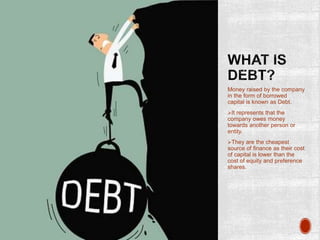
Money raised by the company
in the form of borrowed
capital is known as Debt.
It represents that the
company owes money
towards another person or
entity.
They are the cheapest
source of finance as their cost
of capital is lower than the
cost of equity and preference
shares.
Funds raised through debt financing are to be repaid after the expiry of the
specific term.
Debt can be in the form of term loans, debentures or bonds.
 Term loans are obtained from financial institutions or banks while
debentures and bonds are issued to the general public.
 They carry fixed interest, which requires timely payments.
The interest is tax deductible in nature, so, the benefit of tax is also
available.
Debt can be secured or unsecured.
Secured Debt requires pledging of an asset as security so that if the money
is not paid back within a reasonable time, the lender can forfeit the asset and
recover the money.
In the case of unsecured debt, there is no obligation to pledge an asset for
getting the funds.
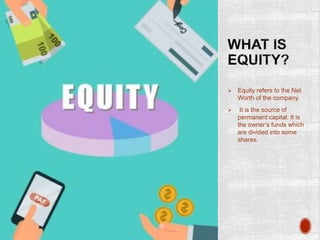
 Equity refers to the Net
Worth of the company.
 It is the source of
permanent capital. It is
the owner’s funds which
are divided into some
shares.
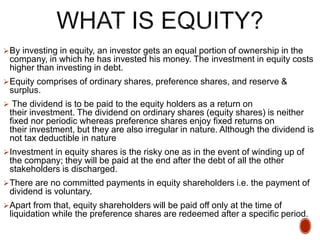
By investing in equity, an investor gets an equal portion of ownership in the
company, in which he has invested his money. The investment in equity costs
higher than investing in debt.
Equity comprises of ordinary shares, preference shares, and reserve &
surplus.
 The dividend is to be paid to the equity holders as a return on
their investment. The dividend on ordinary shares (equity shares) is neither
fixed nor periodic whereas preference shares enjoy fixed returns on
their investment, but they are also irregular in nature. Although the dividend is
not tax deductible in nature
Investment in equity shares is the risky one as in the event of winding up of
the company; they will be paid at the end after the debt of all the other
stakeholders is discharged.
There are no committed payments in equity shareholders i.e. the payment of
dividend is voluntary.
Apart from that, equity shareholders will be paid off only at the time of
liquidation while the preference shares are redeemed after a specific period.
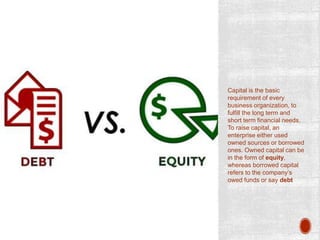
Capital is the basic
requirement of every
business organization, to
fulfill the long term and
short term financial needs.
To raise capital, an
enterprise either used
owned sources or borrowed
ones. Owned capital can be
in the form of equity,
whereas borrowed capital
refers to the company’s
owed funds or say debt
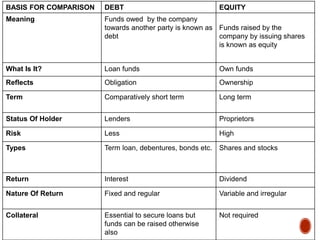
BASIS FOR COMPARISON DEBT EQUITY
Meaning Funds owed by the company
towards another party is known as
debt
Funds raised by the
company by issuing shares
is known as equity
What Is It? Loan funds Own funds
Reflects Obligation Ownership
Term Comparatively short term Long term
Status Of Holder Lenders Proprietors
Risk Less High
Types Term loan, debentures, bonds etc. Shares and stocks
Return Interest Dividend
Nature Of Return Fixed and regular Variable and irregular
Collateral Essential to secure loans but
funds can be raised otherwise
also
Not required
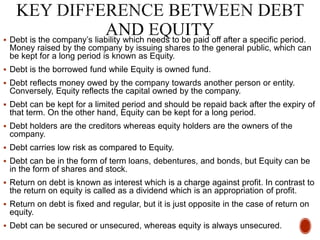
 Debt is the company’s liability which needs to be paid off after a specific period.
Money raised by the company by issuing shares to the general public, which can
be kept for a long period is known as Equity.
 Debt is the borrowed fund while Equity is owned fund.
 Debt reflects money owed by the company towards another person or entity.
Conversely, Equity reflects the capital owned by the company.
 Debt can be kept for a limited period and should be repaid back after the expiry of
that term. On the other hand, Equity can be kept for a long period.
 Debt holders are the creditors whereas equity holders are the owners of the
company.
 Debt carries low risk as compared to Equity.
 Debt can be in the form of term loans, debentures, and bonds, but Equity can be
in the form of shares and stock.
 Return on debt is known as interest which is a charge against profit. In contrast to
the return on equity is called as a dividend which is an appropriation of profit.
 Return on debt is fixed and regular, but it is just opposite in the case of return on
equity.
 Debt can be secured or unsecured, whereas equity is always unsecured.
It is essential for all the companies to maintain a balance
between debt and equity funds. The ideal debt-equity ratio is 2:1
i.e. equity should always be twice of the debt, only then it can be
assumed that the company can cover its losses effectively.
Difference Between Debt And Equity

Difference Between Debt And Equity

  • 2.
    Money raised bythe company in the form of borrowed capital is known as Debt. It represents that the company owes money towards another person or entity. They are the cheapest source of finance as their cost of capital is lower than the cost of equity and preference shares.
  • 3.
    Funds raised throughdebt financing are to be repaid after the expiry of the specific term. Debt can be in the form of term loans, debentures or bonds.  Term loans are obtained from financial institutions or banks while debentures and bonds are issued to the general public.  They carry fixed interest, which requires timely payments. The interest is tax deductible in nature, so, the benefit of tax is also available. Debt can be secured or unsecured. Secured Debt requires pledging of an asset as security so that if the money is not paid back within a reasonable time, the lender can forfeit the asset and recover the money. In the case of unsecured debt, there is no obligation to pledge an asset for getting the funds.
  • 4.
     Equity refersto the Net Worth of the company.  It is the source of permanent capital. It is the owner’s funds which are divided into some shares.
  • 5.
    By investing inequity, an investor gets an equal portion of ownership in the company, in which he has invested his money. The investment in equity costs higher than investing in debt. Equity comprises of ordinary shares, preference shares, and reserve & surplus.  The dividend is to be paid to the equity holders as a return on their investment. The dividend on ordinary shares (equity shares) is neither fixed nor periodic whereas preference shares enjoy fixed returns on their investment, but they are also irregular in nature. Although the dividend is not tax deductible in nature Investment in equity shares is the risky one as in the event of winding up of the company; they will be paid at the end after the debt of all the other stakeholders is discharged. There are no committed payments in equity shareholders i.e. the payment of dividend is voluntary. Apart from that, equity shareholders will be paid off only at the time of liquidation while the preference shares are redeemed after a specific period.
  • 6.
    Capital is thebasic requirement of every business organization, to fulfill the long term and short term financial needs. To raise capital, an enterprise either used owned sources or borrowed ones. Owned capital can be in the form of equity, whereas borrowed capital refers to the company’s owed funds or say debt
  • 7.
    BASIS FOR COMPARISONDEBT EQUITY Meaning Funds owed by the company towards another party is known as debt Funds raised by the company by issuing shares is known as equity What Is It? Loan funds Own funds Reflects Obligation Ownership Term Comparatively short term Long term Status Of Holder Lenders Proprietors Risk Less High Types Term loan, debentures, bonds etc. Shares and stocks Return Interest Dividend Nature Of Return Fixed and regular Variable and irregular Collateral Essential to secure loans but funds can be raised otherwise also Not required
  • 8.
     Debt isthe company’s liability which needs to be paid off after a specific period. Money raised by the company by issuing shares to the general public, which can be kept for a long period is known as Equity.  Debt is the borrowed fund while Equity is owned fund.  Debt reflects money owed by the company towards another person or entity. Conversely, Equity reflects the capital owned by the company.  Debt can be kept for a limited period and should be repaid back after the expiry of that term. On the other hand, Equity can be kept for a long period.  Debt holders are the creditors whereas equity holders are the owners of the company.  Debt carries low risk as compared to Equity.  Debt can be in the form of term loans, debentures, and bonds, but Equity can be in the form of shares and stock.  Return on debt is known as interest which is a charge against profit. In contrast to the return on equity is called as a dividend which is an appropriation of profit.  Return on debt is fixed and regular, but it is just opposite in the case of return on equity.  Debt can be secured or unsecured, whereas equity is always unsecured.
  • 9.
    It is essentialfor all the companies to maintain a balance between debt and equity funds. The ideal debt-equity ratio is 2:1 i.e. equity should always be twice of the debt, only then it can be assumed that the company can cover its losses effectively.