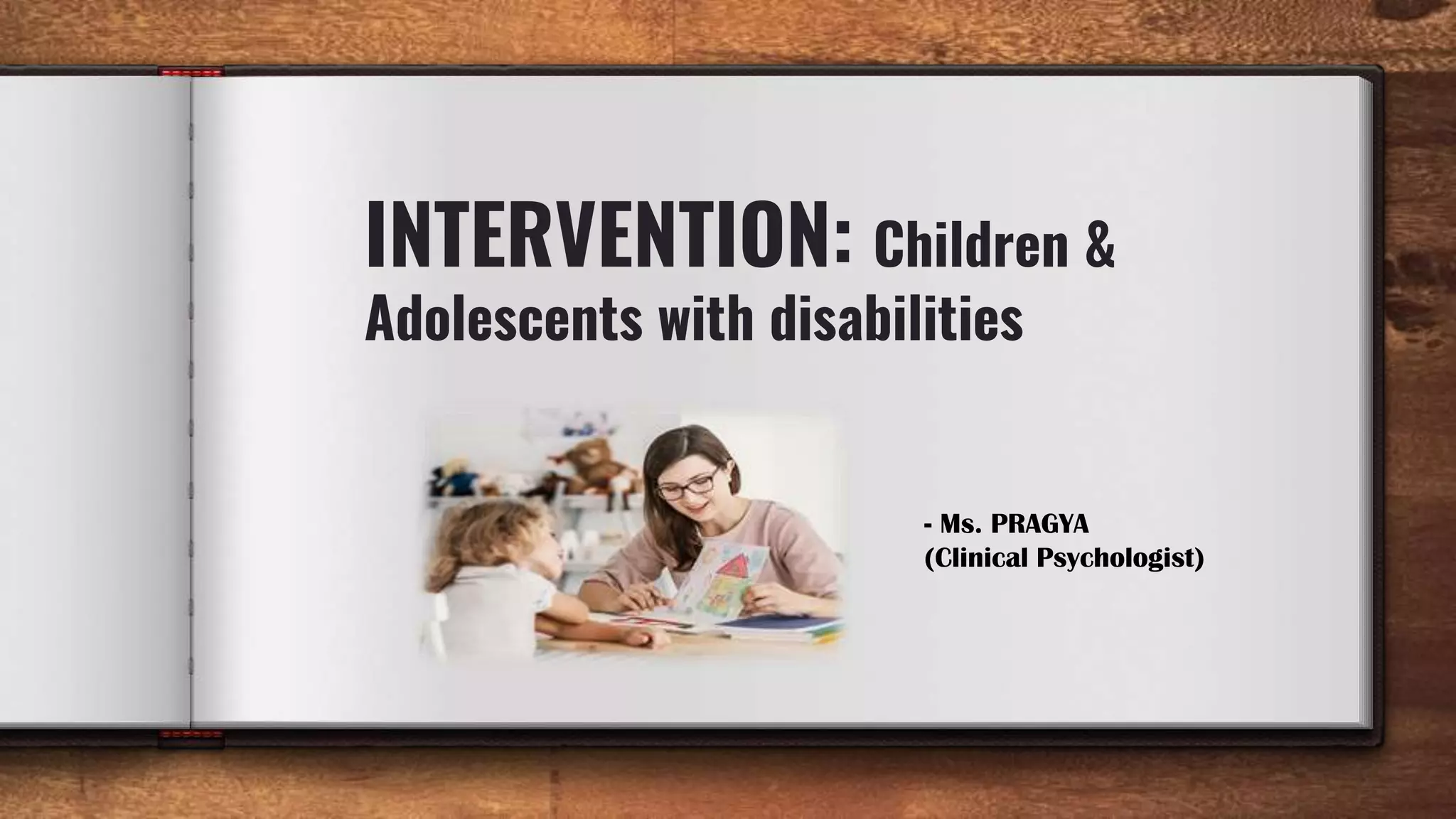
INTERVENTION: Children &
Adolescents with disabilities
- Ms. PRAGYA
(Clinical Psychologist)
GENERAL CONSIDERATION
When provide psychotherapeutic services to Children & adolescents with
disabilities, clinician must consider-
• They receive special education services
• They interact with various professionals
• Services involve family & caregiver, and this involvement may take
various forms
• Services require modification (individually tailored)
2
AUTISM SPECTRUM DISORDER
(ASD)
Characterized by impaired social
communication development &
repetitive patterns of behaviors and
restricted interests
3
SPECIAL ISSUES
As children starts at different baseline level of skills and have different
treatment goals, clinician must have:
• Understanding of impacts on behavior & learning
• Interpret behavior from child’s perspective
• Flexible to apply ‘trial –and-error’ method
• Originality to develop treatment plan
4
Core impairments:
• Abilities to interpret & express nonverbal and verbal social
communication or atypical social-emotional-cognitive understanding
varies
• Restricted & repetitive patterns of behavior may include recurrent motor
movements (body rocking, hand flapping, complex compulsive behavior
and resistance to change in routines)
5
COGNITIVE THEORIES
1. Theory of Mind (ToM):
o Ability to understand and attribute meaning of mental states
o Children with ASD have difficulty in understanding source of
thoughts, feelings & behavior of self and others creates challenges
in social interactions & problem solving
6
2. Central Coherence (CC):
o Tendency to focus on details rather than overall meaning
o Individuals with ASD have problem in generalizing information
from one situation to other
3. Executive Functions (EF):
o Individuals with ASD have difficulty taking in multiple types of
information, making quick decisions based on that information and
evaluate consequences
7
COMORBID ISSUES
Comorbid psychiatric disorders includes:
• Depression
• Anxiety
• Obsessive Compulsive Disorder (OCD)
• Bipolar disorder
Maladaptive behavior associated with core symptoms (such difficulty in
being assertive)
8
THERAPEUTIC APPROACHES
o Approach and goals are selected by using multimethod, multisource
approach include parent and teacher interview and direct child
assessment
o Assessment focus on core symptoms as well as comorbid issues
9
o After careful assessment of needs from multiple sources, therapeutic
relationship are structured
o This requires:
• Directive approach
• Expectations are clearly addressed with parent and child
• Children have significant organizational difficulty which continues
to homework assignment
• Active engagement is facilitated by visual schedules and self-
monitoring strategies
10
o Goal is established at beginning of session, reward is also identified for
goal accomplishment (if needed)
o Identify the connection between therapy goals and long-term outcomes
is necessary
o Make them understand benefit of therapy
11
TREATMENT OF CORE SYMPTOMS
• Establish specific strategies designed for increasing social cognitive
understanding, prosocial behavior and other skills identified by
assessment
• Therapeutic techniques must be individually tailored and adapted from
combined effect of disordered development of ToM, CC, EF
12
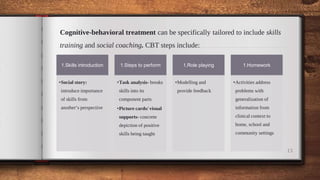
Cognitive-behavioral treatment can be specifically tailored to include skills
training and social coaching. CBT steps include:
13
1.Skills introduction
•Social story:
introduce importance
of skills from
another’s perspective
1.Steps to perform
•Task analysis- breaks
skills into its
component parts
•Picture cards/ visual
supports- concrete
depiction of positive
skills being taught
1.Role playing
•Modelling and
provide feedback
1.Homework
•Activities address
problems with
generalization of
information from
clinical context to
home, school and
community settings
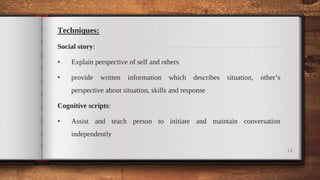
Techniques:
Social story:
• Explain perspective of self and others
• provide written information which describes situation, other’s
perspective about situation, skills and response
Cognitive scripts:
• Assist and teach person to initiate and maintain conversation
independently
14
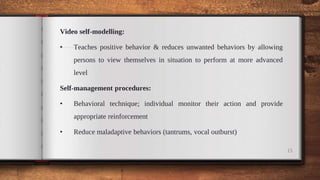
Video self-modelling:
• Teaches positive behavior & reduces unwanted behaviors by allowing
persons to view themselves in situation to perform at more advanced
level
Self-management procedures:
• Behavioral technique; individual monitor their action and provide
appropriate reinforcement
• Reduce maladaptive behaviors (tantrums, vocal outburst)
15
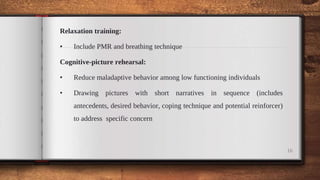
Relaxation training:
• Include PMR and breathing technique
Cognitive-picture rehearsal:
• Reduce maladaptive behavior among low functioning individuals
• Drawing pictures with short narratives in sequence (includes
antecedents, desired behavior, coping technique and potential reinforcer)
to address specific concern
16
Treatment for comorbid issues:
• Psychosocial interventions using cognitive behavioral strategies for
anxiety, depression, self-injurious behavior, OCD, etc.
Family & parent issues:
• Involve sadness & grief, fatigue and lack of patience, guilt, confusion
understanding symptoms, sibling embarrassment, acceptance and
problem accessing services
• Addressed through- family intervention (psychoeducation & behavior
management)
17
INTELLECTUAL DISABILITY (ID)
Characterized by:
a. Deficits in intellectual functions
b. Deficits in adaptive functioning
c. Onset during developmental periods
18
SPECIAL ISSUES & SOCIO-EMOTIONAL CONCERNS
• Specifiers of severity (mild, moderate, severe, profound) based on
adaptive functioning and level of support required for individual
• Risk of developing psychopathology is high in:
a) Moderate ID
b) Limitations in adaptive behavior
c) Poor socializations
d) Living with one biological parent
e) Low SES
19
• Individual with ID are more likely to experience psychopathology than
general population
• Mental illness & overgeneralized attribution of behavior being part of ID
may confound goal of effective treatment
• Assessment should include tools to further investigate such comorbidity
• Upon identification, clinician should include formal, goal directed
treatment plans
20
THERAPEUTIC APPROACHES
• Treatment principle for individual with ID should be same with some
modification based on individual characteristics and communication
• Individualized comprehensive treatment based on unique ability
• Provide instructional needs in academic & adaptive skills
• Clinician may interpret ID as root of problem and believe, no additional
help is warranted
21
• Mental health professionals must view emotional & behavioral
disturbance in presence of ID as behavioral manifestation
• Behavior modification techniques and more skill-based treatments
(shaping & task analysis) are included
• Progress should be monitored by using visual representations (graphics)
which make therapy and progress more meaningful
• Graphic representation also increase self-efficacy & self-advocacy
22
Parent training:
• Provide additional support for child & family
• Parent Child Interaction Therapy (PCIT), effective training program for
parents of children with severe behavioral issues
• Disruptive behavior decreases and parent experience more positive
interaction with children
23
Cognitive-Behavior Therapy:
• Effective treatment
• Training session is required to teach them link feeling to thoughts
(cognitive mediation)
• Include less complex and specific techniques
• Parent involvement is necessary
• Use visual aids or play therapy to communicate aids
24
Behavioral intervention:
• Main goal is to prioritize and effectively treat individual based on
symptoms
• Also helps in comorbid issues
• Includes functional assessment techniques, crisis intervention and
counselling to decrease disruptive behavior
25
Solution-Focused Brief Therapy (SFBT):
• Goal-oriented therapy
• Individuals with Severe or profound ID have difficulty in traditional
talk-based therapy
• So SFBT is used with mothers to gain insight, hopefulness, motivation &
confidence
• Focus on present & future goals
• Symptoms are not targeted
26
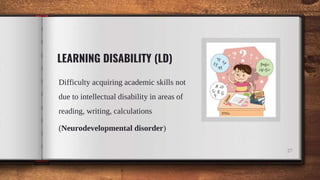
LEARNING DISABILITY (LD)
Difficulty acquiring academic skills not
due to intellectual disability in areas of
reading, writing, calculations
(Neurodevelopmental disorder)
27
SPECIAL ISSUES & SOCIO-EMOTIONAL CONCERNS
• Comorbid psychiatric disorders (ADHD, depression, anxiety)
• Engage in risky behavior (use marijuana or delinquency)
• Social skills deficits
• Often experience challenges beyond specific academic deficits, which
include low self-esteem or difficulty in peer interaction
28
THERAPEUTIC APPROACHES
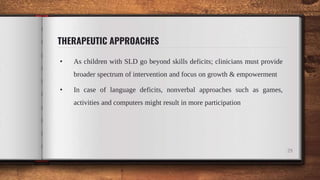
• As children with SLD go beyond skills deficits; clinicians must provide
broader spectrum of intervention and focus on growth & empowerment
• In case of language deficits, nonverbal approaches such as games,
activities and computers might result in more participation
29
30
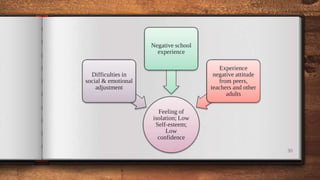
Feeling of
isolation; Low
Self-esteem;
Low
confidence
Difficulties in
social & emotional
adjustment
Negative school
experience
Experience
negative attitude
from peers,
teachers and other
adults
• Difficulties in metacognitive processes negatively impact child to
accurately report emotion during therapy
• Thus, therapeutic approaches need to investigate function of behavioral
difficulties while intervening both academic and behavioral domains
• Ensure that selected treatment is beneficial, and progress is monitored
• Individual strength is utilized to support therapeutic process & goals
31
CBT:
• Effective with children with LD and depression
• Clinicians should consider some modifications base on individual
problem
• Instead of complete homework (such as recording thoughts) on paper,
alternate method might be used like tape recorder
32
Group therapy/counselling:
• Incorporates specific techniques that are supportive-expressive
• May involve mixture of cognitive and behavioral techniques (age-
appropriate techniques)
• Improve social and emotional functioning
33
Solution-Focused Brief Therapy (SFBT):
• Action-oriented nature
• Provide outlet to focus on goals to accomplish (rather than skill deficits
in academic settings)
• Significant improvement in externalizing or internalizing behavior
34
Social Skills Training (SST):
• Social skills deficits have been well documented in individuals with LD
• Effectiveness of SST is questionable as targeted skills, at times, failed to
generalize outside of training session
• Clinicians should consider implementing SST (if indicated) but with
clear planning for generalization and monitoring of effectiveness
35
Parent Training:
• Students with LD may be viewed as “lazy” or “indifferent”, which
impact academic & social functioning
• Specific education on nature & manifestation of LD and unique
individual characteristics should be emphasized
• Clinicians work with family to develop supportive home environment
and consistent home-school program of reinforcement
• This provide protective factor from negative school/peer experience
36
TRAUMATIC BRAIN INJURY
(TBI)
Alteration in brain function or brain
pathology caused by external force
(affect skull & brain)
37
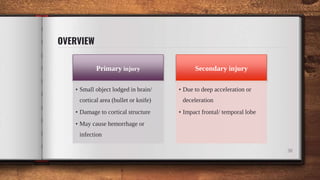
OVERVIEW
38
Primary injury
• Small object lodged in brain/
cortical area (bullet or knife)
• Damage to cortical structure
• May cause hemorrhage or
infection
Secondary injury
• Due to deep acceleration or
deceleration
• Impact frontal/ temporal lobe
• Pathophysiology of TBI and impacts on various aspects of CNS
functioning (neurocognitive deficits and strength) guide
psychotherapeutic intervention
• Difficulties with EF (organizing, planning, disinhibition, etc.); memory
problem; speech & language difficulty; attentional problems with slow
processing speed are common
• Common externalizing problems in children & adolescents with TBI
include inattention, hyperactivity, impulsivity, aggressive behavior
39
• Social difficulties which include difficulties in social problem-solving,
managing social-conflict and coordinating play activities
• Appropriate education is required if TBI is negatively impacting on
academic attainment
• Speech, occupational and physical therapies may also be provided
depending upon neurocognitive impact of injury
40
SPECIAL ISSUES & SOCIO-EMOTIONAL CONCERNS
• Social difficulties- difficulties with accurately decoding & interpreting
social information and exhibit impaired social judgment
• Loss of previously acquired academic, motor and language skills result
in low self-esteem and frustration
• Family coping and psychological functioning affected by TBI & impacts
long-term outcomes
41
Behavioral approaches:
• Methods of applied behavioral analysis (understanding antecedent or
consequence)
• Operant & antecedent intervention to manage & reduce impulsive,
aggressive, disruptive behavior
• Effective intervention include differential reinforcements, token
economies, extinction, time-out procedure and combinations of
behavioral techniques
42
Family-centered Problem-Solving (FPS) intervention:
• Structured family-based intervention
• Provide orientation and training in problem-solving approach (didactic
in nature)
• TBI tailored information- possible effects of TBI on memory, attention,
learning & behavior as well as strategies to address such difficulties
• Focus on family communication, handling family crisis, and structure
environment to facilitate optimal adjustment
43
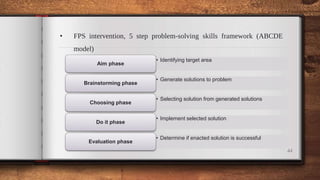
• FPS intervention, 5 step problem-solving skills framework (ABCDE
model)
44
• Identifying target area
Aim phase
• Generate solutions to problem
Brainstorming phase
• Selecting solution from generated solutions
Choosing phase
• Implement selected solution
Do it phase
• Determine if enacted solution is successful
Evaluation phase
Social intervention:
• Social outcomes are more important than academic, physical or sports-
related functioning
• Social network interventions target development of a supportive team of
peers, teachers and parents to increase social contact, social acceptance
and social interaction within school setting
45
46
THANK
YOU !!

Intervention children

  • 1.
    INTERVENTION: Children & Adolescentswith disabilities - Ms. PRAGYA (Clinical Psychologist)
  • 2.
    GENERAL CONSIDERATION When providepsychotherapeutic services to Children & adolescents with disabilities, clinician must consider- • They receive special education services • They interact with various professionals • Services involve family & caregiver, and this involvement may take various forms • Services require modification (individually tailored) 2
  • 3.
    AUTISM SPECTRUM DISORDER (ASD) Characterizedby impaired social communication development & repetitive patterns of behaviors and restricted interests 3
  • 4.
    SPECIAL ISSUES As childrenstarts at different baseline level of skills and have different treatment goals, clinician must have: • Understanding of impacts on behavior & learning • Interpret behavior from child’s perspective • Flexible to apply ‘trial –and-error’ method • Originality to develop treatment plan 4
  • 5.
    Core impairments: • Abilitiesto interpret & express nonverbal and verbal social communication or atypical social-emotional-cognitive understanding varies • Restricted & repetitive patterns of behavior may include recurrent motor movements (body rocking, hand flapping, complex compulsive behavior and resistance to change in routines) 5
  • 6.
    COGNITIVE THEORIES 1. Theoryof Mind (ToM): o Ability to understand and attribute meaning of mental states o Children with ASD have difficulty in understanding source of thoughts, feelings & behavior of self and others creates challenges in social interactions & problem solving 6
  • 7.
    2. Central Coherence(CC): o Tendency to focus on details rather than overall meaning o Individuals with ASD have problem in generalizing information from one situation to other 3. Executive Functions (EF): o Individuals with ASD have difficulty taking in multiple types of information, making quick decisions based on that information and evaluate consequences 7
  • 8.
    COMORBID ISSUES Comorbid psychiatricdisorders includes: • Depression • Anxiety • Obsessive Compulsive Disorder (OCD) • Bipolar disorder Maladaptive behavior associated with core symptoms (such difficulty in being assertive) 8
  • 9.
    THERAPEUTIC APPROACHES o Approachand goals are selected by using multimethod, multisource approach include parent and teacher interview and direct child assessment o Assessment focus on core symptoms as well as comorbid issues 9
  • 10.
    o After carefulassessment of needs from multiple sources, therapeutic relationship are structured o This requires: • Directive approach • Expectations are clearly addressed with parent and child • Children have significant organizational difficulty which continues to homework assignment • Active engagement is facilitated by visual schedules and self- monitoring strategies 10
  • 11.
    o Goal isestablished at beginning of session, reward is also identified for goal accomplishment (if needed) o Identify the connection between therapy goals and long-term outcomes is necessary o Make them understand benefit of therapy 11
  • 12.
    TREATMENT OF CORESYMPTOMS • Establish specific strategies designed for increasing social cognitive understanding, prosocial behavior and other skills identified by assessment • Therapeutic techniques must be individually tailored and adapted from combined effect of disordered development of ToM, CC, EF 12
  • 13.
    Cognitive-behavioral treatment canbe specifically tailored to include skills training and social coaching. CBT steps include: 13 1.Skills introduction •Social story: introduce importance of skills from another’s perspective 1.Steps to perform •Task analysis- breaks skills into its component parts •Picture cards/ visual supports- concrete depiction of positive skills being taught 1.Role playing •Modelling and provide feedback 1.Homework •Activities address problems with generalization of information from clinical context to home, school and community settings
  • 14.
    Techniques: Social story: • Explainperspective of self and others • provide written information which describes situation, other’s perspective about situation, skills and response Cognitive scripts: • Assist and teach person to initiate and maintain conversation independently 14
  • 15.
    Video self-modelling: • Teachespositive behavior & reduces unwanted behaviors by allowing persons to view themselves in situation to perform at more advanced level Self-management procedures: • Behavioral technique; individual monitor their action and provide appropriate reinforcement • Reduce maladaptive behaviors (tantrums, vocal outburst) 15
  • 16.
    Relaxation training: • IncludePMR and breathing technique Cognitive-picture rehearsal: • Reduce maladaptive behavior among low functioning individuals • Drawing pictures with short narratives in sequence (includes antecedents, desired behavior, coping technique and potential reinforcer) to address specific concern 16
  • 17.
    Treatment for comorbidissues: • Psychosocial interventions using cognitive behavioral strategies for anxiety, depression, self-injurious behavior, OCD, etc. Family & parent issues: • Involve sadness & grief, fatigue and lack of patience, guilt, confusion understanding symptoms, sibling embarrassment, acceptance and problem accessing services • Addressed through- family intervention (psychoeducation & behavior management) 17
  • 18.
    INTELLECTUAL DISABILITY (ID) Characterizedby: a. Deficits in intellectual functions b. Deficits in adaptive functioning c. Onset during developmental periods 18
  • 19.
    SPECIAL ISSUES &SOCIO-EMOTIONAL CONCERNS • Specifiers of severity (mild, moderate, severe, profound) based on adaptive functioning and level of support required for individual • Risk of developing psychopathology is high in: a) Moderate ID b) Limitations in adaptive behavior c) Poor socializations d) Living with one biological parent e) Low SES 19
  • 20.
    • Individual withID are more likely to experience psychopathology than general population • Mental illness & overgeneralized attribution of behavior being part of ID may confound goal of effective treatment • Assessment should include tools to further investigate such comorbidity • Upon identification, clinician should include formal, goal directed treatment plans 20
  • 21.
    THERAPEUTIC APPROACHES • Treatmentprinciple for individual with ID should be same with some modification based on individual characteristics and communication • Individualized comprehensive treatment based on unique ability • Provide instructional needs in academic & adaptive skills • Clinician may interpret ID as root of problem and believe, no additional help is warranted 21
  • 22.
    • Mental healthprofessionals must view emotional & behavioral disturbance in presence of ID as behavioral manifestation • Behavior modification techniques and more skill-based treatments (shaping & task analysis) are included • Progress should be monitored by using visual representations (graphics) which make therapy and progress more meaningful • Graphic representation also increase self-efficacy & self-advocacy 22
  • 23.
    Parent training: • Provideadditional support for child & family • Parent Child Interaction Therapy (PCIT), effective training program for parents of children with severe behavioral issues • Disruptive behavior decreases and parent experience more positive interaction with children 23
  • 24.
    Cognitive-Behavior Therapy: • Effectivetreatment • Training session is required to teach them link feeling to thoughts (cognitive mediation) • Include less complex and specific techniques • Parent involvement is necessary • Use visual aids or play therapy to communicate aids 24
  • 25.
    Behavioral intervention: • Maingoal is to prioritize and effectively treat individual based on symptoms • Also helps in comorbid issues • Includes functional assessment techniques, crisis intervention and counselling to decrease disruptive behavior 25
  • 26.
    Solution-Focused Brief Therapy(SFBT): • Goal-oriented therapy • Individuals with Severe or profound ID have difficulty in traditional talk-based therapy • So SFBT is used with mothers to gain insight, hopefulness, motivation & confidence • Focus on present & future goals • Symptoms are not targeted 26
  • 27.
    LEARNING DISABILITY (LD) Difficultyacquiring academic skills not due to intellectual disability in areas of reading, writing, calculations (Neurodevelopmental disorder) 27
  • 28.
    SPECIAL ISSUES &SOCIO-EMOTIONAL CONCERNS • Comorbid psychiatric disorders (ADHD, depression, anxiety) • Engage in risky behavior (use marijuana or delinquency) • Social skills deficits • Often experience challenges beyond specific academic deficits, which include low self-esteem or difficulty in peer interaction 28
  • 29.
    THERAPEUTIC APPROACHES • Aschildren with SLD go beyond skills deficits; clinicians must provide broader spectrum of intervention and focus on growth & empowerment • In case of language deficits, nonverbal approaches such as games, activities and computers might result in more participation 29
  • 30.
    30 Feeling of isolation; Low Self-esteem; Low confidence Difficultiesin social & emotional adjustment Negative school experience Experience negative attitude from peers, teachers and other adults
  • 31.
    • Difficulties inmetacognitive processes negatively impact child to accurately report emotion during therapy • Thus, therapeutic approaches need to investigate function of behavioral difficulties while intervening both academic and behavioral domains • Ensure that selected treatment is beneficial, and progress is monitored • Individual strength is utilized to support therapeutic process & goals 31
  • 32.
    CBT: • Effective withchildren with LD and depression • Clinicians should consider some modifications base on individual problem • Instead of complete homework (such as recording thoughts) on paper, alternate method might be used like tape recorder 32
  • 33.
    Group therapy/counselling: • Incorporatesspecific techniques that are supportive-expressive • May involve mixture of cognitive and behavioral techniques (age- appropriate techniques) • Improve social and emotional functioning 33
  • 34.
    Solution-Focused Brief Therapy(SFBT): • Action-oriented nature • Provide outlet to focus on goals to accomplish (rather than skill deficits in academic settings) • Significant improvement in externalizing or internalizing behavior 34
  • 35.
    Social Skills Training(SST): • Social skills deficits have been well documented in individuals with LD • Effectiveness of SST is questionable as targeted skills, at times, failed to generalize outside of training session • Clinicians should consider implementing SST (if indicated) but with clear planning for generalization and monitoring of effectiveness 35
  • 36.
    Parent Training: • Studentswith LD may be viewed as “lazy” or “indifferent”, which impact academic & social functioning • Specific education on nature & manifestation of LD and unique individual characteristics should be emphasized • Clinicians work with family to develop supportive home environment and consistent home-school program of reinforcement • This provide protective factor from negative school/peer experience 36
  • 37.
    TRAUMATIC BRAIN INJURY (TBI) Alterationin brain function or brain pathology caused by external force (affect skull & brain) 37
  • 38.
    OVERVIEW 38 Primary injury • Smallobject lodged in brain/ cortical area (bullet or knife) • Damage to cortical structure • May cause hemorrhage or infection Secondary injury • Due to deep acceleration or deceleration • Impact frontal/ temporal lobe
  • 39.
    • Pathophysiology ofTBI and impacts on various aspects of CNS functioning (neurocognitive deficits and strength) guide psychotherapeutic intervention • Difficulties with EF (organizing, planning, disinhibition, etc.); memory problem; speech & language difficulty; attentional problems with slow processing speed are common • Common externalizing problems in children & adolescents with TBI include inattention, hyperactivity, impulsivity, aggressive behavior 39
  • 40.
    • Social difficultieswhich include difficulties in social problem-solving, managing social-conflict and coordinating play activities • Appropriate education is required if TBI is negatively impacting on academic attainment • Speech, occupational and physical therapies may also be provided depending upon neurocognitive impact of injury 40
  • 41.
    SPECIAL ISSUES &SOCIO-EMOTIONAL CONCERNS • Social difficulties- difficulties with accurately decoding & interpreting social information and exhibit impaired social judgment • Loss of previously acquired academic, motor and language skills result in low self-esteem and frustration • Family coping and psychological functioning affected by TBI & impacts long-term outcomes 41
  • 42.
    Behavioral approaches: • Methodsof applied behavioral analysis (understanding antecedent or consequence) • Operant & antecedent intervention to manage & reduce impulsive, aggressive, disruptive behavior • Effective intervention include differential reinforcements, token economies, extinction, time-out procedure and combinations of behavioral techniques 42
  • 43.
    Family-centered Problem-Solving (FPS)intervention: • Structured family-based intervention • Provide orientation and training in problem-solving approach (didactic in nature) • TBI tailored information- possible effects of TBI on memory, attention, learning & behavior as well as strategies to address such difficulties • Focus on family communication, handling family crisis, and structure environment to facilitate optimal adjustment 43
  • 44.
    • FPS intervention,5 step problem-solving skills framework (ABCDE model) 44 • Identifying target area Aim phase • Generate solutions to problem Brainstorming phase • Selecting solution from generated solutions Choosing phase • Implement selected solution Do it phase • Determine if enacted solution is successful Evaluation phase
  • 45.
    Social intervention: • Socialoutcomes are more important than academic, physical or sports- related functioning • Social network interventions target development of a supportive team of peers, teachers and parents to increase social contact, social acceptance and social interaction within school setting 45
  • 46.