1 
Career Maturity Inventory Test 
Melissa Atkinson, Monica Castro, Claudia Chandler, 
Brocha Cohen & Erika Ober
2 
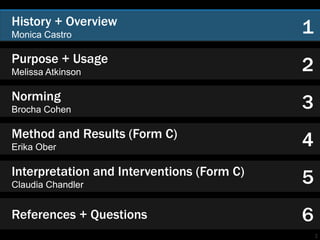
History + Overview 
Monica Castro 
Purpose + Usage 
Melissa Atkinson 
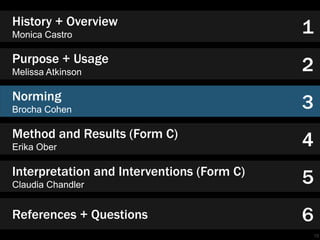
Norming 
Brocha Cohen 
Method and Results (Form C) 
Erika Ober 
Interpretation and Interventions (Form C) 
Claudia Chandler 
References + Questions 
1 
2 
3 
4 
5 
6
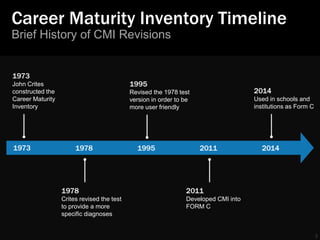
Career Maturity Inventory Timeline 
3 
Brief History of CMI Revisions 
1973 
John Crites 
constructed the 
Career Maturity 
Inventory 
1973 1978 1995 2011 2014 
1978 
Crites revised the test 
to provide a more 
specific diagnoses 
1995 
Revised the 1978 test 
version in order to be 
more user friendly 
2014 
Used in schools and 
institutions as Form C 
2011 
Developed CMI into 
FORM C
4 
History 
‣ 1973 John Crites constructed the Career Maturity 
Inventory (CMI) 
• Wanted to distinguish between consistency of vocational 
choice and wisdom of development between ones 
occupational choice and ones interest, abilities and 
experience. 
‣ Original Career Maturity Inventory 
• Attitude Scale: 50 items, T/F, 30 minutes 
• Competence Test: 100 items, 5 parts, 2 hours
5 
First Revision 
‣ In 1978 Crites revised the test to provide a more 
specific diagnoses 
• Added 25-new items to the Career Maturity Inventory-Attitude 
scale in 2 different forms: Counseling form (B-1) and 
Screening form (A-2) 
‣ Form differences 
• A-2 used for research and screening purposes
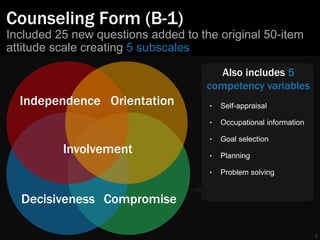
Counseling Form (B-1) 
6 
Included 25 new questions added to the original 50-item 
attitude scale creating 5 subscales 
Also includes 5 
competency variables 
‣ Self-appraisal 
‣ Occupational information 
‣ Goal selection 
‣ Planning 
‣ Problem solving 
Independence 
Involvement 
Decisiveness 
Orientation 
Compromise
7 
1995 Revision of CMI 
‣ Revised the 1978 test version 
in order to be more user 
friendly 
‣ Made applicable to students 
and adults 
‣ Subscales were eliminated
2011 Revision 
8 
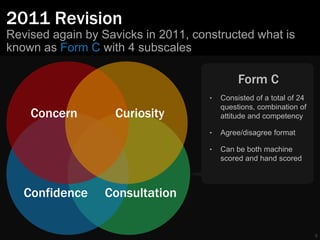
Revised again by Savicks in 2011, constructed what is 
known as Form C with 4 subscales 
Form C 
‣ Consisted of a total of 24 
questions, combination of 
attitude and competency 
‣ Agree/disagree format 
‣ Can be both machine 
scored and hand scored 
Concern 
Confidence 
Curiosity 
Consultation
History + Overview 
Monica Castro 1 
9 
Purpose + Usage 
Melissa Atkinson 
Norming 
Brocha Cohen 
Method and Results (Form C) 
Erika Ober 
Interpretation and Interventions (Form C) 
Claudia Chandler 
References + Questions 
2 
3 
4 
5 
6
10 
What is the Career Maturity 
Inventory test for?
11 
The Career Maturity Inventory 
is used for teaching students the process of 
career decision-making as well as help them 
gain career maturity.
12 
The CMI 
‣ It is used for students up to 
grade 12 
• to gain personal insight into 
the processes of making 
career decisions 
• as well as the readiness of 
such choices 
- (Hays, 2013, p. 211).
Primary Uses 
13 
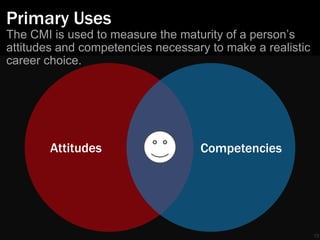
The CMI is used to measure the maturity of a person’s 
attitudes and competencies necessary to make a realistic 
career choice. 
Attitudes Competencies
14 
CMI does not measure 
the cognitive competencies, which include 
comprehension and problem-solving abilities
15 
Recommended 
to be used as a screening tool to address areas 
of concern where the clients may not have 
enough information about themselves or the 
world in order to make a realistic career decision 
(Powell & Luzzo, 
1998).
History + Overview 
Monica Castro 1 
16 
Purpose + Usage 
Melissa Atkinson 
Norming 
Brocha Cohen 
Method and Results (Form C) 
Erika Ober 
Interpretation and Interventions (Form C) 
Claudia Chandler 
References + Questions 
2 
3 
4 
5 
6
Reliability, Validity and Norms 
17 
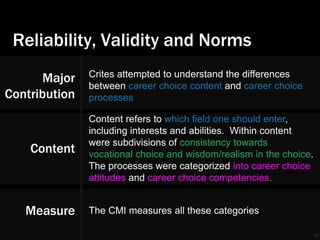
Major 
Contribution 
Content 
Measure 
Crites attempted to understand the differences 
between career choice content and career choice 
processes 
Content refers to which field one should enter, 
including interests and abilities. Within content 
were subdivisions of consistency towards 
vocational choice and wisdom/realism in the choice. 
The processes were categorized into career choice 
attitudes and career choice competencies. 
The CMI measures all these categories
CMI ‘Form C’ 
18 
Normed 
CMI is normed for mostly adolescents and 
recently for young adults 
Inclusive 
The revised version is made to work for 
high school students and postsecondary 
adults, also eliminating race, ethnic and 
cultural biases 
Efficacy 
The CMI was normed through research and 
clinical studies by Crites for career 
development with adolescents
Validity 
19 
The CMI construction is based on the idea that developmental 
variables have to be related to time in that they either increase or 
decrease with age. 
In order to determine validity items have only been selected for the 
CMI if they increase or decrease with time, this is effective with the 
school age. 
As evidence of validity, one see an increase in the CMI as a function 
of age and grade levels 
Past studies have found correlations between the CMI and realism in 
career choice in secondary school students 
Another correlation was found between 11th grades career maturity 
levels and occupational plans scores 
✔ 
✔ 
✔ 
✔ 
✔
Efficacy 
20 
Career Maturity Inventory Test 
‣ A recent study was conducted to 
determine internal reliability from the 
CMI-R with a sample of 157 students 
from five public high schools, ages 
ranging from 14-19 
‣ Each student was administered a few 
career tests; biographical information 
was taken and the test was given over 
a period of two weeks and was 
administered in school. 
‣ Results for reliability, for the attitude 
scale was .54, for the competence test 
was .52 and the entire inventory was 
.61. 
‣ There was a significant difference in 
females scoring higher than males for 
the competence test 
‣ There was a significant difference in 
age level and grade for the attitudes 
test 
‣ Modest validity compared to the 
original CMI, Low level of reliability 
compared to its predecessor and The 
original CMI values of internal 
reliability range somewhat higher
21 
‣ CMI-R and CMI Form C lacks psychometric data 
concerning validity and reliability 
‣ CMI Form C was designed to gain more reliability 
‣ More studies need to be done to determine real 
reliability and validity 
‣ McDivitt (2002) believes that the CMI greatly 
enhances teaching students the processes of career 
decision making and helping them gain career 
maturity.
22 
History + Overview 
Monica Castro 
Purpose + Usage 
Melissa Atkinson 
Norming 
Brocha Cohen 
Method and Results (Form C) 
Erika Ober 
Interpretation and Interventions (Form C) 
Claudia Chandler 
References + Questions 
1 
2 
3 
4 
5 
6
23 
CMI Form C 
• Consists of 24 questions 
• The present research revised the CMI by 
applying Savickas’ theory of career 
construction to the 75 items in Form B-1
24 
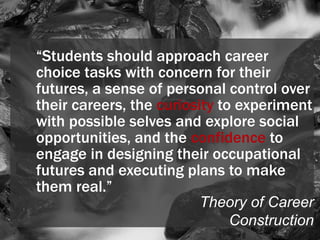
“Students should approach career 
choice tasks with concern for their 
futures, a sense of personal control over 
their careers, the curiosity to experiment 
with possible selves and explore social 
opportunities, and the confidence to 
engage in designing their occupational 
futures and executing plans to make 
them real.” 
Theory of Career 
Construction
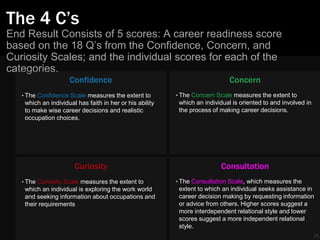
The 4 C’s 
25 
End Result Consists of 5 scores: A career readiness score 
based on the 18 Q’s from the Confidence, Concern, and 
Curiosity Scales; and the individual scores for each of the 
categories. 
Confidence 
‣The Confidence Scale measures the extent to 
which an individual has faith in her or his ability 
to make wise career decisions and realistic 
occupation choices. 
Concern 
Curiosity Consultation 
‣The Curiosity Scale measures the extent to 
which an individual is exploring the work world 
and seeking information about occupations and 
their requirements 
‣The Concern Scale measures the extent to 
which an individual is oriented to and involved in 
the process of making career decisions. 
‣The Consultation Scale, which measures the 
extent to which an individual seeks assistance in 
career decision making by requesting information 
or advice from others. Higher scores suggest a 
more interdependent relational style and lower 
scores suggest a more independent relational 
style.
26 
History + Overview 
Monica Castro 
Purpose + Usage 
Melissa Atkinson 
Norming 
Brocha Cohen 
Method and Results (Form C) 
Erika Ober 
Interpretation and Interventions (Form C) 
Claudia Chandler 
References + Questions 
1 
2 
3 
4 
5 
6
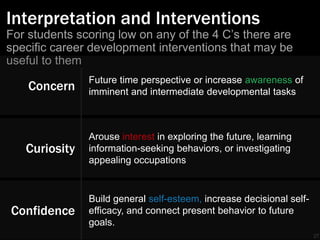
Interpretation and Interventions 
27 
For students scoring low on any of the 4 C’s there are 
specific career development interventions that may be 
useful to them 
Concern 
Curiosity 
Confidence 
Future time perspective or increase awareness of 
imminent and intermediate developmental tasks 
Arouse interest in exploring the future, learning 
information-seeking behaviors, or investigating 
appealing occupations 
Build general self-esteem, increase decisional self-efficacy, 
and connect present behavior to future 
goals.
28 
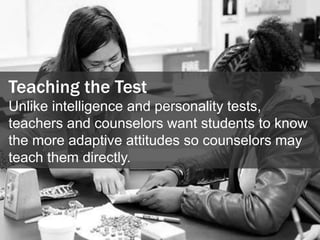
Teaching the Test 
Unlike intelligence and personality tests, 
teachers and counselors want students to know 
the more adaptive attitudes so counselors may 
teach them directly.
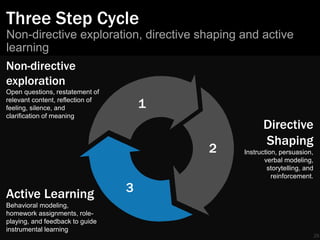
Three Step Cycle 
29 
Non-directive exploration, directive shaping and active 
learning 
Non-directive 
exploration 
Open questions, restatement of 
relevant content, reflection of 
feeling, silence, and 
clarification of meaning 
Directive 
Shaping 
Instruction, persuasion, 
verbal modeling, 
storytelling, and 
reinforcement. 
Active Learning 
Behavioral modeling, 
homework assignments, role-playing, 
and feedback to guide 
instrumental learning 
1 
2 
3
30 
References 
Busacca, L. A., & Taber, B. J. (2002). The Career Maturity 
Inventory-Revised: A preliminary psychometric 
investigation. Journal of Career Assessment 10(4), 
441-455. doi: 10.1177/1069072702238406 
Hays, D.G., & Hood, A.B. (2013). Assessment in 
counseling: A guide to the use of psychological 
assessment procedures. (5th ed.). Alexandria, VA: 
American Counseling Association 
Powell, D., & Luzzo, D. A. (1998). Evaluating factors 
associated with career maturity of high school students. 
Career Development Quarterly, 47(2), 145-158. 
Savickas, M. L, & Porfeli, E. J. (2011). Revision of the 
Career Maturity Inventory: The adaptability form. Journal 
of Career Assessment, 19(4), 355-374.

Career Maturity Inventory Presentation

  • 1.
    1 Career MaturityInventory Test Melissa Atkinson, Monica Castro, Claudia Chandler, Brocha Cohen & Erika Ober
  • 2.
    2 History +Overview Monica Castro Purpose + Usage Melissa Atkinson Norming Brocha Cohen Method and Results (Form C) Erika Ober Interpretation and Interventions (Form C) Claudia Chandler References + Questions 1 2 3 4 5 6
  • 3.
    Career Maturity InventoryTimeline 3 Brief History of CMI Revisions 1973 John Crites constructed the Career Maturity Inventory 1973 1978 1995 2011 2014 1978 Crites revised the test to provide a more specific diagnoses 1995 Revised the 1978 test version in order to be more user friendly 2014 Used in schools and institutions as Form C 2011 Developed CMI into FORM C
  • 4.
    4 History ‣1973 John Crites constructed the Career Maturity Inventory (CMI) • Wanted to distinguish between consistency of vocational choice and wisdom of development between ones occupational choice and ones interest, abilities and experience. ‣ Original Career Maturity Inventory • Attitude Scale: 50 items, T/F, 30 minutes • Competence Test: 100 items, 5 parts, 2 hours
  • 5.
    5 First Revision ‣ In 1978 Crites revised the test to provide a more specific diagnoses • Added 25-new items to the Career Maturity Inventory-Attitude scale in 2 different forms: Counseling form (B-1) and Screening form (A-2) ‣ Form differences • A-2 used for research and screening purposes
  • 6.
    Counseling Form (B-1) 6 Included 25 new questions added to the original 50-item attitude scale creating 5 subscales Also includes 5 competency variables ‣ Self-appraisal ‣ Occupational information ‣ Goal selection ‣ Planning ‣ Problem solving Independence Involvement Decisiveness Orientation Compromise
  • 7.
    7 1995 Revisionof CMI ‣ Revised the 1978 test version in order to be more user friendly ‣ Made applicable to students and adults ‣ Subscales were eliminated
  • 8.
    2011 Revision 8 Revised again by Savicks in 2011, constructed what is known as Form C with 4 subscales Form C ‣ Consisted of a total of 24 questions, combination of attitude and competency ‣ Agree/disagree format ‣ Can be both machine scored and hand scored Concern Confidence Curiosity Consultation
  • 9.
    History + Overview Monica Castro 1 9 Purpose + Usage Melissa Atkinson Norming Brocha Cohen Method and Results (Form C) Erika Ober Interpretation and Interventions (Form C) Claudia Chandler References + Questions 2 3 4 5 6
  • 10.
    10 What isthe Career Maturity Inventory test for?
  • 11.
    11 The CareerMaturity Inventory is used for teaching students the process of career decision-making as well as help them gain career maturity.
  • 12.
    12 The CMI ‣ It is used for students up to grade 12 • to gain personal insight into the processes of making career decisions • as well as the readiness of such choices - (Hays, 2013, p. 211).
  • 13.
    Primary Uses 13 The CMI is used to measure the maturity of a person’s attitudes and competencies necessary to make a realistic career choice. Attitudes Competencies
  • 14.
    14 CMI doesnot measure the cognitive competencies, which include comprehension and problem-solving abilities
  • 15.
    15 Recommended tobe used as a screening tool to address areas of concern where the clients may not have enough information about themselves or the world in order to make a realistic career decision (Powell & Luzzo, 1998).
  • 16.
    History + Overview Monica Castro 1 16 Purpose + Usage Melissa Atkinson Norming Brocha Cohen Method and Results (Form C) Erika Ober Interpretation and Interventions (Form C) Claudia Chandler References + Questions 2 3 4 5 6
  • 17.
    Reliability, Validity andNorms 17 Major Contribution Content Measure Crites attempted to understand the differences between career choice content and career choice processes Content refers to which field one should enter, including interests and abilities. Within content were subdivisions of consistency towards vocational choice and wisdom/realism in the choice. The processes were categorized into career choice attitudes and career choice competencies. The CMI measures all these categories
  • 18.
    CMI ‘Form C’ 18 Normed CMI is normed for mostly adolescents and recently for young adults Inclusive The revised version is made to work for high school students and postsecondary adults, also eliminating race, ethnic and cultural biases Efficacy The CMI was normed through research and clinical studies by Crites for career development with adolescents
  • 19.
    Validity 19 TheCMI construction is based on the idea that developmental variables have to be related to time in that they either increase or decrease with age. In order to determine validity items have only been selected for the CMI if they increase or decrease with time, this is effective with the school age. As evidence of validity, one see an increase in the CMI as a function of age and grade levels Past studies have found correlations between the CMI and realism in career choice in secondary school students Another correlation was found between 11th grades career maturity levels and occupational plans scores ✔ ✔ ✔ ✔ ✔
  • 20.
    Efficacy 20 CareerMaturity Inventory Test ‣ A recent study was conducted to determine internal reliability from the CMI-R with a sample of 157 students from five public high schools, ages ranging from 14-19 ‣ Each student was administered a few career tests; biographical information was taken and the test was given over a period of two weeks and was administered in school. ‣ Results for reliability, for the attitude scale was .54, for the competence test was .52 and the entire inventory was .61. ‣ There was a significant difference in females scoring higher than males for the competence test ‣ There was a significant difference in age level and grade for the attitudes test ‣ Modest validity compared to the original CMI, Low level of reliability compared to its predecessor and The original CMI values of internal reliability range somewhat higher
  • 21.
    21 ‣ CMI-Rand CMI Form C lacks psychometric data concerning validity and reliability ‣ CMI Form C was designed to gain more reliability ‣ More studies need to be done to determine real reliability and validity ‣ McDivitt (2002) believes that the CMI greatly enhances teaching students the processes of career decision making and helping them gain career maturity.
  • 22.
    22 History +Overview Monica Castro Purpose + Usage Melissa Atkinson Norming Brocha Cohen Method and Results (Form C) Erika Ober Interpretation and Interventions (Form C) Claudia Chandler References + Questions 1 2 3 4 5 6
  • 23.
    23 CMI FormC • Consists of 24 questions • The present research revised the CMI by applying Savickas’ theory of career construction to the 75 items in Form B-1
  • 24.
    24 “Students shouldapproach career choice tasks with concern for their futures, a sense of personal control over their careers, the curiosity to experiment with possible selves and explore social opportunities, and the confidence to engage in designing their occupational futures and executing plans to make them real.” Theory of Career Construction
  • 25.
    The 4 C’s 25 End Result Consists of 5 scores: A career readiness score based on the 18 Q’s from the Confidence, Concern, and Curiosity Scales; and the individual scores for each of the categories. Confidence ‣The Confidence Scale measures the extent to which an individual has faith in her or his ability to make wise career decisions and realistic occupation choices. Concern Curiosity Consultation ‣The Curiosity Scale measures the extent to which an individual is exploring the work world and seeking information about occupations and their requirements ‣The Concern Scale measures the extent to which an individual is oriented to and involved in the process of making career decisions. ‣The Consultation Scale, which measures the extent to which an individual seeks assistance in career decision making by requesting information or advice from others. Higher scores suggest a more interdependent relational style and lower scores suggest a more independent relational style.
  • 26.
    26 History +Overview Monica Castro Purpose + Usage Melissa Atkinson Norming Brocha Cohen Method and Results (Form C) Erika Ober Interpretation and Interventions (Form C) Claudia Chandler References + Questions 1 2 3 4 5 6
  • 27.
    Interpretation and Interventions 27 For students scoring low on any of the 4 C’s there are specific career development interventions that may be useful to them Concern Curiosity Confidence Future time perspective or increase awareness of imminent and intermediate developmental tasks Arouse interest in exploring the future, learning information-seeking behaviors, or investigating appealing occupations Build general self-esteem, increase decisional self-efficacy, and connect present behavior to future goals.
  • 28.
    28 Teaching theTest Unlike intelligence and personality tests, teachers and counselors want students to know the more adaptive attitudes so counselors may teach them directly.
  • 29.
    Three Step Cycle 29 Non-directive exploration, directive shaping and active learning Non-directive exploration Open questions, restatement of relevant content, reflection of feeling, silence, and clarification of meaning Directive Shaping Instruction, persuasion, verbal modeling, storytelling, and reinforcement. Active Learning Behavioral modeling, homework assignments, role-playing, and feedback to guide instrumental learning 1 2 3
  • 30.
    30 References Busacca,L. A., & Taber, B. J. (2002). The Career Maturity Inventory-Revised: A preliminary psychometric investigation. Journal of Career Assessment 10(4), 441-455. doi: 10.1177/1069072702238406 Hays, D.G., & Hood, A.B. (2013). Assessment in counseling: A guide to the use of psychological assessment procedures. (5th ed.). Alexandria, VA: American Counseling Association Powell, D., & Luzzo, D. A. (1998). Evaluating factors associated with career maturity of high school students. Career Development Quarterly, 47(2), 145-158. Savickas, M. L, & Porfeli, E. J. (2011). Revision of the Career Maturity Inventory: The adaptability form. Journal of Career Assessment, 19(4), 355-374.