RETAIL
MANAGEMENT
MODULE-1
INTORODUCTION TO RETAILING
Introduction:
the word “Retail” is derived from the French word retailer, meaning “to cut a piece of” or “
to break the bulk”.
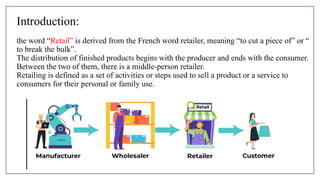
The distribution of finished products begins with the producer and ends with the consumer.
Between the two of them, there is a middle-person retailer.
Retailing is defined as a set of activities or steps used to sell a product or a service to
consumers for their personal or family use.
What Is Retail?
Retail is the final channel of distribution where small quantities of goods (or
services) are sold directly to the consumer for their own use.
What Is Retailing?
Retailing is the distribution process of a retailer getting the goods (either from the
manufacturer. wholesaler, or agents) and selling them to the customers for actual
use.
Who is A Retailer?
A retailer is a person or a business that sells small quantities of goods to customers
for actual use.
According to Philip Kotler : “Retailing includes all the activities involved in selling
goods or services to the final customers for personal, non – business use.”
Meaning and Definition of Retailing :
Characteristics of retailing
Direct interaction with customer
Sale volume large in quantities but less in monetary value
Customer plays a vital role
Sales promotions are offered at this point only
Retail outlets are more than any other form of business
Location and layout are critical factors in retail business.
It offers employment opportunities to all ages.
Functions of Retailing - :
1. Understanding the Needs of Consumers
2. Buying and Assembling
3. Breaking the Bulk
4. Warehousing or Storing
5. Selling
6. Credit Facilities
7. Risk Bearing
8. Grading and Packing
9. Collection and Supply of Market Information
10.Helps in Introducing New Products
11.Window Display and Advertising
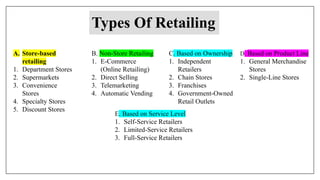
Types Of Retailing
A. Store-based
retailing
1. Department Stores
2. Supermarkets
3. Convenience
Stores
4. Specialty Stores
5. Discount Stores
B. Non-Store Retailing
1. E-Commerce
(Online Retailing)
2. Direct Selling
3. Telemarketing
4. Automatic Vending
C. Based on Ownership
1. Independent
Retailers
2. Chain Stores
3. Franchises
4. Government-Owned
Retail Outlets
D. Based on Product Line
1. General Merchandise
Stores
2. Single-Line Stores
E. Based on Service Level
1. Self-Service Retailers
2. Limited-Service Retailers
3. Full-Service Retailers
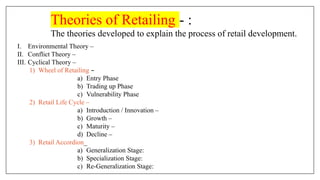
Theories of Retailing - :
The theories developed to explain the process of retail development.
I. Environmental Theory –
II. Conflict Theory –
III. Cyclical Theory –
1) Wheel of Retailing –
a) Entry Phase
b) Trading up Phase
c) Vulnerability Phase
2) Retail Life Cycle –
a) Introduction / Innovation –
b) Growth –
c) Maturity –
d) Decline –
3) Retail Accordion_
a) Generalization Stage:
b) Specialization Stage:
c) Re-Generalization Stage:
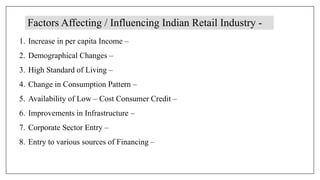
Factors Affecting / Influencing Indian Retail Industry -
1. Increase in per capita Income –
2. Demographical Changes –
3. High Standard of Living –
4. Change in Consumption Pattern –
5. Availability of Low – Cost Consumer Credit –
6. Improvements in Infrastructure –
7. Corporate Sector Entry –
8. Entry to various sources of Financing –
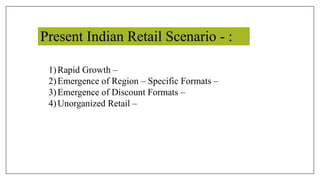
Present Indian Retail Scenario - :
1)Rapid Growth –
2)Emergence of Region – Specific Formats –
3)Emergence of Discount Formats –
4)Unorganized Retail –
The major factors responsible for the growth of
organized retailing in India are as follows –
1)Enhanced Working Women –
2)Value for Money –
3)Rural Market –
4)Enhanced Middle Class Consumers –
5)Growth of Consumerism –
6)Technological Impact –
7)Enhanced Income –
8)Media Explosion –
International Perspective in Retail Business
The internationalization of retailing has become a critical aspect of global trade as businesses
expand beyond domestic markets to tap into new customer bases, leverage cost efficiencies, and
gain competitive advantages.
Reasons for Internationalization
1. Market Saturation in Domestic Markets (e.g., Walmart expanding globally).
2. Global Consumer Trends (e.g., Indian demand for Zara, Starbucks).
3. Technological Advancements (e.g., Amazon’s global e-commerce operations).
4. Diverse Growth Opportunities (e.g., Reliance Retail partnerships).
Challenges in International Retailing
1. Cultural Differences (e.g., McDonald’s vegetarian menu in
India).
2. Regulatory Barriers (e.g., Walmart and FDI in India).
3. Logistics and Supply Chain (e.g., Zara’s fast-fashion model).
4. Competition with Local Players (e.g., DMart vs. international
brands).
Impact of International Retailing
1.Positive Impacts:
1. Boosts local employment through store operations and supply chain
needs.
2. Enhances consumer choice with access to global products and brands.
3. Drives innovation in retail formats, technology, and customer
experience.
2.Negative Impacts:
1. Challenges for domestic retailers to compete with global giants.
2. Potential cultural homogenization, where global brands overshadow
local traditions.
3. Risks of monopolistic practices by dominant international retailers.

Retail management first chapter notes in one

  • 1.
  • 2.
    Introduction: the word “Retail”is derived from the French word retailer, meaning “to cut a piece of” or “ to break the bulk”. The distribution of finished products begins with the producer and ends with the consumer. Between the two of them, there is a middle-person retailer. Retailing is defined as a set of activities or steps used to sell a product or a service to consumers for their personal or family use.
  • 3.
    What Is Retail? Retailis the final channel of distribution where small quantities of goods (or services) are sold directly to the consumer for their own use. What Is Retailing? Retailing is the distribution process of a retailer getting the goods (either from the manufacturer. wholesaler, or agents) and selling them to the customers for actual use. Who is A Retailer? A retailer is a person or a business that sells small quantities of goods to customers for actual use. According to Philip Kotler : “Retailing includes all the activities involved in selling goods or services to the final customers for personal, non – business use.” Meaning and Definition of Retailing :
  • 4.
    Characteristics of retailing Directinteraction with customer Sale volume large in quantities but less in monetary value Customer plays a vital role Sales promotions are offered at this point only Retail outlets are more than any other form of business Location and layout are critical factors in retail business. It offers employment opportunities to all ages.
  • 5.
    Functions of Retailing- : 1. Understanding the Needs of Consumers 2. Buying and Assembling 3. Breaking the Bulk 4. Warehousing or Storing 5. Selling 6. Credit Facilities 7. Risk Bearing 8. Grading and Packing 9. Collection and Supply of Market Information 10.Helps in Introducing New Products 11.Window Display and Advertising
  • 6.
    Types Of Retailing A.Store-based retailing 1. Department Stores 2. Supermarkets 3. Convenience Stores 4. Specialty Stores 5. Discount Stores B. Non-Store Retailing 1. E-Commerce (Online Retailing) 2. Direct Selling 3. Telemarketing 4. Automatic Vending C. Based on Ownership 1. Independent Retailers 2. Chain Stores 3. Franchises 4. Government-Owned Retail Outlets D. Based on Product Line 1. General Merchandise Stores 2. Single-Line Stores E. Based on Service Level 1. Self-Service Retailers 2. Limited-Service Retailers 3. Full-Service Retailers
  • 7.
    Theories of Retailing- : The theories developed to explain the process of retail development. I. Environmental Theory – II. Conflict Theory – III. Cyclical Theory – 1) Wheel of Retailing – a) Entry Phase b) Trading up Phase c) Vulnerability Phase 2) Retail Life Cycle – a) Introduction / Innovation – b) Growth – c) Maturity – d) Decline – 3) Retail Accordion_ a) Generalization Stage: b) Specialization Stage: c) Re-Generalization Stage:
  • 8.
    Factors Affecting /Influencing Indian Retail Industry - 1. Increase in per capita Income – 2. Demographical Changes – 3. High Standard of Living – 4. Change in Consumption Pattern – 5. Availability of Low – Cost Consumer Credit – 6. Improvements in Infrastructure – 7. Corporate Sector Entry – 8. Entry to various sources of Financing –
  • 9.
    Present Indian RetailScenario - : 1)Rapid Growth – 2)Emergence of Region – Specific Formats – 3)Emergence of Discount Formats – 4)Unorganized Retail –
  • 10.
    The major factorsresponsible for the growth of organized retailing in India are as follows – 1)Enhanced Working Women – 2)Value for Money – 3)Rural Market – 4)Enhanced Middle Class Consumers – 5)Growth of Consumerism – 6)Technological Impact – 7)Enhanced Income – 8)Media Explosion –
  • 11.
    International Perspective inRetail Business The internationalization of retailing has become a critical aspect of global trade as businesses expand beyond domestic markets to tap into new customer bases, leverage cost efficiencies, and gain competitive advantages. Reasons for Internationalization 1. Market Saturation in Domestic Markets (e.g., Walmart expanding globally). 2. Global Consumer Trends (e.g., Indian demand for Zara, Starbucks). 3. Technological Advancements (e.g., Amazon’s global e-commerce operations). 4. Diverse Growth Opportunities (e.g., Reliance Retail partnerships).
  • 12.
    Challenges in InternationalRetailing 1. Cultural Differences (e.g., McDonald’s vegetarian menu in India). 2. Regulatory Barriers (e.g., Walmart and FDI in India). 3. Logistics and Supply Chain (e.g., Zara’s fast-fashion model). 4. Competition with Local Players (e.g., DMart vs. international brands).
  • 13.
    Impact of InternationalRetailing 1.Positive Impacts: 1. Boosts local employment through store operations and supply chain needs. 2. Enhances consumer choice with access to global products and brands. 3. Drives innovation in retail formats, technology, and customer experience. 2.Negative Impacts: 1. Challenges for domestic retailers to compete with global giants. 2. Potential cultural homogenization, where global brands overshadow local traditions. 3. Risks of monopolistic practices by dominant international retailers.