Mazera
Presentation
Education AboutOcean
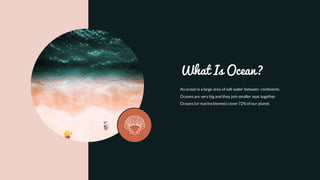
An ocean is a large area of salt water between continents.
Oceansare very big and they join smaller seas together.
Oceans(or marinebiomes) cover 72%of our planet.
What Is Ocean?
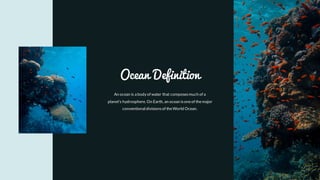
An ocean is a body of water that composesmuch of a
planet's hydrosphere. On Earth, an ocean isoneof themajor
conventional divisionsof theWorld Ocean.
Ocean Definition
Color Of Ocean
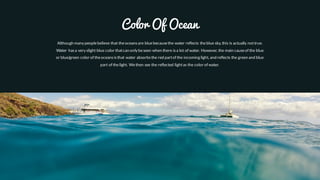
Although many peoplebelieve that theoceansare bluebecausethe water reflects theblue sky, this is actually nottrue.
Water hasa very slight blue color thatcan only beseen when there isa lot of water. However, the main causeof the blue
or blue/green color of theoceansisthat water absorbsthe red partof the incoming light, and reflects the green and blue
part of thelight. Wethen see the reflected lightas the color of water.
How Many
Oceans Are In The World?
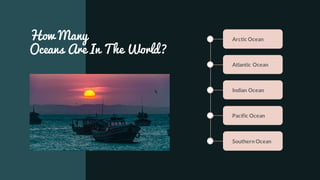
Arctic Ocean
Atlantic Ocean
Indian Ocean
Pacific Ocean
Southern Ocean
Arctic Ocean
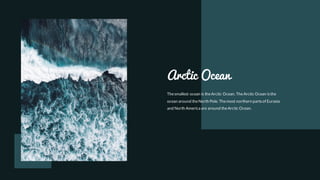
Thesmallest ocean is theArctic Ocean. TheArctic Ocean isthe
ocean around theNorth Pole. Themost northern partsof Eurasia
and North America are around theArctic Ocean.
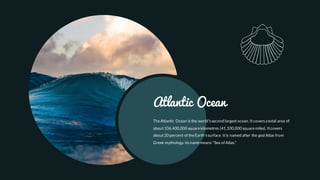
TheAtlantic Ocean isthe world'ssecond largest ocean. Itcoversa total area of
about106,400,000 squarekilometres (41,100,000 squaremiles). Itcovers
about20 percent of theEarth's surface. Itis named after the god Atlas from
Greek mythology. Its namemeans "Sea of Atlas."
Atlantic Ocean
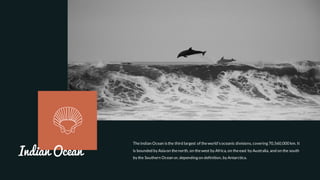
TheIndian Ocean isthe third largest of theworld'soceanic divisions, covering 70,560,000 km. It
is bounded by Asia on thenorth, on thewest by Africa, on theeast by Australia, and on the south
by the Southern Ocean or, depending on definition, by Antarctica.
Indian Ocean
Pacific Ocean
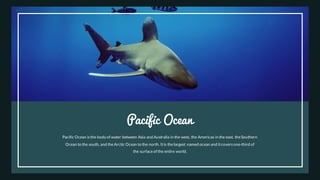
Pacific Ocean isthe body of water between Asia and Australia in the west, the Americas in the east, theSouthern
Ocean to the south, and theArctic Ocean to the north. Itis thelargest named ocean and itcoversone-third of
the surfaceof the entire world.
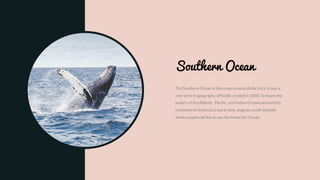
TheSouthern Ocean is theocean around Antarctica. Itwas a
new term in geography officially created in 2000. It meansthe
waters of theAtlantic, Pacific, and Indian Oceans around the
continentof Antarctica outto sixty degrees south latitude.
Some peoplecall this ocean theAntarctic Ocean.
Southern Ocean
The
Deepest Ocean
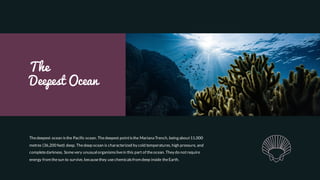
Thedeepest ocean isthe Pacific ocean. Thedeepest pointisthe Mariana Trench, being about11,000
metres (36,200 feet) deep. Thedeep ocean is characterized by cold temperatures, high pressure, and
completedarkness. Somevery unusual organismslivein this part of theocean. They do notrequire
energy from thesun to survive, becausethey usechemicalsfrom deep inside theEarth.
Ocean Temperatures
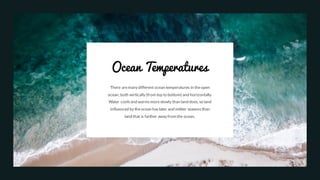
There aremany different ocean temperatures in theopen
ocean, both vertically (from top to bottom) and horizontally.
Water coolsand warmsmoreslowly than land does, so land
influenced by theocean haslater and milder seasons than
land that is farther away from the ocean.
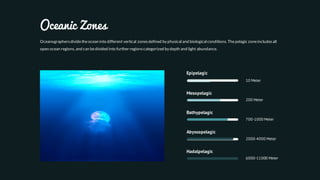
Oceanographersdividetheocean into different vertical zonesdefined by physical and biological conditions. Thepelagic zoneincludes all
open ocean regions, and can bedivided into further regionscategorized by depth and light abundance.
Oceanic Zones
200 Meter
Mesopelagic
Bathypelagic
700-1000 Meter
Abyssopelagic
2000-4000 Meter
Hadalpelagic
6000-11000 Meter
Epipelagic
10 Meter
Oceanic
Divisions
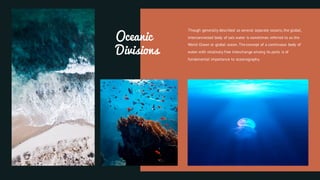
Though generally described as several separate oceans, the global,
interconnected body of salt water is sometimes referred to as the
World Ocean or global ocean. The concept of a continuous body of
water with relatively free interchange among its parts is of
fundamental importance to oceanography.
Harvesting
The Ocean
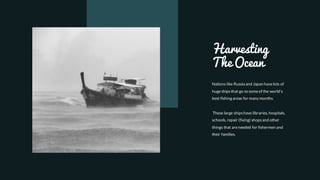
Nations like Russia and Japan havelots of
hugeshipsthat go to someof the world's
best fishing areas for many months.
These large shipshave libraries, hospitals,
schools, repair (fixing) shopsand other
things that areneeded for fishermen and
their families.
This Is
Break
Section
Fishing On Ocean
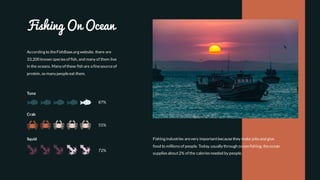
According to theFishBase.org website, there are
33,200 known speciesof fish, and many of them live
in the oceans. Many of these fish are a finesourceof
protein, so many peopleeat them.
Fishing industries arevery importantbecausethey make jobsand give
food to millionsof people. Today, usually through ocean fishing, theocean
suppliesabout2% of the caloriesneeded by people.
Tuna
87%
Crab
55%
Squid
72%
Oceanic Maritime
Currents
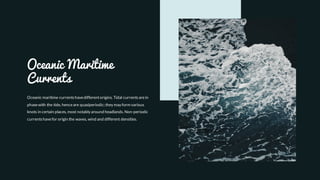
Oceanic maritime currentshavedifferentorigins. Tidal currentsarein
phasewith the tide, henceare quasiperiodic; they may form various
knots in certain places, most notably around headlands. Non-periodic
currentshavefor origin the waves, wind and different densities.
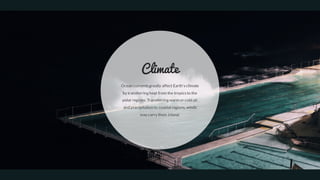
Ocean currentsgreatly affect Earth'sclimate
by transferring heat from the tropicsto the
polar regions. Transferring warm or cold air
and precipitation to coastal regions, winds
may carry them inland.
Climate
Biodiversity
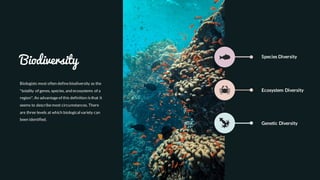
Biologists most often definebiodiversity as the
"totality of genes, species, and ecosystems of a
region". An advantageof this definition isthat it
seems to describemost circumstances. There
are three levels at which biological variety can
been identified.
Species Diversity
Ecosystem Diversity
Genetic Diversity
Plants and animals
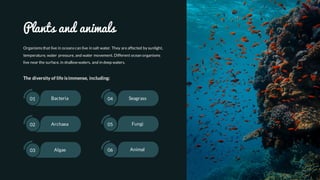
Organismsthat live in oceanscan live in salt water. They areaffected by sunlight,
temperature, water pressure, and water movement. Different ocean organisms
live near the surface, in shallow waters, and in deep waters.
The diversity of life isimmense, including:
Bacteria01
Algae03
Archaea02
Animal06
Fungi05
Seagrass04
Bacteria
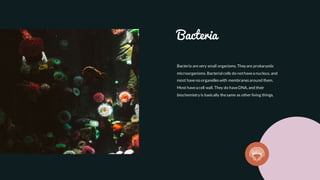
Bacteria arevery small organisms. They are prokaryotic
microorganisms. Bacterial cells do nothavea nucleus, and
most haveno organelleswith membranesaround them.
Most havea cell wall. They do haveDNA, and their
biochemistry is basically thesame as other living things.
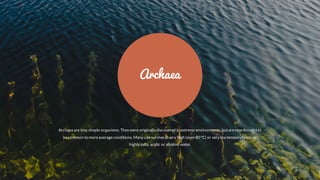
Archaea are tiny, simple organisms. They were originally discovered in extreme environments, butarenow thoughtto
becommon to moreaverageconditions. Many can surviveatvery high (over 80 °C) or very low temperatures, or
highly salty, acidic or alkaline water.
Archaea
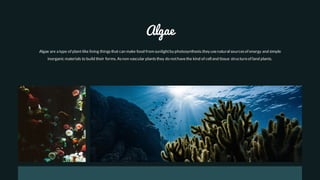
Algae are a type of plant-like living thingsthat can make food from sunlightby photosynthesis.they usenatural sourcesof energy and simple
inorganic materials to build their forms. Asnon vascular plantsthey do nothavethe kind of cell and tissue structureof land plants.
Algae
Seagrass
Sea grasses are flowering plants which livein the
sea. They comefrom oneof four plantfamiliesin
the order Alismatales. They aremonocotyledons
which grow in marine, fully saline environments.
Sea grass is a key partof continental shelf
ecosystems where phytoplankton produce
carbonatesediment.
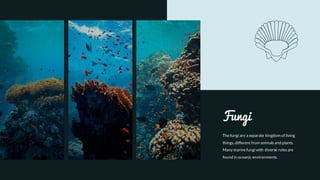
Thefungi are a separate kingdom of living
things, different from animalsand plants.
Many marinefungi with diverse rolesare
found in oceanic environments.
Fungi
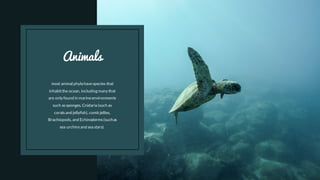
most animal phyla havespecies that
inhabitthe ocean, including many that
are only found in marineenvironments
such assponges, Cnidaria (such as
coralsand jellyfish), comb jellies,
Brachiopods, and Echinoderms(suchas
sea urchinsand sea stars).
Animals
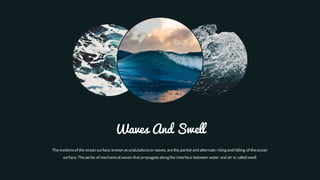
Themotionsof the ocean surface, known asundulationsor waves, arethe partial and alternate rising and falling of theocean
surface. Theseries of mechanical waves that propagatealong the interface between water and air is called swell
Waves And Swell
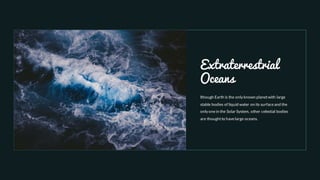
lthough Earth is the only known planetwith large
stable bodies of liquid water on its surfaceand the
only onein the Solar System, other celestial bodies
are thoughtto havelarge oceans.
Extraterrestrial
Oceans
Thanks
For Watching
Mazera Presentation : Dark Color Version

Mazera Presentation : Dark Color Version

  • 1.
  • 2.
    An ocean isa large area of salt water between continents. Oceansare very big and they join smaller seas together. Oceans(or marinebiomes) cover 72%of our planet. What Is Ocean?
  • 3.
    An ocean isa body of water that composesmuch of a planet's hydrosphere. On Earth, an ocean isoneof themajor conventional divisionsof theWorld Ocean. Ocean Definition
  • 4.
    Color Of Ocean Althoughmany peoplebelieve that theoceansare bluebecausethe water reflects theblue sky, this is actually nottrue. Water hasa very slight blue color thatcan only beseen when there isa lot of water. However, the main causeof the blue or blue/green color of theoceansisthat water absorbsthe red partof the incoming light, and reflects the green and blue part of thelight. Wethen see the reflected lightas the color of water.
  • 5.
    How Many Oceans AreIn The World? Arctic Ocean Atlantic Ocean Indian Ocean Pacific Ocean Southern Ocean
  • 6.
    Arctic Ocean Thesmallest oceanis theArctic Ocean. TheArctic Ocean isthe ocean around theNorth Pole. Themost northern partsof Eurasia and North America are around theArctic Ocean.
  • 7.
    TheAtlantic Ocean istheworld'ssecond largest ocean. Itcoversa total area of about106,400,000 squarekilometres (41,100,000 squaremiles). Itcovers about20 percent of theEarth's surface. Itis named after the god Atlas from Greek mythology. Its namemeans "Sea of Atlas." Atlantic Ocean
  • 8.
    TheIndian Ocean isthethird largest of theworld'soceanic divisions, covering 70,560,000 km. It is bounded by Asia on thenorth, on thewest by Africa, on theeast by Australia, and on the south by the Southern Ocean or, depending on definition, by Antarctica. Indian Ocean
  • 9.
    Pacific Ocean Pacific Oceanisthe body of water between Asia and Australia in the west, the Americas in the east, theSouthern Ocean to the south, and theArctic Ocean to the north. Itis thelargest named ocean and itcoversone-third of the surfaceof the entire world.
  • 10.
    TheSouthern Ocean istheocean around Antarctica. Itwas a new term in geography officially created in 2000. It meansthe waters of theAtlantic, Pacific, and Indian Oceans around the continentof Antarctica outto sixty degrees south latitude. Some peoplecall this ocean theAntarctic Ocean. Southern Ocean
  • 11.
    The Deepest Ocean Thedeepest oceanisthe Pacific ocean. Thedeepest pointisthe Mariana Trench, being about11,000 metres (36,200 feet) deep. Thedeep ocean is characterized by cold temperatures, high pressure, and completedarkness. Somevery unusual organismslivein this part of theocean. They do notrequire energy from thesun to survive, becausethey usechemicalsfrom deep inside theEarth.
  • 12.
    Ocean Temperatures There aremanydifferent ocean temperatures in theopen ocean, both vertically (from top to bottom) and horizontally. Water coolsand warmsmoreslowly than land does, so land influenced by theocean haslater and milder seasons than land that is farther away from the ocean.
  • 13.
    Oceanographersdividetheocean into differentvertical zonesdefined by physical and biological conditions. Thepelagic zoneincludes all open ocean regions, and can bedivided into further regionscategorized by depth and light abundance. Oceanic Zones 200 Meter Mesopelagic Bathypelagic 700-1000 Meter Abyssopelagic 2000-4000 Meter Hadalpelagic 6000-11000 Meter Epipelagic 10 Meter
  • 14.
    Oceanic Divisions Though generally describedas several separate oceans, the global, interconnected body of salt water is sometimes referred to as the World Ocean or global ocean. The concept of a continuous body of water with relatively free interchange among its parts is of fundamental importance to oceanography.
  • 15.
    Harvesting The Ocean Nations likeRussia and Japan havelots of hugeshipsthat go to someof the world's best fishing areas for many months. These large shipshave libraries, hospitals, schools, repair (fixing) shopsand other things that areneeded for fishermen and their families.
  • 16.
  • 17.
    Fishing On Ocean Accordingto theFishBase.org website, there are 33,200 known speciesof fish, and many of them live in the oceans. Many of these fish are a finesourceof protein, so many peopleeat them. Fishing industries arevery importantbecausethey make jobsand give food to millionsof people. Today, usually through ocean fishing, theocean suppliesabout2% of the caloriesneeded by people. Tuna 87% Crab 55% Squid 72%
  • 18.
    Oceanic Maritime Currents Oceanic maritimecurrentshavedifferentorigins. Tidal currentsarein phasewith the tide, henceare quasiperiodic; they may form various knots in certain places, most notably around headlands. Non-periodic currentshavefor origin the waves, wind and different densities.
  • 19.
    Ocean currentsgreatly affectEarth'sclimate by transferring heat from the tropicsto the polar regions. Transferring warm or cold air and precipitation to coastal regions, winds may carry them inland. Climate
  • 20.
    Biodiversity Biologists most oftendefinebiodiversity as the "totality of genes, species, and ecosystems of a region". An advantageof this definition isthat it seems to describemost circumstances. There are three levels at which biological variety can been identified. Species Diversity Ecosystem Diversity Genetic Diversity
  • 21.
    Plants and animals Organismsthatlive in oceanscan live in salt water. They areaffected by sunlight, temperature, water pressure, and water movement. Different ocean organisms live near the surface, in shallow waters, and in deep waters. The diversity of life isimmense, including: Bacteria01 Algae03 Archaea02 Animal06 Fungi05 Seagrass04
  • 22.
    Bacteria Bacteria arevery smallorganisms. They are prokaryotic microorganisms. Bacterial cells do nothavea nucleus, and most haveno organelleswith membranesaround them. Most havea cell wall. They do haveDNA, and their biochemistry is basically thesame as other living things.
  • 23.
    Archaea are tiny,simple organisms. They were originally discovered in extreme environments, butarenow thoughtto becommon to moreaverageconditions. Many can surviveatvery high (over 80 °C) or very low temperatures, or highly salty, acidic or alkaline water. Archaea
  • 24.
    Algae are atype of plant-like living thingsthat can make food from sunlightby photosynthesis.they usenatural sourcesof energy and simple inorganic materials to build their forms. Asnon vascular plantsthey do nothavethe kind of cell and tissue structureof land plants. Algae
  • 25.
    Seagrass Sea grasses areflowering plants which livein the sea. They comefrom oneof four plantfamiliesin the order Alismatales. They aremonocotyledons which grow in marine, fully saline environments. Sea grass is a key partof continental shelf ecosystems where phytoplankton produce carbonatesediment.
  • 26.
    Thefungi are aseparate kingdom of living things, different from animalsand plants. Many marinefungi with diverse rolesare found in oceanic environments. Fungi
  • 27.
    most animal phylahavespecies that inhabitthe ocean, including many that are only found in marineenvironments such assponges, Cnidaria (such as coralsand jellyfish), comb jellies, Brachiopods, and Echinoderms(suchas sea urchinsand sea stars). Animals
  • 28.
    Themotionsof the oceansurface, known asundulationsor waves, arethe partial and alternate rising and falling of theocean surface. Theseries of mechanical waves that propagatealong the interface between water and air is called swell Waves And Swell
  • 29.
    lthough Earth isthe only known planetwith large stable bodies of liquid water on its surfaceand the only onein the Solar System, other celestial bodies are thoughtto havelarge oceans. Extraterrestrial Oceans
  • 30.