WHAT IS THE USE OF
OCEANOGRAPHY
by www.oceansconnectes.org
EDITORIAL
This 11 February 2022 will undoubtedly be a historic date.
For the first time, a international environmental summit, entirely dedicated to the
oceans, the «One Ocean Summit», will take place in France, in Brest «itself», facing
the Atlantic.
At the initiative of French President Emmanuel Macron, scientists, practitioners, entre-
preneurs, government and European representatives, regional and local players and
civilians are invited to sit around the table, with the aim of imagining together concrete
solutions for a reasoned and sustainable management of the maritime space.
A space that is mostly beyond any jurisdiction, a pillar of our life on Earth and yet highly
threatened by multiple human pressures.
Ahead of the meeting of European heads of state, a number of workshops have
been scheduled over two days as a creative forum. Solutions must emerge from a
cross-practice approach and the sharing of scientific, technological and environmental
knowledge.
Therefore, as this event approaches and looks like the first «mini-COP of the oceans»,
we wanted to fulfil our role as a media dedicated to marine sciences and contribute to
this objective of sharing scientific knowledge.
We offer you this guide to shed light on the question you are probably asking yourself:
«What is the use of oceanography?»
By tracing the history of marine science, we explain how oceanographers have been
able to put the oceans at the heart of their work and demonstrate the crucial role they
play in the planetary balance.
Today, the scientific community is warning us that the health of the oceans is deterio-
rating under the pressure of our human activities. It calls for collective action for an
intelligent and sustainable co-management of the maritime space.
Convinced that the prerequisite for any action is a better understanding of the issues
by science, we hope that this guide to oceanography will help to crytalise on the issues
and challenges posed by science. We hope that it will help lay the foundation for buil-
ding a common and shared ocean culture.
Available in a bilingual version (French and English), the format of this dossier is ex-
clusively digital.
As a white paper open to the marine sciences, we hope that it will be distributed free of
charge, so that together we can connect the oceans.
ESSENTIAL TO LIFE ON EARTH
WHAT THE OCEANS BRING US
THE AIR WE BREATHE CLIMATE CONTROL
RECREATION ECONOMY
FOOD HEALTH
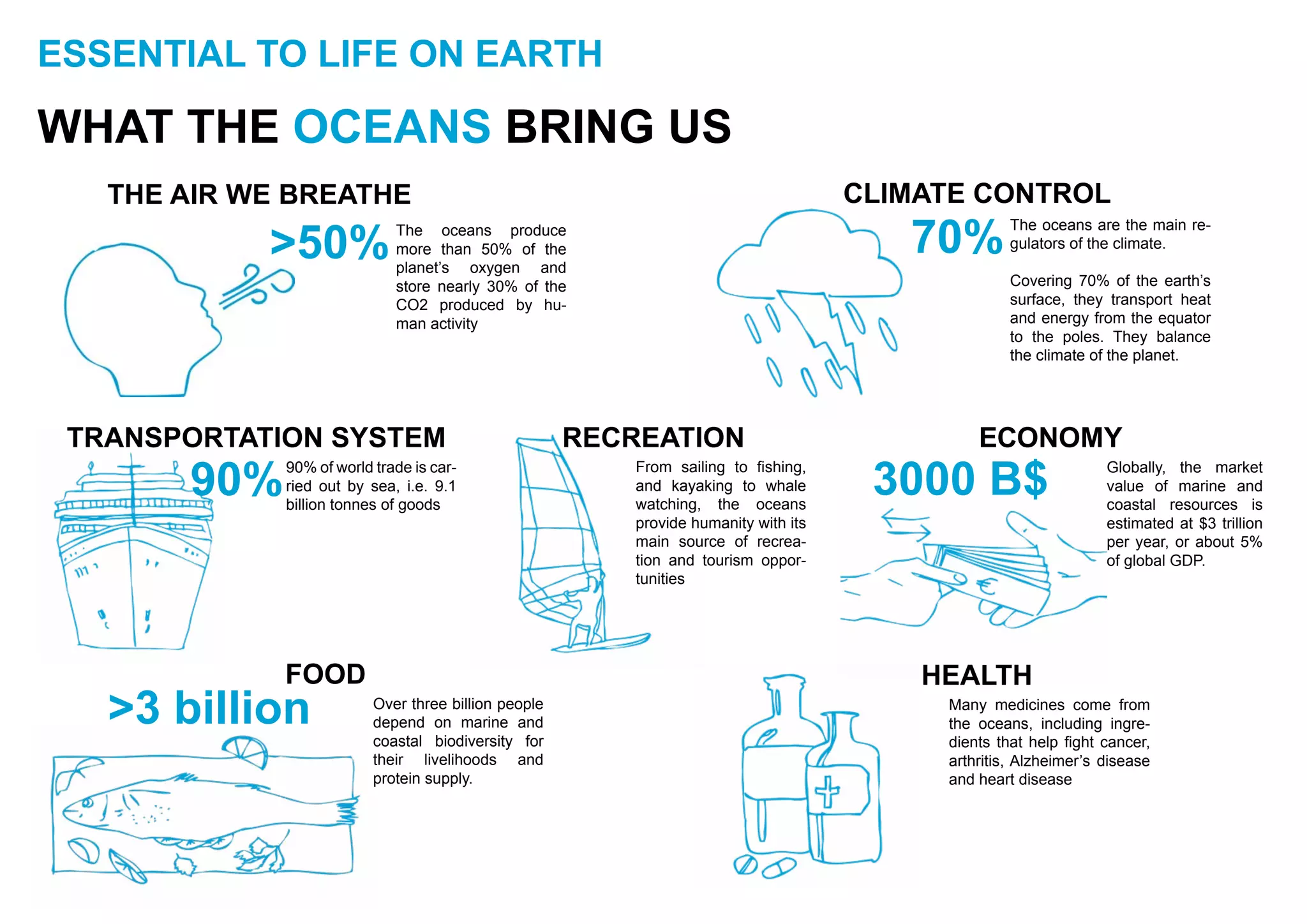
>50%The oceans produce
more than 50% of the
planet’s oxygen and
store nearly 30% of the
CO2 produced by hu-
man activity
70%The oceans are the main re-
gulators of the climate.
Covering 70% of the earth’s
surface, they transport heat
and energy from the equator
to the poles. They balance
the climate of the planet.
90%90% of world trade is car-
ried out by sea, i.e. 9.1
billion tonnes of goods
TRANSPORTATION SYSTEM
From sailing to fishing,
and kayaking to whale
watching, the oceans
provide humanity with its
main source of recrea-
tion and tourism oppor-
tunities
Globally, the market
value of marine and
coastal resources is
estimated at $3 trillion
per year, or about 5%
of global GDP.
3000 B$
>3 billion Over three billion people
depend on marine and
coastal biodiversity for
their livelihoods and
protein supply.
Many medicines come from
the oceans, including ingre-
dients that help fight cancer,
arthritis, Alzheimer’s disease
and heart disease
OCEANOGRAPHY
THE STUDY OF SEAS AND OCEANS
A MULTIPLE SCIENCE AND A CHAIN OF PROFESSIONS
Oceanography is a multi-scientific discipline, touching
many fields of study.
Biological, chemical, geological and physical phenomenon
and processes often interact with each other.
Scientists from different disciplines therefore carry out
their experiments each in their own speciality, but come
together to work and interpret their results on a common
research programme.
The oceanographer may be a technician, an engineer or
a researcher, but one is never without the other. The work
is done as a team, and the expertise of each person is
necessary and complementary.
An oceanographer spends some time at sea, mainly du-
ring oceanographic campaigns.
But most of their work is done in the laboratory. There, they
prepare missions, process data in front of their computers
and share their results by publishing them and presenting
them to the community at scientific conferences.
In France, various organisations such as the CNRS
(Centre National de la Recherche Scientifique), IFREMER
(Institut Français de Recherche pour l’Exploitation de la
MER), IRD (Institut de Recherche pour le Développement),
SHOM (Service Hydrographique et Océanographique de
la Marine Nationale), MÉTÉO-FRANCE and universities
host laboratories specialised in oceanography.
They are spread throughout the country, mainly in Brest,
Cherbourg, Paris, Marseille, Toulouse and Grenoble.
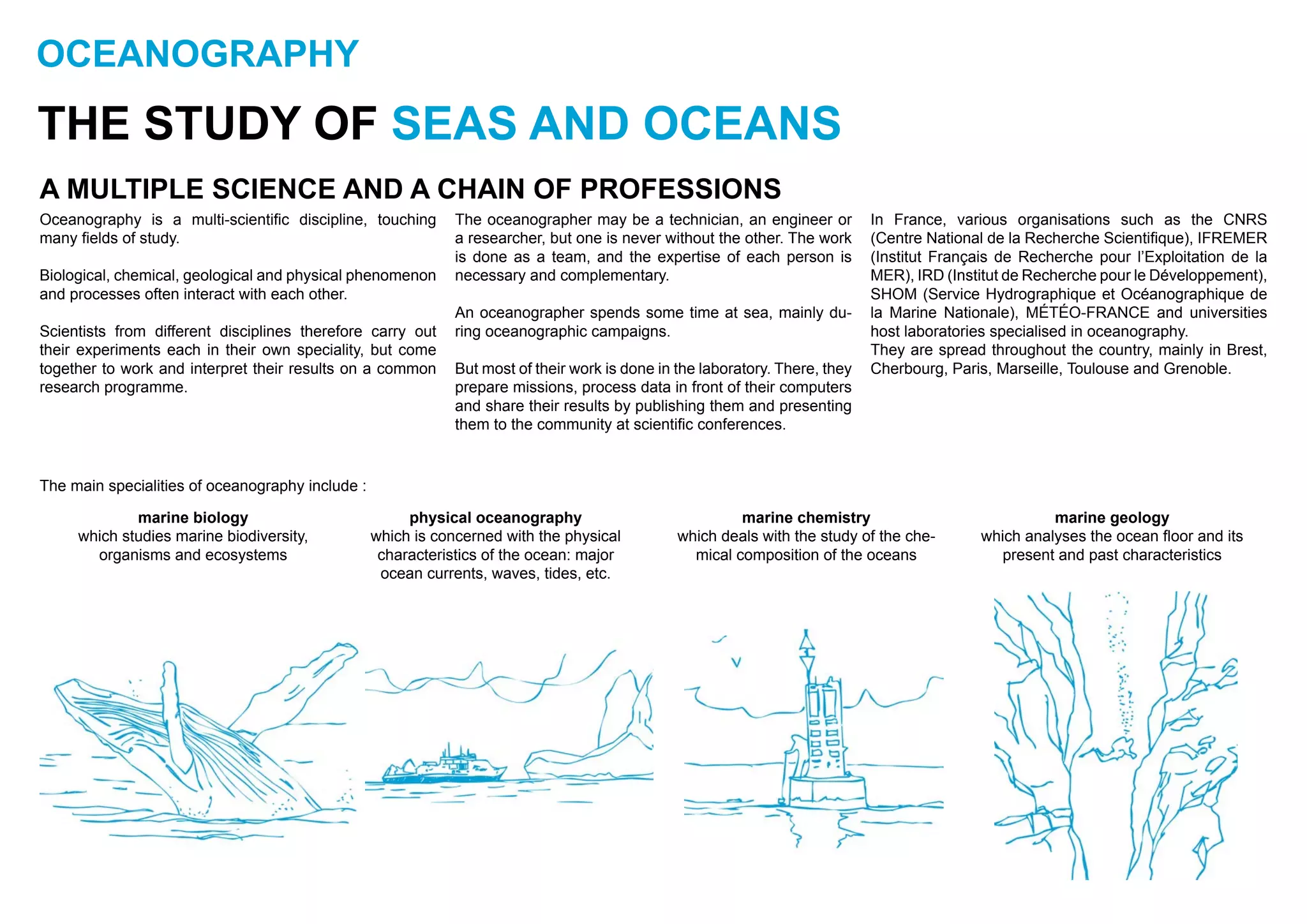
marine biology
which studies marine biodiversity,
organisms and ecosystems
marine chemistry
which deals with the study of the che-
mical composition of the oceans
physical oceanography
which is concerned with the physical
characteristics of the ocean: major
ocean currents, waves, tides, etc.
marine geology
which analyses the ocean floor and its
present and past characteristics
The main specialities of oceanography include :
A FASCINATING STORY
SAILORS & SCIENTISTS CONQUERING THE OCEANS
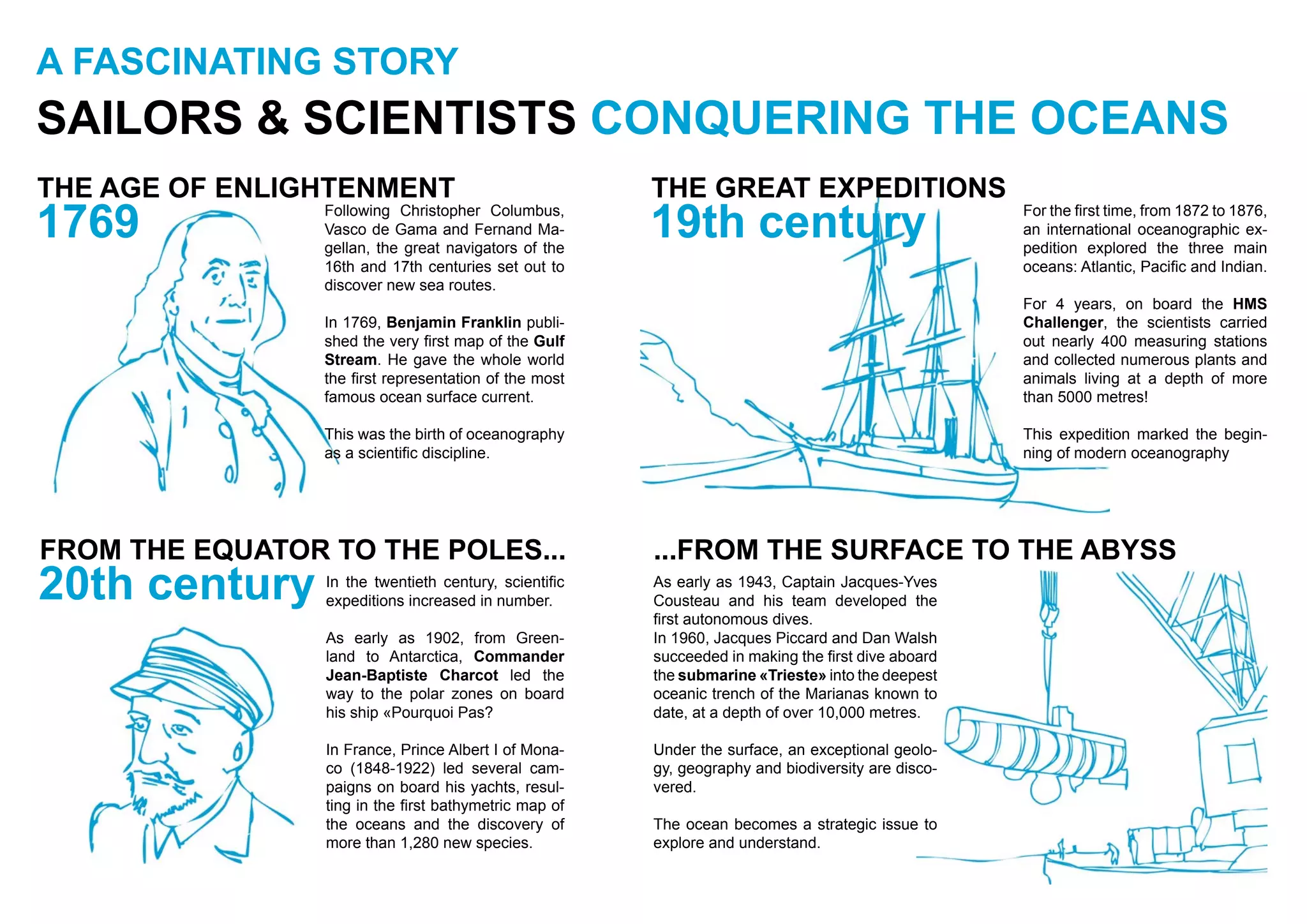
THE AGE OF ENLIGHTENMENT
1769 Following Christopher Columbus,
Vasco de Gama and Fernand Ma-
gellan, the great navigators of the
16th and 17th centuries set out to
discover new sea routes.
In 1769, Benjamin Franklin publi-
shed the very first map of the Gulf
Stream. He gave the whole world
the first representation of the most
famous ocean surface current.
This was the birth of oceanography
as a scientific discipline.
THE GREAT EXPEDITIONS
19th century For the first time, from 1872 to 1876,
an international oceanographic ex-
pedition explored the three main
oceans: Atlantic, Pacific and Indian.
For 4 years, on board the HMS
Challenger, the scientists carried
out nearly 400 measuring stations
and collected numerous plants and
animals living at a depth of more
than 5000 metres!
This expedition marked the begin-
ning of modern oceanography
FROM THE EQUATOR TO THE POLES...
20th century In the twentieth century, scientific
expeditions increased in number.
As early as 1902, from Green-
land to Antarctica, Commander
Jean-Baptiste Charcot led the
way to the polar zones on board
his ship «Pourquoi Pas?
In France, Prince Albert I of Mona-
co (1848-1922) led several cam-
paigns on board his yachts, resul-
ting in the first bathymetric map of
the oceans and the discovery of
more than 1,280 new species.
As early as 1943, Captain Jacques-Yves
Cousteau and his team developed the
first autonomous dives.
In 1960, Jacques Piccard and Dan Walsh
succeeded in making the first dive aboard
the submarine «Trieste» into the deepest
oceanic trench of the Marianas known to
date, at a depth of over 10,000 metres.
Under the surface, an exceptional geolo-
gy, geography and biodiversity are disco-
vered.
The ocean becomes a strategic issue to
explore and understand.
...FROM THE SURFACE TO THE ABYSS
OCEANOGRAPHY TODAY
OPEN HEART OCEANS
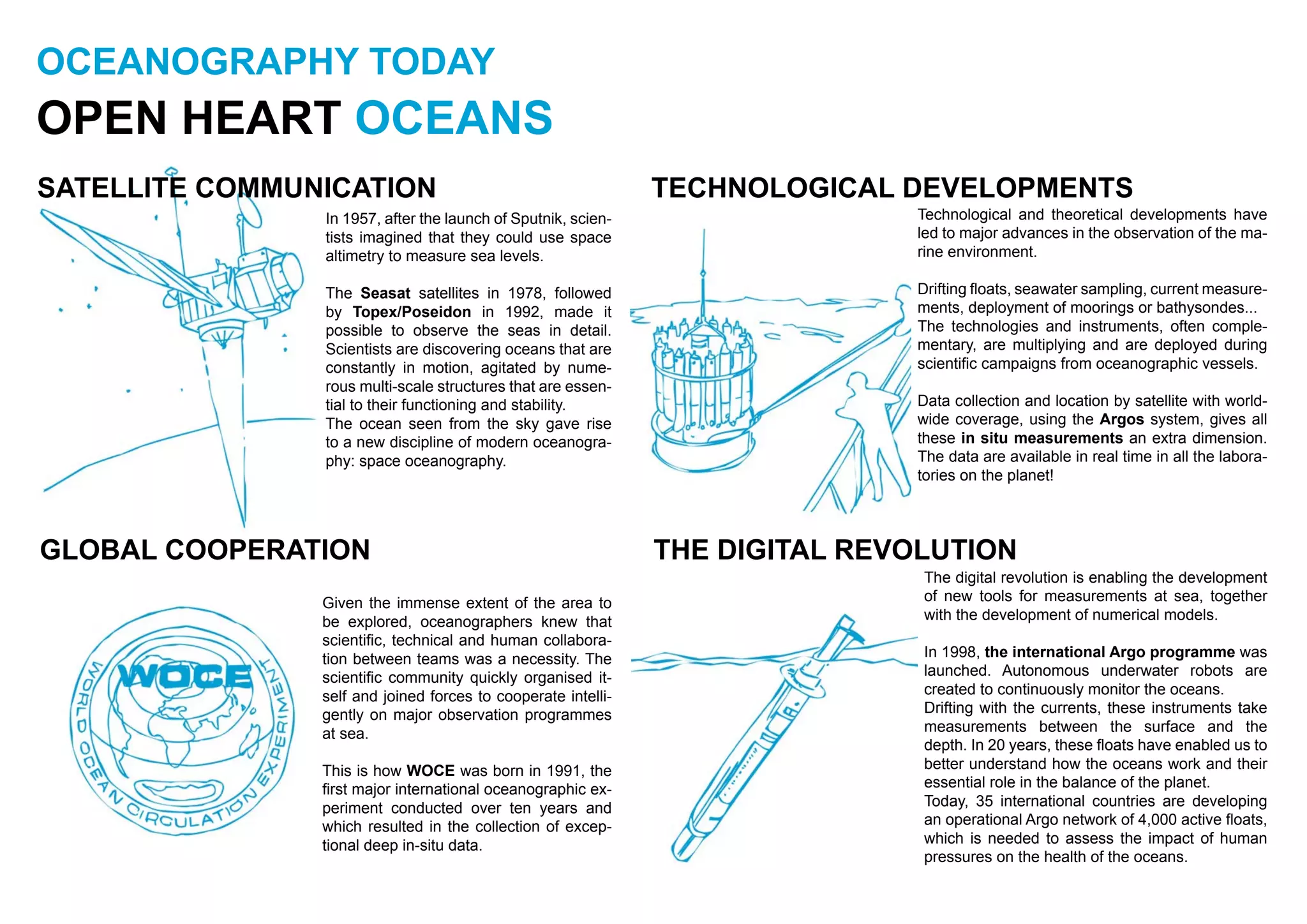
SATELLITE COMMUNICATION
In 1957, after the launch of Sputnik, scien-
tists imagined that they could use space
altimetry to measure sea levels.
The Seasat satellites in 1978, followed
by Topex/Poseidon in 1992, made it
possible to observe the seas in detail.
Scientists are discovering oceans that are
constantly in motion, agitated by nume-
rous multi-scale structures that are essen-
tial to their functioning and stability.
The ocean seen from the sky gave rise
to a new discipline of modern oceanogra-
phy: space oceanography.
TECHNOLOGICAL DEVELOPMENTS
GLOBAL COOPERATION THE DIGITAL REVOLUTION
Technological and theoretical developments have
led to major advances in the observation of the ma-
rine environment.
Drifting floats, seawater sampling, current measure-
ments, deployment of moorings or bathysondes...
The technologies and instruments, often comple-
mentary, are multiplying and are deployed during
scientific campaigns from oceanographic vessels.
Data collection and location by satellite with world-
wide coverage, using the Argos system, gives all
these in situ measurements an extra dimension.
The data are available in real time in all the labora-
tories on the planet!
The digital revolution is enabling the development
of new tools for measurements at sea, together
with the development of numerical models.
In 1998, the international Argo programme was
launched. Autonomous underwater robots are
created to continuously monitor the oceans.
Drifting with the currents, these instruments take
measurements between the surface and the
depth. In 20 years, these floats have enabled us to
better understand how the oceans work and their
essential role in the balance of the planet.
Today, 35 international countries are developing
an operational Argo network of 4,000 active floats,
which is needed to assess the impact of human
pressures on the health of the oceans.
Given the immense extent of the area to
be explored, oceanographers knew that
scientific, technical and human collabora-
tion between teams was a necessity. The
scientific community quickly organised it-
self and joined forces to cooperate intelli-
gently on major observation programmes
at sea.
This is how WOCE was born in 1991, the
first major international oceanographic ex-
periment conducted over ten years and
which resulted in the collection of excep-
tional deep in-situ data.
AND TOMORROW
THE CHALLENGES OF OCEANOGRAPHY
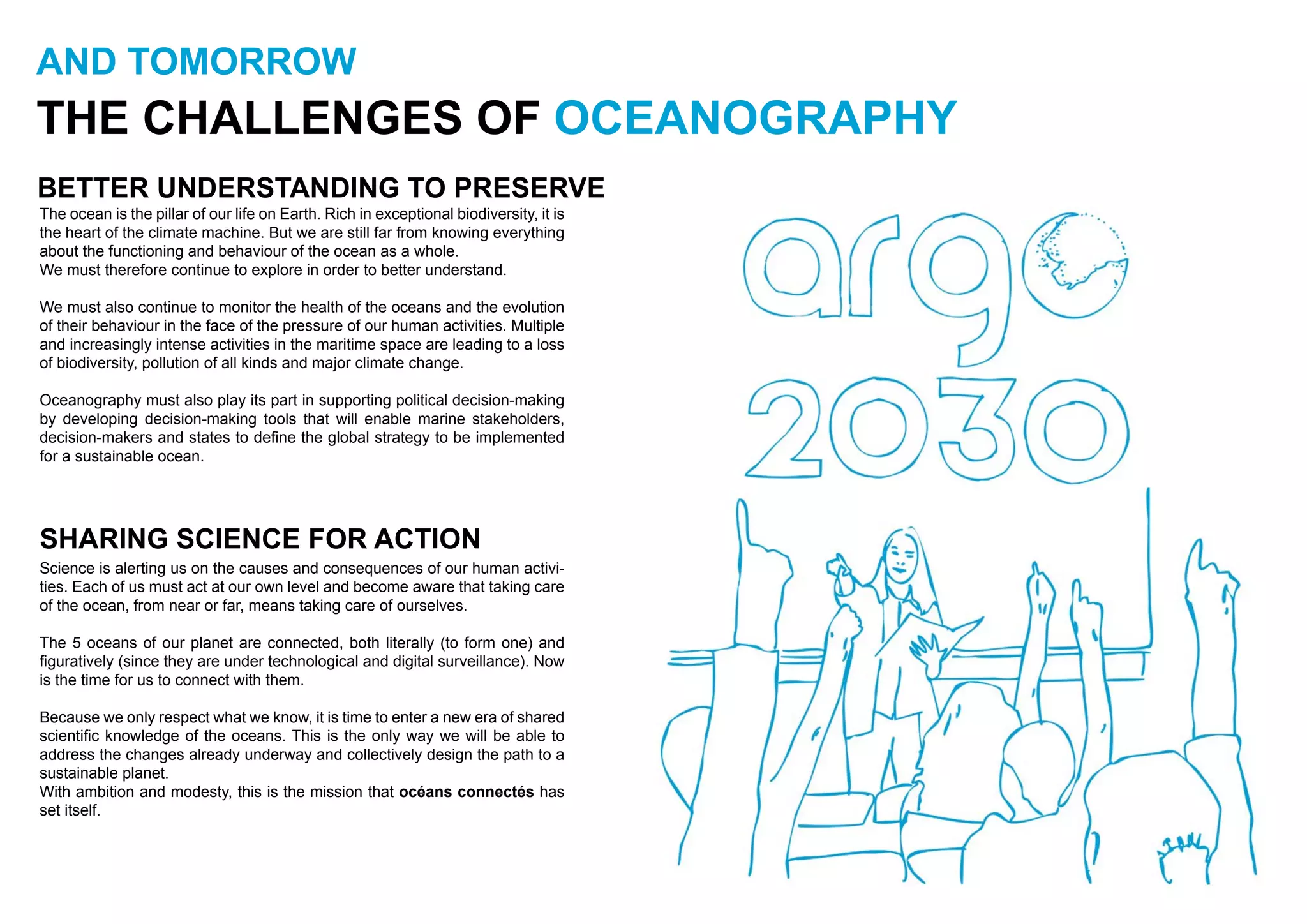
BETTER UNDERSTANDING TO PRESERVE
The ocean is the pillar of our life on Earth. Rich in exceptional biodiversity, it is
the heart of the climate machine. But we are still far from knowing everything
about the functioning and behaviour of the ocean as a whole.
We must therefore continue to explore in order to better understand.
We must also continue to monitor the health of the oceans and the evolution
of their behaviour in the face of the pressure of our human activities. Multiple
and increasingly intense activities in the maritime space are leading to a loss
of biodiversity, pollution of all kinds and major climate change.
Oceanography must also play its part in supporting political decision-making
by developing decision-making tools that will enable marine stakeholders,
decision-makers and states to define the global strategy to be implemented
for a sustainable ocean.
SHARING SCIENCE FOR ACTION
Science is alerting us on the causes and consequences of our human activi-
ties. Each of us must act at our own level and become aware that taking care
of the ocean, from near or far, means taking care of ourselves.
The 5 oceans of our planet are connected, both literally (to form one) and
figuratively (since they are under technological and digital surveillance). Now
is the time for us to connect with them.
Because we only respect what we know, it is time to enter a new era of shared
scientific knowledge of the oceans. This is the only way we will be able to
address the changes already underway and collectively design the path to a
sustainable planet.
With ambition and modesty, this is the mission that océans connectés has
set itself.
Press contact:
Carole Saout-Grit
founder of océans connectés
t : +33 (0)6 30 33 81 63
mail : carole@oceansconnectes.org
ABOUT US
océans connectés is a new online media entirely dedicated to marine
sciences.
Its ambition is to give access to a new scientific culture of the oceans.
Conceived as a collective and collaborative project, this media is intended to be a
meeting point for scientists, journalists and the general public.
It is a space for meetings and exchanges necessary to raise awareness, education
and training on the issues of protection and sustainable management of the seas
and oceans.
A digital platform for popularising science, www.oceansconnectes.org invites the
general public to understand how the oceans work through science. The media
shares news, events, jobs and resources on French, European and international
oceanography.
océans connectés was created in February 2021 by Carole Saout-Grit, a research
engineer in physical oceanography and director of the Glazeo research department.
Link to the platform:
www.oceansconnectes.org
Social networks:
https://www.facebook.com/OceansConnectes/
https://twitter.com/OceansConnectes
https://www.linkedin.com/showcase/oceans-connectes/
https://www.instagram.com/oceansconnectes/
Free publication of connected oceans
Content © océans connectés
Graphic design Nantes

What is the use of oceanography?

  • 1.
    WHAT IS THEUSE OF OCEANOGRAPHY by www.oceansconnectes.org
  • 2.
    EDITORIAL This 11 February2022 will undoubtedly be a historic date. For the first time, a international environmental summit, entirely dedicated to the oceans, the «One Ocean Summit», will take place in France, in Brest «itself», facing the Atlantic. At the initiative of French President Emmanuel Macron, scientists, practitioners, entre- preneurs, government and European representatives, regional and local players and civilians are invited to sit around the table, with the aim of imagining together concrete solutions for a reasoned and sustainable management of the maritime space. A space that is mostly beyond any jurisdiction, a pillar of our life on Earth and yet highly threatened by multiple human pressures. Ahead of the meeting of European heads of state, a number of workshops have been scheduled over two days as a creative forum. Solutions must emerge from a cross-practice approach and the sharing of scientific, technological and environmental knowledge. Therefore, as this event approaches and looks like the first «mini-COP of the oceans», we wanted to fulfil our role as a media dedicated to marine sciences and contribute to this objective of sharing scientific knowledge. We offer you this guide to shed light on the question you are probably asking yourself: «What is the use of oceanography?» By tracing the history of marine science, we explain how oceanographers have been able to put the oceans at the heart of their work and demonstrate the crucial role they play in the planetary balance. Today, the scientific community is warning us that the health of the oceans is deterio- rating under the pressure of our human activities. It calls for collective action for an intelligent and sustainable co-management of the maritime space. Convinced that the prerequisite for any action is a better understanding of the issues by science, we hope that this guide to oceanography will help to crytalise on the issues and challenges posed by science. We hope that it will help lay the foundation for buil- ding a common and shared ocean culture. Available in a bilingual version (French and English), the format of this dossier is ex- clusively digital. As a white paper open to the marine sciences, we hope that it will be distributed free of charge, so that together we can connect the oceans.
  • 3.
    ESSENTIAL TO LIFEON EARTH WHAT THE OCEANS BRING US THE AIR WE BREATHE CLIMATE CONTROL RECREATION ECONOMY FOOD HEALTH >50%The oceans produce more than 50% of the planet’s oxygen and store nearly 30% of the CO2 produced by hu- man activity 70%The oceans are the main re- gulators of the climate. Covering 70% of the earth’s surface, they transport heat and energy from the equator to the poles. They balance the climate of the planet. 90%90% of world trade is car- ried out by sea, i.e. 9.1 billion tonnes of goods TRANSPORTATION SYSTEM From sailing to fishing, and kayaking to whale watching, the oceans provide humanity with its main source of recrea- tion and tourism oppor- tunities Globally, the market value of marine and coastal resources is estimated at $3 trillion per year, or about 5% of global GDP. 3000 B$ >3 billion Over three billion people depend on marine and coastal biodiversity for their livelihoods and protein supply. Many medicines come from the oceans, including ingre- dients that help fight cancer, arthritis, Alzheimer’s disease and heart disease
  • 4.
    OCEANOGRAPHY THE STUDY OFSEAS AND OCEANS A MULTIPLE SCIENCE AND A CHAIN OF PROFESSIONS Oceanography is a multi-scientific discipline, touching many fields of study. Biological, chemical, geological and physical phenomenon and processes often interact with each other. Scientists from different disciplines therefore carry out their experiments each in their own speciality, but come together to work and interpret their results on a common research programme. The oceanographer may be a technician, an engineer or a researcher, but one is never without the other. The work is done as a team, and the expertise of each person is necessary and complementary. An oceanographer spends some time at sea, mainly du- ring oceanographic campaigns. But most of their work is done in the laboratory. There, they prepare missions, process data in front of their computers and share their results by publishing them and presenting them to the community at scientific conferences. In France, various organisations such as the CNRS (Centre National de la Recherche Scientifique), IFREMER (Institut Français de Recherche pour l’Exploitation de la MER), IRD (Institut de Recherche pour le Développement), SHOM (Service Hydrographique et Océanographique de la Marine Nationale), MÉTÉO-FRANCE and universities host laboratories specialised in oceanography. They are spread throughout the country, mainly in Brest, Cherbourg, Paris, Marseille, Toulouse and Grenoble. marine biology which studies marine biodiversity, organisms and ecosystems marine chemistry which deals with the study of the che- mical composition of the oceans physical oceanography which is concerned with the physical characteristics of the ocean: major ocean currents, waves, tides, etc. marine geology which analyses the ocean floor and its present and past characteristics The main specialities of oceanography include :
  • 5.
    A FASCINATING STORY SAILORS& SCIENTISTS CONQUERING THE OCEANS THE AGE OF ENLIGHTENMENT 1769 Following Christopher Columbus, Vasco de Gama and Fernand Ma- gellan, the great navigators of the 16th and 17th centuries set out to discover new sea routes. In 1769, Benjamin Franklin publi- shed the very first map of the Gulf Stream. He gave the whole world the first representation of the most famous ocean surface current. This was the birth of oceanography as a scientific discipline. THE GREAT EXPEDITIONS 19th century For the first time, from 1872 to 1876, an international oceanographic ex- pedition explored the three main oceans: Atlantic, Pacific and Indian. For 4 years, on board the HMS Challenger, the scientists carried out nearly 400 measuring stations and collected numerous plants and animals living at a depth of more than 5000 metres! This expedition marked the begin- ning of modern oceanography FROM THE EQUATOR TO THE POLES... 20th century In the twentieth century, scientific expeditions increased in number. As early as 1902, from Green- land to Antarctica, Commander Jean-Baptiste Charcot led the way to the polar zones on board his ship «Pourquoi Pas? In France, Prince Albert I of Mona- co (1848-1922) led several cam- paigns on board his yachts, resul- ting in the first bathymetric map of the oceans and the discovery of more than 1,280 new species. As early as 1943, Captain Jacques-Yves Cousteau and his team developed the first autonomous dives. In 1960, Jacques Piccard and Dan Walsh succeeded in making the first dive aboard the submarine «Trieste» into the deepest oceanic trench of the Marianas known to date, at a depth of over 10,000 metres. Under the surface, an exceptional geolo- gy, geography and biodiversity are disco- vered. The ocean becomes a strategic issue to explore and understand. ...FROM THE SURFACE TO THE ABYSS
  • 6.
    OCEANOGRAPHY TODAY OPEN HEARTOCEANS SATELLITE COMMUNICATION In 1957, after the launch of Sputnik, scien- tists imagined that they could use space altimetry to measure sea levels. The Seasat satellites in 1978, followed by Topex/Poseidon in 1992, made it possible to observe the seas in detail. Scientists are discovering oceans that are constantly in motion, agitated by nume- rous multi-scale structures that are essen- tial to their functioning and stability. The ocean seen from the sky gave rise to a new discipline of modern oceanogra- phy: space oceanography. TECHNOLOGICAL DEVELOPMENTS GLOBAL COOPERATION THE DIGITAL REVOLUTION Technological and theoretical developments have led to major advances in the observation of the ma- rine environment. Drifting floats, seawater sampling, current measure- ments, deployment of moorings or bathysondes... The technologies and instruments, often comple- mentary, are multiplying and are deployed during scientific campaigns from oceanographic vessels. Data collection and location by satellite with world- wide coverage, using the Argos system, gives all these in situ measurements an extra dimension. The data are available in real time in all the labora- tories on the planet! The digital revolution is enabling the development of new tools for measurements at sea, together with the development of numerical models. In 1998, the international Argo programme was launched. Autonomous underwater robots are created to continuously monitor the oceans. Drifting with the currents, these instruments take measurements between the surface and the depth. In 20 years, these floats have enabled us to better understand how the oceans work and their essential role in the balance of the planet. Today, 35 international countries are developing an operational Argo network of 4,000 active floats, which is needed to assess the impact of human pressures on the health of the oceans. Given the immense extent of the area to be explored, oceanographers knew that scientific, technical and human collabora- tion between teams was a necessity. The scientific community quickly organised it- self and joined forces to cooperate intelli- gently on major observation programmes at sea. This is how WOCE was born in 1991, the first major international oceanographic ex- periment conducted over ten years and which resulted in the collection of excep- tional deep in-situ data.
  • 7.
    AND TOMORROW THE CHALLENGESOF OCEANOGRAPHY BETTER UNDERSTANDING TO PRESERVE The ocean is the pillar of our life on Earth. Rich in exceptional biodiversity, it is the heart of the climate machine. But we are still far from knowing everything about the functioning and behaviour of the ocean as a whole. We must therefore continue to explore in order to better understand. We must also continue to monitor the health of the oceans and the evolution of their behaviour in the face of the pressure of our human activities. Multiple and increasingly intense activities in the maritime space are leading to a loss of biodiversity, pollution of all kinds and major climate change. Oceanography must also play its part in supporting political decision-making by developing decision-making tools that will enable marine stakeholders, decision-makers and states to define the global strategy to be implemented for a sustainable ocean. SHARING SCIENCE FOR ACTION Science is alerting us on the causes and consequences of our human activi- ties. Each of us must act at our own level and become aware that taking care of the ocean, from near or far, means taking care of ourselves. The 5 oceans of our planet are connected, both literally (to form one) and figuratively (since they are under technological and digital surveillance). Now is the time for us to connect with them. Because we only respect what we know, it is time to enter a new era of shared scientific knowledge of the oceans. This is the only way we will be able to address the changes already underway and collectively design the path to a sustainable planet. With ambition and modesty, this is the mission that océans connectés has set itself.
  • 8.
    Press contact: Carole Saout-Grit founderof océans connectés t : +33 (0)6 30 33 81 63 mail : carole@oceansconnectes.org ABOUT US océans connectés is a new online media entirely dedicated to marine sciences. Its ambition is to give access to a new scientific culture of the oceans. Conceived as a collective and collaborative project, this media is intended to be a meeting point for scientists, journalists and the general public. It is a space for meetings and exchanges necessary to raise awareness, education and training on the issues of protection and sustainable management of the seas and oceans. A digital platform for popularising science, www.oceansconnectes.org invites the general public to understand how the oceans work through science. The media shares news, events, jobs and resources on French, European and international oceanography. océans connectés was created in February 2021 by Carole Saout-Grit, a research engineer in physical oceanography and director of the Glazeo research department. Link to the platform: www.oceansconnectes.org Social networks: https://www.facebook.com/OceansConnectes/ https://twitter.com/OceansConnectes https://www.linkedin.com/showcase/oceans-connectes/ https://www.instagram.com/oceansconnectes/ Free publication of connected oceans Content © océans connectés Graphic design Nantes