Education System in USA
Fact File of USA
Official name- United States of America
Continent-North America
Area- 9,629,091 km2
Latitude – 39.828127 N
Longitude – 98.579404 W
Continue…
Population- 320,351,371
Population density- 88.6 per sq kilometer
Language- No official language!
English, Spanish, Hawaiian, Indo- European
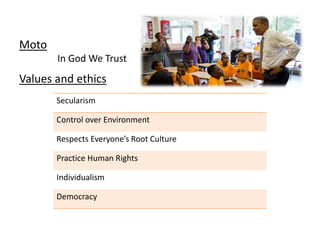
Moto
In God We Trust
Values and ethics
Secularism
Control over Environment
Respects Everyone’s Root Culture
Practice Human Rights
Individualism
Democracy
Administration of Education System in USA
Federal Gov : 10% budget, Determine Age group, International
Standardized Tests, determine some value and ethics
State and local Gov: budgeting 60%, curriculum, curriculum, test
books, learning Standers, years of compulsory education,
Local School District: budgeting 30%, teaching Strategies,
subjects to be Taught, Assessment Strategy
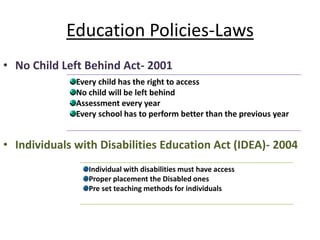
Education Policies-Laws
• No Child Left Behind Act- 2001
• Individuals with Disabilities Education Act (IDEA)- 2004
Every child has the right to access
No child will be left behind
Assessment every year
Every school has to perform better than the previous year
Individual with disabilities must have access
Proper placement the Disabled ones
Pre set teaching methods for individuals
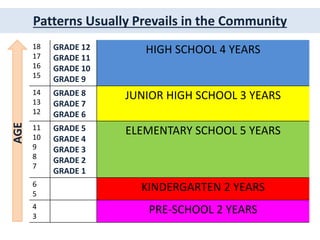
Patterns Usually Prevails in the Community
18
17
16
15
GRADE 12
GRADE 11
GRADE 10
GRADE 9
HIGH SCHOOL 4 YEARS
14
13
12
GRADE 8
GRADE 7
GRADE 6
JUNIOR HIGH SCHOOL 3 YEARS
11
10
9
8
7
GRADE 5
GRADE 4
GRADE 3
GRADE 2
GRADE 1
ELEMENTARY SCHOOL 5 YEARS
6
5
KINDERGARTEN 2 YEARS
4
3
PRE-SCHOOL 2 YEARS
AGE
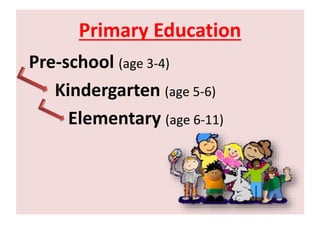
Primary Education
Pre-school (age 3-4)
Kindergarten (age 5-6)
Elementary (age 6-11)
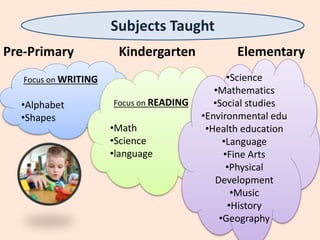
Pre-Primary Kindergarten Elementary
Subjects Taught
Focus on WRITING
•Alphabet
•Shapes
Focus on READING
•Math
•Science
•language
•Science
•Mathematics
•Social studies
•Environmental edu
•Health education
•Language
•Fine Arts
•Physical
Development
•Music
•History
•Geography
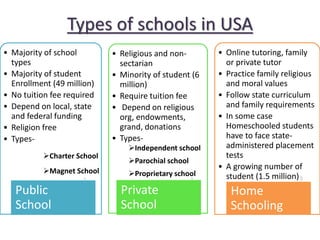
Types of schools in USA
• Majority of school
types
• Majority of student
Enrollment (49 million)
• No tuition fee required
• Depend on local, state
and federal funding
• Religion free
• Types-
Public
School
• Religious and non-
sectarian
• Minority of student (6
million)
• Require tuition fee
• Depend on religious
org, endowments,
grand, donations
• Types-
Private
School
• Online tutoring, family
or private tutor
• Practice family religious
and moral values
• Follow state curriculum
and family requirements
• In some case
Homeschooled students
have to face state-
administered placement
tests
• A growing number of
student (1.5 million)
Home
Schooling
Charter School
Magnet School
Independent school
Parochial school
Proprietary school
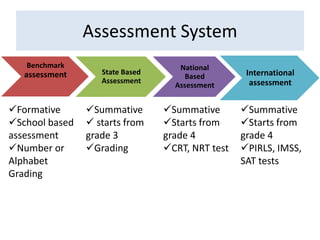
Assessment System
Benchmark
assessment State Based
Assessment
National
Based
Assessment
International
assessment
Formative
School based
assessment
Number or
Alphabet
Grading
Summative
 starts from
grade 3
Grading
Summative
Starts from
grade 4
CRT, NRT test
Summative
Starts from
grade 4
PIRLS, IMSS,
SAT tests
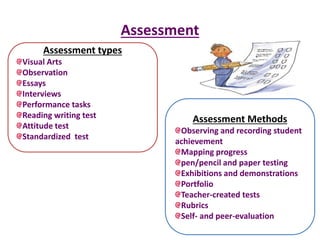
Assessment
Assessment Methods
Observing and recording student
achievement
Mapping progress
pen/pencil and paper testing
Exhibitions and demonstrations
Portfolio
Teacher-created tests
Rubrics
Self- and peer-evaluation
Assessment types
Visual Arts
Observation
Essays
Interviews
Performance tasks
Reading writing test
Attitude test
Standardized test
Secondary Education
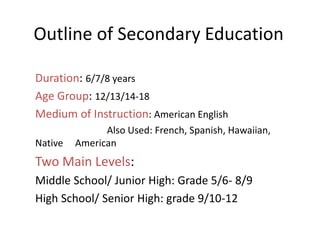
Outline of Secondary Education
Duration: 6/7/8 years
Age Group: 12/13/14-18
Medium of Instruction: American English
Also Used: French, Spanish, Hawaiian,
Native American
Two Main Levels:
Middle School/ Junior High: Grade 5/6- 8/9
High School/ Senior High: grade 9/10-12
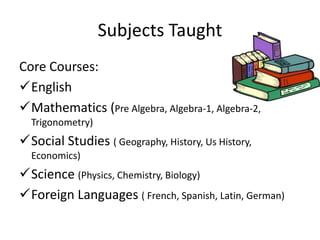
Subjects Taught
Core Courses:
English
Mathematics (Pre Algebra, Algebra-1, Algebra-2,
Trigonometry)
Social Studies ( Geography, History, Us History,
Economics)
Science (Physics, Chemistry, Biology)
Foreign Languages ( French, Spanish, Latin, German)
Advanced/ Additional Study Options
(AP Courses)
Courses Related AP Courses
Science Geology, Anatomy, Astrology, Health
Science, Environmental Science,
Forensic Science
Mathematics Calculus, Statistics, Discrete Math
Social Studies Law, Criminal Justice, Psychology,
Sociology
English Public Speaking, Journalism
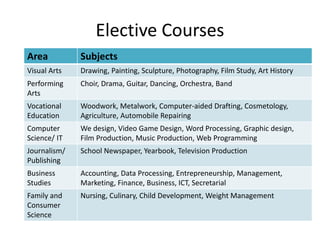
Elective Courses
Area Subjects
Visual Arts Drawing, Painting, Sculpture, Photography, Film Study, Art History
Performing
Arts
Choir, Drama, Guitar, Dancing, Orchestra, Band
Vocational
Education
Woodwork, Metalwork, Computer-aided Drafting, Cosmetology,
Agriculture, Automobile Repairing
Computer
Science/ IT
We design, Video Game Design, Word Processing, Graphic design,
Film Production, Music Production, Web Programming
Journalism/
Publishing
School Newspaper, Yearbook, Television Production
Business
Studies
Accounting, Data Processing, Entrepreneurship, Management,
Marketing, Finance, Business, ICT, Secretarial
Family and
Consumer
Science
Nursing, Culinary, Child Development, Weight Management
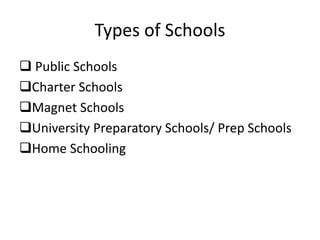
Types of Schools
 Public Schools
Charter Schools
Magnet Schools
University Preparatory Schools/ Prep Schools
Home Schooling
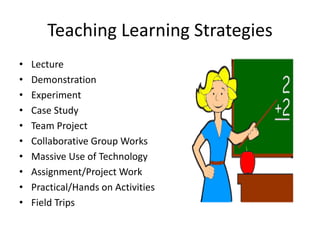
Teaching Learning Strategies
• Lecture
• Demonstration
• Experiment
• Case Study
• Team Project
• Collaborative Group Works
• Massive Use of Technology
• Assignment/Project Work
• Practical/Hands on Activities
• Field Trips
Teaching Learning Strategies (Cont.)
Focus:
 Inclusiveness of learning
 Diverse learners- diverse teaching
 Engaging students
 Constructing practical skills
 Developing leadership
 Creating Technologically skilled citizens
 Enhancing collaboration, social harmony
Technology in Education
Thousands of Online-
 Schools (K-12)
 Colleges
 Universities
 Diploma courses
 Professional Courses
Technology in Education (Cont.)
Contributions:
 Enhancing physical with virtual
 Distance learning
 Virtual schooling
 Virtual internship
 Institutionalizing subjects like Film Making, Video Games
Designing etc at school level
 Continuing and independent learning
Uses of Technology in Classrooms
Used tools/Technologies:
 Computer
 Laptop
 Cell Phones
 Wireless Microphones
 Interactive Screens/Whiteboards
 ipad
 Class Blogs and Wikis
 Digital Textbooks
 Online Study Tools
 Learning Games
Latest Uses of Technology
Innovations
 Uniquely diversified education system
 AP courses
 Honors Classes for the motivated and Gifted
 Massive online courses and degrees
 Individuals with Disabilities Education Act (IDEA)
 No Child Left Behind Act
 Innovative and practical courses at school level
 Magnet School
 Charter School
 Summer School
 Home Schooling
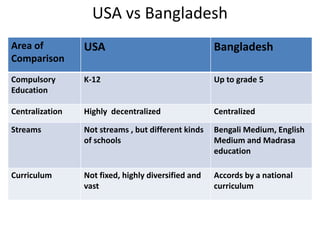
USA vs Bangladesh
Area of
Comparison
USA Bangladesh
Compulsory
Education
K-12 Up to grade 5
Centralization Highly decentralized Centralized
Streams Not streams , but different kinds
of schools
Bengali Medium, English
Medium and Madrasa
education
Curriculum Not fixed, highly diversified and
vast
Accords by a national
curriculum
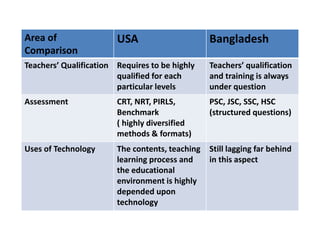
Area of
Comparison
USA Bangladesh
Teachers’ Qualification Requires to be highly
qualified for each
particular levels
Teachers’ qualification
and training is always
under question
Assessment CRT, NRT, PIRLS,
Benchmark
( highly diversified
methods & formats)
PSC, JSC, SSC, HSC
(structured questions)
Uses of Technology The contents, teaching
learning process and
the educational
environment is highly
depended upon
technology
Still lagging far behind
in this aspect
Worthwhile Features
Extreme diversification of the education
system
AP Courses
Home schooling
Vast private investment in schooling
Lessons to be Learnt
 Extended compulsory education
 Diversification of education according to needs
 Interactive, collaborative and practical teaching learning
activities
 Enhancing Private investment in education
 Introducing truly inclusive education system
 Online courses, distance and independent learning
 Empowering the youth through education
Action Aid at a glance…
 Name: Action Aid International
 Founder: Cecil Jackson-Cole
 Formed: 1972
 Purpose: Action Aid is a global movement of
people working together to further human
rights for all and defeat poverty
 Headquarter: Johannesburg
 Chief Executive: Adriano Campolina
 Region served: Africa, Asia, Europe, Australia,
the Middle East, Americas
Short introduction of Action Aid...
 Action Aid is an international non-governmental
organization whose primary aim is to fight poverty and
injustice worldwide.
 Action Aid was created as a child sponsorship charity
when 88 UK supporters sponsored 88 children in India and
Kenya, the focus primarily being to provide children with
an education.
 Action Aid helping over 15 million impoverished and
disadvantaged people in 45 countries worldwide.
 Though its head office is located in South Africa it has
hubs in Asia, The Americas and Europe.
 The international functions for campaigning and
fundraising are based in the UK.
Vision…
A world without poverty and injustice
in which every person enjoys their
right to a life with dignity
Mission…
To work with poor and
excluded people to
eradicate poverty and
injustice.
Values…
Mutual respect
Equity and justice
Honesty and transparency
Solidarity with the poor
Courage of conviction
Independence
Humility
Action Aid's work…
 fighting poverty across the globe
 promoting and secure poor and
marginalized communities basic rights
To achieve its mission, Action Aid also
works in the following areas:
• Women's rights
• Education
• Food rights
• Democratic Governance
• Emergencies and conflict
• Climate change
• Youth
It is also currently focused on 2 international
campaigns:
• Tax Power
• Land For Communities
Contd.
Women's rights…(Right to education)
Support excluded and disadvantaged groups,
especially girls, in gaining access to the quality
education which is their right
Promote the rights of all learners within
education systems and ensure that both boys
and girls understand women's rights, and
discrimination and violence are eliminated.
Partners they work with…
Local community-based organizations and
NGOs
International NGOs
Social movements
Networks
Academic institutions
Government
Private sector
Action Aids Educational
Work…
Education – especially that of girls
and women –
saves lives,
reduces inequality and
transforms communities.
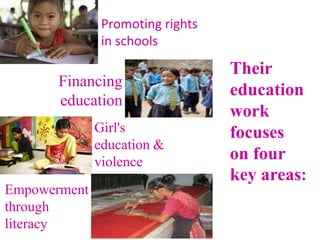
Their
education
work
focuses
on four
key areas:
Promoting rights
in schools
Girl's
education &
violence
Financing
education
Empowerment
through
literacy
Action Aid in Bangladesh
Action Aid Bangladesh
 Action Aid Bangladesh starting its journey
with a very minimalist approach today has
become a relatively important player of the
vibrant NGO movement that seeks to fight
poverty in the country.
 Action Aid came to Bangladesh in 1983 to
support an orphanage in Bhola locally known
as ‘Bittohin’
 accelerate support for anti–poverty initiatives
 improve sustainable development to create a
confident and responsible nation
 Create a indignity and poverty free country
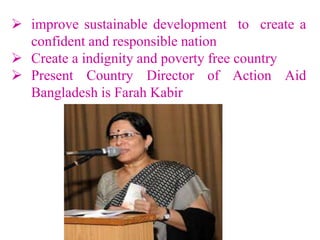
 Present Country Director of Action Aid
Bangladesh is Farah Kabir
Food shortage
Child labor
Inclusive society
Focuses on long-term rehabilitation
activities
Introduce alternative earning way in Sex
worker community where children suffer
from social taboos
Protecting rights of women
River erosion and early marriage issues
Indigenous communities are deprived from
government’s safety-net
Working Sector of Action Aid Bangladesh
Access to Common Food Resourse
Community Adaption
Communication for Development
Cyclone Recovery
Food Security Network
Happy Homes
LEADER
Paribarvittik Jeboo-boichitro Gram
Removing Cultural Barriers IV
Responsible and Accountable Garments
Sustainable Agriculture for Monga Mitigation
Shapla Kuri
Peach With Earth
LEADER
Power In Women!
Action Aid’s Educational Works in Bangladesh
• Providing educational activities in Four areas
1. Programmatic activities
2. Community related activities
3. Quality education & governance related activities
4. Others
Working sectors in USA…
o Biofuels
o Climate Change
o Food and Agriculture
o Emergencies
o Haiti Advocacy
o Land Rights
o Tax Justice
o Women’s Rights
Action Aids Contribution in Some Policy
Making in Bangladesh:
The Policies are-
 Paribarik Nirzaton(Domon o Niontron) law-
2010
 Nagoricotto songshodhoni law-2009
 Toiri Poshak Shilpe Nunotomo Mojuri protha
proborton, 2010
 Bangladesh e fire service o civil defense e
volunteer group toiri, 2010
 Review and Reformation of Disaster
Management law- 2010
Lesson to be learnt
Creating awareness
Sustainable development
Empowering people
ARTICLE No- 1
Educational Policies and Content in
Developing Countries
By
JACQUES HALLAK
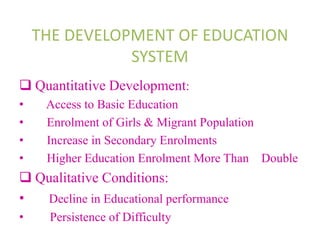
THE DEVELOPMENT OF EDUCATION
SYSTEM
 Quantitative Development:
• Access to Basic Education
• Enrolment of Girls & Migrant Population
• Increase in Secondary Enrolments
• Higher Education Enrolment More Than Double
 Qualitative Conditions:
• Decline in Educational performance
• Persistence of Difficulty
KEY FACTORS
Budgetary Constraints
Role of International Aid
Human Resources
EDUCATIONAL POLICIES
Factors Affecting Their Development:
 Economic & Financial Factors
 External Financial bodies
 International Conferences
 Globalization
 Decentralization of Administration
NEW PROSPECTS
 Priority for Higher Education
 Secondary Education in Search of an Identity
 Social Functions of Higher Education
 Education Throughout Life
GLOBALIZATION:
Result of Interlocking of the Economic &
Financial Sectors
 Consequences of Globalization:
• Emergence of “Knowledge Societies”
• Transformation of the Nature of Work
• Increase in Social Exclusion
DEVELOPMENTS BY
GLOBALIZATION
 Exchange of Experiences About
Educational policies
 Convergence of Curricula
 Convergence of Areas of Concerns
AREAS OF CONCERNS
 Relating to structures
Basic Education and the Alternatives
Levels or Cycles
Secondary Education as a Complete or
Preparatory Course
Initial and Continuing Training
Relating to implementation
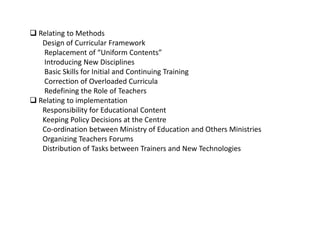
 Relating to Methods
Design of Curricular Framework
Replacement of “Uniform Contents”
Introducing New Disciplines
Basic Skills for Initial and Continuing Training
Correction of Overloaded Curricula
Redefining the Role of Teachers
 Relating to implementation
Responsibility for Educational Content
Keeping Policy Decisions at the Centre
Co-ordination between Ministry of Education and Others Ministries
Organizing Teachers Forums
Distribution of Tasks between Trainers and New Technologies
REAL QUESTIONS & UNCERTAIN
REPLIES
Presented by Group 8
Rabeya Sultana 014-563
Israt Jahan 014-564
Monira Akter 014-565
Shobhana Alam 014-544

Education system in usa

  • 1.
  • 2.
    Fact File ofUSA Official name- United States of America Continent-North America Area- 9,629,091 km2 Latitude – 39.828127 N Longitude – 98.579404 W
  • 3.
    Continue… Population- 320,351,371 Population density-88.6 per sq kilometer Language- No official language! English, Spanish, Hawaiian, Indo- European
  • 4.
    Moto In God WeTrust Values and ethics Secularism Control over Environment Respects Everyone’s Root Culture Practice Human Rights Individualism Democracy
  • 5.
    Administration of EducationSystem in USA Federal Gov : 10% budget, Determine Age group, International Standardized Tests, determine some value and ethics State and local Gov: budgeting 60%, curriculum, curriculum, test books, learning Standers, years of compulsory education, Local School District: budgeting 30%, teaching Strategies, subjects to be Taught, Assessment Strategy
  • 6.
    Education Policies-Laws • NoChild Left Behind Act- 2001 • Individuals with Disabilities Education Act (IDEA)- 2004 Every child has the right to access No child will be left behind Assessment every year Every school has to perform better than the previous year Individual with disabilities must have access Proper placement the Disabled ones Pre set teaching methods for individuals
  • 7.
    Patterns Usually Prevailsin the Community 18 17 16 15 GRADE 12 GRADE 11 GRADE 10 GRADE 9 HIGH SCHOOL 4 YEARS 14 13 12 GRADE 8 GRADE 7 GRADE 6 JUNIOR HIGH SCHOOL 3 YEARS 11 10 9 8 7 GRADE 5 GRADE 4 GRADE 3 GRADE 2 GRADE 1 ELEMENTARY SCHOOL 5 YEARS 6 5 KINDERGARTEN 2 YEARS 4 3 PRE-SCHOOL 2 YEARS AGE
  • 8.
    Primary Education Pre-school (age3-4) Kindergarten (age 5-6) Elementary (age 6-11)
  • 9.
    Pre-Primary Kindergarten Elementary SubjectsTaught Focus on WRITING •Alphabet •Shapes Focus on READING •Math •Science •language •Science •Mathematics •Social studies •Environmental edu •Health education •Language •Fine Arts •Physical Development •Music •History •Geography
  • 10.
    Types of schoolsin USA • Majority of school types • Majority of student Enrollment (49 million) • No tuition fee required • Depend on local, state and federal funding • Religion free • Types- Public School • Religious and non- sectarian • Minority of student (6 million) • Require tuition fee • Depend on religious org, endowments, grand, donations • Types- Private School • Online tutoring, family or private tutor • Practice family religious and moral values • Follow state curriculum and family requirements • In some case Homeschooled students have to face state- administered placement tests • A growing number of student (1.5 million) Home Schooling Charter School Magnet School Independent school Parochial school Proprietary school
  • 11.
    Assessment System Benchmark assessment StateBased Assessment National Based Assessment International assessment Formative School based assessment Number or Alphabet Grading Summative  starts from grade 3 Grading Summative Starts from grade 4 CRT, NRT test Summative Starts from grade 4 PIRLS, IMSS, SAT tests
  • 12.
    Assessment Assessment Methods Observing andrecording student achievement Mapping progress pen/pencil and paper testing Exhibitions and demonstrations Portfolio Teacher-created tests Rubrics Self- and peer-evaluation Assessment types Visual Arts Observation Essays Interviews Performance tasks Reading writing test Attitude test Standardized test
  • 13.
  • 14.
    Outline of SecondaryEducation Duration: 6/7/8 years Age Group: 12/13/14-18 Medium of Instruction: American English Also Used: French, Spanish, Hawaiian, Native American Two Main Levels: Middle School/ Junior High: Grade 5/6- 8/9 High School/ Senior High: grade 9/10-12
  • 15.
    Subjects Taught Core Courses: English Mathematics(Pre Algebra, Algebra-1, Algebra-2, Trigonometry) Social Studies ( Geography, History, Us History, Economics) Science (Physics, Chemistry, Biology) Foreign Languages ( French, Spanish, Latin, German)
  • 16.
    Advanced/ Additional StudyOptions (AP Courses) Courses Related AP Courses Science Geology, Anatomy, Astrology, Health Science, Environmental Science, Forensic Science Mathematics Calculus, Statistics, Discrete Math Social Studies Law, Criminal Justice, Psychology, Sociology English Public Speaking, Journalism
  • 17.
    Elective Courses Area Subjects VisualArts Drawing, Painting, Sculpture, Photography, Film Study, Art History Performing Arts Choir, Drama, Guitar, Dancing, Orchestra, Band Vocational Education Woodwork, Metalwork, Computer-aided Drafting, Cosmetology, Agriculture, Automobile Repairing Computer Science/ IT We design, Video Game Design, Word Processing, Graphic design, Film Production, Music Production, Web Programming Journalism/ Publishing School Newspaper, Yearbook, Television Production Business Studies Accounting, Data Processing, Entrepreneurship, Management, Marketing, Finance, Business, ICT, Secretarial Family and Consumer Science Nursing, Culinary, Child Development, Weight Management
  • 18.
    Types of Schools Public Schools Charter Schools Magnet Schools University Preparatory Schools/ Prep Schools Home Schooling
  • 19.
    Teaching Learning Strategies •Lecture • Demonstration • Experiment • Case Study • Team Project • Collaborative Group Works • Massive Use of Technology • Assignment/Project Work • Practical/Hands on Activities • Field Trips
  • 20.
    Teaching Learning Strategies(Cont.) Focus:  Inclusiveness of learning  Diverse learners- diverse teaching  Engaging students  Constructing practical skills  Developing leadership  Creating Technologically skilled citizens  Enhancing collaboration, social harmony
  • 21.
    Technology in Education Thousandsof Online-  Schools (K-12)  Colleges  Universities  Diploma courses  Professional Courses
  • 22.
    Technology in Education(Cont.) Contributions:  Enhancing physical with virtual  Distance learning  Virtual schooling  Virtual internship  Institutionalizing subjects like Film Making, Video Games Designing etc at school level  Continuing and independent learning
  • 23.
    Uses of Technologyin Classrooms Used tools/Technologies:  Computer  Laptop  Cell Phones  Wireless Microphones  Interactive Screens/Whiteboards  ipad  Class Blogs and Wikis  Digital Textbooks  Online Study Tools  Learning Games
  • 24.
    Latest Uses ofTechnology
  • 25.
    Innovations  Uniquely diversifiededucation system  AP courses  Honors Classes for the motivated and Gifted  Massive online courses and degrees  Individuals with Disabilities Education Act (IDEA)  No Child Left Behind Act  Innovative and practical courses at school level  Magnet School  Charter School  Summer School  Home Schooling
  • 26.
    USA vs Bangladesh Areaof Comparison USA Bangladesh Compulsory Education K-12 Up to grade 5 Centralization Highly decentralized Centralized Streams Not streams , but different kinds of schools Bengali Medium, English Medium and Madrasa education Curriculum Not fixed, highly diversified and vast Accords by a national curriculum
  • 27.
    Area of Comparison USA Bangladesh Teachers’Qualification Requires to be highly qualified for each particular levels Teachers’ qualification and training is always under question Assessment CRT, NRT, PIRLS, Benchmark ( highly diversified methods & formats) PSC, JSC, SSC, HSC (structured questions) Uses of Technology The contents, teaching learning process and the educational environment is highly depended upon technology Still lagging far behind in this aspect
  • 28.
    Worthwhile Features Extreme diversificationof the education system AP Courses Home schooling Vast private investment in schooling
  • 29.
    Lessons to beLearnt  Extended compulsory education  Diversification of education according to needs  Interactive, collaborative and practical teaching learning activities  Enhancing Private investment in education  Introducing truly inclusive education system  Online courses, distance and independent learning  Empowering the youth through education
  • 32.
    Action Aid ata glance…  Name: Action Aid International  Founder: Cecil Jackson-Cole  Formed: 1972  Purpose: Action Aid is a global movement of people working together to further human rights for all and defeat poverty  Headquarter: Johannesburg  Chief Executive: Adriano Campolina  Region served: Africa, Asia, Europe, Australia, the Middle East, Americas
  • 33.
    Short introduction ofAction Aid...  Action Aid is an international non-governmental organization whose primary aim is to fight poverty and injustice worldwide.  Action Aid was created as a child sponsorship charity when 88 UK supporters sponsored 88 children in India and Kenya, the focus primarily being to provide children with an education.  Action Aid helping over 15 million impoverished and disadvantaged people in 45 countries worldwide.  Though its head office is located in South Africa it has hubs in Asia, The Americas and Europe.  The international functions for campaigning and fundraising are based in the UK.
  • 34.
    Vision… A world withoutpoverty and injustice in which every person enjoys their right to a life with dignity
  • 35.
    Mission… To work withpoor and excluded people to eradicate poverty and injustice.
  • 36.
    Values… Mutual respect Equity andjustice Honesty and transparency Solidarity with the poor Courage of conviction Independence Humility
  • 37.
    Action Aid's work… fighting poverty across the globe  promoting and secure poor and marginalized communities basic rights To achieve its mission, Action Aid also works in the following areas: • Women's rights • Education • Food rights
  • 38.
    • Democratic Governance •Emergencies and conflict • Climate change • Youth It is also currently focused on 2 international campaigns: • Tax Power • Land For Communities Contd.
  • 39.
    Women's rights…(Right toeducation) Support excluded and disadvantaged groups, especially girls, in gaining access to the quality education which is their right Promote the rights of all learners within education systems and ensure that both boys and girls understand women's rights, and discrimination and violence are eliminated.
  • 40.
    Partners they workwith… Local community-based organizations and NGOs International NGOs Social movements Networks Academic institutions Government Private sector
  • 41.
    Action Aids Educational Work… Education– especially that of girls and women – saves lives, reduces inequality and transforms communities.
  • 42.
    Their education work focuses on four key areas: Promotingrights in schools Girl's education & violence Financing education Empowerment through literacy
  • 43.
    Action Aid inBangladesh
  • 44.
    Action Aid Bangladesh Action Aid Bangladesh starting its journey with a very minimalist approach today has become a relatively important player of the vibrant NGO movement that seeks to fight poverty in the country.  Action Aid came to Bangladesh in 1983 to support an orphanage in Bhola locally known as ‘Bittohin’  accelerate support for anti–poverty initiatives
  • 45.
     improve sustainabledevelopment to create a confident and responsible nation  Create a indignity and poverty free country  Present Country Director of Action Aid Bangladesh is Farah Kabir
  • 47.
    Food shortage Child labor Inclusivesociety Focuses on long-term rehabilitation activities Introduce alternative earning way in Sex worker community where children suffer from social taboos Protecting rights of women River erosion and early marriage issues Indigenous communities are deprived from government’s safety-net
  • 48.
    Working Sector ofAction Aid Bangladesh Access to Common Food Resourse Community Adaption Communication for Development Cyclone Recovery Food Security Network Happy Homes LEADER Paribarvittik Jeboo-boichitro Gram Removing Cultural Barriers IV Responsible and Accountable Garments Sustainable Agriculture for Monga Mitigation
  • 49.
    Shapla Kuri Peach WithEarth LEADER Power In Women!
  • 50.
    Action Aid’s EducationalWorks in Bangladesh • Providing educational activities in Four areas 1. Programmatic activities 2. Community related activities 3. Quality education & governance related activities 4. Others
  • 51.
    Working sectors inUSA… o Biofuels o Climate Change o Food and Agriculture o Emergencies o Haiti Advocacy o Land Rights o Tax Justice o Women’s Rights
  • 52.
    Action Aids Contributionin Some Policy Making in Bangladesh: The Policies are-  Paribarik Nirzaton(Domon o Niontron) law- 2010  Nagoricotto songshodhoni law-2009  Toiri Poshak Shilpe Nunotomo Mojuri protha proborton, 2010  Bangladesh e fire service o civil defense e volunteer group toiri, 2010  Review and Reformation of Disaster Management law- 2010
  • 53.
  • 54.
  • 56.
    ARTICLE No- 1 EducationalPolicies and Content in Developing Countries By JACQUES HALLAK
  • 57.
    THE DEVELOPMENT OFEDUCATION SYSTEM  Quantitative Development: • Access to Basic Education • Enrolment of Girls & Migrant Population • Increase in Secondary Enrolments • Higher Education Enrolment More Than Double  Qualitative Conditions: • Decline in Educational performance • Persistence of Difficulty
  • 58.
    KEY FACTORS Budgetary Constraints Roleof International Aid Human Resources
  • 59.
    EDUCATIONAL POLICIES Factors AffectingTheir Development:  Economic & Financial Factors  External Financial bodies  International Conferences  Globalization  Decentralization of Administration
  • 60.
    NEW PROSPECTS  Priorityfor Higher Education  Secondary Education in Search of an Identity  Social Functions of Higher Education  Education Throughout Life
  • 61.
    GLOBALIZATION: Result of Interlockingof the Economic & Financial Sectors  Consequences of Globalization: • Emergence of “Knowledge Societies” • Transformation of the Nature of Work • Increase in Social Exclusion
  • 62.
    DEVELOPMENTS BY GLOBALIZATION  Exchangeof Experiences About Educational policies  Convergence of Curricula  Convergence of Areas of Concerns
  • 63.
    AREAS OF CONCERNS Relating to structures Basic Education and the Alternatives Levels or Cycles Secondary Education as a Complete or Preparatory Course Initial and Continuing Training Relating to implementation
  • 64.
     Relating toMethods Design of Curricular Framework Replacement of “Uniform Contents” Introducing New Disciplines Basic Skills for Initial and Continuing Training Correction of Overloaded Curricula Redefining the Role of Teachers  Relating to implementation Responsibility for Educational Content Keeping Policy Decisions at the Centre Co-ordination between Ministry of Education and Others Ministries Organizing Teachers Forums Distribution of Tasks between Trainers and New Technologies
  • 65.
    REAL QUESTIONS &UNCERTAIN REPLIES
  • 67.
    Presented by Group8 Rabeya Sultana 014-563 Israt Jahan 014-564 Monira Akter 014-565 Shobhana Alam 014-544