INDIAN EDUCATION SYSTEM CHARACTERISTICS
: CHANGE FOR A BETTER TOMORROW
 Prepared & presented by :
Sheth Bhaumik l.
ANCIENT INDIAN EDUCATION SYSTEM :
’GURUKULA & VISHWAVIDHYALAYA’
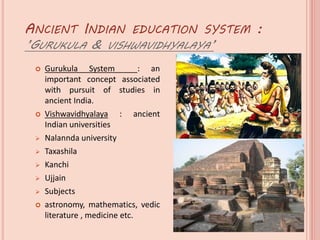
 Gurukula System : an
important concept associated
with pursuit of studies in
ancient India.
 Vishwavidhyalaya : ancient
Indian universities
 Nalannda university
 Taxashila
 Kanchi
 Ujjain
 Subjects
 astronomy, mathematics, vedic
literature , medicine etc.
CHANGE IN EDUCATION SYSTEM DUE TO
BRITISH IMPACT :
‘FROM MAHARSHI TO MACAULAY’
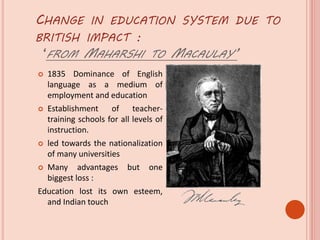
 1835 Dominance of English
language as a medium of
employment and education
 Establishment of teacher-
training schools for all levels of
instruction.
 led towards the nationalization
of many universities
 Many advantages but one
biggest loss :
Education lost its own esteem,
and Indian touch
INDIAN EDUCATION SYSTEM :
‘POST INDEPENDENCE’
 Strong central control over
education
 Guided by national goals,
aspirations as embodied in Indian
constitution
 National Policy on Education (NPE)
was adopted
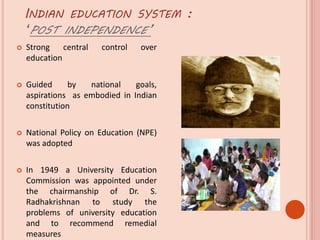
 In 1949 a University Education
Commission was appointed under
the chairmanship of Dr. S.
Radhakrishnan to study the
problems of university education
and to recommend remedial
measures
INDIAN EDUCATION SYSTEM :
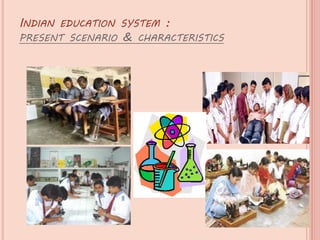
PRESENT SCENARIO & CHARACTERISTICS
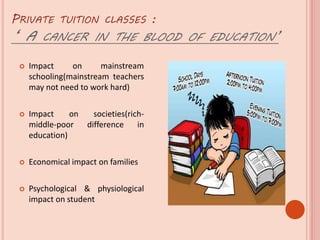
PRIVATE TUITION CLASSES :
‘ A CANCER IN THE BLOOD OF EDUCATION’
 Impact on mainstream
schooling(mainstream teachers
may not need to work hard)
 Impact on societies(rich-
middle-poor difference in
education)
 Economical impact on families
 Psychological & physiological
impact on student
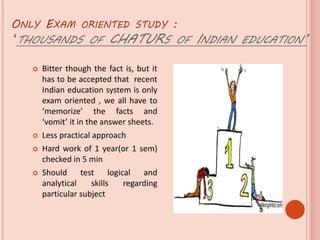
ONLY EXAM ORIENTED STUDY :
‘THOUSANDS OF CHATURS OF INDIAN EDUCATION’
 Bitter though the fact is, but it
has to be accepted that recent
Indian education system is only
exam oriented , we all have to
‘memorize’ the facts and
‘vomit’ it in the answer sheets.
 Less practical approach
 Hard work of 1 year(or 1 sem)
checked in 5 min
 Should test logical and
analytical skills regarding
particular subject
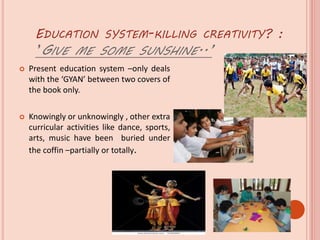
EDUCATION SYSTEM-KILLING CREATIVITY? :
’GIVE ME SOME SUNSHINE..’
 Present education system –only deals
with the ‘GYAN’ between two covers of
the book only.
 Knowingly or unknowingly , other extra
curricular activities like dance, sports,
arts, music have been buried under
the coffin –partially or totally.
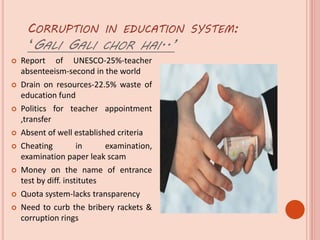
CORRUPTION IN EDUCATION SYSTEM:
‘GALI GALI CHOR HAI..’
 Report of UNESCO-25%-teacher
absenteeism-second in the world
 Drain on resources-22.5% waste of
education fund
 Politics for teacher appointment
,transfer
 Absent of well established criteria
 Cheating in examination,
examination paper leak scam
 Money on the name of entrance
test by diff. institutes
 Quota system-lacks transparency
 Need to curb the bribery rackets &
corruption rings
CAREER CHOICE ON PARENTS/ PUBLIC/TEACHER
ADVICE :
’KUCHH TO LOG KAHEGE..’
 Indian education system has a particular characteristic that in
it, the career of a student is decided by a parents /public /
teacher’s suggestion.
 Their suggestion should be taken into consideration while
thinking, but the final decision should be our-SELF DECISION.
 Career choice should be based on interest, hobby, & self
desire.
 This type of careers have more success rate & satisfaction level
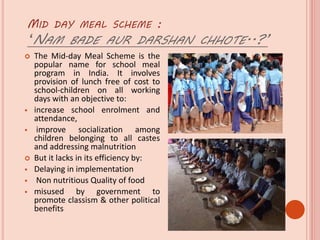
MID DAY MEAL SCHEME :
‘NAM BADE AUR DARSHAN CHHOTE..?’
 The Mid-day Meal Scheme is the
popular name for school meal
program in India. It involves
provision of lunch free of cost to
school-children on all working
days with an objective to:
 increase school enrolment and
attendance,
 improve socialization among
children belonging to all castes
and addressing malnutrition
 But it lacks in its efficiency by:
 Delaying in implementation
 Non nutritious Quality of food
 misused by government to
promote classism & other political
benefits
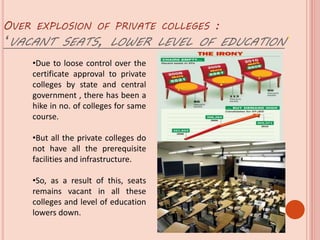
OVER EXPLOSION OF PRIVATE COLLEGES :
‘VACANT SEATS, LOWER LEVEL OF EDUCATION’
•Due to loose control over the
certificate approval to private
colleges by state and central
government , there has been a
hike in no. of colleges for same
course.
•But all the private colleges do
not have all the prerequisite
facilities and infrastructure.
•So, as a result of this, seats
remains vacant in all these
colleges and level of education
lowers down.
TOO OUTDATED SYLLABUS – MISMATCH WITH JOB
REQUIREMENTS:
‘OLD IS NOT GOLD..’
 Growing mismatch between the needs & education received
 Poor quality, outdated undergraduate education – created a
shortage of trained personal
 This has driven in company's training cost high
 Needed change in curriculam but we can’t accept a sudden
change-basics will remain same & atmost necessary
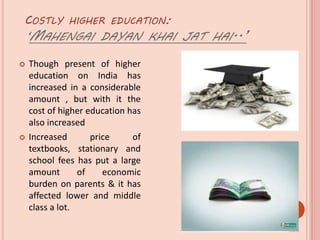
COSTLY HIGHER EDUCATION:
‘MAHENGAI DAYAN KHAI JAT HAI..’
 Though present of higher
education on India has
increased in a considerable
amount , but with it the
cost of higher education has
also increased
 Increased price of
textbooks, stationary and
school fees has put a large
amount of economic
burden on parents & it has
affected lower and middle
class a lot.
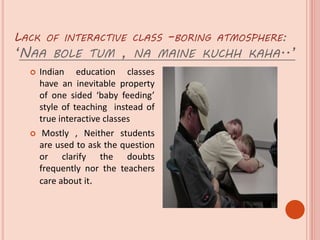
LACK OF INTERACTIVE CLASS –BORING ATMOSPHERE:
‘NAA BOLE TUM , NA MAINE KUCHH KAHA..’
 Indian education classes
have an inevitable property
of one sided ‘baby feeding’
style of teaching instead of
true interactive classes
 Mostly , Neither students
are used to ask the question
or clarify the doubts
frequently nor the teachers
care about it.
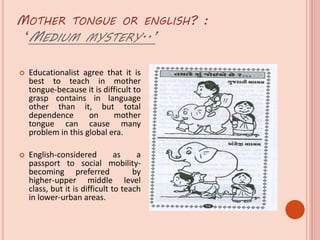
MOTHER TONGUE OR ENGLISH? :
‘MEDIUM MYSTERY..’
 Educationalist agree that it is
best to teach in mother
tongue-because it is difficult to
grasp contains in language
other than it, but total
dependence on mother
tongue can cause many
problem in this global era.
 English-considered as a
passport to social mobility-
becoming preferred by
higher-upper middle level
class, but it is difficult to teach
in lower-urban areas.
STRESS, DEPRESSION & INCREASING RATE
OF SUICIDE : ‘I QUIT..’
 Suicide rate has increased
from 7.9-10.3% -in which
major part is student suicide
 Reason of suicide :
 Ignorance & misperception by
parents & public
 Academic pressure from
parents for higher grades
 These increase No. are very
disturbing and demand
concrete solution
 Though many corresponds
programs have started –
needed to widen the area &
increase its efficiency.
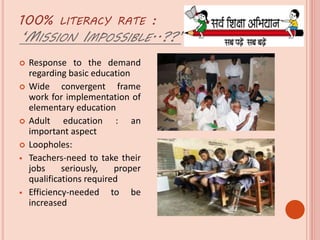
100% LITERACY RATE :
‘MISSION IMPOSSIBLE..??’
 Response to the demand
regarding basic education
 Wide convergent frame
work for implementation of
elementary education
 Adult education : an
important aspect
 Loopholes:
 Teachers-need to take their
jobs seriously, proper
qualifications required
 Efficiency-needed to be
increased
RURAL WOMEN EDUCATION :
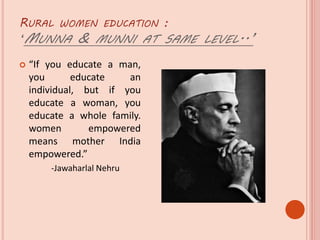
‘MUNNA & MUNNI AT SAME LEVEL..’
 “If you educate a man,
you educate an
individual, but if you
educate a woman, you
educate a whole family.
women empowered
means mother India
empowered.”
-Jawaharlal Nehru
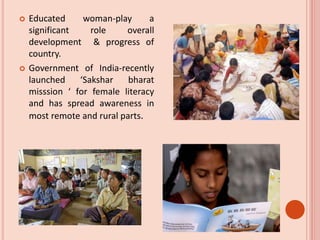
 Educated woman-play a
significant role overall
development & progress of
country.
 Government of India-recently
launched ‘Sakshar bharat
misssion ‘ for female literacy
and has spread awareness in
most remote and rural parts.
UNREASONABLE EXPECTATIONS OF STUDENT OF
PRESENT EDUCATION SYSTEM:
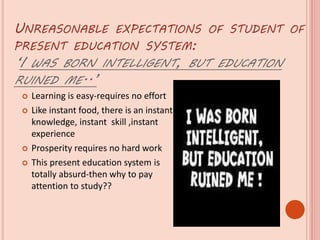
‘I WAS BORN INTELLIGENT, BUT EDUCATION
RUINED ME..’
 Learning is easy-requires no effort
 Like instant food, there is an instant
knowledge, instant skill ,instant
experience
 Prosperity requires no hard work
 This present education system is
totally absurd-then why to pay
attention to study??
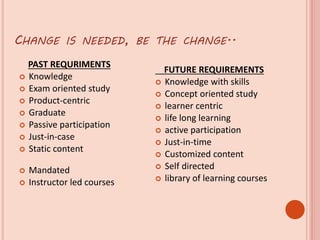
CHANGE IS NEEDED, BE THE CHANGE..
PAST REQURIMENTS
 Knowledge
 Exam oriented study
 Product-centric
 Graduate
 Passive participation
 Just-in-case
 Static content
 Mandated
 Instructor led courses
FUTURE REQUIREMENTS
 Knowledge with skills
 Concept oriented study
 learner centric
 life long learning
 active participation
 Just-in-time
 Customized content
 Self directed
 library of learning courses
REDEFINED GOALS OF EDUCATIONS
 Appropriate field of education
 Emerging demands of the profession
 Professional ethics & human values
 All round development : including moral and cultural
education
 Changing & emerging roles of :
 Leadership, governance
 Faculty, teaching, mentoring, assessment
 Redefined goals of technical education :
 Quality, excellence
 National relevance
 Social & societal responsibility
 Environmental & ecological responsibility
 Resource conversion
REFERENCES :
 Indian education system : an overview By
:St.Mark’s Sr. Sec. Public school, Meera Baugh, New
Delhi
 Educational access in India : by CREATE(consortium for
research on access, transition & equity)
 seminar at ‘International conference on engineering
education’- By : Prof. R.Natrajan(VP-national academy of
engineering)
THANK YOU…