DAYALBAGH EDUCATIONAL
INSITUTE
EDUCATION SYSTEM IN INDIA
PRESENTED BY:
ABHIJEET AGARWAL
MTECH 1ST YEAR
CONTENT
 Introduction & History of our Education system.
 Levels of the Education in systems.
 Current Scenario in Education Systems.
 Problems occur in the Education Systems.
 Change in Requirements.
 Solutions
INTRODUCTION & HISTORY
 The education is the basic necessity in the
human life without education human is not what
they are now so for the management of any
entity we need a system which can check and
help to reach this entity to everyone so that why
we need the Education System.
 Our education system has the long history and
when we see our history we found the various
things and the various way of study in different
era and these make the difference in both the
era
ANCIENT INDIA EDUCATION SYSTEM
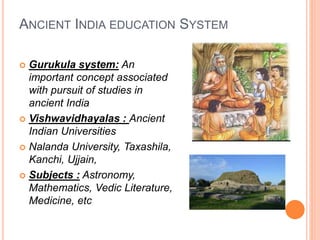
 Gurukula system: An
important concept associated
with pursuit of studies in
ancient India
 Vishwavidhayalas : Ancient
Indian Universities
 Nalanda University, Taxashila,
Kanchi, Ujjain,
 Subjects : Astronomy,
Mathematics, Vedic Literature,
Medicine, etc
CHANGE IN EDUCATION SYSTEM DUE TO
BRITISH IMPACT
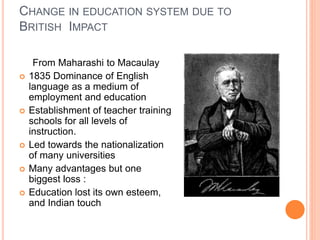
From Maharashi to Macaulay
 1835 Dominance of English
language as a medium of
employment and education
 Establishment of teacher training
schools for all levels of
instruction.
 Led towards the nationalization
of many universities
 Many advantages but one
biggest loss :
 Education lost its own esteem,
and Indian touch
INDIAN EDUCATION SYSTEM AFTER POST
INDEPENDENCE
 Strong central control over
education
 Guided by national goals,
aspirations as embodied in Indian
constitution
 National Policy on Education
(NPE) was adopted
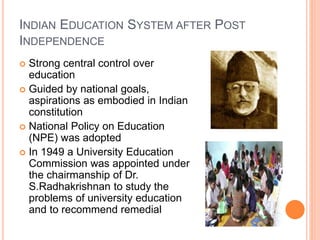
 In 1949 a University Education
Commission was appointed under
the chairmanship of Dr.
S.Radhakrishnan to study the
problems of university education
and to recommend remedial
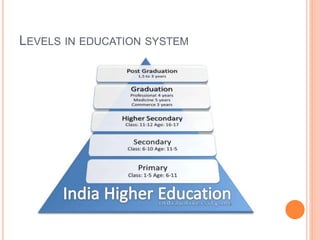
LEVELS IN EDUCATION SYSTEM
CURRENT SCENARIO IN EDUCATION SYSTEMS
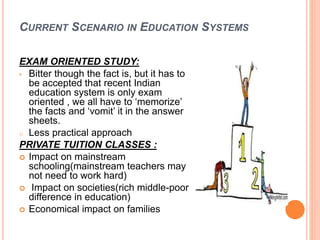
EXAM ORIENTED STUDY:
• Bitter though the fact is, but it has to
be accepted that recent Indian
education system is only exam
oriented , we all have to ‘memorize’
the facts and ‘vomit’ it in the answer
sheets.
o Less practical approach
PRIVATE TUITION CLASSES :
 Impact on mainstream
schooling(mainstream teachers may
not need to work hard)
 Impact on societies(rich middle-poor
difference in education)
 Economical impact on families
CORRUPTION IN EDUCATION
SYSTEM:
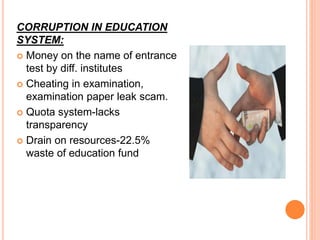
 Money on the name of entrance
test by diff. institutes
 Cheating in examination,
examination paper leak scam.
 Quota system-lacks
transparency
 Drain on resources-22.5%
waste of education fund
PROBLEMS OCCUR IN THE EDUCATION
SYSTEM:
 Politics for teacher appointment.
 Report of UNESCO-25%-teacher
absenteeism-second in the world.
 Indian education system has a
particular characteristic that in it,
the career of a student is decided
by a parents /public /teacher’s
suggestion.
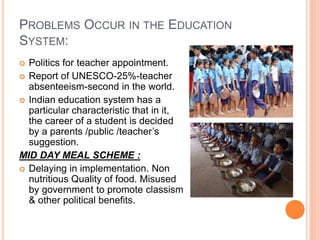
MID DAY MEAL SCHEME :
 Delaying in implementation. Non
nutritious Quality of food. Misused
by government to promote classism
& other political benefits.
OVER EXPLOSION OF PRIVATE
COLLEGES :
 Due to loose control over the
certificate approval to private
colleges by state and central
government , there has been a
hike in no. of colleges for same
course.
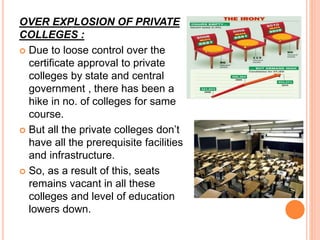
 But all the private colleges don’t
have all the prerequisite facilities
and infrastructure.
 So, as a result of this, seats
remains vacant in all these
colleges and level of education
lowers down.
TOO OUT DATED SYLLABUS –
MISMATCH WITH JOB
REQUIREMENTS:
 Growing mismatch between the
needs & education received
 Poor quality, outdated
undergraduate education created a
shortage of trained personal
 This has driven in company's
training cost high.
COSTLY HIGHER EDUCATION:
 Though present of higher education
on India has increased in a
considerable amount , but with it
the cost of higher education has
also increased
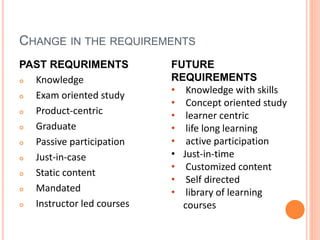
CHANGE IN THE REQUIREMENTS
PAST REQURIMENTS
 Knowledge
 Exam oriented study
 Product-centric
 Graduate
 Passive participation
 Just-in-case
 Static content
 Mandated
 Instructor led courses
FUTURE
REQUIREMENTS
• Knowledge with skills
• Concept oriented study
• learner centric
• life long learning
• active participation
• Just-in-time
• Customized content
• Self directed
• library of learning
courses
SOLUTIONS:
 Appropriate field of education
 Emerging demands of the profession
 Professional ethics & human values
 All round development : including moral and cultural
 Make the class more attractive
 Try to develop the skill base course so that they have
some practical experiences.
 Mid day meal scheme will be execute by much better
way.
 Need to curb the bribery rackets & corruption rings
 Should test logical and analytical skills regarding
particular subject
Changing & emerging roles of :
 Leadership, governance
 Faculty, teaching, mentoring, assessment
 Redefined goals of technical education :
 Quality, excellence
 National relevance
 Social & societal responsibility
 Environmental & ecological responsibility
 Resource conversion
Education System in India

Education System in India

  • 1.
    DAYALBAGH EDUCATIONAL INSITUTE EDUCATION SYSTEMIN INDIA PRESENTED BY: ABHIJEET AGARWAL MTECH 1ST YEAR
  • 2.
    CONTENT  Introduction &History of our Education system.  Levels of the Education in systems.  Current Scenario in Education Systems.  Problems occur in the Education Systems.  Change in Requirements.  Solutions
  • 3.
    INTRODUCTION & HISTORY The education is the basic necessity in the human life without education human is not what they are now so for the management of any entity we need a system which can check and help to reach this entity to everyone so that why we need the Education System.  Our education system has the long history and when we see our history we found the various things and the various way of study in different era and these make the difference in both the era
  • 4.
    ANCIENT INDIA EDUCATIONSYSTEM  Gurukula system: An important concept associated with pursuit of studies in ancient India  Vishwavidhayalas : Ancient Indian Universities  Nalanda University, Taxashila, Kanchi, Ujjain,  Subjects : Astronomy, Mathematics, Vedic Literature, Medicine, etc
  • 5.
    CHANGE IN EDUCATIONSYSTEM DUE TO BRITISH IMPACT From Maharashi to Macaulay  1835 Dominance of English language as a medium of employment and education  Establishment of teacher training schools for all levels of instruction.  Led towards the nationalization of many universities  Many advantages but one biggest loss :  Education lost its own esteem, and Indian touch
  • 6.
    INDIAN EDUCATION SYSTEMAFTER POST INDEPENDENCE  Strong central control over education  Guided by national goals, aspirations as embodied in Indian constitution  National Policy on Education (NPE) was adopted  In 1949 a University Education Commission was appointed under the chairmanship of Dr. S.Radhakrishnan to study the problems of university education and to recommend remedial
  • 7.
  • 8.
    CURRENT SCENARIO INEDUCATION SYSTEMS EXAM ORIENTED STUDY: • Bitter though the fact is, but it has to be accepted that recent Indian education system is only exam oriented , we all have to ‘memorize’ the facts and ‘vomit’ it in the answer sheets. o Less practical approach PRIVATE TUITION CLASSES :  Impact on mainstream schooling(mainstream teachers may not need to work hard)  Impact on societies(rich middle-poor difference in education)  Economical impact on families
  • 9.
    CORRUPTION IN EDUCATION SYSTEM: Money on the name of entrance test by diff. institutes  Cheating in examination, examination paper leak scam.  Quota system-lacks transparency  Drain on resources-22.5% waste of education fund
  • 10.
    PROBLEMS OCCUR INTHE EDUCATION SYSTEM:  Politics for teacher appointment.  Report of UNESCO-25%-teacher absenteeism-second in the world.  Indian education system has a particular characteristic that in it, the career of a student is decided by a parents /public /teacher’s suggestion. MID DAY MEAL SCHEME :  Delaying in implementation. Non nutritious Quality of food. Misused by government to promote classism & other political benefits.
  • 11.
    OVER EXPLOSION OFPRIVATE COLLEGES :  Due to loose control over the certificate approval to private colleges by state and central government , there has been a hike in no. of colleges for same course.  But all the private colleges don’t have all the prerequisite facilities and infrastructure.  So, as a result of this, seats remains vacant in all these colleges and level of education lowers down.
  • 12.
    TOO OUT DATEDSYLLABUS – MISMATCH WITH JOB REQUIREMENTS:  Growing mismatch between the needs & education received  Poor quality, outdated undergraduate education created a shortage of trained personal  This has driven in company's training cost high. COSTLY HIGHER EDUCATION:  Though present of higher education on India has increased in a considerable amount , but with it the cost of higher education has also increased
  • 13.
    CHANGE IN THEREQUIREMENTS PAST REQURIMENTS  Knowledge  Exam oriented study  Product-centric  Graduate  Passive participation  Just-in-case  Static content  Mandated  Instructor led courses FUTURE REQUIREMENTS • Knowledge with skills • Concept oriented study • learner centric • life long learning • active participation • Just-in-time • Customized content • Self directed • library of learning courses
  • 14.
    SOLUTIONS:  Appropriate fieldof education  Emerging demands of the profession  Professional ethics & human values  All round development : including moral and cultural  Make the class more attractive  Try to develop the skill base course so that they have some practical experiences.  Mid day meal scheme will be execute by much better way.  Need to curb the bribery rackets & corruption rings  Should test logical and analytical skills regarding particular subject
  • 15.
    Changing & emergingroles of :  Leadership, governance  Faculty, teaching, mentoring, assessment  Redefined goals of technical education :  Quality, excellence  National relevance  Social & societal responsibility  Environmental & ecological responsibility  Resource conversion