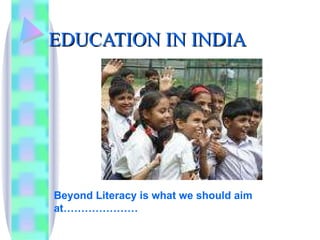
EDUCATION IN INDIA Beyond Literacy is what we should aim at…………………
OUTLINE INDIAN EDUCATION SYSTEM  PRIVATE EDUCATION WOMEN EDUCATION RURAL EDUCATION TECHNICAL EDUCATION ISSUES INITIATIVES GOVERNMENT INVOLVEMENT
 
National Council of Educational Research and Training  (NCERT) It is the apex body for school education in India. The NCERT provides support and technical assistance to a number of schools in India and oversees many aspects of enforcement of education policies
Other bodies……… The state government boards, in which the majority of Indian children are enrolled.  The Central Board of Secondary Education (CBSE) board.  The Council for the Indian School Certificate Examinations (CISCE) board.  The National Institute of Open Schooling.  Islamic Madrasah schools, whose boards are controlled by local state governments
Primary Education The Indian government lays emphasis to primary education up to the age of fourteen years The District Primary Education Program (DPEP) was launched in 1994  85% of the DPEP is funded by the central government and the remaining 15 percent is funded by the state. Indian government has also banned child labor
The DPEP, which has opened 160000 new schools including 84000 alternative education schools delivering alternative education to approximately 3.5 million children, is also supported by UNICEF and other international programs. Education has also been made free for children up to the age of 14 or class IX
Secondary Education The National Policy on Education (NPE), 1986, has provided for environment awareness, science and technology education, and introduction of traditional elements such as Yoga into the Indian secondary school system
Emphasis on profession based vocational training to help students attain skills for finding a vocation of his/her choosing A special Integrated Education for Disabled Children (IEDC) program was started in 1974 The Kendriya Vidyalaya project, was started in 1965 for the employees of the central government of India, who are distributed throughout the country.
TERTIARY EDUCATION India's higher education system is the third largest in the world, after China and the United States. The main governing body at the tertiary level is the University Grants Commission (India), which enforces its standards, advises the government, and helps  to coordinate between the centre and the state.
As of 2009, India has 20 central universities, 215 state universities, 100 deemed universities, 5 institutions established and functioning under the State Act, and 13 institutes which are of national importance Other institutions include 16000 colleges, including 1800 exclusive women's colleges, functioning under these universities and institutions
The emphasis in the tertiary level of education lies on science and technology As of 2006 some 1200 engineering colleges awarded degrees in India and approximately 380000 students were admitted in them The IITs enroll about 4000 students annually and the alumni have contributed to both the growth of the private sector and the public sectors of India.
Technical education India's National Policy on Education (NPE) provisioned for an apex body for regulation and development of higher technical education, which came into being as the All India Council for Technical Education (AICTE) in 1987 through an act of the Indian parliament
At the level of the centre the Indian Institutes of Technology are deemed of national importance. The Indian Institutes of Management are also among the nation's premier education facilities. Several Regional Engineering Colleges (REC) have been converted into National Institutes of Technology. The UGC has inter-university centres at a number of locations throughout India to promote common research, eg. the Nuclear Science Centre at the Jawaharlal Nehru University, New Delhi
PRIVATE EDUCATION Because of poor quality of public education, 27% of Indian children are privately educated Private schools cover the entire curriculum and offer extra-curricular activities such as science fairs, general knowledge, sports, music and drama Even the poorest often go to private schools despite the fact that government schools are free. A study found that 65% of schoolchildren in Hyderabad's slums attend private schools
WOMEN’S EDUCATION Women have much lower literacy rate The number of literate women among the female population of India was between 2-6% from the British Raj onwards to the formation of the Republic of India in 1947 By 2001 the literacy for women had exceeded 50% of the overall female population
RURAL EDUCATION The administrative control was effectively initiated in the 1950s, when, in 1952, the government grouped villages under a  Community Development Block —an authority under national program which could control education in up to 100 villages A Block Development Officer oversees a geographical area of 150 square miles which could contain a population of as many as 70000 people
ISSUES Gender Gaps- Three Out of Five girls attend School  Versus three Out of Four Boys Beyond Literacy-T here is a minimum threshold of education (more than 5 or 6 years) that must be achieved before there are significant improvements in female autonomy
Alternative Education- The Non-formal Education (NFE) program was created by the Indian Government in 1979-80 to reach Women of the World children that were not in the formal education system, particularly girls and working children. Fake degrees - In February 2009, the University Grant Commission found 19 fake institutions operating in India
Barriers to Education India Has a Shortage of Female Teachers Inadequate School Facilities Gender Bias in Curriculum Still Exists
Initiatives  Following India's independence a number of rules were formulated for the backward Scheduled Castes and the Scheduled Tribes of India, and in 1960 a list identifying 405 Scheduled Castes and 225 Scheduled Tribes was published by the central government. An amendment was made to the list in 1975, which identified 841 Scheduled Castes and 510 Scheduled Tribes
The government objective for the Sarva Shiksha Abhiyan (SSA), started in 2001, is to provide education to children between 6–14 years by 2010 The SSA also aims to provide practical infrastructure and relevant source material in form of free textbooks to children in remote areas. The government allowed 340 million rupees during 2007–08 to carry out this scheme over 83 districts including more than 21, 000 villages.
Currently there are 68  Bal Bhavans  and 10  Bal Kendra  affiliated to the  National Bal Bhavan
Government involvement  As a part of the tenth Five year Plan (2002–2007), the central government of India outlined an expenditure of 65.6% of its total education budget of Rs. 4,38,250 million, or (Rs. 2,87,500 million) on elementary education; 9.9% (Rs. 43,250 million) on secondary education; 2.9% (Rs. 12,500 million) on adult education; 9.5% (Rs. 41,765 million) on higher education; 10.7% (Rs. 47000 million) on technical education; and the remaining 1.4% (Rs. 6,235 million) on miscellaneous education schemes
Thank you………. Alka Soni NRO0202083

Education In India

  • 1.
    EDUCATION IN INDIABeyond Literacy is what we should aim at…………………
  • 2.
    OUTLINE INDIAN EDUCATIONSYSTEM PRIVATE EDUCATION WOMEN EDUCATION RURAL EDUCATION TECHNICAL EDUCATION ISSUES INITIATIVES GOVERNMENT INVOLVEMENT
  • 3.
  • 4.
    National Council ofEducational Research and Training (NCERT) It is the apex body for school education in India. The NCERT provides support and technical assistance to a number of schools in India and oversees many aspects of enforcement of education policies
  • 5.
    Other bodies……… Thestate government boards, in which the majority of Indian children are enrolled. The Central Board of Secondary Education (CBSE) board. The Council for the Indian School Certificate Examinations (CISCE) board. The National Institute of Open Schooling. Islamic Madrasah schools, whose boards are controlled by local state governments
  • 6.
    Primary Education TheIndian government lays emphasis to primary education up to the age of fourteen years The District Primary Education Program (DPEP) was launched in 1994 85% of the DPEP is funded by the central government and the remaining 15 percent is funded by the state. Indian government has also banned child labor
  • 7.
    The DPEP, whichhas opened 160000 new schools including 84000 alternative education schools delivering alternative education to approximately 3.5 million children, is also supported by UNICEF and other international programs. Education has also been made free for children up to the age of 14 or class IX
  • 8.
    Secondary Education TheNational Policy on Education (NPE), 1986, has provided for environment awareness, science and technology education, and introduction of traditional elements such as Yoga into the Indian secondary school system
  • 9.
    Emphasis on professionbased vocational training to help students attain skills for finding a vocation of his/her choosing A special Integrated Education for Disabled Children (IEDC) program was started in 1974 The Kendriya Vidyalaya project, was started in 1965 for the employees of the central government of India, who are distributed throughout the country.
  • 10.
    TERTIARY EDUCATION India'shigher education system is the third largest in the world, after China and the United States. The main governing body at the tertiary level is the University Grants Commission (India), which enforces its standards, advises the government, and helps to coordinate between the centre and the state.
  • 11.
    As of 2009,India has 20 central universities, 215 state universities, 100 deemed universities, 5 institutions established and functioning under the State Act, and 13 institutes which are of national importance Other institutions include 16000 colleges, including 1800 exclusive women's colleges, functioning under these universities and institutions
  • 12.
    The emphasis inthe tertiary level of education lies on science and technology As of 2006 some 1200 engineering colleges awarded degrees in India and approximately 380000 students were admitted in them The IITs enroll about 4000 students annually and the alumni have contributed to both the growth of the private sector and the public sectors of India.
  • 13.
    Technical education India'sNational Policy on Education (NPE) provisioned for an apex body for regulation and development of higher technical education, which came into being as the All India Council for Technical Education (AICTE) in 1987 through an act of the Indian parliament
  • 14.
    At the levelof the centre the Indian Institutes of Technology are deemed of national importance. The Indian Institutes of Management are also among the nation's premier education facilities. Several Regional Engineering Colleges (REC) have been converted into National Institutes of Technology. The UGC has inter-university centres at a number of locations throughout India to promote common research, eg. the Nuclear Science Centre at the Jawaharlal Nehru University, New Delhi
  • 15.
    PRIVATE EDUCATION Becauseof poor quality of public education, 27% of Indian children are privately educated Private schools cover the entire curriculum and offer extra-curricular activities such as science fairs, general knowledge, sports, music and drama Even the poorest often go to private schools despite the fact that government schools are free. A study found that 65% of schoolchildren in Hyderabad's slums attend private schools
  • 16.
    WOMEN’S EDUCATION Womenhave much lower literacy rate The number of literate women among the female population of India was between 2-6% from the British Raj onwards to the formation of the Republic of India in 1947 By 2001 the literacy for women had exceeded 50% of the overall female population
  • 17.
    RURAL EDUCATION Theadministrative control was effectively initiated in the 1950s, when, in 1952, the government grouped villages under a Community Development Block —an authority under national program which could control education in up to 100 villages A Block Development Officer oversees a geographical area of 150 square miles which could contain a population of as many as 70000 people
  • 18.
    ISSUES Gender Gaps-Three Out of Five girls attend School Versus three Out of Four Boys Beyond Literacy-T here is a minimum threshold of education (more than 5 or 6 years) that must be achieved before there are significant improvements in female autonomy
  • 19.
    Alternative Education- TheNon-formal Education (NFE) program was created by the Indian Government in 1979-80 to reach Women of the World children that were not in the formal education system, particularly girls and working children. Fake degrees - In February 2009, the University Grant Commission found 19 fake institutions operating in India
  • 20.
    Barriers to EducationIndia Has a Shortage of Female Teachers Inadequate School Facilities Gender Bias in Curriculum Still Exists
  • 21.
    Initiatives FollowingIndia's independence a number of rules were formulated for the backward Scheduled Castes and the Scheduled Tribes of India, and in 1960 a list identifying 405 Scheduled Castes and 225 Scheduled Tribes was published by the central government. An amendment was made to the list in 1975, which identified 841 Scheduled Castes and 510 Scheduled Tribes
  • 22.
    The government objectivefor the Sarva Shiksha Abhiyan (SSA), started in 2001, is to provide education to children between 6–14 years by 2010 The SSA also aims to provide practical infrastructure and relevant source material in form of free textbooks to children in remote areas. The government allowed 340 million rupees during 2007–08 to carry out this scheme over 83 districts including more than 21, 000 villages.
  • 23.
    Currently there are68 Bal Bhavans and 10 Bal Kendra affiliated to the National Bal Bhavan
  • 24.
    Government involvement As a part of the tenth Five year Plan (2002–2007), the central government of India outlined an expenditure of 65.6% of its total education budget of Rs. 4,38,250 million, or (Rs. 2,87,500 million) on elementary education; 9.9% (Rs. 43,250 million) on secondary education; 2.9% (Rs. 12,500 million) on adult education; 9.5% (Rs. 41,765 million) on higher education; 10.7% (Rs. 47000 million) on technical education; and the remaining 1.4% (Rs. 6,235 million) on miscellaneous education schemes
  • 25.
    Thank you………. AlkaSoni NRO0202083