TETRA
                       ASSOCIATION
Specialised TETRA terminals
            and
    Product Compliance
            Roger Dowling
     Board Member TETRA Association

           9th September 2009
                  Delhi
TETRA
                         ASSOCIATION
Part 1 – Specialised TETRA terminals
Extending Coverage of a TETRA Network
using Gateways and Repeaters
TETRA Surveillance Products
TETRA in hazardous environments (ATEX)

Part 2  ‐ Product Compliance
TETRA Interoperability (IOP)
Basic Requirements of any
                   TETRA Network/Terminal
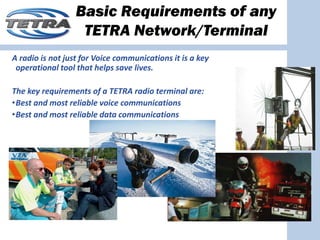
A radio is not just for Voice communications it is a key 
 operational tool that helps save lives.

The key requirements of a TETRA radio terminal are:
•Best and most reliable voice communications
•Best and most reliable data communications
Extended Coverage For Voice
                                   and Data


TMO Repeaters 
•   On frequency repeaters that extend TMO coverage only
•   Can be expensive and normally are fixed to a location – inflexible


DMO Gateways
•   Provide a link between TMO users and DMO users who may not have enough 
    RF power to reach the network


DMO Repeaters
•   Extend coverage between DMO users


         Some terminals can act as both Gateways and Repeaters
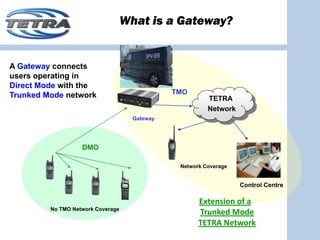
What is a Gateway?


A Gateway connects
users operating in
Direct Mode with the
Trunked Mode network                           TMO
                                                         TETRA
                                                         Network
                                     Gateway


                   DMO

                                                Network Coverage


                                                                   Control Centre

                                                      Extension of a 
         No TMO Network Coverage
                                                      Trunked Mode 
                                                      TETRA Network
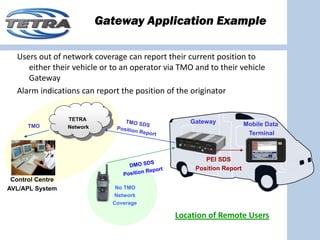
Gateway Application Example

  Users out of network coverage can report their current position to 
     either their vehicle or to an operator via TMO and to their vehicle 
     Gateway
  Alarm indications can report the position of the originator


                  TETRA                            Gateway
      TMO         Network                                             Mobile Data
                                                                       Terminal


                                                       PEI SDS
                                                    Position Report
 Control Centre
AVL/APL System                 No TMO
                              Network
                              Coverage

                                              Location of Remote Users
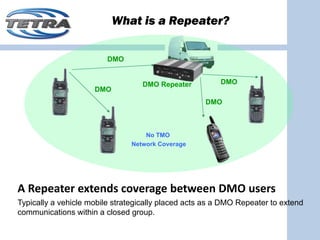
What is a Repeater?

                         DMO


                                   DMO Repeater         DMO
                     DMO
                                                    DMO


                                   No TMO
                               Network Coverage


A Repeater extends coverage between DMO users
Typically a vehicle mobile strategically placed acts as a DMO Repeater to extend
communications within a closed group.
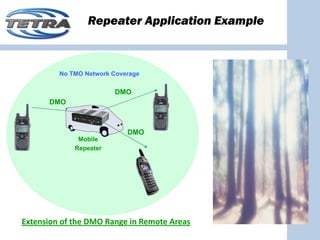
Repeater Application Example


         No TMO Network Coverage

                        DMO
      DMO


                            DMO
              Mobile
             Repeater


Extension of the DMO Range in Remote Areas
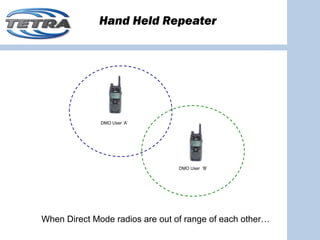
Hand Held Repeater


              DMO User ‘A’


                                 DMO User ‘B’


When Direct Mode radios are out of range of each other…
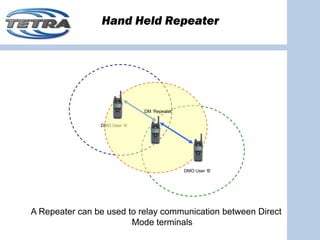
Hand Held Repeater


                               DM ‘Repeater’


                DMO User ‘A’


                                               DMO User ‘B’


A Repeater can be used to relay communication between Direct
                        Mode terminals
Users of Gateways & Repeaters

  Utility companies
  Fire Services
  Oil & Gas
  Public and Private Ambulance Services
  Police Services
  Airports
  Border Guards 

Many users now buy Gateway and Repeater hardware
enabled radios and add the functionality when needed.
TETRA
                          ASSOCIATION
Part 1 – Specialised TETRA terminals
 Extending Coverage of a TETRA Network 
 using Gateways and Repeaters
TETRA Surveillance Solutions

TETRA in hazardous environments (ATEX) 
Part 2  ‐ Product Compliance
TETRA Interoperability (IOP) 
User Community

• Police
• “Undercover” teams
• Specialist units
• Government Agencies
• Military
• Private Security Companies

 Any team that does not want to be seen carrying or 
                   using radios
User Roles

• Surveillance teams
• Firearms/Sniper teams
• Intelligence gathering
• Personal protection


          Any role where secure, covert 
          communications are a necessity
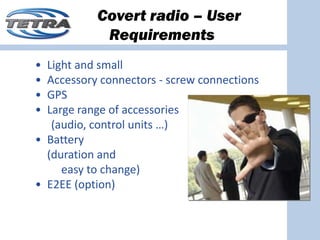
Covert radio – User
            Requirements
• Light and small
• Accessory connectors ‐ screw connections
• GPS
• Large range of accessories
   (audio, control units …)
• Battery 
  (duration and 
     easy to change)
• E2EE (option)
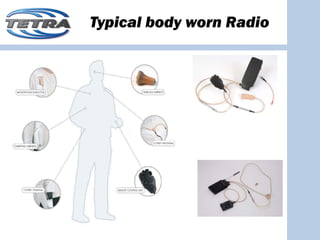
Typical body worn Radio
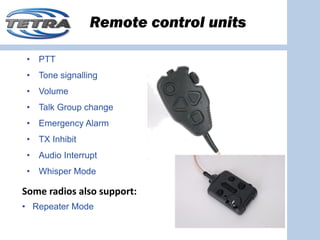
Remote control units

 •   PTT
 •   Tone signalling
 •   Volume
 •   Talk Group change
 •   Emergency Alarm
 •   TX Inhibit
 •   Audio Interrupt
 •   Whisper Mode

Some radios also support:
• Repeater Mode
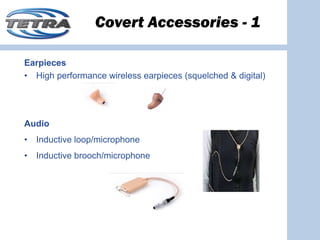
Covert Accessories - 1

Earpieces
• High performance wireless earpieces (squelched & digital)


Audio
•   Inductive loop/microphone
•   Inductive brooch/microphone
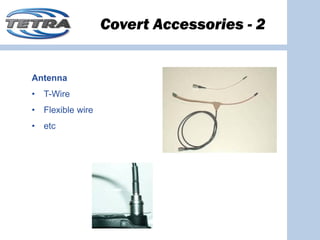
Covert Accessories - 2


Antenna
•   T-Wire
•   Flexible wire
•   etc
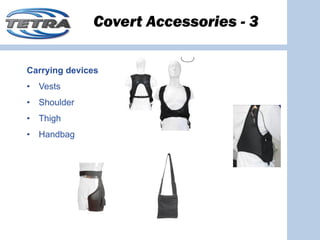
Covert Accessories - 3

Carrying devices
•   Vests
•   Shoulder
•   Thigh
•   Handbag
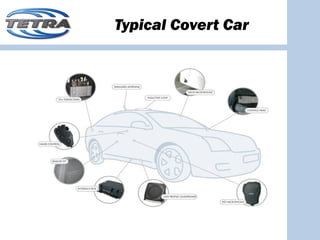
Typical Covert Car
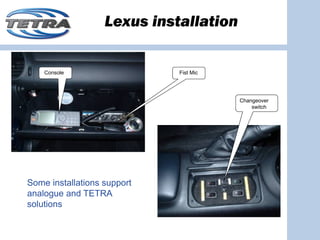
Lexus installation


    Console                  Fist Mic


                                        Changeover
                                            switch


Some installations support
analogue and TETRA
solutions
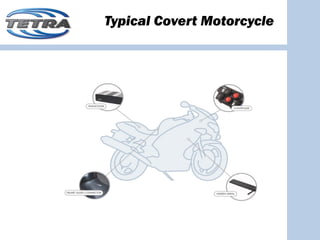
Typical Covert Motorcycle
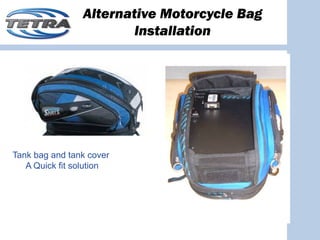
Alternative Motorcycle Bag
                        Installation


Tank bag and tank cover
   A Quick fit solution
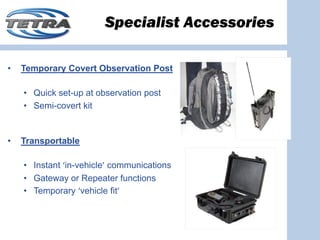
Specialist Accessories

•   Temporary Covert Observation Post

    • Quick set-up at observation post
    • Semi-covert kit


•   Transportable

    • Instant ‘in-vehicle’ communications
    • Gateway or Repeater functions
    • Temporary ‘vehicle fit’
Supporting Products

End to End Encryption
•   Provides secure transmission of voice and SDS data.
         (Decoded ONLY with correct algorithm and traffic key)

Gateways
•   Extends network coverage

Repeaters
•   Improves coverage in buildings and tunnels

GPS option

•   Provides enhanced user safety, improved resource usage
    and improved reporting accuracy
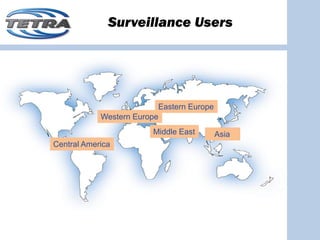
Surveillance Users


                          Eastern Europe
            Western Europe
                         Middle East       Asia
Central America
TETRA
                          ASSOCIATION
Part 1 – Specialised TETRA terminals
 Extending Coverage of a TETRA Network 
 using Gateways and Repeaters

 TETRA Surveillance Solutions

TETRA in hazardous environments (ATEX)

Part 2  ‐ Product Compliance
TETRA Interoperability (IOP) 
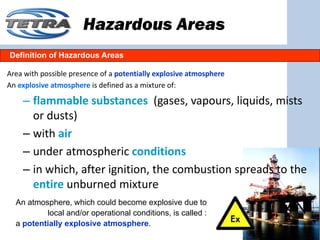
Hazardous Areas
Definition of Hazardous Areas

Area with possible presence of a potentially explosive atmosphere
An explosive atmosphere is defined as a mixture of: 

    – flammable substances (gases, vapours, liquids, mists 
      or dusts)
    – with air
    – under atmospheric conditions
    – in which, after ignition, the combustion spreads to the 
      entire unburned mixture
  An atmosphere, which could become explosive due to
          local and/or operational conditions, is called :
  a potentially explosive atmosphere.
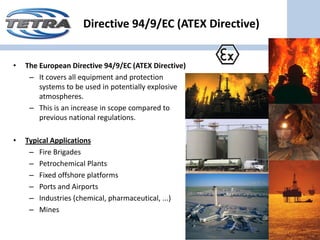
Directive 94/9/EC (ATEX Directive) 


•   The European Directive 94/9/EC (ATEX Directive)
     – It covers all equipment and protection 
        systems to be used in potentially explosive 
        atmospheres. 
     – This is an increase in scope compared to 
        previous national regulations. 

•   Typical Applications
     – Fire Brigades
     – Petrochemical Plants
     – Fixed offshore platforms
     – Ports and Airports
     – Industries (chemical, pharmaceutical, ...)
     – Mines 
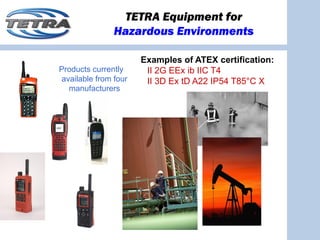
TETRA Equipment for
               Hazardous Environments

                      Examples of ATEX certification:
Products currently     II 2G EEx ib IIC T4
available from four    II 3D Ex tD A22 IP54 T85°C X
  manufacturers
Oil and Gas & Fire Services

• Pipelines and refineries in Africa, Asia ‐ Middle East, Europe , 
  Russia and South America
• Fire Brigades in Europe
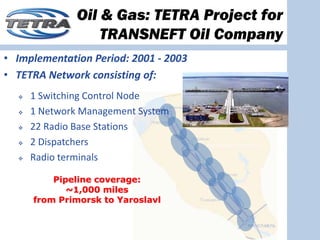
Oil & Gas: TETRA Project for
                  TRANSNEFT Oil Company
• Implementation Period: 2001 ‐ 2003
• TETRA Network consisting of:
     1 Switching Control Node
     1 Network Management System
     22 Radio Base Stations
     2 Dispatchers
     Radio terminals

         Pipeline coverage:
            ~1,000 miles
     from Primorsk to Yaroslavl
and Ferrari !
TETRA
                          ASSOCIATION
Part 1 – Specialised TETRA terminals
 Extending Coverage of a TETRA Network 
 using Gateways and Repeaters

 TETRA Surveillance Solutions

TETRA in hazardous environments (ATEX) 
Part 2  ‐ Product Compliance
TETRA Interoperability (IOP)
What is
                 Interoperability (IOP)?
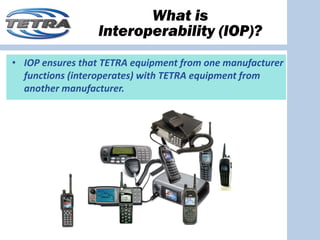
• IOP ensures that TETRA equipment from one manufacturer 
  functions (interoperates) with TETRA equipment from 
  another manufacturer.
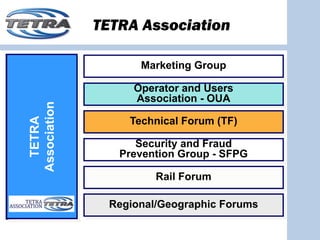
TETRA Association

                     Marketing Group

                    Operator and Users
                    Association - OUA
Association
  TETRA


                   Technical Forum (TF)

                    Security and Fraud
                 Prevention Group - SFPG

                        Rail Forum

                Regional/Geographic Forums
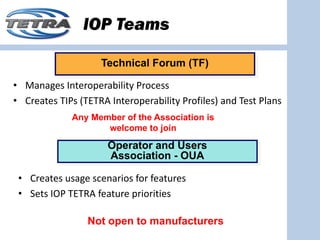
IOP Teams

                    Technical Forum (TF)

• Manages Interoperability Process
• Creates TIPs (TETRA Interoperability Profiles) and Test Plans
             Any Member of the Association is
                    welcome to join

                      Operator and Users
                      Association - OUA

 • Creates usage scenarios for features 
 • Sets IOP TETRA feature priorities

                 Not open to manufacturers
Do I need Interoperability?


• One Supplier
  – makes life easier for operator & user
  – the supplier ensures that infrastructure & terminals 
    operate together?

  – No one supplier provides every type of terminal
  – Dependent on one supplier’s development timescales
  – Features not always released on infrastructure & terminals 
    at same time
  – Locked in – watch the price of enhancements 

 When you buy your cell phone – do you ask who
            supplied the network?
Benefits of an open
                  multi-vendor market

• User benefits
  –   wide choice of compatible terminals – 10+ suppliers
  –   specialised products for special needs
  –   continuous and fast product development & innovation
  –   genuine competition, hence lower prices (c.f. P25)
  –   reduced dependency on a single supplier
• Industry benefits
  – larger market, greater volumes
  – increased possibility to invest – faster product creation
  – Market longevity

The TETRA Association created the IOP certification
 process to guarantee an open multi-vendor market
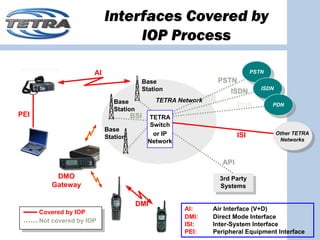
Interfaces Covered by
                                 IOP Process

                       AI                                                     PSTN
                                          Base                  PSTN
                                          Station                                ISDN
                                                                    ISDN
                               Base            TETRA Network
                                                                        PDN          PDN
                               Station
PEI                                   BSI   TETRA
                                             Switch
                            Base
                                              or IP                     ISI             Other TETRA
                            Station                                                      Networks
                                            Network


                                                                  API
           DMO                                                   3rd Party
          Gateway                                                Systems

                                         DMI
                                                       AI:     Air Interface (V+D)
      Covered by IOP
                                                       DMI:    Direct Mode Interface
      Not covered by IOP
                                                       ISI:    Inter-System Interface
                                                       PEI:    Peripheral Equipment Interface
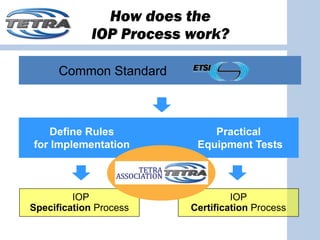
How does the
             IOP Process work?

      Common Standard


   Define Rules              Practical
for Implementation        Equipment Tests


         IOP                      IOP
Specification Process    Certification Process
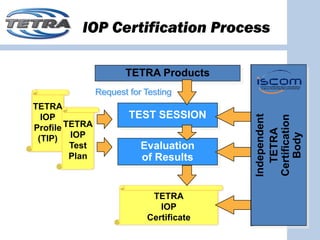
IOP Certification Process

                       TETRA Products
                Request for Testing
TETRA
                        TEST SESSION


                                          Independent
  IOP


                                          Certification
Profile TETRA


                                             TETRA
 (TIP) IOP


                                              Body
         Test              Evaluation
         Plan              of Results


                             TETRA
                               IOP
                            Certificate
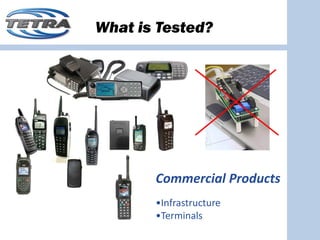
What is Tested?


       Commercial Products
       •Infrastructure
       •Terminals
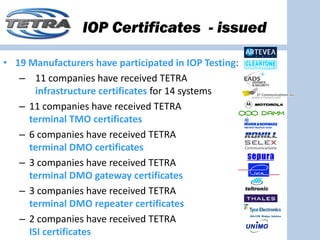
IOP Certificates - issued

• 19 Manufacturers have participated in IOP Testing:
   – 11 companies have received TETRA 
       infrastructure certificates for 14 systems
   – 11 companies have received TETRA
     terminal TMO certificates
   – 6 companies have received TETRA 
     terminal DMO certificates
   – 3 companies have received TETRA
     terminal DMO gateway certificates
   – 3 companies have received TETRA
     terminal DMO repeater certificates
   – 2 companies have received TETRA
     ISI certificates
IOP Certificates

• Over 300 Certificates issued
• Certificates available 
                              (Free)
     for download:
  www.tetra‐association.com
   Using TETRA 
   Interoperability

IOP is a mature well established process 
  & A key factor behind the Worldwide 
            Success of TETRA
Thank You - Any Questions?


          Contact:


     Roger Dowling

e-mail: roger.dowling@sepura.com

India2009 Dowling

  • 1.
    TETRA ASSOCIATION Specialised TETRA terminals and Product Compliance Roger Dowling Board Member TETRA Association 9th September 2009 Delhi
  • 2.
    TETRA ASSOCIATION Part 1 – Specialised TETRA terminals Extending Coverage of a TETRA Network using Gateways and Repeaters TETRA Surveillance Products TETRA in hazardous environments (ATEX) Part 2  ‐ Product Compliance TETRA Interoperability (IOP)
  • 3.
    Basic Requirements ofany TETRA Network/Terminal A radio is not just for Voice communications it is a key  operational tool that helps save lives. The key requirements of a TETRA radio terminal are: •Best and most reliable voice communications •Best and most reliable data communications
  • 4.
    Extended Coverage ForVoice and Data TMO Repeaters  • On frequency repeaters that extend TMO coverage only • Can be expensive and normally are fixed to a location – inflexible DMO Gateways • Provide a link between TMO users and DMO users who may not have enough  RF power to reach the network DMO Repeaters • Extend coverage between DMO users Some terminals can act as both Gateways and Repeaters
  • 5.
    What is aGateway? A Gateway connects users operating in Direct Mode with the Trunked Mode network TMO TETRA Network Gateway DMO Network Coverage Control Centre Extension of a  No TMO Network Coverage Trunked Mode  TETRA Network
  • 6.
    Gateway Application Example Users out of network coverage can report their current position to  either their vehicle or to an operator via TMO and to their vehicle  Gateway Alarm indications can report the position of the originator TETRA Gateway TMO Network Mobile Data Terminal PEI SDS Position Report Control Centre AVL/APL System No TMO Network Coverage Location of Remote Users
  • 7.
    What is aRepeater? DMO DMO Repeater DMO DMO DMO No TMO Network Coverage A Repeater extends coverage between DMO users Typically a vehicle mobile strategically placed acts as a DMO Repeater to extend communications within a closed group.
  • 8.
    Repeater Application Example No TMO Network Coverage DMO DMO DMO Mobile Repeater Extension of the DMO Range in Remote Areas
  • 9.
    Hand Held Repeater DMO User ‘A’ DMO User ‘B’ When Direct Mode radios are out of range of each other…
  • 10.
    Hand Held Repeater DM ‘Repeater’ DMO User ‘A’ DMO User ‘B’ A Repeater can be used to relay communication between Direct Mode terminals
  • 11.
    Users of Gateways& Repeaters Utility companies Fire Services Oil & Gas Public and Private Ambulance Services Police Services Airports Border Guards  Many users now buy Gateway and Repeater hardware enabled radios and add the functionality when needed.
  • 12.
    TETRA ASSOCIATION Part 1 – Specialised TETRA terminals Extending Coverage of a TETRA Network  using Gateways and Repeaters TETRA Surveillance Solutions TETRA in hazardous environments (ATEX)  Part 2  ‐ Product Compliance TETRA Interoperability (IOP) 
  • 13.
    User Community • Police •“Undercover” teams • Specialist units • Government Agencies • Military • Private Security Companies Any team that does not want to be seen carrying or  using radios
  • 14.
    User Roles • Surveillance teams •Firearms/Sniper teams • Intelligence gathering • Personal protection Any role where secure, covert  communications are a necessity
  • 15.
    Covert radio –User Requirements • Light and small • Accessory connectors ‐ screw connections • GPS • Large range of accessories (audio, control units …) • Battery  (duration and  easy to change) • E2EE (option)
  • 16.
  • 17.
    Remote control units • PTT • Tone signalling • Volume • Talk Group change • Emergency Alarm • TX Inhibit • Audio Interrupt • Whisper Mode Some radios also support: • Repeater Mode
  • 18.
    Covert Accessories -1 Earpieces • High performance wireless earpieces (squelched & digital) Audio • Inductive loop/microphone • Inductive brooch/microphone
  • 19.
    Covert Accessories -2 Antenna • T-Wire • Flexible wire • etc
  • 20.
    Covert Accessories -3 Carrying devices • Vests • Shoulder • Thigh • Handbag
  • 21.
  • 22.
    Lexus installation Console Fist Mic Changeover switch Some installations support analogue and TETRA solutions
  • 23.
  • 24.
    Alternative Motorcycle Bag Installation Tank bag and tank cover A Quick fit solution
  • 25.
    Specialist Accessories • Temporary Covert Observation Post • Quick set-up at observation post • Semi-covert kit • Transportable • Instant ‘in-vehicle’ communications • Gateway or Repeater functions • Temporary ‘vehicle fit’
  • 26.
    Supporting Products End toEnd Encryption • Provides secure transmission of voice and SDS data. (Decoded ONLY with correct algorithm and traffic key) Gateways • Extends network coverage Repeaters • Improves coverage in buildings and tunnels GPS option • Provides enhanced user safety, improved resource usage and improved reporting accuracy
  • 27.
    Surveillance Users Eastern Europe Western Europe Middle East Asia Central America
  • 28.
    TETRA ASSOCIATION Part 1 – Specialised TETRA terminals Extending Coverage of a TETRA Network  using Gateways and Repeaters TETRA Surveillance Solutions TETRA in hazardous environments (ATEX) Part 2  ‐ Product Compliance TETRA Interoperability (IOP) 
  • 29.
    Hazardous Areas Definition ofHazardous Areas Area with possible presence of a potentially explosive atmosphere An explosive atmosphere is defined as a mixture of:  – flammable substances (gases, vapours, liquids, mists  or dusts) – with air – under atmospheric conditions – in which, after ignition, the combustion spreads to the  entire unburned mixture An atmosphere, which could become explosive due to local and/or operational conditions, is called : a potentially explosive atmosphere.
  • 30.
    Directive 94/9/EC (ATEX Directive)  • The European Directive 94/9/EC (ATEX Directive) – It covers all equipment and protection  systems to be used in potentially explosive  atmospheres.  – This is an increase in scope compared to  previous national regulations.  • Typical Applications – Fire Brigades – Petrochemical Plants – Fixed offshore platforms – Ports and Airports – Industries (chemical, pharmaceutical, ...) – Mines 
  • 31.
    TETRA Equipment for Hazardous Environments Examples of ATEX certification: Products currently II 2G EEx ib IIC T4 available from four II 3D Ex tD A22 IP54 T85°C X manufacturers
  • 32.
    Oil and Gas& Fire Services • Pipelines and refineries in Africa, Asia ‐ Middle East, Europe ,  Russia and South America • Fire Brigades in Europe
  • 33.
    Oil & Gas:TETRA Project for TRANSNEFT Oil Company • Implementation Period: 2001 ‐ 2003 • TETRA Network consisting of: 1 Switching Control Node 1 Network Management System 22 Radio Base Stations 2 Dispatchers Radio terminals Pipeline coverage: ~1,000 miles from Primorsk to Yaroslavl
  • 34.
  • 35.
    TETRA ASSOCIATION Part 1 – Specialised TETRA terminals Extending Coverage of a TETRA Network  using Gateways and Repeaters TETRA Surveillance Solutions TETRA in hazardous environments (ATEX)  Part 2  ‐ Product Compliance TETRA Interoperability (IOP)
  • 36.
    What is Interoperability (IOP)? • IOP ensures that TETRA equipment from one manufacturer  functions (interoperates) with TETRA equipment from  another manufacturer.
  • 37.
    TETRA Association Marketing Group Operator and Users Association - OUA Association TETRA Technical Forum (TF) Security and Fraud Prevention Group - SFPG Rail Forum Regional/Geographic Forums
  • 38.
    IOP Teams Technical Forum (TF) • Manages Interoperability Process • Creates TIPs (TETRA Interoperability Profiles) and Test Plans Any Member of the Association is welcome to join Operator and Users Association - OUA • Creates usage scenarios for features  • Sets IOP TETRA feature priorities Not open to manufacturers
  • 39.
    Do I needInteroperability? • One Supplier – makes life easier for operator & user – the supplier ensures that infrastructure & terminals  operate together? – No one supplier provides every type of terminal – Dependent on one supplier’s development timescales – Features not always released on infrastructure & terminals  at same time – Locked in – watch the price of enhancements  When you buy your cell phone – do you ask who supplied the network?
  • 40.
    Benefits of anopen multi-vendor market • User benefits – wide choice of compatible terminals – 10+ suppliers – specialised products for special needs – continuous and fast product development & innovation – genuine competition, hence lower prices (c.f. P25) – reduced dependency on a single supplier • Industry benefits – larger market, greater volumes – increased possibility to invest – faster product creation – Market longevity The TETRA Association created the IOP certification process to guarantee an open multi-vendor market
  • 41.
    Interfaces Covered by IOP Process AI PSTN Base PSTN Station ISDN ISDN Base TETRA Network PDN PDN Station PEI BSI TETRA Switch Base or IP ISI Other TETRA Station Networks Network API DMO 3rd Party Gateway Systems DMI AI: Air Interface (V+D) Covered by IOP DMI: Direct Mode Interface Not covered by IOP ISI: Inter-System Interface PEI: Peripheral Equipment Interface
  • 42.
    How does the IOP Process work? Common Standard Define Rules Practical for Implementation Equipment Tests IOP IOP Specification Process Certification Process
  • 43.
    IOP Certification Process TETRA Products Request for Testing TETRA TEST SESSION Independent IOP Certification Profile TETRA TETRA (TIP) IOP Body Test Evaluation Plan of Results TETRA IOP Certificate
  • 44.
    What is Tested? Commercial Products •Infrastructure •Terminals
  • 45.
    IOP Certificates -issued • 19 Manufacturers have participated in IOP Testing: – 11 companies have received TETRA  infrastructure certificates for 14 systems – 11 companies have received TETRA terminal TMO certificates – 6 companies have received TETRA  terminal DMO certificates – 3 companies have received TETRA terminal DMO gateway certificates – 3 companies have received TETRA terminal DMO repeater certificates – 2 companies have received TETRA ISI certificates
  • 46.
    IOP Certificates • Over 300 Certificates issued •Certificates available  (Free) for download: www.tetra‐association.com Using TETRA  Interoperability IOP is a mature well established process  & A key factor behind the Worldwide  Success of TETRA
  • 47.
    Thank You -Any Questions? Contact: Roger Dowling e-mail: roger.dowling@sepura.com