EMERGING
MARKETS
-INDIA
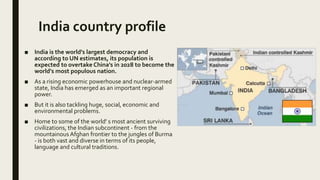
India country profile
■ India is the world's largest democracy and
according to UN estimates, its population is
expected to overtake China's in 2028 to become the
world's most populous nation.
■ As a rising economic powerhouse and nuclear-armed
state, India has emerged as an important regional
power.
■ But it is also tackling huge, social, economic and
environmental problems.
■ Home to some of the world' s most ancient surviving
civilizations, the Indian subcontinent - from the
mountainous Afghan frontier to the jungles of Burma
- is both vast and diverse in terms of its people,
language and cultural traditions.
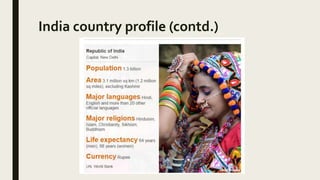
India country profile (contd.)
Characteristics of the Indian Economy
Low per capita income
■ In India, the national income and per capita income is very low and it is considered as
one of the basic features of underdevelopment.
■ As perWorld Bank estimates, the per capita income of India stood at only $ 720 in
2005.
■ Keeping aside a very few countries, this per capita income figure of India is the lowest
in the world and it is even lower thanChina and Pakistan.
Excessive dependence of agriculture
and primary producing
■ Indian economy is characterised by too much dependence on agriculture and thus it is
primary producing.
■ Out of the total working population of our country, a very high proportion of it is
engaged in agriculture and allied activities, which contributed a large share in the
national income of our country.
■ In 2004, nearly 58 per cent of the total working population of our country was engaged
in agriculture and allied activities and was contributing about 21.0 per cent of the total
national income.
High rate of population growth
■ In India, the rate of growth of population has been gradually increasing from 1.31 per
cent annually during 1941-50 to 2.5 per cent annually during 1971-81 to 2.11 per cent
annually during 1981-91 and then finally to 1.77 per cent during 2001-2011.
■ The prime cause behind this rapid growth of population is the steep fall in its death
rate from 49 per thousand during 1911-20 to 7.1 per thousand in 2011.
■ On the other hand, compared to its death rate, the birth rate of our population has
gradually declined from 49 per thousand during 1911-20 to 21.8 per thousand in 2011.
Existence of chronic unemployment
and under-employment
■ During the 5 year period of 1990-95, new entrants to the labour force are estimated to
be around 37 million.
■ To put it in another way we can guess that total burden of unemployment during this
Eighth Plan would be around 65 million which is a matter of serious concern for the
economy of our country.
■ The incidence of unemployment on CDS basis increased from 7.31 per cent of labour
force in 1999-2000 to 8.28 per cent of labour force in 2004-05.
Poor rate of capital formation
■ Capital deficiency is one of the characteristic features of the Indian economy.
■ Both the amount of capital available per head and the present rate of capital
formation in India is very low.
■ Consumption of crude steel and energy are the two important indicators of low capital
per head in the under-developed countries like India.
Inequality in the distribution of wealth
■ Another important characteristic of the Indian economy is the mal-distribution of
wealth:
■ The report of the Reserve Bank of India reveals that nearly 20 per cent of the
households owing less than Rs 1000 worth of assets possess only 0.7 per cent of the
total assets.
■ Moreover, 51 per cent of the households owing less than Rs 5000 worth of assets
possessed barely 8 per cent of the total assets.
■ Lastly, the top four per cent households possessing assets worth more than Rs 50,000
held more than 31 per cent of the total assets.
Low level of technology
■ Prevalence of low level of technology is one of the important characteristics of an
underdeveloped economy like India.
■ The economy of our country is thus suffering from technological backwardness.
■ Obsolete techniques of production are largely being applied in both the agricultural
and industrial sectors of our country.
Under-utilisation of natural resources
■ In respect of natural endowments India is considered as a very rich country.Various
types of natural resources, viz., land, water, minerals, forest and power resources are
available in sufficient quantity in the various parts of the country.
■ A huge quantity of mineral and forest resources of India still remains largely
unexplored. Until recently, India was not in position to develop even 5 per cent of total
hydropower potential of the country.
Lack of infrastructure
■ Lack of infrastructural facilities is one of the serious problems from which the Indian
economy has been suffering till today.
■ These infrastructural facilities include transportation and communication facilities,
electricity generation and distribution, banking and credit facilities, economic
organisation, health and educational institutes etc.
■ The two most vital sectors, i.e. agriculture and industry could not make much
headway in the absence of proper infrastructural facilities in the country.
Low level of living
■ The standard of living of Indian people in general is considered as very low. Nearly 25
to 40 per cent of the population in India suffers from malnutrition.
■ The average protein content in the Indian diet is about 49 grams only per day in
comparison to that of more than double the level in the developed countries of the
world.
■ In 1996 the daily average calorie intake of food in India was only 2,415 in comparison
to that of 3,400 calories per day in various developed countries of the world.
Poor quality of human capital
■ Indian economy is suffering from its poor quality of human capital. Mass illiteracy is
the root of this problem and illiteracy at the same time is retarding the process of
economic growth of our country.
■ As per 2001 census, 65.3 per cent of the total population of India is literate and the rest
34.7 per cent still remains illiterate.
■ In most of the developed countries like U.S.A., U.K., Canada,Australia etc. the level of
illiteracy is even below 3 per cent.
■ Moreover, the problem of illiteracy in India makes way for conservatism and this is
going against the economy of the country.
Demographic characteristics
■ The demographic characteristics of India are not at all satisfactory rather these are
associated with high density of population, a smaller proportion of the population in
working age group of 15-60 years and a comparatively larger proportion of population
in the minor age group of 0-15 years.
■ As per 2011 census, the density of population in India was 382 per sq km. as compared
with world density of population of 41 per sq km.
Inadequate development of economic
organisation
■ In India the development of financial institutions is .still inadequate in the rural areas.
■ There is the urgent need to develop certain credit agencies for advancing loan to small
farmers on easy terms as well as to provide long term and medium term loan to
industries.
■ For protecting poor tenants from the clutches of landlords, proper enforcement of
tenancy legislation is very much necessary.
■ All these require maintenance of honest and efficient administrative machinery which
India is lacking very much.
INDIA ON GROWTH PATH SUPPORTED BY KEY
REFORMS AND HIGHER INVESTMENTS
9.7
9.2
6.8
8.4
9.3
6.7
4.5 4.7
6.4
GDP growth at factor cost ( per cent)
-2
0
2
4
6
8
10
12
14
GDP at factor cost Agriculture, forestry & fishing
Industry Services
GDP and components – growth ( per cent)
According to the World Bank, Indian economy is estimated
to expand 6.4 per cent during FY15
Higher investment in the infrastructure sector, key reforms
in taxation, coal mining auctions, among others would boost
the economy
Current decrease in crude prices would support narrow
deficits
The government plans to spend USD1 trillion on
infrastructure during FY12–17
Growth in the Indian economy is mainly supported by
growth in the service and industry sectors
The government would introduce Goods and Services Tax
(GST), which would create substantial savings for
companies on logistics. This would positively affect on
industrial production
Major contributors were the finance and real estate sectors,
which witnessed double-digit growth in the last 7–8 years
COUNTRY TO RECORD HIGHEST FOODGRAIN PRODUCTION IN
FY 2014
99
89 96
105 105 106
81 81 87
95 94 96
15 15 18 17 18 20
234
218
244
259 257 264
0
50
100
150
200
250
300
0
20
40
60
80
100
120
FY09 FY10 FY11 FY12 FY13 FY14*
Rice
Wheat
Total Pulses
Total Foodgrains (RHS)
Production of major agricultural crops (in Million Tonnes)
Scanty rainfall in FY10 affected foodgrain production. Orissa, Jharkhand and Bihar faced a deficit of 55 per cent, 47 per cent and 28
per cent, respectively
Foodgrain production increased at a CAGR of 2.4 per cent from 234 million tonnes in FY09 to an estimated 264 million tonnes in
FY14
Major growth was observed in production of pulses, which rose at CAGR of 6.1 per cent from 15 million tonnes in FY09 to an
estimated 20 million tonnes in FY14
India ranks second in the production of rice, sugarcane, potatoes, wheat, garlic and tomatoes
During FY13, Indian household spent USD20.3 billion on food, indicating good business opportunity
The country has estimated highest ever foodgrain production of 264 million tonnes during FY14
IMPROVING TRADE BALANCE (1/2)
185 179
251
306 300 313304 288
370
489 491
450
-118
-110
-119
-183 -190
-137
-250
-200
-150
-100
-50
00
100
200
300
400
500
600
FY09 FY10 FY11 FY12 FY13 FY14
Exports Imports Trade balance (RHS)
Export-import and trade balance (USD Billion)
94 87 106
155 164 165
210 201
264
334 327
285
FY09 FY10 FY11 FY12 FY13 FY14
Oil imports Non-Oil imports
Oil and non-oil imports (USD Billion)
Lower demand in the US and Europe affected exports negatively, widening trade deficits in FY13
During FY09–14, exports rose at a CAGR of 11 per cent, while imports rose at a CAGR of 8.2 per cent
India’s trade balance reached a negative USD190 billion in FY13, which improved 27.8 per cent to a negative USD137 billion in
FY14
Decreasing crude prices by more than half in six months would support India to narrow trade deficit as oil imports comprise ~37 per
cent of the total imports
IMPROVING TRADE BALANCE (2/2)
40.3
13.0
6.8
6.5
3.8
29.7
Oil and Minerals
Precious or semi-
precious Stones
Nuclear reactors
Electrical Machinery
Organic Chemicals
Others
Top five Importing commodities ( per cent) (FY 2014)
20.6
13.3
4.1
3.8
3.8
54.4
Oil and Minerals
Precious or semi-
precious Stones
Vehicles and parts other
than rail
Nuclear reactors
Organic Chemicals
Others
Top five exporting commodities ( per cent) (FY 2014)
During 2013, India’s petroleum imports comprised 20 per cent from Saudi Arabia, 22 per cent from other Middle East countries and
14 per cent from Iraq
Of the total exports, oil contributes ~21 per cent
During FY14 export of oil and minerals increased to USD64.7 billion from USD62.1 billion a year earlier
The automobile industry contributed 4.1 per cent to total exports. India is the seventh largest producer of automobiles in the world
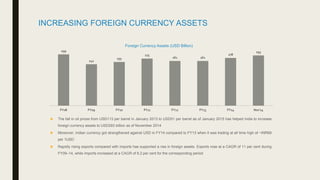
INCREASING FOREIGN CURRENCY ASSETS
299
242
255
275
261 261
278
293
FY08 FY09 FY10 FY11 FY12 FY13 FY14 Nov'14
Foreign Currency Assets (USD Billion)
The fall in oil prices from USD113 per barrel in January 2013 to USD51 per barrel as of January 2015 has helped India to increase
foreign currency assets to USD293 billion as of November 2014
Moreover, Indian currency got strengthened against USD in FY14 compared to FY13 when it was trading at all time high of ~INR69
per 1USD
Rapidly rising exports compared with imports has supported a rise in foreign assets. Exports rose at a CAGR of 11 per cent during
FY09–14, while imports increased at a CAGR of 8.2 per cent for the corresponding period
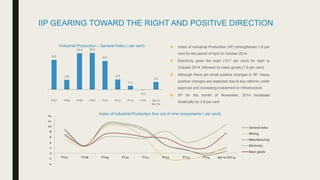
IIP GEARING TOWARD THE RIGHT AND POSITIVE DIRECTION
8.5
2.8
10.4 10.5
8.2
2.9
1.1
-0.1
2.2
FY07 FY08 FY09 FY10 FY11 FY12 FY13 FY14 Apr to
Nov'14
Industrial Production – General Index ( per cent) Index of Industrial Production (IIP) strengthened 1.9 per
cent for the period of April to October 2014
Electricity grew the most (10.7 per cent) for April to
October 2014, followed by basic goods (7.6 per cent)
Although there are small positive changes in IIP, heavy
positive changes are expected due to key reforms under
approval and increasing investment in infrastructure
IIP for the month of November, 2014 increased
drastically by 3.8 per cent
-4
-2
0
2
4
6
8
10
12
14
FY07 FY08 FY09 FY10 FY11 FY12 FY13 FY14 Apr to Oct'14
General index
Mining
Manufacturing
Electricity
Basic goods
Index of Industrial Production four out of nine components ( per cent)
GROWTH OF EIGHT CORE SECTOR NECESSARY FOR OVERALL
GROWTH IN INDUSTRIAL PRODUCTION
3
5.5
6.6
5
6.5
2.6
9.4
FY09 FY10 FY11 FY12 FY13 FY14 Apr to
Nov'14
Total production growth (per cent) in core infrastructure commodities Eight core infrastructure industries reported a growth of
4.3 per cent during April to October 2015
The highest growth was reported by Electricity (10.5 per
cent), followed by Coal of (8.5 per cent)
These eight industries contribute ~38 per cent to the
industrial production
The thermal power sector witnessed increased
investment as India targeted capacity addition of 174.9
GW by 2022
-20
-15
-10
-5
0
5
10
15
20
25
30
35
FY11 FY12 FY13 FY14 Apr to Oct'14
Coal
Crude oil
Natural Gas
Refinery Products
Fertilizers
Steel
Cement
Electricity
Production growth ( per cent) in eight core infrastructure commodities
RISING INVESTMENTS IN INFRASTRUCTURE AND
DEVELOPMENT PROJECTS
Road and
Highways
 Outlay of USD3.8 billion is planned for highways for the current year
 Infrastructure development worth USD19 billion is planned during 2012–17
 Completed 100 public private partnership projects (PPPs) and 165 more PPPs are under construction
 Investment of USD31 billion in national highways is expected in the next five years
Railways
 Indian Railways plans to award projects worth USD1 trillion through the PPP model
 Budget 2015 lays emphasis on diamond quadrilateral network of high-speed rails to connect major metro cities and business
centres
 Projects worth USD40 billion have been approved for establishing rail connectivity between major ports
Construction
 Investment worth USD1 trillion is planned for the infrastructure sector during FY2012–17
 Investment worth USD650 billion is estimated in the urban infrastructure over the next 20 years
 The government is under process to launch urban development mission to develop 500 cities with a population of more than
100,000
Thermal
Power and
Renewable
Energy
 The government is targeting a capacity addition of 88.5 GW by 2017 and 86.4 GW during 2017–22 in the thermal power
sector
 The government aims to have 20,000 MW of solar power by 2022
Emerging Market: India
■ India ranks among the well known emerging markets in the global economic scenario.
■ Since the economic liberalization policies were undertaken in the 1990s, emerging
market India has really prospered which has helped to boost the Indian economy to a
great extent.
■ According to the recent survey, there are around 28 emerging markets in the world
out of which India ranks in the second place.
■ The main factors behind this booming emerging market are the economic
liberalization and the perfect competition market, the high standard of living and per
capita income, the development of medical facilities and infrastructure, the increase in
foreign investments and so on.
Emerging Market: India (contd.)
■ Over the few years, there has been a significant growth of the Indian market which has
resulted in the high Gross Domestic Product (GDP).
■ The average annual growth rate ranges between 6 to 7 %.The growth rate of GDP was
around 6.7 % during the financial year 2008-09.
■ Currently, India is the 4th largest economic system in the world in terms of the purchasing
power parity.
■ The recent economic development has also put a positive impact on the various sectors.
■ There has been a significant development in the agricultural, service and industrial sector in
the country.
■ To complement the rapid pace of economic growth, the service sector contributes around
54 % of the annual Gross Domestic Product.
Emerging Market: India (contd.)
■ The increase in foreign investment has also cast a favorable effect on the emerging
market in India.
■ Due to the increase in demand, well known global companies are investing in the
Indian market.
■ The foreign institutional investments (FII) amount has reached around US$ 10 billion
mark.
■ In case of the Foreign direct investments (FDI, there has been a significant increase of
around 85.1 % from US$ 25.1 billion to US$ 46.5 billion.
India Market Entry
■ India GDP has registered 6.7% growth in the period 2008-09.
■ India has the ability to sustain the growth rate of 8 to 10% in the coming years.
■ The current growth rate and the projected figures serve as perfect bait for the foreign
investors.
Factors dominating India Market Entry
The real worth of the Indian Market can be illustrated in the following manner:
■ Finding good partners who know local market well and are completely acquainted with
procedural issues
■ Smart planning
■ Identifying the target market
■ Promotion of products and services
■ Contacting apt agents and distributors
With these, the foreign investors also need to explore various market options in India that
include forming subsidiary relationship or a joint venture with an India-based company. It also
comprises setting up of a branch office or a liaison office.
Steps for India Market Entry
■ Identifying potential of the particular market in India
■ Developing a fair knowledge of the market
■ Creating strategies for market entry
While venturing into Indian market, it is very important for any investor to develop a basic
knowledge of the potential of the concerned market in India.
Obstacles on the Path to the Market
Entry in India
■ Rigid and complex social framework
•Indian Bureaucracy
•Infrastructure issues
Strong
financial
regulatory
system
 RBI is among the best central banks in the world
 It controls the monetary policy of India and acts as a watchdog over the banking system
 SEBI acts as the regulator of the twin stock exchanges – the BSE and NSE
 Indian regulatory system was applauded for its strong mechanisms that weathered the 2008 global crisis
Robust Indian
banking
system
 Indian banking system is a huge network of 151 commercial banks with more than 100,000 branches
 Seventeen Indian banks rank in the top 500 global banks list, with SBI at the top among the Indian banks
 In line with the recent ‘Jan Dhan Yojna’ initiative, more than 110 million new bank accounts were opened
 A strong banking system creates a strong investment environment and increases liquidity
Prominent
stock
exchange
 BSE is the world’s largest stock exchange in terms of number of listed companies; NSE takes the third spot in terms of
number of transactions
 India entered the elite club of world’s 10 largest stock markets
 In 2014, net foreign investment in equity and debt markets was USD16.1 billion and USD26.3 billion, respectively
Ease of doing
business
 India currently ranks 142 on the Ease of Doing Business list
 The new government has set up a mandate to rise to the 50th place on this list in the next two years
 New measures taken by the government to facilitate business like digitisation and a one-stop licensing system would
significantly boost India’s ranking
 Rise in investment interests from global companies is a sign of improvement in the economy and the process
CONDUCIVE ENVIRONMENT FOR INVESTMENT

INDIA - economy analysis

  • 1.
  • 2.
    India country profile ■India is the world's largest democracy and according to UN estimates, its population is expected to overtake China's in 2028 to become the world's most populous nation. ■ As a rising economic powerhouse and nuclear-armed state, India has emerged as an important regional power. ■ But it is also tackling huge, social, economic and environmental problems. ■ Home to some of the world' s most ancient surviving civilizations, the Indian subcontinent - from the mountainous Afghan frontier to the jungles of Burma - is both vast and diverse in terms of its people, language and cultural traditions.
  • 3.
  • 4.
    Characteristics of theIndian Economy Low per capita income ■ In India, the national income and per capita income is very low and it is considered as one of the basic features of underdevelopment. ■ As perWorld Bank estimates, the per capita income of India stood at only $ 720 in 2005. ■ Keeping aside a very few countries, this per capita income figure of India is the lowest in the world and it is even lower thanChina and Pakistan.
  • 5.
    Excessive dependence ofagriculture and primary producing ■ Indian economy is characterised by too much dependence on agriculture and thus it is primary producing. ■ Out of the total working population of our country, a very high proportion of it is engaged in agriculture and allied activities, which contributed a large share in the national income of our country. ■ In 2004, nearly 58 per cent of the total working population of our country was engaged in agriculture and allied activities and was contributing about 21.0 per cent of the total national income.
  • 6.
    High rate ofpopulation growth ■ In India, the rate of growth of population has been gradually increasing from 1.31 per cent annually during 1941-50 to 2.5 per cent annually during 1971-81 to 2.11 per cent annually during 1981-91 and then finally to 1.77 per cent during 2001-2011. ■ The prime cause behind this rapid growth of population is the steep fall in its death rate from 49 per thousand during 1911-20 to 7.1 per thousand in 2011. ■ On the other hand, compared to its death rate, the birth rate of our population has gradually declined from 49 per thousand during 1911-20 to 21.8 per thousand in 2011.
  • 7.
    Existence of chronicunemployment and under-employment ■ During the 5 year period of 1990-95, new entrants to the labour force are estimated to be around 37 million. ■ To put it in another way we can guess that total burden of unemployment during this Eighth Plan would be around 65 million which is a matter of serious concern for the economy of our country. ■ The incidence of unemployment on CDS basis increased from 7.31 per cent of labour force in 1999-2000 to 8.28 per cent of labour force in 2004-05.
  • 8.
    Poor rate ofcapital formation ■ Capital deficiency is one of the characteristic features of the Indian economy. ■ Both the amount of capital available per head and the present rate of capital formation in India is very low. ■ Consumption of crude steel and energy are the two important indicators of low capital per head in the under-developed countries like India.
  • 9.
    Inequality in thedistribution of wealth ■ Another important characteristic of the Indian economy is the mal-distribution of wealth: ■ The report of the Reserve Bank of India reveals that nearly 20 per cent of the households owing less than Rs 1000 worth of assets possess only 0.7 per cent of the total assets. ■ Moreover, 51 per cent of the households owing less than Rs 5000 worth of assets possessed barely 8 per cent of the total assets. ■ Lastly, the top four per cent households possessing assets worth more than Rs 50,000 held more than 31 per cent of the total assets.
  • 10.
    Low level oftechnology ■ Prevalence of low level of technology is one of the important characteristics of an underdeveloped economy like India. ■ The economy of our country is thus suffering from technological backwardness. ■ Obsolete techniques of production are largely being applied in both the agricultural and industrial sectors of our country.
  • 11.
    Under-utilisation of naturalresources ■ In respect of natural endowments India is considered as a very rich country.Various types of natural resources, viz., land, water, minerals, forest and power resources are available in sufficient quantity in the various parts of the country. ■ A huge quantity of mineral and forest resources of India still remains largely unexplored. Until recently, India was not in position to develop even 5 per cent of total hydropower potential of the country.
  • 12.
    Lack of infrastructure ■Lack of infrastructural facilities is one of the serious problems from which the Indian economy has been suffering till today. ■ These infrastructural facilities include transportation and communication facilities, electricity generation and distribution, banking and credit facilities, economic organisation, health and educational institutes etc. ■ The two most vital sectors, i.e. agriculture and industry could not make much headway in the absence of proper infrastructural facilities in the country.
  • 13.
    Low level ofliving ■ The standard of living of Indian people in general is considered as very low. Nearly 25 to 40 per cent of the population in India suffers from malnutrition. ■ The average protein content in the Indian diet is about 49 grams only per day in comparison to that of more than double the level in the developed countries of the world. ■ In 1996 the daily average calorie intake of food in India was only 2,415 in comparison to that of 3,400 calories per day in various developed countries of the world.
  • 14.
    Poor quality ofhuman capital ■ Indian economy is suffering from its poor quality of human capital. Mass illiteracy is the root of this problem and illiteracy at the same time is retarding the process of economic growth of our country. ■ As per 2001 census, 65.3 per cent of the total population of India is literate and the rest 34.7 per cent still remains illiterate. ■ In most of the developed countries like U.S.A., U.K., Canada,Australia etc. the level of illiteracy is even below 3 per cent. ■ Moreover, the problem of illiteracy in India makes way for conservatism and this is going against the economy of the country.
  • 15.
    Demographic characteristics ■ Thedemographic characteristics of India are not at all satisfactory rather these are associated with high density of population, a smaller proportion of the population in working age group of 15-60 years and a comparatively larger proportion of population in the minor age group of 0-15 years. ■ As per 2011 census, the density of population in India was 382 per sq km. as compared with world density of population of 41 per sq km.
  • 16.
    Inadequate development ofeconomic organisation ■ In India the development of financial institutions is .still inadequate in the rural areas. ■ There is the urgent need to develop certain credit agencies for advancing loan to small farmers on easy terms as well as to provide long term and medium term loan to industries. ■ For protecting poor tenants from the clutches of landlords, proper enforcement of tenancy legislation is very much necessary. ■ All these require maintenance of honest and efficient administrative machinery which India is lacking very much.
  • 17.
    INDIA ON GROWTHPATH SUPPORTED BY KEY REFORMS AND HIGHER INVESTMENTS 9.7 9.2 6.8 8.4 9.3 6.7 4.5 4.7 6.4 GDP growth at factor cost ( per cent) -2 0 2 4 6 8 10 12 14 GDP at factor cost Agriculture, forestry & fishing Industry Services GDP and components – growth ( per cent) According to the World Bank, Indian economy is estimated to expand 6.4 per cent during FY15 Higher investment in the infrastructure sector, key reforms in taxation, coal mining auctions, among others would boost the economy Current decrease in crude prices would support narrow deficits The government plans to spend USD1 trillion on infrastructure during FY12–17 Growth in the Indian economy is mainly supported by growth in the service and industry sectors The government would introduce Goods and Services Tax (GST), which would create substantial savings for companies on logistics. This would positively affect on industrial production Major contributors were the finance and real estate sectors, which witnessed double-digit growth in the last 7–8 years
  • 18.
    COUNTRY TO RECORDHIGHEST FOODGRAIN PRODUCTION IN FY 2014 99 89 96 105 105 106 81 81 87 95 94 96 15 15 18 17 18 20 234 218 244 259 257 264 0 50 100 150 200 250 300 0 20 40 60 80 100 120 FY09 FY10 FY11 FY12 FY13 FY14* Rice Wheat Total Pulses Total Foodgrains (RHS) Production of major agricultural crops (in Million Tonnes) Scanty rainfall in FY10 affected foodgrain production. Orissa, Jharkhand and Bihar faced a deficit of 55 per cent, 47 per cent and 28 per cent, respectively Foodgrain production increased at a CAGR of 2.4 per cent from 234 million tonnes in FY09 to an estimated 264 million tonnes in FY14 Major growth was observed in production of pulses, which rose at CAGR of 6.1 per cent from 15 million tonnes in FY09 to an estimated 20 million tonnes in FY14 India ranks second in the production of rice, sugarcane, potatoes, wheat, garlic and tomatoes During FY13, Indian household spent USD20.3 billion on food, indicating good business opportunity The country has estimated highest ever foodgrain production of 264 million tonnes during FY14
  • 19.
    IMPROVING TRADE BALANCE(1/2) 185 179 251 306 300 313304 288 370 489 491 450 -118 -110 -119 -183 -190 -137 -250 -200 -150 -100 -50 00 100 200 300 400 500 600 FY09 FY10 FY11 FY12 FY13 FY14 Exports Imports Trade balance (RHS) Export-import and trade balance (USD Billion) 94 87 106 155 164 165 210 201 264 334 327 285 FY09 FY10 FY11 FY12 FY13 FY14 Oil imports Non-Oil imports Oil and non-oil imports (USD Billion) Lower demand in the US and Europe affected exports negatively, widening trade deficits in FY13 During FY09–14, exports rose at a CAGR of 11 per cent, while imports rose at a CAGR of 8.2 per cent India’s trade balance reached a negative USD190 billion in FY13, which improved 27.8 per cent to a negative USD137 billion in FY14 Decreasing crude prices by more than half in six months would support India to narrow trade deficit as oil imports comprise ~37 per cent of the total imports
  • 20.
    IMPROVING TRADE BALANCE(2/2) 40.3 13.0 6.8 6.5 3.8 29.7 Oil and Minerals Precious or semi- precious Stones Nuclear reactors Electrical Machinery Organic Chemicals Others Top five Importing commodities ( per cent) (FY 2014) 20.6 13.3 4.1 3.8 3.8 54.4 Oil and Minerals Precious or semi- precious Stones Vehicles and parts other than rail Nuclear reactors Organic Chemicals Others Top five exporting commodities ( per cent) (FY 2014) During 2013, India’s petroleum imports comprised 20 per cent from Saudi Arabia, 22 per cent from other Middle East countries and 14 per cent from Iraq Of the total exports, oil contributes ~21 per cent During FY14 export of oil and minerals increased to USD64.7 billion from USD62.1 billion a year earlier The automobile industry contributed 4.1 per cent to total exports. India is the seventh largest producer of automobiles in the world
  • 21.
    INCREASING FOREIGN CURRENCYASSETS 299 242 255 275 261 261 278 293 FY08 FY09 FY10 FY11 FY12 FY13 FY14 Nov'14 Foreign Currency Assets (USD Billion) The fall in oil prices from USD113 per barrel in January 2013 to USD51 per barrel as of January 2015 has helped India to increase foreign currency assets to USD293 billion as of November 2014 Moreover, Indian currency got strengthened against USD in FY14 compared to FY13 when it was trading at all time high of ~INR69 per 1USD Rapidly rising exports compared with imports has supported a rise in foreign assets. Exports rose at a CAGR of 11 per cent during FY09–14, while imports increased at a CAGR of 8.2 per cent for the corresponding period
  • 22.
    IIP GEARING TOWARDTHE RIGHT AND POSITIVE DIRECTION 8.5 2.8 10.4 10.5 8.2 2.9 1.1 -0.1 2.2 FY07 FY08 FY09 FY10 FY11 FY12 FY13 FY14 Apr to Nov'14 Industrial Production – General Index ( per cent) Index of Industrial Production (IIP) strengthened 1.9 per cent for the period of April to October 2014 Electricity grew the most (10.7 per cent) for April to October 2014, followed by basic goods (7.6 per cent) Although there are small positive changes in IIP, heavy positive changes are expected due to key reforms under approval and increasing investment in infrastructure IIP for the month of November, 2014 increased drastically by 3.8 per cent -4 -2 0 2 4 6 8 10 12 14 FY07 FY08 FY09 FY10 FY11 FY12 FY13 FY14 Apr to Oct'14 General index Mining Manufacturing Electricity Basic goods Index of Industrial Production four out of nine components ( per cent)
  • 23.
    GROWTH OF EIGHTCORE SECTOR NECESSARY FOR OVERALL GROWTH IN INDUSTRIAL PRODUCTION 3 5.5 6.6 5 6.5 2.6 9.4 FY09 FY10 FY11 FY12 FY13 FY14 Apr to Nov'14 Total production growth (per cent) in core infrastructure commodities Eight core infrastructure industries reported a growth of 4.3 per cent during April to October 2015 The highest growth was reported by Electricity (10.5 per cent), followed by Coal of (8.5 per cent) These eight industries contribute ~38 per cent to the industrial production The thermal power sector witnessed increased investment as India targeted capacity addition of 174.9 GW by 2022 -20 -15 -10 -5 0 5 10 15 20 25 30 35 FY11 FY12 FY13 FY14 Apr to Oct'14 Coal Crude oil Natural Gas Refinery Products Fertilizers Steel Cement Electricity Production growth ( per cent) in eight core infrastructure commodities
  • 24.
    RISING INVESTMENTS ININFRASTRUCTURE AND DEVELOPMENT PROJECTS Road and Highways  Outlay of USD3.8 billion is planned for highways for the current year  Infrastructure development worth USD19 billion is planned during 2012–17  Completed 100 public private partnership projects (PPPs) and 165 more PPPs are under construction  Investment of USD31 billion in national highways is expected in the next five years Railways  Indian Railways plans to award projects worth USD1 trillion through the PPP model  Budget 2015 lays emphasis on diamond quadrilateral network of high-speed rails to connect major metro cities and business centres  Projects worth USD40 billion have been approved for establishing rail connectivity between major ports Construction  Investment worth USD1 trillion is planned for the infrastructure sector during FY2012–17  Investment worth USD650 billion is estimated in the urban infrastructure over the next 20 years  The government is under process to launch urban development mission to develop 500 cities with a population of more than 100,000 Thermal Power and Renewable Energy  The government is targeting a capacity addition of 88.5 GW by 2017 and 86.4 GW during 2017–22 in the thermal power sector  The government aims to have 20,000 MW of solar power by 2022
  • 25.
    Emerging Market: India ■India ranks among the well known emerging markets in the global economic scenario. ■ Since the economic liberalization policies were undertaken in the 1990s, emerging market India has really prospered which has helped to boost the Indian economy to a great extent. ■ According to the recent survey, there are around 28 emerging markets in the world out of which India ranks in the second place. ■ The main factors behind this booming emerging market are the economic liberalization and the perfect competition market, the high standard of living and per capita income, the development of medical facilities and infrastructure, the increase in foreign investments and so on.
  • 26.
    Emerging Market: India(contd.) ■ Over the few years, there has been a significant growth of the Indian market which has resulted in the high Gross Domestic Product (GDP). ■ The average annual growth rate ranges between 6 to 7 %.The growth rate of GDP was around 6.7 % during the financial year 2008-09. ■ Currently, India is the 4th largest economic system in the world in terms of the purchasing power parity. ■ The recent economic development has also put a positive impact on the various sectors. ■ There has been a significant development in the agricultural, service and industrial sector in the country. ■ To complement the rapid pace of economic growth, the service sector contributes around 54 % of the annual Gross Domestic Product.
  • 27.
    Emerging Market: India(contd.) ■ The increase in foreign investment has also cast a favorable effect on the emerging market in India. ■ Due to the increase in demand, well known global companies are investing in the Indian market. ■ The foreign institutional investments (FII) amount has reached around US$ 10 billion mark. ■ In case of the Foreign direct investments (FDI, there has been a significant increase of around 85.1 % from US$ 25.1 billion to US$ 46.5 billion.
  • 28.
    India Market Entry ■India GDP has registered 6.7% growth in the period 2008-09. ■ India has the ability to sustain the growth rate of 8 to 10% in the coming years. ■ The current growth rate and the projected figures serve as perfect bait for the foreign investors.
  • 29.
    Factors dominating IndiaMarket Entry The real worth of the Indian Market can be illustrated in the following manner: ■ Finding good partners who know local market well and are completely acquainted with procedural issues ■ Smart planning ■ Identifying the target market ■ Promotion of products and services ■ Contacting apt agents and distributors With these, the foreign investors also need to explore various market options in India that include forming subsidiary relationship or a joint venture with an India-based company. It also comprises setting up of a branch office or a liaison office.
  • 30.
    Steps for IndiaMarket Entry ■ Identifying potential of the particular market in India ■ Developing a fair knowledge of the market ■ Creating strategies for market entry While venturing into Indian market, it is very important for any investor to develop a basic knowledge of the potential of the concerned market in India.
  • 31.
    Obstacles on thePath to the Market Entry in India ■ Rigid and complex social framework •Indian Bureaucracy •Infrastructure issues
  • 32.
    Strong financial regulatory system  RBI isamong the best central banks in the world  It controls the monetary policy of India and acts as a watchdog over the banking system  SEBI acts as the regulator of the twin stock exchanges – the BSE and NSE  Indian regulatory system was applauded for its strong mechanisms that weathered the 2008 global crisis Robust Indian banking system  Indian banking system is a huge network of 151 commercial banks with more than 100,000 branches  Seventeen Indian banks rank in the top 500 global banks list, with SBI at the top among the Indian banks  In line with the recent ‘Jan Dhan Yojna’ initiative, more than 110 million new bank accounts were opened  A strong banking system creates a strong investment environment and increases liquidity Prominent stock exchange  BSE is the world’s largest stock exchange in terms of number of listed companies; NSE takes the third spot in terms of number of transactions  India entered the elite club of world’s 10 largest stock markets  In 2014, net foreign investment in equity and debt markets was USD16.1 billion and USD26.3 billion, respectively Ease of doing business  India currently ranks 142 on the Ease of Doing Business list  The new government has set up a mandate to rise to the 50th place on this list in the next two years  New measures taken by the government to facilitate business like digitisation and a one-stop licensing system would significantly boost India’s ranking  Rise in investment interests from global companies is a sign of improvement in the economy and the process CONDUCIVE ENVIRONMENT FOR INVESTMENT