Management Practices  for  Sustainable Growth-Focus India  as if   People and Environment Matter Presentation by  Prof.K.Prabhakar [email_address]
Some Questions Are we growing or developing in economic sense?  Do you agree with India’s Growth as unprecedented and the future is the brightest and most prosperous for all of us including the world? Do you think India will be a knowledge super power by 2010?  Do you have a limit for growth?
What I am going to talk? Growth- The economic phenomenon; should we address this?  Sustainable Growth- The ecological phenomenon; should we address this?  Management Practices; what are management practices? What are relevant?  Some questions for you.
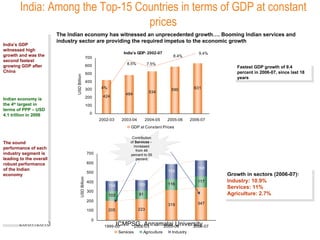
India: Among the Top-15 Countries in terms of GDP at constant prices The Indian economy has witnessed an unprecedented growth…. Booming Indian services and industry sector are providing the required impetus to the economic growth  The sound performance of each industry segment is leading to the overall robust performance of the Indian economy Indian economy is the 4 th  largest in terms of PPP – USD 4.1 trillion in 2006  India’s GDP witnessed high growth and was the second fastest growing GDP after China Growth in sectors (2006-07): Industry: 10.9% Services: 11% Agriculture: 2.7% Fastest GDP growth of 9.4 percent in 2006-07, since last 18 years Contribution of  Services -  increased from 49 percent to 55 percent 4% 8.5% 7.5% 8.4% 9.4%
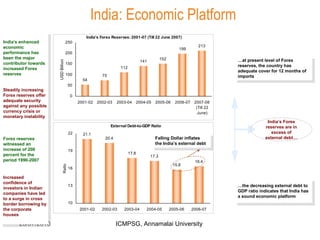
India: Economic Platform India’s enhanced economic performance has been the major contributor towards increased Forex reserves Steadily increasing Forex reserves offer adequate security against any possible currency crisis or monetary instability Falling Dollar inflates the India’s external debt Increased confidence of investors in Indian companies have led to a surge in cross border borrowing by the corporate houses Forex reserves witnessed an increase of 200 percent for the period 1990-2007 … at present level of Forex reserves, the country has adequate cover for 12 months of imports  India’s Forex reserves are in excess of external debt… … t he decreasing external debt to GDP ratio indicates that India has a sound economic platform
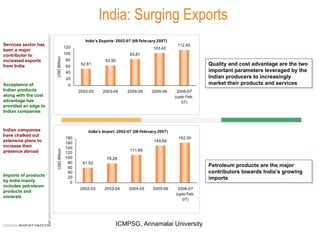
India: Surging Exports Petroleum products are the major contributors towards India’s growing imports Quality and cost advantage are the two important parameters leveraged by the Indian producers to increasingly market their products and services Services sector has been a major contributor to increased exports from India Imports of products by India mainly includes petroleum products and minerals Indian companies have chalked out extensive plans to increase their presence abroad Acceptance of Indian products along with the cost advantage has provided an edge to Indian companies
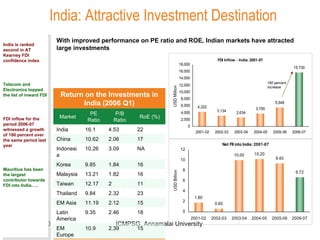
India: Attractive Investment Destination India is ranked second in AT Kearney FDI confidence index Telecom and Electronics topped the list of inward FDI FDI inflow for the period 2006-07 witnessed a growth of 180 percent over the same period last year Mauritius has been the largest contributor towards FDI into India….. With improved performance on PE ratio and ROE, Indian markets have attracted large investments 180 percent Increase Return on the Investments in India (2006 Q1) 15 2.39 10.9 EM Europe 18 2.46 9.35 Latin America 15 2.12 11.19 EM Asia 9.84 12.17 13.21 9.85 10.26 10.62 16.1 PE Ratio Thailand Taiwan Malaysia Korea Indonesia China India Market 23 2.32 11 2 16 1.82 16 1.84 NA 3.09 17 2.06 22 4.53 RoE (%) P/B Ratio
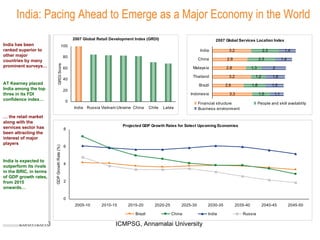
India: Pacing Ahead to Emerge as a Major Economy in the World 2007 Global Retail Development Index (GRDI) India has been ranked superior to other major countries by many prominent surveys… AT Kearney placed India among the top three in its FDI confidence index… …  the retail market along with the services sector has been attracting the interest of major players India is expected to outperform its rivals in the BRIC, in terms of GDP growth rates, from 2015 onwards…
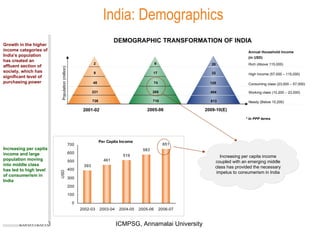
India: Demographics 2 9 48 221 726 2001-02 2005-06 2009-10(E) Rich (Above 115,000) High Income (57,000 – 115,000) Consuming class (23,000 – 57,000) Working class (10,200 – 23,000) Needy (Below 10,200) Annual Household Income  (in USD) * In PPP terms Population (million)  Increasing per capita income coupled with an emerging middle class has provided the necessary impetus to consumerism in India Growth in the higher income categories of India’s population has created an affluent section of society, which has significant level of purchasing power Increasing per capita income and large population moving into middle class has led to high level of consumerism in India DEMOGRAPHIC TRANSFORMATION OF INDIA 9 17 74 285 710 20 33 120 404 613
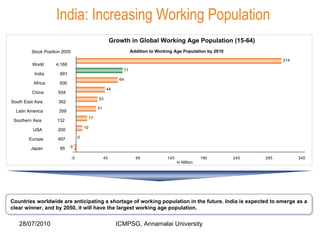
Countries worldwide are anticipating a shortage of working population in the future. India is expected to emerge as a clear winner, and by 2050, it will have the largest working age population. India: Increasing Working Population Stock Position 2005 South East Asia  362 Southern Asia  132 India  691 Africa  500 China  934 Latin America  359 USA  200 Europe  497 Japan  85 World  4,168 In Million Addition to Working Age Population by 2010 Growth in Global Working Age Population (15-64)
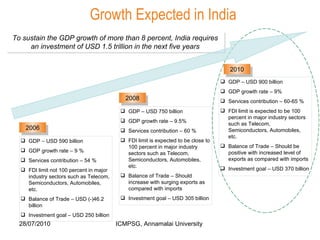
Growth Expected in India To sustain the GDP growth of more than 8 percent, India requires an investment of USD 1.5 trillion in the next five years GDP – USD 590 billion GDP growth rate – 9 % Services contribution – 54 % FDI limit not 100 percent in major industry sectors such as Telecom, Semiconductors, Automobiles, etc. Balance of Trade – USD (-)46.2  billion Investment goal – USD 250 billion 2006 GDP – USD 750 billion GDP growth rate – 9.5% Services contribution – 60 % FDI limit is expected to be close to 100 percent in major industry sectors such as Telecom, Semiconductors, Automobiles, etc. Balance of Trade – Should increase with surging exports as compared with imports Investment goal – USD 305 billion 2008 GDP – USD 900 billion GDP growth rate – 9% Services contribution – 60-65 % FDI limit is expected to be 100 percent in major industry sectors such as Telecom, Semiconductors, Automobiles, etc. Balance of Trade – Should be positive with increased level of exports as compared with imports  Investment goal – USD 370 billion 2010
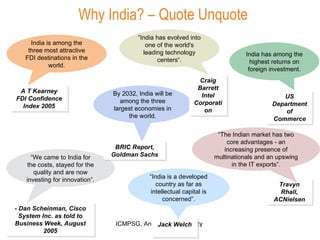
India has among the highest returns on foreign investment. - Dan Scheinman, Cisco System Inc. as told to Business Week, August 2005 “ We came to India for the costs, stayed for the quality and are now investing for innovation”. A T Kearney FDI Confidence Index 2005 India is among the three most attractive FDI destinations in the world. Jack Welch “ India is a developed country as far as intellectual capital is concerned”. US Department of Commerce By 2032, India will be among the three largest economies in the world. BRIC Report, Goldman Sachs Why India? – Quote Unquote Travyn Rhall, ACNielsen “ The Indian market has two core advantages - an increasing presence of multinationals and an upswing in the IT exports”. Craig Barrett Intel Corporation “ India has evolved into one of the world's leading technology centers“.
Economic Growth
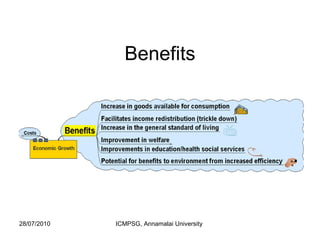
Benefits
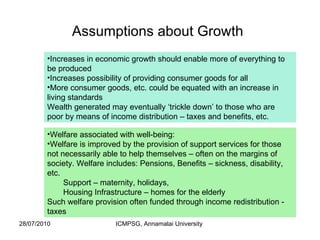
Assumptions about Growth   Increases in economic growth should enable more of everything to be produced Increases possibility of providing consumer goods for all More consumer goods, etc. could be equated with an increase in living standards Wealth generated may eventually ‘trickle down’ to those who are poor by means of income distribution – taxes and benefits, etc. Welfare associated with well-being: Welfare is improved by the provision of support services for those not necessarily able to help themselves – often on the margins of society. Welfare includes: Pensions, Benefits – sickness, disability, etc. Support – maternity, holidays,  Housing Infrastructure – homes for the elderly Such welfare provision often funded through income redistribution - taxes
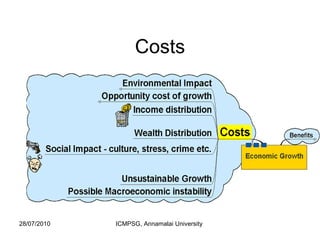
Costs
Economic growth can bring with it costs:  Not all income distributed equally Wealth often in the hands of a few ‘ Trickle down’ does not always seem to work in practice Corruption may reduce redistribution effects Growth funded in part by spending on weapons which do not benefit the population as a whole Negative Externalities Pollution – dumping of hazardous waste Environmental degradation – over farming reduces productivity of the soil, deforestation, damage to eco-systems and reduction in biodiversity Non-renewable resources – finite resources
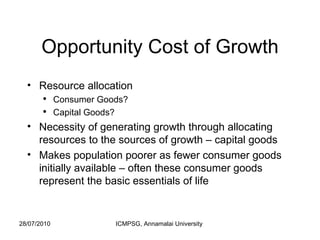
Opportunity Cost of Growth Resource allocation Consumer Goods? Capital Goods? Necessity of generating growth through allocating resources to the sources of growth – capital goods Makes population poorer as fewer consumer goods initially available – often these consumer goods represent the basic essentials of life
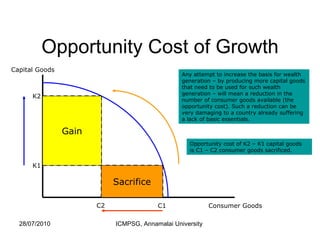
Opportunity Cost of Growth Capital Goods Consumer Goods C1 C2 K1 K2 Production Possibility Frontier: Assume initial output levels of C1 consumer goods and K1 capital goods – where C1 barely represents the essentials of life in a developing country – clean water, food, shelter, etc. Any attempt to increase the basis for wealth generation – by producing more capital goods that need to be used for such wealth generation – will mean a reduction in the number of consumer goods available (the opportunity cost). Such a reduction can be very damaging to a country already suffering a lack of basic essentials. Opportunity cost of K2 – K1 capital goods  is C1 – C2 consumer goods sacrificed. Sacrifice Gain
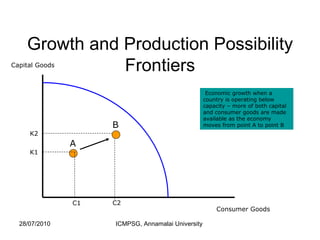
Growth and Production Possibility Frontiers C1 Capital Goods Consumer Goods A B Economic growth when a country is operating below capacity – more of both capital and consumer goods are made available as the economy moves from point A to point B K1 K2 C2
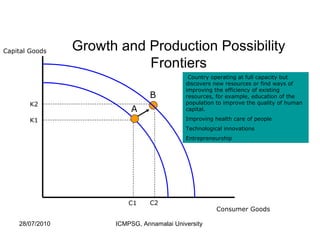
Growth and Production Possibility Frontiers C1 Consumer Goods A B K1 K2 C2 Country operating at full capacity but discovers new resources or find ways of improving the efficiency of existing resources, for example, education of the population to improve the quality of human capital. Improving health care of people  Technological innovations Entrepreneurship  Capital Goods
Is growth limitless-NO These variables that limits growth are world population, industrialization, pollution, food production and resource depletion.
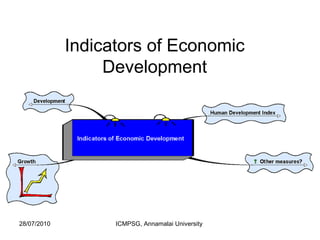
Indicators of Economic Development
Economic Growth Using measures of economic performance in terms of the value of income, expenditure and output GDP – Gross Domestic Product   The value of output produced within a country during a time period GNP – Gross National Product The value of output produced within a country plus net property income from abroad GDP/GNP per head/per capita   Takes account of the size of the population Real GDP/GNP   Accounts for differences in price levels in different countries
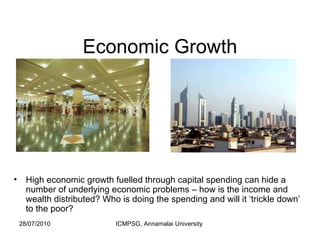
Economic Growth High economic growth fuelled through capital spending can hide a number of underlying economic problems – how is the income and wealth distributed? Who is doing the spending and will it ‘trickle down’ to the poor?
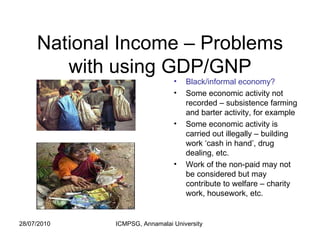
National Income – Problems with using GDP/GNP Black/informal economy? Some economic activity not recorded – subsistence farming and barter activity, for example Some economic activity is carried out illegally – building work ‘cash in hand’, drug dealing, etc.  Work of the non-paid may not be considered but may contribute to welfare – charity work, housework, etc.
Development
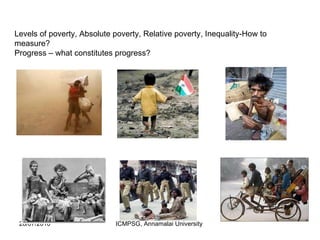
Levels of poverty, Absolute poverty, Relative poverty, Inequality-How to measure? Progress – what constitutes progress?
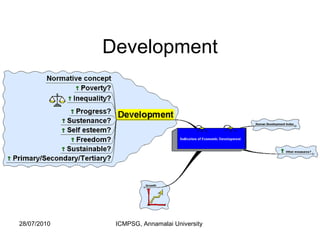
Development Other considerations of human welfare: Political freedoms? Sustenance? Sustainable development? Self esteem? Proportion of activity in different sectors of the economy: Primary Secondary Tertiary We are not sure how to measure?
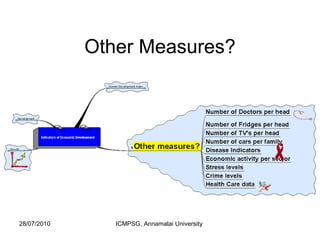
Other Measures?
What is said what we believe. Source:  www.ibef.org
What is UNSAID
Listen to What Rachel Carson said in 1964
What is happening to our climate? Many people are familiar with the recent graphic images of shrinking ice on the Arctic Ocean, and may be aware of projections that the Arctic could be ice-free in the summer by the year 2030. However, there is little recognition of the significant loss in  economic value  that the disappearance of Arctic sea ice, snow, glaciers and permafrost could impose on humans. The frozen Arctic may seem to visitors to be simply a barren sea- and landscape, but in fact it serves as habitat for many species and is the foundation for the Inuit and other indigenous cultures of the North. Arctic sea ice has anchored the ecosystems of northern regions and helped regulate global climate for at least 800,000 years (Overpeck et al., 2005). Its seasonal disappearance would have far-reaching ecological, climatic, and economic impacts that we are just beginning to understand. On a global scale, the reflective surfaces of ice and snow have a cooling effect. Sea ice formation and melting help drive the world.’s ocean currents, permafrost traps vast quantities of methane and other forms of carbon, and the Greenland Ice Sheet holds enough water to raise sea level by 7 meters (AMAP, 2009). Greenland is in fact losing ice and contributing to sea level rise at a much faster rate than scientists predicted only a few years ago (Mernild et al., 2009).
What is one single measure? Climate policy is finally moving forward Serious discussion of emission reductions underway More or less (almost) heading for 450 ppm CO2 Climate science is moving faster More and more evidence of potential harm at lower temperatures and concentrations Hansen (1): doubling of CO2 causes 6oC of warming, not 3oC as previously believed Hansen (2): 450 ppm is the threshold for an ice-free earth,disastrously higher sea levels, disruption of water supply If climate protection requires 350 ppm, can we afford to get there from here?
Sustainability  Sustainability  is the capacity to endure, maintain or support. In  ecology  the word describes how biological systems remain  diverse  and productive over time. For humans it is the potential for long-term maintenance of well being, which in turn depends on the well being of the natural world and the responsible use of  natural resources . What we had was extract-use-waste paradigm.
Sustainable Development “ Sustainable development is development that meets the needs of the present without compromising the ability of future generations to meet their own needs.” “ Sustainability is improving the quality of human life while living within the carrying capacity of supporting eco-systems”  conveys the idea of sustainability having quantifiable limits. But sustainability is also a call to action, a task in progress or “journey” and therefore a political process, so some definitions set out common goals and values.
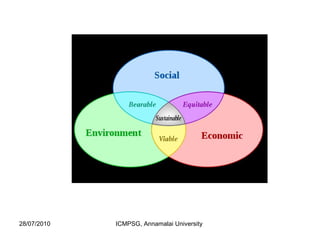
The dimensions to be addressed  The field of sustainable development can be conceptually broken into three constituent parts:  environmental   sustainability ,  economic  sustainability and  sociopolitical  sustainability.
 
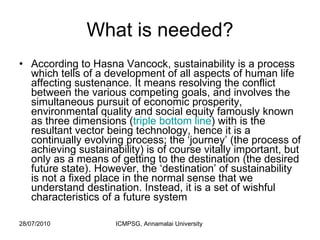
What is needed? According to Hasna Vancock, sustainability is a process which tells of a development of all aspects of human life affecting sustenance. It means resolving the conflict between the various competing goals, and involves the simultaneous pursuit of economic prosperity, environmental quality and social equity famously known as three dimensions ( triple bottom line ) with is the resultant vector being technology, hence it is a continually evolving process; the ‘journey’ (the process of achieving sustainability) is of course vitally important, but only as a means of getting to the destination (the desired future state). However, the ‘destination’ of sustainability is not a fixed place in the normal sense that we understand destination. Instead, it is a set of wishful characteristics of a future system
Types of Capital   The sustainable development debate is based on the assumption that societies need to manage three types of capital (economic, social, and natural), which may be non-substitutable and whose consumption might be irreversible. Multiple uses of natural resources.  Failure of market to allocate resources.  Perfect markets fail perfectly .  Similar to the eco-efficiency concept but so far less explored is the second criterion for  corporate sustainability . Socio-efficiency describes the relation between a firm’s value added and its social impact. Whereas, it can be assumed that most corporate impacts on the environment are negative (apart from rare exceptions such as the planting of trees) this is not true for social impacts. These can be either positive (e.g. corporate giving, creation of employment) or negative (e.g. work accidents, mobbing of employees, human rights abuses). Depending on the type of impact socio-efficiency thus either tries to minimize negative social impacts (i.e. accidents per value added) or maximise positive social impacts (i.e. donations per value added) in relation to the value added. Both  eco-efficiency  and  socio-efficiency  are concerned primarily with increasing economic sustainability. In this process they instrumentalize both natural and social capital aiming to benefit from win-win situations.
What we should do for sustainable development? Renewable resources such as fish, soil, and groundwater must be used no faster than the rate at which they regenerate.  Nonrenewable resources such as minerals and fossil fuels must be used no faster than renewable substitutes for them can be put into place.  Pollution and wastes must be emitted no faster than natural systems can absorb them, recycle them, or render them harmless.
 
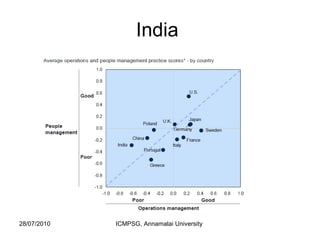
India
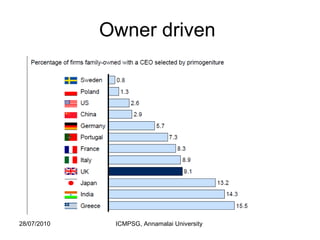
Owner driven
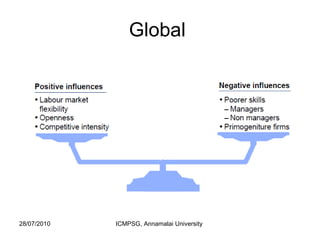
Global
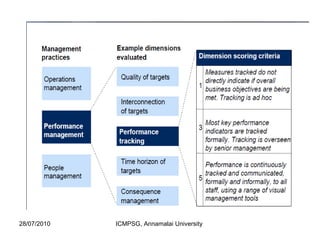
Dualism in Indian Management Practices  features of Indian management is the emphasis on the personality of the top leader in the organization. Study also indicates that the expectation of the people in India is more towards paternalism. The essential requisite for paternalism appears to be unity in the leadership, and single, identifiable source of power. Duality in this regard spawns  patronage. The line of succession, if not clear leads to people lobbying for the position and in the process subtly divides the organization in to cliques. Another unique feature of  Indian management is the “familial feeling” perceived by the employees because of the parental attitude adopted by the superiors and colleagues which gives a sense o fsecurity and belongingness among the employees. We also found among the organizations studied that harmony is easier achieved when due deference is given to the familiality, seniority, age and open door communication, be it among the multinational, public sector, the traditional family-owned company or the government department.
What is your suggestions?
Thank you  If you have any questions please do send you mail to  [email_address]

Management practices for sustainable growth

  • 1.
    Management Practices for Sustainable Growth-Focus India as if People and Environment Matter Presentation by Prof.K.Prabhakar [email_address]
  • 2.
    Some Questions Arewe growing or developing in economic sense? Do you agree with India’s Growth as unprecedented and the future is the brightest and most prosperous for all of us including the world? Do you think India will be a knowledge super power by 2010? Do you have a limit for growth?
  • 3.
    What I amgoing to talk? Growth- The economic phenomenon; should we address this? Sustainable Growth- The ecological phenomenon; should we address this? Management Practices; what are management practices? What are relevant? Some questions for you.
  • 4.
    India: Among theTop-15 Countries in terms of GDP at constant prices The Indian economy has witnessed an unprecedented growth…. Booming Indian services and industry sector are providing the required impetus to the economic growth The sound performance of each industry segment is leading to the overall robust performance of the Indian economy Indian economy is the 4 th largest in terms of PPP – USD 4.1 trillion in 2006 India’s GDP witnessed high growth and was the second fastest growing GDP after China Growth in sectors (2006-07): Industry: 10.9% Services: 11% Agriculture: 2.7% Fastest GDP growth of 9.4 percent in 2006-07, since last 18 years Contribution of Services - increased from 49 percent to 55 percent 4% 8.5% 7.5% 8.4% 9.4%
  • 5.
    India: Economic PlatformIndia’s enhanced economic performance has been the major contributor towards increased Forex reserves Steadily increasing Forex reserves offer adequate security against any possible currency crisis or monetary instability Falling Dollar inflates the India’s external debt Increased confidence of investors in Indian companies have led to a surge in cross border borrowing by the corporate houses Forex reserves witnessed an increase of 200 percent for the period 1990-2007 … at present level of Forex reserves, the country has adequate cover for 12 months of imports India’s Forex reserves are in excess of external debt… … t he decreasing external debt to GDP ratio indicates that India has a sound economic platform
  • 6.
    India: Surging ExportsPetroleum products are the major contributors towards India’s growing imports Quality and cost advantage are the two important parameters leveraged by the Indian producers to increasingly market their products and services Services sector has been a major contributor to increased exports from India Imports of products by India mainly includes petroleum products and minerals Indian companies have chalked out extensive plans to increase their presence abroad Acceptance of Indian products along with the cost advantage has provided an edge to Indian companies
  • 7.
    India: Attractive InvestmentDestination India is ranked second in AT Kearney FDI confidence index Telecom and Electronics topped the list of inward FDI FDI inflow for the period 2006-07 witnessed a growth of 180 percent over the same period last year Mauritius has been the largest contributor towards FDI into India….. With improved performance on PE ratio and ROE, Indian markets have attracted large investments 180 percent Increase Return on the Investments in India (2006 Q1) 15 2.39 10.9 EM Europe 18 2.46 9.35 Latin America 15 2.12 11.19 EM Asia 9.84 12.17 13.21 9.85 10.26 10.62 16.1 PE Ratio Thailand Taiwan Malaysia Korea Indonesia China India Market 23 2.32 11 2 16 1.82 16 1.84 NA 3.09 17 2.06 22 4.53 RoE (%) P/B Ratio
  • 8.
    India: Pacing Aheadto Emerge as a Major Economy in the World 2007 Global Retail Development Index (GRDI) India has been ranked superior to other major countries by many prominent surveys… AT Kearney placed India among the top three in its FDI confidence index… … the retail market along with the services sector has been attracting the interest of major players India is expected to outperform its rivals in the BRIC, in terms of GDP growth rates, from 2015 onwards…
  • 9.
    India: Demographics 29 48 221 726 2001-02 2005-06 2009-10(E) Rich (Above 115,000) High Income (57,000 – 115,000) Consuming class (23,000 – 57,000) Working class (10,200 – 23,000) Needy (Below 10,200) Annual Household Income (in USD) * In PPP terms Population (million) Increasing per capita income coupled with an emerging middle class has provided the necessary impetus to consumerism in India Growth in the higher income categories of India’s population has created an affluent section of society, which has significant level of purchasing power Increasing per capita income and large population moving into middle class has led to high level of consumerism in India DEMOGRAPHIC TRANSFORMATION OF INDIA 9 17 74 285 710 20 33 120 404 613
  • 10.
    Countries worldwide areanticipating a shortage of working population in the future. India is expected to emerge as a clear winner, and by 2050, it will have the largest working age population. India: Increasing Working Population Stock Position 2005 South East Asia 362 Southern Asia 132 India 691 Africa 500 China 934 Latin America 359 USA 200 Europe 497 Japan 85 World 4,168 In Million Addition to Working Age Population by 2010 Growth in Global Working Age Population (15-64)
  • 11.
    Growth Expected inIndia To sustain the GDP growth of more than 8 percent, India requires an investment of USD 1.5 trillion in the next five years GDP – USD 590 billion GDP growth rate – 9 % Services contribution – 54 % FDI limit not 100 percent in major industry sectors such as Telecom, Semiconductors, Automobiles, etc. Balance of Trade – USD (-)46.2 billion Investment goal – USD 250 billion 2006 GDP – USD 750 billion GDP growth rate – 9.5% Services contribution – 60 % FDI limit is expected to be close to 100 percent in major industry sectors such as Telecom, Semiconductors, Automobiles, etc. Balance of Trade – Should increase with surging exports as compared with imports Investment goal – USD 305 billion 2008 GDP – USD 900 billion GDP growth rate – 9% Services contribution – 60-65 % FDI limit is expected to be 100 percent in major industry sectors such as Telecom, Semiconductors, Automobiles, etc. Balance of Trade – Should be positive with increased level of exports as compared with imports Investment goal – USD 370 billion 2010
  • 12.
    India has amongthe highest returns on foreign investment. - Dan Scheinman, Cisco System Inc. as told to Business Week, August 2005 “ We came to India for the costs, stayed for the quality and are now investing for innovation”. A T Kearney FDI Confidence Index 2005 India is among the three most attractive FDI destinations in the world. Jack Welch “ India is a developed country as far as intellectual capital is concerned”. US Department of Commerce By 2032, India will be among the three largest economies in the world. BRIC Report, Goldman Sachs Why India? – Quote Unquote Travyn Rhall, ACNielsen “ The Indian market has two core advantages - an increasing presence of multinationals and an upswing in the IT exports”. Craig Barrett Intel Corporation “ India has evolved into one of the world's leading technology centers“.
  • 13.
  • 14.
  • 15.
    Assumptions about Growth Increases in economic growth should enable more of everything to be produced Increases possibility of providing consumer goods for all More consumer goods, etc. could be equated with an increase in living standards Wealth generated may eventually ‘trickle down’ to those who are poor by means of income distribution – taxes and benefits, etc. Welfare associated with well-being: Welfare is improved by the provision of support services for those not necessarily able to help themselves – often on the margins of society. Welfare includes: Pensions, Benefits – sickness, disability, etc. Support – maternity, holidays, Housing Infrastructure – homes for the elderly Such welfare provision often funded through income redistribution - taxes
  • 16.
  • 17.
    Economic growth canbring with it costs: Not all income distributed equally Wealth often in the hands of a few ‘ Trickle down’ does not always seem to work in practice Corruption may reduce redistribution effects Growth funded in part by spending on weapons which do not benefit the population as a whole Negative Externalities Pollution – dumping of hazardous waste Environmental degradation – over farming reduces productivity of the soil, deforestation, damage to eco-systems and reduction in biodiversity Non-renewable resources – finite resources
  • 18.
    Opportunity Cost ofGrowth Resource allocation Consumer Goods? Capital Goods? Necessity of generating growth through allocating resources to the sources of growth – capital goods Makes population poorer as fewer consumer goods initially available – often these consumer goods represent the basic essentials of life
  • 19.
    Opportunity Cost ofGrowth Capital Goods Consumer Goods C1 C2 K1 K2 Production Possibility Frontier: Assume initial output levels of C1 consumer goods and K1 capital goods – where C1 barely represents the essentials of life in a developing country – clean water, food, shelter, etc. Any attempt to increase the basis for wealth generation – by producing more capital goods that need to be used for such wealth generation – will mean a reduction in the number of consumer goods available (the opportunity cost). Such a reduction can be very damaging to a country already suffering a lack of basic essentials. Opportunity cost of K2 – K1 capital goods is C1 – C2 consumer goods sacrificed. Sacrifice Gain
  • 20.
    Growth and ProductionPossibility Frontiers C1 Capital Goods Consumer Goods A B Economic growth when a country is operating below capacity – more of both capital and consumer goods are made available as the economy moves from point A to point B K1 K2 C2
  • 21.
    Growth and ProductionPossibility Frontiers C1 Consumer Goods A B K1 K2 C2 Country operating at full capacity but discovers new resources or find ways of improving the efficiency of existing resources, for example, education of the population to improve the quality of human capital. Improving health care of people Technological innovations Entrepreneurship Capital Goods
  • 22.
    Is growth limitless-NOThese variables that limits growth are world population, industrialization, pollution, food production and resource depletion.
  • 23.
  • 24.
    Economic Growth Usingmeasures of economic performance in terms of the value of income, expenditure and output GDP – Gross Domestic Product The value of output produced within a country during a time period GNP – Gross National Product The value of output produced within a country plus net property income from abroad GDP/GNP per head/per capita Takes account of the size of the population Real GDP/GNP Accounts for differences in price levels in different countries
  • 25.
    Economic Growth Higheconomic growth fuelled through capital spending can hide a number of underlying economic problems – how is the income and wealth distributed? Who is doing the spending and will it ‘trickle down’ to the poor?
  • 26.
    National Income –Problems with using GDP/GNP Black/informal economy? Some economic activity not recorded – subsistence farming and barter activity, for example Some economic activity is carried out illegally – building work ‘cash in hand’, drug dealing, etc. Work of the non-paid may not be considered but may contribute to welfare – charity work, housework, etc.
  • 27.
  • 28.
    Levels of poverty,Absolute poverty, Relative poverty, Inequality-How to measure? Progress – what constitutes progress?
  • 29.
    Development Other considerationsof human welfare: Political freedoms? Sustenance? Sustainable development? Self esteem? Proportion of activity in different sectors of the economy: Primary Secondary Tertiary We are not sure how to measure?
  • 30.
  • 31.
    What is saidwhat we believe. Source: www.ibef.org
  • 32.
  • 33.
    Listen to WhatRachel Carson said in 1964
  • 34.
    What is happeningto our climate? Many people are familiar with the recent graphic images of shrinking ice on the Arctic Ocean, and may be aware of projections that the Arctic could be ice-free in the summer by the year 2030. However, there is little recognition of the significant loss in economic value that the disappearance of Arctic sea ice, snow, glaciers and permafrost could impose on humans. The frozen Arctic may seem to visitors to be simply a barren sea- and landscape, but in fact it serves as habitat for many species and is the foundation for the Inuit and other indigenous cultures of the North. Arctic sea ice has anchored the ecosystems of northern regions and helped regulate global climate for at least 800,000 years (Overpeck et al., 2005). Its seasonal disappearance would have far-reaching ecological, climatic, and economic impacts that we are just beginning to understand. On a global scale, the reflective surfaces of ice and snow have a cooling effect. Sea ice formation and melting help drive the world.’s ocean currents, permafrost traps vast quantities of methane and other forms of carbon, and the Greenland Ice Sheet holds enough water to raise sea level by 7 meters (AMAP, 2009). Greenland is in fact losing ice and contributing to sea level rise at a much faster rate than scientists predicted only a few years ago (Mernild et al., 2009).
  • 35.
    What is onesingle measure? Climate policy is finally moving forward Serious discussion of emission reductions underway More or less (almost) heading for 450 ppm CO2 Climate science is moving faster More and more evidence of potential harm at lower temperatures and concentrations Hansen (1): doubling of CO2 causes 6oC of warming, not 3oC as previously believed Hansen (2): 450 ppm is the threshold for an ice-free earth,disastrously higher sea levels, disruption of water supply If climate protection requires 350 ppm, can we afford to get there from here?
  • 36.
    Sustainability Sustainability is the capacity to endure, maintain or support. In ecology the word describes how biological systems remain diverse and productive over time. For humans it is the potential for long-term maintenance of well being, which in turn depends on the well being of the natural world and the responsible use of natural resources . What we had was extract-use-waste paradigm.
  • 37.
    Sustainable Development “Sustainable development is development that meets the needs of the present without compromising the ability of future generations to meet their own needs.” “ Sustainability is improving the quality of human life while living within the carrying capacity of supporting eco-systems” conveys the idea of sustainability having quantifiable limits. But sustainability is also a call to action, a task in progress or “journey” and therefore a political process, so some definitions set out common goals and values.
  • 38.
    The dimensions tobe addressed The field of sustainable development can be conceptually broken into three constituent parts: environmental sustainability , economic sustainability and sociopolitical sustainability.
  • 39.
  • 40.
    What is needed?According to Hasna Vancock, sustainability is a process which tells of a development of all aspects of human life affecting sustenance. It means resolving the conflict between the various competing goals, and involves the simultaneous pursuit of economic prosperity, environmental quality and social equity famously known as three dimensions ( triple bottom line ) with is the resultant vector being technology, hence it is a continually evolving process; the ‘journey’ (the process of achieving sustainability) is of course vitally important, but only as a means of getting to the destination (the desired future state). However, the ‘destination’ of sustainability is not a fixed place in the normal sense that we understand destination. Instead, it is a set of wishful characteristics of a future system
  • 41.
    Types of Capital The sustainable development debate is based on the assumption that societies need to manage three types of capital (economic, social, and natural), which may be non-substitutable and whose consumption might be irreversible. Multiple uses of natural resources. Failure of market to allocate resources. Perfect markets fail perfectly . Similar to the eco-efficiency concept but so far less explored is the second criterion for corporate sustainability . Socio-efficiency describes the relation between a firm’s value added and its social impact. Whereas, it can be assumed that most corporate impacts on the environment are negative (apart from rare exceptions such as the planting of trees) this is not true for social impacts. These can be either positive (e.g. corporate giving, creation of employment) or negative (e.g. work accidents, mobbing of employees, human rights abuses). Depending on the type of impact socio-efficiency thus either tries to minimize negative social impacts (i.e. accidents per value added) or maximise positive social impacts (i.e. donations per value added) in relation to the value added. Both eco-efficiency and socio-efficiency are concerned primarily with increasing economic sustainability. In this process they instrumentalize both natural and social capital aiming to benefit from win-win situations.
  • 42.
    What we shoulddo for sustainable development? Renewable resources such as fish, soil, and groundwater must be used no faster than the rate at which they regenerate. Nonrenewable resources such as minerals and fossil fuels must be used no faster than renewable substitutes for them can be put into place. Pollution and wastes must be emitted no faster than natural systems can absorb them, recycle them, or render them harmless.
  • 43.
  • 44.
  • 45.
  • 46.
  • 47.
    Dualism in IndianManagement Practices features of Indian management is the emphasis on the personality of the top leader in the organization. Study also indicates that the expectation of the people in India is more towards paternalism. The essential requisite for paternalism appears to be unity in the leadership, and single, identifiable source of power. Duality in this regard spawns patronage. The line of succession, if not clear leads to people lobbying for the position and in the process subtly divides the organization in to cliques. Another unique feature of Indian management is the “familial feeling” perceived by the employees because of the parental attitude adopted by the superiors and colleagues which gives a sense o fsecurity and belongingness among the employees. We also found among the organizations studied that harmony is easier achieved when due deference is given to the familiality, seniority, age and open door communication, be it among the multinational, public sector, the traditional family-owned company or the government department.
  • 48.
    What is yoursuggestions?
  • 49.
    Thank you If you have any questions please do send you mail to [email_address]