INDIA IN THE
FIRST HALF
OF THE 20TH
CENTURY:
from imperial
gem to
independence
and partition
References:
 Text: pp 238 - 241
 Handbook: pp 61 - 62
 Handout (old text - Howarth): pp 71 - 72,

202 - 204, (295 - 298: 1947-1990)
Amritsar, 1919
Muslim League
Indian National Congress
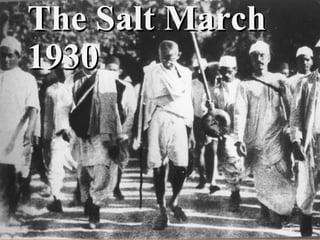
Salt March, 1930
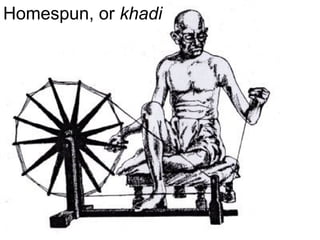
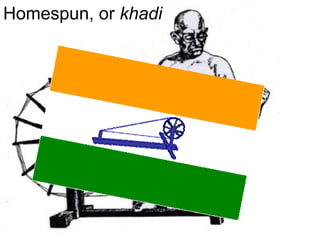
Home Spun
Hartal

Partition, 1947
Civil Disobedience
Satyagraha
Gov of India Act, 1935
Initial Organizers (so what?)
 India was the “most truly bright and precious

jewel” in the Empire’s crown.
 For the essayist, one of two examples of a
pacifistic revolution in the 20th century
(in contrast to violent revolutions).
 Example of a charismatic leader who gained
attention on the world stage and brought political
pressure to bear.
 Shows the contrast between British and French
post-war policies towards their colonies.
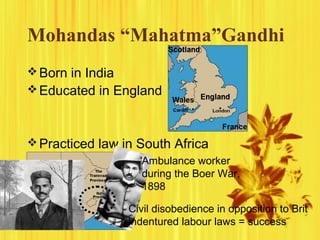
Mohandas “Mahatma”Gandhi
 Born in India
 Educated in England

 Practiced law in South Africa
Ambulance worker
during the Boer War,
1898
Civil disobedience in opposition to Brit
indentured labour laws = success
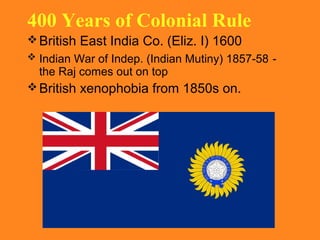
400 Years of Colonial Rule
 British East India Co. (Eliz. I) 1600
 Indian War of Indep. (Indian Mutiny) 1857-58 -

the Raj comes out on top

 British xenophobia from 1850s on.
Indian National Congress
(the Congress Party)

 Formed by middle class Indians in 1885
 Nationalist
 Hindu-dominated, but

 Large Muslim minority
 Used non-violent resistance (satyagraha)
 Disobey laws
 Don’t pay taxes
 Strikes
 Fasts

hartal

 Gatherings/demonstrations/marches
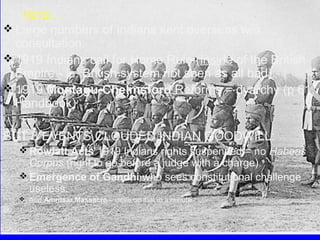
1919…
 Large numbers of Indians sent overseas w/o
consultation.
 1919 Indians call for Home Rule (inside of the British
Empire - ie. British system not seen as all bad).
 1919 Montagu-Chelmsford Reforms = dyarchy (p 61,
Handbook)
BUT 3 EVENTS CLOUDED INDIAN GOODWILL:
 Rowlatt Acts 1919 Indians rights suspended = no Habeas

Corpus (right to go before a judge with a charge).
 Emergence of Gandhi who sees constitutional challenge
useless.
 And Amritsar Massacre – more on that in a minute

So…
1919…
Congress Party calls for “Hartal”

= non-violent boycott of all Raj-sponsored
institutions (including the army) and
goods/services (especially clothing).
However…rioting showed Indians not

ready, so hartal ends. But…
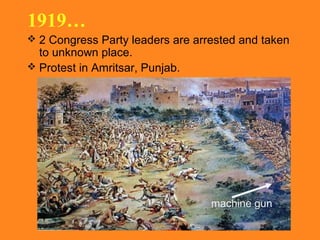
1919…
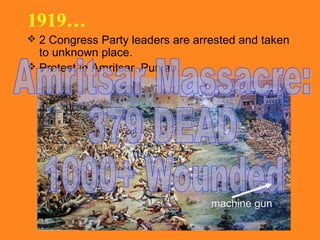
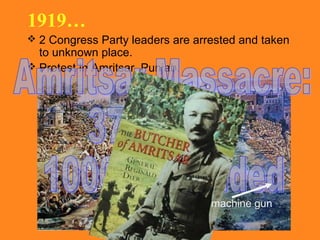
 2 Congress Party leaders are arrested and taken

to unknown place.
 Protest in Amritsar, Punjab.

machine gun
1919…
 2 Congress Party leaders are arrested and taken

to unknown place.
 Protest in Amritsar, Punjab.

machine gun
1919…
 2 Congress Party leaders are arrested and taken

to unknown place.
 Protest in Amritsar, Punjab.

machine gun
Reaction in India and Britain is
swift:
 Churchill condemns General Dyer in the

Commons.
 A few years of periodic revolts/violence in
India follows in spite of Gandhi’s call for
Muslims and Hindus to unite in
satyagraha.
 Call for Hindu-Muslim unity + Gandhi calls
for all to reject the caste system that
divides - ex. He called the Untouchables
Harijans: “Children of God.”
 Some very bloody events…..
Reaction, cont.
 Gandhi said Indians must not fight back,

even if beaten by police.
 1922 15 Indian policemen hacked up after
rough arrests - tensions boil over.
 Gandhi 21 day fast unto death nationalists stop to save Gandhi!
 Gandhi still jailed for sedition even though
he single-handedly stopped anarchistic
revolt.
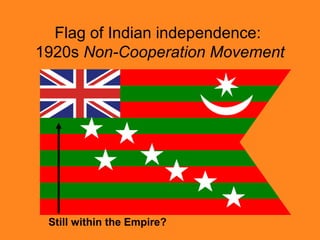
Flag of Indian independence:
1920s Non-Cooperation Movement

Still within the Empire?
Homespun, or khadi
Homespun, or khadi
The Salt March
1930
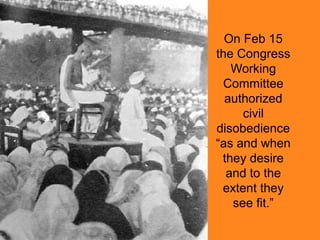
On Feb 15
the Congress
Working
Committee
authorized
civil
disobedience
“as and when
they desire
and to the
extent they
see fit.”
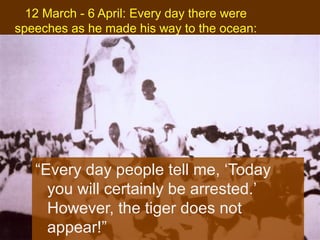
12 March - 6 April: Every day there were
speeches as he made his way to the ocean:

“Every day people tell me, ‘Today
you will certainly be arrested.’
However, the tiger does not
appear!”
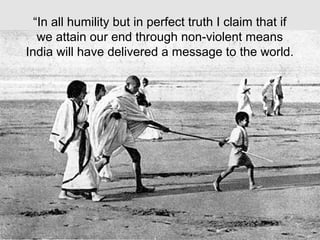
“In all humility but in perfect truth I claim that if
we attain our end through non-violent means
India will have delivered a message to the world.
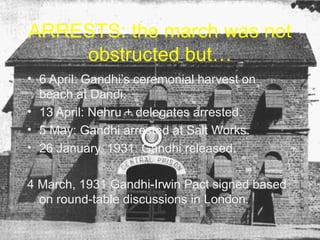
ARRESTS: the march was not
obstructed but…
• 6 April: Gandhi’s ceremonial harvest on
beach at Dandi.
• 13 April: Nehru + delegates arrested.
• 5 May: Gandhi arrested at Salt Works.
• 26 January, 1931: Gandhi released.
4 March, 1931 Gandhi-Irwin Pact signed based
on round-table discussions in London.
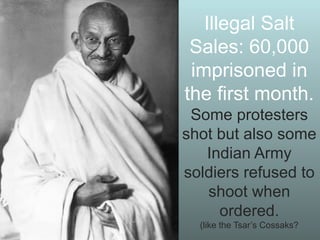
Illegal Salt
Sales: 60,000
imprisoned in
the first month.
Some protesters
shot but also some
Indian Army
soldiers refused to
shoot when
ordered.
(like the Tsar’s Cossaks?
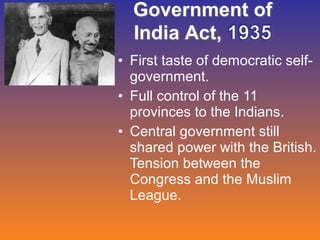
• First taste of democratic selfgovernment.
• Full control of the 11
provinces to the Indians.
• Central government still
shared power with the British.
Tension between the
Congress and the Muslim
League.
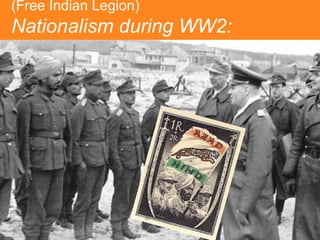
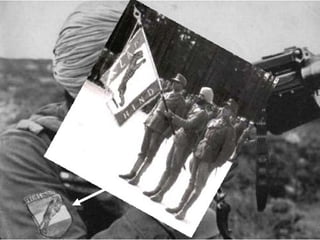
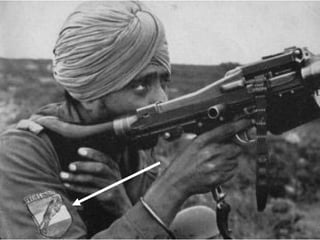
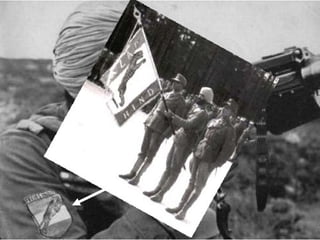
(Free Indian Legion)

Nationalism during WW2:
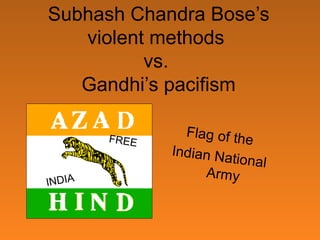
Subhash Chandra Bose’s
violent methods
vs.
Gandhi’s pacifism
FREE

INDIA

Flag of th
e
Indian Na
tional
A rm y
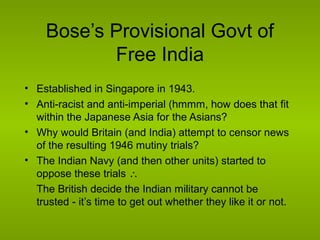
Bose’s Provisional Govt of
Free India
• Established in Singapore in 1943.
• Anti-racist and anti-imperial (hmmm, how does that fit
within the Japanese Asia for the Asians?
• Why would Britain (and India) attempt to censor news
of the resulting 1946 mutiny trials?
• The Indian Navy (and then other units) started to
oppose these trials ∴
The British decide the Indian military cannot be
trusted - it’s time to get out whether they like it or not.
And how about the Congress?
• Refused to support Brit war effort

(not even with

promise of Dominion status)

“a post-dated cheque from a crashing
bank.” Gandhi
• Why wouldn’t Gandhi trust a govt led by
Churchill? “I have not become His Majesty’s first minister in
order to preside over the dissolution of the British Empire” Churchill

= Quit

India slogan.

• Clement Attlee sees India as a political liability:
£ + casualties = not re-elected.
Post WW2
Gandhi wanted to keep India
together.
 Aug 1946: riots speed up transfer of

power and Viceroy Mountbatten
initiates conferences
- time is short: the bloodshed must be
curbed.

 Ali Jinnah will get his “Land of the

Pure.”
 The Sihks and Hindus will share
India.
 Individual provinces will vote to
discover their nation of choice.
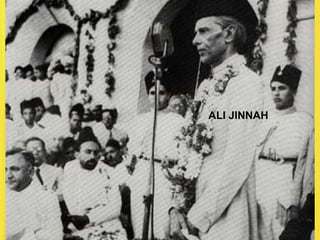
ALI JINNAH
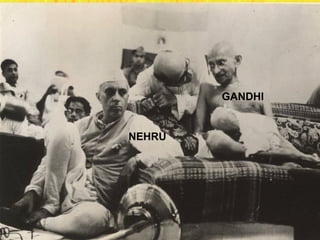
GANDHI

NEHRU
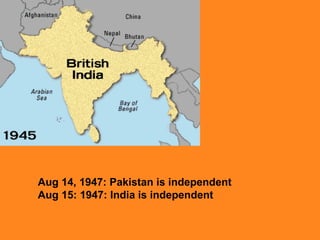
Aug 14, 1947: Pakistan is independent
Aug 15: 1947: India is independent
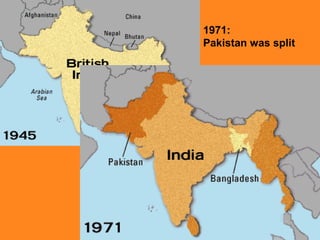
1971:
Pakistan was split
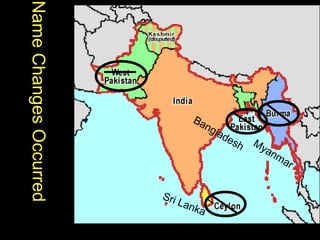
Name Changes Occurred

Ba
ng
lad
es

Sri
Lan
ka

h

My
an
ma

r
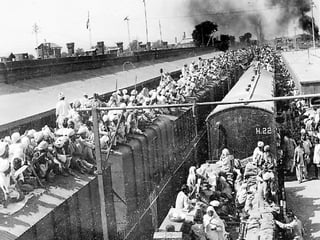
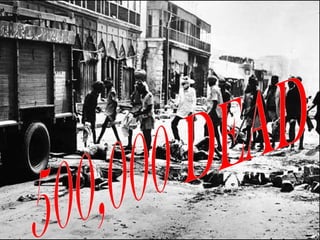
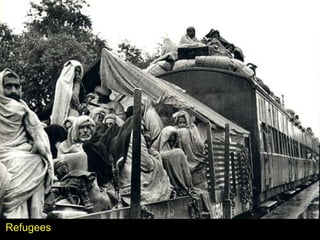
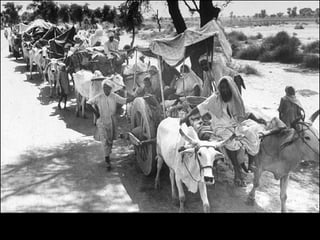
Partition brought Violence and
Turmoil:
 Some states were ruled by princes, not the

British - some were large!
 Slaughters took place where ethnic groups
were “out of their territory.”
 1.5 million refugees.
RRefugees
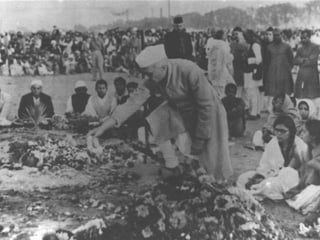
Gandhi’s worst fears were realized - he went to
Calcutta to try to stop reprisals by Hindus
against Muslims.
He was killed by an extremist Hindu:
thank goodness it wasn’t a Muslim!
“Gandhi has been killed by his own people for
whose redemption he lived….Father forgive
us.” Hindustan Standard, Feb 1, 1947
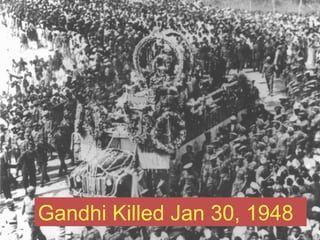
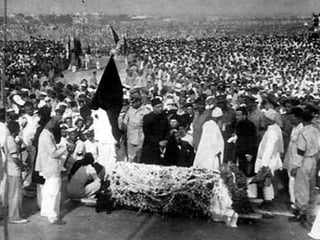
Gandhi Killed Jan 30, 1948
Considerations:
•
•
•
•
•
•
•
•

Peaceful civil disobedience vs. violent revolution
Role of nationalism
Charismatic leadership
World opinion - domestic political pressure
Imperial nations unburdening themselves
Vacuum created by decolonization
Ethnic cleansing
Partition
end
Use these key words to write a concise
75-word summary:
Muslim League
Indian National Congress
Amritsar, 1919
Home Rule
Montagu-Chelmsford
Civil Disobedience
Satyagraha
Hartal
Home Spun

Salt March, 1930
Gov of India Act, 1935
Partition, 1947