COP22 side event “Advancing (I)NDC implementation and
ambition: Bridging research and practice”
INDC preparation process and
countries’ progress
Takeshi Kuramochi
7 November, 2016, Marrakech
Kick-started, consolidated and
enhanced national climate
policy processes
Increased capacity for climate
planning
Indirectly enhanced pre-2020
ambition
08/11/2016 www.newclimate.org 2
INDC process as catalyst for
national policy making
See Briefing Paper:
Preparation of Intended
Nationally Determined
Contributions (INDCs) as
a catalyst for national
climate action (Day et al.,
2015)
www.mitigationpartnership.net/in
dcs-catalysts-climate-action
Availability of high-quality data and
analysis
Technical expertise on potential
mitigation options in all sectors
Framework on criteria and approaches
to assess ambition and fairness
Socio-economic impact assessments of
potential mitigation options
Understanding of finance and resources
needed to implement ambitious
mitigation
08/11/2016 www.newclimate.org 3
But there were also challenges…
See Briefing Paper:
Challenges and lessons
learned in the preparation of
Intended Nationally
Determined Contributions
(Kurdziel et al., 2016)
www.mitigationpartnership.net/i
ndcs-catalysts-climate-action
Overview of challenges
08/11/2016 www.newclimate.org 4
0% 25% 50% 75% 100%
Lack of high level political support / mandate
Conflict with other political priorities
Difficulties to assess the level of fairness and ambition
Limited understanding of how to formulate the INDC
Lack of coordination with and between various ministries
Lack of understanding of the objective amongst ministries
Lack of progress in other parallel climate strategy processes
Difficulties to consult broader non-governmental stakeholders
Lack of capacity/ personnel
Limited availability of information / expertise on technical…
Limited synchronisation between the political & technical…
Difficulties to assess economic impacts and co-benefits
Difficulties to assess financial and support needs
Strongly disagree Somewhat disagree Neither agree nor disagree
Somewhat agree Strongly agree
Source: Kurdziel et al. (2016)
www.climateactiontracker.org 5
Assessing (I)NDCs based on
effort sharing approaches
Gambia Bhutan
Costa Rica
Country
Assessments
(incl. current
policy projections)
updated on 3
November
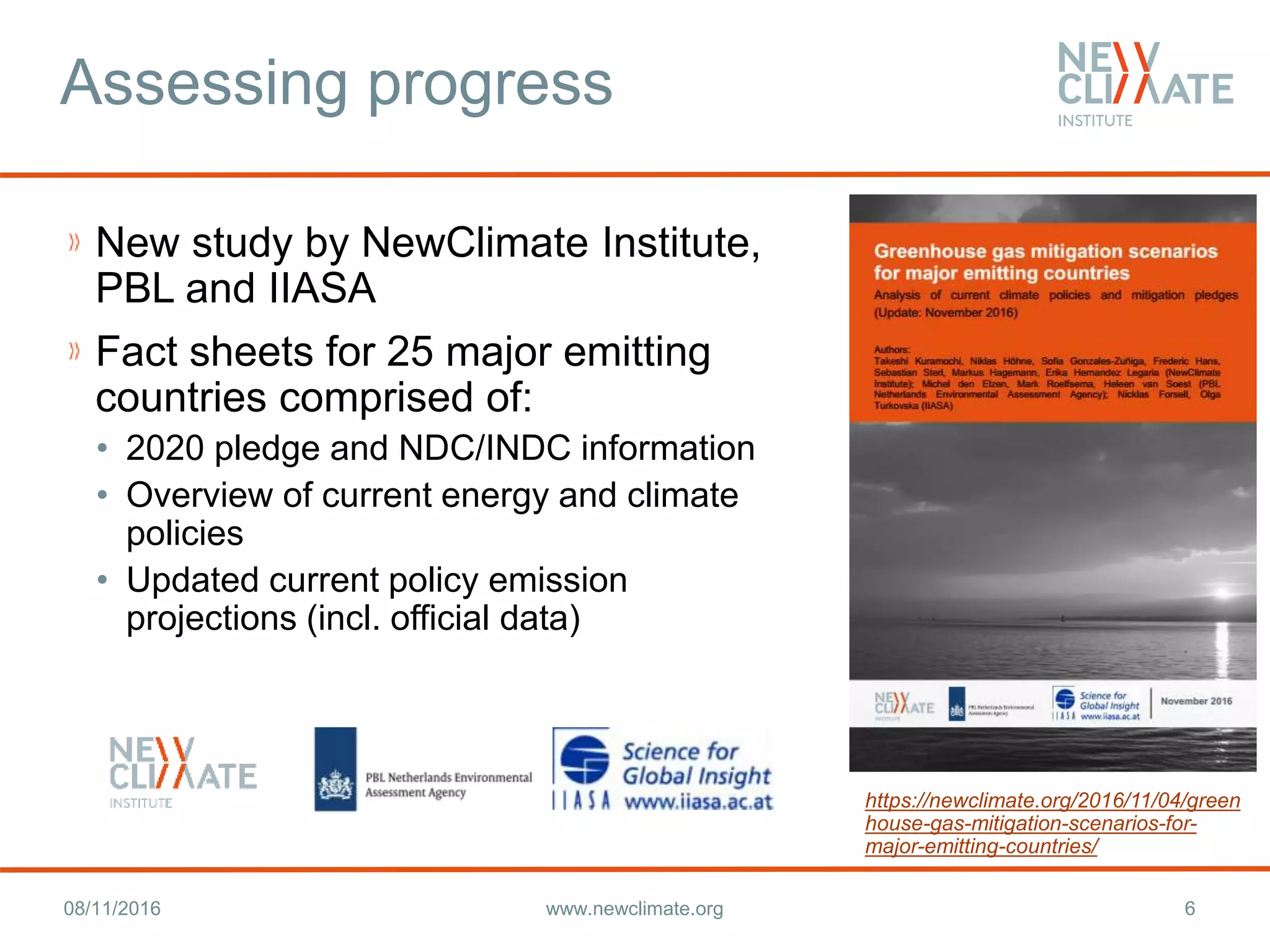
Assessing progress
New study by NewClimate Institute,
PBL and IIASA
Fact sheets for 25 major emitting
countries comprised of:
• 2020 pledge and NDC/INDC information
• Overview of current energy and climate
policies
• Updated current policy emission
projections (incl. official data)
https://newclimate.org/2016/11/04/green
house-gas-mitigation-scenarios-for-
major-emitting-countries/
08/11/2016 www.newclimate.org 6
Main finding: less than a third of the countries
are on track to achieve the (I)NDCs
08/11/2016 www.newclimate.org 7
NOTE: a country being likely to meet its targets
≠ it undertakes more stringent action than a
country that is not on track
Main finding: less than a third of the
countries are on track to achieve the INDCs
Of the 25 countries, six are (roughly) on track to achieve
their self-determined targets with current policies (and
one with large uncertainty).
The other ones would require additional measures to
achieve their 2025/2030 targets.
Progress on cutting down greenhouse gas emissions
also varies. For some countries currently implemented
policies do not stop emissions from increasing until 2030
(above 2010 levels)
Still more effort needed to stay well below 2 °C
8
Morocco: Raised ambition in NDC
Current policies
• Energy supply
o Installed RE capacity of 52% by
2030
o 15-20% of total primary energy
by 2030
• Energy efficiency
o 20% energy saving in 2030
o Minimum efficiency
requirements for new buildings
Additional policies needed
partly due to raised
ambition in NDC
Source: NewClimate Institute, PBL and IIASA (2016)
08/11/2016 www.newclimate.org 9
NDC:
-17% vs. BAU in 2030
(unconditional)
-42% vs. BAU in 2030
(conditional)
Japan: additional measures
needed to achieve 2030 targets
Current policies
• Economy-wide
o Global warming tax (3USD/tCO2)
• Energy supply
o Renewable electricity target 22-24% by
2030
o Renewable Feed-In Tariff
• Energy efficiency
o Top Runner Standards
o Building insulation standards
• F-gases
o Act on rational use and proper
management
Current policies projections revised
downward
Additional policies needed
regardless of future on nuclear
Source: NewClimate Institute, PBL and IIASA (2016)
08/11/2016 www.newclimate.org 10
INDC:
-26% vs. 2013 levels
Mexico: current policies not
sufficient for peaking before 2030
Current policies
• Energy Transition Law
o Clean energy incl. cogeneration:
35% by 2024 (possibly less
ambitious than previous RE
targets)
o Power auctions for wind and
solar
• National Forestry Programme
o Reduce annual deforestation rate
to 0.2% of total forest area in
2018
Current policies projections
revised upward
Additional policies needed to
achieve NDC target
08/11/2016 www.newclimate.org 11
NDC:
-22% vs. baseline in 2030
(unconditional)
-26% vs. baseline in 2030
(conditional)
Contact details:
Thank you for your attention!
www.newclimate.org
Takeshi Kuramochi
t.Kuramochi@newclimate.org

INDC preparation process and countries' progress

  • 1.
    COP22 side event“Advancing (I)NDC implementation and ambition: Bridging research and practice” INDC preparation process and countries’ progress Takeshi Kuramochi 7 November, 2016, Marrakech
  • 2.
    Kick-started, consolidated and enhancednational climate policy processes Increased capacity for climate planning Indirectly enhanced pre-2020 ambition 08/11/2016 www.newclimate.org 2 INDC process as catalyst for national policy making See Briefing Paper: Preparation of Intended Nationally Determined Contributions (INDCs) as a catalyst for national climate action (Day et al., 2015) www.mitigationpartnership.net/in dcs-catalysts-climate-action
  • 3.
    Availability of high-qualitydata and analysis Technical expertise on potential mitigation options in all sectors Framework on criteria and approaches to assess ambition and fairness Socio-economic impact assessments of potential mitigation options Understanding of finance and resources needed to implement ambitious mitigation 08/11/2016 www.newclimate.org 3 But there were also challenges… See Briefing Paper: Challenges and lessons learned in the preparation of Intended Nationally Determined Contributions (Kurdziel et al., 2016) www.mitigationpartnership.net/i ndcs-catalysts-climate-action
  • 4.
    Overview of challenges 08/11/2016www.newclimate.org 4 0% 25% 50% 75% 100% Lack of high level political support / mandate Conflict with other political priorities Difficulties to assess the level of fairness and ambition Limited understanding of how to formulate the INDC Lack of coordination with and between various ministries Lack of understanding of the objective amongst ministries Lack of progress in other parallel climate strategy processes Difficulties to consult broader non-governmental stakeholders Lack of capacity/ personnel Limited availability of information / expertise on technical… Limited synchronisation between the political & technical… Difficulties to assess economic impacts and co-benefits Difficulties to assess financial and support needs Strongly disagree Somewhat disagree Neither agree nor disagree Somewhat agree Strongly agree Source: Kurdziel et al. (2016)
  • 5.
    www.climateactiontracker.org 5 Assessing (I)NDCsbased on effort sharing approaches Gambia Bhutan Costa Rica Country Assessments (incl. current policy projections) updated on 3 November
  • 6.
    Assessing progress New studyby NewClimate Institute, PBL and IIASA Fact sheets for 25 major emitting countries comprised of: • 2020 pledge and NDC/INDC information • Overview of current energy and climate policies • Updated current policy emission projections (incl. official data) https://newclimate.org/2016/11/04/green house-gas-mitigation-scenarios-for- major-emitting-countries/ 08/11/2016 www.newclimate.org 6
  • 7.
    Main finding: lessthan a third of the countries are on track to achieve the (I)NDCs 08/11/2016 www.newclimate.org 7 NOTE: a country being likely to meet its targets ≠ it undertakes more stringent action than a country that is not on track
  • 8.
    Main finding: lessthan a third of the countries are on track to achieve the INDCs Of the 25 countries, six are (roughly) on track to achieve their self-determined targets with current policies (and one with large uncertainty). The other ones would require additional measures to achieve their 2025/2030 targets. Progress on cutting down greenhouse gas emissions also varies. For some countries currently implemented policies do not stop emissions from increasing until 2030 (above 2010 levels) Still more effort needed to stay well below 2 °C 8
  • 9.
    Morocco: Raised ambitionin NDC Current policies • Energy supply o Installed RE capacity of 52% by 2030 o 15-20% of total primary energy by 2030 • Energy efficiency o 20% energy saving in 2030 o Minimum efficiency requirements for new buildings Additional policies needed partly due to raised ambition in NDC Source: NewClimate Institute, PBL and IIASA (2016) 08/11/2016 www.newclimate.org 9 NDC: -17% vs. BAU in 2030 (unconditional) -42% vs. BAU in 2030 (conditional)
  • 10.
    Japan: additional measures neededto achieve 2030 targets Current policies • Economy-wide o Global warming tax (3USD/tCO2) • Energy supply o Renewable electricity target 22-24% by 2030 o Renewable Feed-In Tariff • Energy efficiency o Top Runner Standards o Building insulation standards • F-gases o Act on rational use and proper management Current policies projections revised downward Additional policies needed regardless of future on nuclear Source: NewClimate Institute, PBL and IIASA (2016) 08/11/2016 www.newclimate.org 10 INDC: -26% vs. 2013 levels
  • 11.
    Mexico: current policiesnot sufficient for peaking before 2030 Current policies • Energy Transition Law o Clean energy incl. cogeneration: 35% by 2024 (possibly less ambitious than previous RE targets) o Power auctions for wind and solar • National Forestry Programme o Reduce annual deforestation rate to 0.2% of total forest area in 2018 Current policies projections revised upward Additional policies needed to achieve NDC target 08/11/2016 www.newclimate.org 11 NDC: -22% vs. baseline in 2030 (unconditional) -26% vs. baseline in 2030 (conditional)
  • 12.
    Contact details: Thank youfor your attention! www.newclimate.org Takeshi Kuramochi t.Kuramochi@newclimate.org

Editor's Notes

  • #5 Key challenges: assessing costs and benefits of INDCs Another interesting observation: fairness and ambition – perhaps no need for a deep-dive due to INDCs being “self-determined”
  • #9 Not all countries on track to achieve targets set in INDCs Of the 25 countries and regions studied here, seven are (roughly) (THE GREEN ONES) on track to achieve their self-determined (unconditional) 2025 and/or 2030 targets with currently implemented policies. These include Brazil, Chile, China, India, the Russian Federation, Turkey, and Ukraine. The other ones ORANGE AND RED (including Argentina, Australia, Canada, Colombia, Democratic Republic of the Congo, Ethiopia, the EU, Indonesia, Japan, Kazakhstan, Mexico, Morocco, Republic of Korea, Saudi Arabia, South Africa, Thailand, the Philippines, and the United States) would require additional measures to achieve their 2025/2030 targets. Note: It should be noted that a country being likely to meet its targets does not necessarily mean that it undertakes more stringent action on mitigation than a country that is not on track, because it depends on the ambition of the nationally determined target and countries have different policy-making approaches. Progress on cutting down greenhouse gas emissions also varies The researchers also found that in some countries, such as Australia, China, India, Mexico, Saudi Arabia, and Turkey, currently implemented policies do not stop emissions from increasing until 2030 (above 2010 levels), mainly due to these countries’ projected high economic growth. Greenhouse gas emissions in other countries are projected to remain stable at approximately current levels, or decrease further, under current policies.