11/16/2017 www.newclimate.org 1
COP23 Bonn, 10-11-2017, EU Pavilion, 16:45-
18:15
Beyond Philanthropy
PROSPECTS—A transparent energy and
emissions tracking tool for developing countries
Sebastian Sterl
NewClimate Institute
Purpose
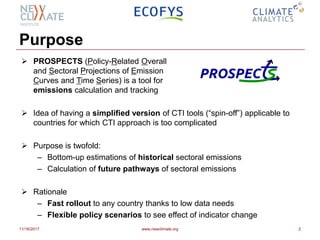
 PROSPECTS (Policy-Related Overall
and Sectoral Projections of Emission
Curves and Time Series) is a tool for
emissions calculation and tracking
 Idea of having a simplified version of CTI tools (“spin-off”) applicable to
countries for which CTI approach is too complicated
 Purpose is twofold:
– Bottom-up estimations of historical sectoral emissions
– Calculation of future pathways of sectoral emissions
 Rationale
– Fast rollout to any country thanks to low data needs
– Flexible policy scenarios to see effect of indicator change
11/16/2017 www.newclimate.org 2
Overview
• Overall functional design
• Demonstrations
• Way forward
11/16/2017 www.newclimate.org 3
Overall functional design
11/16/2017 www.newclimate.org 4
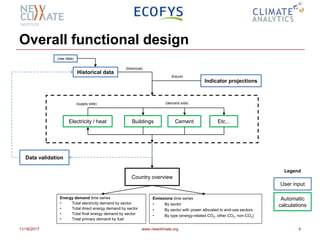
Historical data
Electricity / heat Buildings Cement Etc...
(supply side)
Indicator projections
(demand side)
Country overview
Data validation
(historical)
(future)
(raw data)
User input
Automatic
calculations
Legend
Energy demand time series
• Total electricity demand by sector
• Total direct energy demand by sector
• Total final energy demand by sector
• Total primary demand by fuel
Emissions time series
• By sector
• By sector with power allocated to end-use sectors
• By type (energy-related CO2, other CO2, non-CO2)
Sectoral split
11/16/2017 www. newclimate.org 5
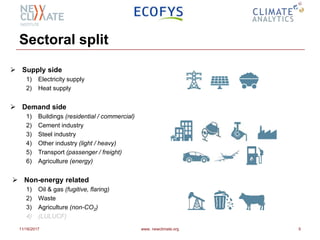
 Supply side
1) Electricity supply
2) Heat supply
 Demand side
1) Buildings (residential / commercial)
2) Cement industry
3) Steel industry
4) Other industry (light / heavy)
5) Transport (passenger / freight)
6) Agriculture (energy)
 Non-energy related
1) Oil & gas (fugitive, flaring)
2) Waste
3) Agriculture (non-CO2)
4) (LULUCF)
The power of PROSPECTS
Optimal balance between accuracy and simplicity
• Distilled list of metrics that together account for ~100% of a country’s emissions
• Separation of data into activity and intensity metrics
 Activity: country-specific, e.g. steel production, traffic demand, fuel mixes
 Intensity: context-specific, e.g. energy intensity of steel, vehicle fuel economy
• Tailored link with existing databases to minimise specific data requirements
• High degree of user flexibility for emission projections through indicator levers;
intuitive list of indicators for future projections; easy to grasp for people who
are not model experts
Bottom line:
To get a good estimate of any country’s emissions, the country-specific data and resource needs can be
straightforwardly limited by appropriate choices of metrics.
11/16/2017 www.newclimate.org 6
Overview
• Overall functional design
• Demonstrations
• Way forward
11/16/2017 www.newclimate.org 7
Demonstrations
• European Union (Validation exercise)
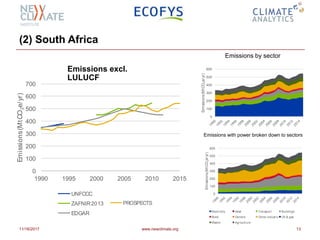
• South Africa (Litmus test)
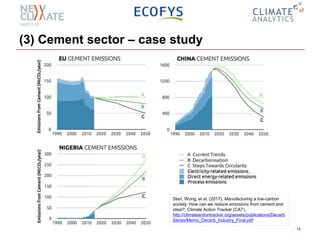
• Cement sector in EU, China & Nigeria (Successful
application)
• Analysis of pledges (Potential application)
11/16/2017 www.newclimate.org 8
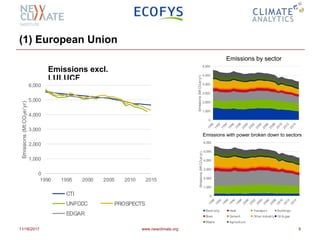
(1) European Union
11/16/2017 www.newclimate.org 9
Emissions excl.
LULUCF
Emissions by sector
Emissions with power broken down to sectors
s(excl. LULUCF)
CTI
UNFCCC
EDGAR
empty4
empty5
95 2000 2005 2010 2015
rall emissions(excl. LULUCF)
CTI
UNFCCC
EDGAR
empty4
empty5
PROSPECTS
0
1,000
2,000
3,000
4,000
5,000
6,000
1990 1995 2000 2005 2010 2015
Emissions(MtCO2e/yr)
Overall emissions (excl.LULUCF)
CTI
UNFCCC
EDGAR
empty4
empty5
PROSPECTS
0
1,000
2,000
3,000
4,000
5,000
6,000
Emissions(MtCO2e/yr)
Emissions by sector
Electricity Heat Transport Buildings
Steel Cement Other industry Oil & gas
Waste Agriculture
0
1,000
2,000
3,000
4,000
5,000
6,000
Emissions(MtCO2e/yr)
Emissions by sector
Electricity Heat Transport Buildings
Steel Cement Other industry Oil & gas
Waste Agriculture
11/16/2017 www.newclimate.org 10
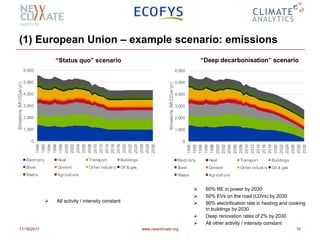
“Status quo” scenario “Deep decarbonisation” scenario
 60% RE in power by 2030
 50% EVs on the road (LDVs) by 2030
 90% electrification rate in heating and cooking
in buildings by 2030
 Deep renovation rates of 2% by 2030
 All other activity / intensity constant
 All activity / intensity constant
0
1,000
2,000
3,000
4,000
5,000
6,000
1990
1992
1994
1996
1998
2000
2002
2004
2006
2008
2010
2012
2014
2016
2018
2020
2022
2024
2026
2028
2030
Emissions(MtCO2e/yr)
Emissions by sector
Electricity Heat Transport Buildings
Steel Cement Other industry Oil & gas
Waste Agriculture
0
1,000
2,000
3,000
4,000
5,000
6,000
1990
1992
1994
1996
1998
2000
2002
2004
2006
2008
2010
2012
2014
2016
2018
2020
2022
2024
2026
2028
2030
Emissions(MtCO2e/yr)
Emissions by sector
Electricity Heat Transport Buildings
Steel Cement Other industry Oil & gas
Waste Agriculture
(1) European Union – example scenario: emissions
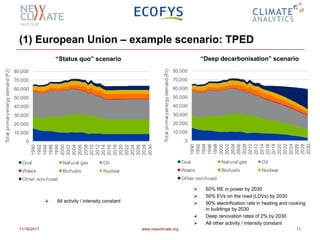
(1) European Union – example scenario: TPED
11/16/2017 www.newclimate.org 11
“Status quo” scenario “Deep decarbonisation” scenario
 60% RE in power by 2030
 50% EVs on the road (LDVs) by 2030
 90% electrification rate in heating and cooking
in buildings by 2030
 Deep renovation rates of 2% by 2030
 All other activity / intensity constant
 All activity / intensity constant
0
10,000
20,000
30,000
40,000
50,000
60,000
70,000
80,000
1990
1992
1994
1996
1998
2000
2002
2004
2006
2008
2010
2012
2014
2016
2018
2020
2022
2024
2026
2028
2030
Totalprimaryenergydemand(PJ)
Total demand for fuels
Coal Natural gas Oil
Waste Biofuels Nuclear
Other non-fossil
0
10,000
20,000
30,000
40,000
50,000
60,000
70,000
80,000
1990
1992
1994
1996
1998
2000
2002
2004
2006
2008
2010
2012
2014
2016
2018
2020
2022
2024
2026
2028
2030
Totalprimaryenergydemand(PJ)
Total demand for fuels
Coal Natural gas Oil
Waste Biofuels Nuclear
Other non-fossil
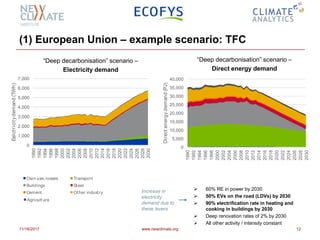
(1) European Union – example scenario: TFC
11/16/2017 www.newclimate.org 12
“Deep decarbonisation” scenario –
Electricity demand
0
5,000
10,000
15,000
20,000
25,000
30,000
35,000
40,000
1990
1992
1994
1996
1998
2000
2002
2004
2006
2008
2010
2012
2014
2016
2018
2020
2022
2024
2026
2028
2030
Directenergydemand(PJ)
Direct energy demand
Own use, losses Transport
Buildings Steel
Cement Other industry
Oil & gas Waste
Agricult ure
0
1,000
2,000
3,000
4,000
5,000
6,000
7,000
1990
1992
1994
1996
1998
2000
2002
2004
2006
2008
2010
2012
2014
2016
2018
2020
2022
2024
2026
2028
2030
Eelctricitydemand(TWh)
Electricity demand
Own use, losses Transport
Buildings Steel
Cement Other industry
Oil & gas Waste
Agricult ure
“Deep decarbonisation” scenario –
Direct energy demand
0
5,000
10,000
15,000
20,000
25,000
30,000
35,000
40,000
Directenergydemand(PJ)
Direct energy demand
Own use, losses Transport
Buildings Steel
Cement Other industry
Oil & gas Waste
Agricult ure
0
5,000
10,000
15,000
20,000
25,000
30,000
35,000
40,000
Directenergydemand(PJ)
Direct energy demand
Own use, losses Transport
Buildings Steel
Cement Other industry
Oil & gas Waste
Agricult ure
Increase in
electricity
demand due to
these levers
 60% RE in power by 2030
 50% EVs on the road (LDVs) by 2030
 90% electrification rate in heating and
cooking in buildings by 2030
 Deep renovation rates of 2% by 2030
 All other activity / intensity constant
(2) South Africa
11/16/2017 www.newclimate.org 13
Emissions excl.
LULUCF
Emissions by sector
Emissions with power broken down to sectors
ns(excl. LULUCF)
UNFCCC
ZAFNIR2013
EDGAR
empty4
empty5
95 2000 2005 2010 2015
verall emissions(excl. LULUCF)
UNFCCC
ZAFNIR2013
EDGAR
empty4
empty5
PROSPECTS
0
100
200
300
400
500
600
Emissions(MtCO2e/yr)
Emissions by sector
Electricity Heat Transport Buildings
Steel Cement Other industry Oil & gas
Waste Agriculture
0
100
200
300
400
500
600
700
1990 1995 2000 2005 2010 2015
Emissions(MtCO2e/yr)
Overall emissions(excl. LULUCF)
UNFCCC
ZAFNIR2013
EDGAR
empty4
empty5
PROSPECTS
0
100
200
300
400
500
600
Emissions(MtCO2e/yr)
Emissions by sector
Electricit y Heat Transport
Buildings Steel Cement
Other industry Oil & gas Waste
Agricult ure
0
100
200
300
400
500
600
Emissions(MtCO2e/yr)
Emissions by sector
Electricit y Heat Transport
Buildings Steel Cement
Other industry Oil & gas Waste
Agricult ure
(3) Cement sector – case study
14
Sterl, Wong, et al. (2017), Manufacturing a low-carbon
society: How can we reduce emissions from cement and
steel?, Climate Action Tracker (CAT),
http://climateactiontracker.org/assets/publications/Decarb
Series/Memo_Decarb_Industry_Final.pdf
(4) Achieving the EU NDC: parameter space
11/16/2017 www.newclimate.org 15
Target:
Reduction of 40% by 2030
compared to 1990 levels
Idea:
Reaching the EU NDC through
- Electrifying transport
- Electrifying buildings
- Increasing RE share
Assumptions:
- RE replaces fossil fuels, nuclear
- EV penetration applies to all
motorised road transport (cars,
buses, trucks)
- All demand-side energy
intensities (buildings, industry,
transport, agriculture) show
autonomous improvement of
1%/year
- All other activity/intensity
indicators constant (Values in graph are for 2030; linear development from 2015 assumed)
Overview
• Overall functional design
• Demonstrations
• Way forward
11/16/2017 www.newclimate.org 16
Future work
 Build a shell tool / interface around PROSPECTS for support of
ICAT (Initiative for Climate Action Transparency)
 Further validation of methodology through testing on USA case
 Design of credible future scenarios based on current policies
 Further tests (full inventories + projections) for the following
countries planned:
– Argentina (G20) – Mongolia
– Indonesia (G20) – Georgia (under consideration)
– Turkey (G20) – Kenya (under consideration)
11/16/2017 www.climateactiontracker.org 17
Collaborators and co-authors
NewClimate Institute
Jing Zhang, Markus Hagemann, Hanna Fekete, prof. dr. Niklas Höhne
Ecofys
dr. Yvonne Deng, Karlien Wouters, Tom Berg, prof. dr. Kornelis Blok
Climate Analytics
Fabio Sferra, Jasmin Cantzler, dr. (h.c.) Bill Hare, dr. Michiel Schaeffer
PROSPECTS © 2017 Climate Action Tracker (NewClimate Institute,
Ecofys, Climate Analytics). All rights reserved.
This work was funded by the ClimateWorks Foundation.
11/16/2017 www.newclimate.org 18

PROSPECTS - A transparent energy and emissions tracking tool for developing countries - COP 23

  • 1.
    11/16/2017 www.newclimate.org 1 COP23Bonn, 10-11-2017, EU Pavilion, 16:45- 18:15 Beyond Philanthropy PROSPECTS—A transparent energy and emissions tracking tool for developing countries Sebastian Sterl NewClimate Institute
  • 2.
    Purpose  PROSPECTS (Policy-RelatedOverall and Sectoral Projections of Emission Curves and Time Series) is a tool for emissions calculation and tracking  Idea of having a simplified version of CTI tools (“spin-off”) applicable to countries for which CTI approach is too complicated  Purpose is twofold: – Bottom-up estimations of historical sectoral emissions – Calculation of future pathways of sectoral emissions  Rationale – Fast rollout to any country thanks to low data needs – Flexible policy scenarios to see effect of indicator change 11/16/2017 www.newclimate.org 2
  • 3.
    Overview • Overall functionaldesign • Demonstrations • Way forward 11/16/2017 www.newclimate.org 3
  • 4.
    Overall functional design 11/16/2017www.newclimate.org 4 Historical data Electricity / heat Buildings Cement Etc... (supply side) Indicator projections (demand side) Country overview Data validation (historical) (future) (raw data) User input Automatic calculations Legend Energy demand time series • Total electricity demand by sector • Total direct energy demand by sector • Total final energy demand by sector • Total primary demand by fuel Emissions time series • By sector • By sector with power allocated to end-use sectors • By type (energy-related CO2, other CO2, non-CO2)
  • 5.
    Sectoral split 11/16/2017 www.newclimate.org 5  Supply side 1) Electricity supply 2) Heat supply  Demand side 1) Buildings (residential / commercial) 2) Cement industry 3) Steel industry 4) Other industry (light / heavy) 5) Transport (passenger / freight) 6) Agriculture (energy)  Non-energy related 1) Oil & gas (fugitive, flaring) 2) Waste 3) Agriculture (non-CO2) 4) (LULUCF)
  • 6.
    The power ofPROSPECTS Optimal balance between accuracy and simplicity • Distilled list of metrics that together account for ~100% of a country’s emissions • Separation of data into activity and intensity metrics  Activity: country-specific, e.g. steel production, traffic demand, fuel mixes  Intensity: context-specific, e.g. energy intensity of steel, vehicle fuel economy • Tailored link with existing databases to minimise specific data requirements • High degree of user flexibility for emission projections through indicator levers; intuitive list of indicators for future projections; easy to grasp for people who are not model experts Bottom line: To get a good estimate of any country’s emissions, the country-specific data and resource needs can be straightforwardly limited by appropriate choices of metrics. 11/16/2017 www.newclimate.org 6
  • 7.
    Overview • Overall functionaldesign • Demonstrations • Way forward 11/16/2017 www.newclimate.org 7
  • 8.
    Demonstrations • European Union(Validation exercise) • South Africa (Litmus test) • Cement sector in EU, China & Nigeria (Successful application) • Analysis of pledges (Potential application) 11/16/2017 www.newclimate.org 8
  • 9.
    (1) European Union 11/16/2017www.newclimate.org 9 Emissions excl. LULUCF Emissions by sector Emissions with power broken down to sectors s(excl. LULUCF) CTI UNFCCC EDGAR empty4 empty5 95 2000 2005 2010 2015 rall emissions(excl. LULUCF) CTI UNFCCC EDGAR empty4 empty5 PROSPECTS 0 1,000 2,000 3,000 4,000 5,000 6,000 1990 1995 2000 2005 2010 2015 Emissions(MtCO2e/yr) Overall emissions (excl.LULUCF) CTI UNFCCC EDGAR empty4 empty5 PROSPECTS 0 1,000 2,000 3,000 4,000 5,000 6,000 Emissions(MtCO2e/yr) Emissions by sector Electricity Heat Transport Buildings Steel Cement Other industry Oil & gas Waste Agriculture 0 1,000 2,000 3,000 4,000 5,000 6,000 Emissions(MtCO2e/yr) Emissions by sector Electricity Heat Transport Buildings Steel Cement Other industry Oil & gas Waste Agriculture
  • 10.
    11/16/2017 www.newclimate.org 10 “Statusquo” scenario “Deep decarbonisation” scenario  60% RE in power by 2030  50% EVs on the road (LDVs) by 2030  90% electrification rate in heating and cooking in buildings by 2030  Deep renovation rates of 2% by 2030  All other activity / intensity constant  All activity / intensity constant 0 1,000 2,000 3,000 4,000 5,000 6,000 1990 1992 1994 1996 1998 2000 2002 2004 2006 2008 2010 2012 2014 2016 2018 2020 2022 2024 2026 2028 2030 Emissions(MtCO2e/yr) Emissions by sector Electricity Heat Transport Buildings Steel Cement Other industry Oil & gas Waste Agriculture 0 1,000 2,000 3,000 4,000 5,000 6,000 1990 1992 1994 1996 1998 2000 2002 2004 2006 2008 2010 2012 2014 2016 2018 2020 2022 2024 2026 2028 2030 Emissions(MtCO2e/yr) Emissions by sector Electricity Heat Transport Buildings Steel Cement Other industry Oil & gas Waste Agriculture (1) European Union – example scenario: emissions
  • 11.
    (1) European Union– example scenario: TPED 11/16/2017 www.newclimate.org 11 “Status quo” scenario “Deep decarbonisation” scenario  60% RE in power by 2030  50% EVs on the road (LDVs) by 2030  90% electrification rate in heating and cooking in buildings by 2030  Deep renovation rates of 2% by 2030  All other activity / intensity constant  All activity / intensity constant 0 10,000 20,000 30,000 40,000 50,000 60,000 70,000 80,000 1990 1992 1994 1996 1998 2000 2002 2004 2006 2008 2010 2012 2014 2016 2018 2020 2022 2024 2026 2028 2030 Totalprimaryenergydemand(PJ) Total demand for fuels Coal Natural gas Oil Waste Biofuels Nuclear Other non-fossil 0 10,000 20,000 30,000 40,000 50,000 60,000 70,000 80,000 1990 1992 1994 1996 1998 2000 2002 2004 2006 2008 2010 2012 2014 2016 2018 2020 2022 2024 2026 2028 2030 Totalprimaryenergydemand(PJ) Total demand for fuels Coal Natural gas Oil Waste Biofuels Nuclear Other non-fossil
  • 12.
    (1) European Union– example scenario: TFC 11/16/2017 www.newclimate.org 12 “Deep decarbonisation” scenario – Electricity demand 0 5,000 10,000 15,000 20,000 25,000 30,000 35,000 40,000 1990 1992 1994 1996 1998 2000 2002 2004 2006 2008 2010 2012 2014 2016 2018 2020 2022 2024 2026 2028 2030 Directenergydemand(PJ) Direct energy demand Own use, losses Transport Buildings Steel Cement Other industry Oil & gas Waste Agricult ure 0 1,000 2,000 3,000 4,000 5,000 6,000 7,000 1990 1992 1994 1996 1998 2000 2002 2004 2006 2008 2010 2012 2014 2016 2018 2020 2022 2024 2026 2028 2030 Eelctricitydemand(TWh) Electricity demand Own use, losses Transport Buildings Steel Cement Other industry Oil & gas Waste Agricult ure “Deep decarbonisation” scenario – Direct energy demand 0 5,000 10,000 15,000 20,000 25,000 30,000 35,000 40,000 Directenergydemand(PJ) Direct energy demand Own use, losses Transport Buildings Steel Cement Other industry Oil & gas Waste Agricult ure 0 5,000 10,000 15,000 20,000 25,000 30,000 35,000 40,000 Directenergydemand(PJ) Direct energy demand Own use, losses Transport Buildings Steel Cement Other industry Oil & gas Waste Agricult ure Increase in electricity demand due to these levers  60% RE in power by 2030  50% EVs on the road (LDVs) by 2030  90% electrification rate in heating and cooking in buildings by 2030  Deep renovation rates of 2% by 2030  All other activity / intensity constant
  • 13.
    (2) South Africa 11/16/2017www.newclimate.org 13 Emissions excl. LULUCF Emissions by sector Emissions with power broken down to sectors ns(excl. LULUCF) UNFCCC ZAFNIR2013 EDGAR empty4 empty5 95 2000 2005 2010 2015 verall emissions(excl. LULUCF) UNFCCC ZAFNIR2013 EDGAR empty4 empty5 PROSPECTS 0 100 200 300 400 500 600 Emissions(MtCO2e/yr) Emissions by sector Electricity Heat Transport Buildings Steel Cement Other industry Oil & gas Waste Agriculture 0 100 200 300 400 500 600 700 1990 1995 2000 2005 2010 2015 Emissions(MtCO2e/yr) Overall emissions(excl. LULUCF) UNFCCC ZAFNIR2013 EDGAR empty4 empty5 PROSPECTS 0 100 200 300 400 500 600 Emissions(MtCO2e/yr) Emissions by sector Electricit y Heat Transport Buildings Steel Cement Other industry Oil & gas Waste Agricult ure 0 100 200 300 400 500 600 Emissions(MtCO2e/yr) Emissions by sector Electricit y Heat Transport Buildings Steel Cement Other industry Oil & gas Waste Agricult ure
  • 14.
    (3) Cement sector– case study 14 Sterl, Wong, et al. (2017), Manufacturing a low-carbon society: How can we reduce emissions from cement and steel?, Climate Action Tracker (CAT), http://climateactiontracker.org/assets/publications/Decarb Series/Memo_Decarb_Industry_Final.pdf
  • 15.
    (4) Achieving theEU NDC: parameter space 11/16/2017 www.newclimate.org 15 Target: Reduction of 40% by 2030 compared to 1990 levels Idea: Reaching the EU NDC through - Electrifying transport - Electrifying buildings - Increasing RE share Assumptions: - RE replaces fossil fuels, nuclear - EV penetration applies to all motorised road transport (cars, buses, trucks) - All demand-side energy intensities (buildings, industry, transport, agriculture) show autonomous improvement of 1%/year - All other activity/intensity indicators constant (Values in graph are for 2030; linear development from 2015 assumed)
  • 16.
    Overview • Overall functionaldesign • Demonstrations • Way forward 11/16/2017 www.newclimate.org 16
  • 17.
    Future work  Builda shell tool / interface around PROSPECTS for support of ICAT (Initiative for Climate Action Transparency)  Further validation of methodology through testing on USA case  Design of credible future scenarios based on current policies  Further tests (full inventories + projections) for the following countries planned: – Argentina (G20) – Mongolia – Indonesia (G20) – Georgia (under consideration) – Turkey (G20) – Kenya (under consideration) 11/16/2017 www.climateactiontracker.org 17
  • 18.
    Collaborators and co-authors NewClimateInstitute Jing Zhang, Markus Hagemann, Hanna Fekete, prof. dr. Niklas Höhne Ecofys dr. Yvonne Deng, Karlien Wouters, Tom Berg, prof. dr. Kornelis Blok Climate Analytics Fabio Sferra, Jasmin Cantzler, dr. (h.c.) Bill Hare, dr. Michiel Schaeffer PROSPECTS © 2017 Climate Action Tracker (NewClimate Institute, Ecofys, Climate Analytics). All rights reserved. This work was funded by the ClimateWorks Foundation. 11/16/2017 www.newclimate.org 18