Achieving Net Zero
Opportunities to close the gap to
1.5◦C in Europe and beyond
Claire Stockwell, Paola Yanguas Parra, Swithin Lui, Louise Jeffery,
Andreas Geiges | Climate Action Tracker
6 December 2019
www.climateactiontracker.org
Outline
• Tracking progress on climate action
– New country analysis: UK, Germany, Kenya, Viet Nam
• Scaling up action at the sectoral level
• Assessing climate governance and its contribution to decarbonization
• Introducing our Climate Target Update Tracker
– First rapid analysis: Proposed Chilean NDC update
• Panel Discussion - Delivering on climate action in 2020
www.climateactiontracker.org
More ambitious NDCs needed by 2020
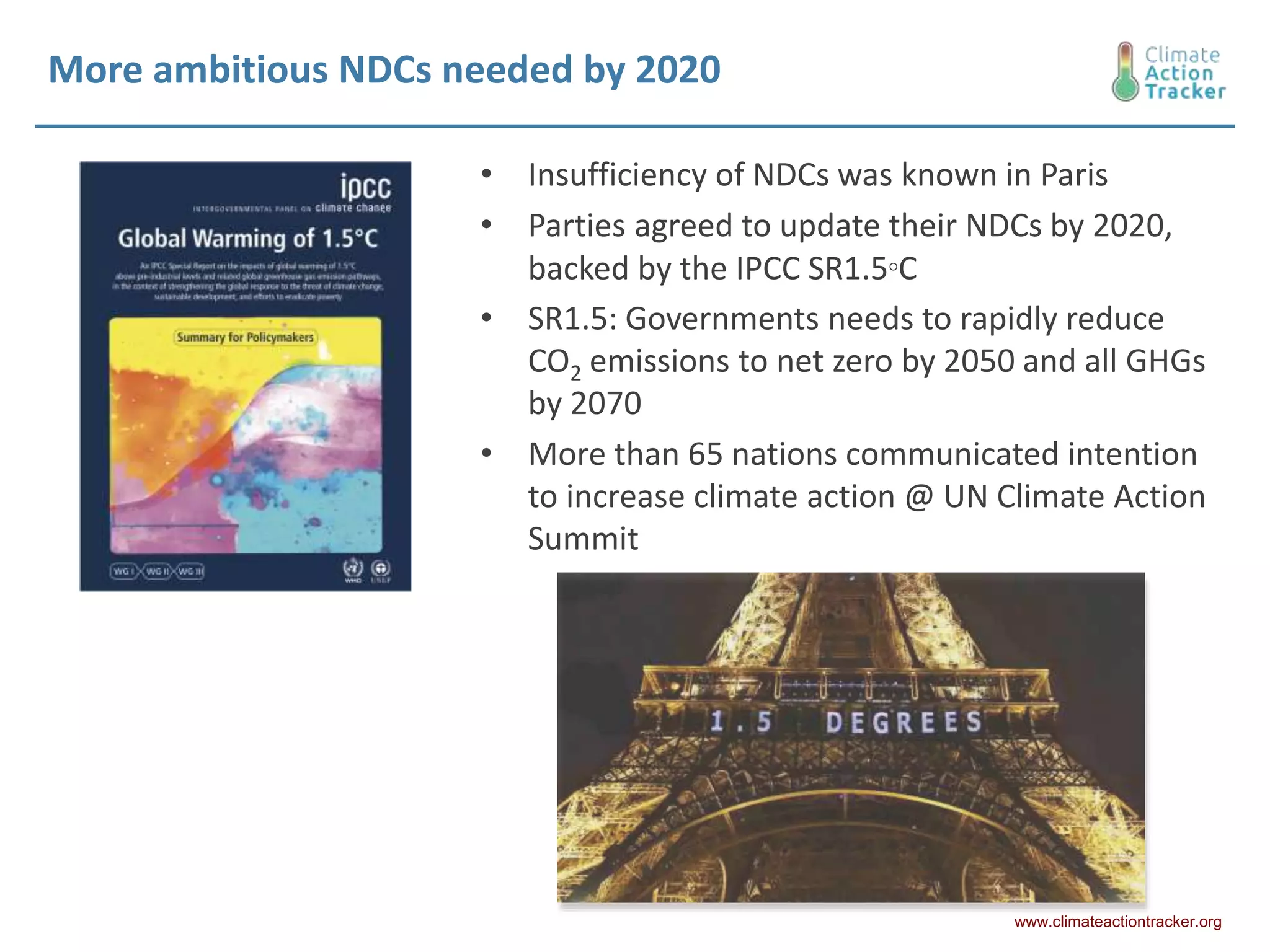
• Insufficiency of NDCs was known in Paris
• Parties agreed to update their NDCs by 2020,
backed by the IPCC SR1.5◦C
• SR1.5: Governments needs to rapidly reduce
CO2 emissions to net zero by 2050 and all GHGs
by 2070
• More than 65 nations communicated intention
to increase climate action @ UN Climate Action
Summit
www.climateactiontracker.org
Climate Action Tracker
www.climateactiontracker.org
CAT Press Conference
• Tuesday, Dec. 10 @ 11am
• Room Mocha
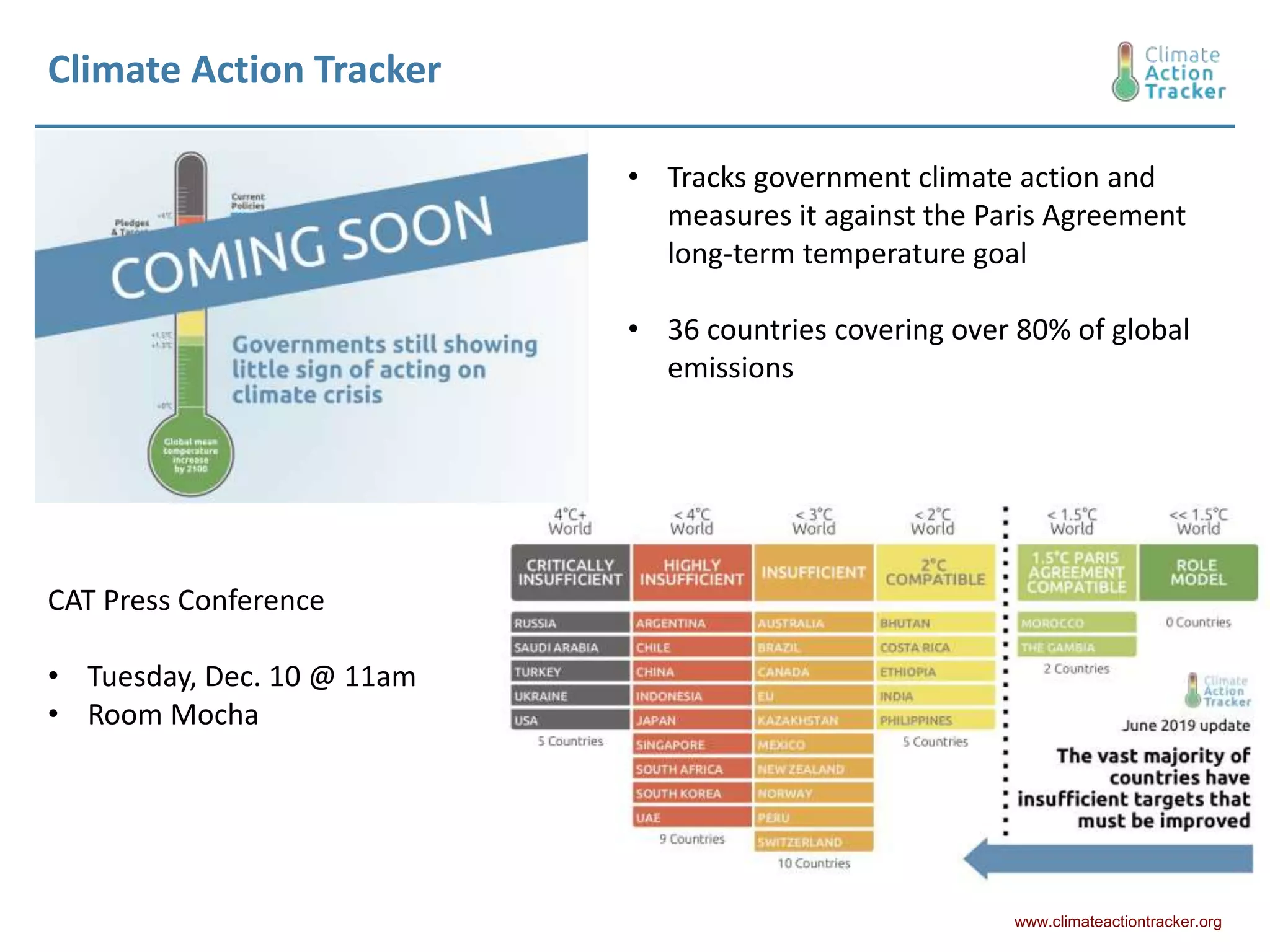
• Tracks government climate action and
measures it against the Paris Agreement
long-term temperature goal
• 36 countries covering over 80% of global
emissions
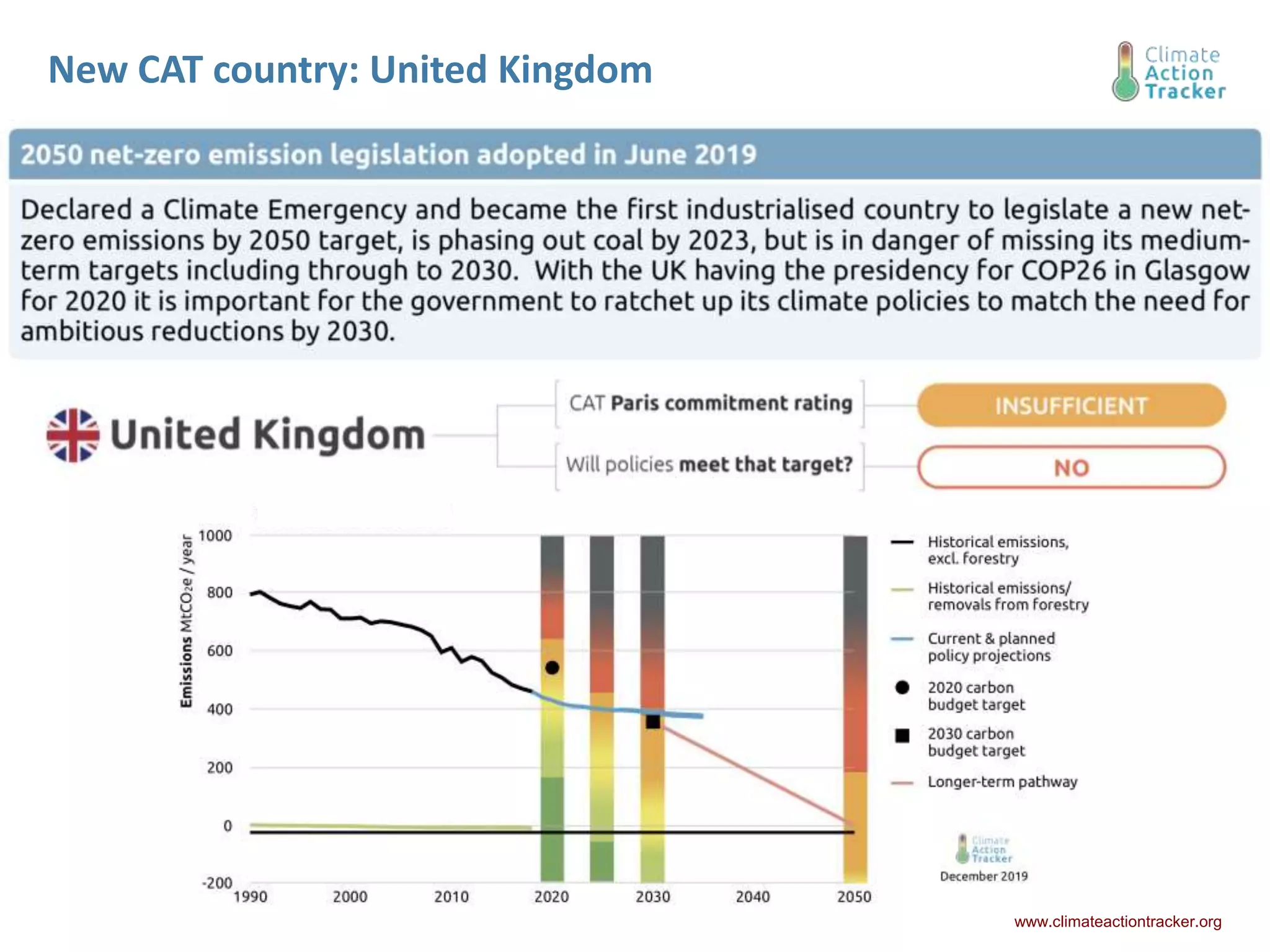
New CAT country: United Kingdom
www.climateactiontracker.org
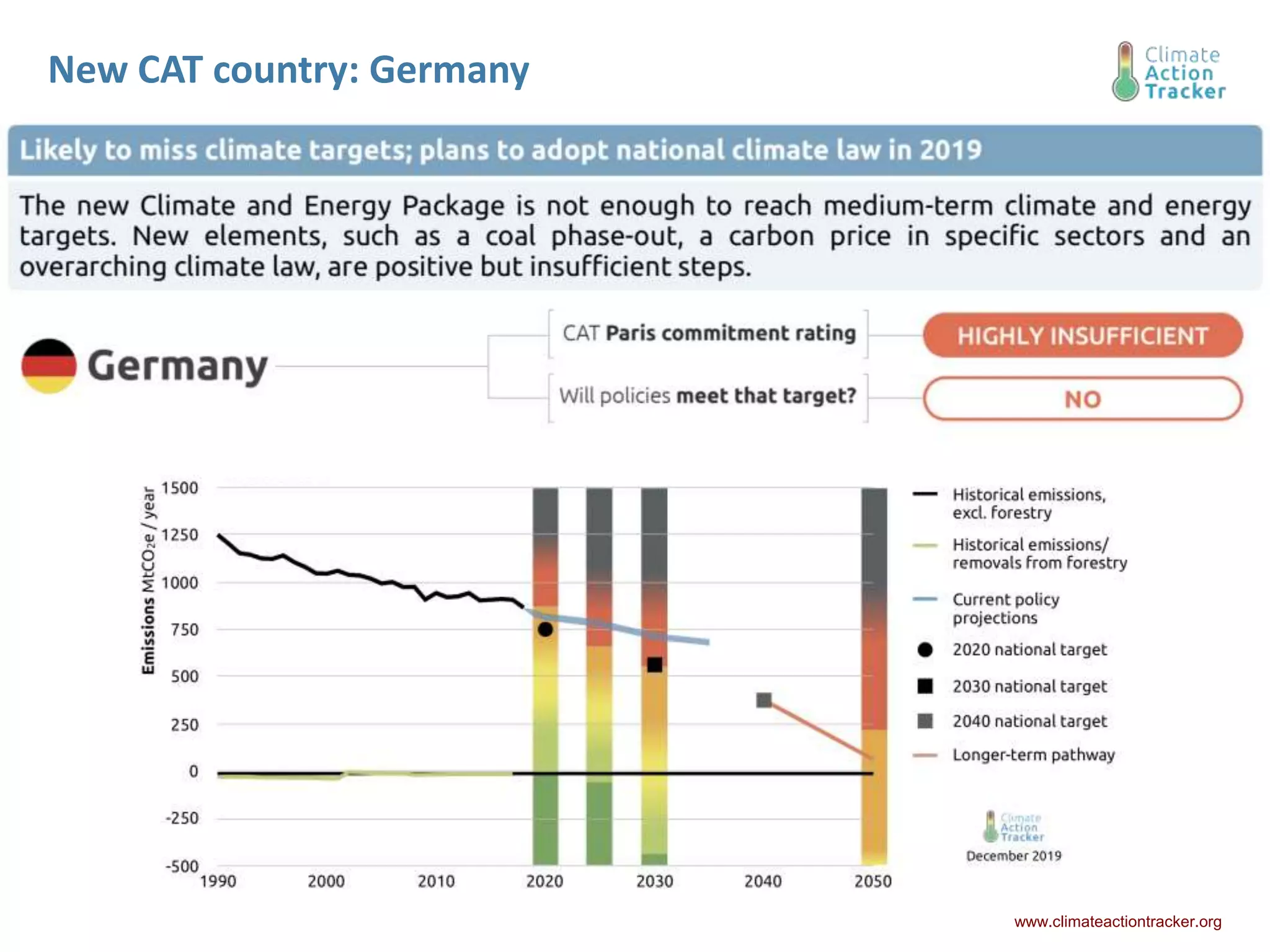
New CAT country: Germany
www.climateactiontracker.org
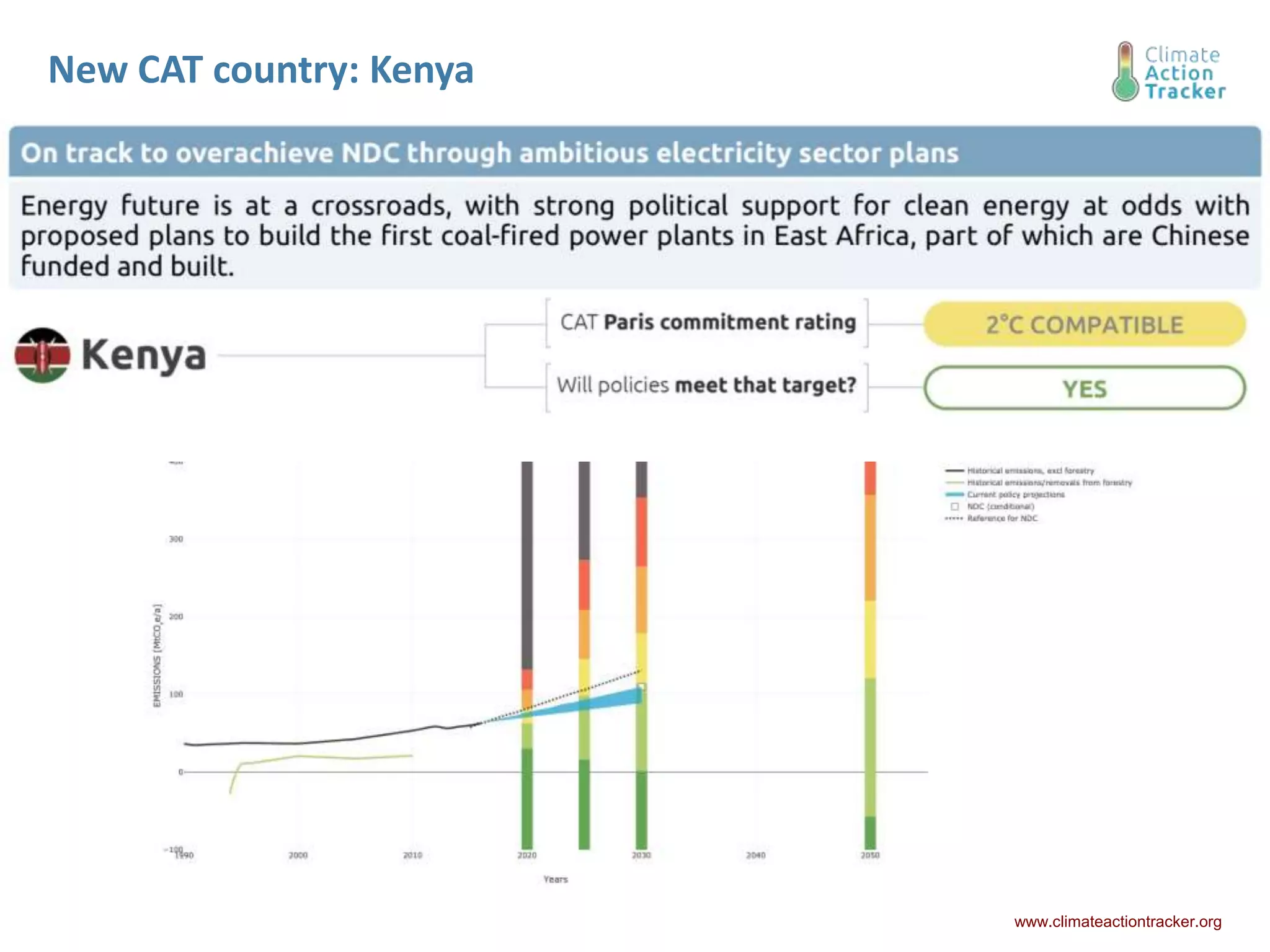
New CAT country: Kenya
www.climateactiontracker.org
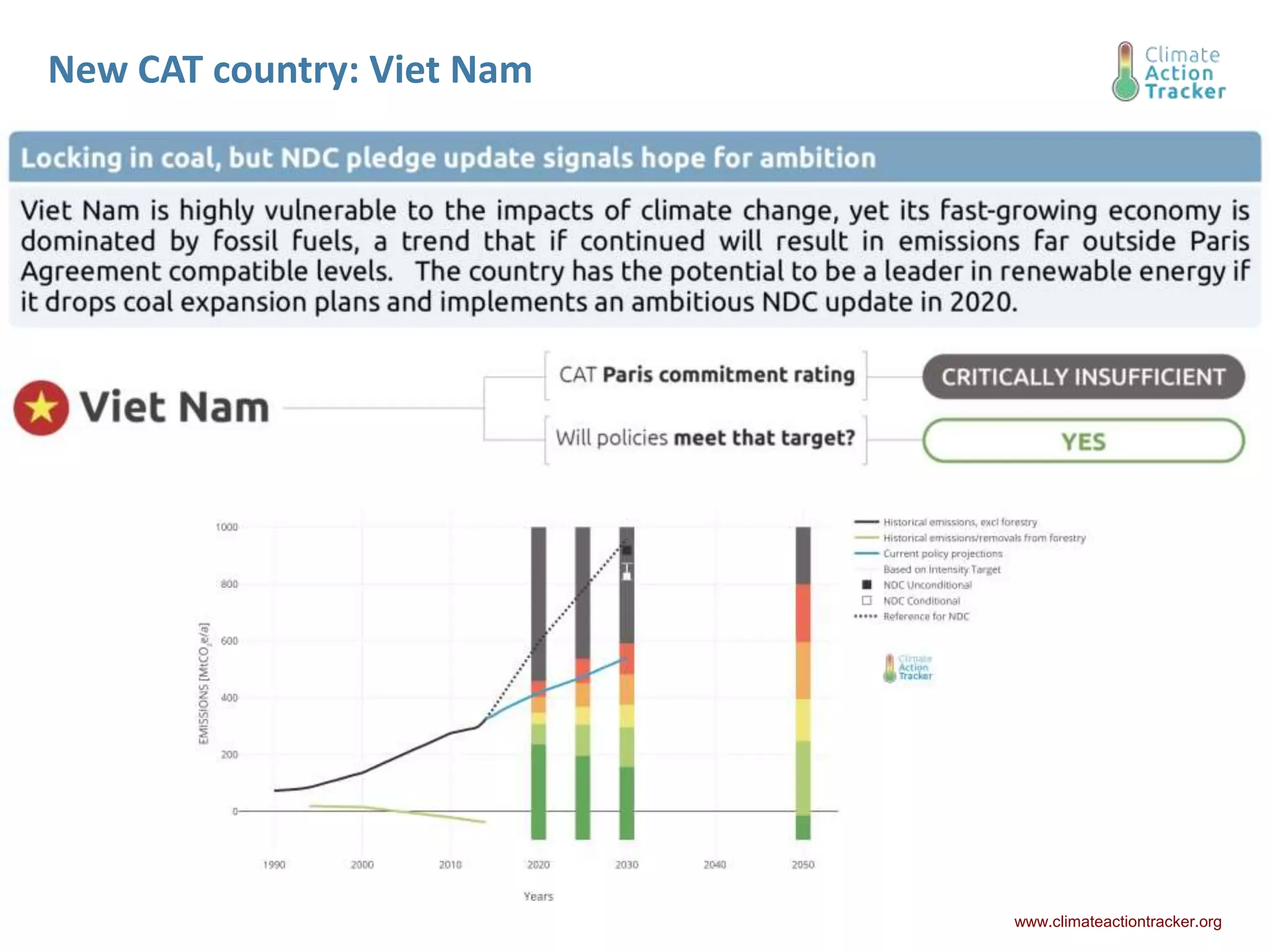
New CAT country: Viet Nam
www.climateactiontracker.org
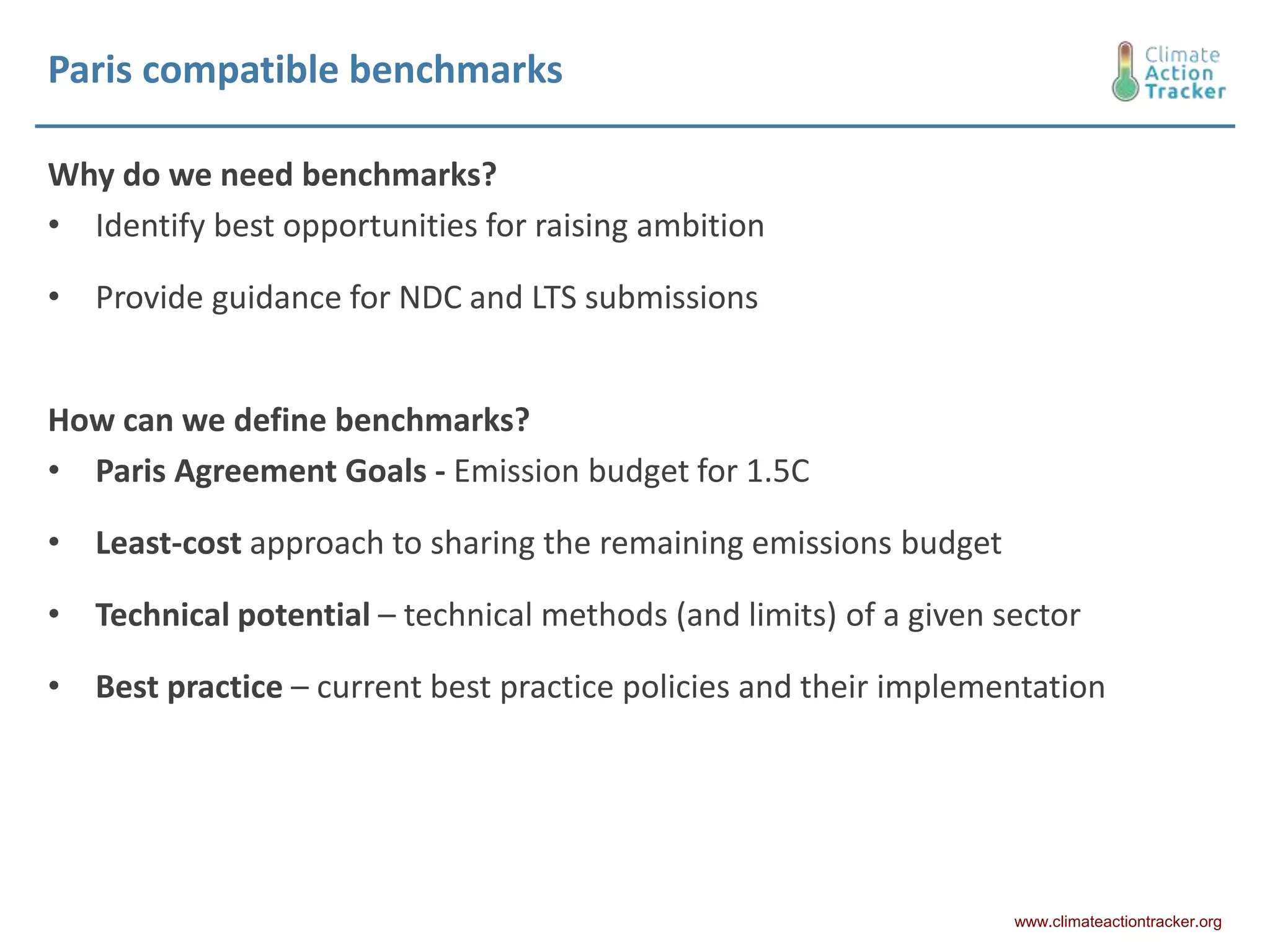
Paris compatible benchmarks
Why do we need benchmarks?
• Identify best opportunities for raising ambition
• Provide guidance for NDC and LTS submissions
How can we define benchmarks?
• Paris Agreement Goals - Emission budget for 1.5C
• Least-cost approach to sharing the remaining emissions budget
• Technical potential – technical methods (and limits) of a given sector
• Best practice – current best practice policies and their implementation
www.climateactiontracker.org
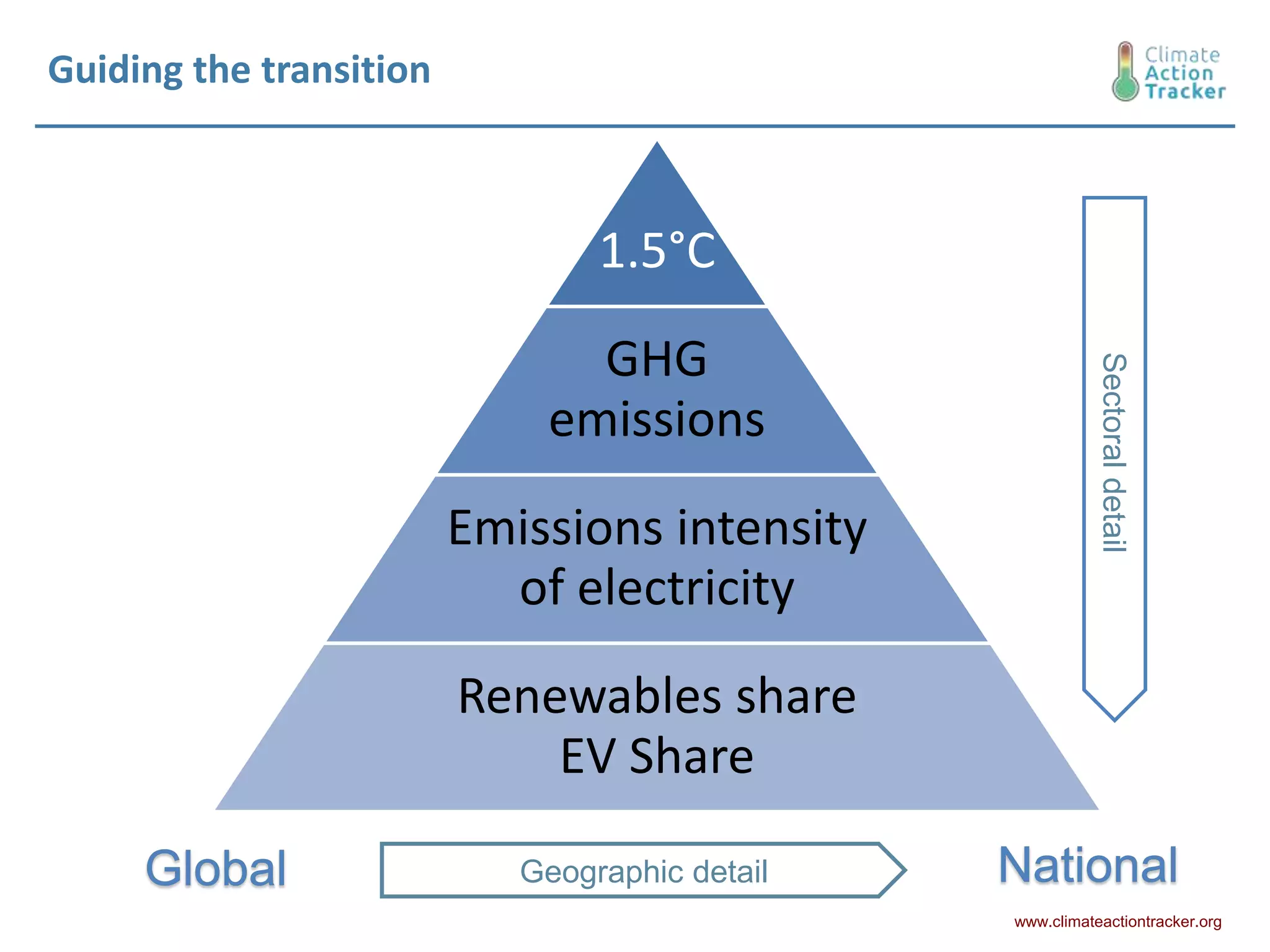
1.5°C
GHG
emissions
Emissions intensity
of electricity
Renewables share
EV Share
Guiding the transition
www.climateactiontracker.org
Sectoraldetail
Geographic detail
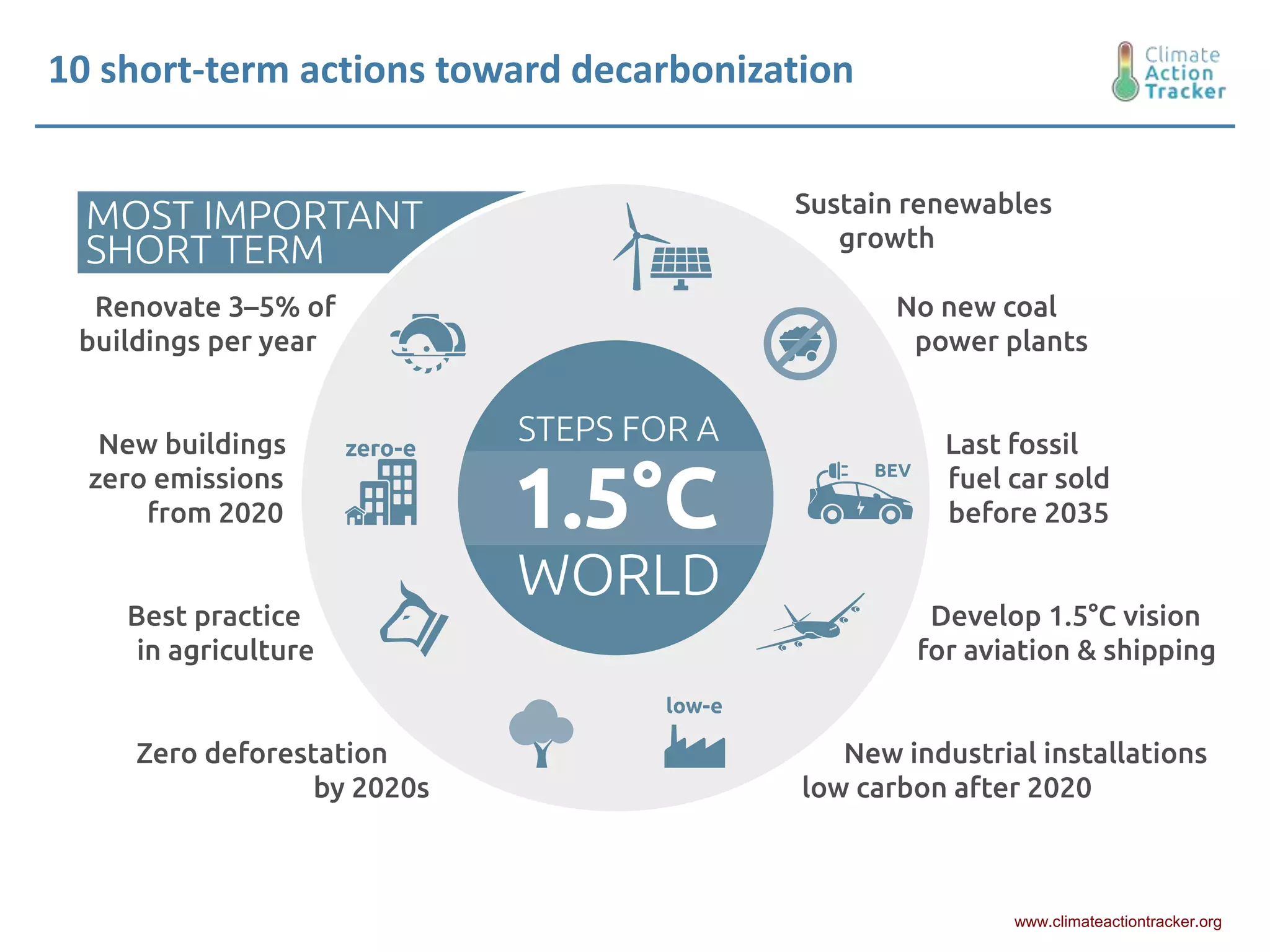
10 short-term actions toward decarbonization
www.climateactiontracker.org
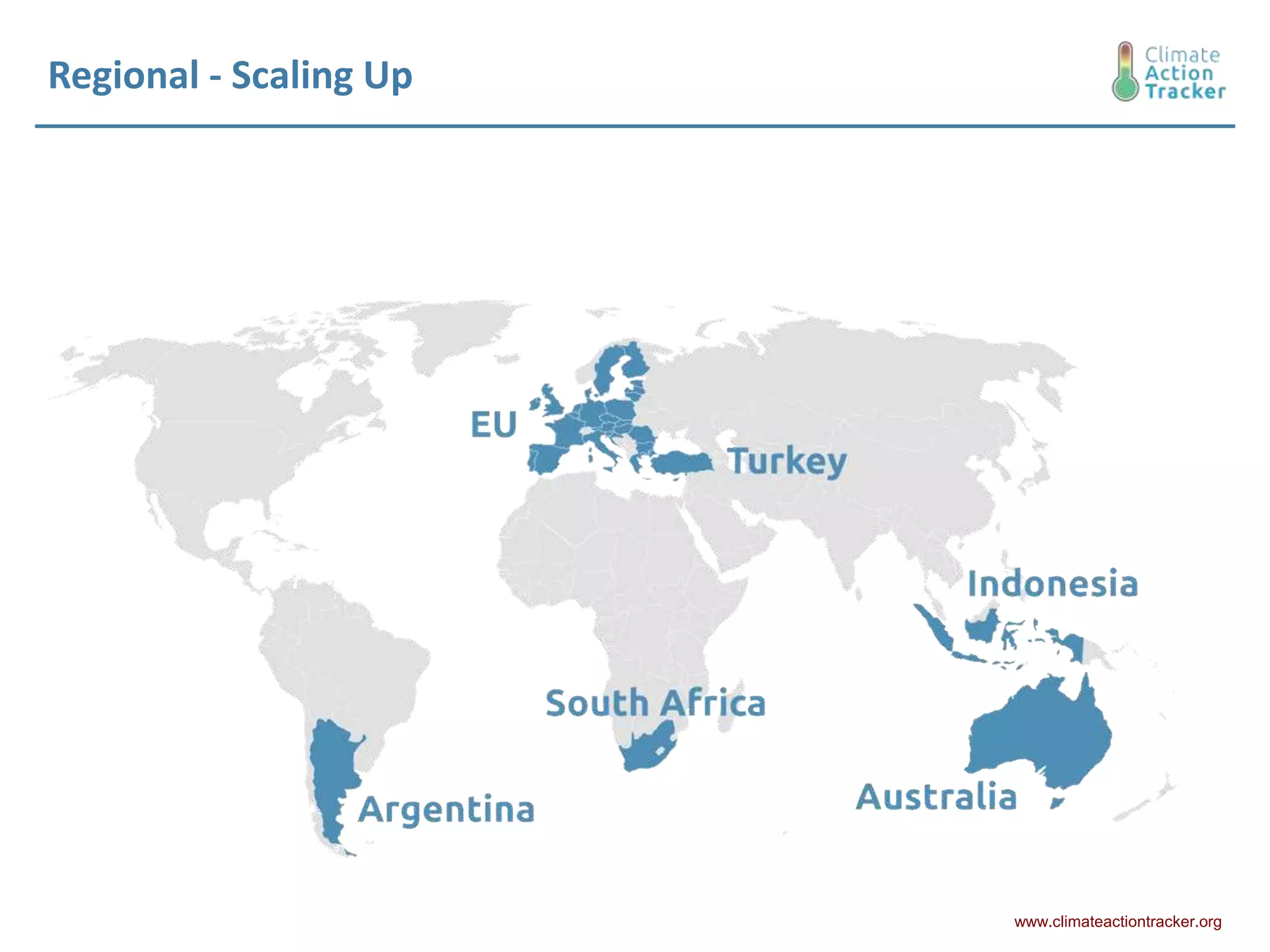
Regional - Scaling Up
www.climateactiontracker.org
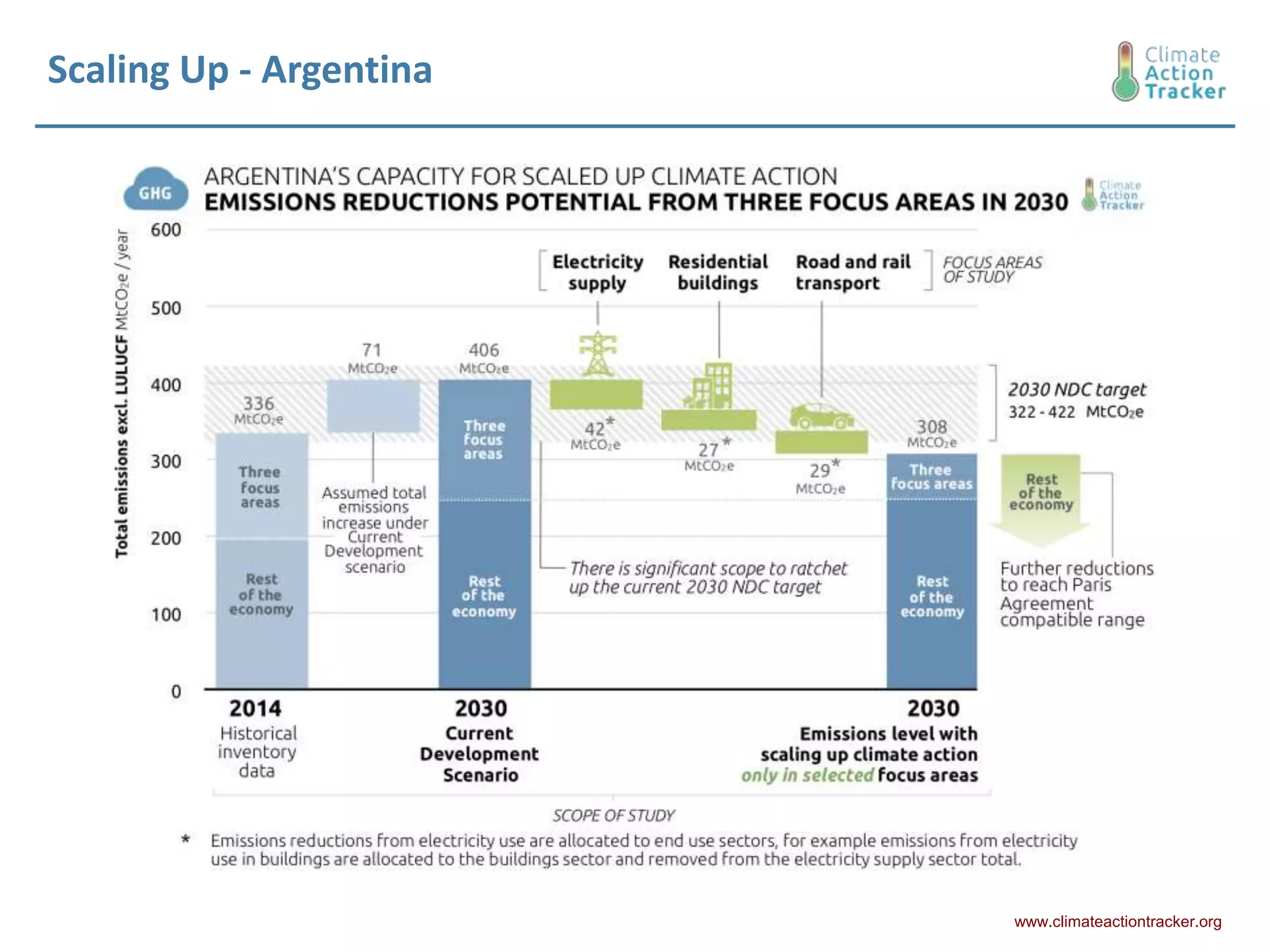
Scaling Up - Argentina
www.climateactiontracker.org
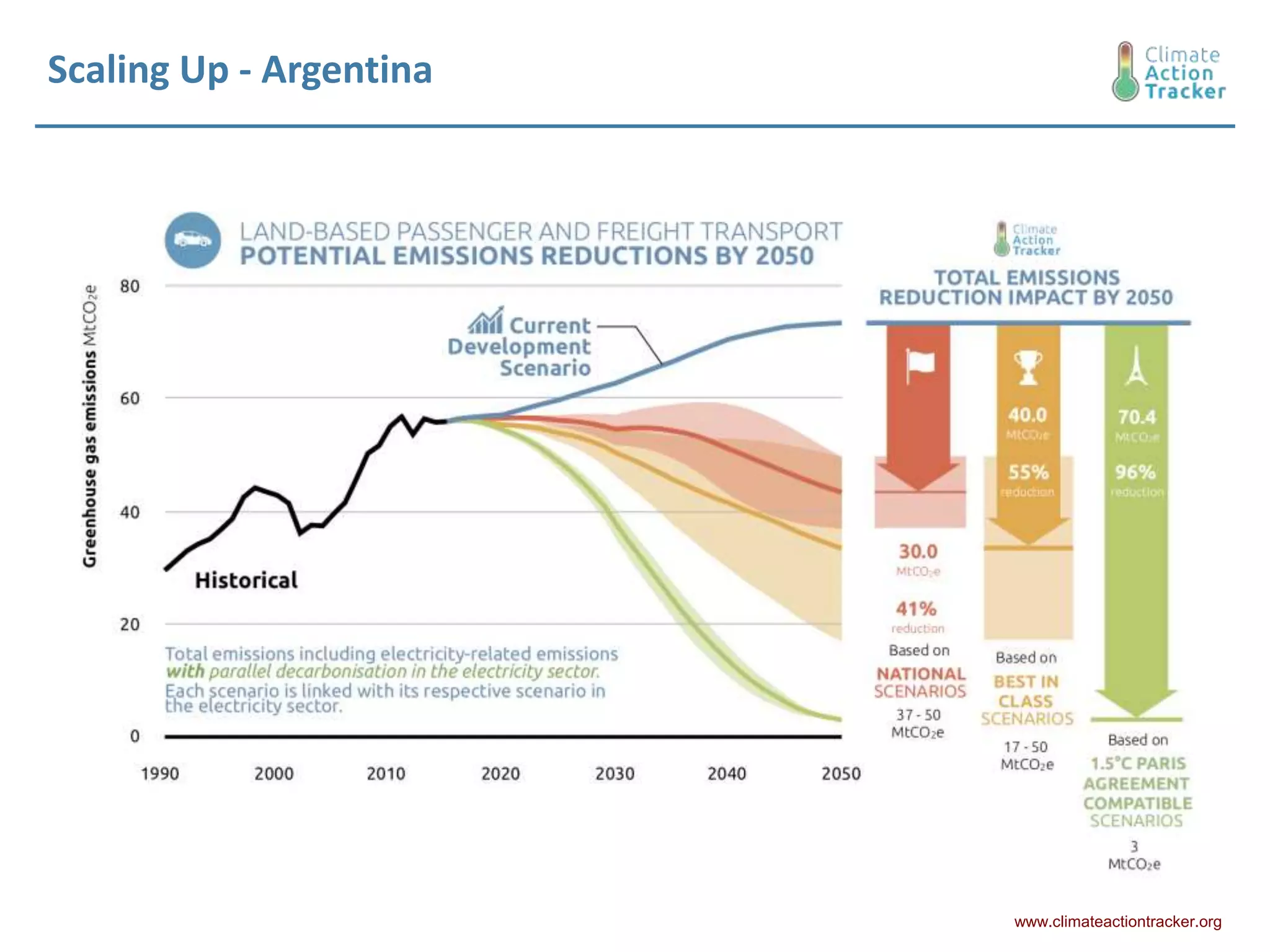
Scaling Up - Argentina
www.climateactiontracker.org
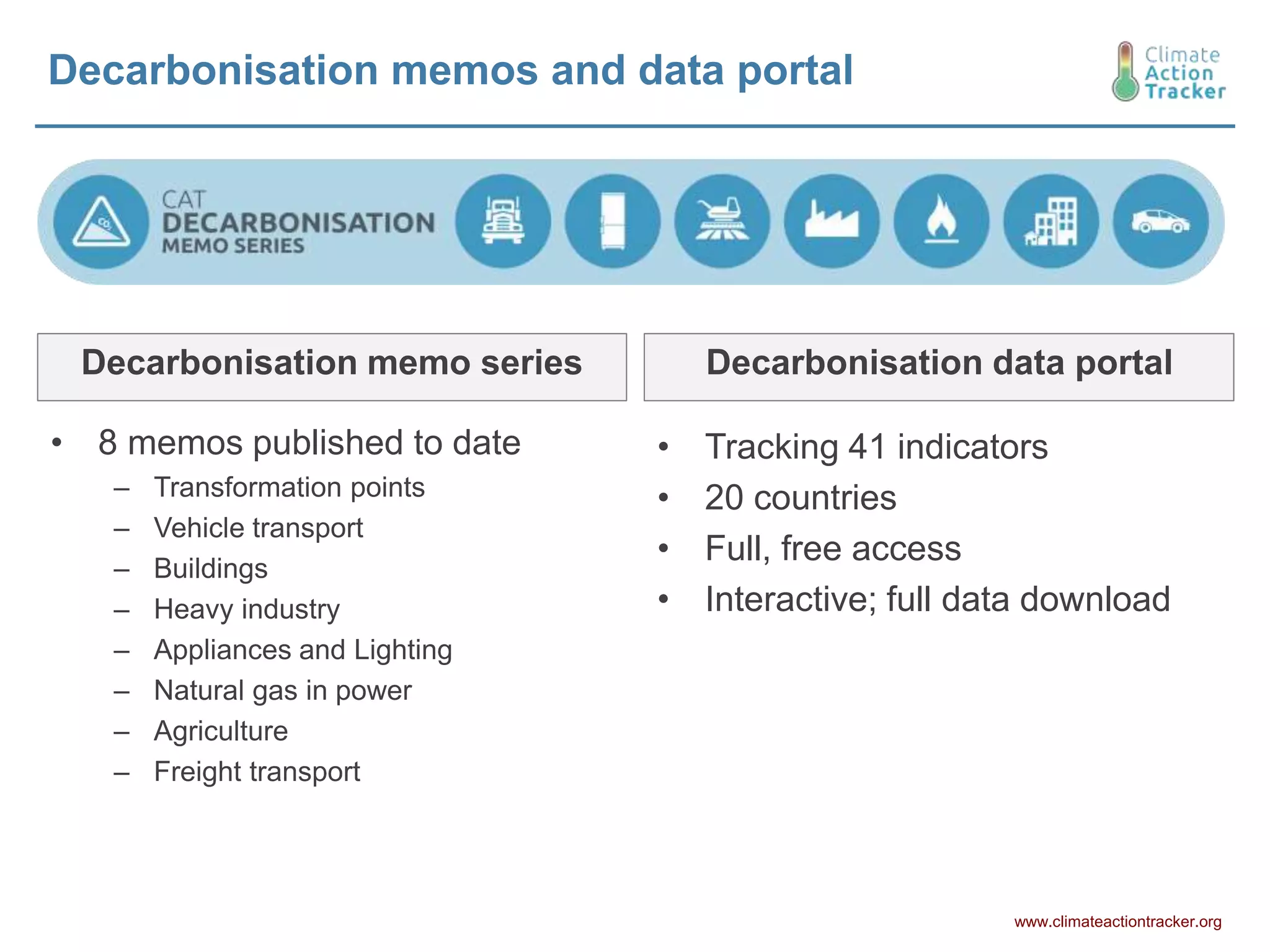
Decarbonisation memos and data portal
• Tracking 41 indicators
• 20 countries
• Full, free access
• Interactive; full data download
• 8 memos published to date
– Transformation points
– Vehicle transport
– Buildings
– Heavy industry
– Appliances and Lighting
– Natural gas in power
– Agriculture
– Freight transport
www.climateactiontracker.org
Decarbonisation memo series Decarbonisation data portal
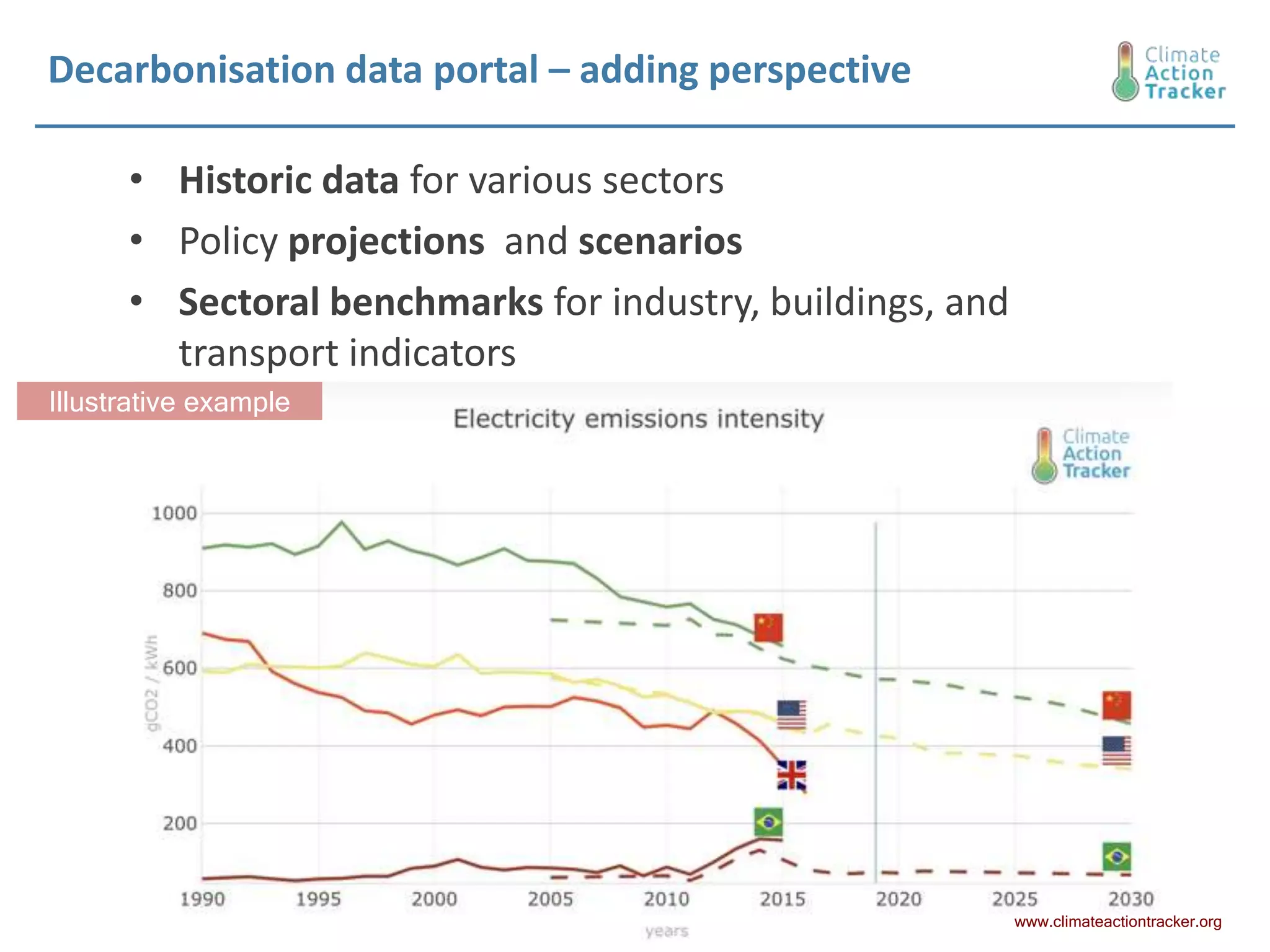
Decarbonisation data portal – adding perspective
• Historic data for various sectors
• Policy projections and scenarios
• Sectoral benchmarks for industry, buildings, and
transport indicators
Illustrative example
www.climateactiontracker.org
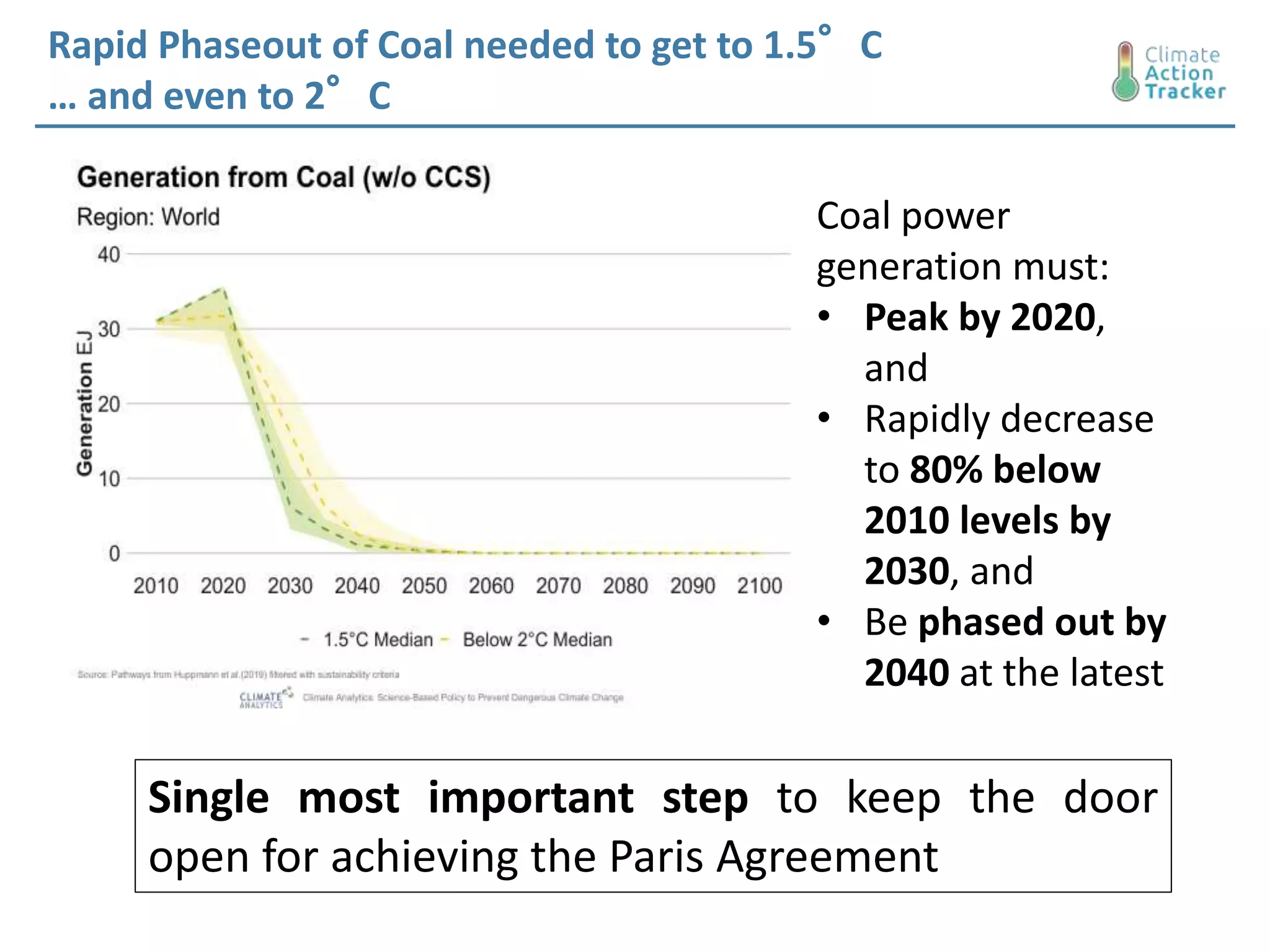
Rapid Phaseout of Coal needed to get to 1.5°C
… and even to 2°C
Coal power
generation must:
• Peak by 2020,
and
• Rapidly decrease
to 80% below
2010 levels by
2030, and
• Be phased out by
2040 at the latest
Single most important step to keep the door
open for achieving the Paris Agreement
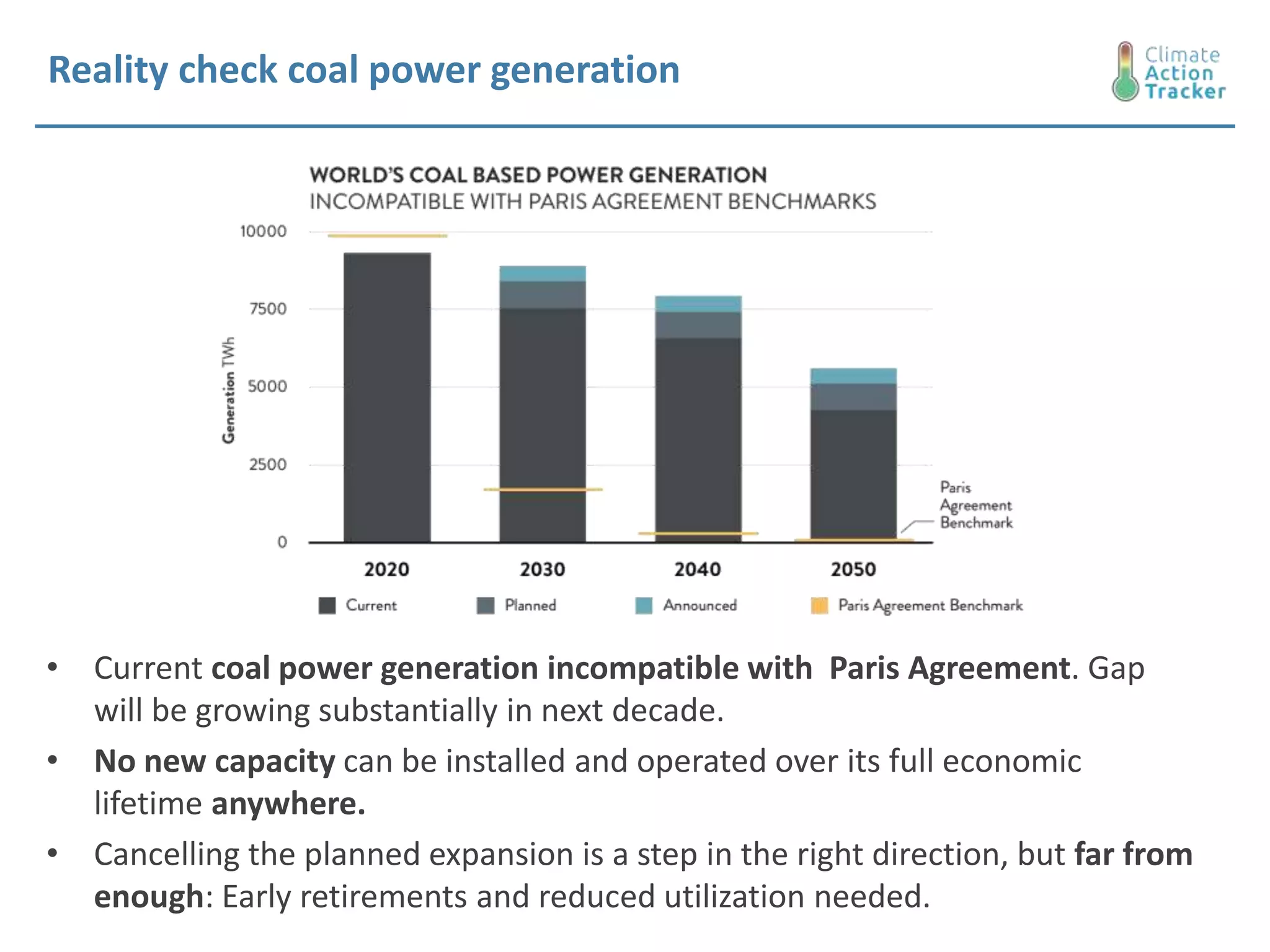
Reality check coal power generation
• Current coal power generation incompatible with Paris Agreement. Gap
will be growing substantially in next decade.
• No new capacity can be installed and operated over its full economic
lifetime anywhere.
• Cancelling the planned expansion is a step in the right direction, but far from
enough: Early retirements and reduced utilization needed.
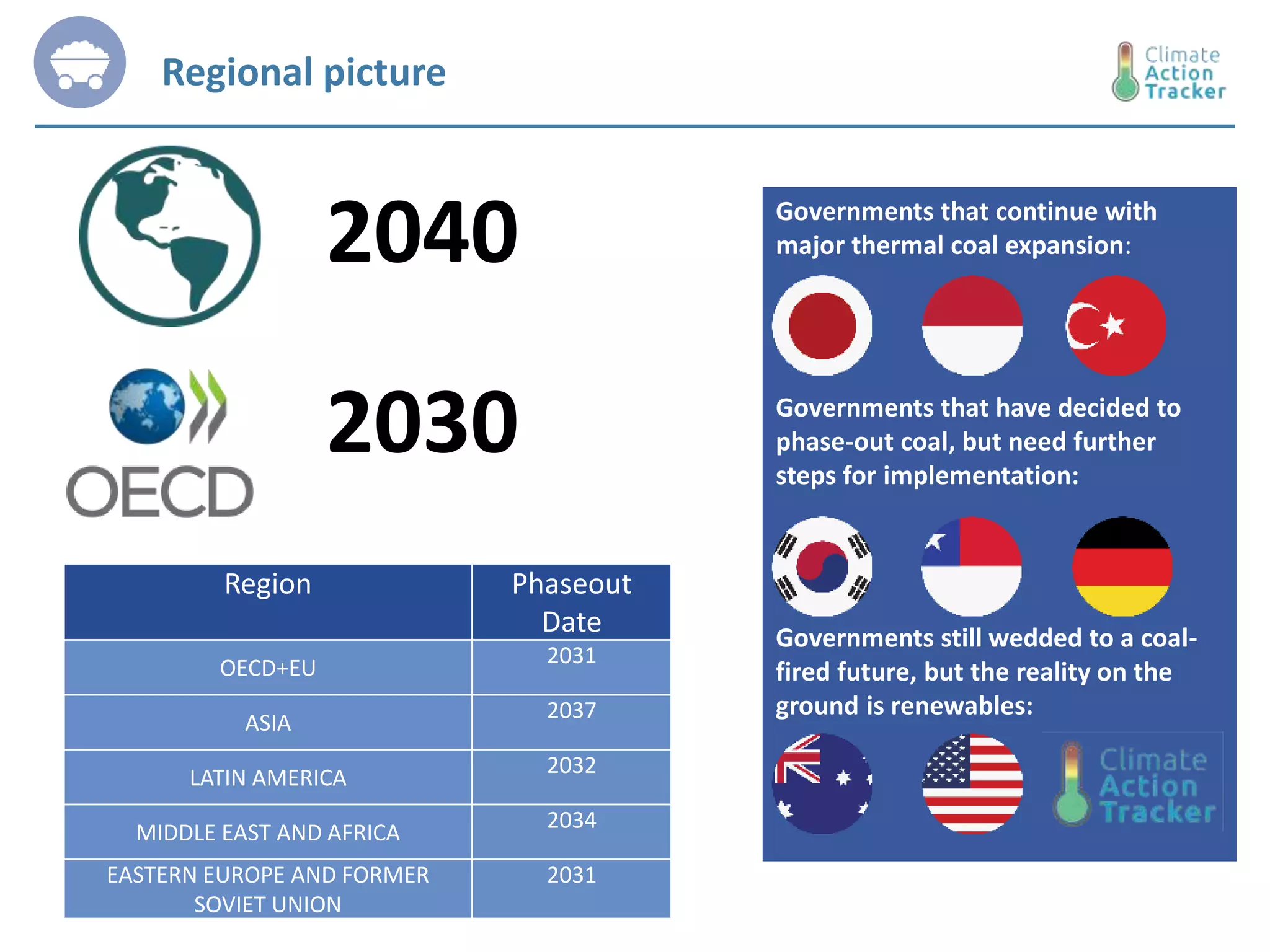
Regional picture
2040
Region Phaseout
Date
OECD+EU
2031
ASIA
2037
LATIN AMERICA
2032
MIDDLE EAST AND AFRICA
2034
EASTERN EUROPE AND FORMER
SOVIET UNION
2031
2030
Governments that continue with
major thermal coal expansion:
Governments that have decided to
phase-out coal, but need further
steps for implementation:
Governments still wedded to a coal-
fired future, but the reality on the
ground is renewables:
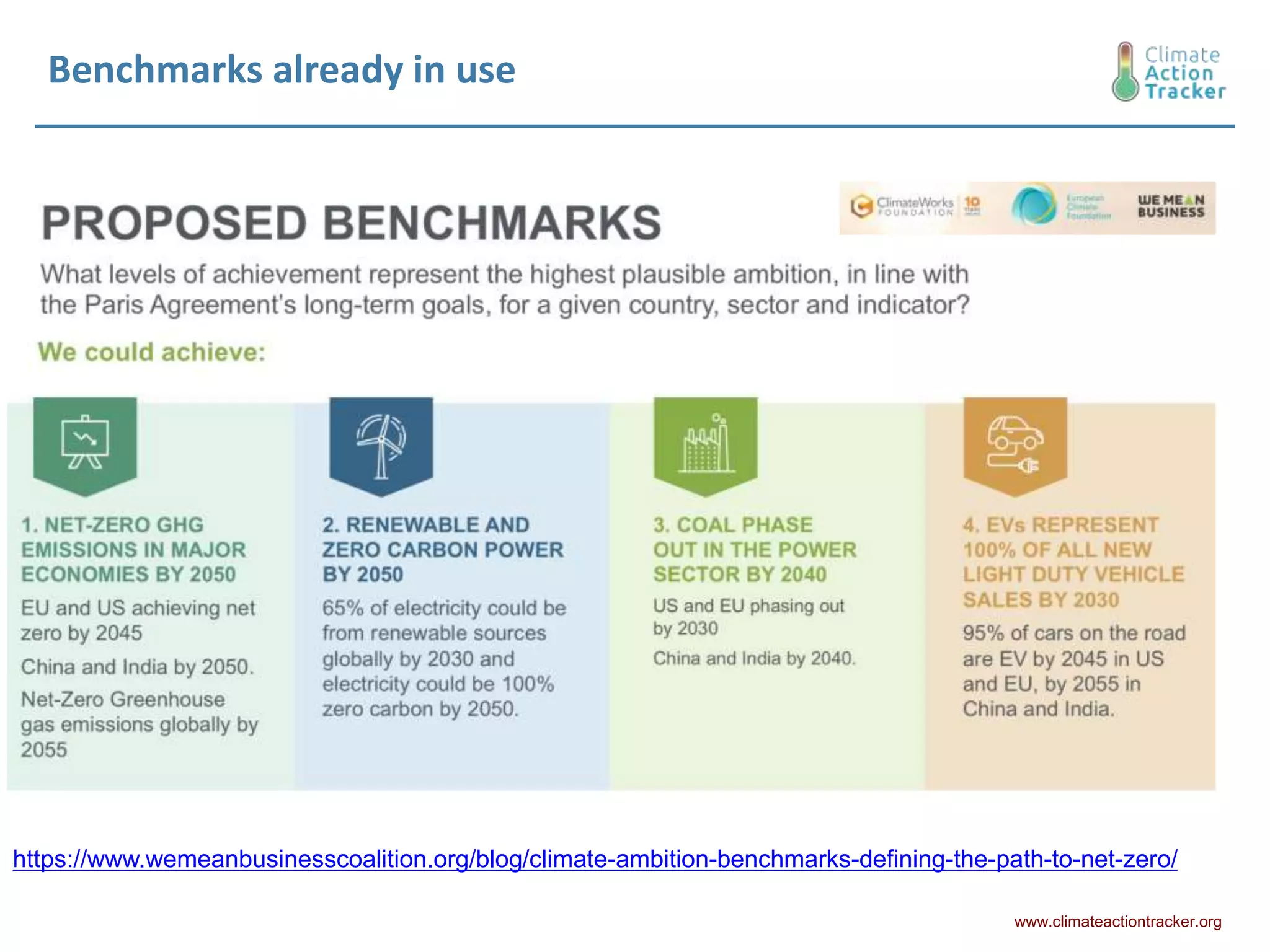
Benchmarks already in use
www.climateactiontracker.org
https://www.wemeanbusinesscoalition.org/blog/climate-ambition-benchmarks-defining-the-path-to-net-zero/
www.climateactiontracker.org
https://climateactiontracker.org/publication
mate-governance/
• Swithin Lui
s.lui@newclimate.org
• Claire Stockwell
claire.stockwell@climateanalytics.or
Structure of the Framework
www.climateactiontracker.org
Structure of the Framework
www.climateactiontracker.org
Scoring and rating system
• Scoring
• Rating
www.climateactiontracker.org
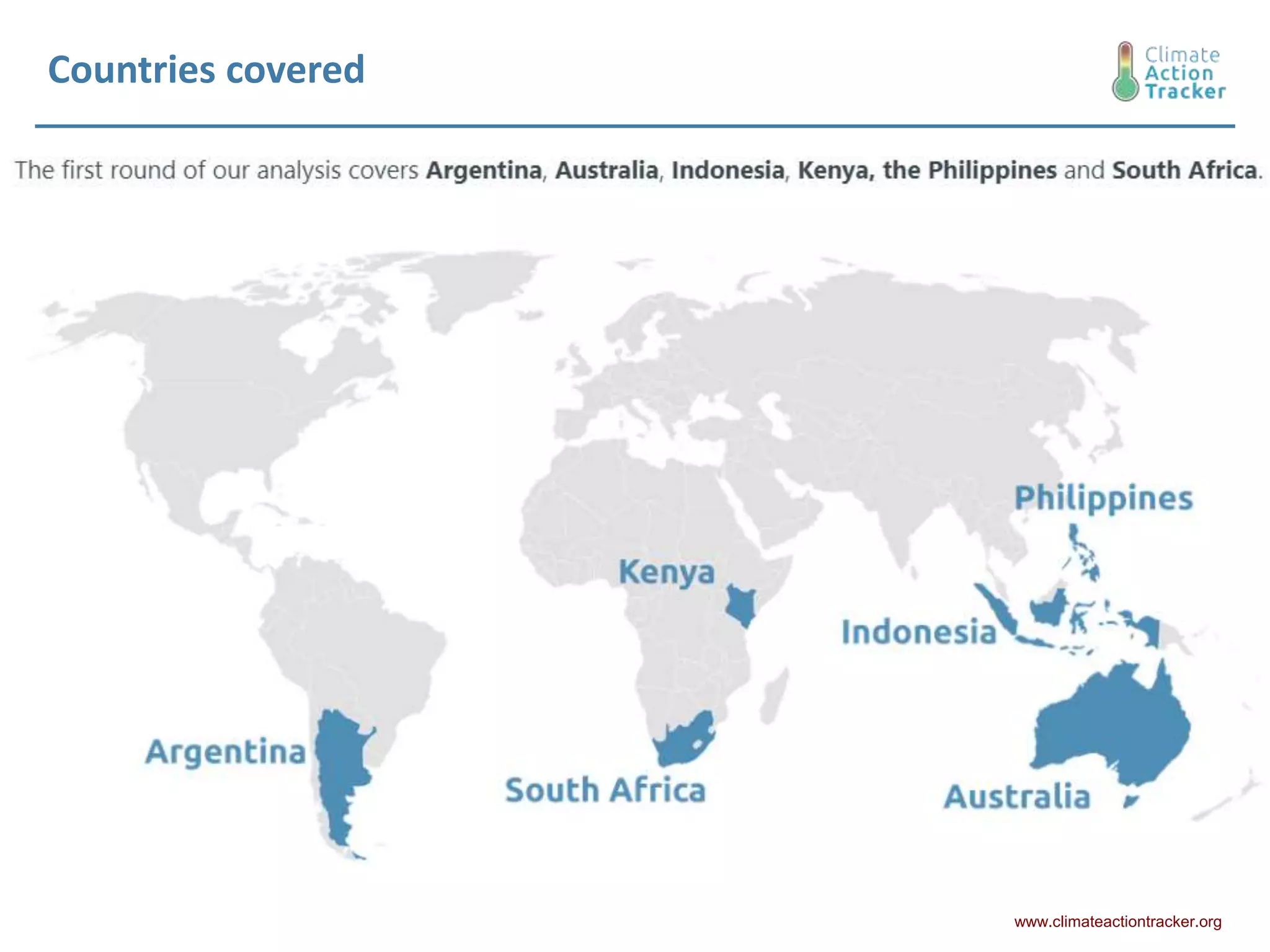
Countries covered
www.climateactiontracker.org
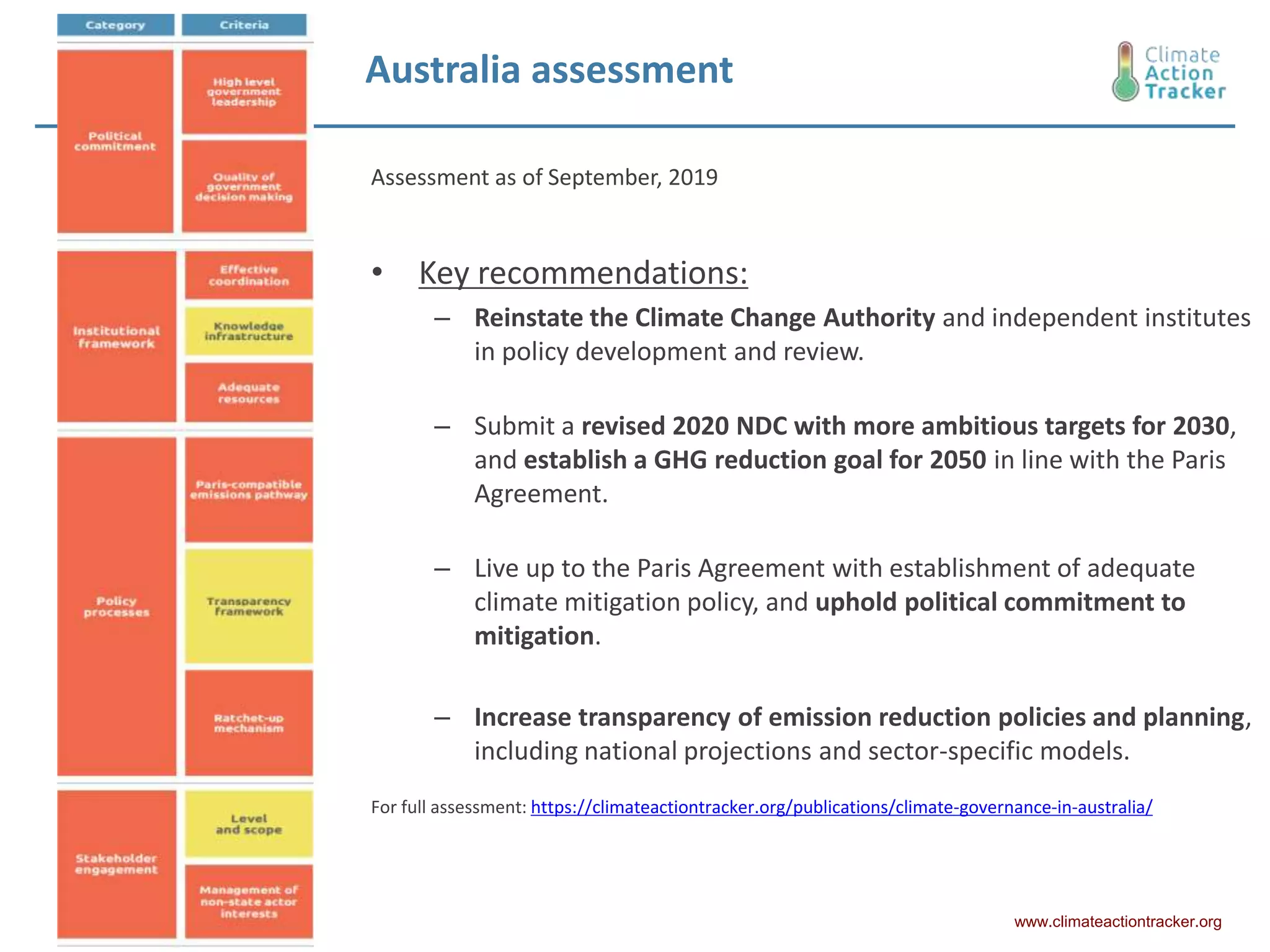
Australia assessment
www.climateactiontracker.org
Assessment as of September, 2019
• Key recommendations:
– Reinstate the Climate Change Authority and independent institutes
in policy development and review.
– Submit a revised 2020 NDC with more ambitious targets for 2030,
and establish a GHG reduction goal for 2050 in line with the Paris
Agreement.
– Live up to the Paris Agreement with establishment of adequate
climate mitigation policy, and uphold political commitment to
mitigation.
– Increase transparency of emission reduction policies and planning,
including national projections and sector-specific models.
For full assessment: https://climateactiontracker.org/publications/climate-governance-in-australia/
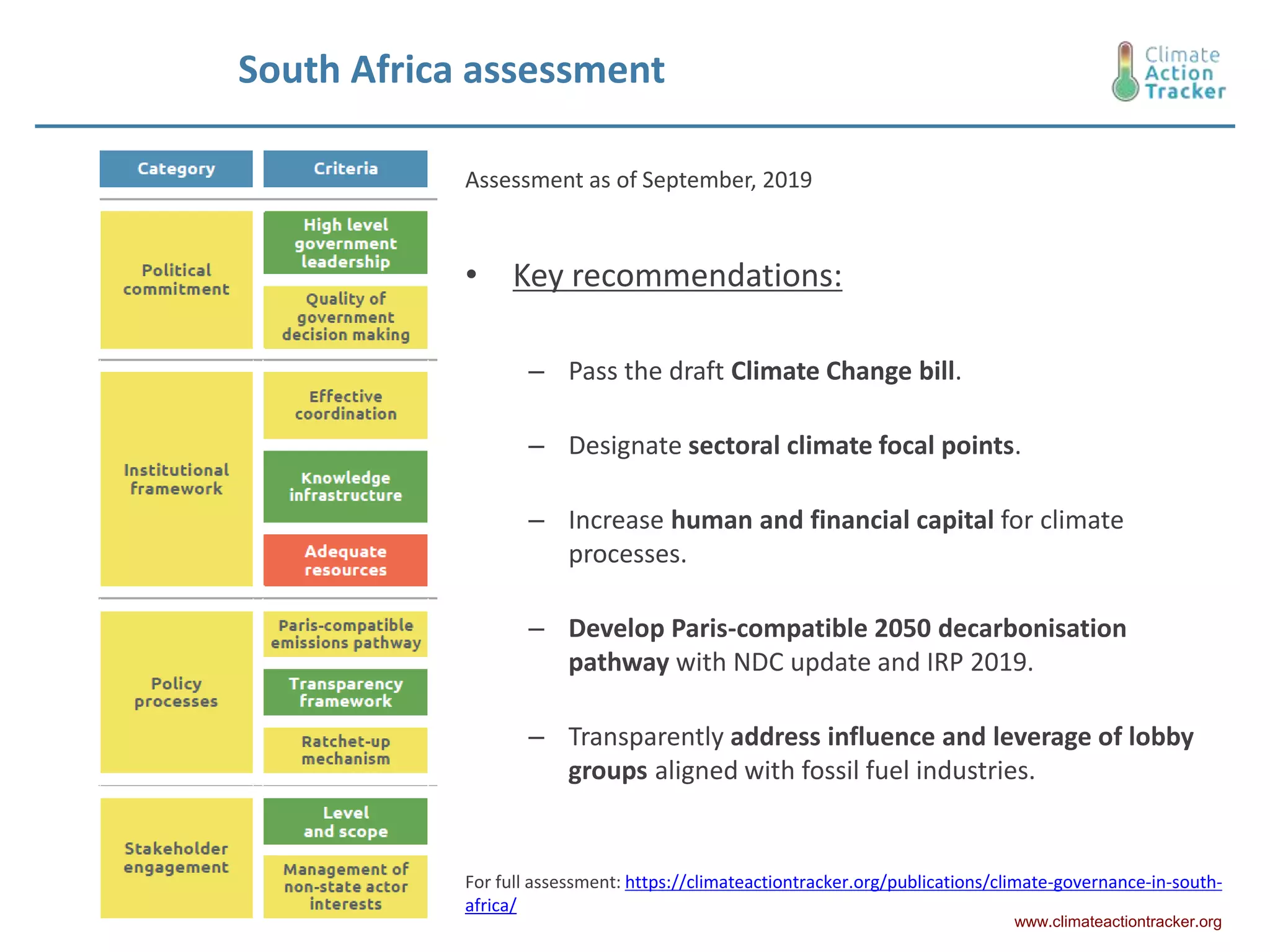
South Africa assessment
Assessment as of September, 2019
• Key recommendations:
– Pass the draft Climate Change bill.
– Designate sectoral climate focal points.
– Increase human and financial capital for climate
processes.
– Develop Paris-compatible 2050 decarbonisation
pathway with NDC update and IRP 2019.
– Transparently address influence and leverage of lobby
groups aligned with fossil fuel industries.
For full assessment: https://climateactiontracker.org/publications/climate-governance-in-south-
africa/
www.climateactiontracker.org
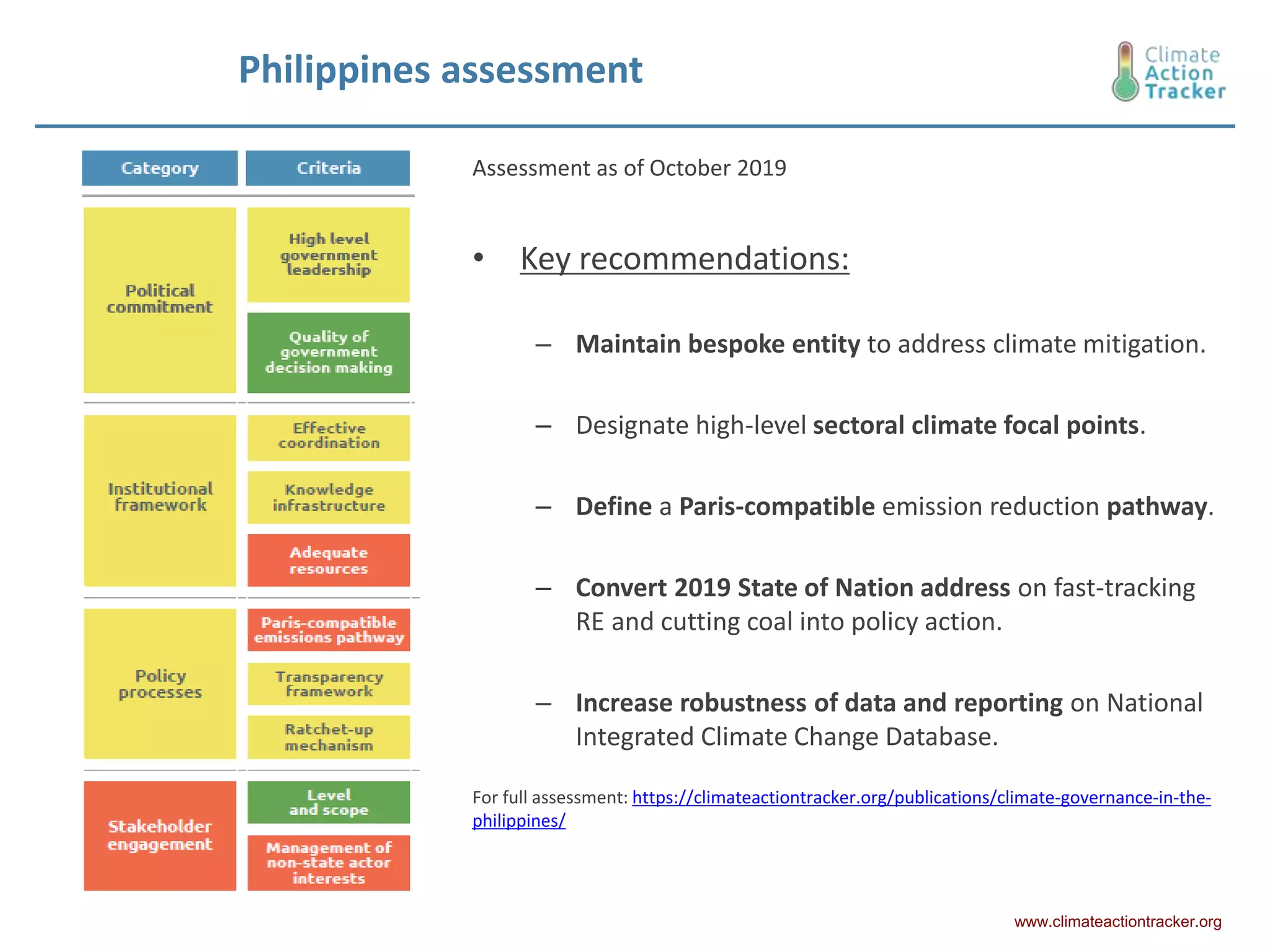
Philippines assessment
Assessment as of October 2019
• Key recommendations:
– Maintain bespoke entity to address climate mitigation.
– Designate high-level sectoral climate focal points.
– Define a Paris-compatible emission reduction pathway.
– Convert 2019 State of Nation address on fast-tracking
RE and cutting coal into policy action.
– Increase robustness of data and reporting on National
Integrated Climate Change Database.
For full assessment: https://climateactiontracker.org/publications/climate-governance-in-the-
philippines/
www.climateactiontracker.org
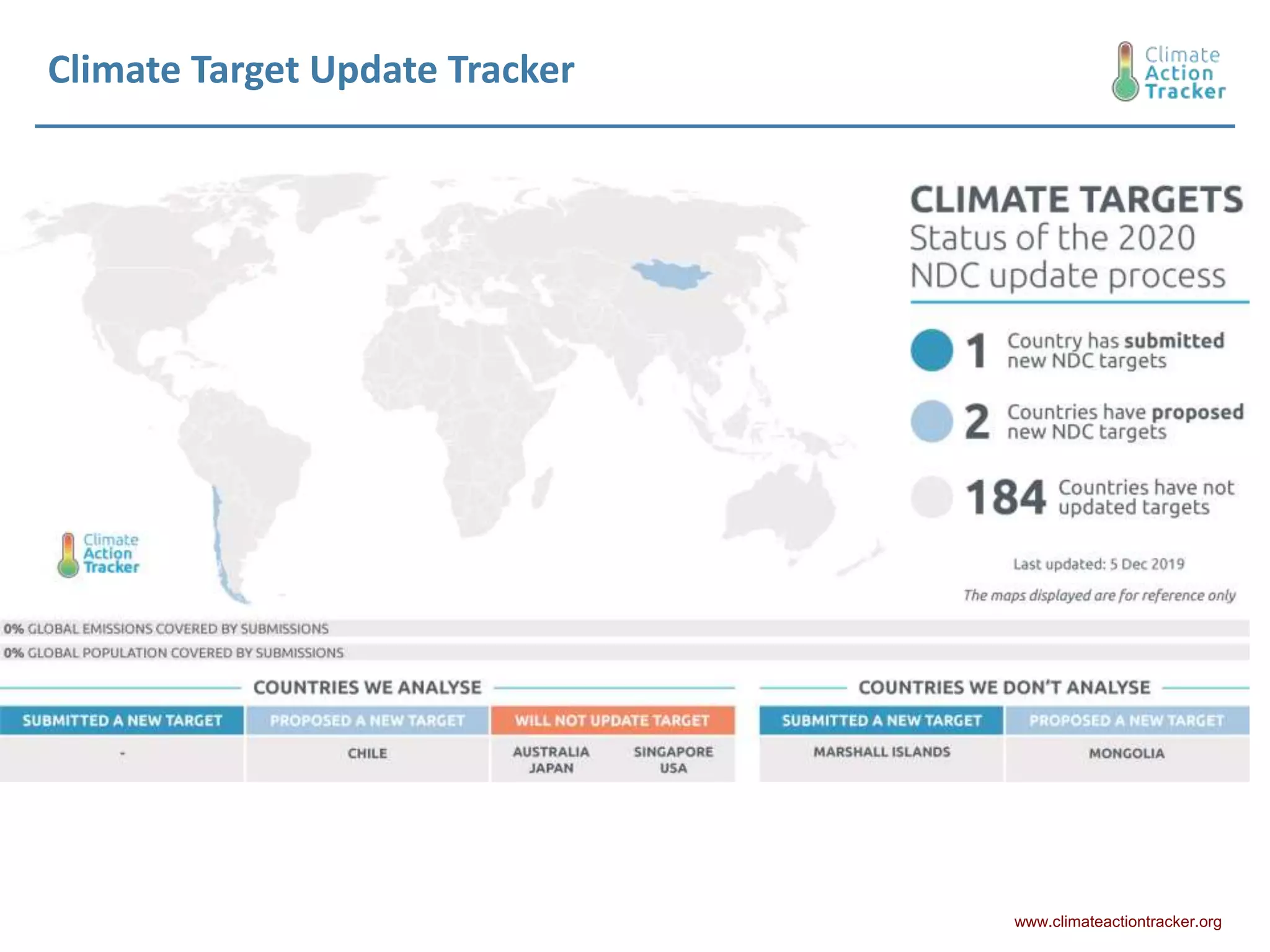
Climate Target Update Tracker
www.climateactiontracker.org
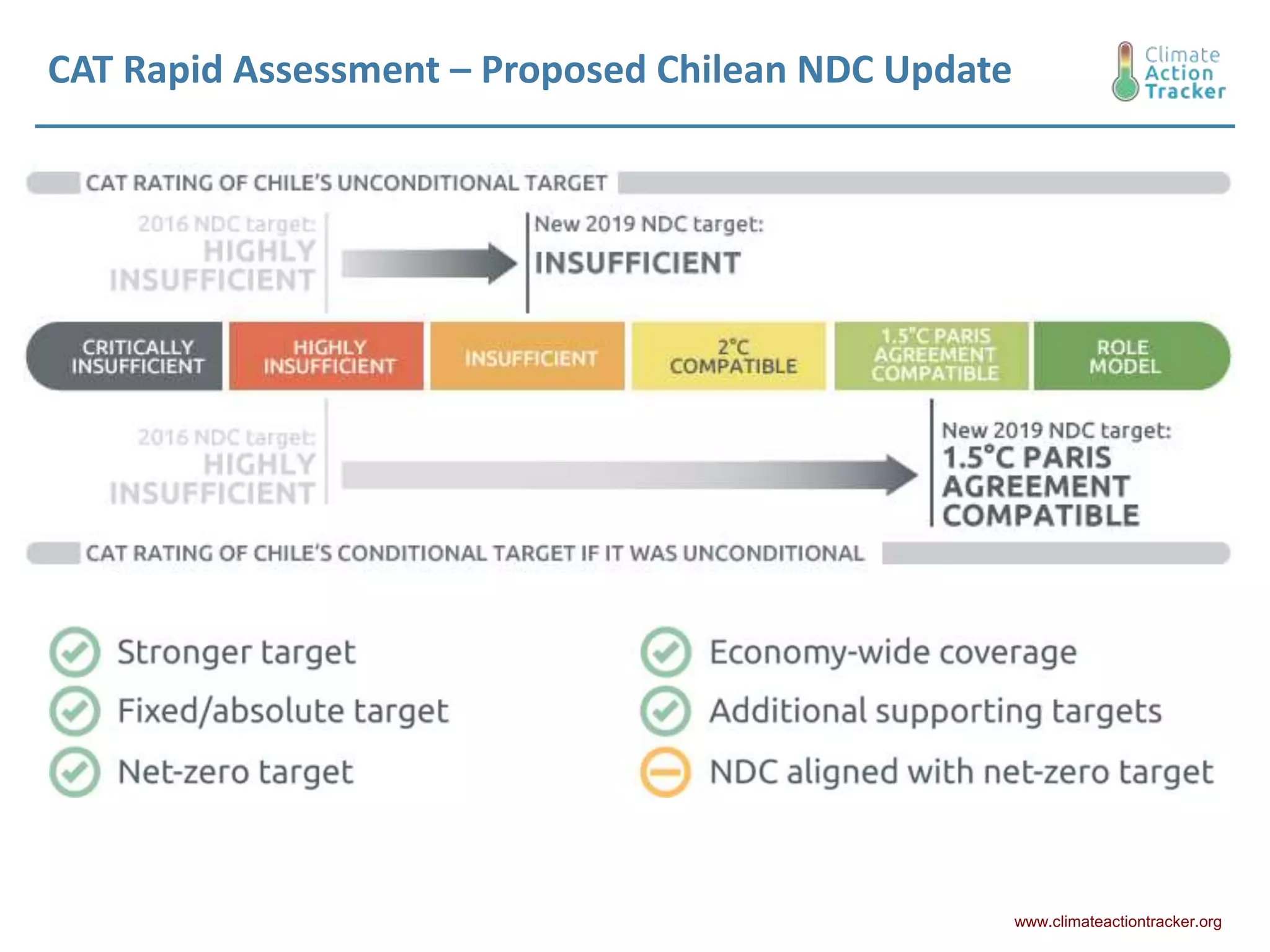
CAT Rapid Assessment – Proposed Chilean NDC Update
www.climateactiontracker.org
Concluding Remarks
• The Climate Action Tracker will continue to rate and evaluate government
climate action
• Expanding analysis in 2020 to include international aviation & maritime
emissions
www.climateactiontracker.org
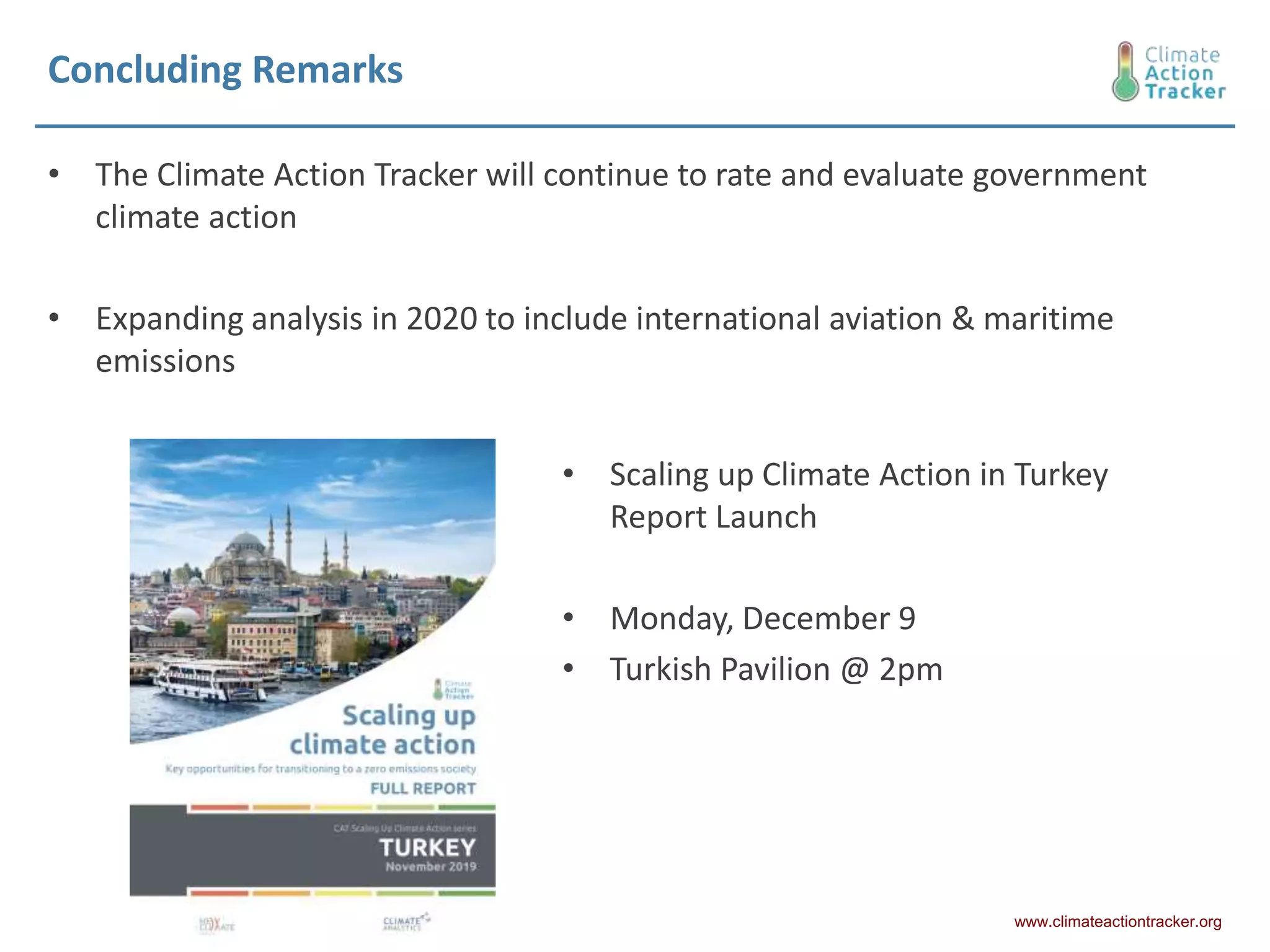
• Scaling up Climate Action in Turkey
Report Launch
• Monday, December 9
• Turkish Pavilion @ 2pm
Panel Discussion – Delivering on climate action in 2020
• Jenny Mager, Mitigation Coordinator, Environment Ministry, Chile
• Silke Karcher, Head of Division, EU Climate and Energy Policy, European
Climate Initiative, Carbon markets, Federal Ministry for the Environment,
Nature Conservation and Nuclear Safety, Germany
• Andrew Marquard, Professor, Energy Research Centre, University of Cape
Town, South Africa
• Renato Redentor Constantino, Executive Director, Institute for Climate and
Sustainable Cities, the Philippines
• Bill Hare, CEO, Climate Analytics
• Niklas Höhne, Partner, NewClimate Institute
www.climateactiontracker.org

Climate Action Tracker - Achieving Net Zero: Opportunities to close the gap to 1.5◦C in Europe and beyond

  • 1.
    Achieving Net Zero Opportunitiesto close the gap to 1.5◦C in Europe and beyond Claire Stockwell, Paola Yanguas Parra, Swithin Lui, Louise Jeffery, Andreas Geiges | Climate Action Tracker 6 December 2019 www.climateactiontracker.org
  • 2.
    Outline • Tracking progresson climate action – New country analysis: UK, Germany, Kenya, Viet Nam • Scaling up action at the sectoral level • Assessing climate governance and its contribution to decarbonization • Introducing our Climate Target Update Tracker – First rapid analysis: Proposed Chilean NDC update • Panel Discussion - Delivering on climate action in 2020 www.climateactiontracker.org
  • 3.
    More ambitious NDCsneeded by 2020 • Insufficiency of NDCs was known in Paris • Parties agreed to update their NDCs by 2020, backed by the IPCC SR1.5◦C • SR1.5: Governments needs to rapidly reduce CO2 emissions to net zero by 2050 and all GHGs by 2070 • More than 65 nations communicated intention to increase climate action @ UN Climate Action Summit www.climateactiontracker.org
  • 4.
    Climate Action Tracker www.climateactiontracker.org CATPress Conference • Tuesday, Dec. 10 @ 11am • Room Mocha • Tracks government climate action and measures it against the Paris Agreement long-term temperature goal • 36 countries covering over 80% of global emissions
  • 5.
    New CAT country:United Kingdom www.climateactiontracker.org
  • 6.
    New CAT country:Germany www.climateactiontracker.org
  • 7.
    New CAT country:Kenya www.climateactiontracker.org
  • 8.
    New CAT country:Viet Nam www.climateactiontracker.org
  • 9.
    Paris compatible benchmarks Whydo we need benchmarks? • Identify best opportunities for raising ambition • Provide guidance for NDC and LTS submissions How can we define benchmarks? • Paris Agreement Goals - Emission budget for 1.5C • Least-cost approach to sharing the remaining emissions budget • Technical potential – technical methods (and limits) of a given sector • Best practice – current best practice policies and their implementation www.climateactiontracker.org
  • 10.
    1.5°C GHG emissions Emissions intensity of electricity Renewablesshare EV Share Guiding the transition www.climateactiontracker.org Sectoraldetail Geographic detail
  • 11.
    10 short-term actionstoward decarbonization www.climateactiontracker.org
  • 12.
    Regional - ScalingUp www.climateactiontracker.org
  • 13.
    Scaling Up -Argentina www.climateactiontracker.org
  • 14.
    Scaling Up -Argentina www.climateactiontracker.org
  • 15.
    Decarbonisation memos anddata portal • Tracking 41 indicators • 20 countries • Full, free access • Interactive; full data download • 8 memos published to date – Transformation points – Vehicle transport – Buildings – Heavy industry – Appliances and Lighting – Natural gas in power – Agriculture – Freight transport www.climateactiontracker.org Decarbonisation memo series Decarbonisation data portal
  • 16.
    Decarbonisation data portal– adding perspective • Historic data for various sectors • Policy projections and scenarios • Sectoral benchmarks for industry, buildings, and transport indicators Illustrative example www.climateactiontracker.org
  • 17.
    Rapid Phaseout ofCoal needed to get to 1.5°C … and even to 2°C Coal power generation must: • Peak by 2020, and • Rapidly decrease to 80% below 2010 levels by 2030, and • Be phased out by 2040 at the latest Single most important step to keep the door open for achieving the Paris Agreement
  • 18.
    Reality check coalpower generation • Current coal power generation incompatible with Paris Agreement. Gap will be growing substantially in next decade. • No new capacity can be installed and operated over its full economic lifetime anywhere. • Cancelling the planned expansion is a step in the right direction, but far from enough: Early retirements and reduced utilization needed.
  • 19.
    Regional picture 2040 Region Phaseout Date OECD+EU 2031 ASIA 2037 LATINAMERICA 2032 MIDDLE EAST AND AFRICA 2034 EASTERN EUROPE AND FORMER SOVIET UNION 2031 2030 Governments that continue with major thermal coal expansion: Governments that have decided to phase-out coal, but need further steps for implementation: Governments still wedded to a coal- fired future, but the reality on the ground is renewables:
  • 20.
    Benchmarks already inuse www.climateactiontracker.org https://www.wemeanbusinesscoalition.org/blog/climate-ambition-benchmarks-defining-the-path-to-net-zero/
  • 21.
  • 22.
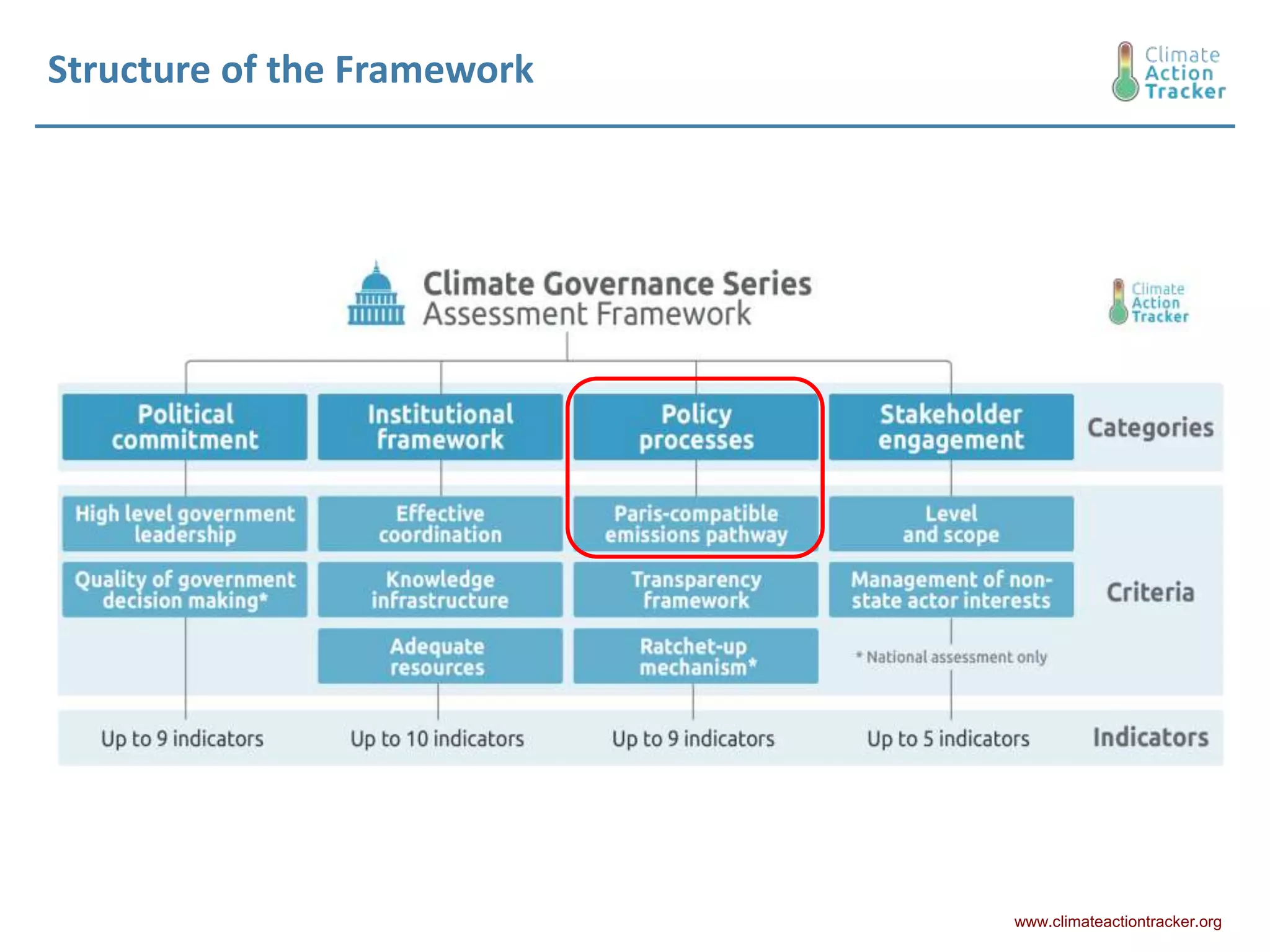
    Structure of theFramework www.climateactiontracker.org
  • 23.
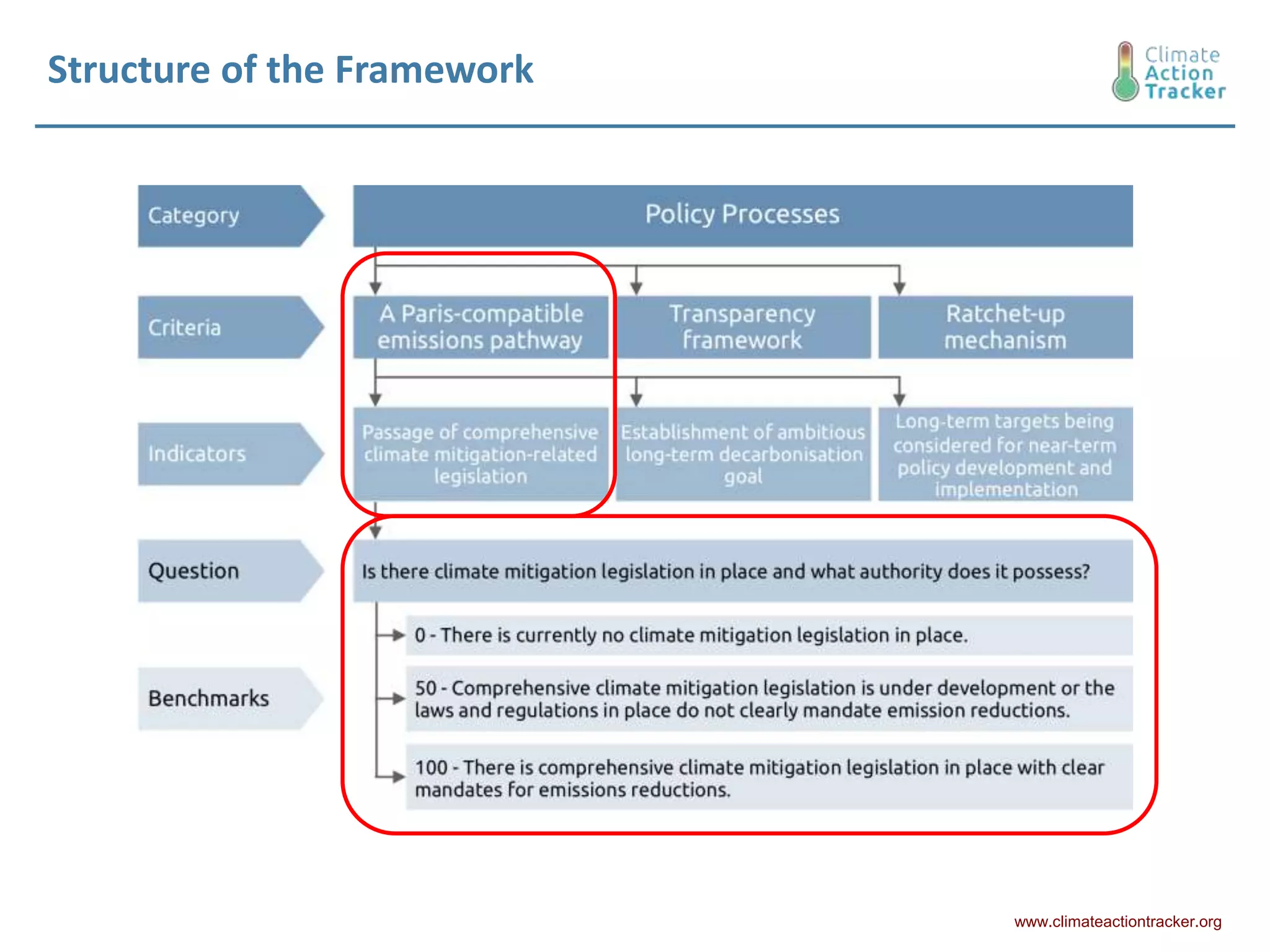
    Structure of theFramework www.climateactiontracker.org
  • 24.
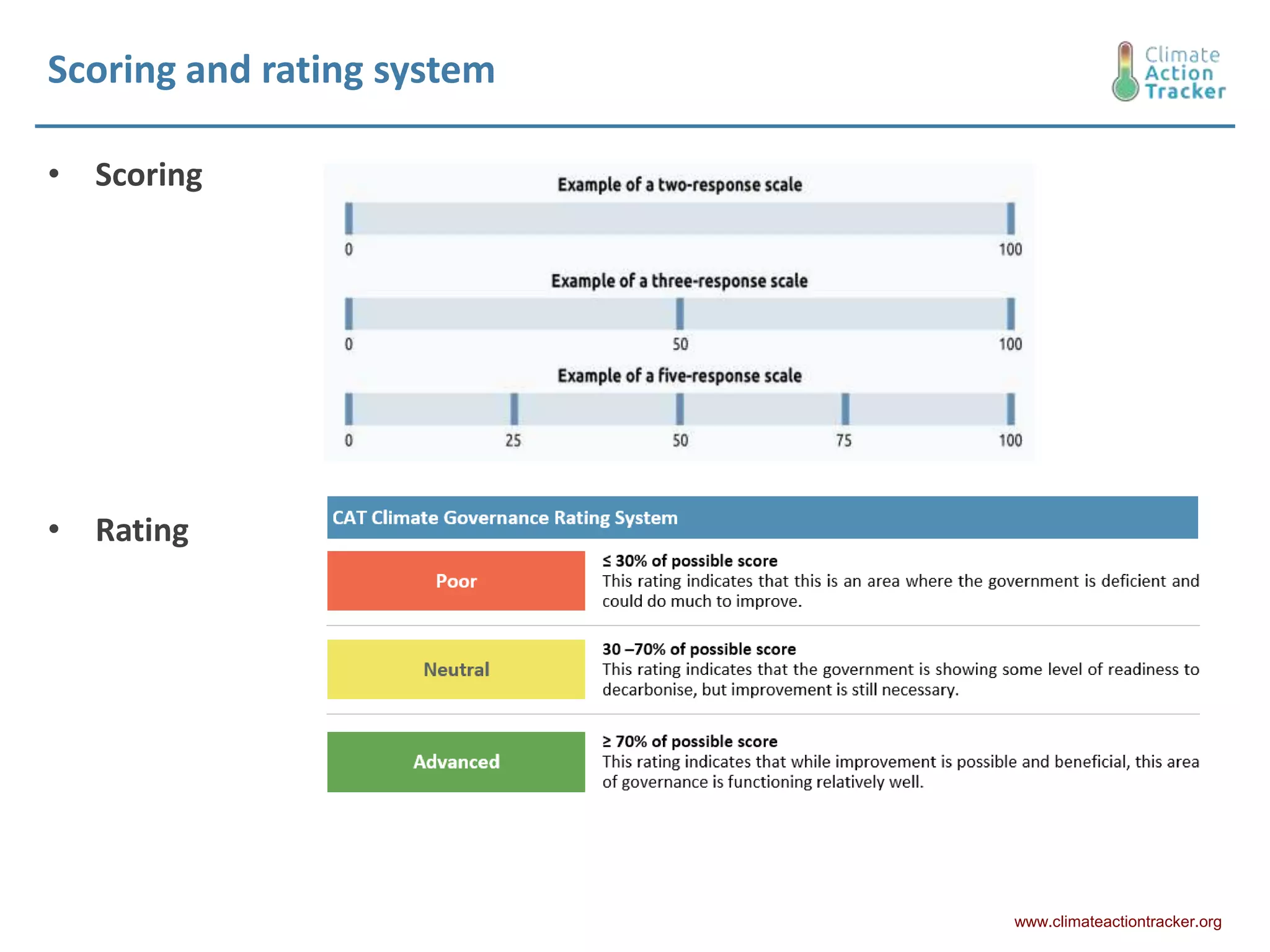
    Scoring and ratingsystem • Scoring • Rating www.climateactiontracker.org
  • 25.
  • 26.
    Australia assessment www.climateactiontracker.org Assessment asof September, 2019 • Key recommendations: – Reinstate the Climate Change Authority and independent institutes in policy development and review. – Submit a revised 2020 NDC with more ambitious targets for 2030, and establish a GHG reduction goal for 2050 in line with the Paris Agreement. – Live up to the Paris Agreement with establishment of adequate climate mitigation policy, and uphold political commitment to mitigation. – Increase transparency of emission reduction policies and planning, including national projections and sector-specific models. For full assessment: https://climateactiontracker.org/publications/climate-governance-in-australia/
  • 27.
    South Africa assessment Assessmentas of September, 2019 • Key recommendations: – Pass the draft Climate Change bill. – Designate sectoral climate focal points. – Increase human and financial capital for climate processes. – Develop Paris-compatible 2050 decarbonisation pathway with NDC update and IRP 2019. – Transparently address influence and leverage of lobby groups aligned with fossil fuel industries. For full assessment: https://climateactiontracker.org/publications/climate-governance-in-south- africa/ www.climateactiontracker.org
  • 28.
    Philippines assessment Assessment asof October 2019 • Key recommendations: – Maintain bespoke entity to address climate mitigation. – Designate high-level sectoral climate focal points. – Define a Paris-compatible emission reduction pathway. – Convert 2019 State of Nation address on fast-tracking RE and cutting coal into policy action. – Increase robustness of data and reporting on National Integrated Climate Change Database. For full assessment: https://climateactiontracker.org/publications/climate-governance-in-the- philippines/ www.climateactiontracker.org
  • 29.
    Climate Target UpdateTracker www.climateactiontracker.org
  • 30.
    CAT Rapid Assessment– Proposed Chilean NDC Update www.climateactiontracker.org
  • 31.
    Concluding Remarks • TheClimate Action Tracker will continue to rate and evaluate government climate action • Expanding analysis in 2020 to include international aviation & maritime emissions www.climateactiontracker.org • Scaling up Climate Action in Turkey Report Launch • Monday, December 9 • Turkish Pavilion @ 2pm
  • 33.
    Panel Discussion –Delivering on climate action in 2020 • Jenny Mager, Mitigation Coordinator, Environment Ministry, Chile • Silke Karcher, Head of Division, EU Climate and Energy Policy, European Climate Initiative, Carbon markets, Federal Ministry for the Environment, Nature Conservation and Nuclear Safety, Germany • Andrew Marquard, Professor, Energy Research Centre, University of Cape Town, South Africa • Renato Redentor Constantino, Executive Director, Institute for Climate and Sustainable Cities, the Philippines • Bill Hare, CEO, Climate Analytics • Niklas Höhne, Partner, NewClimate Institute www.climateactiontracker.org

Editor's Notes

  • #10  How quickly can those limits be met? How quickly can those be replicated or improved?
  • #11 Benchmarks can be made more concrete along two dimensions - > the spatial and sectoral dimensions. Each of these dimensions helps us to speak more concretely to policy makers. The 1.5C temperature limit is an example of a global benchmark, but if we want to meet that target we also need to know what it means for individual countries, and for individual industries, or sectors. Of course, it’s not always either/or! We could have a sectoral benchamark at the global level that international industries could apply or compare, but a sectoral benchmarks, such as EV share could also be determined at the national level.
  • #12 Elaborate on a vision for a 1.5C world Sectoral benchmarks speak more closely to the policy agenda; actionable recommendations! Allow us to determine which sectors are performing well and where further action is needed Sectoral level discussions under the UNFCCC are a useful framework for knowledge and technology transfer