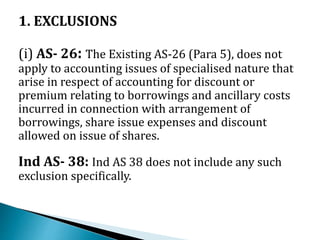

1. EXCLUSIONS
(i) AS- 26: The Existing AS-26 (Para 5), does not
apply to accounting issues of specialised nature that
arise in respect of accounting for discount or
premium relating to borrowings and ancillary costs
incurred in connection with arrangement of
borrowings, share issue expenses and discount
allowed on issue of shares.
Ind AS- 38: Ind AS 38 does not include any such
exclusion specifically.
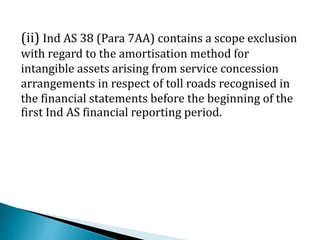
(ii) Ind AS 38 (Para 7AA) contains a scope exclusion
with regard to the amortisation method for
intangible assets arising from service concession
arrangements in respect of toll roads recognised in
the financial statements before the beginning of the
first Ind AS financial reporting period.
2. DEFINITION OF INTANGIBLE ASSETS:
 AS-26: An intangible asset is an identifiable non-
monetary asset, without physical substance, held for use
in the production or supply of goods or services, for
rental to others, or for administrative purposes. (Para 6)
 Ind AS-38: An intangible asset is an identifiable non-
monetary asset without physical substance. (Para 8)
In Ind AS 38, the requirement for the asset to be held for
use in the production or supply of goods or services, for
rental to others, or for administrative purposes has been
removed from the definition of an intangible asset.
3. IDENTIFIABILITY:
AS-26: The existing AS-26 does not define identifiability.
AS-26 states that:
To be identifiable, it is necessary that the intangible asset is
clearly distinguished from goodwill.
An intangible asset could be distinguished clearly from
goodwill if the asset is separable, but that separability is not a
necessary condition for identifiability.
An asset is separable if the enterprise could rent, sell,
exchange or distribute the specific future economic benefits
attributable to the asset without also disposing of future
economic benefits that flow from other assets used in the
same revenue earning activity.”
Ind AS-38:
It provides detailed guidance in respect of identifiability.
As per Para 12, An asset is identifiable if it either:
(a) is separable, i.e. is capable of being separated or
divided from the entity and sold, transferred, licensed,
rented or exchanged, either individually or together
with a related contract, identifiable asset or liability,
regardless of whether the entity intends to do so; or
(b) arises from contractual or other legal rights,
regardless of whether those rights are transferable or
separable from the entity or from other rights and
obligations.
4. SEPARATELY ACQUIRED INTANGIBLE ASSETS:
As per Para 25 of Ind AS 38, in the case of separately acquired
intangibles, the criterion of probable inflow of expected future
economic benefits is always considered satisfied, even if there is
uncertainty about the timing or the amount of the inflow. However,
there is no such provision in the existing standard.
Recognition Criteria as given in AS-26 and Ind AS-38:
An intangible asset shall be recognised if, and only if:
(a) it is probable that the expected future economic benefits that
are attributable to the asset will flow to the entity; and
(b) the cost of the asset can be measured reliably.
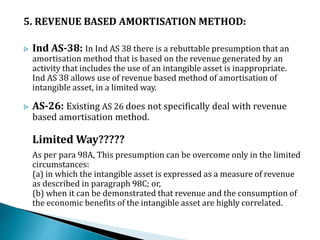
5. REVENUE BASED AMORTISATION METHOD:
⩥ Ind AS-38: In Ind AS 38 there is a rebuttable presumption that an
amortisation method that is based on the revenue generated by an
activity that includes the use of an intangible asset is inappropriate.
Ind AS 38 allows use of revenue based method of amortisation of
intangible asset, in a limited way.
⩥ AS-26: Existing AS 26 does not specifically deal with revenue
based amortisation method.
Limited Way?????
As per para 98A, This presumption can be overcome only in the limited
circumstances:
(a) in which the intangible asset is expressed as a measure of revenue
as described in paragraph 98C; or,
(b) when it can be demonstrated that revenue and the consumption of
the economic benefits of the intangible asset are highly correlated.
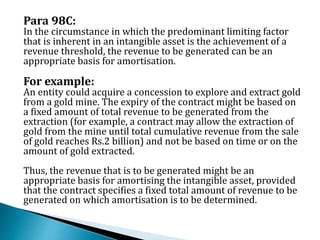
Para 98C:
In the circumstance in which the predominant limiting factor
that is inherent in an intangible asset is the achievement of a
revenue threshold, the revenue to be generated can be an
appropriate basis for amortisation.
For example:
An entity could acquire a concession to explore and extract gold
from a gold mine. The expiry of the contract might be based on
a fixed amount of total revenue to be generated from the
extraction (for example, a contract may allow the extraction of
gold from the mine until total cumulative revenue from the sale
of gold reaches Rs.2 billion) and not be based on time or on the
amount of gold extracted.
Thus, the revenue that is to be generated might be an
appropriate basis for amortising the intangible asset, provided
that the contract specifies a fixed total amount of revenue to be
generated on which amortisation is to be determined.
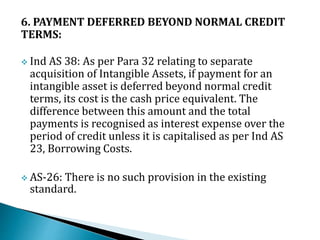
6. PAYMENT DEFERRED BEYOND NORMAL CREDIT
TERMS:
 Ind AS 38: As per Para 32 relating to separate
acquisition of Intangible Assets, if payment for an
intangible asset is deferred beyond normal credit
terms, its cost is the cash price equivalent. The
difference between this amount and the total
payments is recognised as interest expense over the
period of credit unless it is capitalised as per Ind AS
23, Borrowing Costs.
 AS-26: There is no such provision in the existing
standard.
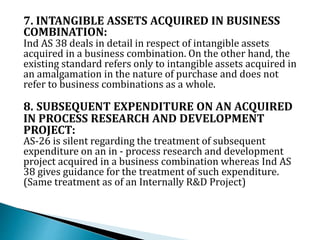
7. INTANGIBLE ASSETS ACQUIRED IN BUSINESS
COMBINATION:
Ind AS 38 deals in detail in respect of intangible assets
acquired in a business combination. On the other hand, the
existing standard refers only to intangible assets acquired in
an amalgamation in the nature of purchase and does not
refer to business combinations as a whole.
8. SUBSEQUENT EXPENDITURE ON AN ACQUIRED
IN PROCESS RESEARCH AND DEVELOPMENT
PROJECT:
AS-26 is silent regarding the treatment of subsequent
expenditure on an in - process research and development
project acquired in a business combination whereas Ind AS
38 gives guidance for the treatment of such expenditure.
(Same treatment as of an Internally R&D Project)
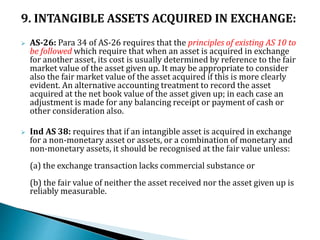
9. INTANGIBLE ASSETS ACQUIRED IN EXCHANGE:
 AS-26: Para 34 of AS-26 requires that the principles of existing AS 10 to
be followed which require that when an asset is acquired in exchange
for another asset, its cost is usually determined by reference to the fair
market value of the asset given up. It may be appropriate to consider
also the fair market value of the asset acquired if this is more clearly
evident. An alternative accounting treatment to record the asset
acquired at the net book value of the asset given up; in each case an
adjustment is made for any balancing receipt or payment of cash or
other consideration also.
 Ind AS 38: requires that if an intangible asset is acquired in exchange
for a non-monetary asset or assets, or a combination of monetary and
non-monetary assets, it should be recognised at the fair value unless:
(a) the exchange transaction lacks commercial substance or
(b) the fair value of neither the asset received nor the asset given up is
reliably measurable.
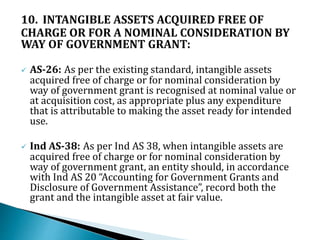
10. INTANGIBLE ASSETS ACQUIRED FREE OF
CHARGE OR FOR A NOMINAL CONSIDERATION BY
WAY OF GOVERNMENT GRANT:
 AS-26: As per the existing standard, intangible assets
acquired free of charge or for nominal consideration by
way of government grant is recognised at nominal value or
at acquisition cost, as appropriate plus any expenditure
that is attributable to making the asset ready for intended
use.
 Ind AS-38: As per Ind AS 38, when intangible assets are
acquired free of charge or for nominal consideration by
way of government grant, an entity should, in accordance
with Ind AS 20 “Accounting for Government Grants and
Disclosure of Government Assistance”, record both the
grant and the intangible asset at fair value.
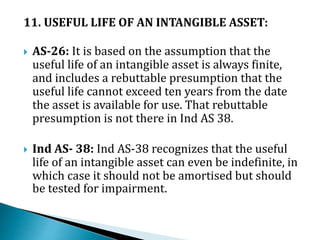
11. USEFUL LIFE OF AN INTANGIBLE ASSET:
 AS-26: It is based on the assumption that the
useful life of an intangible asset is always finite,
and includes a rebuttable presumption that the
useful life cannot exceed ten years from the date
the asset is available for use. That rebuttable
presumption is not there in Ind AS 38.
 Ind AS- 38: Ind AS-38 recognizes that the useful
life of an intangible asset can even be indefinite, in
which case it should not be amortised but should
be tested for impairment.
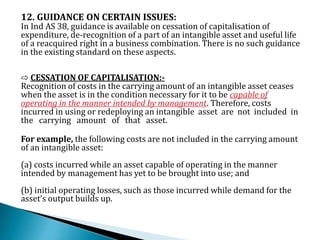
12. GUIDANCE ON CERTAIN ISSUES:
In Ind AS 38, guidance is available on cessation of capitalisation of
expenditure, de-recognition of a part of an intangible asset and useful life
of a reacquired right in a business combination. There is no such guidance
in the existing standard on these aspects.
⇨ CESSATION OF CAPITALISATION:-
Recognition of costs in the carrying amount of an intangible asset ceases
when the asset is in the condition necessary for it to be capable of
operating in the manner intended by management. Therefore, costs
incurred in using or redeploying an intangible asset are not included in
the carrying amount of that asset.
For example, the following costs are not included in the carrying amount
of an intangible asset:
(a) costs incurred while an asset capable of operating in the manner
intended by management has yet to be brought into use; and
(b) initial operating losses, such as those incurred while demand for the
asset’s output builds up.
⇨ DE-RECOGNITION OF A PART OF AN INTANGIBLE
ASSET:
If an entity recognises in the carrying amount of an asset the
cost of a replacement for part of an intangible asset, then it
derecognises the carrying amount of the replaced part. If it is
not practicable for an entity to determine the carrying
amount of the replaced part, it may use the cost of the
replacement as an indication of what the cost of the replaced
part was at the time it was acquired or internally generated.
⇨ USEFUL LIFE OF A REACQUIRED RIGHT IN A BUSINESS
COMBINATION:
The useful life of a reacquired right recognised as an
intangible asset in a business combination is the remaining
contractual period of the contract in which the right was
granted and shall not include renewal periods.
13. CONTRACTUAL OR LEGAL RIGHTS MAY
BE SHORTER THAN LEGAL LIFE:
Ind AS 38 acknowledges that the useful life of an
intangible asset arising from contractual or legal
rights may be shorter than the legal life.
The existing standard does not include such a
provision.
14. VALUATION MODEL AS ACCOUNTING POLICY:
Ind AS 38 permits an entity to choose either the cost model
or the revaluation model as its accounting policy, whereas in
the existing standard, revaluation model is not permitted.
COST MODEL:
After initial recognition, an intangible asset shall be carried
at its cost less any accumulated amortisation and any
accumulated impairment losses.
REVALUATION MODEL:
After initial recognition, an intangible asset shall be carried
at a revalued amount, being its fair value at the date of the
revaluation less any subsequent accumulated amortisation
and any subsequent accumulated impairment losses.
15. SUBSEQUENT INCREASE OF RESIDUAL VALUE FOR
CHANGES IN PRICES OR VALUE:
 AS-26: As per Para 77 The residual value is estimated using prices
prevailing at the date of acquisition of the asset, for the sale of a similar
asset that has reached the end of its estimated useful life and that has
operated under conditions similar to those in which the asset will be
used. The residual value is not subsequently increased for changes in
prices or value.
 Ind AS-38: Under Ind AS 38, the residual value is reviewed at least at
each financial year -end. If it increases to an amount equal to or greater
than the asset’s carrying amount, amortisation charge is zero unless the
residual value subsequently decreases to an amount below the asset’s
carrying amount.
A change in the asset’s residual value is accounted for as a change in an
accounting estimate in accordance with Ind AS 8, “Accounting Policies,
Changes in Accounting Estimates and Errors”.
16. CHANGE IN METHOD OF AMORTIZATION:
AS-26: Change in the method of amortisation is a
change in accounting policy.
Ind AS-38: Change in the method of amortisation is
change in accounting estimate.
17. ANNUAL IMPAIRMENT TESTING:
AS-26 also requires annual impairment testing of:
⇨ an intangible asset not yet available for use, and
⇨ an intangible asset that is amortised over a
period exceeding ten years from the date when the
asset is available for use,
even if there is no indication that the asset is
impaired.
There is no such requirement in Ind AS 38.
18. INTANGIBLE ASSETS RETIRED FROM USE AND
HELD FOR SALE:
AS-26: Intangible assets retired from use and held
for sale are covered by the existing standard.
(Carried at carrying amount and tested for
impairment at least at each financial year end)
Ind AS-38: It does not include such intangible assets
since they would be covered by Ind AS 105, “Non-
Current Assets held for sale and Discontinued
Operations”.
As 26 vs ind as-38

As 26 vs ind as-38

  • 2.
    1. EXCLUSIONS (i) AS-26: The Existing AS-26 (Para 5), does not apply to accounting issues of specialised nature that arise in respect of accounting for discount or premium relating to borrowings and ancillary costs incurred in connection with arrangement of borrowings, share issue expenses and discount allowed on issue of shares. Ind AS- 38: Ind AS 38 does not include any such exclusion specifically.
  • 3.
    (ii) Ind AS38 (Para 7AA) contains a scope exclusion with regard to the amortisation method for intangible assets arising from service concession arrangements in respect of toll roads recognised in the financial statements before the beginning of the first Ind AS financial reporting period.
  • 4.
    2. DEFINITION OFINTANGIBLE ASSETS:  AS-26: An intangible asset is an identifiable non- monetary asset, without physical substance, held for use in the production or supply of goods or services, for rental to others, or for administrative purposes. (Para 6)  Ind AS-38: An intangible asset is an identifiable non- monetary asset without physical substance. (Para 8) In Ind AS 38, the requirement for the asset to be held for use in the production or supply of goods or services, for rental to others, or for administrative purposes has been removed from the definition of an intangible asset.
  • 5.
    3. IDENTIFIABILITY: AS-26: Theexisting AS-26 does not define identifiability. AS-26 states that: To be identifiable, it is necessary that the intangible asset is clearly distinguished from goodwill. An intangible asset could be distinguished clearly from goodwill if the asset is separable, but that separability is not a necessary condition for identifiability. An asset is separable if the enterprise could rent, sell, exchange or distribute the specific future economic benefits attributable to the asset without also disposing of future economic benefits that flow from other assets used in the same revenue earning activity.”
  • 6.
    Ind AS-38: It providesdetailed guidance in respect of identifiability. As per Para 12, An asset is identifiable if it either: (a) is separable, i.e. is capable of being separated or divided from the entity and sold, transferred, licensed, rented or exchanged, either individually or together with a related contract, identifiable asset or liability, regardless of whether the entity intends to do so; or (b) arises from contractual or other legal rights, regardless of whether those rights are transferable or separable from the entity or from other rights and obligations.
  • 7.
    4. SEPARATELY ACQUIREDINTANGIBLE ASSETS: As per Para 25 of Ind AS 38, in the case of separately acquired intangibles, the criterion of probable inflow of expected future economic benefits is always considered satisfied, even if there is uncertainty about the timing or the amount of the inflow. However, there is no such provision in the existing standard. Recognition Criteria as given in AS-26 and Ind AS-38: An intangible asset shall be recognised if, and only if: (a) it is probable that the expected future economic benefits that are attributable to the asset will flow to the entity; and (b) the cost of the asset can be measured reliably.
  • 8.
    5. REVENUE BASEDAMORTISATION METHOD: ⩥ Ind AS-38: In Ind AS 38 there is a rebuttable presumption that an amortisation method that is based on the revenue generated by an activity that includes the use of an intangible asset is inappropriate. Ind AS 38 allows use of revenue based method of amortisation of intangible asset, in a limited way. ⩥ AS-26: Existing AS 26 does not specifically deal with revenue based amortisation method. Limited Way????? As per para 98A, This presumption can be overcome only in the limited circumstances: (a) in which the intangible asset is expressed as a measure of revenue as described in paragraph 98C; or, (b) when it can be demonstrated that revenue and the consumption of the economic benefits of the intangible asset are highly correlated.
  • 9.
    Para 98C: In thecircumstance in which the predominant limiting factor that is inherent in an intangible asset is the achievement of a revenue threshold, the revenue to be generated can be an appropriate basis for amortisation. For example: An entity could acquire a concession to explore and extract gold from a gold mine. The expiry of the contract might be based on a fixed amount of total revenue to be generated from the extraction (for example, a contract may allow the extraction of gold from the mine until total cumulative revenue from the sale of gold reaches Rs.2 billion) and not be based on time or on the amount of gold extracted. Thus, the revenue that is to be generated might be an appropriate basis for amortising the intangible asset, provided that the contract specifies a fixed total amount of revenue to be generated on which amortisation is to be determined.
  • 10.
    6. PAYMENT DEFERREDBEYOND NORMAL CREDIT TERMS:  Ind AS 38: As per Para 32 relating to separate acquisition of Intangible Assets, if payment for an intangible asset is deferred beyond normal credit terms, its cost is the cash price equivalent. The difference between this amount and the total payments is recognised as interest expense over the period of credit unless it is capitalised as per Ind AS 23, Borrowing Costs.  AS-26: There is no such provision in the existing standard.
  • 11.
    7. INTANGIBLE ASSETSACQUIRED IN BUSINESS COMBINATION: Ind AS 38 deals in detail in respect of intangible assets acquired in a business combination. On the other hand, the existing standard refers only to intangible assets acquired in an amalgamation in the nature of purchase and does not refer to business combinations as a whole. 8. SUBSEQUENT EXPENDITURE ON AN ACQUIRED IN PROCESS RESEARCH AND DEVELOPMENT PROJECT: AS-26 is silent regarding the treatment of subsequent expenditure on an in - process research and development project acquired in a business combination whereas Ind AS 38 gives guidance for the treatment of such expenditure. (Same treatment as of an Internally R&D Project)
  • 12.
    9. INTANGIBLE ASSETSACQUIRED IN EXCHANGE:  AS-26: Para 34 of AS-26 requires that the principles of existing AS 10 to be followed which require that when an asset is acquired in exchange for another asset, its cost is usually determined by reference to the fair market value of the asset given up. It may be appropriate to consider also the fair market value of the asset acquired if this is more clearly evident. An alternative accounting treatment to record the asset acquired at the net book value of the asset given up; in each case an adjustment is made for any balancing receipt or payment of cash or other consideration also.  Ind AS 38: requires that if an intangible asset is acquired in exchange for a non-monetary asset or assets, or a combination of monetary and non-monetary assets, it should be recognised at the fair value unless: (a) the exchange transaction lacks commercial substance or (b) the fair value of neither the asset received nor the asset given up is reliably measurable.
  • 13.
    10. INTANGIBLE ASSETSACQUIRED FREE OF CHARGE OR FOR A NOMINAL CONSIDERATION BY WAY OF GOVERNMENT GRANT:  AS-26: As per the existing standard, intangible assets acquired free of charge or for nominal consideration by way of government grant is recognised at nominal value or at acquisition cost, as appropriate plus any expenditure that is attributable to making the asset ready for intended use.  Ind AS-38: As per Ind AS 38, when intangible assets are acquired free of charge or for nominal consideration by way of government grant, an entity should, in accordance with Ind AS 20 “Accounting for Government Grants and Disclosure of Government Assistance”, record both the grant and the intangible asset at fair value.
  • 14.
    11. USEFUL LIFEOF AN INTANGIBLE ASSET:  AS-26: It is based on the assumption that the useful life of an intangible asset is always finite, and includes a rebuttable presumption that the useful life cannot exceed ten years from the date the asset is available for use. That rebuttable presumption is not there in Ind AS 38.  Ind AS- 38: Ind AS-38 recognizes that the useful life of an intangible asset can even be indefinite, in which case it should not be amortised but should be tested for impairment.
  • 15.
    12. GUIDANCE ONCERTAIN ISSUES: In Ind AS 38, guidance is available on cessation of capitalisation of expenditure, de-recognition of a part of an intangible asset and useful life of a reacquired right in a business combination. There is no such guidance in the existing standard on these aspects. ⇨ CESSATION OF CAPITALISATION:- Recognition of costs in the carrying amount of an intangible asset ceases when the asset is in the condition necessary for it to be capable of operating in the manner intended by management. Therefore, costs incurred in using or redeploying an intangible asset are not included in the carrying amount of that asset. For example, the following costs are not included in the carrying amount of an intangible asset: (a) costs incurred while an asset capable of operating in the manner intended by management has yet to be brought into use; and (b) initial operating losses, such as those incurred while demand for the asset’s output builds up.
  • 16.
    ⇨ DE-RECOGNITION OFA PART OF AN INTANGIBLE ASSET: If an entity recognises in the carrying amount of an asset the cost of a replacement for part of an intangible asset, then it derecognises the carrying amount of the replaced part. If it is not practicable for an entity to determine the carrying amount of the replaced part, it may use the cost of the replacement as an indication of what the cost of the replaced part was at the time it was acquired or internally generated. ⇨ USEFUL LIFE OF A REACQUIRED RIGHT IN A BUSINESS COMBINATION: The useful life of a reacquired right recognised as an intangible asset in a business combination is the remaining contractual period of the contract in which the right was granted and shall not include renewal periods.
  • 17.
    13. CONTRACTUAL ORLEGAL RIGHTS MAY BE SHORTER THAN LEGAL LIFE: Ind AS 38 acknowledges that the useful life of an intangible asset arising from contractual or legal rights may be shorter than the legal life. The existing standard does not include such a provision.
  • 18.
    14. VALUATION MODELAS ACCOUNTING POLICY: Ind AS 38 permits an entity to choose either the cost model or the revaluation model as its accounting policy, whereas in the existing standard, revaluation model is not permitted. COST MODEL: After initial recognition, an intangible asset shall be carried at its cost less any accumulated amortisation and any accumulated impairment losses. REVALUATION MODEL: After initial recognition, an intangible asset shall be carried at a revalued amount, being its fair value at the date of the revaluation less any subsequent accumulated amortisation and any subsequent accumulated impairment losses.
  • 19.
    15. SUBSEQUENT INCREASEOF RESIDUAL VALUE FOR CHANGES IN PRICES OR VALUE:  AS-26: As per Para 77 The residual value is estimated using prices prevailing at the date of acquisition of the asset, for the sale of a similar asset that has reached the end of its estimated useful life and that has operated under conditions similar to those in which the asset will be used. The residual value is not subsequently increased for changes in prices or value.  Ind AS-38: Under Ind AS 38, the residual value is reviewed at least at each financial year -end. If it increases to an amount equal to or greater than the asset’s carrying amount, amortisation charge is zero unless the residual value subsequently decreases to an amount below the asset’s carrying amount. A change in the asset’s residual value is accounted for as a change in an accounting estimate in accordance with Ind AS 8, “Accounting Policies, Changes in Accounting Estimates and Errors”.
  • 20.
    16. CHANGE INMETHOD OF AMORTIZATION: AS-26: Change in the method of amortisation is a change in accounting policy. Ind AS-38: Change in the method of amortisation is change in accounting estimate.
  • 21.
    17. ANNUAL IMPAIRMENTTESTING: AS-26 also requires annual impairment testing of: ⇨ an intangible asset not yet available for use, and ⇨ an intangible asset that is amortised over a period exceeding ten years from the date when the asset is available for use, even if there is no indication that the asset is impaired. There is no such requirement in Ind AS 38.
  • 22.
    18. INTANGIBLE ASSETSRETIRED FROM USE AND HELD FOR SALE: AS-26: Intangible assets retired from use and held for sale are covered by the existing standard. (Carried at carrying amount and tested for impairment at least at each financial year end) Ind AS-38: It does not include such intangible assets since they would be covered by Ind AS 105, “Non- Current Assets held for sale and Discontinued Operations”.

Editor's Notes