IAS 38 INTANGIBLE ASSETS
AGENDA
O INTANGIBLE ASSET
O RECOGNITION AND MEASUREMENT
O SEPARATE ACQUISITION
O INTERNALLY GENERATED GOODWILL,
BRAND, ETC.
O USEFULL LIFE
O RESIDUAL VALUE
O DISPIOSAL AND RETIREMENT
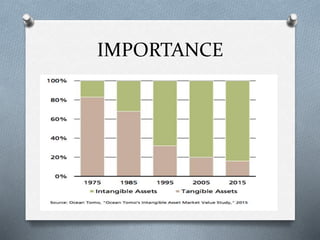
IMPORTANCE
INTANGIBLE ASSET
An intangible asset is an identifiable non-monetary asset without
physical substance.
Monetary assets are money held and assets to be received in fixed or
determinable amounts of money.
Amortisation is the systematic allocation of the depreciable amount
of an intangible asset over its useful life.
An asset is a resource:
O controlled by an entity as a result of past events; and
O from which future economic benefits are expected to flow to the
entity.
IDENTIFIABILITY
An asset is identifiable if it either:
Is separable, i.e is capable of being separated or
divided from the entity and sold, transferred,
licensed, rented or exchanged, either individually or
together with a related contract, identifiable asset or
liability, regardless of whether the entity intends to
do so; or
Arises from contractual or other legal rights,
regardless of whether those rights are transferable or
separable from the entity or from other rights and
obligations.
CONTROL
An entity controls an asset if the entity has the
power
O to obtain the future economic benefits flowing
from the underlying resource and
O to restrict the access of others to those
benefits.
FUTURE ECONOMIC BENFIT
Intangible asset may include revenue from the
O sale of products or services,
O cost savings, or
O other benefits resulting from the use of the
asset by the entity
RECOGNITION AND
MEASUREMENT
An intangible asset shall be recognised if, and
only if:
(a) it is probable that the expected future
economic benefits that are attributable to the
asset will flow to the entity; and
(b) the cost of the asset can be measured
reliably.
An intangible asset shall be measured initially at
cost.
SEPARATE ACQUISITION
The cost comprises:
O its purchase price,
O any directly attributable cost of preparing the Asset for
its intended use.
Directly attributable costs are:
O costs of employee benefits
O professional fees
O costs of testing
SEPARATE
ACQUISITION(cont.)
Expenditures that are not part of the cost of an
intangible asset are:
O costs of introducing a new product or service
(including costs of advertising and
promotional activities);
O costs of conducting business in a new location
or with a new class of customer (including
costs of staff training);and
O administration and other general overhead
costs.
SEPARATE
ACQUISITION(cont.)
Ceases when the asset is
In the condition necessary for it to be capable of
operating
In the manner intended by management.
Costs are not included in the carrying amount of an
intangible asset:
O costs incurred while an asset capable of operating
in the manner intended by management has yet to
be brought into use; and
O initial operating losses, such as those incurred
while demand for the asset’s output builds up.
INTERNALLY GENARATTED
GOODWILL,BRAND ETC.
Internally generated goodwill shall not be
recognised as an asset.
Internally generated brands, mastheads,
publishing titles, customer lists and items
similar in substance shall not be recognised as
intangible assets.
USEFUL LIFE
Useful life is:
O the period over which an asset is expected to be available for use by an
entity; or
O the number of production or similar units expected to be obtained
from the asset by an entity.
Useful life of an intangible asset may be
O Finite (the length of, or number of production or similar units),or
O Indefinite (analysis of all of the relevant factors, there is no
foreseeable limit to the period over which the asset is expected to
generate net cash inflows for the entity)
FINITE USEFUL LIFE
Amortisation shall begin when the asset is available for use, i.e. when it is in the
location and condition necessary for it to be capable of operating in the manner
intended by management.
Amortisation shall cease at the earlier of the date that the asset is classified as held
for sale and the date that the asset is derecognised.
The amortisation method used shall reflect the pattern in which the asset’s future
economic benefits are expected to be consumed by the entity.(otherwise straight
line)
The amortisation charge for each period shall be recognised in profit or loss unless
his or another Standard permits or requires it to be included in the carrying amount
of another asset.
INDEFINITE USEFUL LIFE
An intangible asset with an indefinite useful life
shall not be amortised.
In accordance with IAS 36, an entity is required to
test an intangible asset with an indefinite useful life
for impairment by comparing its recoverable
amount with its carrying amount
O annually, and
O whenever there is an indication that the intangible
asset may be impaired.
RESIDUAL VALUE
The residual value of an intangible asset with a finite useful life
shall be assumed to be zero unless:
O there is a commitment by a third party to purchase the asset at
the end of its useful life; or
O there is an active market for the asset and:
(i) residual value can be determined by reference to that
market; and
(ii) it is probable that such a market will exist at the end of the
asset’s useful life.
DEFINITIONS
An active market is a market in which all the
following conditions exist:
O the items traded in the market are homogeneous;
O willing buyers and sellers can normally be found
at any time; and
O prices are available to the public.
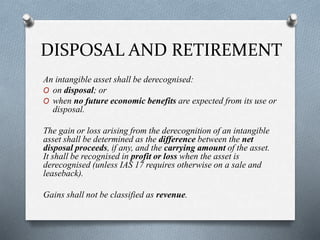
DISPOSAL AND RETIREMENT
An intangible asset shall be derecognised:
O on disposal; or
O when no future economic benefits are expected from its use or
disposal.
The gain or loss arising from the derecognition of an intangible
asset shall be determined as the difference between the net
disposal proceeds, if any, and the carrying amount of the asset.
It shall be recognised in profit or loss when the asset is
derecognised (unless IAS 17 requires otherwise on a sale and
leaseback).
Gains shall not be classified as revenue.
QUESTIONS
THANKS

IAS 38 Intangible Assets

  • 1.
  • 2.
    AGENDA O INTANGIBLE ASSET ORECOGNITION AND MEASUREMENT O SEPARATE ACQUISITION O INTERNALLY GENERATED GOODWILL, BRAND, ETC. O USEFULL LIFE O RESIDUAL VALUE O DISPIOSAL AND RETIREMENT
  • 3.
  • 4.
    INTANGIBLE ASSET An intangibleasset is an identifiable non-monetary asset without physical substance. Monetary assets are money held and assets to be received in fixed or determinable amounts of money. Amortisation is the systematic allocation of the depreciable amount of an intangible asset over its useful life. An asset is a resource: O controlled by an entity as a result of past events; and O from which future economic benefits are expected to flow to the entity.
  • 5.
    IDENTIFIABILITY An asset isidentifiable if it either: Is separable, i.e is capable of being separated or divided from the entity and sold, transferred, licensed, rented or exchanged, either individually or together with a related contract, identifiable asset or liability, regardless of whether the entity intends to do so; or Arises from contractual or other legal rights, regardless of whether those rights are transferable or separable from the entity or from other rights and obligations.
  • 6.
    CONTROL An entity controlsan asset if the entity has the power O to obtain the future economic benefits flowing from the underlying resource and O to restrict the access of others to those benefits.
  • 7.
    FUTURE ECONOMIC BENFIT Intangibleasset may include revenue from the O sale of products or services, O cost savings, or O other benefits resulting from the use of the asset by the entity
  • 8.
    RECOGNITION AND MEASUREMENT An intangibleasset shall be recognised if, and only if: (a) it is probable that the expected future economic benefits that are attributable to the asset will flow to the entity; and (b) the cost of the asset can be measured reliably. An intangible asset shall be measured initially at cost.
  • 9.
    SEPARATE ACQUISITION The costcomprises: O its purchase price, O any directly attributable cost of preparing the Asset for its intended use. Directly attributable costs are: O costs of employee benefits O professional fees O costs of testing
  • 10.
    SEPARATE ACQUISITION(cont.) Expenditures that arenot part of the cost of an intangible asset are: O costs of introducing a new product or service (including costs of advertising and promotional activities); O costs of conducting business in a new location or with a new class of customer (including costs of staff training);and O administration and other general overhead costs.
  • 11.
    SEPARATE ACQUISITION(cont.) Ceases when theasset is In the condition necessary for it to be capable of operating In the manner intended by management. Costs are not included in the carrying amount of an intangible asset: O costs incurred while an asset capable of operating in the manner intended by management has yet to be brought into use; and O initial operating losses, such as those incurred while demand for the asset’s output builds up.
  • 12.
    INTERNALLY GENARATTED GOODWILL,BRAND ETC. Internallygenerated goodwill shall not be recognised as an asset. Internally generated brands, mastheads, publishing titles, customer lists and items similar in substance shall not be recognised as intangible assets.
  • 13.
    USEFUL LIFE Useful lifeis: O the period over which an asset is expected to be available for use by an entity; or O the number of production or similar units expected to be obtained from the asset by an entity. Useful life of an intangible asset may be O Finite (the length of, or number of production or similar units),or O Indefinite (analysis of all of the relevant factors, there is no foreseeable limit to the period over which the asset is expected to generate net cash inflows for the entity)
  • 14.
    FINITE USEFUL LIFE Amortisationshall begin when the asset is available for use, i.e. when it is in the location and condition necessary for it to be capable of operating in the manner intended by management. Amortisation shall cease at the earlier of the date that the asset is classified as held for sale and the date that the asset is derecognised. The amortisation method used shall reflect the pattern in which the asset’s future economic benefits are expected to be consumed by the entity.(otherwise straight line) The amortisation charge for each period shall be recognised in profit or loss unless his or another Standard permits or requires it to be included in the carrying amount of another asset.
  • 15.
    INDEFINITE USEFUL LIFE Anintangible asset with an indefinite useful life shall not be amortised. In accordance with IAS 36, an entity is required to test an intangible asset with an indefinite useful life for impairment by comparing its recoverable amount with its carrying amount O annually, and O whenever there is an indication that the intangible asset may be impaired.
  • 16.
    RESIDUAL VALUE The residualvalue of an intangible asset with a finite useful life shall be assumed to be zero unless: O there is a commitment by a third party to purchase the asset at the end of its useful life; or O there is an active market for the asset and: (i) residual value can be determined by reference to that market; and (ii) it is probable that such a market will exist at the end of the asset’s useful life.
  • 17.
    DEFINITIONS An active marketis a market in which all the following conditions exist: O the items traded in the market are homogeneous; O willing buyers and sellers can normally be found at any time; and O prices are available to the public.
  • 18.
    DISPOSAL AND RETIREMENT Anintangible asset shall be derecognised: O on disposal; or O when no future economic benefits are expected from its use or disposal. The gain or loss arising from the derecognition of an intangible asset shall be determined as the difference between the net disposal proceeds, if any, and the carrying amount of the asset. It shall be recognised in profit or loss when the asset is derecognised (unless IAS 17 requires otherwise on a sale and leaseback). Gains shall not be classified as revenue.
  • 19.
  • 20.