By CA SK Varshney
(Asst Manager Gold Plus Glass Industry Limited
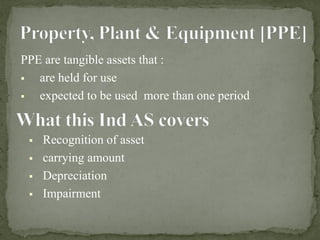
PPE are tangible assets that :
▪ are held for use
▪ expected to be used more than one period
▪ Recognition of asset
▪ carrying amount
▪ Depreciation
▪ Impairment
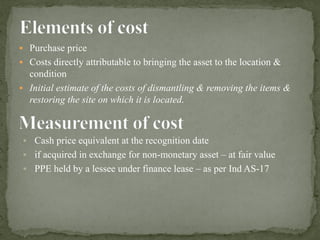
▪ Purchase price
▪ Costs directly attributable to bringing the asset to the location &
condition
▪ Initial estimate of the costs of dismantling & removing the items &
restoring the site on which it is located.
▪ Cash price equivalent at the recognition date
▪ if acquired in exchange for non-monetary asset – at fair value
▪ PPE held by a lessee under finance lease – as per Ind AS-17
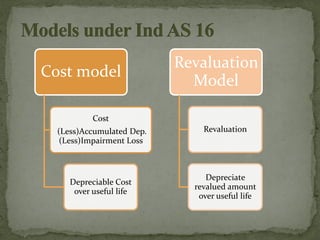
Cost model
Cost
(Less)Accumulated Dep.
(Less)Impairment Loss
Depreciable Cost
over useful life
Revaluation
Model
Revaluation
Depreciate
revalued amount
over useful life
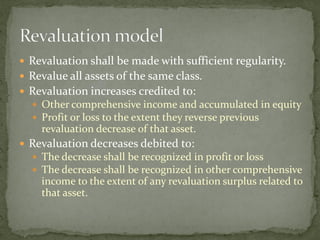
 Revaluation shall be made with sufficient regularity.
 Revalue all assets of the same class.
 Revaluation increases credited to:
 Other comprehensive income and accumulated in equity
 Profit or loss to the extent they reverse previous
revaluation decrease of that asset.
 Revaluation decreases debited to:
 The decrease shall be recognized in profit or loss
 The decrease shall be recognized in other comprehensive
income to the extent of any revaluation surplus related to
that asset.
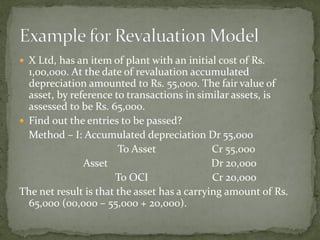
 X Ltd, has an item of plant with an initial cost of Rs.
1,00,000. At the date of revaluation accumulated
depreciation amounted to Rs. 55,000. The fair value of
asset, by reference to transactions in similar assets, is
assessed to be Rs. 65,000.
 Find out the entries to be passed?
Method – I: Accumulated depreciation Dr 55,000
To Asset Cr 55,000
Asset Dr 20,000
To OCI Cr 20,000
The net result is that the asset has a carrying amount of Rs.
65,000 (00,000 – 55,000 + 20,000).
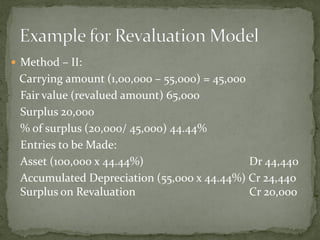
 Method – II:
Carrying amount (1,00,000 – 55,000) = 45,000
Fair value (revalued amount) 65,000
Surplus 20,000
% of surplus (20,000/ 45,000) 44.44%
Entries to be Made:
Asset (100,000 x 44.44%) Dr 44,440
Accumulated Depreciation (55,000 x 44.44%) Cr 24,440
Surplus on Revaluation Cr 20,000
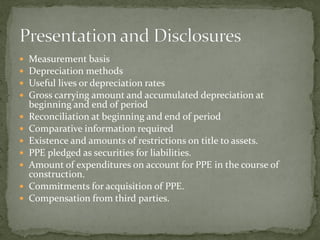
 Measurement basis
 Depreciation methods
 Useful lives or depreciation rates
 Gross carrying amount and accumulated depreciation at
beginning and end of period
 Reconciliation at beginning and end of period
 Comparative information required
 Existence and amounts of restrictions on title to assets.
 PPE pledged as securities for liabilities.
 Amount of expenditures on account for PPE in the course of
construction.
 Commitments for acquisition of PPE.
 Compensation from third parties.
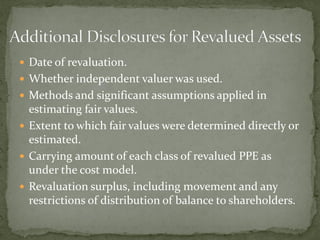
 Date of revaluation.
 Whether independent valuer was used.
 Methods and significant assumptions applied in
estimating fair values.
 Extent to which fair values were determined directly or
estimated.
 Carrying amount of each class of revalued PPE as
under the cost model.
 Revaluation surplus, including movement and any
restrictions of distribution of balance to shareholders.
 Derecognition: –
 On disposal, or
 When no future benefits expected from use or disposal.
 Difference between carrying amount and net disposal
proceeds recognised as gain/loss in profit or loss.
 Gains not classified as revenue.
 Apply Ind AS 18 Revenue in determining date of
disposal.
 Consideration receivable measured at fair value.
 Gain shall not be classified as revenue unless Ind AS-
17 requires otherwise on a sale and leaseback.
For any query kindly mail me at acaskvarshney@gmail.com

Ind as 16

  • 1.
    By CA SKVarshney (Asst Manager Gold Plus Glass Industry Limited
  • 2.
    PPE are tangibleassets that : ▪ are held for use ▪ expected to be used more than one period ▪ Recognition of asset ▪ carrying amount ▪ Depreciation ▪ Impairment
  • 3.
    ▪ Purchase price ▪Costs directly attributable to bringing the asset to the location & condition ▪ Initial estimate of the costs of dismantling & removing the items & restoring the site on which it is located. ▪ Cash price equivalent at the recognition date ▪ if acquired in exchange for non-monetary asset – at fair value ▪ PPE held by a lessee under finance lease – as per Ind AS-17
  • 4.
    Cost model Cost (Less)Accumulated Dep. (Less)ImpairmentLoss Depreciable Cost over useful life Revaluation Model Revaluation Depreciate revalued amount over useful life
  • 5.
     Revaluation shallbe made with sufficient regularity.  Revalue all assets of the same class.  Revaluation increases credited to:  Other comprehensive income and accumulated in equity  Profit or loss to the extent they reverse previous revaluation decrease of that asset.  Revaluation decreases debited to:  The decrease shall be recognized in profit or loss  The decrease shall be recognized in other comprehensive income to the extent of any revaluation surplus related to that asset.
  • 6.
     X Ltd,has an item of plant with an initial cost of Rs. 1,00,000. At the date of revaluation accumulated depreciation amounted to Rs. 55,000. The fair value of asset, by reference to transactions in similar assets, is assessed to be Rs. 65,000.  Find out the entries to be passed? Method – I: Accumulated depreciation Dr 55,000 To Asset Cr 55,000 Asset Dr 20,000 To OCI Cr 20,000 The net result is that the asset has a carrying amount of Rs. 65,000 (00,000 – 55,000 + 20,000).
  • 7.
     Method –II: Carrying amount (1,00,000 – 55,000) = 45,000 Fair value (revalued amount) 65,000 Surplus 20,000 % of surplus (20,000/ 45,000) 44.44% Entries to be Made: Asset (100,000 x 44.44%) Dr 44,440 Accumulated Depreciation (55,000 x 44.44%) Cr 24,440 Surplus on Revaluation Cr 20,000
  • 8.
     Measurement basis Depreciation methods  Useful lives or depreciation rates  Gross carrying amount and accumulated depreciation at beginning and end of period  Reconciliation at beginning and end of period  Comparative information required  Existence and amounts of restrictions on title to assets.  PPE pledged as securities for liabilities.  Amount of expenditures on account for PPE in the course of construction.  Commitments for acquisition of PPE.  Compensation from third parties.
  • 9.
     Date ofrevaluation.  Whether independent valuer was used.  Methods and significant assumptions applied in estimating fair values.  Extent to which fair values were determined directly or estimated.  Carrying amount of each class of revalued PPE as under the cost model.  Revaluation surplus, including movement and any restrictions of distribution of balance to shareholders.
  • 10.
     Derecognition: – On disposal, or  When no future benefits expected from use or disposal.  Difference between carrying amount and net disposal proceeds recognised as gain/loss in profit or loss.  Gains not classified as revenue.  Apply Ind AS 18 Revenue in determining date of disposal.  Consideration receivable measured at fair value.  Gain shall not be classified as revenue unless Ind AS- 17 requires otherwise on a sale and leaseback.
  • 11.
    For any querykindly mail me at acaskvarshney@gmail.com