1
Green University of Bangladesh (GUB)
Assignment
On
Financial Reporting – (ACT – 406)
Topic: Intangible Assets – IAS 38 (Chapter – 09)
Semester: Summer – 2014 (1402)
Course Instructor:
Md. Kamruzzaman
Lecturer, Financial Reporting, Accounting
Department of Business Administration (DBA)
Green University of Bangladesh (GUB)
Dhaka, Bangladesh.
Prepared By:
Date: 13th
August 2014
“INDIVIDUAL”
1) Md. Moazzem Hossain (G. L.) 110106034
2) Md. Taijul Islam 110306009
3) Md. Mehedi Hasan 110306029
2
Table of Contents
Sl. No. Name of Topic Page No.
i. Letter of Transmittal 3
ii. Acknowledgement 4
iii. Executive Summary 5
iv. Definition of 'Intangible Asset' 6
v. Overview 6
vi. Objective 6
vii. Classifications 7
viii. Types of Intangible Assets 8
ix. Initial Recognition of Intangible Assets 8
x. Recognizing Impairments 8
xi. Impairment Testing for Intangible Assets 9
xii. Measuring Impairments 9
xiii. Limited Life Intangibles 10
xiv. Disclosure 10
xv. Goodwill 11
xvi. Bad-Will 11
xvii. Fair Value 11
xviii. Impairment of Indefinite-Life Intangible Other Than Goodwill 12
xix. Impairment of Goodwill 12
xx. Purchased Goodwill 12
xxi. Accounting Treatment of Purchased Goodwill 12 & 13
xxii. Negative Goodwill 13
xxiii. Research and Development Costs; Other Costs Similar to R&D Costs 14
xxiv. Bibliography 14
3
Letter of Transmittal
August 13, 2014
Md. Kamruzzaman
Lecturer, Accounting Theory
Department of Business Administration (DBA)
Green University of Bangladesh (GUB)
Subject: Submission of an assignment.
Dear Sir
We gladly present to you the assignment titled “Intangible Assets – IAS 38 (Chapter – 09).” We
have made the assignment as you give me to do by help of your lectures, lecture sheet for the
course titled “Financial Reporting” and internet.
We believe the knowledge and experience we gathered during the assignment will be extremely
helpful in our future academic and professional life. We will be grateful to you if you accept the
assignment.
Your support in this regard will be highly appreciated.
Thanking you.
___________________
Group Leader (INDIVIDUALS)
Md. Moazzem Hossain
ID. 110106034
4
ACKNOWLEDGEMENT
We are really grateful because we managed to complete our Intangible Assets (Chapter – 09)
within the time given by our lecturer Md. Kamruzzaman. This assignment cannot be completed
without the effort and co-operation from our group members, Md. Moazzem Hossain, Md.
Taijul Islam and Md. Mehedi Hasan. We also sincerely thank our lecturer of Financial
Reporting (ACT – 406) , Md. Kamruzzaman for the guidance and encouragement in finishing
this assignment and also for teaching us in this course. Last but not least, we would like to
express our gratitude to our friends and respondents for the support and willingness to spend
some times with us to fill in the questionnaires.
5
EXECUTIVE SUMMARY
An intangible asset is an identifiable non-monetary asset without physical substance. Examples
include computer software, licenses, and development costs. The key characteristics of intangible
assets are that they are identifiable resources controlled by the entity from which the entity
expects to derive future economic benefits or service potential, and they lack physical substance.
Intangible assets are identifiable when they can be separated from the entity, for example, they
can be sold, exchanged, licensed or, when they arise as a result of a contractual or other legal
right, excluding those legal rights that arise from statute. Consequently, the right to levy taxes or
fines, or issue licenses does not give rise to intangible assets for those entities that are granted
those rights through legislation or similar means.
An entity recognizes an intangible asset in its statement of financial position only when it is
probable that the expected future economic benefits or service potential that are attributable to
the asset will flow to the entity; and the entity can measure the cost or fair value of the asset
reliably.
There are two categories of intangible assets, each with their own recognition and measurement
considerations - acquired intangible assets and internally generated intangible assets.
The cost of an internally generated intangible asset is the sum of expenditure incurred from the
date when the intangible asset first meets the recognition criteria.
For both acquired and internally generated intangible assets, an entity can choose either the cost
model (cost less accumulated amortization and accumulated impairment losses) or the
revaluation model (fair value less accumulated amortization and accumulated impairment losses)
as its accounting policy. If an intangible asset is accounted for using the revaluation model, all
the other assets in its class shall also be accounted for using the same model, unless there is no
active market for those assets. The fair value of intangible assets can only be determined in
relation to prices in an active market. No other basis is permitted.
The cost of intangible assets is expensed over their useful lives, known as amortization.
An entity should assess whether the useful life or service potential of an intangible asset is finite
or indefinite. An entity regards an intangible asset as having an indefinite useful life when there
is no foreseeable limit to the period over which the entity expects the asset to generate net cash
inflows or service potential for the entity. An entity deems goodwill acquired, as part of an entity
combination, to have an indefinite life.
The useful life of an intangible asset that arises from contractual or legal rights must not exceed
the period of the contractual or legal rights, but may be shorter depending on the period over
which the entity expects to use the asset. Entities should review the amortization method, useful
lives and residual values of intangible assets annually.
6
Definition of 'Intangible Asset'
An asset that is not physical in nature. Corporate intellectual property (items such as patents,
trademarks, copyrights, business methodologies), goodwill and brand recognition are all
common intangible assets in today's marketplace. An intangible asset can be classified as either
indefinite or definite depending on the specifics of that asset. A company brand name is
considered to be an indefinite asset, as it stays with the company as long as the company
continues operations. However, if a company enters a legal agreement to operate under another
company's patent, with no plans of extending the agreement, it would have a limited life and
would be classified as a definite asset.
Intangible assets are assets that lack physical existence and are not financial
instruments. Intangible assets are usually classified as concurrent (long-term) assets because
they produce benefits over several years. They are valuable because they provide rights and
privileges to their owners.
Examples of intangible assets are: trademarks, copyrights, patents, franchises, customer lists,
and goodwill.
Overview
IAS 38 Intangible Assets outlines the accounting requirements for intangible assets, which are
non-monetary assets which are without physical substance and identifiable (either being
separable or arising from contractual or other legal rights). Intangible assets meeting the relevant
recognition criteria are initially measured at cost, subsequently measured at cost or using the
revaluation model, and amortised on a systematic basis over their useful lives (unless the asset
has an indefinite useful life, in which case it is not amortised).
IAS 38 was revised in March 2004 and applies to intangible assets acquired in business
combinations occurring on or after 31 March 2004 or otherwise to other intangible assets for
annual periods beginning on or after 31 March 2004.
Objective
The objective of IAS 38 is to prescribe the accounting treatment for intangible assets that are not
dealt with specifically in another IFRS. The Standard requires an entity to recognize an
intangible asset if, and only if, certain criteria are met. The Standard also specifies how to
measure the carrying amount of intangible assets and requires certain disclosures regarding
intangible assets. [IAS 38.1]
7
Classifications
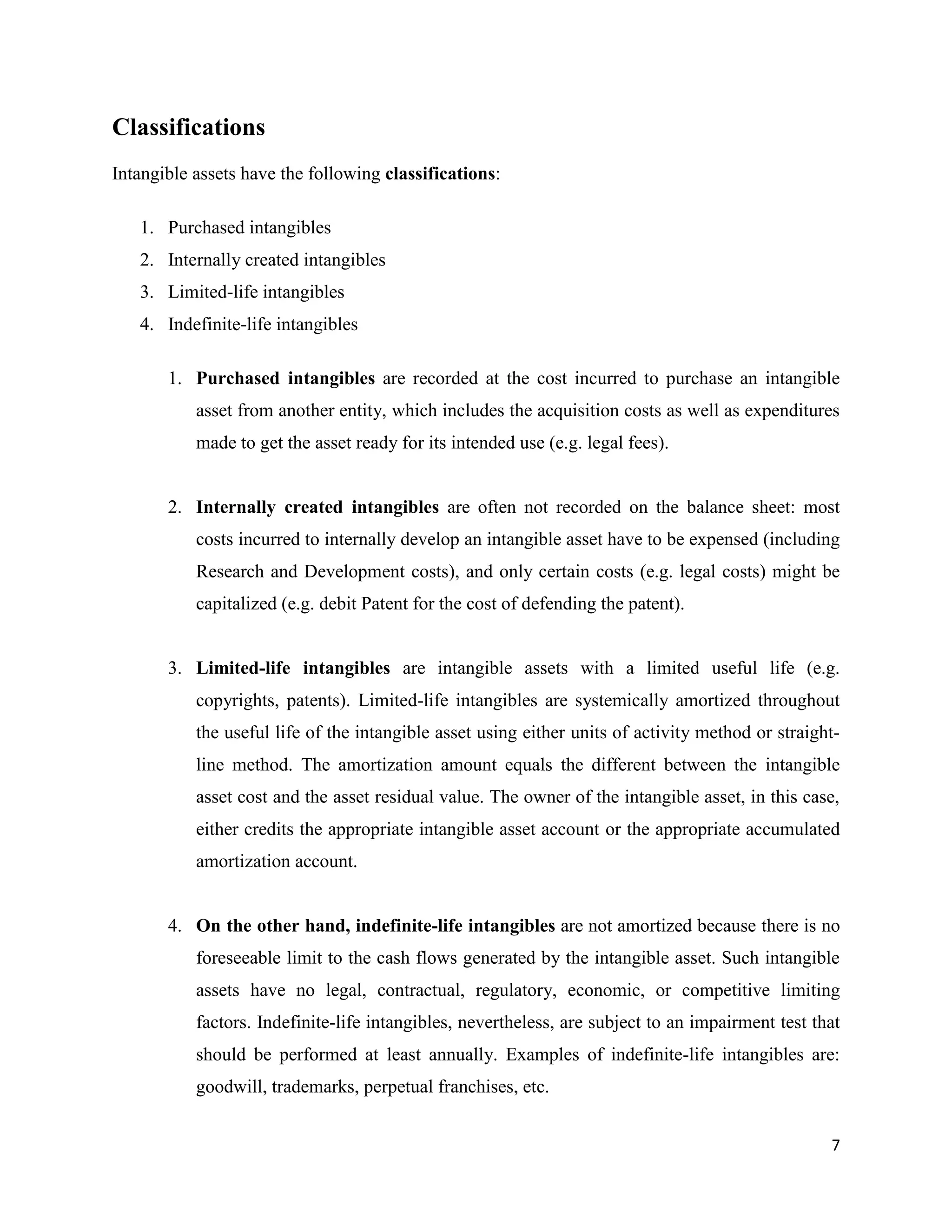
Intangible assets have the following classifications:
1. Purchased intangibles
2. Internally created intangibles
3. Limited-life intangibles
4. Indefinite-life intangibles
1. Purchased intangibles are recorded at the cost incurred to purchase an intangible
asset from another entity, which includes the acquisition costs as well as expenditures
made to get the asset ready for its intended use (e.g. legal fees).
2. Internally created intangibles are often not recorded on the balance sheet: most
costs incurred to internally develop an intangible asset have to be expensed (including
Research and Development costs), and only certain costs (e.g. legal costs) might be
capitalized (e.g. debit Patent for the cost of defending the patent).
3. Limited-life intangibles are intangible assets with a limited useful life (e.g.
copyrights, patents). Limited-life intangibles are systemically amortized throughout
the useful life of the intangible asset using either units of activity method or straight-
line method. The amortization amount equals the different between the intangible
asset cost and the asset residual value. The owner of the intangible asset, in this case,
either credits the appropriate intangible asset account or the appropriate accumulated
amortization account.
4. On the other hand, indefinite-life intangibles are not amortized because there is no
foreseeable limit to the cash flows generated by the intangible asset. Such intangible
assets have no legal, contractual, regulatory, economic, or competitive limiting
factors. Indefinite-life intangibles, nevertheless, are subject to an impairment test that
should be performed at least annually. Examples of indefinite-life intangibles are:
goodwill, trademarks, perpetual franchises, etc.
8
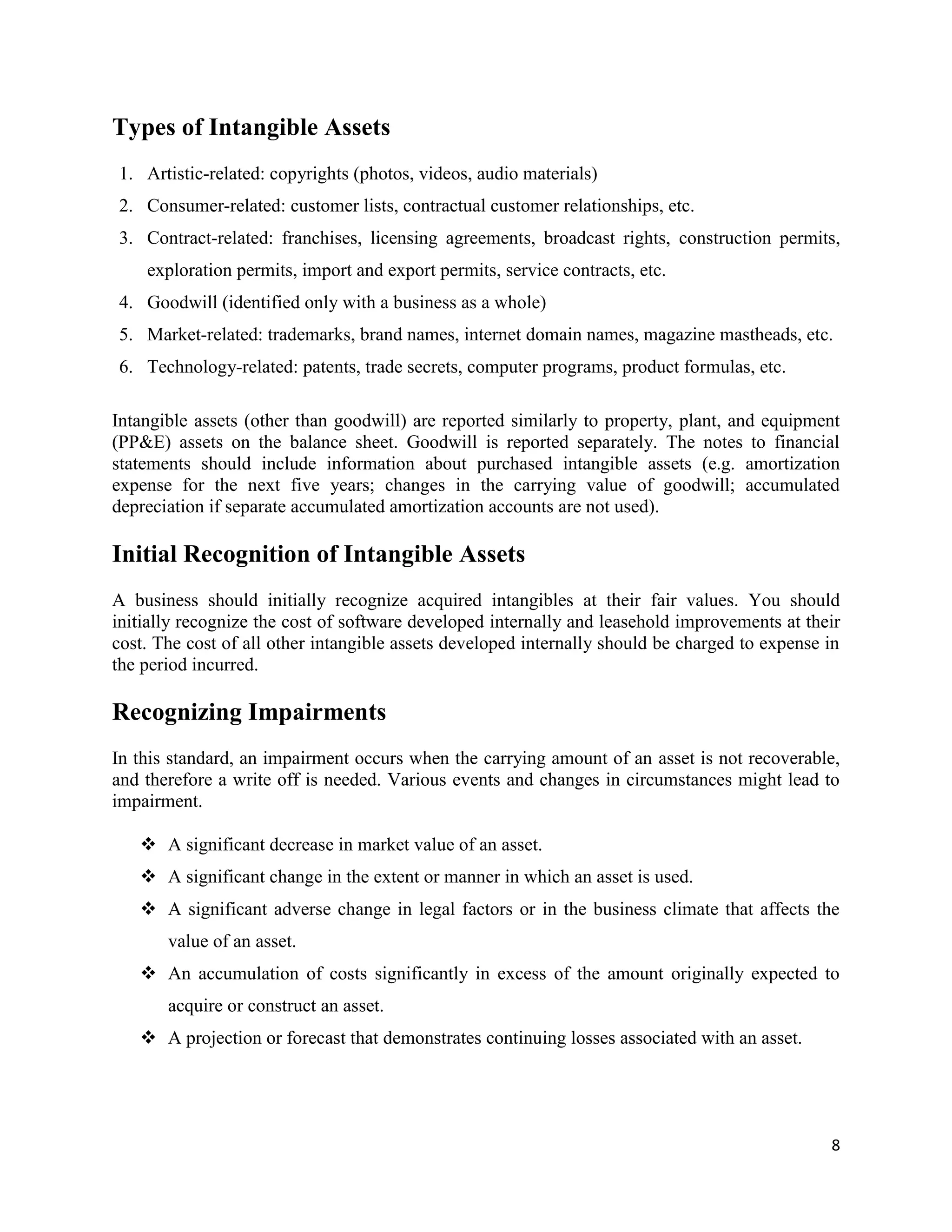
Types of Intangible Assets
1. Artistic-related: copyrights (photos, videos, audio materials)
2. Consumer-related: customer lists, contractual customer relationships, etc.
3. Contract-related: franchises, licensing agreements, broadcast rights, construction permits,
exploration permits, import and export permits, service contracts, etc.
4. Goodwill (identified only with a business as a whole)
5. Market-related: trademarks, brand names, internet domain names, magazine mastheads, etc.
6. Technology-related: patents, trade secrets, computer programs, product formulas, etc.
Intangible assets (other than goodwill) are reported similarly to property, plant, and equipment
(PP&E) assets on the balance sheet. Goodwill is reported separately. The notes to financial
statements should include information about purchased intangible assets (e.g. amortization
expense for the next five years; changes in the carrying value of goodwill; accumulated
depreciation if separate accumulated amortization accounts are not used).
Initial Recognition of Intangible Assets
A business should initially recognize acquired intangibles at their fair values. You should
initially recognize the cost of software developed internally and leasehold improvements at their
cost. The cost of all other intangible assets developed internally should be charged to expense in
the period incurred.
Recognizing Impairments
In this standard, an impairment occurs when the carrying amount of an asset is not recoverable,
and therefore a write off is needed. Various events and changes in circumstances might lead to
impairment.
 A significant decrease in market value of an asset.
 A significant change in the extent or manner in which an asset is used.
 A significant adverse change in legal factors or in the business climate that affects the
value of an asset.
 An accumulation of costs significantly in excess of the amount originally expected to
acquire or construct an asset.
 A projection or forecast that demonstrates continuing losses associated with an asset.
9
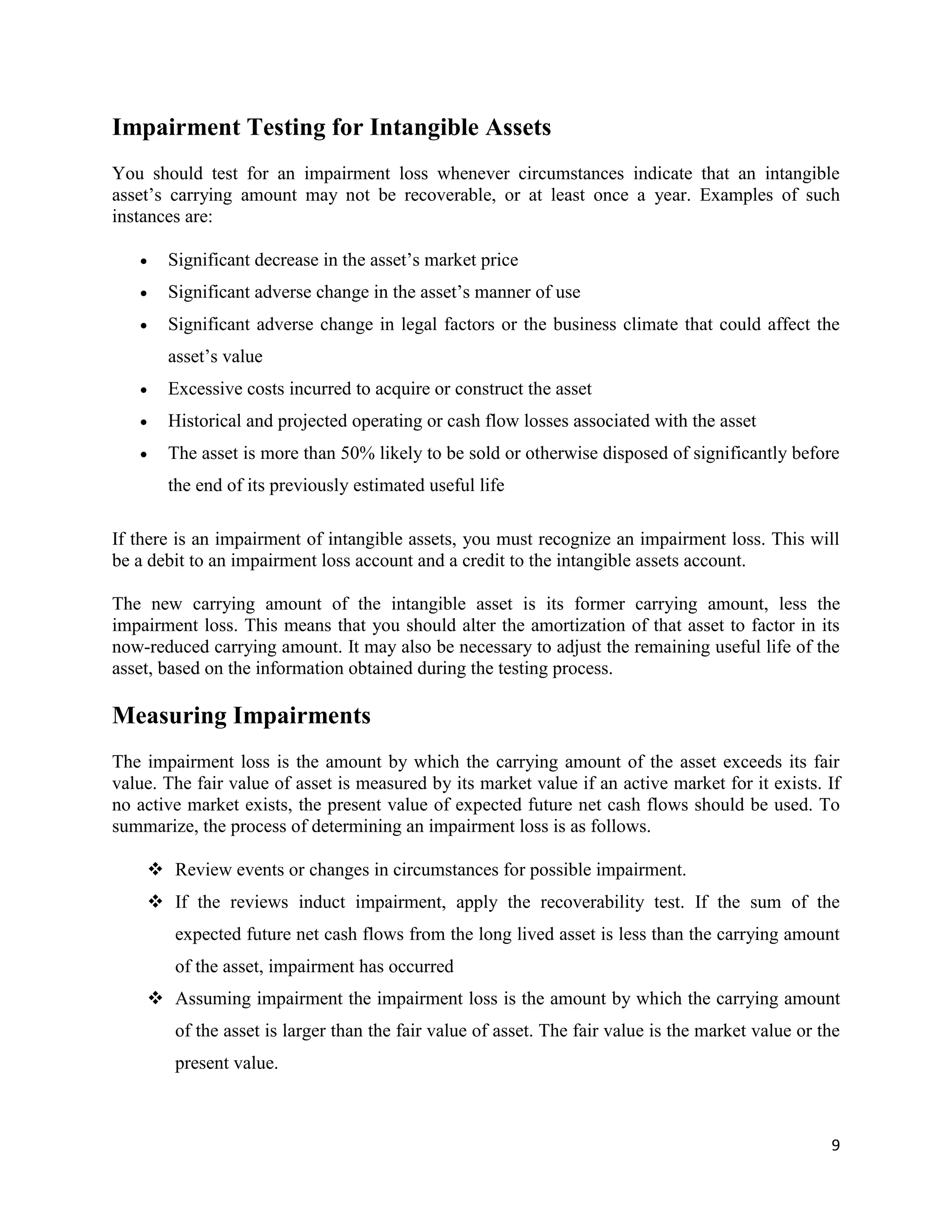
Impairment Testing for Intangible Assets
You should test for an impairment loss whenever circumstances indicate that an intangible
asset’s carrying amount may not be recoverable, or at least once a year. Examples of such
instances are:
 Significant decrease in the asset’s market price
 Significant adverse change in the asset’s manner of use
 Significant adverse change in legal factors or the business climate that could affect the
asset’s value
 Excessive costs incurred to acquire or construct the asset
 Historical and projected operating or cash flow losses associated with the asset
 The asset is more than 50% likely to be sold or otherwise disposed of significantly before
the end of its previously estimated useful life
If there is an impairment of intangible assets, you must recognize an impairment loss. This will
be a debit to an impairment loss account and a credit to the intangible assets account.
The new carrying amount of the intangible asset is its former carrying amount, less the
impairment loss. This means that you should alter the amortization of that asset to factor in its
now-reduced carrying amount. It may also be necessary to adjust the remaining useful life of the
asset, based on the information obtained during the testing process.
Measuring Impairments
The impairment loss is the amount by which the carrying amount of the asset exceeds its fair
value. The fair value of asset is measured by its market value if an active market for it exists. If
no active market exists, the present value of expected future net cash flows should be used. To
summarize, the process of determining an impairment loss is as follows.
 Review events or changes in circumstances for possible impairment.
 If the reviews induct impairment, apply the recoverability test. If the sum of the
expected future net cash flows from the long lived asset is less than the carrying amount
of the asset, impairment has occurred
 Assuming impairment the impairment loss is the amount by which the carrying amount
of the asset is larger than the fair value of asset. The fair value is the market value or the
present value.
10
Limited Life Intangibles
The expiration of intangible assets is called amortization. Limited life intangible should be
amortized by systematic changes to expense over their useful life. The useful life should reflect
the periods over which these assets will contribute to cash flows. Factors considered in
determining useful life are:
 The expected use of the asset by the entity.

the intangible asset may relate.
 Any legal, regulatory, or contractual provisions that may limit the useful life.
 Any legal, regulatory, or contractual provisions that enable renewal or extension of the
asset’s legal or contractual life without substantial cost.
Disclosure
For each class of intangible asset, disclose: [IAS 38.118 and 38.122]
 Useful life or amortization rate
 Amortization method
 Gross carrying amount
 Accumulated amortization and impairment losses
 Line items in the income statement in which amortization is included
 Reconciliation of the carrying amount at the beginning and the end of the period
showing:
o additions (business combinations separately)
o assets held for sale
o retirements and other disposals
o revaluations
o impairments
o reversals of impairments
o amortization
o foreign exchange differences
o other changes
 basis for determining that an intangible has an indefinite life
 description and carrying amount of individually material intangible assets
 certain special disclosures about intangible assets acquired by way of government grants
 information about intangible assets whose title is restricted
11
Goodwill
Goodwill in financial statements arises when a company is purchased for more than the fair
value of the identifiable assets of the company. The difference between the purchase price and
the sum of the fair value of the net assets is by definition the value of the “goodwill” of the
purchased company. The acquiring company must recognize goodwill as an asset in its financial
statements and present it as a separate line item on the balance sheet, according to the current
purchase accounting method. In this sense, goodwill serves as the balancing sum that allows one
firm to provide accounting information regarding its purchase of another firm for a price
substantially different from its book value. Goodwill can be negative, arising where the net assets
at the date of acquisition, fairly valued, exceed the cost of acquisition.[1]
Negative goodwill is
recognized as a liability.
Bad-Will
The negative effect felt by a company when shareholders and the investment community find out
that is has done something that is not in accordance with good business practices. Although
typically not expressed in a dollar amount, bad-will can play out in the form of decreased
revenue, loss of clients or suppliers, loss of market share and federal indictments for any crimes
committed.
Fair Value
 The estimated value of all assets and liabilities of an acquired company used to
consolidate the financial statements of both companies.
 In the futures market, fair value is the equilibrium price for a futures contract. This is
equal to the spot price after taking into account compounded interest (and dividends lost
because the investor owns the futures contract rather than the physical stocks) over a
certain period of time.
 A valuation, in accordance with standard methodology, that is reasonable to all parties
involved in a transaction in light of all pre-existing conditions and circumstances
In the case of futures, the sum of the value of the underlying securities and the cost of carry
(interest earned due to not holding the underlying minus dividends lost due to not holding the
underlying). Under GAAP, the fair value of an asset is the amount at which that asset could be
bought or sold in a current transaction between willing parties, other than in liquidation. On the
other side of the balance sheet, the fair value of a liability is the amount at which that liability
could be incurred or settled in a current transaction between willing parties, other than in
liquidation. If available, a quoted market price in an active market is the best evidence of fair
value and should be used as the basis for the measurement.
12
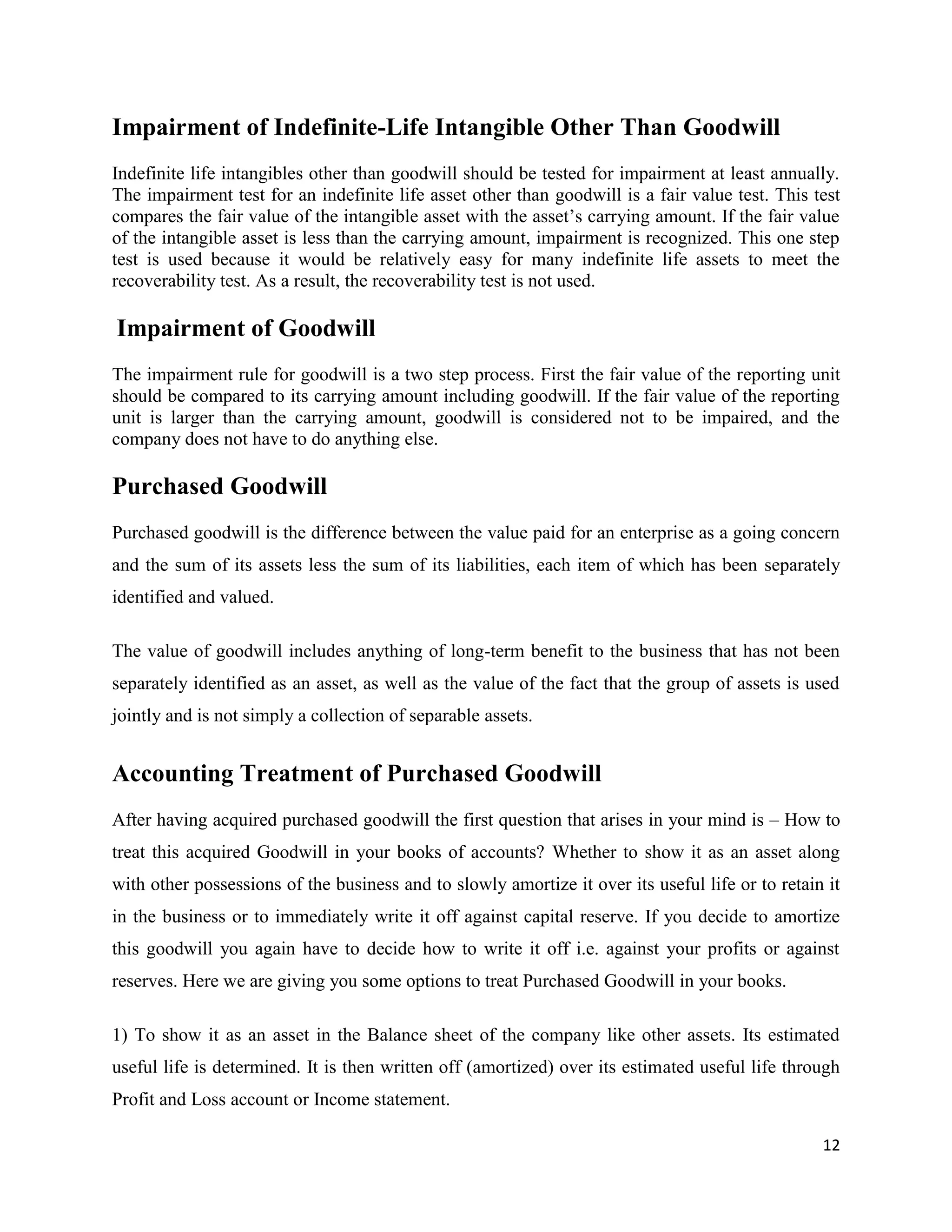
Impairment of Indefinite-Life Intangible Other Than Goodwill
Indefinite life intangibles other than goodwill should be tested for impairment at least annually.
The impairment test for an indefinite life asset other than goodwill is a fair value test. This test
compares the fair value of the intangible asset with the asset’s carrying amount. If the fair value
of the intangible asset is less than the carrying amount, impairment is recognized. This one step
test is used because it would be relatively easy for many indefinite life assets to meet the
recoverability test. As a result, the recoverability test is not used.
Impairment of Goodwill
The impairment rule for goodwill is a two step process. First the fair value of the reporting unit
should be compared to its carrying amount including goodwill. If the fair value of the reporting
unit is larger than the carrying amount, goodwill is considered not to be impaired, and the
company does not have to do anything else.
Purchased Goodwill
Purchased goodwill is the difference between the value paid for an enterprise as a going concern
and the sum of its assets less the sum of its liabilities, each item of which has been separately
identified and valued.
The value of goodwill includes anything of long-term benefit to the business that has not been
separately identified as an asset, as well as the value of the fact that the group of assets is used
jointly and is not simply a collection of separable assets.
Accounting Treatment of Purchased Goodwill
After having acquired purchased goodwill the first question that arises in your mind is – How to
treat this acquired Goodwill in your books of accounts? Whether to show it as an asset along
with other possessions of the business and to slowly amortize it over its useful life or to retain it
in the business or to immediately write it off against capital reserve. If you decide to amortize
this goodwill you again have to decide how to write it off i.e. against your profits or against
reserves. Here we are giving you some options to treat Purchased Goodwill in your books.
1) To show it as an asset in the Balance sheet of the company like other assets. Its estimated
useful life is determined. It is then written off (amortized) over its estimated useful life through
Profit and Loss account or Income statement.
13
2) To show it as an asset in the Balance sheet and amortize it over its estimated useful life
against general reserve or capital reserve or both.
3) To eliminate it completely against capital reserves immediately on its acquisition.
4) To write it off just like any other expense through Profit and Loss account in the accounting
period in which it was acquired.
5) To retain it in your business, unless a permanent reduction occurs in it due to circumstances.
Negative Goodwill
Negative goodwill arises where the net assets at the date of acquisition, fairly valued, exceed
the cost of acquisition. It is reflected on the balance sheet net of other intangible assets.
Negative goodwill is recognized as income as follows:
 To the extent that negative goodwill relates to expected future losses and expenses, it is
recognized in the income statement when the future losses and expenses are recognized.
 The amount of negative goodwill relating to identifiable non-monetary assets (not
exceeding the fair values of such acquired assets), is recognized as income on a
systematic basis over the remaining useful lives of the identifiable acquired
depreciable/amortizable assets with a maximum of 20 years.
 The amount of the negative goodwill in excess of the fair values of the acquired
identifiable non-monetary assets is recognized as income immediately.
 The amount of the negative goodwill relating to monetary assets is recognized as income
immediately.
 Negative goodwill is accounted for under the Purchase (Accounting) Method when the
fair market value of the net assets of the acquired company exceeds the purchase price
paid. The credit difference reduces certain assets acquired. If any remaining credit exists,
it is accounted for as an extraordinary gain.
14
Research and Development Costs
Research and development (R&D) costs are not in themselves intangible assets. The accounting
for R&D costs is presented here however because research and development activities frequently
result in the development of something that is patented or copyrighted (such as a new product,
process, idea, formula, composition, or literary work).
Two difficulties arise in accounting for these research and development (R&D) expenditures :(1)
identifying the costs associated with particular activities, projects or achievements, and (2)
determining the magnitude of the future benefits and length of time over which such benefits
may be realized .
Other Costs Similar to R&D Costs
Many costs have characteristics similar to research and development costs.
Examples are:
1. Start up costs for a new operation.
2. Initial operating losses.
3. Advertising costs.
4. Computer software costs.
Bibliography
 http://www.investopedia.com/terms/i/intangibleasset.asp
 http://www.iasplus.com/en/standards/ias/ias38
 http://www.accountingtools.com/intangible-assets-accounting
 http://studytesttime.com/about-goodwill/38-accounting-treatment-of-purchased-goodwill
 http://www.assignmentpoint.com/business/assignment-on-intangible-assets.html

Intangible assets financial reporting (ACT - 406)

  • 1.
    1 Green University ofBangladesh (GUB) Assignment On Financial Reporting – (ACT – 406) Topic: Intangible Assets – IAS 38 (Chapter – 09) Semester: Summer – 2014 (1402) Course Instructor: Md. Kamruzzaman Lecturer, Financial Reporting, Accounting Department of Business Administration (DBA) Green University of Bangladesh (GUB) Dhaka, Bangladesh. Prepared By: Date: 13th August 2014 “INDIVIDUAL” 1) Md. Moazzem Hossain (G. L.) 110106034 2) Md. Taijul Islam 110306009 3) Md. Mehedi Hasan 110306029
  • 2.
    2 Table of Contents Sl.No. Name of Topic Page No. i. Letter of Transmittal 3 ii. Acknowledgement 4 iii. Executive Summary 5 iv. Definition of 'Intangible Asset' 6 v. Overview 6 vi. Objective 6 vii. Classifications 7 viii. Types of Intangible Assets 8 ix. Initial Recognition of Intangible Assets 8 x. Recognizing Impairments 8 xi. Impairment Testing for Intangible Assets 9 xii. Measuring Impairments 9 xiii. Limited Life Intangibles 10 xiv. Disclosure 10 xv. Goodwill 11 xvi. Bad-Will 11 xvii. Fair Value 11 xviii. Impairment of Indefinite-Life Intangible Other Than Goodwill 12 xix. Impairment of Goodwill 12 xx. Purchased Goodwill 12 xxi. Accounting Treatment of Purchased Goodwill 12 & 13 xxii. Negative Goodwill 13 xxiii. Research and Development Costs; Other Costs Similar to R&D Costs 14 xxiv. Bibliography 14
  • 3.
    3 Letter of Transmittal August13, 2014 Md. Kamruzzaman Lecturer, Accounting Theory Department of Business Administration (DBA) Green University of Bangladesh (GUB) Subject: Submission of an assignment. Dear Sir We gladly present to you the assignment titled “Intangible Assets – IAS 38 (Chapter – 09).” We have made the assignment as you give me to do by help of your lectures, lecture sheet for the course titled “Financial Reporting” and internet. We believe the knowledge and experience we gathered during the assignment will be extremely helpful in our future academic and professional life. We will be grateful to you if you accept the assignment. Your support in this regard will be highly appreciated. Thanking you. ___________________ Group Leader (INDIVIDUALS) Md. Moazzem Hossain ID. 110106034
  • 4.
    4 ACKNOWLEDGEMENT We are reallygrateful because we managed to complete our Intangible Assets (Chapter – 09) within the time given by our lecturer Md. Kamruzzaman. This assignment cannot be completed without the effort and co-operation from our group members, Md. Moazzem Hossain, Md. Taijul Islam and Md. Mehedi Hasan. We also sincerely thank our lecturer of Financial Reporting (ACT – 406) , Md. Kamruzzaman for the guidance and encouragement in finishing this assignment and also for teaching us in this course. Last but not least, we would like to express our gratitude to our friends and respondents for the support and willingness to spend some times with us to fill in the questionnaires.
  • 5.
    5 EXECUTIVE SUMMARY An intangibleasset is an identifiable non-monetary asset without physical substance. Examples include computer software, licenses, and development costs. The key characteristics of intangible assets are that they are identifiable resources controlled by the entity from which the entity expects to derive future economic benefits or service potential, and they lack physical substance. Intangible assets are identifiable when they can be separated from the entity, for example, they can be sold, exchanged, licensed or, when they arise as a result of a contractual or other legal right, excluding those legal rights that arise from statute. Consequently, the right to levy taxes or fines, or issue licenses does not give rise to intangible assets for those entities that are granted those rights through legislation or similar means. An entity recognizes an intangible asset in its statement of financial position only when it is probable that the expected future economic benefits or service potential that are attributable to the asset will flow to the entity; and the entity can measure the cost or fair value of the asset reliably. There are two categories of intangible assets, each with their own recognition and measurement considerations - acquired intangible assets and internally generated intangible assets. The cost of an internally generated intangible asset is the sum of expenditure incurred from the date when the intangible asset first meets the recognition criteria. For both acquired and internally generated intangible assets, an entity can choose either the cost model (cost less accumulated amortization and accumulated impairment losses) or the revaluation model (fair value less accumulated amortization and accumulated impairment losses) as its accounting policy. If an intangible asset is accounted for using the revaluation model, all the other assets in its class shall also be accounted for using the same model, unless there is no active market for those assets. The fair value of intangible assets can only be determined in relation to prices in an active market. No other basis is permitted. The cost of intangible assets is expensed over their useful lives, known as amortization. An entity should assess whether the useful life or service potential of an intangible asset is finite or indefinite. An entity regards an intangible asset as having an indefinite useful life when there is no foreseeable limit to the period over which the entity expects the asset to generate net cash inflows or service potential for the entity. An entity deems goodwill acquired, as part of an entity combination, to have an indefinite life. The useful life of an intangible asset that arises from contractual or legal rights must not exceed the period of the contractual or legal rights, but may be shorter depending on the period over which the entity expects to use the asset. Entities should review the amortization method, useful lives and residual values of intangible assets annually.
  • 6.
    6 Definition of 'IntangibleAsset' An asset that is not physical in nature. Corporate intellectual property (items such as patents, trademarks, copyrights, business methodologies), goodwill and brand recognition are all common intangible assets in today's marketplace. An intangible asset can be classified as either indefinite or definite depending on the specifics of that asset. A company brand name is considered to be an indefinite asset, as it stays with the company as long as the company continues operations. However, if a company enters a legal agreement to operate under another company's patent, with no plans of extending the agreement, it would have a limited life and would be classified as a definite asset. Intangible assets are assets that lack physical existence and are not financial instruments. Intangible assets are usually classified as concurrent (long-term) assets because they produce benefits over several years. They are valuable because they provide rights and privileges to their owners. Examples of intangible assets are: trademarks, copyrights, patents, franchises, customer lists, and goodwill. Overview IAS 38 Intangible Assets outlines the accounting requirements for intangible assets, which are non-monetary assets which are without physical substance and identifiable (either being separable or arising from contractual or other legal rights). Intangible assets meeting the relevant recognition criteria are initially measured at cost, subsequently measured at cost or using the revaluation model, and amortised on a systematic basis over their useful lives (unless the asset has an indefinite useful life, in which case it is not amortised). IAS 38 was revised in March 2004 and applies to intangible assets acquired in business combinations occurring on or after 31 March 2004 or otherwise to other intangible assets for annual periods beginning on or after 31 March 2004. Objective The objective of IAS 38 is to prescribe the accounting treatment for intangible assets that are not dealt with specifically in another IFRS. The Standard requires an entity to recognize an intangible asset if, and only if, certain criteria are met. The Standard also specifies how to measure the carrying amount of intangible assets and requires certain disclosures regarding intangible assets. [IAS 38.1]
  • 7.
    7 Classifications Intangible assets havethe following classifications: 1. Purchased intangibles 2. Internally created intangibles 3. Limited-life intangibles 4. Indefinite-life intangibles 1. Purchased intangibles are recorded at the cost incurred to purchase an intangible asset from another entity, which includes the acquisition costs as well as expenditures made to get the asset ready for its intended use (e.g. legal fees). 2. Internally created intangibles are often not recorded on the balance sheet: most costs incurred to internally develop an intangible asset have to be expensed (including Research and Development costs), and only certain costs (e.g. legal costs) might be capitalized (e.g. debit Patent for the cost of defending the patent). 3. Limited-life intangibles are intangible assets with a limited useful life (e.g. copyrights, patents). Limited-life intangibles are systemically amortized throughout the useful life of the intangible asset using either units of activity method or straight- line method. The amortization amount equals the different between the intangible asset cost and the asset residual value. The owner of the intangible asset, in this case, either credits the appropriate intangible asset account or the appropriate accumulated amortization account. 4. On the other hand, indefinite-life intangibles are not amortized because there is no foreseeable limit to the cash flows generated by the intangible asset. Such intangible assets have no legal, contractual, regulatory, economic, or competitive limiting factors. Indefinite-life intangibles, nevertheless, are subject to an impairment test that should be performed at least annually. Examples of indefinite-life intangibles are: goodwill, trademarks, perpetual franchises, etc.
  • 8.
    8 Types of IntangibleAssets 1. Artistic-related: copyrights (photos, videos, audio materials) 2. Consumer-related: customer lists, contractual customer relationships, etc. 3. Contract-related: franchises, licensing agreements, broadcast rights, construction permits, exploration permits, import and export permits, service contracts, etc. 4. Goodwill (identified only with a business as a whole) 5. Market-related: trademarks, brand names, internet domain names, magazine mastheads, etc. 6. Technology-related: patents, trade secrets, computer programs, product formulas, etc. Intangible assets (other than goodwill) are reported similarly to property, plant, and equipment (PP&E) assets on the balance sheet. Goodwill is reported separately. The notes to financial statements should include information about purchased intangible assets (e.g. amortization expense for the next five years; changes in the carrying value of goodwill; accumulated depreciation if separate accumulated amortization accounts are not used). Initial Recognition of Intangible Assets A business should initially recognize acquired intangibles at their fair values. You should initially recognize the cost of software developed internally and leasehold improvements at their cost. The cost of all other intangible assets developed internally should be charged to expense in the period incurred. Recognizing Impairments In this standard, an impairment occurs when the carrying amount of an asset is not recoverable, and therefore a write off is needed. Various events and changes in circumstances might lead to impairment.  A significant decrease in market value of an asset.  A significant change in the extent or manner in which an asset is used.  A significant adverse change in legal factors or in the business climate that affects the value of an asset.  An accumulation of costs significantly in excess of the amount originally expected to acquire or construct an asset.  A projection or forecast that demonstrates continuing losses associated with an asset.
  • 9.
    9 Impairment Testing forIntangible Assets You should test for an impairment loss whenever circumstances indicate that an intangible asset’s carrying amount may not be recoverable, or at least once a year. Examples of such instances are:  Significant decrease in the asset’s market price  Significant adverse change in the asset’s manner of use  Significant adverse change in legal factors or the business climate that could affect the asset’s value  Excessive costs incurred to acquire or construct the asset  Historical and projected operating or cash flow losses associated with the asset  The asset is more than 50% likely to be sold or otherwise disposed of significantly before the end of its previously estimated useful life If there is an impairment of intangible assets, you must recognize an impairment loss. This will be a debit to an impairment loss account and a credit to the intangible assets account. The new carrying amount of the intangible asset is its former carrying amount, less the impairment loss. This means that you should alter the amortization of that asset to factor in its now-reduced carrying amount. It may also be necessary to adjust the remaining useful life of the asset, based on the information obtained during the testing process. Measuring Impairments The impairment loss is the amount by which the carrying amount of the asset exceeds its fair value. The fair value of asset is measured by its market value if an active market for it exists. If no active market exists, the present value of expected future net cash flows should be used. To summarize, the process of determining an impairment loss is as follows.  Review events or changes in circumstances for possible impairment.  If the reviews induct impairment, apply the recoverability test. If the sum of the expected future net cash flows from the long lived asset is less than the carrying amount of the asset, impairment has occurred  Assuming impairment the impairment loss is the amount by which the carrying amount of the asset is larger than the fair value of asset. The fair value is the market value or the present value.
  • 10.
    10 Limited Life Intangibles Theexpiration of intangible assets is called amortization. Limited life intangible should be amortized by systematic changes to expense over their useful life. The useful life should reflect the periods over which these assets will contribute to cash flows. Factors considered in determining useful life are:  The expected use of the asset by the entity.  the intangible asset may relate.  Any legal, regulatory, or contractual provisions that may limit the useful life.  Any legal, regulatory, or contractual provisions that enable renewal or extension of the asset’s legal or contractual life without substantial cost. Disclosure For each class of intangible asset, disclose: [IAS 38.118 and 38.122]  Useful life or amortization rate  Amortization method  Gross carrying amount  Accumulated amortization and impairment losses  Line items in the income statement in which amortization is included  Reconciliation of the carrying amount at the beginning and the end of the period showing: o additions (business combinations separately) o assets held for sale o retirements and other disposals o revaluations o impairments o reversals of impairments o amortization o foreign exchange differences o other changes  basis for determining that an intangible has an indefinite life  description and carrying amount of individually material intangible assets  certain special disclosures about intangible assets acquired by way of government grants  information about intangible assets whose title is restricted
  • 11.
    11 Goodwill Goodwill in financialstatements arises when a company is purchased for more than the fair value of the identifiable assets of the company. The difference between the purchase price and the sum of the fair value of the net assets is by definition the value of the “goodwill” of the purchased company. The acquiring company must recognize goodwill as an asset in its financial statements and present it as a separate line item on the balance sheet, according to the current purchase accounting method. In this sense, goodwill serves as the balancing sum that allows one firm to provide accounting information regarding its purchase of another firm for a price substantially different from its book value. Goodwill can be negative, arising where the net assets at the date of acquisition, fairly valued, exceed the cost of acquisition.[1] Negative goodwill is recognized as a liability. Bad-Will The negative effect felt by a company when shareholders and the investment community find out that is has done something that is not in accordance with good business practices. Although typically not expressed in a dollar amount, bad-will can play out in the form of decreased revenue, loss of clients or suppliers, loss of market share and federal indictments for any crimes committed. Fair Value  The estimated value of all assets and liabilities of an acquired company used to consolidate the financial statements of both companies.  In the futures market, fair value is the equilibrium price for a futures contract. This is equal to the spot price after taking into account compounded interest (and dividends lost because the investor owns the futures contract rather than the physical stocks) over a certain period of time.  A valuation, in accordance with standard methodology, that is reasonable to all parties involved in a transaction in light of all pre-existing conditions and circumstances In the case of futures, the sum of the value of the underlying securities and the cost of carry (interest earned due to not holding the underlying minus dividends lost due to not holding the underlying). Under GAAP, the fair value of an asset is the amount at which that asset could be bought or sold in a current transaction between willing parties, other than in liquidation. On the other side of the balance sheet, the fair value of a liability is the amount at which that liability could be incurred or settled in a current transaction between willing parties, other than in liquidation. If available, a quoted market price in an active market is the best evidence of fair value and should be used as the basis for the measurement.
  • 12.
    12 Impairment of Indefinite-LifeIntangible Other Than Goodwill Indefinite life intangibles other than goodwill should be tested for impairment at least annually. The impairment test for an indefinite life asset other than goodwill is a fair value test. This test compares the fair value of the intangible asset with the asset’s carrying amount. If the fair value of the intangible asset is less than the carrying amount, impairment is recognized. This one step test is used because it would be relatively easy for many indefinite life assets to meet the recoverability test. As a result, the recoverability test is not used. Impairment of Goodwill The impairment rule for goodwill is a two step process. First the fair value of the reporting unit should be compared to its carrying amount including goodwill. If the fair value of the reporting unit is larger than the carrying amount, goodwill is considered not to be impaired, and the company does not have to do anything else. Purchased Goodwill Purchased goodwill is the difference between the value paid for an enterprise as a going concern and the sum of its assets less the sum of its liabilities, each item of which has been separately identified and valued. The value of goodwill includes anything of long-term benefit to the business that has not been separately identified as an asset, as well as the value of the fact that the group of assets is used jointly and is not simply a collection of separable assets. Accounting Treatment of Purchased Goodwill After having acquired purchased goodwill the first question that arises in your mind is – How to treat this acquired Goodwill in your books of accounts? Whether to show it as an asset along with other possessions of the business and to slowly amortize it over its useful life or to retain it in the business or to immediately write it off against capital reserve. If you decide to amortize this goodwill you again have to decide how to write it off i.e. against your profits or against reserves. Here we are giving you some options to treat Purchased Goodwill in your books. 1) To show it as an asset in the Balance sheet of the company like other assets. Its estimated useful life is determined. It is then written off (amortized) over its estimated useful life through Profit and Loss account or Income statement.
  • 13.
    13 2) To showit as an asset in the Balance sheet and amortize it over its estimated useful life against general reserve or capital reserve or both. 3) To eliminate it completely against capital reserves immediately on its acquisition. 4) To write it off just like any other expense through Profit and Loss account in the accounting period in which it was acquired. 5) To retain it in your business, unless a permanent reduction occurs in it due to circumstances. Negative Goodwill Negative goodwill arises where the net assets at the date of acquisition, fairly valued, exceed the cost of acquisition. It is reflected on the balance sheet net of other intangible assets. Negative goodwill is recognized as income as follows:  To the extent that negative goodwill relates to expected future losses and expenses, it is recognized in the income statement when the future losses and expenses are recognized.  The amount of negative goodwill relating to identifiable non-monetary assets (not exceeding the fair values of such acquired assets), is recognized as income on a systematic basis over the remaining useful lives of the identifiable acquired depreciable/amortizable assets with a maximum of 20 years.  The amount of the negative goodwill in excess of the fair values of the acquired identifiable non-monetary assets is recognized as income immediately.  The amount of the negative goodwill relating to monetary assets is recognized as income immediately.  Negative goodwill is accounted for under the Purchase (Accounting) Method when the fair market value of the net assets of the acquired company exceeds the purchase price paid. The credit difference reduces certain assets acquired. If any remaining credit exists, it is accounted for as an extraordinary gain.
  • 14.
    14 Research and DevelopmentCosts Research and development (R&D) costs are not in themselves intangible assets. The accounting for R&D costs is presented here however because research and development activities frequently result in the development of something that is patented or copyrighted (such as a new product, process, idea, formula, composition, or literary work). Two difficulties arise in accounting for these research and development (R&D) expenditures :(1) identifying the costs associated with particular activities, projects or achievements, and (2) determining the magnitude of the future benefits and length of time over which such benefits may be realized . Other Costs Similar to R&D Costs Many costs have characteristics similar to research and development costs. Examples are: 1. Start up costs for a new operation. 2. Initial operating losses. 3. Advertising costs. 4. Computer software costs. Bibliography  http://www.investopedia.com/terms/i/intangibleasset.asp  http://www.iasplus.com/en/standards/ias/ias38  http://www.accountingtools.com/intangible-assets-accounting  http://studytesttime.com/about-goodwill/38-accounting-treatment-of-purchased-goodwill  http://www.assignmentpoint.com/business/assignment-on-intangible-assets.html