IAS 38 Intangible Assets (part two)Accounting treatment and disclosure1/17/20101IAS 38 Intangible Asset Part Two
Recognition and measurementRecognise if:Probable expected future economic benefits attributable to the asset will flow to the entityCost can be measured reliablyAssess the probabilityUsing reasonable and supportable assumptionsRepresent management’s best estimate of economic conditions over useful life of asset1/17/20102IAS 38 Intangible Asset Part Two
Subsequent expenditure on research and development project Research phase:Treat as expense when incurredDevelopment phaseTreat as intangible asset if the entity can demonstrate all of the following:Technical feasibilityIntention to completeAbility to use or sell itHow economic benefits will be generatedAvailable resources to complete, use or sellAble to measure reliably expenditure during developmentInternally generated brands, mastheads, publishing titles, customer lists etc are expensed as incurred1/17/20103IAS 38 Intangible Asset Part Two
Recognition of an expenseRecognise expenditure on intangible item as expense unless Intangible asset meets recognition criteriaAcquired in a business combination as part of goodwillOnce recognised as expense, it cannot be recognised as an asset at a later date1/17/20104IAS 38 Intangible Asset Part Two
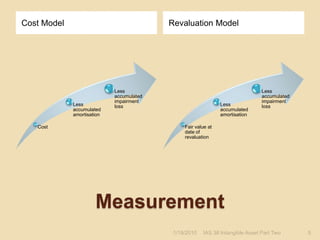
MeasurementCost ModelRevaluation Model1/17/20105IAS 38 Intangible Asset Part Two
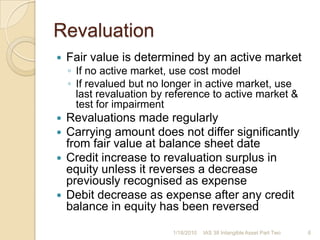
RevaluationFair value is determined by an active marketIf no active market, use cost modelIf revalued but no longer in active market, use last revaluation by reference to active market & test for impairmentRevaluations made regularlyCarrying amount does not differ significantly from fair value at balance sheet dateCredit increase to revaluation surplus in equity unless it reverses a decrease previously recognised as expenseDebit decrease as expense after any credit balance in equity has been reversed1/17/20106IAS 38 Intangible Asset Part Two
Useful lifeDecide if useful life is finite or indefiniteIf definite, how long will it generate net cash inflows?No forseeable limit to period of net cash inflows = indefinite useful lifeDoes not exceed period of contractual or legal rights but can be shorterInclude renewal periods if evidence supports renewal without significant cost1/17/20107IAS 38 Intangible Asset Part Two
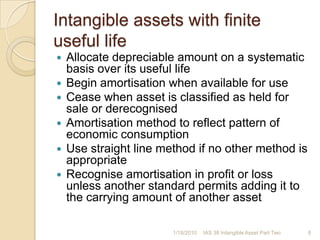
Intangible assets with finite useful lifeAllocate depreciable amount on a systematic basis over its useful lifeBegin amortisation when available for useCease when asset is classified as held for sale or derecognisedAmortisation method to reflect pattern of economic consumptionUse straight line method if no other method is appropriateRecognise amortisation in profit or loss unless another standard permits adding it to the carrying amount of another asset1/17/20108IAS 38 Intangible Asset Part Two
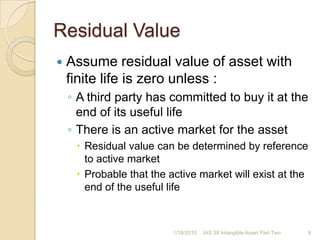
Residual ValueAssume residual value of asset with finite life is zero unless :A third party has committed to buy it at the end of its useful lifeThere is an active market for the assetResidual value can be determined by reference to active marketProbable that the active market will exist at the end of the useful life1/17/20109IAS 38 Intangible Asset Part Two
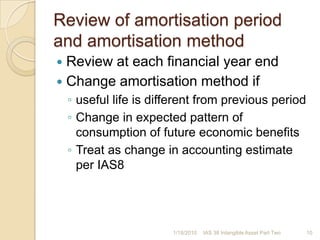
Review of amortisation period and amortisation methodReview at each financial year endChange amortisation method if useful life is different from previous periodChange in expected pattern of consumption of future economic benefitsTreat as change in accounting estimate per IAS81/17/201010IAS 38 Intangible Asset Part Two
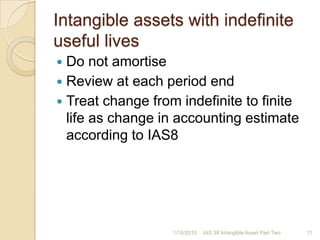
Intangible assets with indefinite useful livesDo not amortiseReview at each period endTreat change from indefinite to finite life as change in accounting estimate according to IAS81/17/201011IAS 38 Intangible Asset Part Two
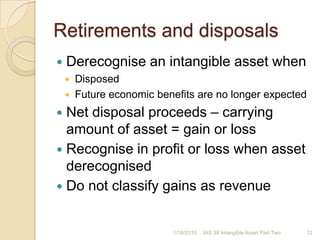
Retirements and disposalsDerecognise an intangible asset whenDisposed
Future economic benefits are no longer expectedNet disposal proceeds – carrying amount of asset = gain or lossRecognise in profit or loss when asset derecognisedDo not classify gains as revenue1/17/201012IAS 38 Intangible Asset Part Two
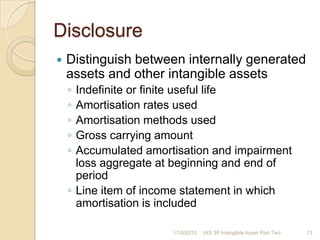
DisclosureDistinguish between internally generated assets and other intangible assetsIndefinite or finite useful lifeAmortisation rates usedAmortisation methods usedGross carrying amountAccumulated amortisation and impairment loss aggregate at beginning and end of periodLine item of income statement in which amortisation is included1/17/201013IAS 38 Intangible Asset Part Two
DisclosureReconciliation of carrying amount at beginning and end of periodAdditions (internally developed, separately acquired and acquired through business combinations)Classified as held for saleIncluded in disposal group classified as held for saleIncreases or decreases from revaluationIncreases or decreases from impairment losses in equityImpairment loss in profit or lossImpairment loss reversed in profit or lossAmortisation recognised in the periodNet exchange differences arising on translationOther changes in carrying amount1/17/201014IAS 38 Intangible Asset Part Two
DisclosureIntangible asset with indefinite useful lifeCarrying amountReason for indefinite useful life assessmentSignificant factors assessedIntangible asset material to financial statementsDescription, carrying amount and amortisation and remaining amortisation periodIntangible assets acquired with government grant at fair valueInitial fair valueCarrying amountCost or revaluation model usedIntangible assets with restricted titleCarrying amountIntangible assets pledged as security for liabilitiesCarrying amountContractual commitments for acquisition of intangible assets1/17/201015IAS 38 Intangible Asset Part Two
DisclosureResearch and development costs recognised as expense during the periodRevalued intangible assetsClass of intangible assetEffective date of revaluationCarrying amount Carrying amount when measured using cost modelRevaluation surplusAt beginning and end of periodChange during the periodRestriction on distribution of balance to shareholdersFair value estimatesMethods and significant assumptions to estimate fair value1/17/201016IAS 38 Intangible Asset Part Two
Transitional provisionsApply prospectively from same date as applying IFRS3 retrospectivelyDo not adjust carrying amounts recognised at that dateReassess useful lives at that dateIf changed, treat as change in accounting estimate IAS 8Apply from 31 March 2004Agreement date of business combinationProspectively to other intangible assetsApply early together with IFRS 3 and IAS 361/17/201017IAS 38 Intangible Asset Part Two

Ias 38 Intangible Assets (2)

  • 1.
    IAS 38 IntangibleAssets (part two)Accounting treatment and disclosure1/17/20101IAS 38 Intangible Asset Part Two
  • 2.
    Recognition and measurementRecogniseif:Probable expected future economic benefits attributable to the asset will flow to the entityCost can be measured reliablyAssess the probabilityUsing reasonable and supportable assumptionsRepresent management’s best estimate of economic conditions over useful life of asset1/17/20102IAS 38 Intangible Asset Part Two
  • 3.
    Subsequent expenditure onresearch and development project Research phase:Treat as expense when incurredDevelopment phaseTreat as intangible asset if the entity can demonstrate all of the following:Technical feasibilityIntention to completeAbility to use or sell itHow economic benefits will be generatedAvailable resources to complete, use or sellAble to measure reliably expenditure during developmentInternally generated brands, mastheads, publishing titles, customer lists etc are expensed as incurred1/17/20103IAS 38 Intangible Asset Part Two
  • 4.
    Recognition of anexpenseRecognise expenditure on intangible item as expense unless Intangible asset meets recognition criteriaAcquired in a business combination as part of goodwillOnce recognised as expense, it cannot be recognised as an asset at a later date1/17/20104IAS 38 Intangible Asset Part Two
  • 5.
  • 6.
    RevaluationFair value isdetermined by an active marketIf no active market, use cost modelIf revalued but no longer in active market, use last revaluation by reference to active market & test for impairmentRevaluations made regularlyCarrying amount does not differ significantly from fair value at balance sheet dateCredit increase to revaluation surplus in equity unless it reverses a decrease previously recognised as expenseDebit decrease as expense after any credit balance in equity has been reversed1/17/20106IAS 38 Intangible Asset Part Two
  • 7.
    Useful lifeDecide ifuseful life is finite or indefiniteIf definite, how long will it generate net cash inflows?No forseeable limit to period of net cash inflows = indefinite useful lifeDoes not exceed period of contractual or legal rights but can be shorterInclude renewal periods if evidence supports renewal without significant cost1/17/20107IAS 38 Intangible Asset Part Two
  • 8.
    Intangible assets withfinite useful lifeAllocate depreciable amount on a systematic basis over its useful lifeBegin amortisation when available for useCease when asset is classified as held for sale or derecognisedAmortisation method to reflect pattern of economic consumptionUse straight line method if no other method is appropriateRecognise amortisation in profit or loss unless another standard permits adding it to the carrying amount of another asset1/17/20108IAS 38 Intangible Asset Part Two
  • 9.
    Residual ValueAssume residualvalue of asset with finite life is zero unless :A third party has committed to buy it at the end of its useful lifeThere is an active market for the assetResidual value can be determined by reference to active marketProbable that the active market will exist at the end of the useful life1/17/20109IAS 38 Intangible Asset Part Two
  • 10.
    Review of amortisationperiod and amortisation methodReview at each financial year endChange amortisation method if useful life is different from previous periodChange in expected pattern of consumption of future economic benefitsTreat as change in accounting estimate per IAS81/17/201010IAS 38 Intangible Asset Part Two
  • 11.
    Intangible assets withindefinite useful livesDo not amortiseReview at each period endTreat change from indefinite to finite life as change in accounting estimate according to IAS81/17/201011IAS 38 Intangible Asset Part Two
  • 12.
    Retirements and disposalsDerecognisean intangible asset whenDisposed
  • 13.
    Future economic benefitsare no longer expectedNet disposal proceeds – carrying amount of asset = gain or lossRecognise in profit or loss when asset derecognisedDo not classify gains as revenue1/17/201012IAS 38 Intangible Asset Part Two
  • 14.
    DisclosureDistinguish between internallygenerated assets and other intangible assetsIndefinite or finite useful lifeAmortisation rates usedAmortisation methods usedGross carrying amountAccumulated amortisation and impairment loss aggregate at beginning and end of periodLine item of income statement in which amortisation is included1/17/201013IAS 38 Intangible Asset Part Two
  • 15.
    DisclosureReconciliation of carryingamount at beginning and end of periodAdditions (internally developed, separately acquired and acquired through business combinations)Classified as held for saleIncluded in disposal group classified as held for saleIncreases or decreases from revaluationIncreases or decreases from impairment losses in equityImpairment loss in profit or lossImpairment loss reversed in profit or lossAmortisation recognised in the periodNet exchange differences arising on translationOther changes in carrying amount1/17/201014IAS 38 Intangible Asset Part Two
  • 16.
    DisclosureIntangible asset withindefinite useful lifeCarrying amountReason for indefinite useful life assessmentSignificant factors assessedIntangible asset material to financial statementsDescription, carrying amount and amortisation and remaining amortisation periodIntangible assets acquired with government grant at fair valueInitial fair valueCarrying amountCost or revaluation model usedIntangible assets with restricted titleCarrying amountIntangible assets pledged as security for liabilitiesCarrying amountContractual commitments for acquisition of intangible assets1/17/201015IAS 38 Intangible Asset Part Two
  • 17.
    DisclosureResearch and developmentcosts recognised as expense during the periodRevalued intangible assetsClass of intangible assetEffective date of revaluationCarrying amount Carrying amount when measured using cost modelRevaluation surplusAt beginning and end of periodChange during the periodRestriction on distribution of balance to shareholdersFair value estimatesMethods and significant assumptions to estimate fair value1/17/201016IAS 38 Intangible Asset Part Two
  • 18.
    Transitional provisionsApply prospectivelyfrom same date as applying IFRS3 retrospectivelyDo not adjust carrying amounts recognised at that dateReassess useful lives at that dateIf changed, treat as change in accounting estimate IAS 8Apply from 31 March 2004Agreement date of business combinationProspectively to other intangible assetsApply early together with IFRS 3 and IAS 361/17/201017IAS 38 Intangible Asset Part Two