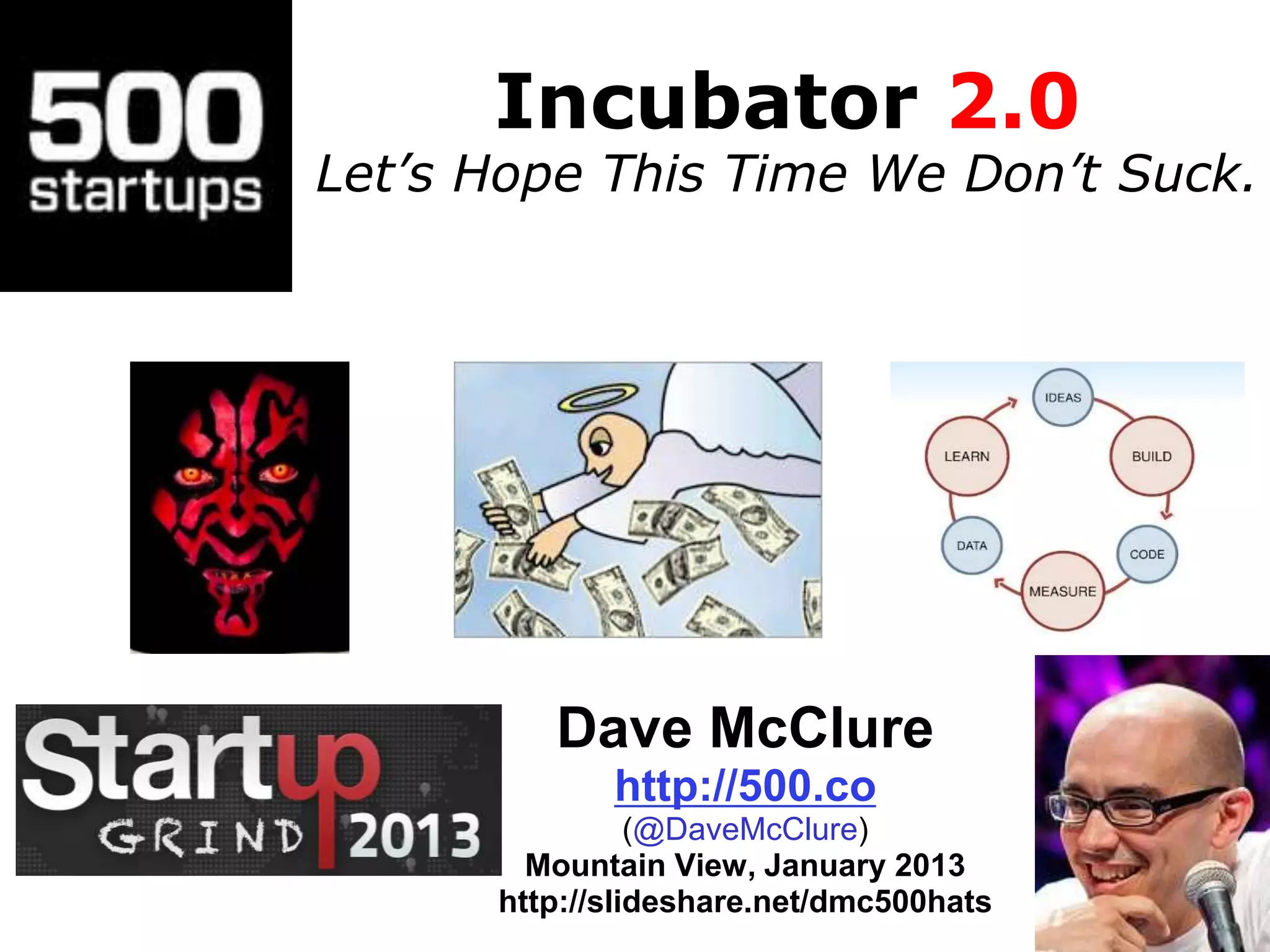
Incubator 2.0
Let’s Hope This Time We Don’t Suck.
Dave McClure
http://500.co
(@DaveMcClure)
Mountain View, January 2013
http://slideshare.net/dmc500hats
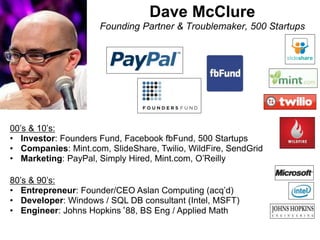
Dave McClure
Founding Partner & Troublemaker, 500 Startups
00’s & 10’s:
• Investor: Founders Fund, Facebook fbFund, 500 Startups
• Companies: Mint.com, SlideShare, Twilio, WildFire, SendGrid
• Marketing: PayPal, Simply Hired, Mint.com, O’Reilly
80’s & 90’s:
• Entrepreneur: Founder/CEO Aslan Computing (acq’d)
• Developer: Windows / SQL DB consultant (Intel, MSFT)
• Engineer: Johns Hopkins‘88, BS Eng / Applied Math
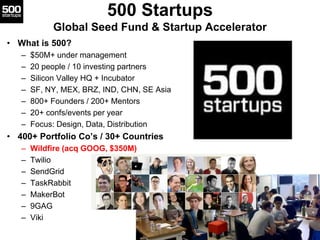
500 Startups
Global Seed Fund & Startup Accelerator
• What is 500?
– $50M+ under management
– 20 people / 10 investing partners
– Silicon Valley HQ + Incubator
– SF, NY, MEX, BRZ, IND, CHN, SE Asia
– 800+ Founders / 200+ Mentors
– 20+ confs/events per year
– Focus: Design, Data, Distribution
• 400+ Portfolio Co’s / 30+ Countries
– Wildfire (acq GOOG, $350M)
– Twilio
– SendGrid
– TaskRabbit
– MakerBot
– 9GAG
– Viki
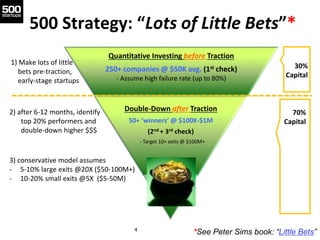
70%
Capital
4
Quantitative Investing before Traction
250+ companies @ $50K avg. (1st check)
- Assume high failure rate (up to 80%)
Double-Down after Traction
50+ ‘winners’ @ $100K-$1M
(2nd + 3rd check)
- - Target 10+ exits @ $100M+
500 Strategy: “Lots of Little Bets”*
1) Make lots of little
bets pre-traction,
early-stage startups
30%
Capital
2) after 6-12 months, identify
top 20% performers and
double-down higher $$$
3) conservative model assumes
- 5-10% large exits @20X ($50-100M+)
- 10-20% small exits @5X ($5-50M)
*See Peter Sims book: “Little Bets”
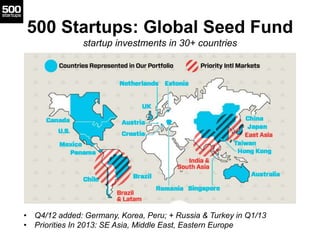
500 Startups: Global Seed Fund
startup investments in 30+ countries
• Q4/12 added: Germany, Korea, Peru; + Russia & Turkey in Q1/13
• Priorities In 2013: SE Asia, Middle East, Eastern Europe
Angel* List: It Rocks.
• Startups & Investors
• Activity & Metrics
• Platform & APIs
• *ps – not just for Angels, or USA
Early-Stage Risk Reduction
• 1st Mtg: Crazy, Idiots, Liars or Crooks?
• Product: does it work? (crappy, not perfect)
• Market: are people using it? (not their mom)
• Revenue: will people pay for it? (just a few)
• Growth: how will it/they scale? (online? offline?)
• Finance: what will it cost?
– Q1: cost to get a customer?
– Q2: how & when do you make money?
Early-Stage Startups:
Your “Due Diligence” Is An Illusion
(Better approach = write a quick, small check then wait ~6 mo’s)
• Problems in Early-Stage Due Diligence:
– You Might Be Able to Detect Idiots & Liars, but…
– Not much history, product, customers, or revenue (yet), so…
– You probably can’t figure out Winners (yet).
• The New Due Diligence = Incremental Achievements
– “Due Diligence”  Trusted Referrals + History
– “Great Team”  Functional Prototype + Usage
– “Size of Market”  Evidence = Customers, Revenue
• The Odds Are: They Suck, You’re Wrong
– You’ll Be Wrong 4x out of 5x. (If U Don’t Suck).
– In 6 Months, You’ll Know If They Don’t Suck.
– In 1-2 Years, You’ll Know If They’re Awesome.
Startup Incubators & Metrics
Lots of Little Bets. Most FAIL.
(but a few succeed :)
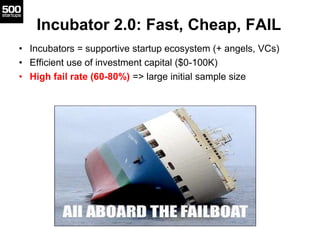
Incubator 2.0: Fast, Cheap, FAIL
• Incubators = supportive startup ecosystem (+ angels, VCs)
• Efficient use of investment capital ($0-100K)
• High fail rate (60-80%) => large initial sample size
Incubator 2.0:
Education, Collaboration, Iteration
• Success based on:
– MANY, small experiments
– common platforms, customers, problems & solutions
– physical proximity, open/collaborative environment
– Domain-specific mentors & expertise
– fast fail, iteration, metrics & feedback loop
• Incremental investment; high-risk, but high-reward
Education & Community
• Mentors, Investors
• Design, Data, Distribution
• Platform Partners
• Sponsors & Strategics
• Marketing & Visibility
Hacker, Hustler, Hipster
• Hacker: engineers & developers
• Hipster: design & UX
• Hustler: marketing & business
1. Build functional prototypes
2. Improve UX so people convert
3. Scale customer acq & distribution
Product, Market, Revenue
• Product: assess functional use, improve design/UX
• Market: test usage, distribution channels
• Revenue: test cust acq cost, revenue, *timing*
• Work on Pitch, Help Find Co-Investors, etc
Outlier Competition +
Modeling Success Behaviors
• You want min 3-5 “rockstars” to compete
• Rockstars to model success for others
• You can’t assume >20% rockstars
• Therefore, pick 5x5 = 25 teams
• 3-5 rockstar teams emerge, compete, win
• 5-10 *other* non-rockstars learn
• Identify losers quickly (but don’t be an ass)
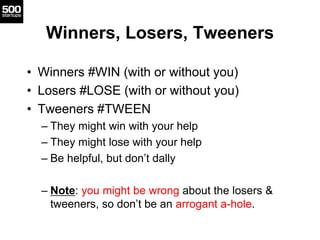
Winners, Losers, Tweeners
• Winners #WIN (with or without you)
• Losers #LOSE (with or without you)
• Tweeners #TWEEN
– They might win with your help
– They might lose with your help
– Be helpful, but don’t dally
– Note: you might be wrong about the losers &
tweeners, so don’t be an arrogant a-hole.
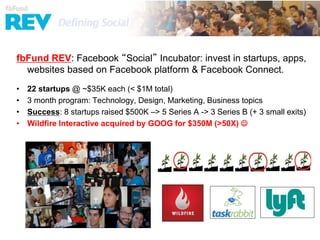
fbFund REV
fbFund REV: Facebook “Social” Incubator: invest in startups, apps,
websites based on Facebook platform & Facebook Connect.
• 22 startups @ ~$35K each (< $1M total)
• 3 month program: Technology, Design, Marketing, Business topics
• Success: 8 startups raised $500K –> 5 Series A -> 3 Series B (+ 3 small exits)
• Wildfire Interactive acquired by GOOG for $350M (>50X) 
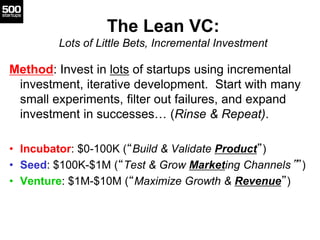
The Lean VC:
Lots of Little Bets, Incremental Investment
Method: Invest in lots of startups using incremental
investment, iterative development. Start with many
small experiments, filter out failures, and expand
investment in successes… (Rinse & Repeat).
• Incubator: $0-100K (“Build & Validate Product”)
• Seed: $100K-$1M (“Test & Grow Marketing Channels””)
• Venture: $1M-$10M (“Maximize Growth & Revenue”)
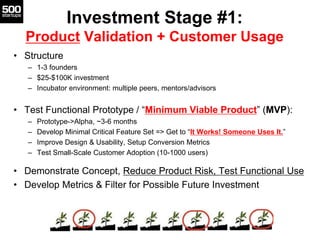
Investment Stage #1:
Product Validation + Customer Usage
• Structure
– 1-3 founders
– $25-$100K investment
– Incubator environment: multiple peers, mentors/advisors
• Test Functional Prototype / “Minimum Viable Product” (MVP):
– Prototype->Alpha, ~3-6 months
– Develop Minimal Critical Feature Set => Get to “It Works! Someone Uses It.”
– Improve Design & Usability, Setup Conversion Metrics
– Test Small-Scale Customer Adoption (10-1000 users)
• Demonstrate Concept, Reduce Product Risk, Test Functional Use
• Develop Metrics & Filter for Possible Future Investment
Investment Stage #2:
Market Validation + Revenue Testing
• Structure
– 2-10 person team
– $100K-$1M investment
– Syndicate of Angel Investors / Small VC Funds
• Improve Product, Expand Customers, Test Revenue:
– Alpha->Beta, ~6-12 months
– Scale Customer Adoption => “Many People Use It, & They Pay.”
– Test Marketing Campaigns, Customer Acquisition Channels + Cost
– Test Revenue Generation, Find Profitable Customer Segments
• Prove Solution/Benefit, Assess Market Size
• Test Channel Cost, Revenue Opportunity
• Determine Org Structure, Key Hires
Investment Stage #3:
Revenue Validation + Growth
• Structure
– 5-25 person team
– $1M-$10M investment
– Seed & Venture Investors
• Make Money (or Go Big), Get to Sustainability:
– Beta->Production, 12-24 months
– Revenue / Growth => “We Can Make (a lot of) Money!”
– Mktg Plan => Predictable Channels / Campaigns + Budget
– Scalability & Infrastructure, Customer Service & Operations
– Connect with Distribution Partners, Expand Growth
• Prove/Expand Market, Operationalize Business
• Future Milestones: Profitable/Sustainable, Exit Options
Thanks 
• Want more info? Go visit:
– http://500startups.com (our company)
– http://500hats.com (my blog)
– https://angel.co/500-startups-fund-ii (our fund)

Incubator 2.0

  • 1.
    Incubator 2.0 Let’s HopeThis Time We Don’t Suck. Dave McClure http://500.co (@DaveMcClure) Mountain View, January 2013 http://slideshare.net/dmc500hats
  • 2.
    Dave McClure Founding Partner& Troublemaker, 500 Startups 00’s & 10’s: • Investor: Founders Fund, Facebook fbFund, 500 Startups • Companies: Mint.com, SlideShare, Twilio, WildFire, SendGrid • Marketing: PayPal, Simply Hired, Mint.com, O’Reilly 80’s & 90’s: • Entrepreneur: Founder/CEO Aslan Computing (acq’d) • Developer: Windows / SQL DB consultant (Intel, MSFT) • Engineer: Johns Hopkins‘88, BS Eng / Applied Math
  • 3.
    500 Startups Global SeedFund & Startup Accelerator • What is 500? – $50M+ under management – 20 people / 10 investing partners – Silicon Valley HQ + Incubator – SF, NY, MEX, BRZ, IND, CHN, SE Asia – 800+ Founders / 200+ Mentors – 20+ confs/events per year – Focus: Design, Data, Distribution • 400+ Portfolio Co’s / 30+ Countries – Wildfire (acq GOOG, $350M) – Twilio – SendGrid – TaskRabbit – MakerBot – 9GAG – Viki
  • 4.
    70% Capital 4 Quantitative Investing beforeTraction 250+ companies @ $50K avg. (1st check) - Assume high failure rate (up to 80%) Double-Down after Traction 50+ ‘winners’ @ $100K-$1M (2nd + 3rd check) - - Target 10+ exits @ $100M+ 500 Strategy: “Lots of Little Bets”* 1) Make lots of little bets pre-traction, early-stage startups 30% Capital 2) after 6-12 months, identify top 20% performers and double-down higher $$$ 3) conservative model assumes - 5-10% large exits @20X ($50-100M+) - 10-20% small exits @5X ($5-50M) *See Peter Sims book: “Little Bets”
  • 5.
    500 Startups: GlobalSeed Fund startup investments in 30+ countries • Q4/12 added: Germany, Korea, Peru; + Russia & Turkey in Q1/13 • Priorities In 2013: SE Asia, Middle East, Eastern Europe
  • 6.
    Angel* List: ItRocks. • Startups & Investors • Activity & Metrics • Platform & APIs • *ps – not just for Angels, or USA
  • 7.
    Early-Stage Risk Reduction •1st Mtg: Crazy, Idiots, Liars or Crooks? • Product: does it work? (crappy, not perfect) • Market: are people using it? (not their mom) • Revenue: will people pay for it? (just a few) • Growth: how will it/they scale? (online? offline?) • Finance: what will it cost? – Q1: cost to get a customer? – Q2: how & when do you make money?
  • 8.
    Early-Stage Startups: Your “DueDiligence” Is An Illusion (Better approach = write a quick, small check then wait ~6 mo’s) • Problems in Early-Stage Due Diligence: – You Might Be Able to Detect Idiots & Liars, but… – Not much history, product, customers, or revenue (yet), so… – You probably can’t figure out Winners (yet). • The New Due Diligence = Incremental Achievements – “Due Diligence”  Trusted Referrals + History – “Great Team”  Functional Prototype + Usage – “Size of Market”  Evidence = Customers, Revenue • The Odds Are: They Suck, You’re Wrong – You’ll Be Wrong 4x out of 5x. (If U Don’t Suck). – In 6 Months, You’ll Know If They Don’t Suck. – In 1-2 Years, You’ll Know If They’re Awesome.
  • 9.
    Startup Incubators &Metrics Lots of Little Bets. Most FAIL. (but a few succeed :)
  • 10.
    Incubator 2.0: Fast,Cheap, FAIL • Incubators = supportive startup ecosystem (+ angels, VCs) • Efficient use of investment capital ($0-100K) • High fail rate (60-80%) => large initial sample size
  • 11.
    Incubator 2.0: Education, Collaboration,Iteration • Success based on: – MANY, small experiments – common platforms, customers, problems & solutions – physical proximity, open/collaborative environment – Domain-specific mentors & expertise – fast fail, iteration, metrics & feedback loop • Incremental investment; high-risk, but high-reward
  • 12.
    Education & Community •Mentors, Investors • Design, Data, Distribution • Platform Partners • Sponsors & Strategics • Marketing & Visibility
  • 13.
    Hacker, Hustler, Hipster •Hacker: engineers & developers • Hipster: design & UX • Hustler: marketing & business 1. Build functional prototypes 2. Improve UX so people convert 3. Scale customer acq & distribution
  • 14.
    Product, Market, Revenue •Product: assess functional use, improve design/UX • Market: test usage, distribution channels • Revenue: test cust acq cost, revenue, *timing* • Work on Pitch, Help Find Co-Investors, etc
  • 15.
    Outlier Competition + ModelingSuccess Behaviors • You want min 3-5 “rockstars” to compete • Rockstars to model success for others • You can’t assume >20% rockstars • Therefore, pick 5x5 = 25 teams • 3-5 rockstar teams emerge, compete, win • 5-10 *other* non-rockstars learn • Identify losers quickly (but don’t be an ass)
  • 16.
    Winners, Losers, Tweeners •Winners #WIN (with or without you) • Losers #LOSE (with or without you) • Tweeners #TWEEN – They might win with your help – They might lose with your help – Be helpful, but don’t dally – Note: you might be wrong about the losers & tweeners, so don’t be an arrogant a-hole.
  • 17.
    fbFund REV fbFund REV:Facebook “Social” Incubator: invest in startups, apps, websites based on Facebook platform & Facebook Connect. • 22 startups @ ~$35K each (< $1M total) • 3 month program: Technology, Design, Marketing, Business topics • Success: 8 startups raised $500K –> 5 Series A -> 3 Series B (+ 3 small exits) • Wildfire Interactive acquired by GOOG for $350M (>50X) 
  • 18.
    The Lean VC: Lotsof Little Bets, Incremental Investment Method: Invest in lots of startups using incremental investment, iterative development. Start with many small experiments, filter out failures, and expand investment in successes… (Rinse & Repeat). • Incubator: $0-100K (“Build & Validate Product”) • Seed: $100K-$1M (“Test & Grow Marketing Channels””) • Venture: $1M-$10M (“Maximize Growth & Revenue”)
  • 19.
    Investment Stage #1: ProductValidation + Customer Usage • Structure – 1-3 founders – $25-$100K investment – Incubator environment: multiple peers, mentors/advisors • Test Functional Prototype / “Minimum Viable Product” (MVP): – Prototype->Alpha, ~3-6 months – Develop Minimal Critical Feature Set => Get to “It Works! Someone Uses It.” – Improve Design & Usability, Setup Conversion Metrics – Test Small-Scale Customer Adoption (10-1000 users) • Demonstrate Concept, Reduce Product Risk, Test Functional Use • Develop Metrics & Filter for Possible Future Investment
  • 20.
    Investment Stage #2: MarketValidation + Revenue Testing • Structure – 2-10 person team – $100K-$1M investment – Syndicate of Angel Investors / Small VC Funds • Improve Product, Expand Customers, Test Revenue: – Alpha->Beta, ~6-12 months – Scale Customer Adoption => “Many People Use It, & They Pay.” – Test Marketing Campaigns, Customer Acquisition Channels + Cost – Test Revenue Generation, Find Profitable Customer Segments • Prove Solution/Benefit, Assess Market Size • Test Channel Cost, Revenue Opportunity • Determine Org Structure, Key Hires
  • 21.
    Investment Stage #3: RevenueValidation + Growth • Structure – 5-25 person team – $1M-$10M investment – Seed & Venture Investors • Make Money (or Go Big), Get to Sustainability: – Beta->Production, 12-24 months – Revenue / Growth => “We Can Make (a lot of) Money!” – Mktg Plan => Predictable Channels / Campaigns + Budget – Scalability & Infrastructure, Customer Service & Operations – Connect with Distribution Partners, Expand Growth • Prove/Expand Market, Operationalize Business • Future Milestones: Profitable/Sustainable, Exit Options
  • 22.
    Thanks  • Wantmore info? Go visit: – http://500startups.com (our company) – http://500hats.com (my blog) – https://angel.co/500-startups-fund-ii (our fund)