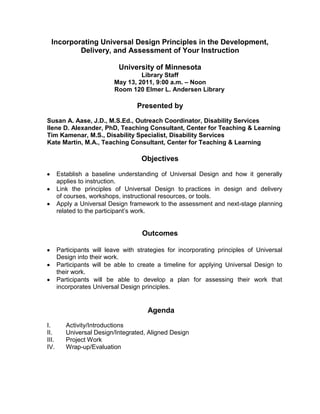
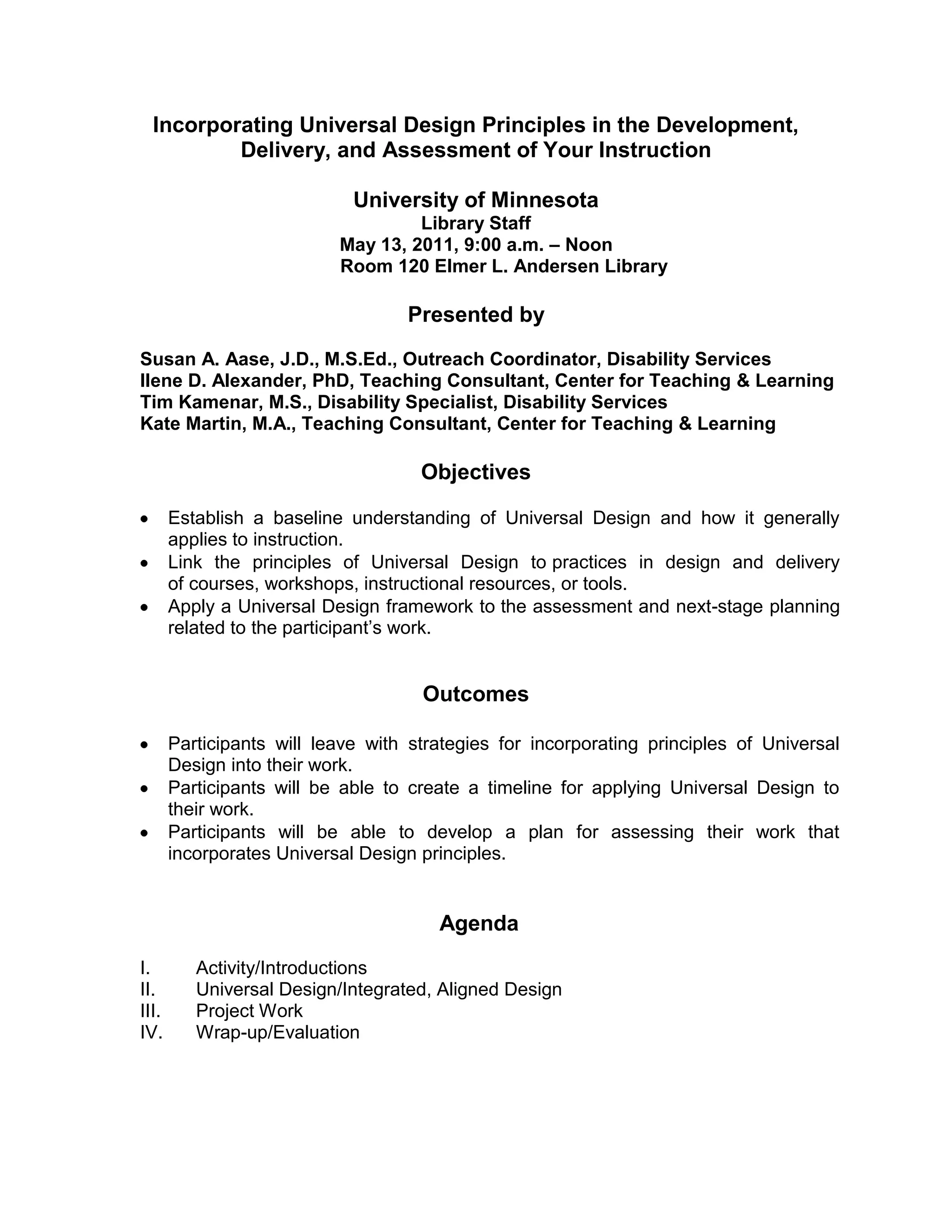

Incorporating Universal Design Principles in the Development, Delivery, and Assessment of Your Instruction<br />University of Minnesota<br />Library Staff<br />May 13, 2011, 9:00 a.m. – Noon<br />Room 120 Elmer L. Andersen Library<br />Presented by <br />Susan A. Aase, J.D., M.S.Ed., Outreach Coordinator, Disability Services<br />Ilene D. Alexander, PhD, Teaching Consultant, Center for Teaching & Learning<br />Tim Kamenar, M.S., Disability Specialist, Disability Services<br />Kate Martin, M.A., Teaching Consultant, Center for Teaching & Learning<br />Objectives<br />Establish a baseline understanding of Universal Design and how it generally applies to instruction.
Link the principles of Universal Design to practices in design and delivery of courses, workshops, instructional resources, or tools.
Apply a Universal Design framework to the assessment and next-stage planning related to the participant’s work. <br />Outcomes<br />Participants will leave with strategies for incorporating principles of Universal Design into their work.
Participants will be able to create a timeline for applying Universal Design to their work.
Participants will be able to develop a plan for assessing their work that incorporates Universal Design principles. Agenda<br />Activity/Introductions
Universal Design/Integrated, Aligned Design
Project Work
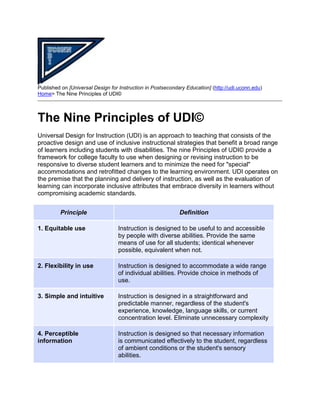
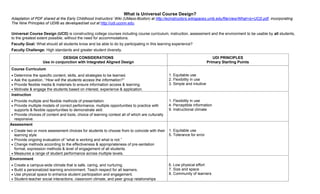
Wrap-up/EvaluationPublished on [Universal Design for Instruction in Postsecondary Education] (http://udi.uconn.edu)<br />Home > The Nine Principles of UDI©<br />The Nine Principles of UDI©<br />Universal Design for Instruction (UDI) is an approach to teaching that consists of the proactive design and use of inclusive instructional strategies that benefit a broad range of learners including students with disabilities. The nine Principles of UDI© provide a framework for college faculty to use when designing or revising instruction to be responsive to diverse student learners and to minimize the need for \"
special\"
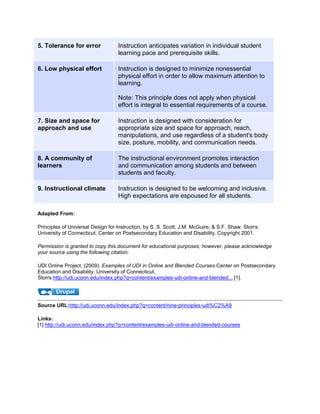
 accommodations and retrofitted changes to the learning environment. UDI operates on the premise that the planning and delivery of instruction, as well as the evaluation of learning can incorporate inclusive attributes that embrace diversity in learners without compromising academic standards.<br />Principle Definition 1. Equitable use Instruction is designed to be useful to and accessible by people with diverse abilities. Provide the same means of use for all students; identical whenever possible, equivalent when not.2. Flexibility in useInstruction is designed to accommodate a wide range of individual abilities. Provide choice in methods of use.3. Simple and intuitiveInstruction is designed in a straightforward and predictable manner, regardless of the student's experience, knowledge, language skills, or current concentration level. Eliminate unnecessary complexity4. Perceptible informationInstruction is designed so that necessary information is communicated effectively to the student, regardless of ambient conditions or the student's sensory abilities.5. Tolerance for errorInstruction anticipates variation in individual student learning pace and prerequisite skills.6. Low physical effort Instruction is designed to minimize nonessential physical effort in order to allow maximum attention to learning.Note: This principle does not apply when physical effort is integral to essential requirements of a course.7. Size and space for approach and useInstruction is designed with consideration for appropriate size and space for approach, reach, manipulations, and use regardless of a student's body size, posture, mobility, and communication needs.8. A community of learnersThe instructional environment promotes interaction and communication among students and between students and faculty.9. Instructional climate Instruction is designed to be welcoming and inclusive. High expectations are espoused for all students.<br />Adapted From:<br />Principles of Universal Design for Instruction, by S. S. Scott, J.M. McGuire, & S.F. Shaw. Storrs: University of Connecticut, Center on Postsecondary Education and Disability. Copyright 2001.<br />Permission is granted to copy this document for educational purposes; however, please acknowledge your source using the following citation:<br />UDI Online Project. (2009). Examples of UDI in Online and Blended Courses. Center on Postsecondary Education and Disability, University of Connecticut, Storrs. http://udi.uconn.edu/index.php?q=content/examples-udi-online-and-blended... [1].<br />Source URL: http://udi.uconn.edu/index.php?q=content/nine-principles-udi%C2%A9<br />Links:[1] http://udi.uconn.edu/index.php?q=content/examples-udi-online-and-blended-courses<br />ACTIVITY: Your Own Project Work<br />I. Getting Started – Do this solo.<br />Using your \"
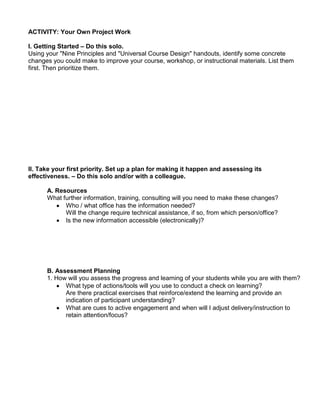
Nine Principles and \"
Universal Course Design\"
 handouts, identify some concrete changes you could make to improve your course, workshop, or instructional materials. List them first. Then prioritize them. <br />II. Take your first priority. Set up a plan for making it happen and assessing its effectiveness. – Do this solo and/or with a colleague.<br />A. Resources<br />What further information, training, consulting will you need to make these changes?<br />Who / what office has the information needed?Will the change require technical assistance, if so, from which person/office?
Is the new information accessible (electronically)?B. Assessment Planning<br />1. How will you assess the progress and learning of your students while you are with them?<br />What type of actions/tools will you use to conduct a check on learning?Are there practical exercises that reinforce/extend the learning and provide an indication of participant understanding?
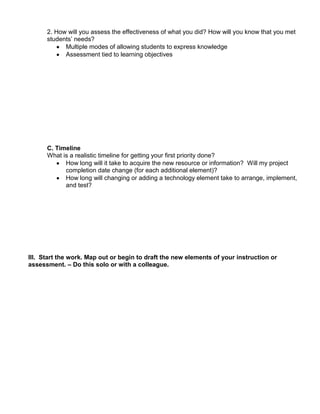
What are cues to active engagement and when will I adjust delivery/instruction to retain attention/focus?2. How will you assess the effectiveness of what you did? How will you know that you met students’ needs?<br />Multiple modes of allowing students to express knowledge

ULibraries Workshop o Design - Handouts

  • 1.
    Incorporating Universal DesignPrinciples in the Development, Delivery, and Assessment of Your Instruction<br />University of Minnesota<br />Library Staff<br />May 13, 2011, 9:00 a.m. – Noon<br />Room 120 Elmer L. Andersen Library<br />Presented by <br />Susan A. Aase, J.D., M.S.Ed., Outreach Coordinator, Disability Services<br />Ilene D. Alexander, PhD, Teaching Consultant, Center for Teaching & Learning<br />Tim Kamenar, M.S., Disability Specialist, Disability Services<br />Kate Martin, M.A., Teaching Consultant, Center for Teaching & Learning<br />Objectives<br />Establish a baseline understanding of Universal Design and how it generally applies to instruction.
  • 2.
    Link the principlesof Universal Design to practices in design and delivery of courses, workshops, instructional resources, or tools.
  • 3.
    Apply a UniversalDesign framework to the assessment and next-stage planning related to the participant’s work. <br />Outcomes<br />Participants will leave with strategies for incorporating principles of Universal Design into their work.
  • 4.
    Participants will beable to create a timeline for applying Universal Design to their work.
  • 5.
    Participants will beable to develop a plan for assessing their work that incorporates Universal Design principles. Agenda<br />Activity/Introductions
  • 6.
  • 7.
  • 8.
    Wrap-up/EvaluationPublished on [UniversalDesign for Instruction in Postsecondary Education] (http://udi.uconn.edu)<br />Home > The Nine Principles of UDI©<br />The Nine Principles of UDI©<br />Universal Design for Instruction (UDI) is an approach to teaching that consists of the proactive design and use of inclusive instructional strategies that benefit a broad range of learners including students with disabilities. The nine Principles of UDI© provide a framework for college faculty to use when designing or revising instruction to be responsive to diverse student learners and to minimize the need for \" special\" accommodations and retrofitted changes to the learning environment. UDI operates on the premise that the planning and delivery of instruction, as well as the evaluation of learning can incorporate inclusive attributes that embrace diversity in learners without compromising academic standards.<br />Principle Definition 1. Equitable use Instruction is designed to be useful to and accessible by people with diverse abilities. Provide the same means of use for all students; identical whenever possible, equivalent when not.2. Flexibility in useInstruction is designed to accommodate a wide range of individual abilities. Provide choice in methods of use.3. Simple and intuitiveInstruction is designed in a straightforward and predictable manner, regardless of the student's experience, knowledge, language skills, or current concentration level. Eliminate unnecessary complexity4. Perceptible informationInstruction is designed so that necessary information is communicated effectively to the student, regardless of ambient conditions or the student's sensory abilities.5. Tolerance for errorInstruction anticipates variation in individual student learning pace and prerequisite skills.6. Low physical effort Instruction is designed to minimize nonessential physical effort in order to allow maximum attention to learning.Note: This principle does not apply when physical effort is integral to essential requirements of a course.7. Size and space for approach and useInstruction is designed with consideration for appropriate size and space for approach, reach, manipulations, and use regardless of a student's body size, posture, mobility, and communication needs.8. A community of learnersThe instructional environment promotes interaction and communication among students and between students and faculty.9. Instructional climate Instruction is designed to be welcoming and inclusive. High expectations are espoused for all students.<br />Adapted From:<br />Principles of Universal Design for Instruction, by S. S. Scott, J.M. McGuire, & S.F. Shaw. Storrs: University of Connecticut, Center on Postsecondary Education and Disability. Copyright 2001.<br />Permission is granted to copy this document for educational purposes; however, please acknowledge your source using the following citation:<br />UDI Online Project. (2009). Examples of UDI in Online and Blended Courses. Center on Postsecondary Education and Disability, University of Connecticut, Storrs. http://udi.uconn.edu/index.php?q=content/examples-udi-online-and-blended... [1].<br />Source URL: http://udi.uconn.edu/index.php?q=content/nine-principles-udi%C2%A9<br />Links:[1] http://udi.uconn.edu/index.php?q=content/examples-udi-online-and-blended-courses<br />ACTIVITY: Your Own Project Work<br />I. Getting Started – Do this solo.<br />Using your \" Nine Principles and \" Universal Course Design\" handouts, identify some concrete changes you could make to improve your course, workshop, or instructional materials. List them first. Then prioritize them. <br />II. Take your first priority. Set up a plan for making it happen and assessing its effectiveness. – Do this solo and/or with a colleague.<br />A. Resources<br />What further information, training, consulting will you need to make these changes?<br />Who / what office has the information needed?Will the change require technical assistance, if so, from which person/office?
  • 9.
    Is the newinformation accessible (electronically)?B. Assessment Planning<br />1. How will you assess the progress and learning of your students while you are with them?<br />What type of actions/tools will you use to conduct a check on learning?Are there practical exercises that reinforce/extend the learning and provide an indication of participant understanding?
  • 10.
    What are cuesto active engagement and when will I adjust delivery/instruction to retain attention/focus?2. How will you assess the effectiveness of what you did? How will you know that you met students’ needs?<br />Multiple modes of allowing students to express knowledge