Jess
Mitchell
INCLUSIVE DESIGN THINKING
A GATEWAY TO INNOVATION
Jess
Mitchell
INCLUSIVE DESIGN THINKING
A PATH TO INNOVATION
Inclusive design helps with ๏ฌnding the path toward innovation. It isnโ€™t a silver bullet, but when youโ€™re asking yourself where to even begin โ€” how to change what youโ€™re
doing now, how to diversify what youโ€™re doing now, how to evolve and ๏ฌnd new markets โ€”- inclusion and diversity are the places to look.

Forbes is talking about โ€œfostering innovation through a diverse workforceโ€

HBR is talking about โ€œhow diversity can drive innovationโ€

Facebook, Google, Apple โ€” all have hiring practices that aim to create diverse teams

WHY? When youโ€™re looking for โ€œout of the boxโ€ thinking โ€” YOU CANโ€™T CREATE A BOX OR A MONOCULTURE

So weโ€™ve all heard these words: innovation, inclusion, disruption โ€” weโ€™re all trying to ๏ฌnd a way to di๏ฌ€erentiate ourselves, our companies, our productsโ€ฆ HOW DO WE
DO IT?

My goal is for you to experience a perspective shift that helps you see ways you can innovate, ways you can create conditions for others that enable innovation, and
ways that you can understand how inclusion and innovation are linked.

To get at what it means to ๏ฌnd the path toward innovation through inclusion weโ€™re going to start by talking about some features of innovation and fold that into learning
about inclusive design.

Then weโ€™re going to apply those concepts to speci๏ฌc problems in an activity that weโ€™ll be doing in groups.
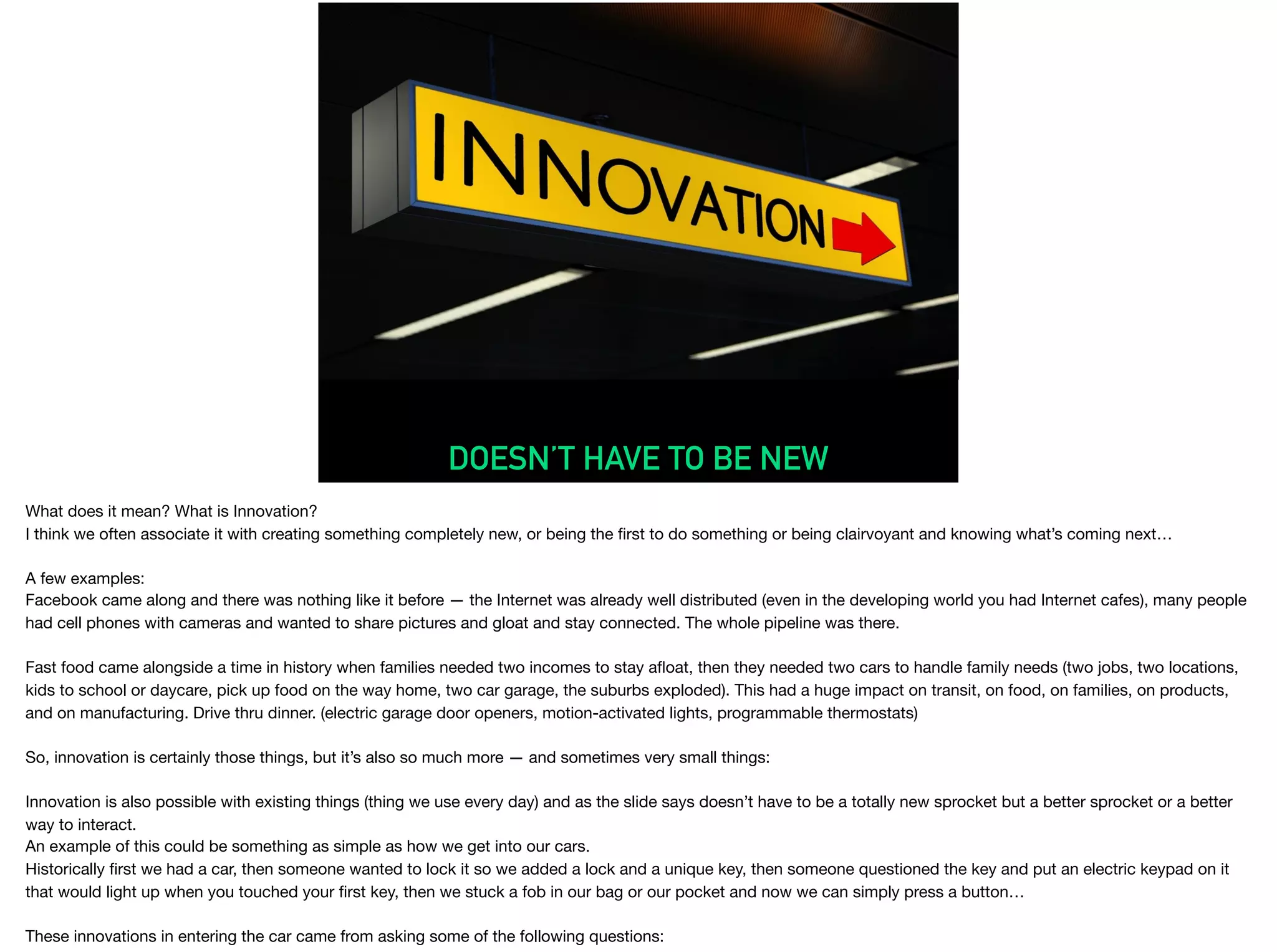
DOESNโ€™T HAVE TO BE NEW
What does it mean? What is Innovation?

I think we often associate it with creating something completely new, or being the ๏ฌrst to do something or being clairvoyant and knowing whatโ€™s coming nextโ€ฆ 

A few examples:

Facebook came along and there was nothing like it before โ€” the Internet was already well distributed (even in the developing world you had Internet cafes), many people
had cell phones with cameras and wanted to share pictures and gloat and stay connected. The whole pipeline was there.


Fast food came alongside a time in history when families needed two incomes to stay a๏ฌ‚oat, then they needed two cars to handle family needs (two jobs, two locations,
kids to school or daycare, pick up food on the way home, two car garage, the suburbs exploded). This had a huge impact on transit, on food, on families, on products,
and on manufacturing. Drive thru dinner. (electric garage door openers, motion-activated lights, programmable thermostats)

So, innovation is certainly those things, but itโ€™s also so much more โ€” and sometimes very small things:

Innovation is also possible with existing things (thing we use every day) and as the slide says doesnโ€™t have to be a totally new sprocket but a better sprocket or a better
way to interact.

An example of this could be something as simple as how we get into our cars.

Historically ๏ฌrst we had a car, then someone wanted to lock it so we added a lock and a unique key, then someone questioned the key and put an electric keypad on it
that would light up when you touched your ๏ฌrst key, then we stuck a fob in our bag or our pocket and now we can simply press a buttonโ€ฆ

These innovations in entering the car came from asking some of the following questions:
MAGIC
We all want the 10 step process to do this.

We want to make it reproducible, concrete steps that will yield predictable results.

We want the science of innovation.

All of our organizations want to be innovative.

But if it were a science then all of us would be doing it, not trying to do it. So what really is innovation?

Letโ€™s break it down a bitโ€ฆ

What are some of the parts of innovation we value?

- the ah-ha moments 

- the solving puzzles/problems/gaps 

- the delight 

- the meeting unmet needs

- the discovering new markets

- the convenience 

- ๏ฌ‚uidity and thoughtfulness (I wish Iโ€™d thought of that!)

- itโ€™s unobtrusive โ€” it just works

- the magic

There are some things we know about this magic โ€” it happens more easily in certain contextsโ€ฆ
FORM & FUNCTION
There seem to be conditions where nurturing innovation is easier, more natural, or more frequent.

How many of you have been stuck on a problem, gotten up to take a walk and then had some clarity for next steps?

Relaxed attention, taking a walk, plans on the back of napkins, waking in the middle of the night with a great idea, the shower.

These are all places where you can loosen your mind: experiment, fail, be creative, think outside the box.

Is that done at a conference table with 20 chairs, a meeting leader, and a notetaker? Could beโ€ฆ but maybe not. Just as we see diversity positively e๏ฌ€ecting our teams
and businesses, diversity of meeting places also helps. It helps to spend the day at OCAD University talking about something di๏ฌ€erent in a di๏ฌ€erent space. Form and
Function are related!

So, letโ€™s all go ๏ฌshing and weโ€™ll have brilliant ideas. No, not necessarilyโ€ฆ

We see this phenomenon when we try to concentrate or pay really close attention to something โ€” 

Some people do better with lots of distractions, some with no distractions at all. Doodlers are often people who have to occupy part of their brain to pay close attention
โ€” so they doodle. 

Some of us cannot multi-task โ€” we can only pay attention to one thing at a time. Weโ€™re all di๏ฌ€erent and weโ€™re di๏ฌ€erent from day to day.

Man ๏ฌ‚y-๏ฌshing in a river

https://upload.wikimedia.org/wikipedia/commons/e/ee/Men_๏ฌ‚y_๏ฌshing.jpg
WE
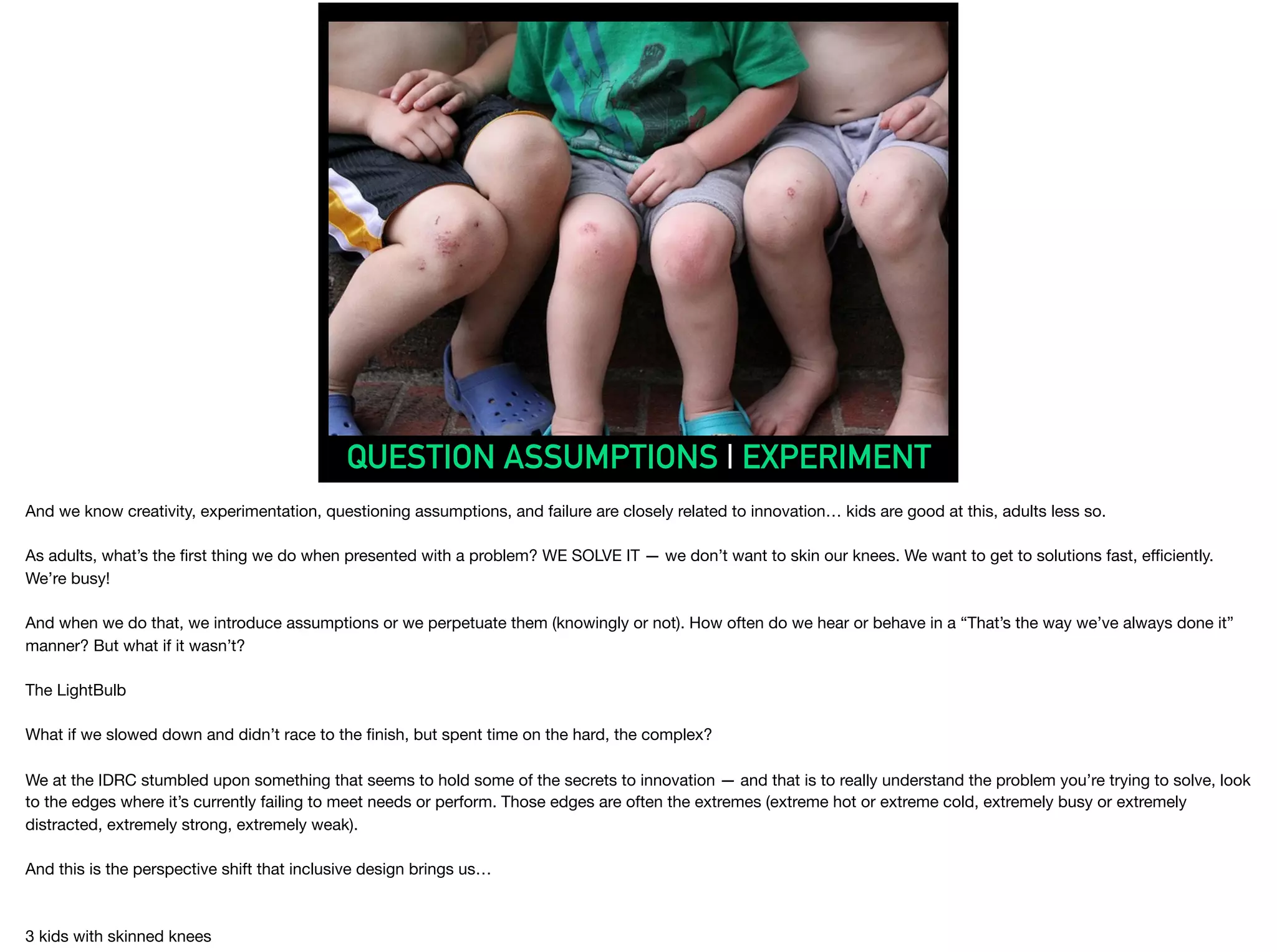
QUESTION ASSUMPTIONS | EXPERIMENT
And we know creativity, experimentation, questioning assumptions, and failure are closely related to innovationโ€ฆ kids are good at this, adults less so.

As adults, whatโ€™s the ๏ฌrst thing we do when presented with a problem? WE SOLVE IT โ€” we donโ€™t want to skin our knees. We want to get to solutions fast, e๏ฌƒciently.
Weโ€™re busy!

And when we do that, we introduce assumptions or we perpetuate them (knowingly or not). How often do we hear or behave in a โ€œThatโ€™s the way weโ€™ve always done itโ€
manner? But what if it wasnโ€™t?

The LightBulb

What if we slowed down and didnโ€™t race to the ๏ฌnish, but spent time on the hard, the complex?

We at the IDRC stumbled upon something that seems to hold some of the secrets to innovation โ€” and that is to really understand the problem youโ€™re trying to solve, look
to the edges where itโ€™s currently failing to meet needs or perform. Those edges are often the extremes (extreme hot or extreme cold, extremely busy or extremely
distracted, extremely strong, extremely weak). 

And this is the perspective shift that inclusive design brings usโ€ฆ

3 kids with skinned knees
PERSPECTIVE SHIFT
And this is the perspective shift that inclusive design brings usโ€ฆ

- instead of thinking of solving for the majority, what happens if we solve for the 20%?

- instead of thinking of average people, what happens if we design for real people with real problems?

- to change the door, the key, the lightbulb we have to ask ourselves some fundamental questions:

- what problem am I trying to solve?

- what am i trying to accomplish?

- for whom?

- who did I leave out? what other assumptions were there?

So, no, this doesnโ€™t come for free โ€” it requires you to change your perspective and your practicesโ€ฆ And weโ€™re going to talk about that for a bit now, and then weโ€™re
going to do it.

Building looking up, turned sideways

https://www.๏ฌ‚ickr.com/photos/wvs/280384849/
I am listening
I am curious
But I donโ€™t get it!
I DONโ€™T UNDERSTAND
WHAT IS
INCLUSIVE DESIGN
Inclusive Design is design that considers the full range of human diversity with respect to ability, language, culture, gender, age and other forms of human di๏ฌ€erence.

Stacked, colourful cups 

https://www.๏ฌ‚ickr.com/photos/doug88888/2987668742/in/photolist-5y1zQ3-9iioxp-4hGtdR-e86mXv-7S3xLA-oGJ71U-2GKVgd-cqo7RQ-LgBMB-LB3EG-5SZRyN-
LBbgF-9GAD7c-6tYNTm-4Ev2tX-4QjDbk-8Vd1QL-gnpzqR-6ZKrmp-rsfoP-teU2X-9q5WPk-9q8YjY-7BF8ob-LBbgP-7EQk6t-dx7TCA-e8bXp5
1. recognize diversity and uniqueness
in people and places
2. personalize
wherever possible, let me be me
3. ask yourself: were you brilliant or did you just
exclude someone?
beware of introducing new assumptions
INCLUSIVE DESIGN
1. everyone is di๏ฌ€erent; all of our homes, families, cars, o๏ฌƒces, โ€” everything is di๏ฌ€erent. Today is di๏ฌ€erent from yesterday. the alternative to this is one-size-๏ฌts-all
which we know never really does. Thatโ€™s us compromising our own individual needs or preferences for something basic.

2. let me be me โ€” iโ€™m the best at it. Empower me to make decisions and I will!

3. beware the brilliant design decision โ€” ask questions to avoid introducing new assumptions
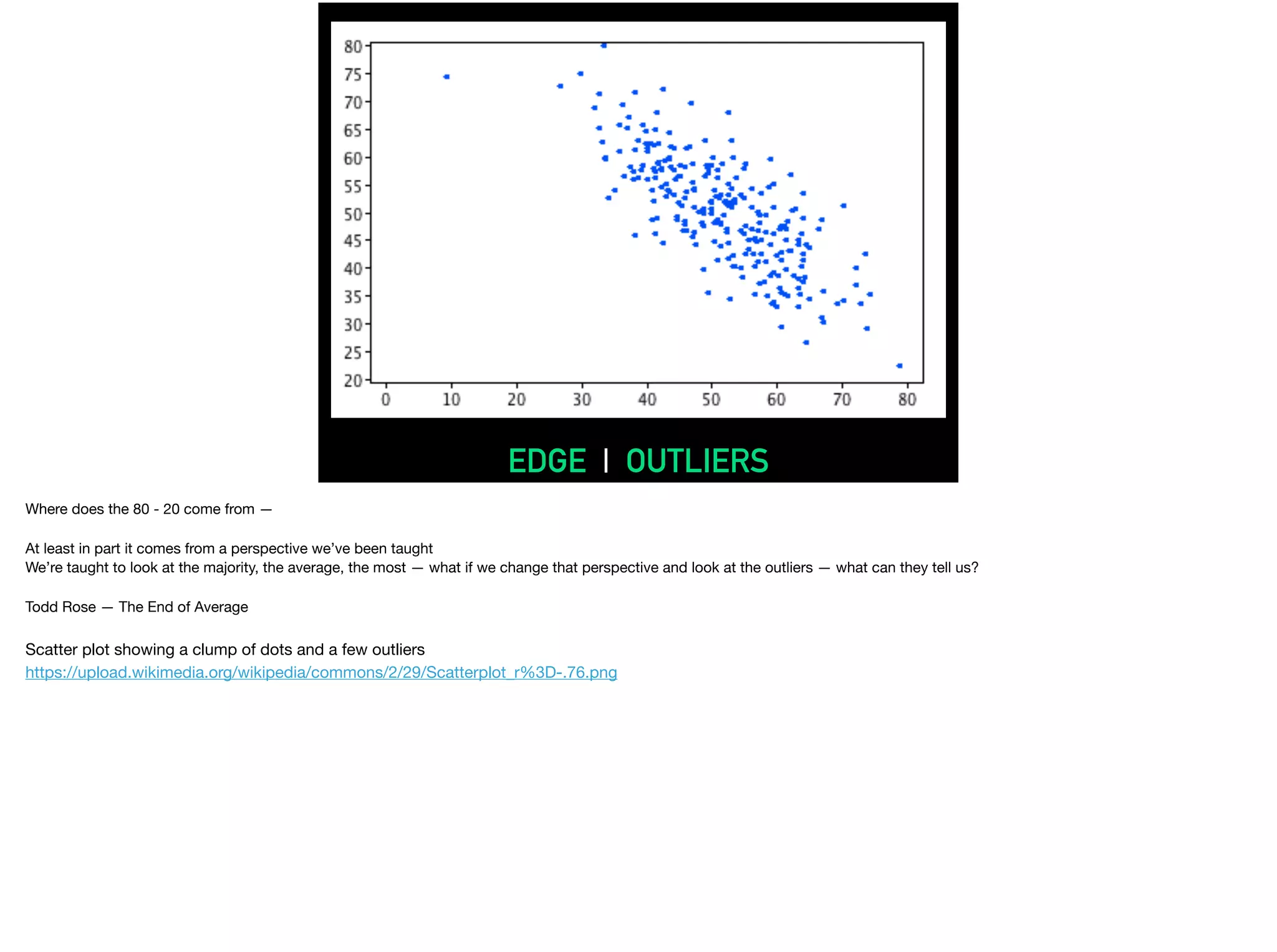
EDGE | OUTLIERS
Where does the 80 - 20 come from โ€” 

At least in part it comes from a perspective weโ€™ve been taught

Weโ€™re taught to look at the majority, the average, the most โ€” what if we change that perspective and look at the outliers โ€” what can they tell us?

Todd Rose โ€” The End of Average

Scatter plot showing a clump of dots and a few outliers

https://upload.wikimedia.org/wikipedia/commons/2/29/Scatterplot_r%3D-.76.png
THE MAGIC AT
THE MARGINS
โ€ข innovation
โ€ข benefits the majority
โ€ข supports the spectrum
โ€ข resiliency
EDGE | OUTLIERS
Instead of fearing the edges or trying to forget them we should be focusing on them.
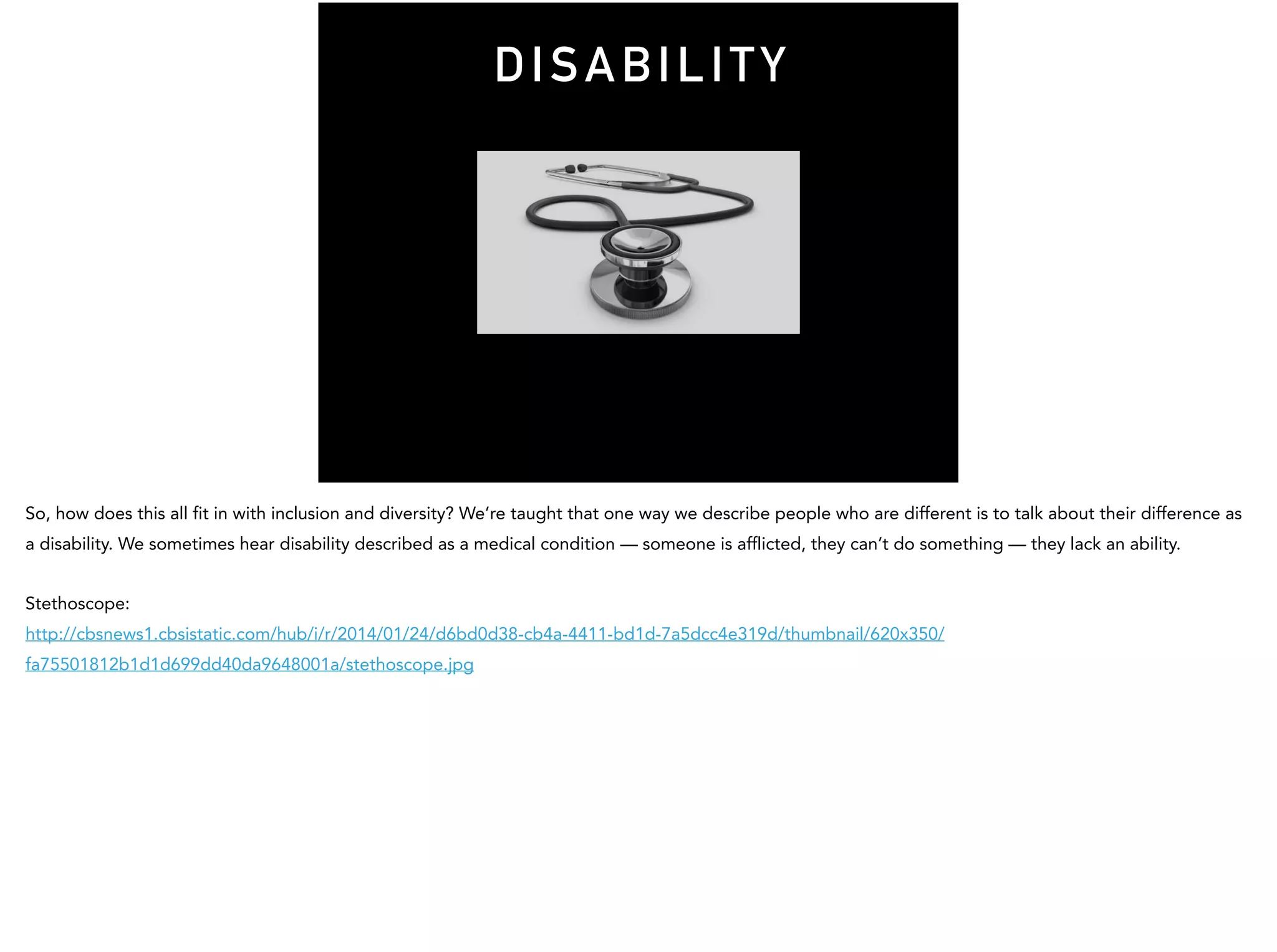
DISABILITY
So, how does this all fit in with inclusion and diversity? Weโ€™re taught that one way we describe people who are different is to talk about their difference as
a disability. We sometimes hear disability described as a medical condition โ€” someone is afflicted, they canโ€™t do something โ€” they lack an ability.
Stethoscope:
http://cbsnews1.cbsistatic.com/hub/i/r/2014/01/24/d6bd0d38-cb4a-4411-bd1d-7a5dcc4e319d/thumbnail/620x350/
fa75501812b1d1d699dd40da9648001a/stethoscope.jpg
DISABILITY
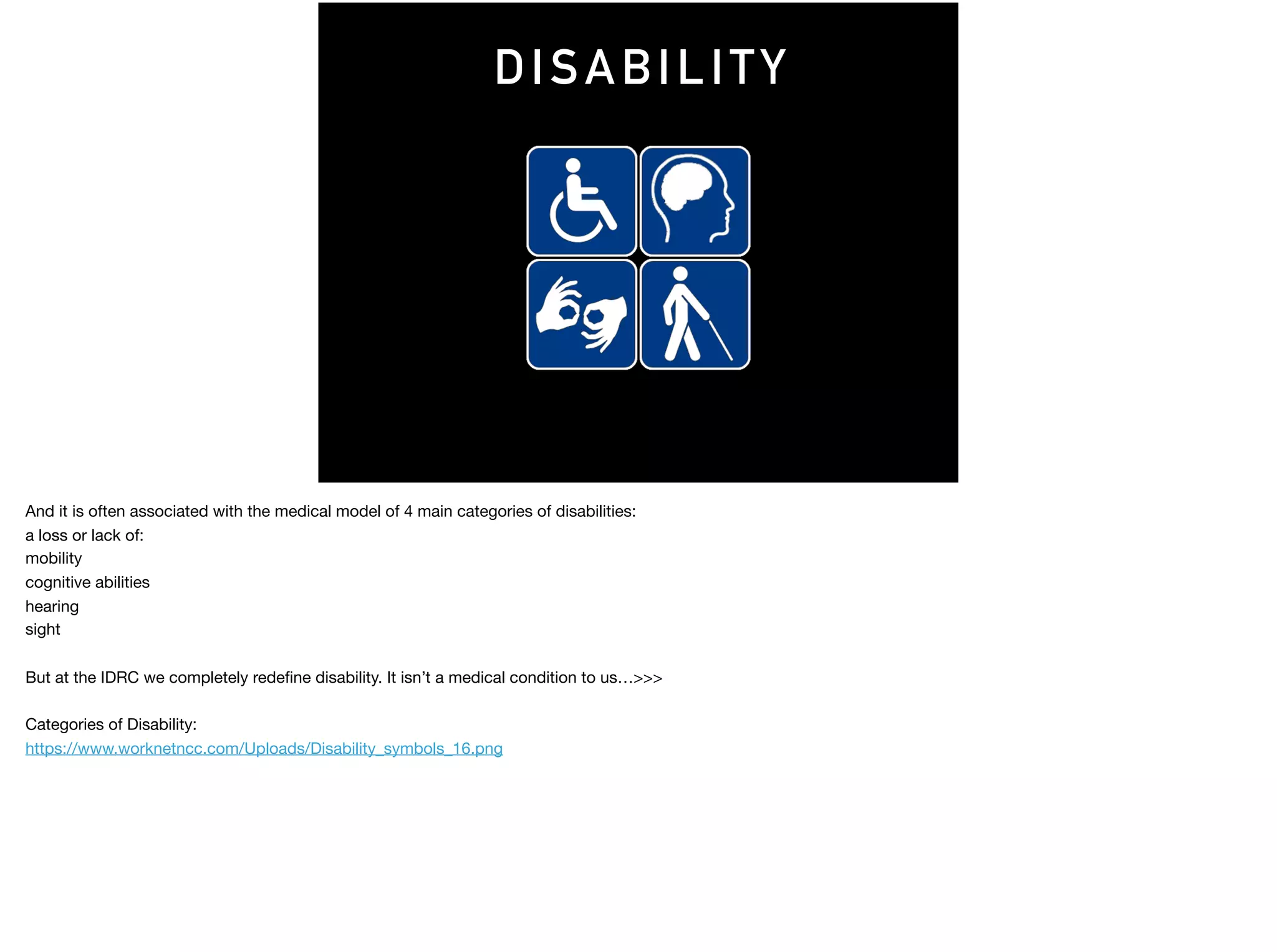
And it is often associated with the medical model of 4 main categories of disabilities:

a loss or lack of:

mobility

cognitive abilities

hearing

sight

But at the IDRC we completely rede๏ฌne disability. It isnโ€™t a medical condition to usโ€ฆ>>>

Categories of Disability: 

https://www.worknetncc.com/Uploads/Disability_symbols_16.png
MISMATCH
EDGE | OUTLIERS
Disability is a mismatch between the needs of the individual, their goals, and the service or experience o๏ฌ€ered

Disability is not a personal trait and because itโ€™s so context dependent, it is a relative condition not permanent.

Accessibility = the ability of the service or system to match the needs of the individual

Square peg, round hole: 

http://wp.production.patheos.com/blogs/adrianwarnock/๏ฌles/2015/08/3546059144_1b33dfdc0e_o.jpg
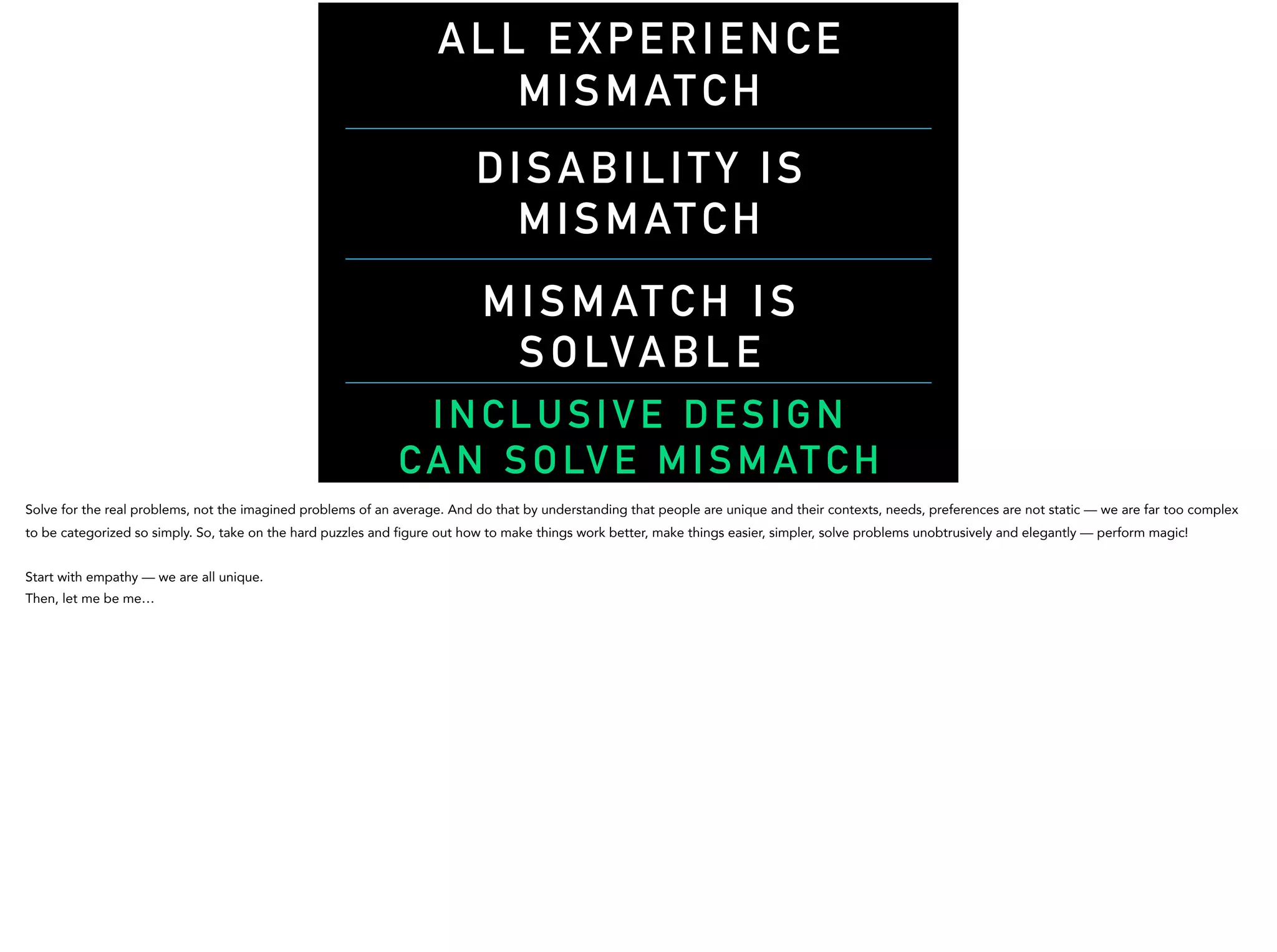
DISABILITY IS
MISMATCH
MISMATCH IS
SOLVABL E
INCLUSIVE DESIGN
C A N SO LV E M I SM AT C H
ALL EXPERIENCE
MISMATCH
Solve for the real problems, not the imagined problems of an average. And do that by understanding that people are unique and their contexts, needs, preferences are not static โ€” we are far too complex
to be categorized so simply. So, take on the hard puzzles and figure out how to make things work better, make things easier, simpler, solve problems unobtrusively and elegantly โ€” perform magic!
Start with empathy โ€” we are all unique.
Then, let me be meโ€ฆ
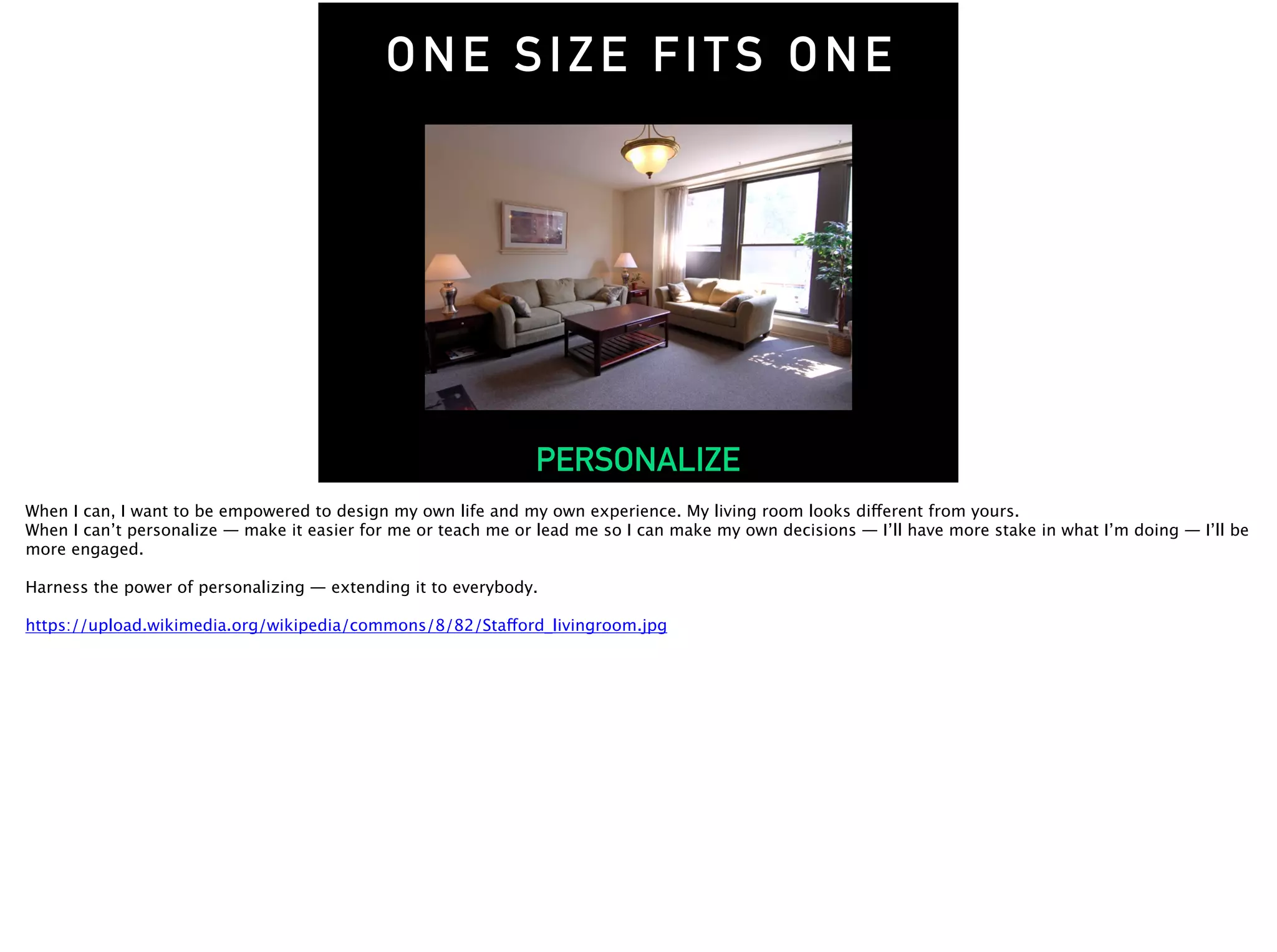
ONE SIZE FITS ONE
PERSONALIZE
When I can, I want to be empowered to design my own life and my own experience. My living room looks different from yours.
When I canโ€™t personalize โ€” make it easier for me or teach me or lead me so I can make my own decisions โ€” Iโ€™ll have more stake in what Iโ€™m doing โ€” Iโ€™ll be
more engaged.
Harness the power of personalizing โ€” extending it to everybody.
https://upload.wikimedia.org/wikipedia/commons/8/82/Stafford_livingroom.jpg
WHY PERSONALIZE
INTERFACES?
http:/insideupmc.blogspot.ca
http://dc.about.com/od
http://www.thejournal.ie
http://inhabitat.com/
http://www-ยญโ€03.ibm.com
PERSONALIZE
We live in an increasingly digital world.

WHO, WHAT, WHERE
โ€ข With this brilliant design idea
who just got excluded?
โ€ข Is there a way I can bridge
the gap I just created? A way
I can solve for the mismatch
or avoid it?
D E S I G N I D E A S :
BRILLIANT OR EXCLUSIONARY
So when we build products and services and tools we should be asking all along who isnโ€™t here? And who got excluded?

One way we do this in the digital world is to 

make it multi-modal

	 - text

	 - audio

	 - video

	 - image

avoid hard to read fonts or font sizes

create an appropriate level of contrast

simulations and visualization provide interesting challenges
make targets easy to hit

can you use it with the keyboard?

be wary of time-based operations

keep content structured โ€” semantic content

But if we just wrap ourselves in WCAG and AODA, we are still missing the point: people are unique, there are gaps in meeting their needs, innovation is in the gaps.
What is accessibility?
EDGE | OUTLIERS | | PERSONALIZE | | BRILLIANT OR EXCLUSIONARY?
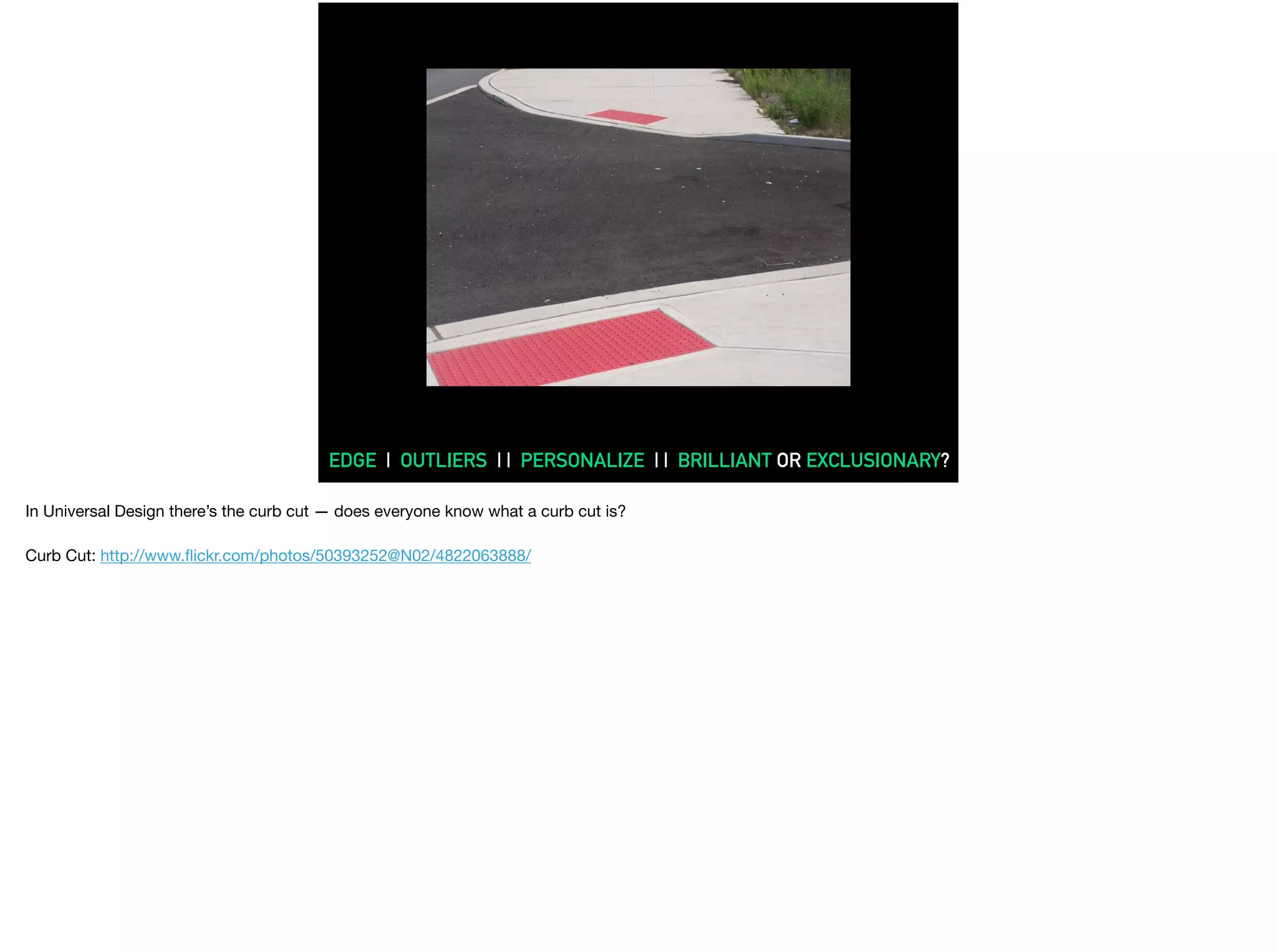
In Universal Design thereโ€™s the curb cut โ€” does everyone know what a curb cut is?

Curb Cut: http://www.๏ฌ‚ickr.com/photos/50393252@N02/4822063888/
What is accessibility?
EDGE | OUTLIERS | | PERSONALIZE | | BRILLIANT OR EXCLUSIONARY?
We have examples in the digital world too:

top 3 uses:

1. in a bar

2. in a gym

3. in bed with a sleeping spouse

CC: https://en.wikipedia.org/wiki/Closed_captioning#/media/File:Closed_captioning_symbol.svg
WHAT WE SHOULD
BE AIMING FOR
EDGE | OUTLIERS | | PERSONALIZE | | BRILLIANT OR EXCLUSIONARY?
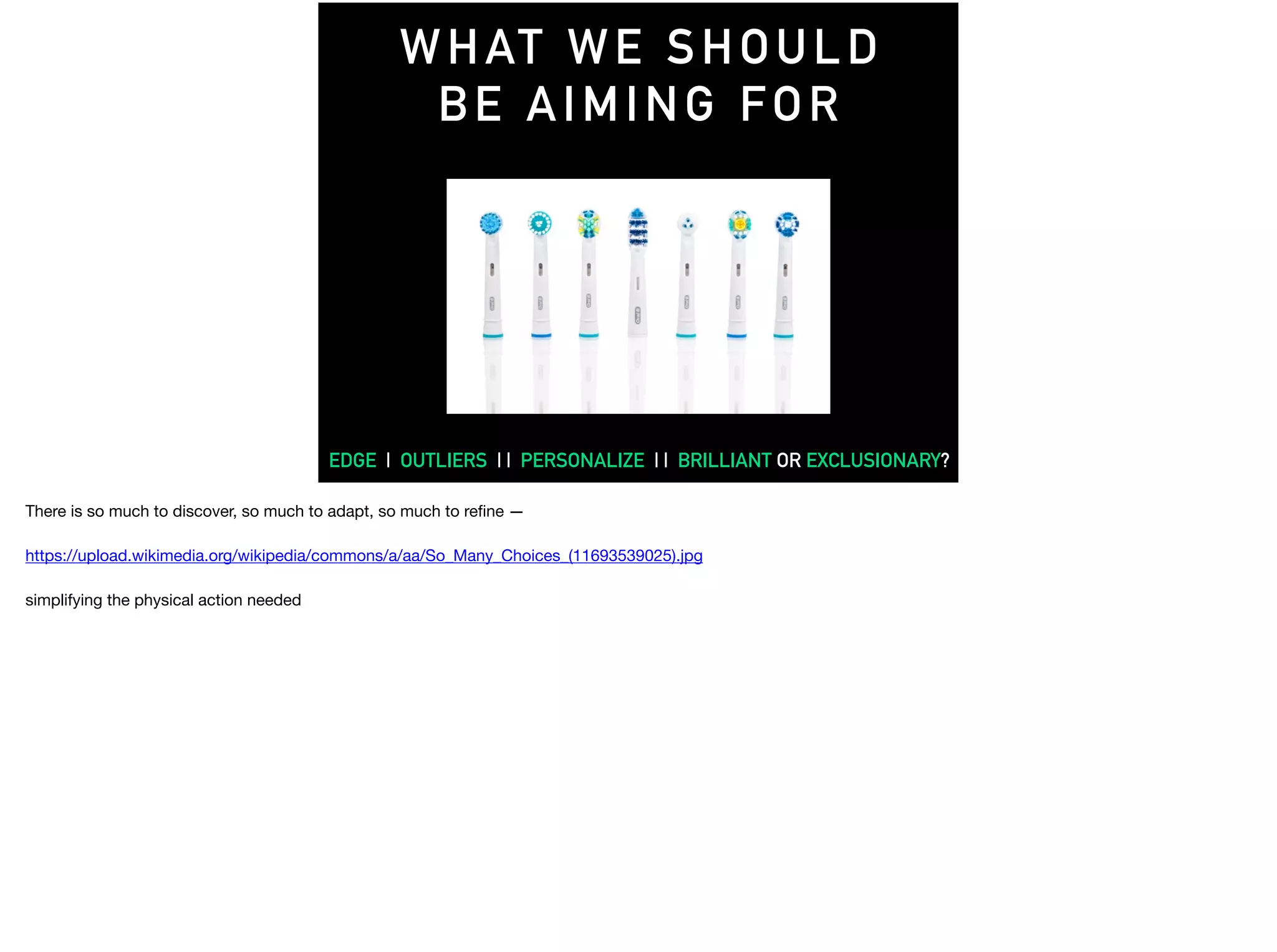
There is so much to discover, so much to adapt, so much to re๏ฌne โ€”

https://upload.wikimedia.org/wikipedia/commons/a/aa/So_Many_Choices_(11693539025).jpg

simplifying the physical action needed
OXO
EDGE | OUTLIERS | | PERSONALIZE | | BRILLIANT OR EXCLUSIONARY?
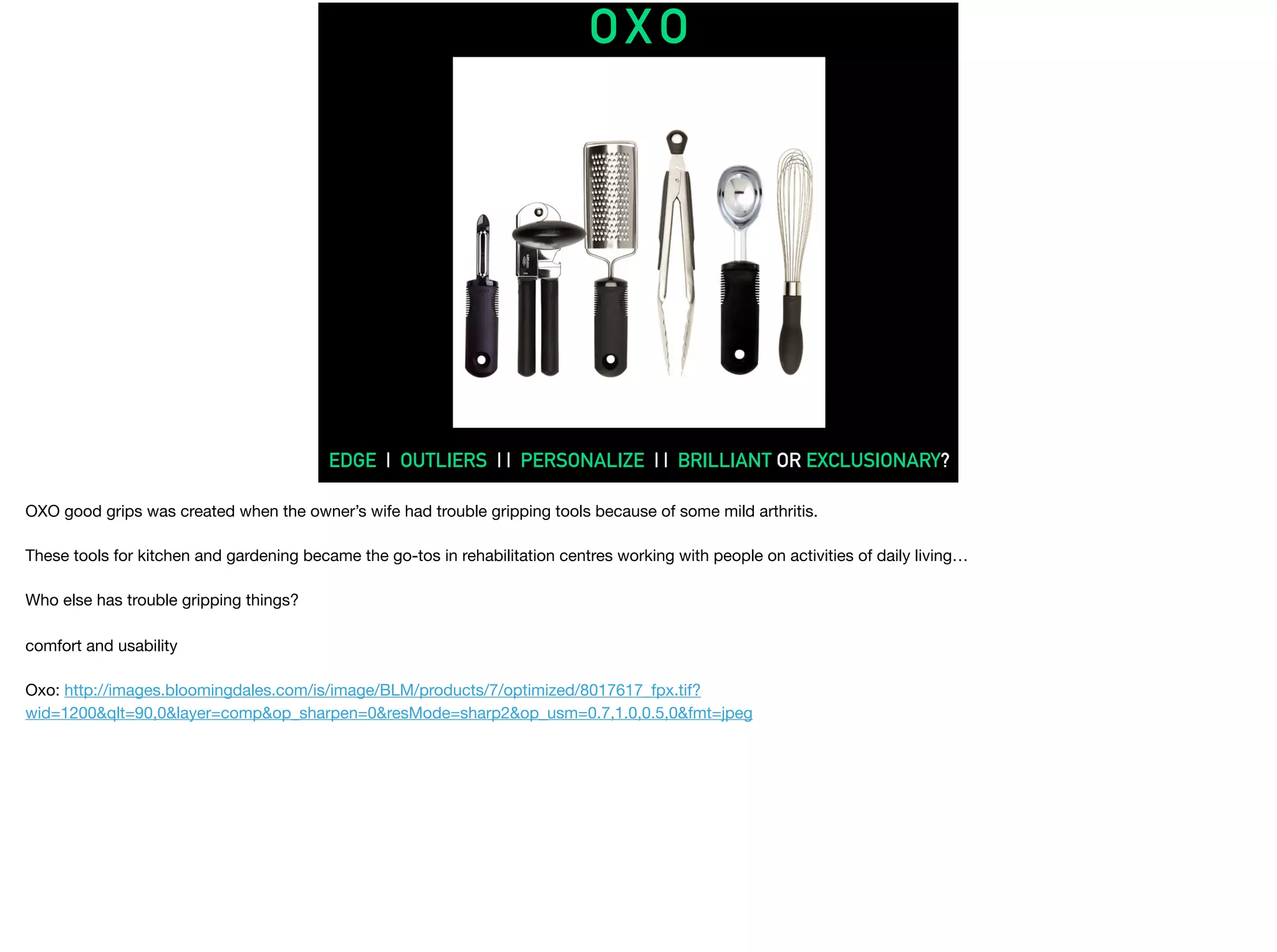
OXO good grips was created when the ownerโ€™s wife had trouble gripping tools because of some mild arthritis.

These tools for kitchen and gardening became the go-tos in rehabilitation centres working with people on activities of daily livingโ€ฆ

Who else has trouble gripping things?

comfort and usability

Oxo: http://images.bloomingdales.com/is/image/BLM/products/7/optimized/8017617_fpx.tif?
wid=1200&qlt=90,0&layer=comp&op_sharpen=0&resMode=sharp2&op_usm=0.7,1.0,0.5,0&fmt=jpeg
OXO
OXO
EDGE | OUTLIERS | | PERSONALIZE | | BRILLIANT OR EXCLUSIONARY?
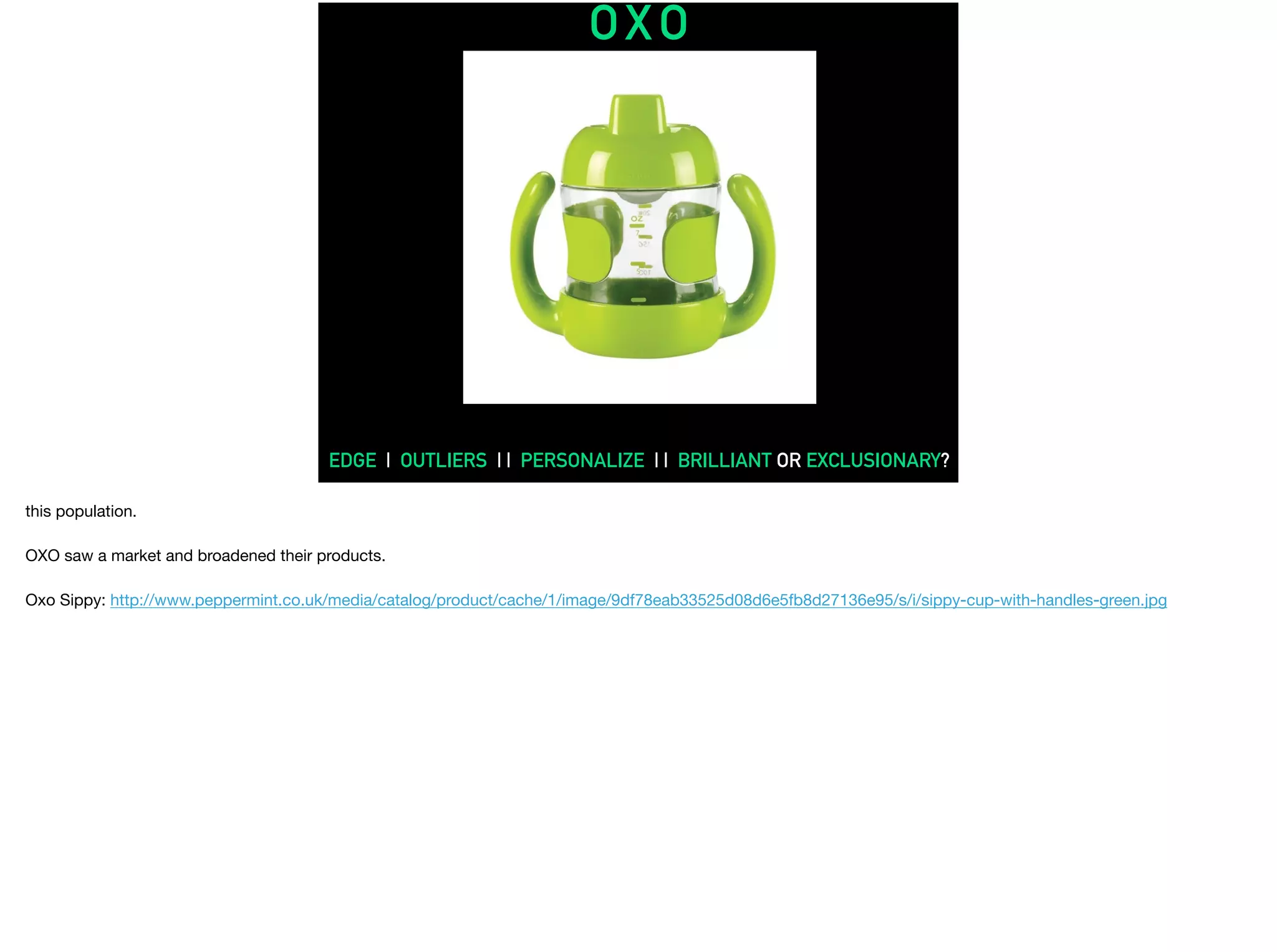
this population. 

OXO saw a market and broadened their products.

Oxo Sippy: http://www.peppermint.co.uk/media/catalog/product/cache/1/image/9df78eab33525d08d6e5fb8d27136e95/s/i/sippy-cup-with-handles-green.jpg
OXO
EDGE | OUTLIERS | | PERSONALIZE | | BRILLIANT OR EXCLUSIONARY?
Jar Pop

https://cdn.shopify.com/s/๏ฌles/1/0840/1971/products/img_7115_17efbe60-0f8d-4b4c-a6cf-f40564a1bbcb_1024x1024.jpeg?v=1464889393
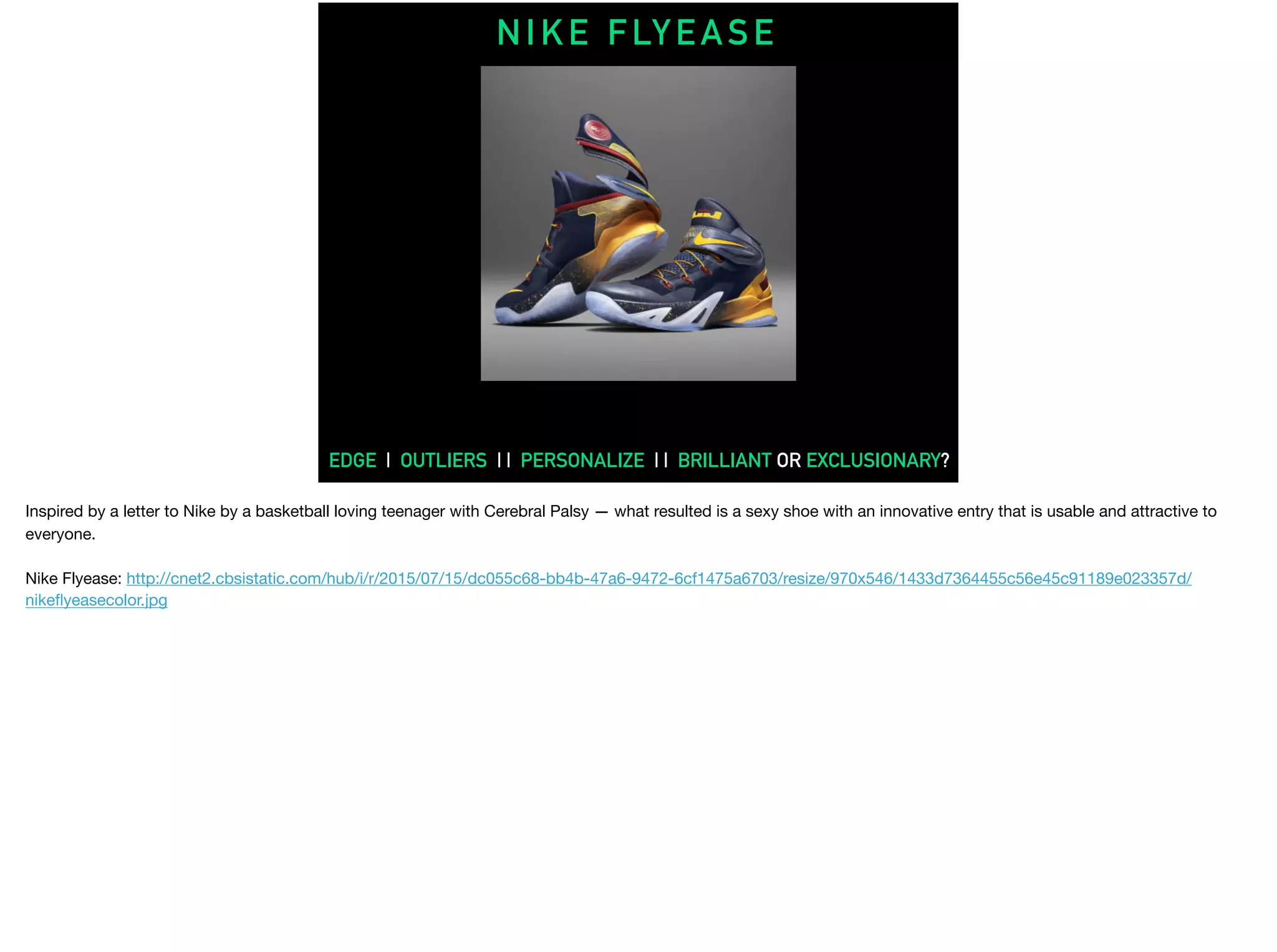
N I K E F LY E A S E
EDGE | OUTLIERS | | PERSONALIZE | | BRILLIANT OR EXCLUSIONARY?
Inspired by a letter to Nike by a basketball loving teenager with Cerebral Palsy โ€” what resulted is a sexy shoe with an innovative entry that is usable and attractive to
everyone.

Nike Flyease: http://cnet2.cbsistatic.com/hub/i/r/2015/07/15/dc055c68-bb4b-47a6-9472-6cf1475a6703/resize/970x546/1433d7364455c56e45c91189e023357d/
nike๏ฌ‚yeasecolor.jpg
TRA MPOLINE
EDGE | OUTLIERS | | PERSONALIZE | | BRILLIANT OR EXCLUSIONARY?
BLOORVIEW rehab hospital has one of these and whatโ€™s so cool about it is that you have kids in their integrated school program playing together without barriers and
kids in wheelchairs who have never had the sensation of jumping can feel what it feels like to jump.

Trampoline: https://s-media-cache-ak0.pinimg.com/736x/8b/21/67/8b2167d7e787e6ca66e6087f694c9ec2.jpg

Stop Gap: http://1.bp.blogspot.com/-cQiJTeXAgGM/UIM1OJYztYI/AAAAAAAAAHw/rIsUt6YhWt0/s1600/DSC04762.JPG
STOPGAP
EDGE | OUTLIERS | | PERSONALIZE | | BRILLIANT OR EXCLUSIONARY?
Stopgap created these little wedges to help folks in wheelchairs get into businesses in the GTA. Folks with strollers also use them โ€” no one is inconvenienced by them
and they help.

Luke Anderson an avid mountain biker had an accident and became paralyzed. He started stopgap.

Stop Gap wooden wedge leading into a business with one step in front: https://www.davidberman.com/wp-content/uploads/Two-stopgap-ramps-outside-a-store-
front.jpeg
ADAPT TO ME
EDGE | OUTLIERS | | PERSONALIZE | | BRILLIANT OR EXCLUSIONARY?
- Nikeโ€™s brand new power lacing shoe โ€” HyperAdapt 1.0

-autolace from Back to the Future 

-Michael J. Fox tried prototype out

-He has parkinsons โ€” a population of people who would bene๏ฌt from this

-In Back to the Future he was a adventurous kid who also bene๏ฌted from this

-Michael J. Fox said when he tried this out โ€œI wish I had this on my hockey skatesโ€

-Your context changes, the environment changes, your feet swell, need them tighten during the game

-Some people canโ€™t tie their shoes

Electro Adaptive Reactive Lacing: E.A.R.L.

https://www.wired.com/2016/09/nike-self-lacing-design-hyperadapt/#slide-1
OXO
HERE ONE
EDGE | OUTLIERS | | PERSONALIZE | | BRILLIANT OR EXCLUSIONARY?
Here One

With two smart earbuds and a connected app, you can stream music, take phone calls, reduce unwanted noise, amplify speech, access Siri and Google Now, and
more. Selectively choose what you want to hear and remove what you donโ€™t using Smart Noise Cancellation.

https://hereplus.me
OXO
EDGE | OUTLIERS | | PERSONALIZE | | BRILLIANT OR EXCLUSIONARY?
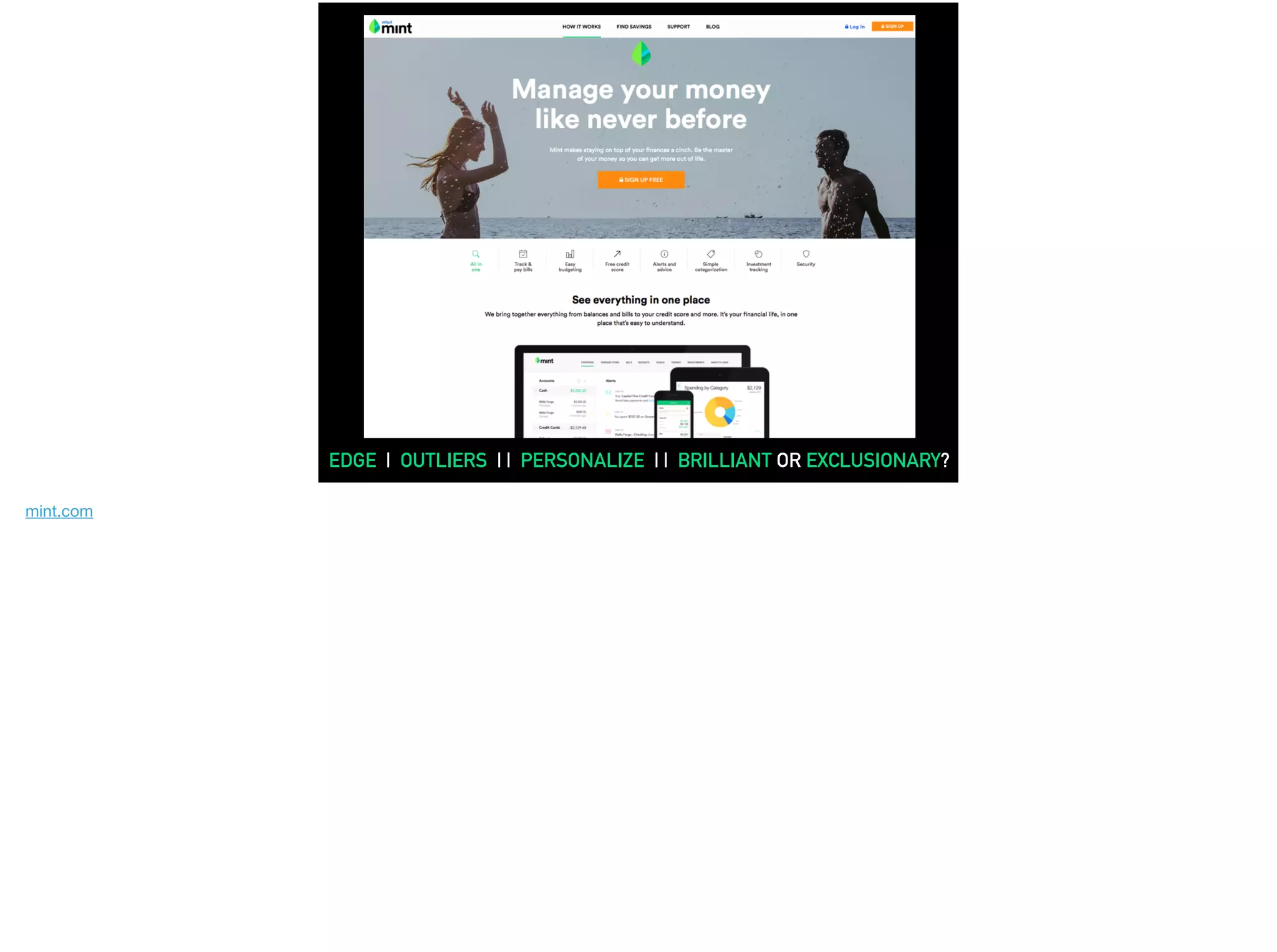
mint.com
OXO
EDGE | OUTLIERS | | PERSONALIZE | | BRILLIANT OR EXCLUSIONARY?
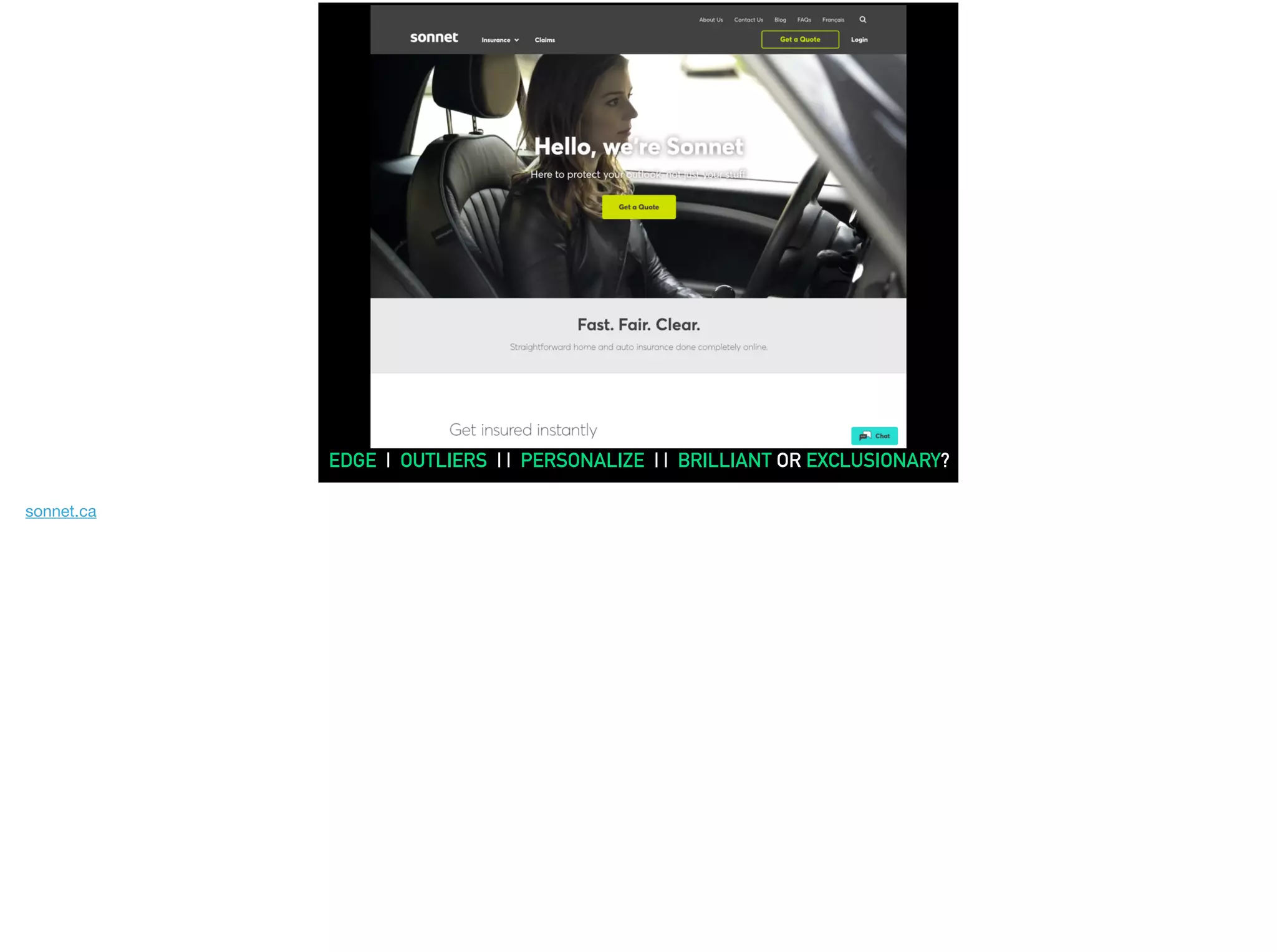
sonnet.ca
OXO
EDGE | OUTLIERS | | PERSONALIZE | | BRILLIANT OR EXCLUSIONARY?
wealthsimple.ca
DOESNโ€™T HAVE TO BE NEW
MAGIC
QUESTION ASSUMPTIONS | EXPERIMENT
FORM & FUNCTION
INNOVATION
PERSPECTIVE SHIFT
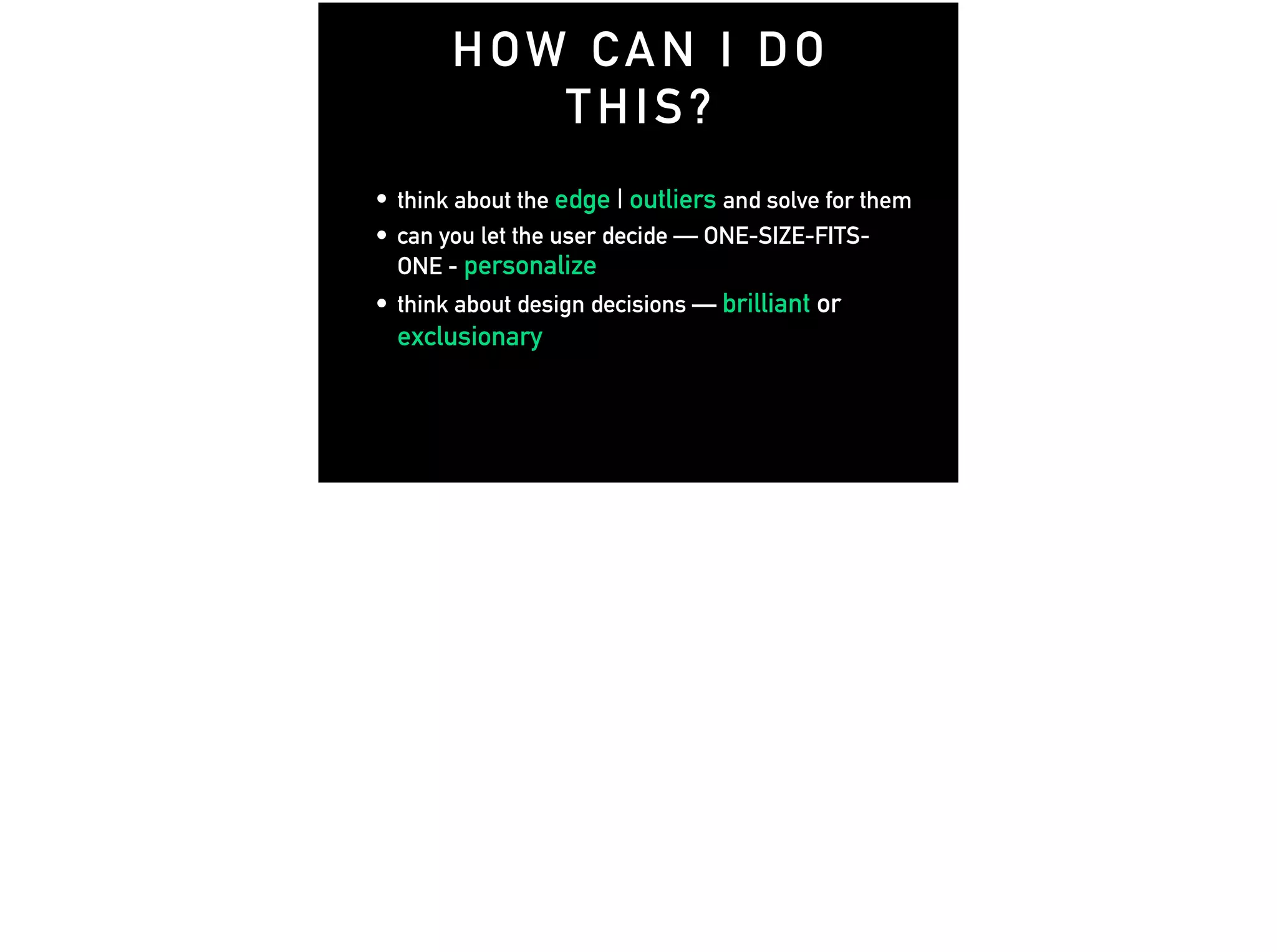
โ€ข think about the edge | outliers and solve for them
โ€ข can you let the user decide โ€” ONE-SIZE-FITS-
ONE - personalize
โ€ข think about design decisions โ€” brilliant or
exclusionary
HOW CAN I DO
THIS?
โ€œWe have clients come to us and say, โ€œHereโ€™s our average customer:โ€,
for instance, โ€œSheโ€™s female, sheโ€™s 34 years old, she has 2.3 kidsโ€ฆโ€
And we listen politely and say: โ€œWell, thatโ€™s great but we donโ€™t care
about that personโ€. What we really need to do to design, is look at the
extremes, the weakest, or the person with arthritis, or the athlete, or
the strongest or the fastest person. Because if we understand what
the extremes are, the middle will take care of itselfโ€.
โ€“ Dan Formosa, Smart Design, โ€œObjectifiedโ€
E D G E C A SE S
They arenโ€™t describing a person. Itโ€™s so abstracted and so removed from what a person does, itโ€™s not that functionally useful. In other words, itโ€™s useless.

How about Emil, heโ€™s 32, and heโ€™s been dating Angela for two years. He has a pretty good job at a tech startup in downtown Toronto, where he works long hours. He
likes going to the gym and he and his girlfriend are thinking about getting him a running companion โ€” a puppy. All this planning has got Emil thinking about the future
and how to best prepare for it.

Emil has an RRSP but he doesnโ€™t really know what that is. He is trying to save money because he knows that Toronto real estate is hard to a๏ฌ€ord but paying rent the rest
of your life doesnโ€™t sound awesome. He wants to buy his girlfriend a wedding ring but has no idea how or where to do that. He also wants to manage his money better โ€”
he knows there are more creative things out there, he just got something in the mail about high interest savings accounts, but he really doesnโ€™t know whatโ€™s right for him
and doesnโ€™t understand all of the lingo. Letโ€™s face it, Emil is lucky if he remembers to pay his credit card balance on time each month.

He knows itโ€™s time to get serious about these things. And he knows that includes getting a will put together once heโ€™s married. Again, itโ€™s something heโ€™s avoided
because he doesnโ€™t understand it. 

Heโ€™s pretty sure heโ€™s terrible at being an adult and he wants to do the responsible and right thing, but obviously could use some guidance.

Sounds pretty typical, right? Emil has ADD and has struggled all his life to organize, plan, and execute hard tasks.

http://sugoru.com/2013/07/14/designing-for-the-extremes/
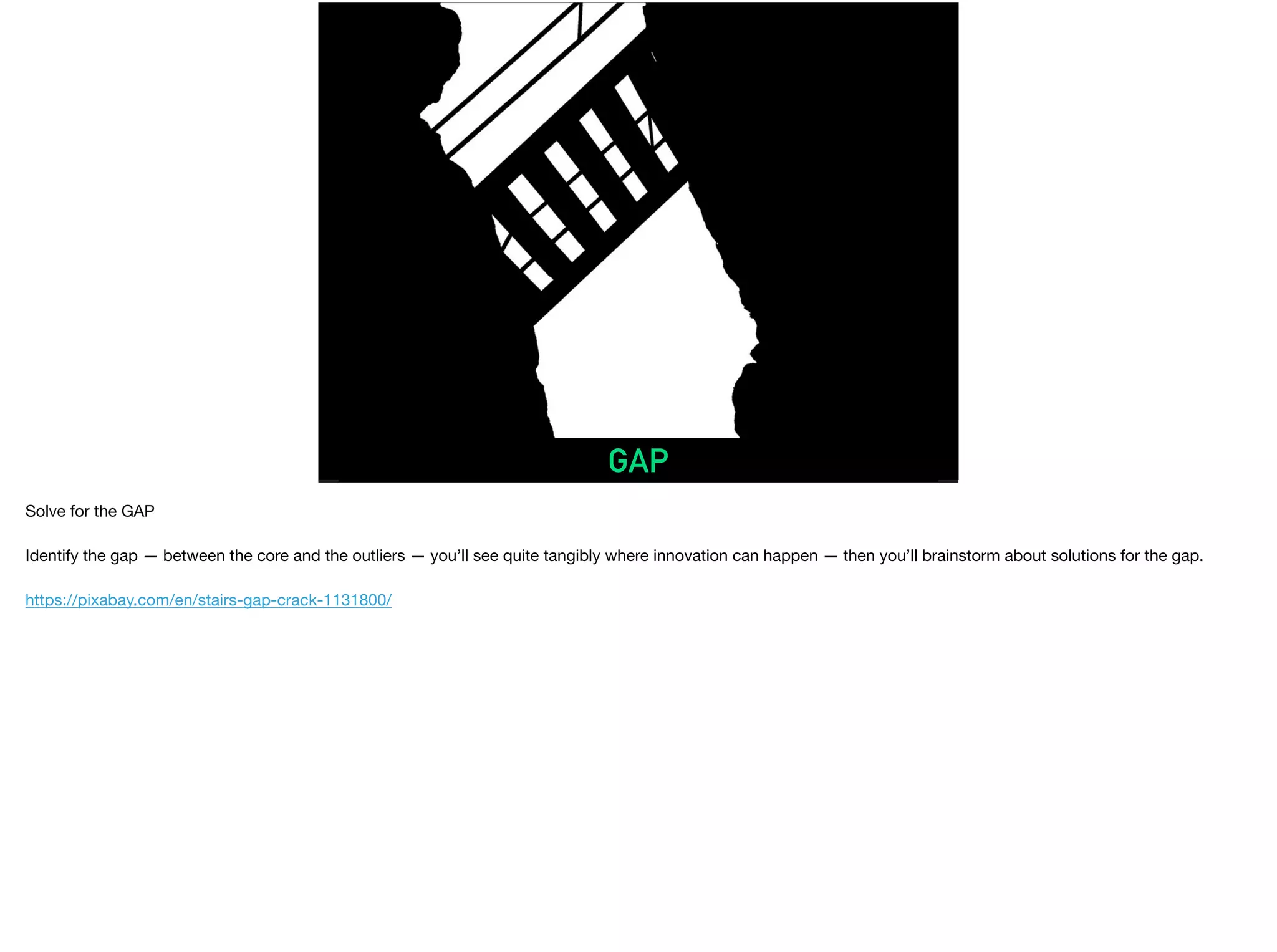
GAP
Solve for the GAP

Identify the gap โ€” between the core and the outliers โ€” youโ€™ll see quite tangibly where innovation can happen โ€” then youโ€™ll brainstorm about solutions for the gap.

https://pixabay.com/en/stairs-gap-crack-1131800/
โ€ข think about a problem you want to solve; or a
service you want to improve
โ€ข map how it meets your needs now
โ€ข think about the edge case โ€” WHO
โ€ข solve for them ONE-SIZE-FITS-ONE /
PERSONALIZE
โ€ข ITERATE โ€” watch for Design BRILLIANCE THAT
EXCLUDES
LETโ€™S DO THIS
NOW
trupanion

(pet insurance)

loved one end-of-life โ€” immigrant with assets in two countries

preparing healthy meals during the week

delivery of a service (health? food? transportation? power?)

๏ฌnding a job

hiring someone for a job

simplify, easy to use, convenient, quick
Jess Mitchell email: jmitchell@ocadu.ca
twitter: @jesshmitchell
mailing list: http://lists.idrc.ocadu.ca
Thank you and I want to thank SenseAbility for having us all here today. And please take these links to keep in touch and participate in inclusive design.
Jess
Mitchell
INCLUSIVE DESIGN THINKING
A GATEWAY TO INNOVATION

Inclusive Design: A Path to Innovation

  • 1.
  • 2.
    Jess Mitchell INCLUSIVE DESIGN THINKING APATH TO INNOVATION Inclusive design helps with ๏ฌnding the path toward innovation. It isnโ€™t a silver bullet, but when youโ€™re asking yourself where to even begin โ€” how to change what youโ€™re doing now, how to diversify what youโ€™re doing now, how to evolve and ๏ฌnd new markets โ€”- inclusion and diversity are the places to look. Forbes is talking about โ€œfostering innovation through a diverse workforceโ€ HBR is talking about โ€œhow diversity can drive innovationโ€ Facebook, Google, Apple โ€” all have hiring practices that aim to create diverse teams WHY? When youโ€™re looking for โ€œout of the boxโ€ thinking โ€” YOU CANโ€™T CREATE A BOX OR A MONOCULTURE So weโ€™ve all heard these words: innovation, inclusion, disruption โ€” weโ€™re all trying to ๏ฌnd a way to di๏ฌ€erentiate ourselves, our companies, our productsโ€ฆ HOW DO WE DO IT? My goal is for you to experience a perspective shift that helps you see ways you can innovate, ways you can create conditions for others that enable innovation, and ways that you can understand how inclusion and innovation are linked. To get at what it means to ๏ฌnd the path toward innovation through inclusion weโ€™re going to start by talking about some features of innovation and fold that into learning about inclusive design. Then weโ€™re going to apply those concepts to speci๏ฌc problems in an activity that weโ€™ll be doing in groups.
  • 3.
    DOESNโ€™T HAVE TOBE NEW What does it mean? What is Innovation? I think we often associate it with creating something completely new, or being the ๏ฌrst to do something or being clairvoyant and knowing whatโ€™s coming nextโ€ฆ A few examples: Facebook came along and there was nothing like it before โ€” the Internet was already well distributed (even in the developing world you had Internet cafes), many people had cell phones with cameras and wanted to share pictures and gloat and stay connected. The whole pipeline was there. Fast food came alongside a time in history when families needed two incomes to stay a๏ฌ‚oat, then they needed two cars to handle family needs (two jobs, two locations, kids to school or daycare, pick up food on the way home, two car garage, the suburbs exploded). This had a huge impact on transit, on food, on families, on products, and on manufacturing. Drive thru dinner. (electric garage door openers, motion-activated lights, programmable thermostats) So, innovation is certainly those things, but itโ€™s also so much more โ€” and sometimes very small things: Innovation is also possible with existing things (thing we use every day) and as the slide says doesnโ€™t have to be a totally new sprocket but a better sprocket or a better way to interact. An example of this could be something as simple as how we get into our cars. Historically ๏ฌrst we had a car, then someone wanted to lock it so we added a lock and a unique key, then someone questioned the key and put an electric keypad on it that would light up when you touched your ๏ฌrst key, then we stuck a fob in our bag or our pocket and now we can simply press a buttonโ€ฆ These innovations in entering the car came from asking some of the following questions:
  • 4.
    MAGIC We all wantthe 10 step process to do this. We want to make it reproducible, concrete steps that will yield predictable results. We want the science of innovation. All of our organizations want to be innovative. But if it were a science then all of us would be doing it, not trying to do it. So what really is innovation? Letโ€™s break it down a bitโ€ฆ What are some of the parts of innovation we value? - the ah-ha moments - the solving puzzles/problems/gaps - the delight - the meeting unmet needs - the discovering new markets - the convenience - ๏ฌ‚uidity and thoughtfulness (I wish Iโ€™d thought of that!) - itโ€™s unobtrusive โ€” it just works - the magic There are some things we know about this magic โ€” it happens more easily in certain contextsโ€ฆ
  • 5.
    FORM & FUNCTION Thereseem to be conditions where nurturing innovation is easier, more natural, or more frequent. How many of you have been stuck on a problem, gotten up to take a walk and then had some clarity for next steps? Relaxed attention, taking a walk, plans on the back of napkins, waking in the middle of the night with a great idea, the shower. These are all places where you can loosen your mind: experiment, fail, be creative, think outside the box. Is that done at a conference table with 20 chairs, a meeting leader, and a notetaker? Could beโ€ฆ but maybe not. Just as we see diversity positively e๏ฌ€ecting our teams and businesses, diversity of meeting places also helps. It helps to spend the day at OCAD University talking about something di๏ฌ€erent in a di๏ฌ€erent space. Form and Function are related! So, letโ€™s all go ๏ฌshing and weโ€™ll have brilliant ideas. No, not necessarilyโ€ฆ We see this phenomenon when we try to concentrate or pay really close attention to something โ€” Some people do better with lots of distractions, some with no distractions at all. Doodlers are often people who have to occupy part of their brain to pay close attention โ€” so they doodle. Some of us cannot multi-task โ€” we can only pay attention to one thing at a time. Weโ€™re all di๏ฌ€erent and weโ€™re di๏ฌ€erent from day to day. Man ๏ฌ‚y-๏ฌshing in a river https://upload.wikimedia.org/wikipedia/commons/e/ee/Men_๏ฌ‚y_๏ฌshing.jpg
  • 6.
    WE QUESTION ASSUMPTIONS |EXPERIMENT And we know creativity, experimentation, questioning assumptions, and failure are closely related to innovationโ€ฆ kids are good at this, adults less so. As adults, whatโ€™s the ๏ฌrst thing we do when presented with a problem? WE SOLVE IT โ€” we donโ€™t want to skin our knees. We want to get to solutions fast, e๏ฌƒciently. Weโ€™re busy! And when we do that, we introduce assumptions or we perpetuate them (knowingly or not). How often do we hear or behave in a โ€œThatโ€™s the way weโ€™ve always done itโ€ manner? But what if it wasnโ€™t? The LightBulb What if we slowed down and didnโ€™t race to the ๏ฌnish, but spent time on the hard, the complex? We at the IDRC stumbled upon something that seems to hold some of the secrets to innovation โ€” and that is to really understand the problem youโ€™re trying to solve, look to the edges where itโ€™s currently failing to meet needs or perform. Those edges are often the extremes (extreme hot or extreme cold, extremely busy or extremely distracted, extremely strong, extremely weak). And this is the perspective shift that inclusive design brings usโ€ฆ 3 kids with skinned knees
  • 7.
    PERSPECTIVE SHIFT And thisis the perspective shift that inclusive design brings usโ€ฆ - instead of thinking of solving for the majority, what happens if we solve for the 20%? - instead of thinking of average people, what happens if we design for real people with real problems? - to change the door, the key, the lightbulb we have to ask ourselves some fundamental questions: - what problem am I trying to solve? - what am i trying to accomplish? - for whom? - who did I leave out? what other assumptions were there? So, no, this doesnโ€™t come for free โ€” it requires you to change your perspective and your practicesโ€ฆ And weโ€™re going to talk about that for a bit now, and then weโ€™re going to do it. Building looking up, turned sideways https://www.๏ฌ‚ickr.com/photos/wvs/280384849/
  • 8.
    I am listening Iam curious But I donโ€™t get it! I DONโ€™T UNDERSTAND WHAT IS INCLUSIVE DESIGN Inclusive Design is design that considers the full range of human diversity with respect to ability, language, culture, gender, age and other forms of human di๏ฌ€erence. Stacked, colourful cups https://www.๏ฌ‚ickr.com/photos/doug88888/2987668742/in/photolist-5y1zQ3-9iioxp-4hGtdR-e86mXv-7S3xLA-oGJ71U-2GKVgd-cqo7RQ-LgBMB-LB3EG-5SZRyN- LBbgF-9GAD7c-6tYNTm-4Ev2tX-4QjDbk-8Vd1QL-gnpzqR-6ZKrmp-rsfoP-teU2X-9q5WPk-9q8YjY-7BF8ob-LBbgP-7EQk6t-dx7TCA-e8bXp5
  • 9.
    1. recognize diversityand uniqueness in people and places 2. personalize wherever possible, let me be me 3. ask yourself: were you brilliant or did you just exclude someone? beware of introducing new assumptions INCLUSIVE DESIGN 1. everyone is di๏ฌ€erent; all of our homes, families, cars, o๏ฌƒces, โ€” everything is di๏ฌ€erent. Today is di๏ฌ€erent from yesterday. the alternative to this is one-size-๏ฌts-all which we know never really does. Thatโ€™s us compromising our own individual needs or preferences for something basic. 2. let me be me โ€” iโ€™m the best at it. Empower me to make decisions and I will! 3. beware the brilliant design decision โ€” ask questions to avoid introducing new assumptions
  • 10.
    EDGE | OUTLIERS Wheredoes the 80 - 20 come from โ€” At least in part it comes from a perspective weโ€™ve been taught Weโ€™re taught to look at the majority, the average, the most โ€” what if we change that perspective and look at the outliers โ€” what can they tell us? Todd Rose โ€” The End of Average Scatter plot showing a clump of dots and a few outliers https://upload.wikimedia.org/wikipedia/commons/2/29/Scatterplot_r%3D-.76.png
  • 11.
    THE MAGIC AT THEMARGINS โ€ข innovation โ€ข benefits the majority โ€ข supports the spectrum โ€ข resiliency EDGE | OUTLIERS Instead of fearing the edges or trying to forget them we should be focusing on them.
  • 12.
    DISABILITY So, how doesthis all fit in with inclusion and diversity? Weโ€™re taught that one way we describe people who are different is to talk about their difference as a disability. We sometimes hear disability described as a medical condition โ€” someone is afflicted, they canโ€™t do something โ€” they lack an ability. Stethoscope: http://cbsnews1.cbsistatic.com/hub/i/r/2014/01/24/d6bd0d38-cb4a-4411-bd1d-7a5dcc4e319d/thumbnail/620x350/ fa75501812b1d1d699dd40da9648001a/stethoscope.jpg
  • 13.
    DISABILITY And it isoften associated with the medical model of 4 main categories of disabilities: a loss or lack of: mobility cognitive abilities hearing sight But at the IDRC we completely rede๏ฌne disability. It isnโ€™t a medical condition to usโ€ฆ>>> Categories of Disability: https://www.worknetncc.com/Uploads/Disability_symbols_16.png
  • 14.
    MISMATCH EDGE | OUTLIERS Disabilityis a mismatch between the needs of the individual, their goals, and the service or experience o๏ฌ€ered Disability is not a personal trait and because itโ€™s so context dependent, it is a relative condition not permanent. Accessibility = the ability of the service or system to match the needs of the individual Square peg, round hole: http://wp.production.patheos.com/blogs/adrianwarnock/๏ฌles/2015/08/3546059144_1b33dfdc0e_o.jpg
  • 15.
    DISABILITY IS MISMATCH MISMATCH IS SOLVABLE INCLUSIVE DESIGN C A N SO LV E M I SM AT C H ALL EXPERIENCE MISMATCH Solve for the real problems, not the imagined problems of an average. And do that by understanding that people are unique and their contexts, needs, preferences are not static โ€” we are far too complex to be categorized so simply. So, take on the hard puzzles and figure out how to make things work better, make things easier, simpler, solve problems unobtrusively and elegantly โ€” perform magic! Start with empathy โ€” we are all unique. Then, let me be meโ€ฆ
  • 16.
    ONE SIZE FITSONE PERSONALIZE When I can, I want to be empowered to design my own life and my own experience. My living room looks different from yours. When I canโ€™t personalize โ€” make it easier for me or teach me or lead me so I can make my own decisions โ€” Iโ€™ll have more stake in what Iโ€™m doing โ€” Iโ€™ll be more engaged. Harness the power of personalizing โ€” extending it to everybody. https://upload.wikimedia.org/wikipedia/commons/8/82/Stafford_livingroom.jpg
  • 17.
  • 18.
    โ€ข With thisbrilliant design idea who just got excluded? โ€ข Is there a way I can bridge the gap I just created? A way I can solve for the mismatch or avoid it? D E S I G N I D E A S : BRILLIANT OR EXCLUSIONARY So when we build products and services and tools we should be asking all along who isnโ€™t here? And who got excluded? One way we do this in the digital world is to make it multi-modal - text - audio - video - image avoid hard to read fonts or font sizes create an appropriate level of contrast simulations and visualization provide interesting challenges make targets easy to hit can you use it with the keyboard? be wary of time-based operations keep content structured โ€” semantic content But if we just wrap ourselves in WCAG and AODA, we are still missing the point: people are unique, there are gaps in meeting their needs, innovation is in the gaps.
  • 19.
    What is accessibility? EDGE| OUTLIERS | | PERSONALIZE | | BRILLIANT OR EXCLUSIONARY? In Universal Design thereโ€™s the curb cut โ€” does everyone know what a curb cut is? Curb Cut: http://www.๏ฌ‚ickr.com/photos/50393252@N02/4822063888/
  • 20.
    What is accessibility? EDGE| OUTLIERS | | PERSONALIZE | | BRILLIANT OR EXCLUSIONARY? We have examples in the digital world too: top 3 uses: 1. in a bar 2. in a gym 3. in bed with a sleeping spouse CC: https://en.wikipedia.org/wiki/Closed_captioning#/media/File:Closed_captioning_symbol.svg
  • 21.
    WHAT WE SHOULD BEAIMING FOR EDGE | OUTLIERS | | PERSONALIZE | | BRILLIANT OR EXCLUSIONARY? There is so much to discover, so much to adapt, so much to re๏ฌne โ€” https://upload.wikimedia.org/wikipedia/commons/a/aa/So_Many_Choices_(11693539025).jpg simplifying the physical action needed
  • 22.
    OXO EDGE | OUTLIERS| | PERSONALIZE | | BRILLIANT OR EXCLUSIONARY? OXO good grips was created when the ownerโ€™s wife had trouble gripping tools because of some mild arthritis. These tools for kitchen and gardening became the go-tos in rehabilitation centres working with people on activities of daily livingโ€ฆ Who else has trouble gripping things? comfort and usability Oxo: http://images.bloomingdales.com/is/image/BLM/products/7/optimized/8017617_fpx.tif? wid=1200&qlt=90,0&layer=comp&op_sharpen=0&resMode=sharp2&op_usm=0.7,1.0,0.5,0&fmt=jpeg
  • 23.
    OXO OXO EDGE | OUTLIERS| | PERSONALIZE | | BRILLIANT OR EXCLUSIONARY? this population. OXO saw a market and broadened their products. Oxo Sippy: http://www.peppermint.co.uk/media/catalog/product/cache/1/image/9df78eab33525d08d6e5fb8d27136e95/s/i/sippy-cup-with-handles-green.jpg
  • 24.
    OXO EDGE | OUTLIERS| | PERSONALIZE | | BRILLIANT OR EXCLUSIONARY? Jar Pop https://cdn.shopify.com/s/๏ฌles/1/0840/1971/products/img_7115_17efbe60-0f8d-4b4c-a6cf-f40564a1bbcb_1024x1024.jpeg?v=1464889393
  • 25.
    N I KE F LY E A S E EDGE | OUTLIERS | | PERSONALIZE | | BRILLIANT OR EXCLUSIONARY? Inspired by a letter to Nike by a basketball loving teenager with Cerebral Palsy โ€” what resulted is a sexy shoe with an innovative entry that is usable and attractive to everyone. Nike Flyease: http://cnet2.cbsistatic.com/hub/i/r/2015/07/15/dc055c68-bb4b-47a6-9472-6cf1475a6703/resize/970x546/1433d7364455c56e45c91189e023357d/ nike๏ฌ‚yeasecolor.jpg
  • 26.
    TRA MPOLINE EDGE |OUTLIERS | | PERSONALIZE | | BRILLIANT OR EXCLUSIONARY? BLOORVIEW rehab hospital has one of these and whatโ€™s so cool about it is that you have kids in their integrated school program playing together without barriers and kids in wheelchairs who have never had the sensation of jumping can feel what it feels like to jump. Trampoline: https://s-media-cache-ak0.pinimg.com/736x/8b/21/67/8b2167d7e787e6ca66e6087f694c9ec2.jpg Stop Gap: http://1.bp.blogspot.com/-cQiJTeXAgGM/UIM1OJYztYI/AAAAAAAAAHw/rIsUt6YhWt0/s1600/DSC04762.JPG
  • 27.
    STOPGAP EDGE | OUTLIERS| | PERSONALIZE | | BRILLIANT OR EXCLUSIONARY? Stopgap created these little wedges to help folks in wheelchairs get into businesses in the GTA. Folks with strollers also use them โ€” no one is inconvenienced by them and they help. Luke Anderson an avid mountain biker had an accident and became paralyzed. He started stopgap. Stop Gap wooden wedge leading into a business with one step in front: https://www.davidberman.com/wp-content/uploads/Two-stopgap-ramps-outside-a-store- front.jpeg
  • 28.
    ADAPT TO ME EDGE| OUTLIERS | | PERSONALIZE | | BRILLIANT OR EXCLUSIONARY? - Nikeโ€™s brand new power lacing shoe โ€” HyperAdapt 1.0 -autolace from Back to the Future -Michael J. Fox tried prototype out -He has parkinsons โ€” a population of people who would bene๏ฌt from this -In Back to the Future he was a adventurous kid who also bene๏ฌted from this -Michael J. Fox said when he tried this out โ€œI wish I had this on my hockey skatesโ€ -Your context changes, the environment changes, your feet swell, need them tighten during the game -Some people canโ€™t tie their shoes Electro Adaptive Reactive Lacing: E.A.R.L. https://www.wired.com/2016/09/nike-self-lacing-design-hyperadapt/#slide-1
  • 29.
    OXO HERE ONE EDGE |OUTLIERS | | PERSONALIZE | | BRILLIANT OR EXCLUSIONARY? Here One With two smart earbuds and a connected app, you can stream music, take phone calls, reduce unwanted noise, amplify speech, access Siri and Google Now, and more. Selectively choose what you want to hear and remove what you donโ€™t using Smart Noise Cancellation. https://hereplus.me
  • 30.
    OXO EDGE | OUTLIERS| | PERSONALIZE | | BRILLIANT OR EXCLUSIONARY? mint.com
  • 31.
    OXO EDGE | OUTLIERS| | PERSONALIZE | | BRILLIANT OR EXCLUSIONARY? sonnet.ca
  • 32.
    OXO EDGE | OUTLIERS| | PERSONALIZE | | BRILLIANT OR EXCLUSIONARY? wealthsimple.ca
  • 33.
    DOESNโ€™T HAVE TOBE NEW MAGIC QUESTION ASSUMPTIONS | EXPERIMENT FORM & FUNCTION INNOVATION PERSPECTIVE SHIFT
  • 34.
    โ€ข think aboutthe edge | outliers and solve for them โ€ข can you let the user decide โ€” ONE-SIZE-FITS- ONE - personalize โ€ข think about design decisions โ€” brilliant or exclusionary HOW CAN I DO THIS?
  • 35.
    โ€œWe have clientscome to us and say, โ€œHereโ€™s our average customer:โ€, for instance, โ€œSheโ€™s female, sheโ€™s 34 years old, she has 2.3 kidsโ€ฆโ€ And we listen politely and say: โ€œWell, thatโ€™s great but we donโ€™t care about that personโ€. What we really need to do to design, is look at the extremes, the weakest, or the person with arthritis, or the athlete, or the strongest or the fastest person. Because if we understand what the extremes are, the middle will take care of itselfโ€. โ€“ Dan Formosa, Smart Design, โ€œObjectifiedโ€ E D G E C A SE S They arenโ€™t describing a person. Itโ€™s so abstracted and so removed from what a person does, itโ€™s not that functionally useful. In other words, itโ€™s useless. How about Emil, heโ€™s 32, and heโ€™s been dating Angela for two years. He has a pretty good job at a tech startup in downtown Toronto, where he works long hours. He likes going to the gym and he and his girlfriend are thinking about getting him a running companion โ€” a puppy. All this planning has got Emil thinking about the future and how to best prepare for it. Emil has an RRSP but he doesnโ€™t really know what that is. He is trying to save money because he knows that Toronto real estate is hard to a๏ฌ€ord but paying rent the rest of your life doesnโ€™t sound awesome. He wants to buy his girlfriend a wedding ring but has no idea how or where to do that. He also wants to manage his money better โ€” he knows there are more creative things out there, he just got something in the mail about high interest savings accounts, but he really doesnโ€™t know whatโ€™s right for him and doesnโ€™t understand all of the lingo. Letโ€™s face it, Emil is lucky if he remembers to pay his credit card balance on time each month. He knows itโ€™s time to get serious about these things. And he knows that includes getting a will put together once heโ€™s married. Again, itโ€™s something heโ€™s avoided because he doesnโ€™t understand it. Heโ€™s pretty sure heโ€™s terrible at being an adult and he wants to do the responsible and right thing, but obviously could use some guidance. Sounds pretty typical, right? Emil has ADD and has struggled all his life to organize, plan, and execute hard tasks. http://sugoru.com/2013/07/14/designing-for-the-extremes/
  • 36.
    GAP Solve for theGAP Identify the gap โ€” between the core and the outliers โ€” youโ€™ll see quite tangibly where innovation can happen โ€” then youโ€™ll brainstorm about solutions for the gap. https://pixabay.com/en/stairs-gap-crack-1131800/
  • 37.
    โ€ข think abouta problem you want to solve; or a service you want to improve โ€ข map how it meets your needs now โ€ข think about the edge case โ€” WHO โ€ข solve for them ONE-SIZE-FITS-ONE / PERSONALIZE โ€ข ITERATE โ€” watch for Design BRILLIANCE THAT EXCLUDES LETโ€™S DO THIS NOW trupanion (pet insurance) loved one end-of-life โ€” immigrant with assets in two countries preparing healthy meals during the week delivery of a service (health? food? transportation? power?) ๏ฌnding a job hiring someone for a job simplify, easy to use, convenient, quick
  • 38.
    Jess Mitchell email:jmitchell@ocadu.ca twitter: @jesshmitchell mailing list: http://lists.idrc.ocadu.ca Thank you and I want to thank SenseAbility for having us all here today. And please take these links to keep in touch and participate in inclusive design.
  • 39.