Which one of the following 5 is least like the
others?
Cow, tiger, snake, bear, dog
Assessment
What are our goals, actually?
Jess Mitchell
Sr. Mgr. Research + Design
@jesshmitchell
jmitchell@ocadu.ca
Why do you teach?
Why do you teach?
•Are you hoping to transfer knowledge
•To build skills
•To transfer a bunch of facts
•To help people think
•To help people become more ethical, accountable
•To help people learn how to learn – and expect they
will do this evermore
•To continue learning yourself
Who are we teaching?
When we teach, do we aim
to do no harm?
When we teach, do we
design inclusively?
You’re a designer
Yes
Do you make
decisions?
Nothing is neutral
We all are Designers
of this world
we are all part of the revolution
…or else the status quo
What is your tolerance for the
FALSE POSITIVE?
Are you more concerned with Billy
than you are with the
FALSE NEGATIVE?
If we cannot have a perfect
predictor, what is the error rate
that we will tolerate?
Who is accountable?
Who is responsible?
Where does the buck stop?
What is YOUR moral responsibility?
power asymmetries
racial dynamics
mental health considerations
and other challenges
When do we apply ethics?
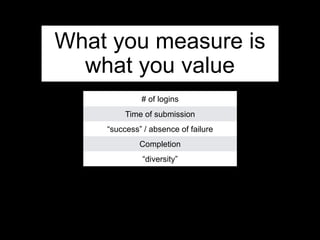
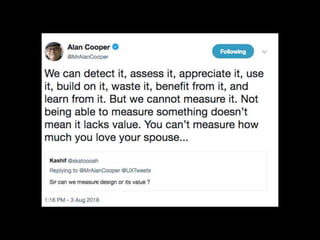
What you measure is
what you value
# of logins
Time of submission
“success” / absence of failure
Completion
“diversity”
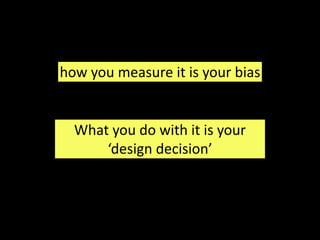
how you measure it is your bias
What you do with it is your
‘design decision’
Would we recognize learning
if we saw it?
Be creative
Try, Fail, Learn from it?
Practice critical thought?
Learn how to work with others?
Learn how to productively critique
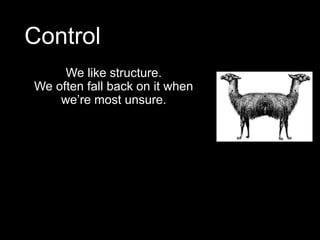
Control
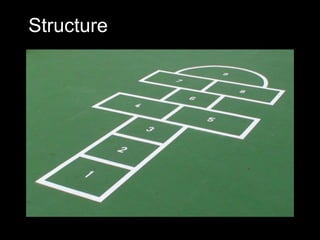
We like structure.
We often fall back on it when
we’re most unsure.
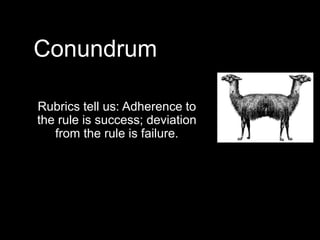
Conundrum
Rubrics tell us: Adherence to
the rule is success; deviation
from the rule is failure.
Structure
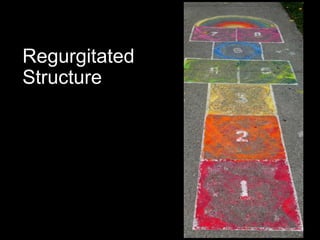
Regurgitated
Structure
Structured Structure-lessness
BASELINE GOALS WEEK 1
Why are you here?
Is there a specific thing you expect to learn, practice, know at the
end of this class?
How will you measure success?
What are your learning goals?
How do you propose to do this?
What support do you need?
What evidence will you provide that you have achieved your goals.
How will you tackle mistakes and failures
How is online learning different?
• What are 5 things that are better?
• What are 5 things that are worse?
What is one thing about you that I should know that I can’t tell by
seeing you online?
If you are comfortable, please share a photo so I can learn your
name faster.
REFLECTION BOOK DUE EACH WEEK (12 TOTAL)
Each week that we have class please reflect on
the following questions:
What stood out for you today in class, what
stuck?
What questions remain?
What are 3 ‘exam’ questions you would create
from the materials and the class?
How can I improve your learning in the class?
How can you improve your learning in the class?
What is new vocabulary from this weeks’
experiences, readings, discussions?
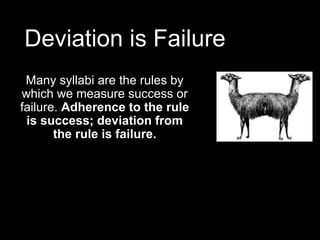
Deviation is Failure
Many syllabi are the rules by
which we measure success or
failure. Adherence to the rule
is success; deviation from
the rule is failure.
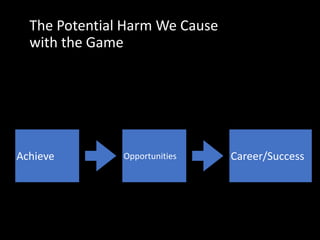
The Potential Harm We Cause
with the Game
Achieve Opportunities Career/Success
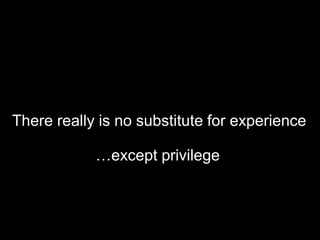
There really is no substitute for experience
…except privilege
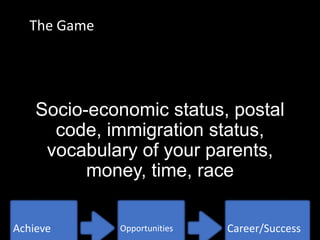
The Game
Achieve Career/Success
Opportunities
Socio-economic status, postal
code, immigration status,
vocabulary of your parents,
money, time, race
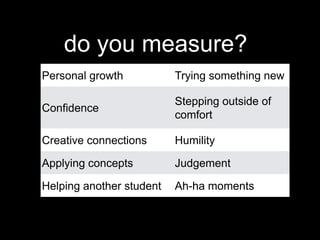
do you measure?
Personal growth Trying something new
Confidence
Stepping outside of
comfort
Creative connections Humility
Applying concepts Judgement
Helping another student Ah-ha moments
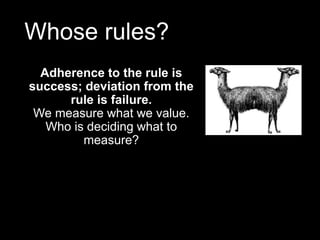
Whose rules?
Adherence to the rule is
success; deviation from the
rule is failure.
We measure what we value.
Who is deciding what to
measure?
Who do the rules limit?
We all are limited by rules
No exceptions
You must report on your department’s success using these
measures
Only English speakers can learn from this material
Only graduate students can take this course
Your thoughts must be organized in a 5 paragraph essay
You cannot use Wikipedia as a reference
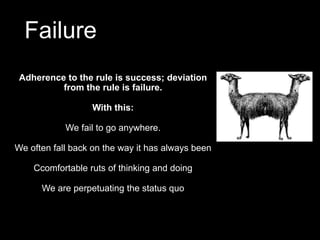
Failure
Adherence to the rule is success; deviation
from the rule is failure.
With this:
We fail to go anywhere.
We often fall back on the way it has always been
Ccomfortable ruts of thinking and doing
We are perpetuating the status quo
how we design matters;
and every decision is a
design decision
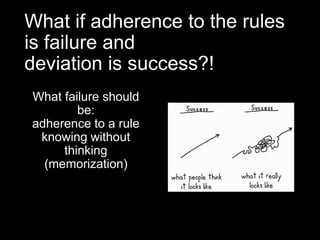
What if adherence to the rules
is failure and
deviation is success?!
What failure should
be:
adherence to a rule
knowing without
thinking
(memorization)
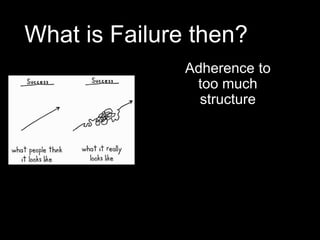
What is Failure then?
Adherence to
too much
structure
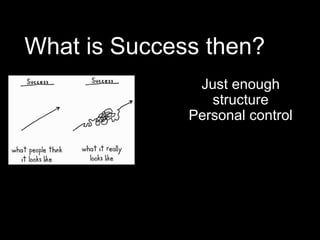
What is Success then?
Just enough
structure
Personal control
Re-Think
Syllabus
Pedagogy
Individual goals and
definitions of success
The contract
The syllabus
What has COVID taught
us?
beware the binary
beware certainty
beware completion
beware idolatry
how we design matters;
and every decision is a
design decision
• Pace, Path, Content, Delivery Method
• text, visual, sonification, video…
• individual, group, didactic, participatory
• Motivation – external, internal, positive, nega
• Social support – peer, instructor, other
• Degree of structure
H o w C a n I d o
t h i s ?
• think about the edge | outliers and
wonder how you impacted them
• can you let the student decide –
personalize and humanize education
• think about design decisions —
brilliant or exclusionary
• Worry about getting it wrong
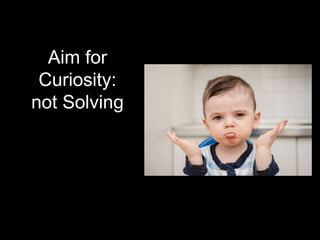
Aim for
Curiosity:
not Solving
Alfie Kohn
wisdom
Your work
begins now
...and it never ends...
IQ: Which one of the following 5 is least like the
others?
Cow, tiger, snake, bear, dog
@jesshmitchell

Assessment Keynote

  • 2.
    Which one ofthe following 5 is least like the others? Cow, tiger, snake, bear, dog
  • 3.
    Assessment What are ourgoals, actually? Jess Mitchell Sr. Mgr. Research + Design @jesshmitchell jmitchell@ocadu.ca
  • 4.
    Why do youteach?
  • 5.
    Why do youteach? •Are you hoping to transfer knowledge •To build skills •To transfer a bunch of facts •To help people think •To help people become more ethical, accountable •To help people learn how to learn – and expect they will do this evermore •To continue learning yourself
  • 6.
    Who are weteaching?
  • 7.
    When we teach,do we aim to do no harm?
  • 8.
    When we teach,do we design inclusively?
  • 9.
    You’re a designer Yes Doyou make decisions?
  • 10.
  • 11.
    We all areDesigners of this world we are all part of the revolution …or else the status quo
  • 12.
    What is yourtolerance for the FALSE POSITIVE?
  • 13.
    Are you moreconcerned with Billy than you are with the FALSE NEGATIVE?
  • 14.
    If we cannothave a perfect predictor, what is the error rate that we will tolerate?
  • 15.
    Who is accountable? Whois responsible? Where does the buck stop? What is YOUR moral responsibility?
  • 16.
    power asymmetries racial dynamics mentalhealth considerations and other challenges
  • 18.
    When do weapply ethics?
  • 19.
    What you measureis what you value # of logins Time of submission “success” / absence of failure Completion “diversity”
  • 21.
    how you measureit is your bias What you do with it is your ‘design decision’
  • 23.
    Would we recognizelearning if we saw it?
  • 24.
    Be creative Try, Fail,Learn from it? Practice critical thought? Learn how to work with others? Learn how to productively critique
  • 26.
    Control We like structure. Weoften fall back on it when we’re most unsure.
  • 27.
    Conundrum Rubrics tell us:Adherence to the rule is success; deviation from the rule is failure.
  • 28.
  • 29.
  • 30.
  • 31.
    BASELINE GOALS WEEK1 Why are you here? Is there a specific thing you expect to learn, practice, know at the end of this class? How will you measure success? What are your learning goals? How do you propose to do this? What support do you need? What evidence will you provide that you have achieved your goals. How will you tackle mistakes and failures How is online learning different? • What are 5 things that are better? • What are 5 things that are worse? What is one thing about you that I should know that I can’t tell by seeing you online? If you are comfortable, please share a photo so I can learn your name faster.
  • 32.
    REFLECTION BOOK DUEEACH WEEK (12 TOTAL) Each week that we have class please reflect on the following questions: What stood out for you today in class, what stuck? What questions remain? What are 3 ‘exam’ questions you would create from the materials and the class? How can I improve your learning in the class? How can you improve your learning in the class? What is new vocabulary from this weeks’ experiences, readings, discussions?
  • 34.
    Deviation is Failure Manysyllabi are the rules by which we measure success or failure. Adherence to the rule is success; deviation from the rule is failure.
  • 35.
    The Potential HarmWe Cause with the Game Achieve Opportunities Career/Success
  • 36.
    There really isno substitute for experience …except privilege
  • 37.
    The Game Achieve Career/Success Opportunities Socio-economicstatus, postal code, immigration status, vocabulary of your parents, money, time, race
  • 38.
    do you measure? Personalgrowth Trying something new Confidence Stepping outside of comfort Creative connections Humility Applying concepts Judgement Helping another student Ah-ha moments
  • 39.
    Whose rules? Adherence tothe rule is success; deviation from the rule is failure. We measure what we value. Who is deciding what to measure?
  • 40.
    Who do therules limit? We all are limited by rules No exceptions You must report on your department’s success using these measures Only English speakers can learn from this material Only graduate students can take this course Your thoughts must be organized in a 5 paragraph essay You cannot use Wikipedia as a reference
  • 41.
    Failure Adherence to therule is success; deviation from the rule is failure. With this: We fail to go anywhere. We often fall back on the way it has always been Ccomfortable ruts of thinking and doing We are perpetuating the status quo
  • 42.
    how we designmatters; and every decision is a design decision
  • 43.
    What if adherenceto the rules is failure and deviation is success?! What failure should be: adherence to a rule knowing without thinking (memorization)
  • 44.
    What is Failurethen? Adherence to too much structure
  • 45.
    What is Successthen? Just enough structure Personal control
  • 46.
  • 47.
  • 48.
    What has COVIDtaught us?
  • 49.
    beware the binary bewarecertainty beware completion beware idolatry
  • 50.
    how we designmatters; and every decision is a design decision
  • 51.
    • Pace, Path,Content, Delivery Method • text, visual, sonification, video… • individual, group, didactic, participatory • Motivation – external, internal, positive, nega • Social support – peer, instructor, other • Degree of structure
  • 52.
    H o wC a n I d o t h i s ? • think about the edge | outliers and wonder how you impacted them • can you let the student decide – personalize and humanize education • think about design decisions — brilliant or exclusionary • Worry about getting it wrong
  • 53.
  • 54.
  • 55.
  • 57.
    IQ: Which oneof the following 5 is least like the others? Cow, tiger, snake, bear, dog
  • 58.