Spaces to Learn Spaces to Innovate ELI Fall Focus Session 2008 Malcolm Brown Educause Learning Initiative [email_address]
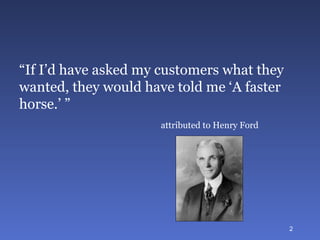
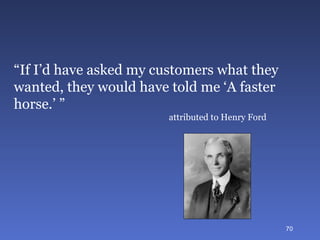
“ If I’d have asked my customers what they wanted, they would have told me ‘A faster horse.’ ” attributed to Henry Ford
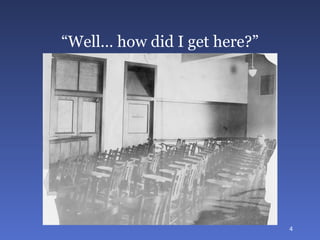
“ Well… how did I get here?”
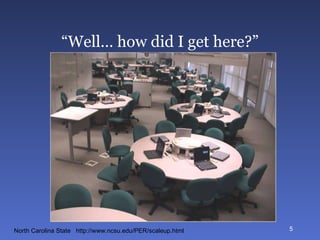
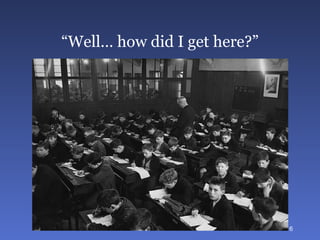
“ Well… how did I get here?” North Carolina State  http://www.ncsu.edu/PER/scaleup.html
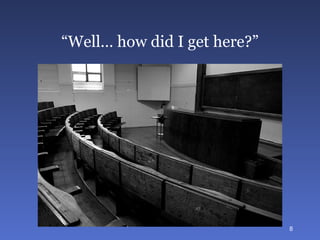
“ Well… how did I get here?”
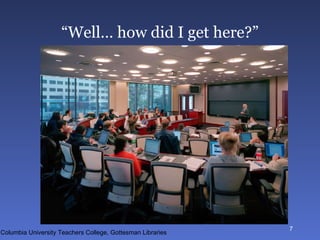
“Well… how did I get here?” Columbia University Teachers College, Gottesman Libraries
“ Well… how did I get here?”
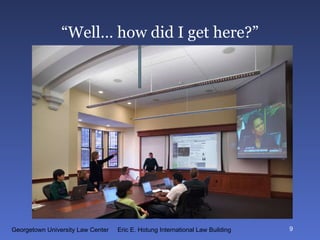
“Well… how did I get here?” Georgetown University Law Center  Eric E. Hotung International Law Building
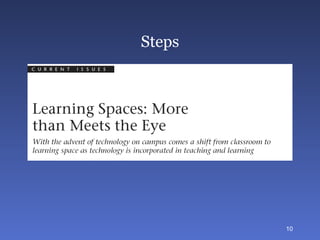
Steps Educause Quarterly ,  No. 1, 2003, pp. 14–15
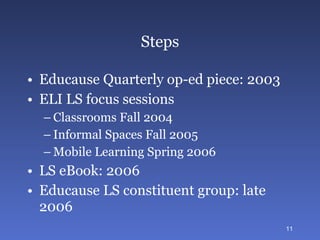
Steps Educause Quarterly op-ed piece: 2003 ELI LS focus sessions Classrooms Fall 2004 Informal Spaces Fall 2005 Mobile Learning Spring 2006 LS eBook: 2006 Educause LS constituent group: late 2006
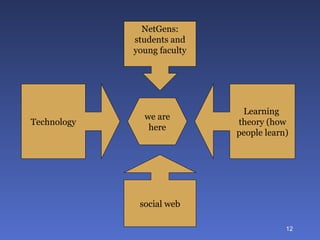
Technology Learning  theory (how people learn) we are here social web NetGens: students and young faculty
How did we get here? We’ve innovated
But what is innovation? What does it “look” like? Feel like? How does it work? How can we be better at it? What are all the moving parts?
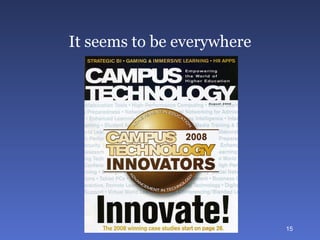
It seems to be everywhere
Innovation seems cool it seems to be about ideas BMW ad here about BMW being all about ideas
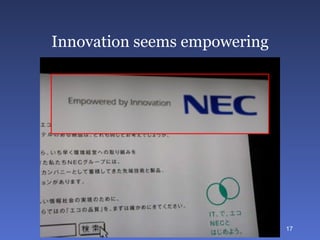
Innovation seems empowering
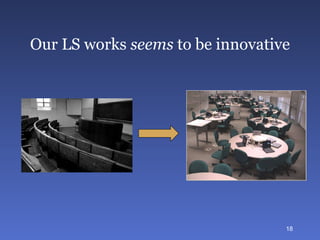
Our LS works  seems  to be innovative
Apollo 13 Excerpt from the movie Apollo 13 here
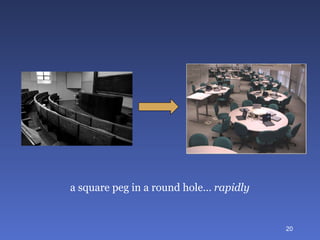
a square peg in a round hole…  rapidly
It  feels  like innovation No formula Adoption to rapidly changing circumstances Working with teams Often handed odds & ends Funding can be uncertain New ideas not always received well
but is innovation?
10
1 Innovation = Epiphany or does it???
Version 2: Innovation = Idea
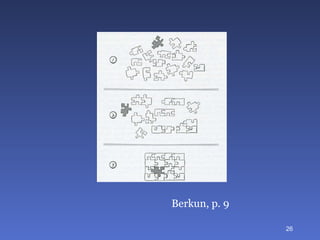
Berkun, p. 9
“ The best way to get a good idea is to get a lot of ideas.” Linus Pauling
Implementation “ The elaboration of idea into function… [is] ‘ the one that takes up the most time and  involves the hardest work.’ ” Berkun,  Myths of Innovation , p. 13
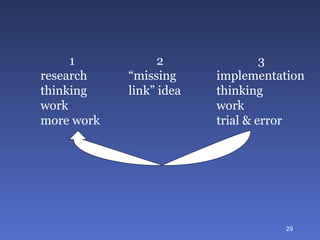
1 research  thinking  work more work 2 “ missing link” idea 3 implementation thinking  work trial & error
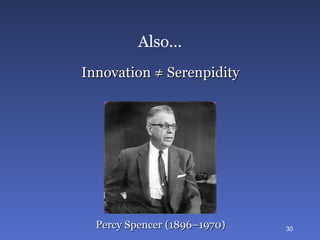
Also… Innovation ≠ Serenpidity Percy Spencer (1896–1970)
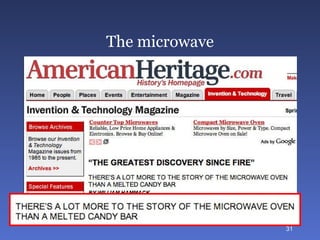
The microwave
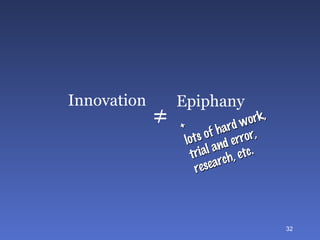
Innovation Epiphany = ≠ +   lots of hard work, trial and error, research, etc.
Thought “ Every innovation is difficult.” Christensen,  Innovator’s Dilemma , p. 154
2 Understand the diffusion process
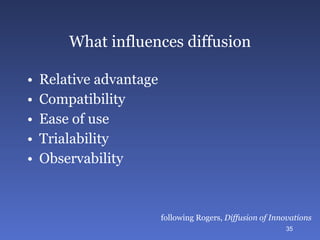
What influences diffusion Relative advantage Compatibility Ease of use Trialability Observability following Rogers,  Diffusion of Innovations
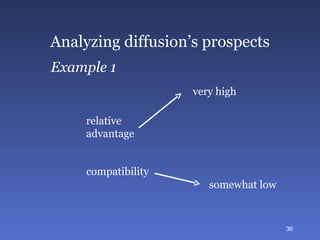
Analyzing diffusion’s prospects Example 1 relative advantage very high compatibility somewhat low
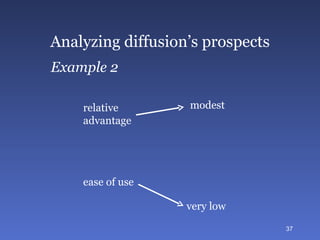
Analyzing diffusion’s prospects Example 2 relative advantage modest ease of use very low
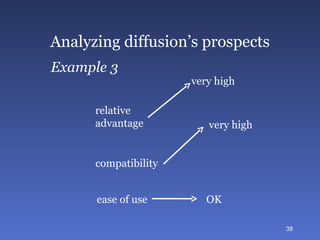
Analyzing diffusion’s prospects Example 3 compatibility very high relative advantage very high ease of use OK
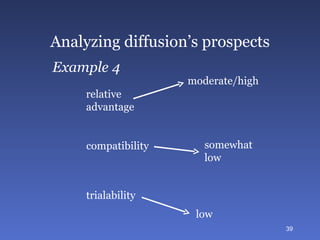
Analyzing diffusion’s prospects Example 4 relative advantage moderate/high compatibility somewhat low trialability low
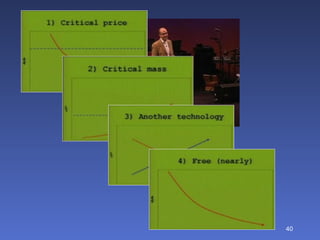
TED talk: Technology’s Long Tail
3 Do better brainstorming
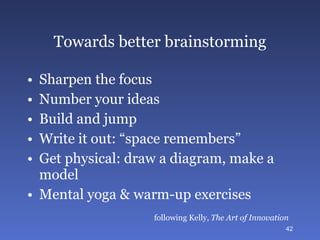
Towards better brainstorming Sharpen the focus Number your ideas Build and jump Write it out: “space remembers” Get physical: draw a diagram, make a model Mental yoga & warm-up exercises following Kelly,  The Art of Innovation
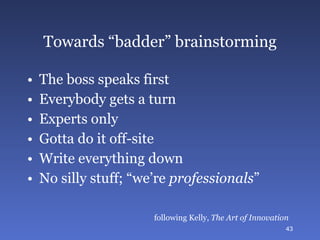
Towards “badder” brainstorming The boss speaks first Everybody gets a turn Experts only Gotta do it off-site Write everything down No silly stuff; “we’re  professionals ” following Kelly,  The Art of Innovation
4 Understand the challenges of disruption
Thought “ If, at first, the idea is not absurd, then there is no  hope for it.” Albert Einstein
“ I can’t waste my time on this stuff.” Disney exec on Pixar, c. 1987 (NYT review)
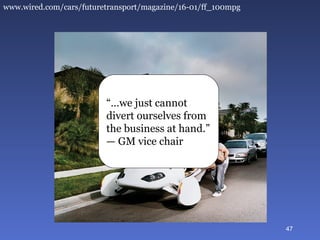
“… we just cannot divert ourselves from the business at hand.” — GM vice chair www.wired.com/cars/futuretransport/magazine/16-01/ff_100mpg
“ Search doesn’t matter.  Portals do.” Yahoo execs, 1998
Disruption is hard Limited market capacity for disruption Disruptive tech won’t fit Our orgs our less flexible than we want to believe Failure and iterative learning are keys Reluctance to invest in disruption: not something you “can bank on” following Christensen,  Innovator’s Dilemma
Managing for disruption Align disruptive tech with the right customers so there’s tangible demand Align to small, independent units for small growth Fail early and inexpensively Search for markets not technological breakthroughs following Christensen,  Innovator’s Dilemma,  p. 113–114
5 Learn to see and observe
“ You can observe a lot by just watching.” Yogi Berra
Learning to see Don’t rely on surveys and focus groups Focus on what they  do  not on what they  say Experts may know too much Customers may lack the vocabulary to say what is wrong or missing
6 Be left-handed
“ It’s not that we build such bad cars; it’s that they are such lousy customers.” Auto executive, 1930’s
Being left handed Customers have “jobs” They “hire” products and services to do them Target circumstances, not customers Carefully observe what people are trying to achieve Danger in asking people to “change jobs” following Christensen,  Innovator’s Solution
7 Fear not failure
Thought “ If I have a thousand ideas and only one turns out  to be good, I am satisfied.” Alfred Bernhard Nobel
http://www.wd40.com/about-us/history/
8 Look for blisters and rule-breakers
“… your customers may lack the vocabulary or the palate to explain what’s wrong and especially what’s  missing .” Kelly,  Art of Innovation , p. 27
“ We all had cell phones. We just hated them, they were so awful to use. Everybody seemed to hate their phones.”  Steve Jobs on the idea of the iPhone
9 Who’s on your LS team?
Team building Lone genius most often a myth Team’s charge and frame Not about defending status quo Sense of something is at stake Flatter the better Select for ability not seniority Create energy: fun
Team motivation “ A specific performance challenge that is clear and compelling to all team members is the greatest motivator.” Wisdom of Teams , p. 269
10 Aim for the wet napkin interface
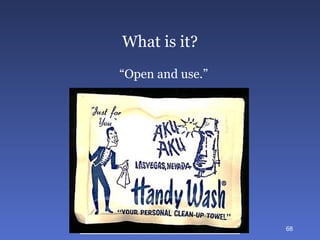
What is it? “ Open and use.”
Getting there More is less Rigorous limits on user options One click is better than two Give users feedback Don’t trust your interface entirely Emphasize essentials
“ If I’d have asked my customers what they wanted, they would have told me ‘A faster horse.’ ” attributed to Henry Ford
Thank you!
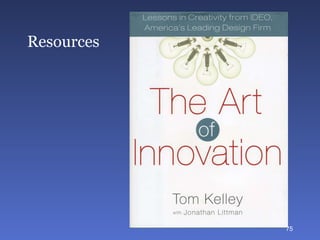
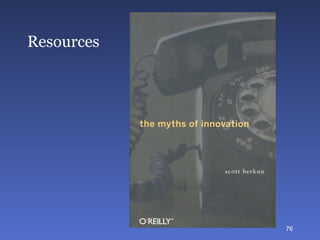
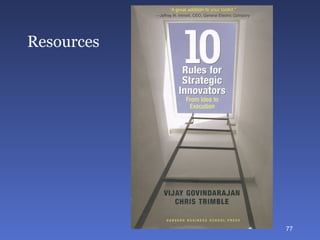
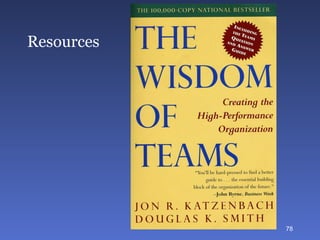
Resources
Resources
Resources
Resources
Resources
Resources
Resources
Resources
Resources
Resources

Eli 2008 Fall Focus

  • 1.
    Spaces to LearnSpaces to Innovate ELI Fall Focus Session 2008 Malcolm Brown Educause Learning Initiative [email_address]
  • 2.
    “ If I’dhave asked my customers what they wanted, they would have told me ‘A faster horse.’ ” attributed to Henry Ford
  • 4.
    “ Well… howdid I get here?”
  • 5.
    “ Well… howdid I get here?” North Carolina State http://www.ncsu.edu/PER/scaleup.html
  • 6.
    “ Well… howdid I get here?”
  • 7.
    “Well… how didI get here?” Columbia University Teachers College, Gottesman Libraries
  • 8.
    “ Well… howdid I get here?”
  • 9.
    “Well… how didI get here?” Georgetown University Law Center Eric E. Hotung International Law Building
  • 10.
    Steps Educause Quarterly, No. 1, 2003, pp. 14–15
  • 11.
    Steps Educause Quarterlyop-ed piece: 2003 ELI LS focus sessions Classrooms Fall 2004 Informal Spaces Fall 2005 Mobile Learning Spring 2006 LS eBook: 2006 Educause LS constituent group: late 2006
  • 12.
    Technology Learning theory (how people learn) we are here social web NetGens: students and young faculty
  • 13.
    How did weget here? We’ve innovated
  • 14.
    But what isinnovation? What does it “look” like? Feel like? How does it work? How can we be better at it? What are all the moving parts?
  • 15.
    It seems tobe everywhere
  • 16.
    Innovation seems coolit seems to be about ideas BMW ad here about BMW being all about ideas
  • 17.
  • 18.
    Our LS works seems to be innovative
  • 19.
    Apollo 13 Excerptfrom the movie Apollo 13 here
  • 20.
    a square pegin a round hole… rapidly
  • 21.
    It feels like innovation No formula Adoption to rapidly changing circumstances Working with teams Often handed odds & ends Funding can be uncertain New ideas not always received well
  • 22.
  • 23.
  • 24.
    1 Innovation =Epiphany or does it???
  • 25.
  • 26.
  • 27.
    “ The bestway to get a good idea is to get a lot of ideas.” Linus Pauling
  • 28.
    Implementation “ Theelaboration of idea into function… [is] ‘ the one that takes up the most time and involves the hardest work.’ ” Berkun, Myths of Innovation , p. 13
  • 29.
    1 research thinking work more work 2 “ missing link” idea 3 implementation thinking work trial & error
  • 30.
    Also… Innovation ≠Serenpidity Percy Spencer (1896–1970)
  • 31.
  • 32.
    Innovation Epiphany =≠ + lots of hard work, trial and error, research, etc.
  • 33.
    Thought “ Everyinnovation is difficult.” Christensen, Innovator’s Dilemma , p. 154
  • 34.
    2 Understand thediffusion process
  • 35.
    What influences diffusionRelative advantage Compatibility Ease of use Trialability Observability following Rogers, Diffusion of Innovations
  • 36.
    Analyzing diffusion’s prospectsExample 1 relative advantage very high compatibility somewhat low
  • 37.
    Analyzing diffusion’s prospectsExample 2 relative advantage modest ease of use very low
  • 38.
    Analyzing diffusion’s prospectsExample 3 compatibility very high relative advantage very high ease of use OK
  • 39.
    Analyzing diffusion’s prospectsExample 4 relative advantage moderate/high compatibility somewhat low trialability low
  • 40.
  • 41.
    3 Do betterbrainstorming
  • 42.
    Towards better brainstormingSharpen the focus Number your ideas Build and jump Write it out: “space remembers” Get physical: draw a diagram, make a model Mental yoga & warm-up exercises following Kelly, The Art of Innovation
  • 43.
    Towards “badder” brainstormingThe boss speaks first Everybody gets a turn Experts only Gotta do it off-site Write everything down No silly stuff; “we’re professionals ” following Kelly, The Art of Innovation
  • 44.
    4 Understand thechallenges of disruption
  • 45.
    Thought “ If,at first, the idea is not absurd, then there is no hope for it.” Albert Einstein
  • 46.
    “ I can’twaste my time on this stuff.” Disney exec on Pixar, c. 1987 (NYT review)
  • 47.
    “… we justcannot divert ourselves from the business at hand.” — GM vice chair www.wired.com/cars/futuretransport/magazine/16-01/ff_100mpg
  • 48.
    “ Search doesn’tmatter. Portals do.” Yahoo execs, 1998
  • 49.
    Disruption is hardLimited market capacity for disruption Disruptive tech won’t fit Our orgs our less flexible than we want to believe Failure and iterative learning are keys Reluctance to invest in disruption: not something you “can bank on” following Christensen, Innovator’s Dilemma
  • 50.
    Managing for disruptionAlign disruptive tech with the right customers so there’s tangible demand Align to small, independent units for small growth Fail early and inexpensively Search for markets not technological breakthroughs following Christensen, Innovator’s Dilemma, p. 113–114
  • 51.
    5 Learn tosee and observe
  • 52.
    “ You canobserve a lot by just watching.” Yogi Berra
  • 53.
    Learning to seeDon’t rely on surveys and focus groups Focus on what they do not on what they say Experts may know too much Customers may lack the vocabulary to say what is wrong or missing
  • 54.
  • 55.
    “ It’s notthat we build such bad cars; it’s that they are such lousy customers.” Auto executive, 1930’s
  • 56.
    Being left handedCustomers have “jobs” They “hire” products and services to do them Target circumstances, not customers Carefully observe what people are trying to achieve Danger in asking people to “change jobs” following Christensen, Innovator’s Solution
  • 57.
    7 Fear notfailure
  • 58.
    Thought “ IfI have a thousand ideas and only one turns out to be good, I am satisfied.” Alfred Bernhard Nobel
  • 60.
  • 61.
    8 Look forblisters and rule-breakers
  • 62.
    “… your customersmay lack the vocabulary or the palate to explain what’s wrong and especially what’s missing .” Kelly, Art of Innovation , p. 27
  • 63.
    “ We allhad cell phones. We just hated them, they were so awful to use. Everybody seemed to hate their phones.” Steve Jobs on the idea of the iPhone
  • 64.
    9 Who’s onyour LS team?
  • 65.
    Team building Lonegenius most often a myth Team’s charge and frame Not about defending status quo Sense of something is at stake Flatter the better Select for ability not seniority Create energy: fun
  • 66.
    Team motivation “A specific performance challenge that is clear and compelling to all team members is the greatest motivator.” Wisdom of Teams , p. 269
  • 67.
    10 Aim forthe wet napkin interface
  • 68.
    What is it?“ Open and use.”
  • 69.
    Getting there Moreis less Rigorous limits on user options One click is better than two Give users feedback Don’t trust your interface entirely Emphasize essentials
  • 70.
    “ If I’dhave asked my customers what they wanted, they would have told me ‘A faster horse.’ ” attributed to Henry Ford
  • 71.
  • 72.
  • 73.
  • 74.
  • 75.
  • 76.
  • 77.
  • 78.
  • 79.
  • 80.
  • 81.

Editor's Notes

  • #5 North Carolina State http://www.ncsu.edu/PER/scaleup.html
  • #6 North Carolina State http://www.ncsu.edu/PER/scaleup.html
  • #7 Columbia University Teachers College, Gottesman Libraries Peter Aaron/Esto c/o Sara Lepanto or Erica Stoller sara@esto.com t. 914-698-4060 f. 914-698-1033
  • #8 Columbia University Teachers College, Gottesman Libraries Peter Aaron/Esto c/o Sara Lepanto or Erica Stoller sara@esto.com t. 914-698-4060 f. 914-698-1033
  • #9 OLD: http://www.flickr.com/photos/janeladeimagens/170838066/ NEW: Georgetown University Law Center Eric E. Hotung International Law Building Peter Aaron/Esto c/o Sara Lepanto or Erica Stoller sara@esto.com t. 914-698-4060 f. 914-698-1033
  • #10 OLD: http://www.flickr.com/photos/janeladeimagens/170838066/ NEW: Georgetown University Law Center Eric E. Hotung International Law Building Peter Aaron/Esto c/o Sara Lepanto or Erica Stoller sara@esto.com t. 914-698-4060 f. 914-698-1033
  • #15 If we know more about innovation and the innovation process, that will help us with our own LSs work.
  • #25 http://www.ted.com/index.php/talks/chris_anderson_of_wired_on_tech_s_long_tail.html One idea of what innovation is and how it works is that of the epiphany, the sudden emergence of a powerful idea, seemingly from nowhere. Why these epiphanies “strike” some and not others is a metaphysical question that we won’t try to address right now. Perhaps the prototype story of the epiphany is that of the apple (nothing to do with Steve Jobs) falling on Newton’s head, which caused an epiphany to erupt in his head about gravity. But if you read the history of innovation, read the case studies, you quickly come to the conclusion that this is a superficial notion of what innovation is and how it works. There is more than meets the eye with respect to innovation than the summative idea. Many innovation processes occur with no "ah ha" moment. And if there is an "ah ha" moment then it is simply the most visible component of a multifaceted process.
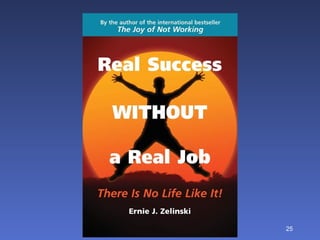
  • #26 Sometimes this notion changes clothes and equates innovation with having an idea. This is a bit analogous to winning the lottery, or making a living without making a living. There is indeed no life like it, there is no innovation like it period, because innovation is far more than just an idea. If you garden, the notion of "having a garden" does not mean just the moment when a flower blooms or a vegetable is ready to harvest. Or that raising a child is equivalent to the moment he or she graduates from high school. There's a bit more to it than that.
  • #27 Berkun: “Epiphany is the moment when the last piece of work fits into place. However, the last piece isn’t any more magical than the others, and has no magic without its connection to the other pieces.” p. 9 A metaphor offered by one of the authors I have read likens innovation to a jigsaw puzzle. To complete the puzzle, all the pieces must be put into place. The final one may be the moment with the highest drama, but it by itself doesn't constitute the puzzle. As the author writes: “Epiphany is the moment when the last piece of work fits into place. However, the last piece isn’t any more magical than the others, and has no magic without its connection to the other pieces.” p. 9
  • #29 This is a good way to debunk the "innovation is having an idea" notion. Once you have had a good idea, it doesn't mean that it is as yet something realized; an idea is not a product. And as we shall see, even if you get to the point of having implemented an idea, to have made it into a product, then there is the question of adoption. Even if you do build it, they still might not come.
  • #30 Iphone: 10 versions
  • #31 following Berkun, p. 133 Example of the discovery of the microwave oven. Berkun p. 133. Dr. Percy Spencer. photo: http://invention.smithsonian.org/centerpieces/iap/inventors_spe.html
  • #32 http://www.gallawa.com/microtech/history.html http://www.americanheritage.com/articles/magazine/it/2005/4/2005_4_48.shtml “The oft-reported candy-bar incident may perhaps have spurred Spencer to experiment with food, but the possibilities of using microwave tubes for heating were already quite well known.”
  • #35 http://www.ted.com/index.php/talks/chris_anderson_of_wired_on_tech_s_long_tail.html
  • #41 http://www.ted.com/index.php/talks/chris_anderson_of_wired_on_tech_s_long_tail.html
  • #47 "In the grinding gears of this story, there is always an older, established entity that acts too timidly for fear of undermining its core business." NYT review
  • #48 http://www.wired.com/cars/futuretransport/magazine/16-01/ff_100mpg http://www.progressiveautoxprize.org/
  • #49 David Vise, “Google’s decade” http://www.technologyreview.com/blog/guest/22128/. “1998: Yahoo and others pass on the chance to buy new search technology developed at Stanford University for $500,000. Their rationale: "Search doesn't matter. Portals do."These rejections forced Sergey Brin and Larry Page to reluctantly take a leave of absence from Stanford (both wanted to become college professors, like their dads) to see if they could turn Google, their new search engine, into a business.”
  • #50 Apple Newton (Christensen, Dilemma, pp. 149–151. Apple I in 1976 200 units. Apple II, then Apple II+. Similar: Lisa failed, third gen Mac. Newton 140K units in 1993 and 1994. Newton perceived to be a flop; expensive, handwriting recognition software disappointing. Christensen: the “flop” was expecting big market (sustaining) sales from a disruptive market, which is inherently small. [CHECK THE IPOD HISTORY… SIMILAR?] Hydraulic story. Again entrenched firms seeing good profit Minimill steel. “Dramatically improving profit” Ice industry story.
  • #51 Apple Newton (Christensen, Dilemma, pp. 149–151. Apple I in 1976 200 units. Apple II, then Apple II+. Similar: Lisa failed, third gen Mac. Newton 140K units in 1993 and 1994. Newton perceived to be a flop; expensive, handwriting recognition software disappointing. Christensen: the “flop” was expecting big market (sustaining) sales from a disruptive market, which is inherently small. [CHECK THE IPOD HISTORY… SIMILAR?] Hydraulic story. Again entrenched firms seeing good profit Minimill steel. “Dramatically improving profit” Ice industry story.
  • #54 Examples: Kelly, filing by piling Kelly: “"We're not big fans of focus groups... We go to the source. Not the 'experts' inside a company, but the actual people who use the product or something similar to what we're hoping to create.” Jobs: "We all had cellphones. We just hated them, they were so awful to use… Everybody seemed to hate their phones.” Jobs: "We do no market research… we never hire consultants, per se. We just want to make great products.”
  • #56 Kelly, p. 41
  • #57 following Christensen, Innovator’s Solution, chapter 3
  • #66 Edison’s four hundred patents. With the help of a fourteen man team. (Kelly p70) michaelangelo + team = sistine chapel
  • #67 “ If a team has the right charge, it will energize.” Kelly 73