IN-VITRO, IN-VIVO STUDIES AND HPTLC FINGERPRINTING AND QUANTIFICATION
OF BIO ACTIVE COMPOUNDS FROM THUNBERGIA GRANDIFLORA
For the partial fulfilment of Degree Master of Pharmacy (Division of Pharmaceutical
chemistry) 2021
Under the guidance of
Dr TC. LALHRIATPUII
Asst. Professor
Department of Pharmacy, RIPANS
Presented by:
Sungjemrenla I Jamir
M.Pharm 4th Semester
RIPANS, Mizoram
AIMS AND OBJECTIVES
Aim: To carry out in-vitro, in-vivo studies and HPTLC fingerprinting
and quantification of bio active compounds from Thunbergia
grandiflora Roxb.
Objectives:
1. Collection and drying of the leaves
2. Authentication of the plant specimen
3. Extraction of the plant components using different solvents
4. Preliminary phytochemical screening
5. To carry out in-vitro Anti-oxidant and Anti-inflammatory studies
7. To carry out in-vivo anti-inflammatory studies
8. HPTLC fingerprint analysis of extract.
9. HPTLC quantification of the bio active compounds
Literature survey:
1. Mohammad Nazmul Alam et al (2015) reported the anti-inflammatory, anti-arthritic activity of
methanol extract of Thunbergia grandiflora Roxb. (Acanthaceae) leaf.
2. Magda T Ibrahim et al Investigated the presence of ten isolated compounds from 70% aqueous
methanol extract of Thunbergia grandiflora Roxb leaves.
3. Anumol Mathew et al (2019) Carried out the Green synthesis of silver nanoparticles from the
leaf extract of Thunbergia grandiflora Roxb. by bioreduction of silver nitrate to silver
nanoparticles due to the presence of biological compounds present in the leaf.
4. Mahesh Babanrao Thorat et al reported the in-vivo acute toxicity, anticancer and antioxidant
activity.
5. Sultana KW et al reported ethnomedicinal importance of common Thunbergia species and
reported the Antibacterial, antifungal and anthelmintic activity of Thunbergia grandiflora.
6. Md. Josim Uddin et al (2016) investigated the anticholinesterase and antioxidant potentials of
Thunbergia grandiflora Roxb.
7. Shuang LIANG et al compared and analyzed the chemical constituents of the volatile oils of the
plant Thunbergia grandiflora.
8. A. Charles et al investigated the phytochemical and bio-activity studies of traditional medicinal
plants –Genus Thunbergia plants and found to be the new sources of phytoconstituents with
many biochemical and pharmacological activities
INTRODUCTION
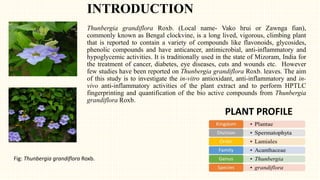
Thunbergia grandiflora Roxb. (Local name- Vako hrui or Zawnga fian),
commonly known as Bengal clockvine, is a long lived, vigorous, climbing plant
that is reported to contain a variety of compounds like flavonoids, glycosides,
phenolic compounds and have anticancer, antimicrobial, anti-inflammatory and
hypoglycemic activities. It is traditionally used in the state of Mizoram, India for
the treatment of cancer, diabetes, eye diseases, cuts and wounds etc. However
few studies have been reported on Thunbergia grandiflora Roxb. leaves. The aim
of this study is to investigate the in-vitro antioxidant, anti-inflammatory and in-
vivo anti-inflammatory activities of the plant extract and to perform HPTLC
fingerprinting and quantification of the bio active compounds from Thunbergia
grandiflora Roxb.
PLANT PROFILE
Fig: Thunbergia grandiflora Roxb.
METHODOLOGY
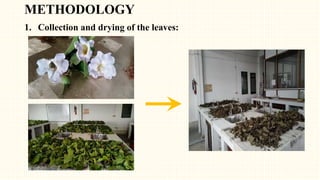
1. Collection and drying of the leaves:
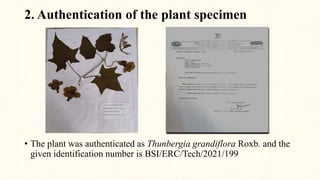
2. Authentication of the plant specimen
• The plant was authenticated as Thunbergia grandiflora Roxb. and the
given identification number is BSI/ERC/Tech/2021/199
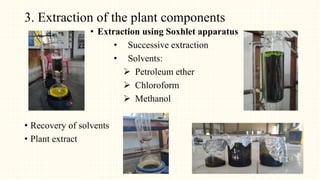
3. Extraction of the plant components
• Extraction using Soxhlet apparatus
• Successive extraction
• Solvents:
 Petroleum ether
 Chloroform
 Methanol
• Recovery of solvents
• Plant extract
4.Preliminary phytochemical screening
• Test for alkaloids
• Test for tannins
• Test for phenols
• Test for Flavonoids
• Test for saponins
• Test for carbohydrates
• Test for proteins and amino acid
• Test for steroids and triterpenoids
• Test for glycosides
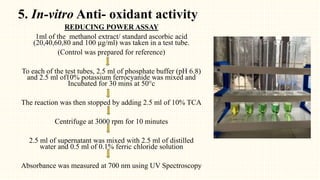
5. In-vitro Anti- oxidant activity
REDUCING POWER ASSAY
1ml of the methanol extract/ standard ascorbic acid
(20,40,60,80 and 100 µg/ml) was taken in a test tube.
(Control was prepared for reference)
To each of the test tubes, 2.5 ml of phosphate buffer (pH 6.8)
and 2.5 ml of10% potassium ferrocyanide was mixed and
Incubated for 30 mins at 50°c
The reaction was then stopped by adding 2.5 ml of 10% TCA
Centrifuge at 3000 rpm for 10 minutes
2.5 ml of supernatant was mixed with 2.5 ml of distilled
water and 0.5 ml of 0.1% ferric chloride solution
Absorbance was measured at 700 nm using UV Spectroscopy
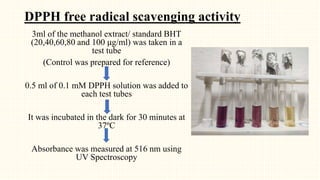
DPPH free radical scavenging activity
3ml of the methanol extract/ standard BHT
(20,40,60,80 and 100 µg/ml) was taken in a
test tube
(Control was prepared for reference)
0.5 ml of 0.1 mM DPPH solution was added to
each test tubes
It was incubated in the dark for 30 minutes at
37ºC
Absorbance was measured at 516 nm using
UV Spectroscopy
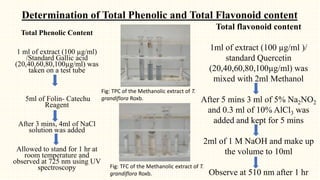
Determination of Total Phenolic and Total Flavonoid content
Total Phenolic Content
1 ml of extract (100 µg/ml)
/Standard Gallic acid
(20,40,60,80,100µg/ml) was
taken on a test tube
5ml of Folin- Catechu
Reagent
After 3 mins, 4ml of NaCl
solution was added
Allowed to stand for 1 hr at
room temperature and
observed at 725 nm using UV
spectroscopy
Total flavonoid content
1ml of extract (100 µg/ml )/
standard Quercetin
(20,40,60,80,100µg/ml) was
mixed with 2ml Methanol
After 5 mins 3 ml of 5% Na2NO2
and 0.3 ml of 10% AlCl3 was
added and kept for 5 mins
2ml of 1 M NaOH and make up
the volume to 10ml
Observe at 510 nm after 1 hr
Fig: TPC of the Methanolic extract of T.
grandiflora Roxb.
Fig: TFC of the Methanolic extract of T.
grandiflora Roxb.
6. In-vitro Anti inflammatory study
Egg Albumin denaturation method
0.2 ml egg albumin + 2.8 ml phosphate buffer saline (pH 6.4)+ 2ml of
varying concentrations( 100,200,300,400,500 µg/ml) of the methanol
extract/ standard drug Diclofenac Sodium was taken in a test tube
(Control was prepared for reference)
It was incubated at 37°C for 15 mins and heated at 70 °C for 5 mins
After cooling, Absorbance was measured at 660nm
Bovine serum albumin denaturation assay
0.45 ml of BSA(5%W/V) + 0.5 ml of the methanol extract/ standard drug
Diclofenac sodium was taken in a test tube
It was incubated at 37°C for 15 mins and heated at 57 °C for 30 mins
After cooling, 2.5 ml of Buffer solution saline (pH 6.3) was added
Absorbance was measured at 416 nm using UV Spectroscopy
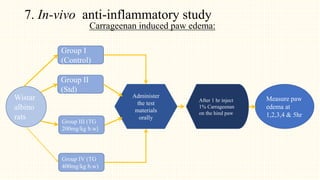
7. In-vivo anti-inflammatory study
Carrageenan induced paw edema:
Wistar
albino
rats
Group I
(Control)
Administer
the test
materials
orally
Group II
(Std)
Group III (TG
200mg/kg b.w)
Group IV (TG
400mg/kg b.w)
After 1 hr inject
1% Carrageenan
on the hind paw
Measure paw
edema at
1,2,3,4 & 5hr
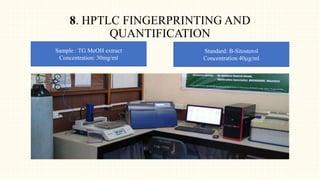
Sample : TG MeOH extract
Concentration: 30mg/ml
8. HPTLC FINGERPRINTING AND
QUANTIFICATION
Standard: B-Sitosterol
Concentration 40µg/ml
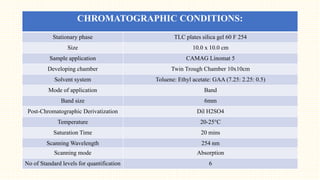
CHROMATOGRAPHIC CONDITIONS:
Stationary phase TLC plates silica gel 60 F 254
Size 10.0 x 10.0 cm
Sample application CAMAG Linomat 5
Developing chamber Twin Trough Chamber 10x10cm
Solvent system Toluene: Ethyl acetate: GAA (7.25: 2.25: 0.5)
Mode of application Band
Band size 6mm
Post-Chromatographic Derivatization Dil H2SO4
Temperature 20-25°C
Saturation Time 20 mins
Scanning Wavelength 254 nm
Scanning mode Absorption
No of Standard levels for quantification 6
Result and discussion:
1. Percentage yield of plant extracts:
I. Soxhlet extraction
Percentage yield (%)= Dry weight of extract X 100
Dry weight of plant material
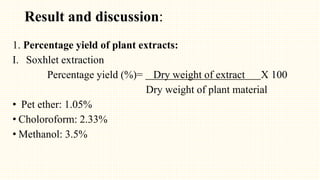
• Pet ether: 1.05%
• Choloroform: 2.33%
• Methanol: 3.5%
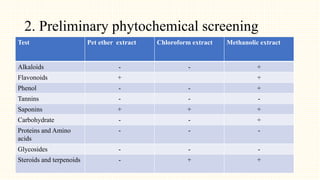
2. Preliminary phytochemical screening
Test Pet ether extract Chloroform extract Methanolic extract
Alkaloids - - +
Flavonoids + +
Phenol - - +
Tannins - - -
Saponins + + +
Carbohydrate - - +
Proteins and Amino
acids
- - -
Glycosides - - -
Steroids and terpenoids - + +
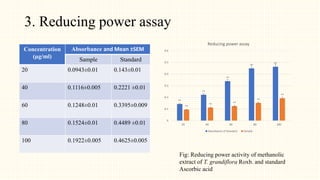
3. Reducing power assay
Concentration
(µg/ml)
Absorbance and Mean ±SEM
Sample Standard
20 0.0943±0.01 0.143±0.01
40 0.1116±0.005 0.2221 ±0.01
60 0.1248±0.01 0.3395±0.009
80 0.1524±0.01 0.4489 ±0.01
100 0.1922±0.005 0.4625±0.005
Fig: Reducing power activity of methanolic
extract of T. grandiflora Roxb. and standard
Ascorbic acid
**
**
**
**
**
**
**
**
**
**
0
0.1
0.2
0.3
0.4
0.5
0.6
20 40 60 80 100
Reducing power assay
Absorbance of Standard Sample
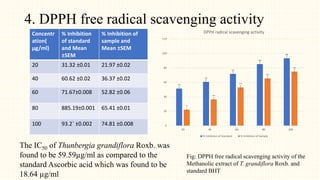
4. DPPH free radical scavenging activity
Concentr
ation(
µg/ml)
% Inhibition
of standard
and Mean
±SEM
% Inhibition of
sample and
Mean ±SEM
20 31.32 ±0.01 21.97 ±0.02
40 60.62 ±0.02 36.37 ±0.02
60 71.67±0.008 52.82 ±0.06
80 885.19±0.001 65.41 ±0.01
100 93.2` ±0.002 74.81 ±0.008
Fig: DPPH free radical scavenging activity of the
Methanolic extract of T. grandiflora Roxb. and
standard BHT
The IC50 of Thunbergia grandiflora Roxb. was
found to be 59.59µg/ml as compared to the
standard Ascorbic acid which was found to be
18.64 µg/ml
**
**
**
**
**
*
**
**
**
**
0
20
40
60
80
100
120
20 40 60 80 100
DPPH radical scavenging activity
% Inhibition of Standard % Inhibition of Sample
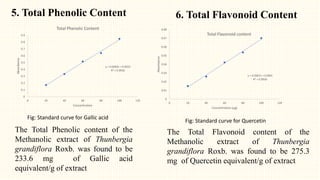
5. Total Phenolic Content
y = 0.0083x + 0.0033
R² = 0.9956
0
0.1
0.2
0.3
0.4
0.5
0.6
0.7
0.8
0.9
0 20 40 60 80 100 120
Absorbance
Concentration
Total Phenolic Content
Fig: Standard curve for Gallic acid
The Total Phenolic content of the
Methanolic extract of Thunbergia
grandiflora Roxb. was found to be
233.6 mg of Gallic acid
equivalent/g of extract
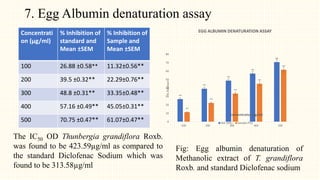
6. Total Flavonoid Content
y = 0.0007x + 0.0001
R² = 0.9956
0
0.01
0.02
0.03
0.04
0.05
0.06
0.07
0.08
0 20 40 60 80 100 120
Absorbance
Concentration (µg)
Total Flavonoid content
Fig: Standard curve for Quercetin
The Total Flavonoid content of the
Methanolic extract of Thunbergia
grandiflora Roxb. was found to be 275.3
mg of Quercetin equivalent/g of extract
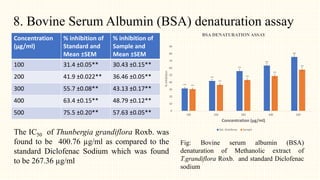
7. Egg Albumin denaturation assay
Concentrati
on (µg/ml)
% Inhibition of
standard and
Mean ±SEM
% Inhibition of
Sample and
Mean ±SEM
100 26.88 ±0.58** 11.32±0.56**
200 39.5 ±0.32** 22.29±0.76**
300 48.8 ±0.31** 33.35±0.48**
400 57.16 ±0.49** 45.05±0.31**
500 70.75 ±0.47** 61.07±0.47**
Fig: Egg albumin denaturation of
Methanolic extract of T. grandiflora
Roxb. and standard Diclofenac sodium
The IC50 OD Thunbergia grandiflora Roxb.
was found to be 423.59µg/ml as compared to
the standard Diclofenac Sodium which was
found to be 313.58µg/ml
**
**
**
**
**
**
**
**
**
**
0
10
20
30
40
50
60
70
80
100 200 300 400 500
%
Ihibition
Comcemtration (µg/ml)
EGG ALBUMIN DENATURATION ASSAY
Std. (DIC) Sample (TG)
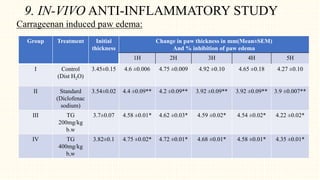
8. Bovine Serum Albumin (BSA) denaturation assay
Concentration
(µg/ml)
% inhibition of
Standard and
Mean ±SEM
% inhibition of
Sample and
Mean ±SEM
100 31.4 ±0.05** 30.43 ±0.15**
200 41.9 ±0.022** 36.46 ±0.05**
300 55.7 ±0.08** 43.13 ±0.17**
400 63.4 ±0.15** 48.79 ±0.12**
500 75.5 ±0.20** 57.63 ±0.05**
Fig: Bovine serum albumin (BSA)
denaturation of Methanolic extract of
T.grandiflora Roxb. and standard Diclofenac
sodium
The IC50 of Thunbergia grandiflora Roxb. was
found to be 400.76 µg/ml as compared to the
standard Diclofenac Sodium which was found
to be 267.36 µg/ml
**
**
**
**
**
**
**
**
**
**
0
10
20
30
40
50
60
70
80
90
100 200 300 400 500
%
Inhibition
Concentration (µg/ml)
BSA DENATURATION ASSAY
Std. Diclofenac Sample
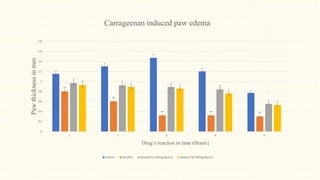
9. IN-VIVO ANTI-INFLAMMATORY STUDY
Carrageenan induced paw edema:
Group Treatment Initial
thickness
Change in paw thickness in mm(Mean±SEM)
And % inhibition of paw edema
1H 2H 3H 4H 5H
I Control
(Dist H2O)
3.45±0.15 4.6 ±0.006 4.75 ±0.009 4.92 ±0.10 4.65 ±0.18 4.27 ±0.10
II Standard
(Diclofenac
sodium)
3.54±0.02 4.4 ±0.09** 4.2 ±0.09** 3.92 ±0.09** 3.92 ±0.09** 3.9 ±0.007**
III TG
200mg/kg
b.w
3.7±0.07 4.58 ±0.01* 4.62 ±0.03* 4.59 ±0.02* 4.54 ±0.02* 4.22 ±0.02*
IV TG
400mg/kg
b,w
3.82±0.1 4.75 ±0.02* 4.72 ±0.01* 4.68 ±0.01* 4.58 ±0.01* 4.35 ±0.01*
**
**
** ** **
*
*
*
*
*
*
*
*
*
*
0
0.2
0.4
0.6
0.8
1
1.2
1.4
1.6
1.8
1 2 3 4 5
Paw
thickness
in
mm
Drug’s reaction in time (Hours}
Carrageenan induced paw edema
Control Std (DIC) Sample(TG) 200mg/Kg b.w Sample (TG) 400mg/kg b.w
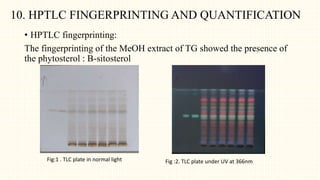
10. HPTLC FINGERPRINTING AND QUANTIFICATION
• HPTLC fingerprinting:
The fingerprinting of the MeOH extract of TG showed the presence of
the phytosterol : B-sitosterol
Fig:1 . TLC plate in normal light Fig :2. TLC plate under UV at 366nm
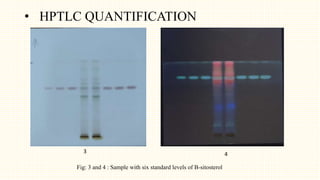
• HPTLC QUANTIFICATION
Fig: 3 and 4 : Sample with six standard levels of B-sitosterol
3 4
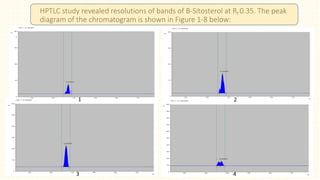
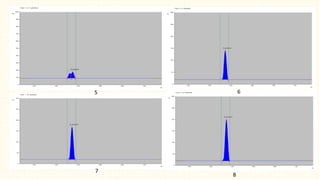
HPTLC study revealed resolutions of bands of B-Sitosterol at Rf 0.35. The peak
diagram of the chromatogram is shown in Figure 1-8 below:
.
1 2
3 4
5 6
7
8
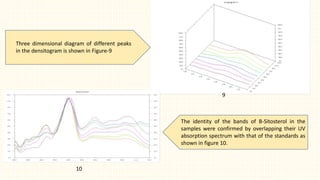
Three dimensional diagram of different peaks
in the densitogram is shown in Figure-9
9
10
The identity of the bands of B-Sitosterol in the
samples were confirmed by overlapping their UV
absorption spectrum with that of the standards as
shown in figure 10.
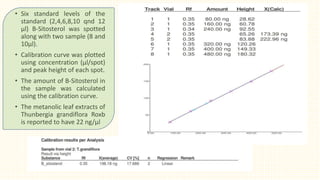
• Six standard levels of the
standard (2,4,6,8,10 qnd 12
µl) B-Sitosterol was spotted
along with two sample (8 and
10µl).
• Calibration curve was plotted
using concentration (µl/spot)
and peak height of each spot.
• The amount of B-Sitosterol in
the sample was calculated
using the calibration curve.
• The metanolic leaf extracts of
Thunbergia grandiflora Roxb
is reported to have 22 ng/µl
Conclusion:
• The different plant extracts (i.e Pet. Ether, Chloroform and MeOH) were
successfully extracted using Soxhlet apparatus.
• Preliminary phytochemical study was done and the results shows the possible
presence of alkaloids, flavonoids , sterols and terpenoids, phenols ,saponins and
carbohydrates.
• For the confirmation of the presence of flavonoids and phenols, quantitative
study was done and the results found were-
• 1. Flavonoid ( mg/gm of Quercetin)- 275.3 mg/gm of Quercetin
2. TPC (mg/gm of Gallic acid)- 233.6 mg/gm of gallic acid.
• Two in-vitro antioxidant studies- DPPH and Reducing power assay, were
performed with the Methanolic extract. After performing the assay, we may
conclude that the plant extract has the ability to scavenge the free radicals and
an increase in the concentration of the sample , increases the reducing power
respectively.
• Two in-vitro anti-inflammatory studies- Egg albumin and BSA Denaturation
studies, were performed with the Methanolic extract and the result obtained was
compared with the standard (Diclofenac sodium) which shows that the extract
may help in reducing inflammation.
• In-vivo anti inflammatory study – Carrageenan induced paw edema, showed
considerable anti inflammatory action for both the doses (200 and 400 mg/kg b,w)
by reducing paw edema. However further studies are essential to elucidate the
exact anti-inflammatory mechanism of action of the plant extract.
• The HPTLC analysis confirmed the presence of the phytosterol: B-Sitosterol.
Further quantification of the Methanolic extract of Thunbergia grandiflora Roxb.
Was done. The amount was found to be 22ng/µl.
B-Sitosterol is known for curing heart diseases and fighting
high cholesterol levels. It is also known to help in the prevention of Cancer,
allergies, asthma, etc. Therefore, it may play a role in the anti-inflammatory action.
We may conclude that the methanolic plant extract possess
anti- oxidant and anti-inflammatory activities which in future may help in
combating various diseases related to Cancer and other inflammatory diseases.
However, further research needs to be done.
Reference:
1. Magda T Ibrahim et al (2017). Phytochemical and Biological Investigation of Thunbergia grandiflora , Journal of Pharmacognosy and Phytochemistry;
6(2): 43-51
2. Bareh V, Imtilemla, Bharbhuiya SB, Sailo L (2021), In vitro antioxidant, anti inflammatory and antidiabetic activity of prunus Undulata buch-ham.wx d don
leaves. JOAPP 1(1), 22-29
3. Anumol Mathew et al (2019). Green Synthesis, Characterization and Applications of Silver Nanoparticles using Thunbergia grandiflora Roxb. J. Nanosci.
Tech. - Volume 5 Issue 2 669–672
4. Md. Josim Uddin et al (2016). In vitro antioxidative and cholinesterase inhibitory properties of Thunbergia grandiflora leaf extract. , Cogent Food &
Agriculture , 1-11
5. Alam M.N, et al., In- vitro comparative study of anti-inflammatory and anti-arthritic effects of the methanol extract of Cissus pentagona Roxb and
Thunbergia grandiflora Roxb leaf
6. Ibrahim et al (2017) Phytochemical and Biological Investigation of Thunbergia grandiflora, Journal of Pharmacognosy and Phytochemistry; 6(2): 43-51
7. Pranporn Kuropakornpong, et al “In Vitro and In Vivo Anti-Inflammatory Activities of Benjakul: APotential Medicinal Product from Thai Traditional
Medicine”
8. Uma. G Balasubramaniam.V abd Jagathes Kumar.S, In-vivo screening of Anti-inflammatory activity in methanolic extract of Corbichonia Decumbens (
Forsk) using various animal models of paw edema; page 146-148.
9. Hunskaar S, Hole K. (1987) The formalin test in mice: dissociation between inflammatory and non-inflammatory pain. Pain.;30:103-104
10. Mahesh Babanrao Thorat, Dr. Neetesh Kumar Jain “In Vivo Acute Toxicity, Anticancer And Antioxidant Assay Evaluation Of Thunbergia Grandiflora”
11. K Thanzami et al (2015) Characterization and in vitro antioxidant activity of Albizia stipulata Boiv. gum exudates, NIH
12. Kalaisezhiyen Pavithra et al (2015). Evaluation of free radical scavenging activity of various extracts of leaves from Kedrostis foetidissima (Jacq.), Food
Science and Human Wellness,1-13
Arenla Presentation.pptx

Arenla Presentation.pptx

  • 1.
    IN-VITRO, IN-VIVO STUDIESAND HPTLC FINGERPRINTING AND QUANTIFICATION OF BIO ACTIVE COMPOUNDS FROM THUNBERGIA GRANDIFLORA For the partial fulfilment of Degree Master of Pharmacy (Division of Pharmaceutical chemistry) 2021 Under the guidance of Dr TC. LALHRIATPUII Asst. Professor Department of Pharmacy, RIPANS Presented by: Sungjemrenla I Jamir M.Pharm 4th Semester RIPANS, Mizoram
  • 2.
    AIMS AND OBJECTIVES Aim:To carry out in-vitro, in-vivo studies and HPTLC fingerprinting and quantification of bio active compounds from Thunbergia grandiflora Roxb. Objectives: 1. Collection and drying of the leaves 2. Authentication of the plant specimen 3. Extraction of the plant components using different solvents 4. Preliminary phytochemical screening 5. To carry out in-vitro Anti-oxidant and Anti-inflammatory studies 7. To carry out in-vivo anti-inflammatory studies 8. HPTLC fingerprint analysis of extract. 9. HPTLC quantification of the bio active compounds
  • 3.
    Literature survey: 1. MohammadNazmul Alam et al (2015) reported the anti-inflammatory, anti-arthritic activity of methanol extract of Thunbergia grandiflora Roxb. (Acanthaceae) leaf. 2. Magda T Ibrahim et al Investigated the presence of ten isolated compounds from 70% aqueous methanol extract of Thunbergia grandiflora Roxb leaves. 3. Anumol Mathew et al (2019) Carried out the Green synthesis of silver nanoparticles from the leaf extract of Thunbergia grandiflora Roxb. by bioreduction of silver nitrate to silver nanoparticles due to the presence of biological compounds present in the leaf. 4. Mahesh Babanrao Thorat et al reported the in-vivo acute toxicity, anticancer and antioxidant activity. 5. Sultana KW et al reported ethnomedicinal importance of common Thunbergia species and reported the Antibacterial, antifungal and anthelmintic activity of Thunbergia grandiflora. 6. Md. Josim Uddin et al (2016) investigated the anticholinesterase and antioxidant potentials of Thunbergia grandiflora Roxb. 7. Shuang LIANG et al compared and analyzed the chemical constituents of the volatile oils of the plant Thunbergia grandiflora. 8. A. Charles et al investigated the phytochemical and bio-activity studies of traditional medicinal plants –Genus Thunbergia plants and found to be the new sources of phytoconstituents with many biochemical and pharmacological activities
  • 4.
    INTRODUCTION Thunbergia grandiflora Roxb.(Local name- Vako hrui or Zawnga fian), commonly known as Bengal clockvine, is a long lived, vigorous, climbing plant that is reported to contain a variety of compounds like flavonoids, glycosides, phenolic compounds and have anticancer, antimicrobial, anti-inflammatory and hypoglycemic activities. It is traditionally used in the state of Mizoram, India for the treatment of cancer, diabetes, eye diseases, cuts and wounds etc. However few studies have been reported on Thunbergia grandiflora Roxb. leaves. The aim of this study is to investigate the in-vitro antioxidant, anti-inflammatory and in- vivo anti-inflammatory activities of the plant extract and to perform HPTLC fingerprinting and quantification of the bio active compounds from Thunbergia grandiflora Roxb. PLANT PROFILE Fig: Thunbergia grandiflora Roxb.
  • 5.
    METHODOLOGY 1. Collection anddrying of the leaves:
  • 6.
    2. Authentication ofthe plant specimen • The plant was authenticated as Thunbergia grandiflora Roxb. and the given identification number is BSI/ERC/Tech/2021/199
  • 7.
    3. Extraction ofthe plant components • Extraction using Soxhlet apparatus • Successive extraction • Solvents:  Petroleum ether  Chloroform  Methanol • Recovery of solvents • Plant extract
  • 8.
    4.Preliminary phytochemical screening •Test for alkaloids • Test for tannins • Test for phenols • Test for Flavonoids • Test for saponins • Test for carbohydrates • Test for proteins and amino acid • Test for steroids and triterpenoids • Test for glycosides
  • 9.
    5. In-vitro Anti-oxidant activity REDUCING POWER ASSAY 1ml of the methanol extract/ standard ascorbic acid (20,40,60,80 and 100 µg/ml) was taken in a test tube. (Control was prepared for reference) To each of the test tubes, 2.5 ml of phosphate buffer (pH 6.8) and 2.5 ml of10% potassium ferrocyanide was mixed and Incubated for 30 mins at 50°c The reaction was then stopped by adding 2.5 ml of 10% TCA Centrifuge at 3000 rpm for 10 minutes 2.5 ml of supernatant was mixed with 2.5 ml of distilled water and 0.5 ml of 0.1% ferric chloride solution Absorbance was measured at 700 nm using UV Spectroscopy
  • 10.
    DPPH free radicalscavenging activity 3ml of the methanol extract/ standard BHT (20,40,60,80 and 100 µg/ml) was taken in a test tube (Control was prepared for reference) 0.5 ml of 0.1 mM DPPH solution was added to each test tubes It was incubated in the dark for 30 minutes at 37ºC Absorbance was measured at 516 nm using UV Spectroscopy
  • 11.
    Determination of TotalPhenolic and Total Flavonoid content Total Phenolic Content 1 ml of extract (100 µg/ml) /Standard Gallic acid (20,40,60,80,100µg/ml) was taken on a test tube 5ml of Folin- Catechu Reagent After 3 mins, 4ml of NaCl solution was added Allowed to stand for 1 hr at room temperature and observed at 725 nm using UV spectroscopy Total flavonoid content 1ml of extract (100 µg/ml )/ standard Quercetin (20,40,60,80,100µg/ml) was mixed with 2ml Methanol After 5 mins 3 ml of 5% Na2NO2 and 0.3 ml of 10% AlCl3 was added and kept for 5 mins 2ml of 1 M NaOH and make up the volume to 10ml Observe at 510 nm after 1 hr Fig: TPC of the Methanolic extract of T. grandiflora Roxb. Fig: TFC of the Methanolic extract of T. grandiflora Roxb.
  • 12.
    6. In-vitro Antiinflammatory study Egg Albumin denaturation method 0.2 ml egg albumin + 2.8 ml phosphate buffer saline (pH 6.4)+ 2ml of varying concentrations( 100,200,300,400,500 µg/ml) of the methanol extract/ standard drug Diclofenac Sodium was taken in a test tube (Control was prepared for reference) It was incubated at 37°C for 15 mins and heated at 70 °C for 5 mins After cooling, Absorbance was measured at 660nm
  • 13.
    Bovine serum albumindenaturation assay 0.45 ml of BSA(5%W/V) + 0.5 ml of the methanol extract/ standard drug Diclofenac sodium was taken in a test tube It was incubated at 37°C for 15 mins and heated at 57 °C for 30 mins After cooling, 2.5 ml of Buffer solution saline (pH 6.3) was added Absorbance was measured at 416 nm using UV Spectroscopy
  • 14.
    7. In-vivo anti-inflammatorystudy Carrageenan induced paw edema: Wistar albino rats Group I (Control) Administer the test materials orally Group II (Std) Group III (TG 200mg/kg b.w) Group IV (TG 400mg/kg b.w) After 1 hr inject 1% Carrageenan on the hind paw Measure paw edema at 1,2,3,4 & 5hr
  • 15.
    Sample : TGMeOH extract Concentration: 30mg/ml 8. HPTLC FINGERPRINTING AND QUANTIFICATION Standard: B-Sitosterol Concentration 40µg/ml
  • 16.
    CHROMATOGRAPHIC CONDITIONS: Stationary phaseTLC plates silica gel 60 F 254 Size 10.0 x 10.0 cm Sample application CAMAG Linomat 5 Developing chamber Twin Trough Chamber 10x10cm Solvent system Toluene: Ethyl acetate: GAA (7.25: 2.25: 0.5) Mode of application Band Band size 6mm Post-Chromatographic Derivatization Dil H2SO4 Temperature 20-25°C Saturation Time 20 mins Scanning Wavelength 254 nm Scanning mode Absorption No of Standard levels for quantification 6
  • 17.
    Result and discussion: 1.Percentage yield of plant extracts: I. Soxhlet extraction Percentage yield (%)= Dry weight of extract X 100 Dry weight of plant material • Pet ether: 1.05% • Choloroform: 2.33% • Methanol: 3.5%
  • 18.
    2. Preliminary phytochemicalscreening Test Pet ether extract Chloroform extract Methanolic extract Alkaloids - - + Flavonoids + + Phenol - - + Tannins - - - Saponins + + + Carbohydrate - - + Proteins and Amino acids - - - Glycosides - - - Steroids and terpenoids - + +
  • 19.
    3. Reducing powerassay Concentration (µg/ml) Absorbance and Mean ±SEM Sample Standard 20 0.0943±0.01 0.143±0.01 40 0.1116±0.005 0.2221 ±0.01 60 0.1248±0.01 0.3395±0.009 80 0.1524±0.01 0.4489 ±0.01 100 0.1922±0.005 0.4625±0.005 Fig: Reducing power activity of methanolic extract of T. grandiflora Roxb. and standard Ascorbic acid ** ** ** ** ** ** ** ** ** ** 0 0.1 0.2 0.3 0.4 0.5 0.6 20 40 60 80 100 Reducing power assay Absorbance of Standard Sample
  • 20.
    4. DPPH freeradical scavenging activity Concentr ation( µg/ml) % Inhibition of standard and Mean ±SEM % Inhibition of sample and Mean ±SEM 20 31.32 ±0.01 21.97 ±0.02 40 60.62 ±0.02 36.37 ±0.02 60 71.67±0.008 52.82 ±0.06 80 885.19±0.001 65.41 ±0.01 100 93.2` ±0.002 74.81 ±0.008 Fig: DPPH free radical scavenging activity of the Methanolic extract of T. grandiflora Roxb. and standard BHT The IC50 of Thunbergia grandiflora Roxb. was found to be 59.59µg/ml as compared to the standard Ascorbic acid which was found to be 18.64 µg/ml ** ** ** ** ** * ** ** ** ** 0 20 40 60 80 100 120 20 40 60 80 100 DPPH radical scavenging activity % Inhibition of Standard % Inhibition of Sample
  • 21.
    5. Total PhenolicContent y = 0.0083x + 0.0033 R² = 0.9956 0 0.1 0.2 0.3 0.4 0.5 0.6 0.7 0.8 0.9 0 20 40 60 80 100 120 Absorbance Concentration Total Phenolic Content Fig: Standard curve for Gallic acid The Total Phenolic content of the Methanolic extract of Thunbergia grandiflora Roxb. was found to be 233.6 mg of Gallic acid equivalent/g of extract 6. Total Flavonoid Content y = 0.0007x + 0.0001 R² = 0.9956 0 0.01 0.02 0.03 0.04 0.05 0.06 0.07 0.08 0 20 40 60 80 100 120 Absorbance Concentration (µg) Total Flavonoid content Fig: Standard curve for Quercetin The Total Flavonoid content of the Methanolic extract of Thunbergia grandiflora Roxb. was found to be 275.3 mg of Quercetin equivalent/g of extract
  • 22.
    7. Egg Albumindenaturation assay Concentrati on (µg/ml) % Inhibition of standard and Mean ±SEM % Inhibition of Sample and Mean ±SEM 100 26.88 ±0.58** 11.32±0.56** 200 39.5 ±0.32** 22.29±0.76** 300 48.8 ±0.31** 33.35±0.48** 400 57.16 ±0.49** 45.05±0.31** 500 70.75 ±0.47** 61.07±0.47** Fig: Egg albumin denaturation of Methanolic extract of T. grandiflora Roxb. and standard Diclofenac sodium The IC50 OD Thunbergia grandiflora Roxb. was found to be 423.59µg/ml as compared to the standard Diclofenac Sodium which was found to be 313.58µg/ml ** ** ** ** ** ** ** ** ** ** 0 10 20 30 40 50 60 70 80 100 200 300 400 500 % Ihibition Comcemtration (µg/ml) EGG ALBUMIN DENATURATION ASSAY Std. (DIC) Sample (TG)
  • 23.
    8. Bovine SerumAlbumin (BSA) denaturation assay Concentration (µg/ml) % inhibition of Standard and Mean ±SEM % inhibition of Sample and Mean ±SEM 100 31.4 ±0.05** 30.43 ±0.15** 200 41.9 ±0.022** 36.46 ±0.05** 300 55.7 ±0.08** 43.13 ±0.17** 400 63.4 ±0.15** 48.79 ±0.12** 500 75.5 ±0.20** 57.63 ±0.05** Fig: Bovine serum albumin (BSA) denaturation of Methanolic extract of T.grandiflora Roxb. and standard Diclofenac sodium The IC50 of Thunbergia grandiflora Roxb. was found to be 400.76 µg/ml as compared to the standard Diclofenac Sodium which was found to be 267.36 µg/ml ** ** ** ** ** ** ** ** ** ** 0 10 20 30 40 50 60 70 80 90 100 200 300 400 500 % Inhibition Concentration (µg/ml) BSA DENATURATION ASSAY Std. Diclofenac Sample
  • 24.
    9. IN-VIVO ANTI-INFLAMMATORYSTUDY Carrageenan induced paw edema: Group Treatment Initial thickness Change in paw thickness in mm(Mean±SEM) And % inhibition of paw edema 1H 2H 3H 4H 5H I Control (Dist H2O) 3.45±0.15 4.6 ±0.006 4.75 ±0.009 4.92 ±0.10 4.65 ±0.18 4.27 ±0.10 II Standard (Diclofenac sodium) 3.54±0.02 4.4 ±0.09** 4.2 ±0.09** 3.92 ±0.09** 3.92 ±0.09** 3.9 ±0.007** III TG 200mg/kg b.w 3.7±0.07 4.58 ±0.01* 4.62 ±0.03* 4.59 ±0.02* 4.54 ±0.02* 4.22 ±0.02* IV TG 400mg/kg b,w 3.82±0.1 4.75 ±0.02* 4.72 ±0.01* 4.68 ±0.01* 4.58 ±0.01* 4.35 ±0.01*
  • 25.
    ** ** ** ** ** * * * * * * * * * * 0 0.2 0.4 0.6 0.8 1 1.2 1.4 1.6 1.8 12 3 4 5 Paw thickness in mm Drug’s reaction in time (Hours} Carrageenan induced paw edema Control Std (DIC) Sample(TG) 200mg/Kg b.w Sample (TG) 400mg/kg b.w
  • 26.
    10. HPTLC FINGERPRINTINGAND QUANTIFICATION • HPTLC fingerprinting: The fingerprinting of the MeOH extract of TG showed the presence of the phytosterol : B-sitosterol Fig:1 . TLC plate in normal light Fig :2. TLC plate under UV at 366nm
  • 27.
    • HPTLC QUANTIFICATION Fig:3 and 4 : Sample with six standard levels of B-sitosterol 3 4
  • 28.
    HPTLC study revealedresolutions of bands of B-Sitosterol at Rf 0.35. The peak diagram of the chromatogram is shown in Figure 1-8 below: . 1 2 3 4
  • 29.
  • 30.
    Three dimensional diagramof different peaks in the densitogram is shown in Figure-9 9 10 The identity of the bands of B-Sitosterol in the samples were confirmed by overlapping their UV absorption spectrum with that of the standards as shown in figure 10.
  • 31.
    • Six standardlevels of the standard (2,4,6,8,10 qnd 12 µl) B-Sitosterol was spotted along with two sample (8 and 10µl). • Calibration curve was plotted using concentration (µl/spot) and peak height of each spot. • The amount of B-Sitosterol in the sample was calculated using the calibration curve. • The metanolic leaf extracts of Thunbergia grandiflora Roxb is reported to have 22 ng/µl
  • 32.
    Conclusion: • The differentplant extracts (i.e Pet. Ether, Chloroform and MeOH) were successfully extracted using Soxhlet apparatus. • Preliminary phytochemical study was done and the results shows the possible presence of alkaloids, flavonoids , sterols and terpenoids, phenols ,saponins and carbohydrates. • For the confirmation of the presence of flavonoids and phenols, quantitative study was done and the results found were- • 1. Flavonoid ( mg/gm of Quercetin)- 275.3 mg/gm of Quercetin 2. TPC (mg/gm of Gallic acid)- 233.6 mg/gm of gallic acid. • Two in-vitro antioxidant studies- DPPH and Reducing power assay, were performed with the Methanolic extract. After performing the assay, we may conclude that the plant extract has the ability to scavenge the free radicals and an increase in the concentration of the sample , increases the reducing power respectively.
  • 33.
    • Two in-vitroanti-inflammatory studies- Egg albumin and BSA Denaturation studies, were performed with the Methanolic extract and the result obtained was compared with the standard (Diclofenac sodium) which shows that the extract may help in reducing inflammation. • In-vivo anti inflammatory study – Carrageenan induced paw edema, showed considerable anti inflammatory action for both the doses (200 and 400 mg/kg b,w) by reducing paw edema. However further studies are essential to elucidate the exact anti-inflammatory mechanism of action of the plant extract. • The HPTLC analysis confirmed the presence of the phytosterol: B-Sitosterol. Further quantification of the Methanolic extract of Thunbergia grandiflora Roxb. Was done. The amount was found to be 22ng/µl. B-Sitosterol is known for curing heart diseases and fighting high cholesterol levels. It is also known to help in the prevention of Cancer, allergies, asthma, etc. Therefore, it may play a role in the anti-inflammatory action. We may conclude that the methanolic plant extract possess anti- oxidant and anti-inflammatory activities which in future may help in combating various diseases related to Cancer and other inflammatory diseases. However, further research needs to be done.
  • 34.
    Reference: 1. Magda TIbrahim et al (2017). Phytochemical and Biological Investigation of Thunbergia grandiflora , Journal of Pharmacognosy and Phytochemistry; 6(2): 43-51 2. Bareh V, Imtilemla, Bharbhuiya SB, Sailo L (2021), In vitro antioxidant, anti inflammatory and antidiabetic activity of prunus Undulata buch-ham.wx d don leaves. JOAPP 1(1), 22-29 3. Anumol Mathew et al (2019). Green Synthesis, Characterization and Applications of Silver Nanoparticles using Thunbergia grandiflora Roxb. J. Nanosci. Tech. - Volume 5 Issue 2 669–672 4. Md. Josim Uddin et al (2016). In vitro antioxidative and cholinesterase inhibitory properties of Thunbergia grandiflora leaf extract. , Cogent Food & Agriculture , 1-11 5. Alam M.N, et al., In- vitro comparative study of anti-inflammatory and anti-arthritic effects of the methanol extract of Cissus pentagona Roxb and Thunbergia grandiflora Roxb leaf 6. Ibrahim et al (2017) Phytochemical and Biological Investigation of Thunbergia grandiflora, Journal of Pharmacognosy and Phytochemistry; 6(2): 43-51 7. Pranporn Kuropakornpong, et al “In Vitro and In Vivo Anti-Inflammatory Activities of Benjakul: APotential Medicinal Product from Thai Traditional Medicine” 8. Uma. G Balasubramaniam.V abd Jagathes Kumar.S, In-vivo screening of Anti-inflammatory activity in methanolic extract of Corbichonia Decumbens ( Forsk) using various animal models of paw edema; page 146-148. 9. Hunskaar S, Hole K. (1987) The formalin test in mice: dissociation between inflammatory and non-inflammatory pain. Pain.;30:103-104 10. Mahesh Babanrao Thorat, Dr. Neetesh Kumar Jain “In Vivo Acute Toxicity, Anticancer And Antioxidant Assay Evaluation Of Thunbergia Grandiflora” 11. K Thanzami et al (2015) Characterization and in vitro antioxidant activity of Albizia stipulata Boiv. gum exudates, NIH 12. Kalaisezhiyen Pavithra et al (2015). Evaluation of free radical scavenging activity of various extracts of leaves from Kedrostis foetidissima (Jacq.), Food Science and Human Wellness,1-13