In Vitro Androgenesis: Anther and
Microspore Culture
Unlocking Plant Reproductive Potential
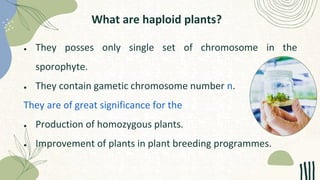
What are haploid plants?
● They posses only single set of chromosome in the
sporophyte.
● They contain gametic chromosome number n.
They are of great significance for the
● Production of homozygous plants.
● Improvement of plants in plant breeding programmes.
Polyhaploids
Poly haploids- They posses half
the number of chromosomes
from a polyploid species.
Eg: Wheat, Potato
They posses half the
number of chromosomes
from a diploid species.
Eg: Maize, Barley
Monoploids
Two categories
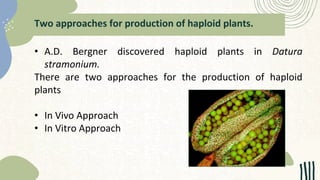
Two approaches for production of haploid plants.
• A.D. Bergner discovered haploid plants in Datura
stramonium.
There are two approaches for the production of haploid
plants
• In Vivo Approach
• In Vitro Approach
In Vitro techniques for haploid production
In plant biotechnology programmes, haploid production is
achieved by two methods,
● Androgenesis- Haploid production occurs through anther/
pollen culture, and they are referred to as androgenic
haploids.
● Gynogenesis- ovary or ovule culture that result in the
production of haploids, known as gynogenic haploids.
In Vitro androgenesis in haploids
● A technique in plant breeding, used for the development
of haploid plants using a controlled environment.
● Basic principle- To stop the development of pollen cell into
a gamete and force it to develop into a haploid plant.
Anther Culture Protocol
Collection of Anthers:
● Anthers are collected from flower buds at a specific
developmental stage.
● The stage is crucial as it determines the competence of the
cells for in vitro culture.
Surface Sterilization:
● Anthers are surface-sterilized to eliminate any contaminants.
● Common sterilization agents include ethanol and sodium
hypochlorite.
● Then anthers are rinsed in distilled water.
● One of the anthers are excised under aseptic conditions, and
crushed in 1% acetocarmine to test the stage of pollen
development.
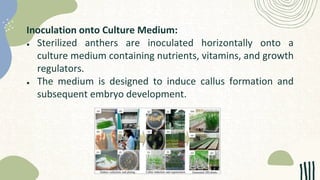
Inoculation onto Culture Medium:
● Sterilized anthers are inoculated horizontally onto a
culture medium containing nutrients, vitamins, and growth
regulators.
● The medium is designed to induce callus formation and
subsequent embryo development.
Embryogenic Callus Formation:
● Anther cells undergo dedifferentiation and form embryogenic
callus.
● The callus is a mass of undifferentiated cells capable of
developing into embryos.
Embryo Development:
● Embryos are induced from the callus.
● The embryos can be converted into plantlets through further
subculturing onto regeneration medium.
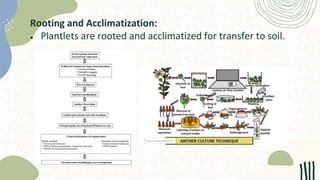
Rooting and Acclimatization:
● Plantlets are rooted and acclimatized for transfer to soil.
Microspore Culture
Growing donor plants
● Seeds are planted with adequate spacing, plants are fertilized
and watered regularly, screened and treated as required to
minimize disease and insect infestations.
● Donor plants can be grown in the field, the greenhouse, or in
environmentally controlled growth chambers.
● Young and healthy flower buds are preferred for higher
microspore yield.
Sterilization:
● Sterilize the flower buds in a solution containing a surface
disinfectant (e.g., 70% ethanol) and a sterilizing agent
(e.g., sodium hypochlorite, mercuric chloride).
● Rinse thoroughly with sterile distilled water to remove any
traces of the sterilizing agents.
Isolation of Microspores:
There are mainly two techniques
● Mechanically crushing the surface-sterilized buds to release
the microspores from the anthers.
The resulting slurry is then passed through a series of filters,
so that the somatic anther wall and bud tissue is separated
from the microspores. The microspores are then collected by
centrifugation.
Isolation of Microspores:
● The second method is shed microspore culture, wherein
anthers are extracted from the buds, placed in a liquid medium,
and microspores are allowed to dehisce. This has been used in
barley and pepper.
 Time and skills are required to isolate anther.
Removal of somatic tissue from microspores is necessary to prevent
negative effects caused by the release of phenolic compounds, and it
helps avoid complications such as the formation of diploid calli,
embryos and plants, facilitating the identification of haploid embryos
and plants.
Plating onto Culture Medium:
● Isolated microspores are plated onto a specific medium
designed for microspore culture.
● The medium typically contains nutrients, vitamins, and plant
growth regulators, amino acids.
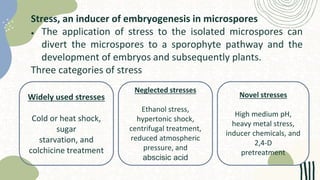
Stress, an inducer of embryogenesis in microspores
● The application of stress to the isolated microspores can
divert the microspores to a sporophyte pathway and the
development of embryos and subsequently plants.
Three categories of stress
Widely used stresses
Cold or heat shock,
sugar
starvation, and
colchicine treatment
Neglected stresses
Ethanol stress,
hypertonic shock,
centrifugal treatment,
reduced atmospheric
pressure, and
abscisic acid
Novel stresses
High medium pH,
heavy metal stress,
inducer chemicals, and
2,4-D
pretreatment
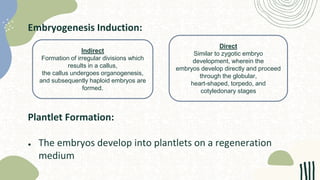
Embryogenesis Induction:
Plantlet Formation:
● The embryos develop into plantlets on a regeneration
medium
Indirect
Formation of irregular divisions which
results in a callus,
the callus undergoes organogenesis,
and subsequently haploid embryos are
formed.
Direct
Similar to zygotic embryo
development, wherein the
embryos develop directly and proceed
through the globular,
heart-shaped, torpedo, and
cotyledonary stages
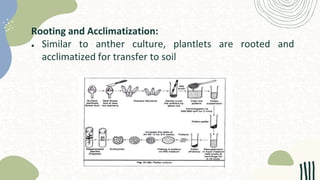
Rooting and Acclimatization:
● Similar to anther culture, plantlets are rooted and
acclimatized for transfer to soil
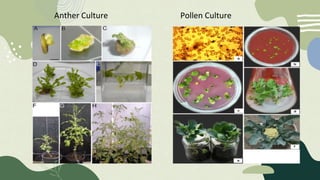
Anther Culture Pollen Culture
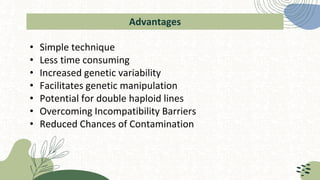
Advantages
• Simple technique
• Less time consuming
• Increased genetic variability
• Facilitates genetic manipulation
• Potential for double haploid lines
• Overcoming Incompatibility Barriers
• Reduced Chances of Contamination
Applications
● Accelerated Crop Improvement: Help in the development
of improved crop varieties with desirable traits, contributing
to more efficient and faster crop improvement programs.
● Production of Homozygous Lines: The technique allows for
the rapid generation of homozygous lines, eliminating the
need for several generations of selfing to achieve genetic
uniformity.
Applications
● Genetic Manipulation and Transformation: Haploid cells
produced through in vitro androgenesis are amenable to
genetic manipulation and transformation, enabling the
introduction of specific genes or genetic modifications for
targeted trait improvements.
● Overcoming Incompatibility Barriers: In vitro androgenesis can
be employed to overcome issues related to male sterility or
incompatibility, allowing for the utilization of otherwise
challenging or unproductive parental lines in breeding
programs.
Applications
● Creation of Doubled Haploid Lines: Haploid plants can be
converted into doubled haploid lines, ensuring complete
homozygosity, which is advantageous for developing stable
and uniform plant varieties.
● Stress Tolerance and Disease Resistance: Through targeted
selection and breeding, in vitro androgenesis can be utilized
to develop plants with enhanced stress tolerance and
resistance to diseases, contributing to more resilient crops
Applications
● Customization of Traits: The technique allows for the
customization of specific traits, such as improved nutritional
content or altered growth characteristics, to meet the
demands of diverse agricultural and industrial applications.
● Resource Efficiency: In vitro androgenesis optimizes the use
of resources by reducing the time and inputs required for
traditional breeding methods, contributing to more
sustainable and resource-efficient agriculture.
THANK YOU

In vitro androgenesis ...............pptx

  • 1.
    In Vitro Androgenesis:Anther and Microspore Culture Unlocking Plant Reproductive Potential
  • 2.
    What are haploidplants? ● They posses only single set of chromosome in the sporophyte. ● They contain gametic chromosome number n. They are of great significance for the ● Production of homozygous plants. ● Improvement of plants in plant breeding programmes.
  • 3.
    Polyhaploids Poly haploids- Theyposses half the number of chromosomes from a polyploid species. Eg: Wheat, Potato They posses half the number of chromosomes from a diploid species. Eg: Maize, Barley Monoploids Two categories
  • 4.
    Two approaches forproduction of haploid plants. • A.D. Bergner discovered haploid plants in Datura stramonium. There are two approaches for the production of haploid plants • In Vivo Approach • In Vitro Approach
  • 5.
    In Vitro techniquesfor haploid production In plant biotechnology programmes, haploid production is achieved by two methods, ● Androgenesis- Haploid production occurs through anther/ pollen culture, and they are referred to as androgenic haploids. ● Gynogenesis- ovary or ovule culture that result in the production of haploids, known as gynogenic haploids.
  • 6.
    In Vitro androgenesisin haploids ● A technique in plant breeding, used for the development of haploid plants using a controlled environment. ● Basic principle- To stop the development of pollen cell into a gamete and force it to develop into a haploid plant. Anther Culture Protocol Collection of Anthers: ● Anthers are collected from flower buds at a specific developmental stage. ● The stage is crucial as it determines the competence of the cells for in vitro culture.
  • 7.
    Surface Sterilization: ● Anthersare surface-sterilized to eliminate any contaminants. ● Common sterilization agents include ethanol and sodium hypochlorite. ● Then anthers are rinsed in distilled water. ● One of the anthers are excised under aseptic conditions, and crushed in 1% acetocarmine to test the stage of pollen development.
  • 8.
    Inoculation onto CultureMedium: ● Sterilized anthers are inoculated horizontally onto a culture medium containing nutrients, vitamins, and growth regulators. ● The medium is designed to induce callus formation and subsequent embryo development.
  • 9.
    Embryogenic Callus Formation: ●Anther cells undergo dedifferentiation and form embryogenic callus. ● The callus is a mass of undifferentiated cells capable of developing into embryos. Embryo Development: ● Embryos are induced from the callus. ● The embryos can be converted into plantlets through further subculturing onto regeneration medium.
  • 10.
    Rooting and Acclimatization: ●Plantlets are rooted and acclimatized for transfer to soil.
  • 11.
    Microspore Culture Growing donorplants ● Seeds are planted with adequate spacing, plants are fertilized and watered regularly, screened and treated as required to minimize disease and insect infestations. ● Donor plants can be grown in the field, the greenhouse, or in environmentally controlled growth chambers. ● Young and healthy flower buds are preferred for higher microspore yield.
  • 12.
    Sterilization: ● Sterilize theflower buds in a solution containing a surface disinfectant (e.g., 70% ethanol) and a sterilizing agent (e.g., sodium hypochlorite, mercuric chloride). ● Rinse thoroughly with sterile distilled water to remove any traces of the sterilizing agents.
  • 13.
    Isolation of Microspores: Thereare mainly two techniques ● Mechanically crushing the surface-sterilized buds to release the microspores from the anthers. The resulting slurry is then passed through a series of filters, so that the somatic anther wall and bud tissue is separated from the microspores. The microspores are then collected by centrifugation.
  • 14.
    Isolation of Microspores: ●The second method is shed microspore culture, wherein anthers are extracted from the buds, placed in a liquid medium, and microspores are allowed to dehisce. This has been used in barley and pepper.  Time and skills are required to isolate anther. Removal of somatic tissue from microspores is necessary to prevent negative effects caused by the release of phenolic compounds, and it helps avoid complications such as the formation of diploid calli, embryos and plants, facilitating the identification of haploid embryos and plants.
  • 15.
    Plating onto CultureMedium: ● Isolated microspores are plated onto a specific medium designed for microspore culture. ● The medium typically contains nutrients, vitamins, and plant growth regulators, amino acids.
  • 16.
    Stress, an inducerof embryogenesis in microspores ● The application of stress to the isolated microspores can divert the microspores to a sporophyte pathway and the development of embryos and subsequently plants. Three categories of stress Widely used stresses Cold or heat shock, sugar starvation, and colchicine treatment Neglected stresses Ethanol stress, hypertonic shock, centrifugal treatment, reduced atmospheric pressure, and abscisic acid Novel stresses High medium pH, heavy metal stress, inducer chemicals, and 2,4-D pretreatment
  • 17.
    Embryogenesis Induction: Plantlet Formation: ●The embryos develop into plantlets on a regeneration medium Indirect Formation of irregular divisions which results in a callus, the callus undergoes organogenesis, and subsequently haploid embryos are formed. Direct Similar to zygotic embryo development, wherein the embryos develop directly and proceed through the globular, heart-shaped, torpedo, and cotyledonary stages
  • 18.
    Rooting and Acclimatization: ●Similar to anther culture, plantlets are rooted and acclimatized for transfer to soil
  • 19.
  • 20.
    Advantages • Simple technique •Less time consuming • Increased genetic variability • Facilitates genetic manipulation • Potential for double haploid lines • Overcoming Incompatibility Barriers • Reduced Chances of Contamination
  • 21.
    Applications ● Accelerated CropImprovement: Help in the development of improved crop varieties with desirable traits, contributing to more efficient and faster crop improvement programs. ● Production of Homozygous Lines: The technique allows for the rapid generation of homozygous lines, eliminating the need for several generations of selfing to achieve genetic uniformity.
  • 22.
    Applications ● Genetic Manipulationand Transformation: Haploid cells produced through in vitro androgenesis are amenable to genetic manipulation and transformation, enabling the introduction of specific genes or genetic modifications for targeted trait improvements. ● Overcoming Incompatibility Barriers: In vitro androgenesis can be employed to overcome issues related to male sterility or incompatibility, allowing for the utilization of otherwise challenging or unproductive parental lines in breeding programs.
  • 23.
    Applications ● Creation ofDoubled Haploid Lines: Haploid plants can be converted into doubled haploid lines, ensuring complete homozygosity, which is advantageous for developing stable and uniform plant varieties. ● Stress Tolerance and Disease Resistance: Through targeted selection and breeding, in vitro androgenesis can be utilized to develop plants with enhanced stress tolerance and resistance to diseases, contributing to more resilient crops
  • 24.
    Applications ● Customization ofTraits: The technique allows for the customization of specific traits, such as improved nutritional content or altered growth characteristics, to meet the demands of diverse agricultural and industrial applications. ● Resource Efficiency: In vitro androgenesis optimizes the use of resources by reducing the time and inputs required for traditional breeding methods, contributing to more sustainable and resource-efficient agriculture.
  • 25.