Improving english pronunciation Jacqueline Rodriguez Nataly Lopez Juan Gabriel Erazo Juan Camilo Gómez M.
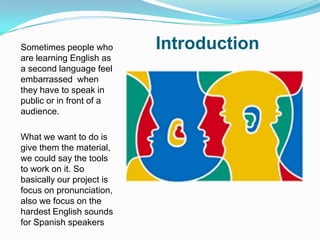
IntroductionSometimes people who are learning English as a second language feel embarrassed  when they have to speak in public or in front of a audience.What we want to do is give them the material, we could say the tools to work on it. So basically our project is focus on pronunciation, also we focus on the hardest English sounds for Spanish speakers
Most difficult sounds These are the most difficult vowels for Spanish speakers.  You can find this sound /ʊ/ in words like:    Cook, book, look, poor, took, mushroom, football…Etc    And you could pronounce it like (U) sound in Spanish. You can find this sound /ɪː/ in words like:    Keep, free, need, feed, been, seek, teeth, feel ...Etc And you could pronounce it like (I) long sound in Spanish. 
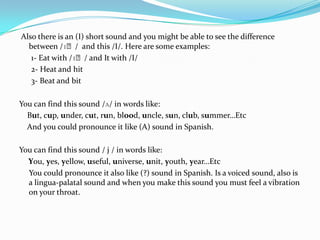
 Also there is an /ɪ/ short sound and you might be able to see the difference between /ɪ:/  and this /I/. Here are some examples:      1- Eat with /ɪ:/ and It with /ɪ/      2- Heat and hit       3- Beat and bit You can find this sound /ʌ/ in words like:    But, cup, under, cut, run, blood, uncle, sun, club, summer…Etc    And you could pronounce it like (A) sound in Spanish.You can find this sound / j / in words like:You, yes, yellow, useful, universe, unit, youth, year…Etc     You could pronounce it also like (?) sound in Spanish. Is a voiced sound, also is a lingua-palatal sound and when you make this sound you must feel a vibration on your throat.
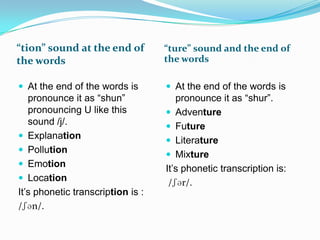
“tion” sound at the end of the words“ture” sound and the end of the words At the end of the words is pronounce it as “shun” pronouncing U like this sound /j/. ExplanationPollutionEmotionLocation It’s phonetic transcription is: /ʃən/.At the end of the words is pronounce it as “shur”. Adventure FutureLiteratureMixtureIt’s phonetic transcription is: /ʃər/.
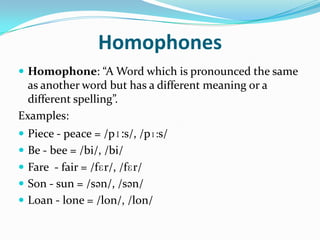
HomophonesHomophone: “A Word which is pronounced the same as another word but has a different meaning or a different spelling”.Examples:Piece - peace = /pɪ:s/, /pɪ:s/Be - bee = /bi/, /bi/Fare  - fair = /fɛr/, /fɛr/ Son - sun = /sən/, /sən/Loan - lone = /lon/, /lon/
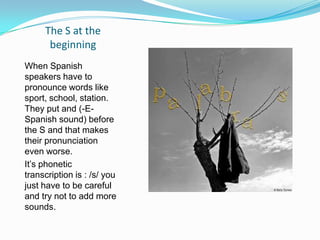
The S at the beginningWhen Spanish speakers have to pronounce words like sport, school, station. They put and (-E-Spanish sound) before the S and that makes their pronunciation even worse. It’s phonetic transcription is : /s/ you just have to be careful and try not to add more sounds.
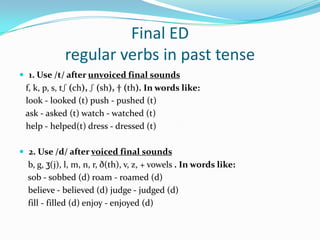
Final EDregular verbs in past tense 1. Use /t/ after unvoiced final sounds    f, k, p, s, tʃ (ch), ʃ (sh), † (th). In words like:   look - looked (t) push - pushed (t)    ask - asked (t) watch - watched (t)    help - helped(t) dress - dressed (t)2. Use /d/ after voiced final sounds     b, g, ʒ(j), l, m, n, r, ð(th), v, z, + vowels . In words like:    sob - sobbed (d) roam - roamed (d)     believe - believed (d) judge - judged (d)     fill - filled (d) enjoy - enjoyed (d)
3. Finally you could Use / \d/ after final /d/ and /t/ . In words like: Need - needed (\d) Wait – waited (\d) Accept – accepted  (\d)
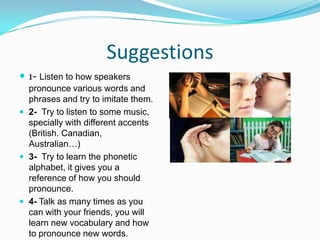
Suggestions 1- Listen to how speakers pronounce various words and phrases and try to imitate them.2-  Try to listen to some music, specially with different accents (British. Canadian, Australian…) 3-  Try to learn the phonetic alphabet, it gives you a reference of how you should pronounce. 4- Talk as many times as you can with your friends, you will learn new vocabulary and how to pronounce new words.
Thank you very much.

Improving English Pronunciation

  • 1.
    Improving english pronunciationJacqueline Rodriguez Nataly Lopez Juan Gabriel Erazo Juan Camilo Gómez M.
  • 2.
    IntroductionSometimes people whoare learning English as a second language feel embarrassed when they have to speak in public or in front of a audience.What we want to do is give them the material, we could say the tools to work on it. So basically our project is focus on pronunciation, also we focus on the hardest English sounds for Spanish speakers
  • 3.
    Most difficult soundsThese are the most difficult vowels for Spanish speakers.  You can find this sound /ʊ/ in words like: Cook, book, look, poor, took, mushroom, football…Etc And you could pronounce it like (U) sound in Spanish. You can find this sound /ɪː/ in words like: Keep, free, need, feed, been, seek, teeth, feel ...Etc And you could pronounce it like (I) long sound in Spanish. 
  • 4.
    Also thereis an /ɪ/ short sound and you might be able to see the difference between /ɪ:/ and this /I/. Here are some examples: 1- Eat with /ɪ:/ and It with /ɪ/ 2- Heat and hit 3- Beat and bit You can find this sound /ʌ/ in words like: But, cup, under, cut, run, blood, uncle, sun, club, summer…Etc And you could pronounce it like (A) sound in Spanish.You can find this sound / j / in words like:You, yes, yellow, useful, universe, unit, youth, year…Etc You could pronounce it also like (?) sound in Spanish. Is a voiced sound, also is a lingua-palatal sound and when you make this sound you must feel a vibration on your throat.
  • 5.
    “tion” sound atthe end of the words“ture” sound and the end of the words At the end of the words is pronounce it as “shun” pronouncing U like this sound /j/. ExplanationPollutionEmotionLocation It’s phonetic transcription is: /ʃən/.At the end of the words is pronounce it as “shur”. Adventure FutureLiteratureMixtureIt’s phonetic transcription is: /ʃər/.
  • 6.
    HomophonesHomophone: “A Wordwhich is pronounced the same as another word but has a different meaning or a different spelling”.Examples:Piece - peace = /pɪ:s/, /pɪ:s/Be - bee = /bi/, /bi/Fare - fair = /fɛr/, /fɛr/ Son - sun = /sən/, /sən/Loan - lone = /lon/, /lon/
  • 7.
    The S atthe beginningWhen Spanish speakers have to pronounce words like sport, school, station. They put and (-E-Spanish sound) before the S and that makes their pronunciation even worse. It’s phonetic transcription is : /s/ you just have to be careful and try not to add more sounds.
  • 8.
    Final EDregular verbsin past tense 1. Use /t/ after unvoiced final sounds f, k, p, s, tʃ (ch), ʃ (sh), † (th). In words like: look - looked (t) push - pushed (t) ask - asked (t) watch - watched (t) help - helped(t) dress - dressed (t)2. Use /d/ after voiced final sounds b, g, ʒ(j), l, m, n, r, ð(th), v, z, + vowels . In words like: sob - sobbed (d) roam - roamed (d) believe - believed (d) judge - judged (d) fill - filled (d) enjoy - enjoyed (d)
  • 9.
    3. Finally youcould Use / \d/ after final /d/ and /t/ . In words like: Need - needed (\d) Wait – waited (\d) Accept – accepted (\d)
  • 10.
    Suggestions 1- Listento how speakers pronounce various words and phrases and try to imitate them.2- Try to listen to some music, specially with different accents (British. Canadian, Australian…) 3- Try to learn the phonetic alphabet, it gives you a reference of how you should pronounce. 4- Talk as many times as you can with your friends, you will learn new vocabulary and how to pronounce new words.
  • 11.