Marketing Decision Management 
Making 
Improving Decision Making 
ارائه دهندگان: 
احسان مدرس 
علی صنعتی 
Graduate School of Management and Economics 
1/26
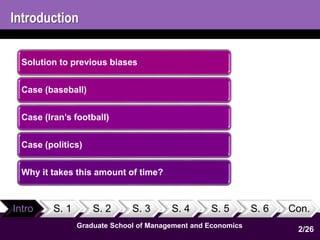
Introduction 
Solution to previous biases 
Case (baseball) 
Case (Iran’s football) 
Case (politics) 
Why it takes this amount of time? 
Intro S. 1 S. 2 S. 3 S. 4 S. 5 S. 6 Con. 
Graduate School of Management and Economics 
2/26
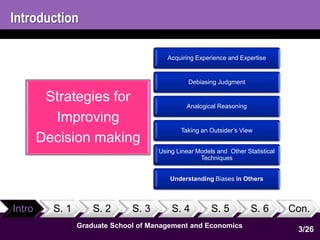
Acquiring Experience and Expertise 
Introduction 
Intro S. 1 S. 2 S. 3 S. 4 S. 5 S. 6 Con. 
Graduate School of Management and Economics 
3 
Debiasing Judgment 
Analogical Reasoning 
Taking an Outsider’s View 
Using Linear Models and Other Statistical 
Techniques 
Understanding Biases in Others 
Strategies for 
Improving 
Decision making 
3/26
Strategy 1: Acquiring Experience and Expertise 
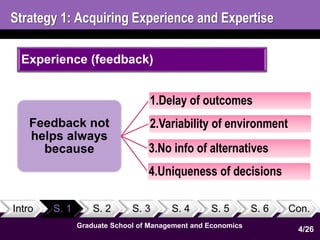
Experience (feedback) 
Feedback not 
helps always 
because 
1.Delay of outcomes 
2.Variability of environment 
3.No info of alternatives 
4.Uniqueness of decisions 
Intro S. 1 S. 2 S. 3 S. 4 S. 5 S. 6 Con. 
Graduate School of Management and Economics 
4/26
Strategy 1: Acquiring Experience and Expertise 
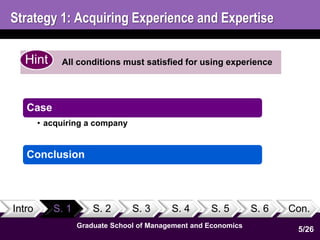
Hint All conditions must satisfied for using experience 
Intro S. 1 S. 2 S. 3 S. 4 S. 5 S. 6 Con. 
Graduate School of Management and Economics 
5 
Case 
• acquiring a company 
Conclusion 
5/26
Strategy 1: Acquiring Experience and Expertise 
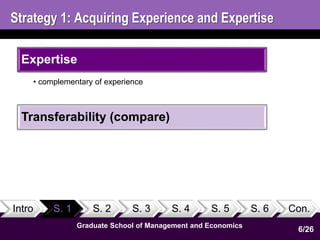
Expertise 
• complementary of experience 
Transferability (compare) 
Intro S. 1 S. 2 S. 3 S. 4 S. 5 S. 6 Con. 
Graduate School of Management and Economics 
6/26
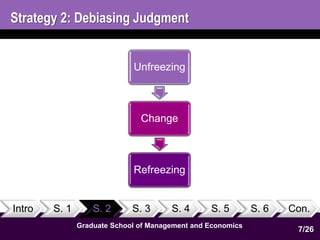
Strategy 2: Debiasing Judgment 
Unfreezing 
Change 
Refreezing 
Intro S. 1 S. 2 S. 3 S. 4 S. 5 S. 6 Con. 
7 
1 
Graduate School of Management and Economics 
7/26
Strategy 2: Debiasing Judgment 
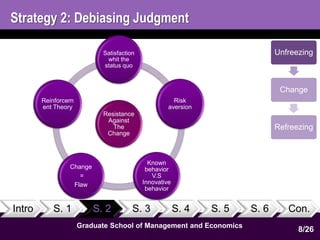
Satisfaction 
whit the 
status quo 
Intro S. 1 S. 2 S. 3 S. 4 S. 5 S. 6 Con. 
8 
1 
Graduate School of Management and Economics 
Unfreezing 
Change 
Refreezing 
Resistance 
Against 
The 
Change 
Risk 
aversion 
Known 
behavior 
V.S 
Innovative 
behavior 
Change 
= 
Flaw 
Reinforcem 
ent Theory 
8/26
Strategy 2: Debiasing Judgment 
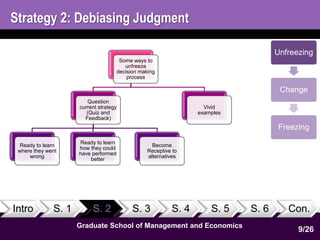
Some ways to 
unfreeze 
decision making 
process 
Question 
current strategy 
(Quiz and 
Feedback) 
Ready to learn 
where they went 
wrong 
Ready to learn 
how they could 
have performed 
better 
Become 
Receptive to 
alternatives 
Vivid 
examples 
Intro S. 1 S. 2 S. 3 S. 4 S. 5 S. 6 Con. 
9 
1 
Graduate School of Management and Economics 
Unfreezing 
Change 
Freezing 
9/26
Strategy 2: Debiasing Judgment 
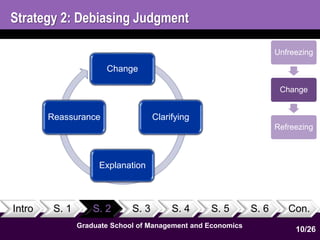
Change 
Clarifying 
Reassurance 
Explanation 
Intro S. 1 S. 2 S. 3 S. 4 S. 5 S. 6 Con. 
10 
1 
Graduate School of Management and Economics 
Unfreezing 
Change 
Refreezing 
10/26
Strategy 2: Debiasing Judgment 
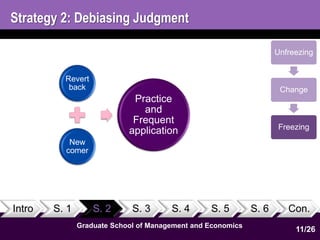
Revert 
back 
New 
comer 
Practice 
and 
Frequent 
application 
Intro S. 1 S. 2 S. 3 S. 4 S. 5 S. 6 Con. 
11 
1 
Graduate School of Management and Economics 
Unfreezing 
Change 
Freezing 
11/26
Strategy 3: Analogical Reasoning 
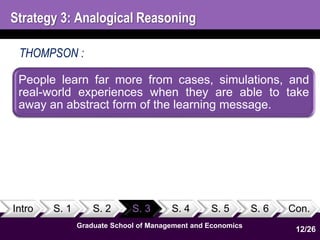
THOMPSON : 
People learn far more from cases, simulations, and 
real-world experiences when they are able to take 
away an abstract form of the learning message. 
Intro S. 1 S. 2 S. 3 S. 4 S. 5 S. 6 Con. 
12 
1 
Graduate School of Management and Economics 
12/26
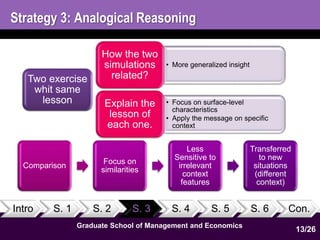
Strategy 3: Analogical Reasoning 
• More generalized insight 
How the two 
simulations 
related? 
• Focus on surface-level 
characteristics 
• Apply the message on specific 
context 
Explain the 
lesson of 
each one. 
Two exercise 
whit same 
Intro S. 1 S. 2 S. 3 S. 4 S. 5 S. 6 Con. 
13 
1 
Graduate School of Management and Economics 
lesson 
Comparison 
Focus on 
similarities 
Less 
Sensitive to 
irrelevant 
context 
features 
Transferred 
to new 
situations 
(different 
context) 
13/26
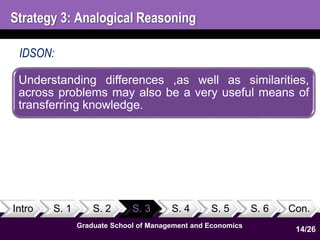
Strategy 3: Analogical Reasoning 
IDSON: 
Understanding differences ,as well as similarities, 
across problems may also be a very useful means of 
transferring knowledge. 
Intro S. 1 S. 2 S. 3 S. 4 S. 5 S. 6 Con. 
14 
1 
Graduate School of Management and Economics 
14/26
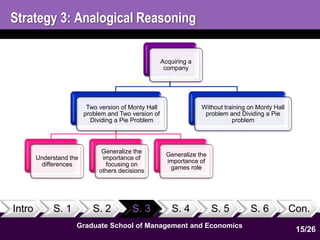
Strategy 3: Analogical Reasoning 
Acquiring a 
company 
Two version of Monty Hall 
problem and Two version of 
Dividing a Pie Problem 
Understand the 
differences 
Generalize the 
importance of 
focusing on 
others decisions 
Without training on Monty Hall 
problem and Dividing a Pie 
Generalize the 
importance of 
games role 
problem 
Intro S. 1 S. 2 S. 3 S. 4 S. 5 S. 6 Con. 
15 
1 
Graduate School of Management and Economics 
15/26
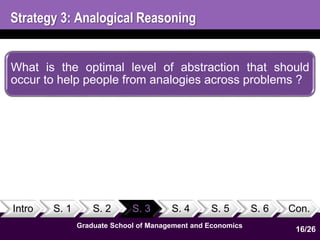
Strategy 3: Analogical Reasoning 
What is the optimal level of abstraction that should 
occur to help people from analogies across problems ? 
Intro S. 1 S. 2 S. 3 S. 4 S. 5 S. 6 Con. 
16 
1 
Graduate School of Management and Economics 
16/26
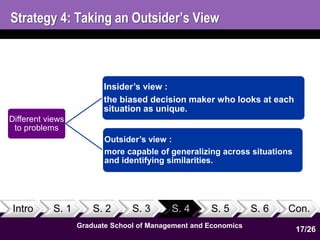
Strategy 4: Taking an Outsider’s View 
Intro S. 1 S. 2 S. 3 S. 4 S. 5 S. 6 Con. 
Graduate School of Management and Economics 
17 
Different views 
to problems 
Insider’s view : 
the biased decision maker who looks at each 
situation as unique. 
Outsider’s view : 
more capable of generalizing across situations 
and identifying similarities. 
17/26
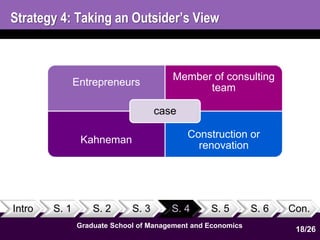
Strategy 4: Taking an Outsider’s View 
Intro S. 1 S. 2 S. 3 S. 4 S. 5 S. 6 Con. 
Graduate School of Management and Economics 
18 
Entrepreneurs 
Member of consulting 
team 
Kahneman 
Construction or 
renovation 
case 
18/26
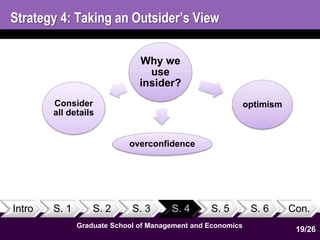
Strategy 4: Taking an Outsider’s View 
Why we 
Intro S. 1 S. 2 S. 3 S. 4 S. 5 S. 6 Con. 
Graduate School of Management and Economics 
19 
use 
insider? 
optimism 
overconfidence 
Consider 
all details 
19/26
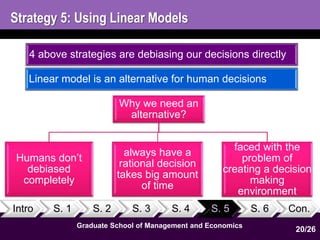
Strategy 5: Using Linear Models 
4 above strategies are debiasing our decisions directly 
Linear model is an alternative for human decisions 
Why we need an 
alternative? 
Intro S. 1 S. 2 S. 3 S. 4 S. 5 S. 6 Con. 
Graduate School of Management and Economics 
20 
Humans don’t 
debiased 
completely 
always have a 
rational decision 
takes big amount 
of time 
faced with the 
problem of 
creating a decision 
making 
environment 
20/26
Strategy 5: Using Linear Models 
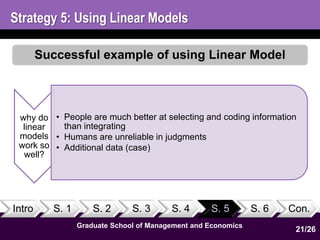
Successful example of using Linear Model 
Intro S. 1 S. 2 S. 3 S. 4 S. 5 S. 6 Con. 
Graduate School of Management and Economics 
21 
why do 
linear 
models 
work so 
well? 
• People are much better at selecting and coding information 
than integrating 
• Humans are unreliable in judgments 
• Additional data (case) 
21/26
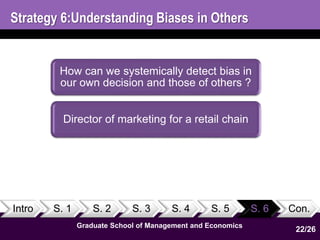
Strategy 6:Understanding Biases in Others 
How can we systemically detect bias in 
our own decision and those of others ? 
Director of marketing for a retail chain 
Intro S. 1 S. 2 S. 3 S. 4 S. 5 S. 6 Con. 
Graduate School of Management and Economics 
22 
22/26
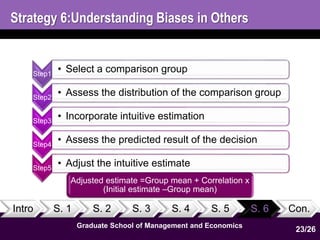
Strategy 6:Understanding Biases in Others 
Step1 • Select a comparison group 
Step2 • Assess the distribution of the comparison group 
Step3 • Incorporate intuitive estimation 
Step4 • Assess the predicted result of the decision 
Step5 • Adjust the intuitive estimate 
Intro S. 1 S. 2 S. 3 S. 4 S. 5 S. 6 Con. 
Graduate School of Management and Economics 
23 
23/26 
Adjusted estimate =Group mean + Correlation x 
(Initial estimate –Group mean)
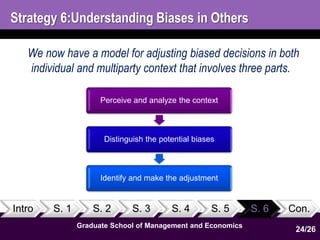
Strategy 6:Understanding Biases in Others 
We now have a model for adjusting biased decisions in both 
individual and multiparty context that involves three parts. 
Perceive and analyze the context 
Distinguish the potential biases 
Identify and make the adjustment 
Intro S. 1 S. 2 S. 3 S. 4 S. 5 S. 6 Con. 
Graduate School of Management and Economics 
24 
24/26
Intro S. 1 S. 2 S. 3 S. 4 S. 5 S. 6 Con. 
Graduate School of Management and Economics 
25 
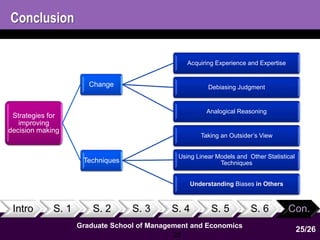
Conclusion 
Strategies for 
improving 
decision making 
Change 
Acquiring Experience and Expertise 
Debiasing Judgment 
Analogical Reasoning 
Techniques 
Taking an Outsider’s View 
Using Linear Models and Other Statistical 
Techniques 
Understanding Biases in Others 
25/26
Thank You 
For Your Attention

Improving decision making

  • 1.
    Marketing Decision Management Making Improving Decision Making ارائه دهندگان: احسان مدرس علی صنعتی Graduate School of Management and Economics 1/26
  • 2.
    Introduction Solution toprevious biases Case (baseball) Case (Iran’s football) Case (politics) Why it takes this amount of time? Intro S. 1 S. 2 S. 3 S. 4 S. 5 S. 6 Con. Graduate School of Management and Economics 2/26
  • 3.
    Acquiring Experience andExpertise Introduction Intro S. 1 S. 2 S. 3 S. 4 S. 5 S. 6 Con. Graduate School of Management and Economics 3 Debiasing Judgment Analogical Reasoning Taking an Outsider’s View Using Linear Models and Other Statistical Techniques Understanding Biases in Others Strategies for Improving Decision making 3/26
  • 4.
    Strategy 1: AcquiringExperience and Expertise Experience (feedback) Feedback not helps always because 1.Delay of outcomes 2.Variability of environment 3.No info of alternatives 4.Uniqueness of decisions Intro S. 1 S. 2 S. 3 S. 4 S. 5 S. 6 Con. Graduate School of Management and Economics 4/26
  • 5.
    Strategy 1: AcquiringExperience and Expertise Hint All conditions must satisfied for using experience Intro S. 1 S. 2 S. 3 S. 4 S. 5 S. 6 Con. Graduate School of Management and Economics 5 Case • acquiring a company Conclusion 5/26
  • 6.
    Strategy 1: AcquiringExperience and Expertise Expertise • complementary of experience Transferability (compare) Intro S. 1 S. 2 S. 3 S. 4 S. 5 S. 6 Con. Graduate School of Management and Economics 6/26
  • 7.
    Strategy 2: DebiasingJudgment Unfreezing Change Refreezing Intro S. 1 S. 2 S. 3 S. 4 S. 5 S. 6 Con. 7 1 Graduate School of Management and Economics 7/26
  • 8.
    Strategy 2: DebiasingJudgment Satisfaction whit the status quo Intro S. 1 S. 2 S. 3 S. 4 S. 5 S. 6 Con. 8 1 Graduate School of Management and Economics Unfreezing Change Refreezing Resistance Against The Change Risk aversion Known behavior V.S Innovative behavior Change = Flaw Reinforcem ent Theory 8/26
  • 9.
    Strategy 2: DebiasingJudgment Some ways to unfreeze decision making process Question current strategy (Quiz and Feedback) Ready to learn where they went wrong Ready to learn how they could have performed better Become Receptive to alternatives Vivid examples Intro S. 1 S. 2 S. 3 S. 4 S. 5 S. 6 Con. 9 1 Graduate School of Management and Economics Unfreezing Change Freezing 9/26
  • 10.
    Strategy 2: DebiasingJudgment Change Clarifying Reassurance Explanation Intro S. 1 S. 2 S. 3 S. 4 S. 5 S. 6 Con. 10 1 Graduate School of Management and Economics Unfreezing Change Refreezing 10/26
  • 11.
    Strategy 2: DebiasingJudgment Revert back New comer Practice and Frequent application Intro S. 1 S. 2 S. 3 S. 4 S. 5 S. 6 Con. 11 1 Graduate School of Management and Economics Unfreezing Change Freezing 11/26
  • 12.
    Strategy 3: AnalogicalReasoning THOMPSON : People learn far more from cases, simulations, and real-world experiences when they are able to take away an abstract form of the learning message. Intro S. 1 S. 2 S. 3 S. 4 S. 5 S. 6 Con. 12 1 Graduate School of Management and Economics 12/26
  • 13.
    Strategy 3: AnalogicalReasoning • More generalized insight How the two simulations related? • Focus on surface-level characteristics • Apply the message on specific context Explain the lesson of each one. Two exercise whit same Intro S. 1 S. 2 S. 3 S. 4 S. 5 S. 6 Con. 13 1 Graduate School of Management and Economics lesson Comparison Focus on similarities Less Sensitive to irrelevant context features Transferred to new situations (different context) 13/26
  • 14.
    Strategy 3: AnalogicalReasoning IDSON: Understanding differences ,as well as similarities, across problems may also be a very useful means of transferring knowledge. Intro S. 1 S. 2 S. 3 S. 4 S. 5 S. 6 Con. 14 1 Graduate School of Management and Economics 14/26
  • 15.
    Strategy 3: AnalogicalReasoning Acquiring a company Two version of Monty Hall problem and Two version of Dividing a Pie Problem Understand the differences Generalize the importance of focusing on others decisions Without training on Monty Hall problem and Dividing a Pie Generalize the importance of games role problem Intro S. 1 S. 2 S. 3 S. 4 S. 5 S. 6 Con. 15 1 Graduate School of Management and Economics 15/26
  • 16.
    Strategy 3: AnalogicalReasoning What is the optimal level of abstraction that should occur to help people from analogies across problems ? Intro S. 1 S. 2 S. 3 S. 4 S. 5 S. 6 Con. 16 1 Graduate School of Management and Economics 16/26
  • 17.
    Strategy 4: Takingan Outsider’s View Intro S. 1 S. 2 S. 3 S. 4 S. 5 S. 6 Con. Graduate School of Management and Economics 17 Different views to problems Insider’s view : the biased decision maker who looks at each situation as unique. Outsider’s view : more capable of generalizing across situations and identifying similarities. 17/26
  • 18.
    Strategy 4: Takingan Outsider’s View Intro S. 1 S. 2 S. 3 S. 4 S. 5 S. 6 Con. Graduate School of Management and Economics 18 Entrepreneurs Member of consulting team Kahneman Construction or renovation case 18/26
  • 19.
    Strategy 4: Takingan Outsider’s View Why we Intro S. 1 S. 2 S. 3 S. 4 S. 5 S. 6 Con. Graduate School of Management and Economics 19 use insider? optimism overconfidence Consider all details 19/26
  • 20.
    Strategy 5: UsingLinear Models 4 above strategies are debiasing our decisions directly Linear model is an alternative for human decisions Why we need an alternative? Intro S. 1 S. 2 S. 3 S. 4 S. 5 S. 6 Con. Graduate School of Management and Economics 20 Humans don’t debiased completely always have a rational decision takes big amount of time faced with the problem of creating a decision making environment 20/26
  • 21.
    Strategy 5: UsingLinear Models Successful example of using Linear Model Intro S. 1 S. 2 S. 3 S. 4 S. 5 S. 6 Con. Graduate School of Management and Economics 21 why do linear models work so well? • People are much better at selecting and coding information than integrating • Humans are unreliable in judgments • Additional data (case) 21/26
  • 22.
    Strategy 6:Understanding Biasesin Others How can we systemically detect bias in our own decision and those of others ? Director of marketing for a retail chain Intro S. 1 S. 2 S. 3 S. 4 S. 5 S. 6 Con. Graduate School of Management and Economics 22 22/26
  • 23.
    Strategy 6:Understanding Biasesin Others Step1 • Select a comparison group Step2 • Assess the distribution of the comparison group Step3 • Incorporate intuitive estimation Step4 • Assess the predicted result of the decision Step5 • Adjust the intuitive estimate Intro S. 1 S. 2 S. 3 S. 4 S. 5 S. 6 Con. Graduate School of Management and Economics 23 23/26 Adjusted estimate =Group mean + Correlation x (Initial estimate –Group mean)
  • 24.
    Strategy 6:Understanding Biasesin Others We now have a model for adjusting biased decisions in both individual and multiparty context that involves three parts. Perceive and analyze the context Distinguish the potential biases Identify and make the adjustment Intro S. 1 S. 2 S. 3 S. 4 S. 5 S. 6 Con. Graduate School of Management and Economics 24 24/26
  • 25.
    Intro S. 1S. 2 S. 3 S. 4 S. 5 S. 6 Con. Graduate School of Management and Economics 25 Conclusion Strategies for improving decision making Change Acquiring Experience and Expertise Debiasing Judgment Analogical Reasoning Techniques Taking an Outsider’s View Using Linear Models and Other Statistical Techniques Understanding Biases in Others 25/26
  • 26.
    Thank You ForYour Attention