IMPRESSIONS FOR 
CONVENTIONAL COMPLETE 
DENTURES. 
Dr. Bahjat Abu Hamdan. 
Consultant Prosthodontist. 
DDS, CES, DSO . 
Damascus – Syria, Paris – France.
1. Introduction 
2. Relevant anatomy and physiology. 
3. Patient examination for impressions 
4. Impression materials. 
5. Classification of impressions 
-primary impressions 
-secondary impressions 
1.compressive. 2. mucostatic . 3. selective. 
Conclusion.
1. Introduction. 
 The purpose of the CD is to restore 
function, aesthetic, phonation and 
maintenance of remaining tissues. 
 To be able to assume these functions, 
dentures should enjoy the following 
mechanical qualities: 
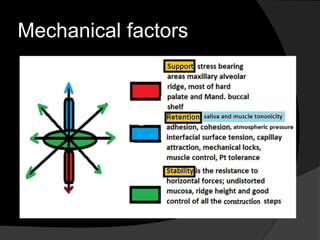
 Retention 
 Stability 
 support
1. Introduction 
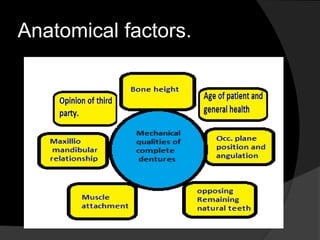
 The following anatomical factors play a 
positive or negative mechanical role; 
1.Bone size Height and width 
2. Maxillo-mandibular relationship. 
3. Position and orientation of the occlusal 
Plane. 
4.Muscle attachment and quality of mucous 
tissue. 
5.Presence of opposed natural teeth to 
edentulous ridge.
1.Introduction. 
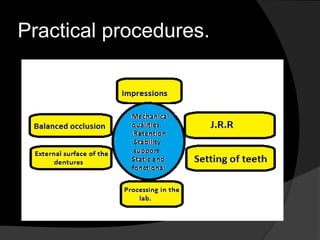
 Mechanical qualities are also related to all 
the steps of complete denture construction 
: 
1. good impressions. 
2. correct JRR 
3. correct setting of the artificial teeth 
4. well established static and dynamic 
occlusion 
5. Good processing 
6. well formed and polished external surfaces 
of the dentures.
Mechanical factors
Anatomical factors.
Practical procedures.
2.Relevant anatomy and 
physiology. 
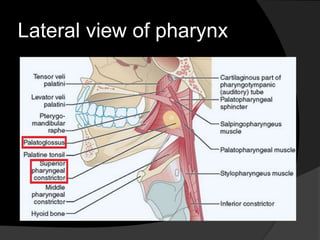
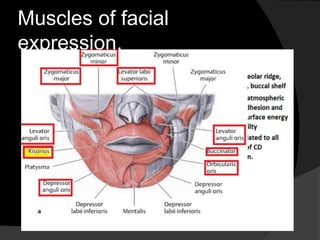
 Good knowledge of the anatomy, 
physiology and histology of all the 
elements in relation with the dentures is 
mandatory; 
 Bone and mucous tissues. 
 Kinetics of the muscles of mastication, 
facial expression, tongue and floor of the 
mouth.
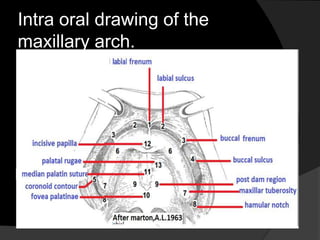
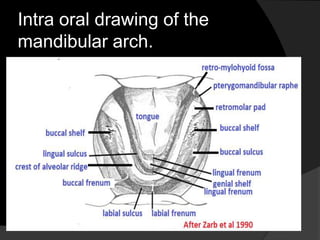
Intra oral drawing of the 
maxillary arch.
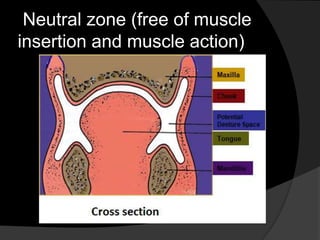
Neutral zone (free of muscle 
insertion and muscle action)
Intra oral drawing of the 
mandibular arch.
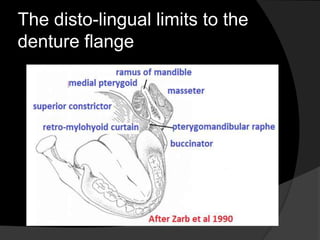
The disto-lingual limits to the 
denture flange
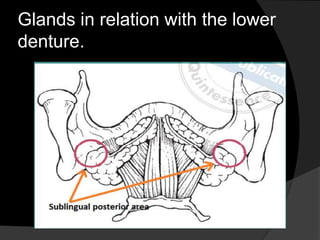
Glands in relation with the lower 
denture.
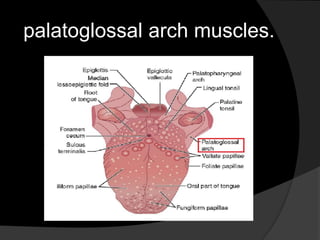
palatoglossal arch muscles.
Lateral view of pharynx
Muscles of facial 
expression.
3.Patient examination 
 Its so important to investigate all the 
elements that may affect the procedure 
and the quality of the impressions which 
affect the quality of the dentures. 
 Medical and dental past. 
 Extra oral examination. 
 Intra oral examination. 
 X ray examination. 
 Study models.
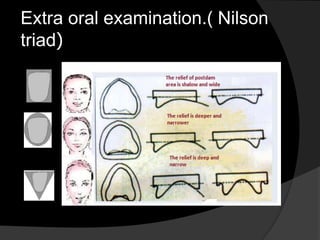
Extra oral examination.( Nilson 
triad(
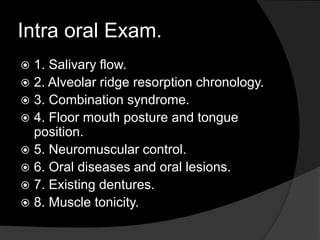
Intra oral Exam. 
 1. Salivary flow. 
 2. Alveolar ridge resorption chronology. 
 3. Combination syndrome. 
 4. Floor mouth posture and tongue 
position. 
 5. Neuromuscular control. 
 6. Oral diseases and oral lesions. 
 7. Existing dentures. 
 8. Muscle tonicity.
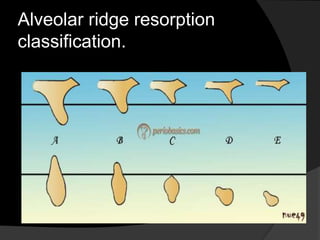
Alveolar ridge resorption 
classification.
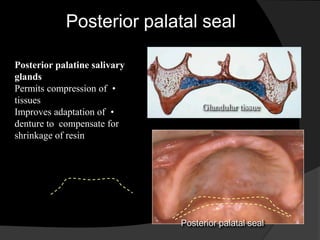
Posterior palatal seal 
Posterior palatine salivary 
glands 
Permits compression of • 
tissues 
Improves adaptation of • 
denture to compensate for 
shrinkage of resin 
Glandular tissue 
Posterior palatal seal
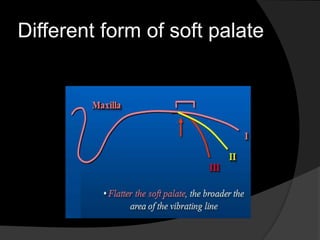
Different form of soft palate
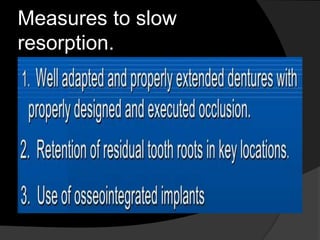
Measures to slow 
resorption.
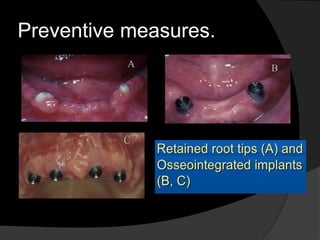
Preventive measures.
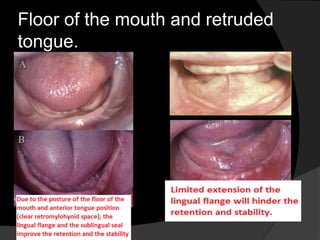
Floor of the mouth and retruded 
tongue.
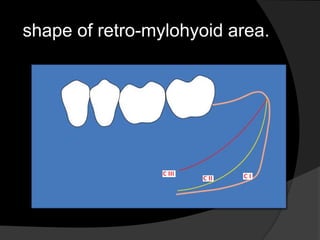
shape of retro-mylohyoid area.
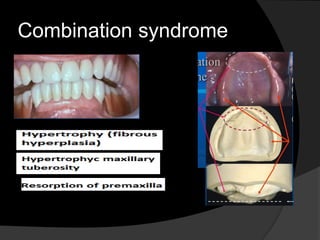
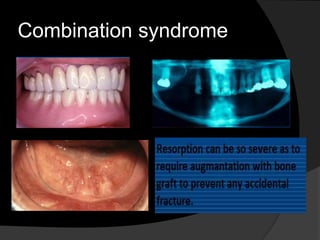
Combination syndrome
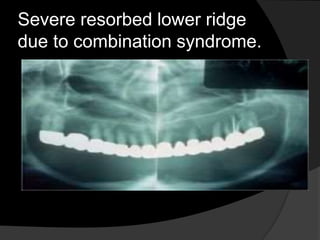
Severe resorbed lower ridge 
due to combination syndrome.
Oral diseases and oral lesions. 
 Long term insulin dependent (diabetes) 
 Oral lichen planus. 
 Pemphygoid. 
 Chronic candidiasis. 
 Inflammatory fibrous hyperplasia. 
 Premalgnant lesions 
leukoplakia,erythroplakia. 
 Malignant lesion.
Surgical preparatory treatment. 
 Augmentation with bone graft. 
 -frenectomy 
-tuberosity reduction 
-tori removal 
-surgical removal of redundant tissue 
(epulus fissuratum) 
-ridge recontouring e.g. flabby ridges 
and -bony undercuts 
-removal of remaining teeth and severe 
undercut.
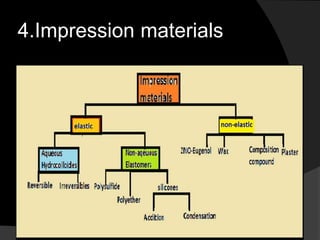
4.Impression materials
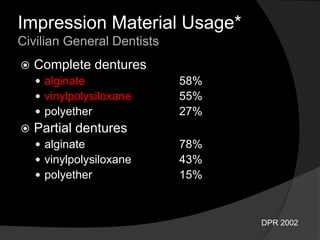
Impression Material Usage* 
Civilian General Dentists 
 Complete dentures 
 alginate 58% 
 vinylpolysiloxane 55% 
 polyether 27% 
 Partial dentures 
 alginate 78% 
 vinylpolysiloxane 43% 
 polyether 15% 
DPR 2002
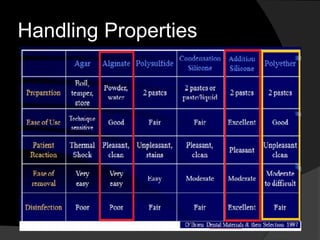
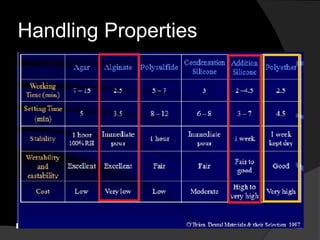
Handling Properties
Handling Properties
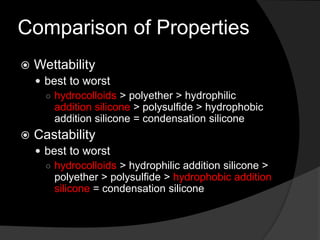
Comparison of Properties 
 Wettability 
 best to worst 
○ hydrocolloids > polyether > hydrophilic 
addition silicone > polysulfide > hydrophobic 
addition silicone = condensation silicone 
 Castability 
 best to worst 
○ hydrocolloids > hydrophilic addition silicone > 
polyether > polysulfide > hydrophobic addition 
silicone = condensation silicone
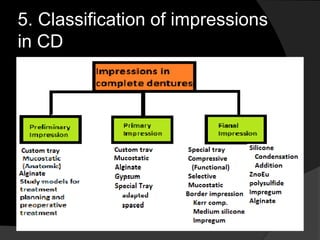
5. Classification of impressions 
in CD
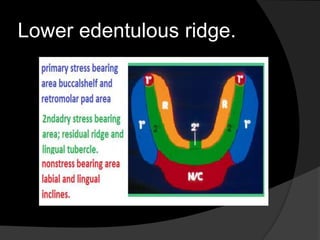
Lower edentulous ridge.
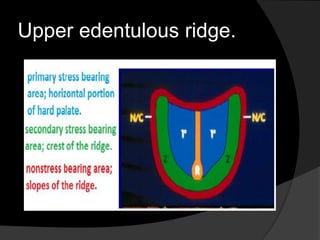
Upper edentulous ridge.
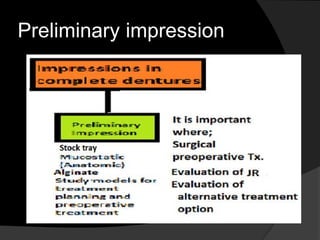
Preliminary impression
Primary impression
Final impression.
Preliminary and primary 
impression 
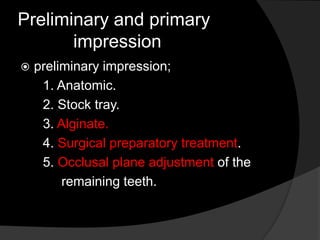
 preliminary impression; 
1. Anatomic. 
2. Stock tray. 
3. Alginate. 
4. Surgical preparatory treatment. 
5. Occlusal plane adjustment of the 
remaining teeth.
Preliminary and primary 
impression 
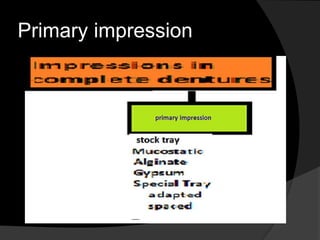
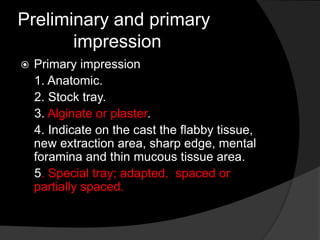
 Primary impression 
1. Anatomic. 
2. Stock tray. 
3. Alginate or plaster. 
4. Indicate on the cast the flabby tissue, 
new extraction area, sharp edge, mental 
foramina and thin mucous tissue area. 
5. Special tray; adapted, spaced or 
partially spaced.
Preliminary and primary 
impression 
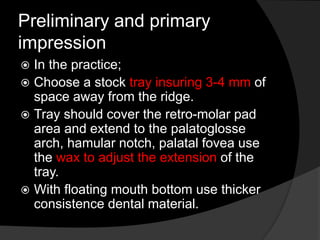
 In the practice; 
 Choose a stock tray insuring 3-4 mm of 
space away from the ridge. 
 Tray should cover the retro-molar pad 
area and extend to the palatoglosse 
arch, hamular notch, palatal fovea use 
the wax to adjust the extension of the 
tray. 
 With floating mouth bottom use thicker 
consistence dental material.
Preliminary and primary 
impression 
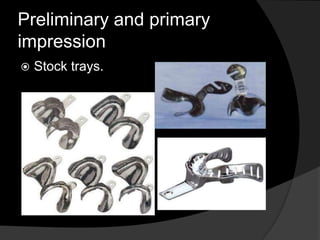
 Stock trays.
Primary impression and 
custom 
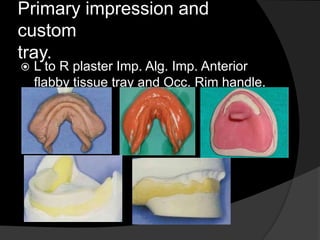
tray. 
 L to R plaster Imp. Alg. Imp. Anterior 
flabby tissue tray and Occ. Rim handle.
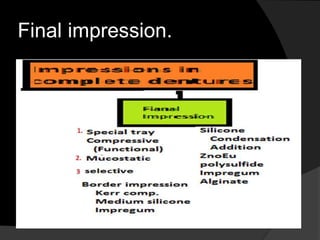
Final impression 
(compressive). 
 Factors controlling the pressure applied by the 
impression; 
 Type of the custom tray adapted or spaced. 
 Consistence of the dental material light, 
regular or putty. 
 Holes opposed to a concerned area means 
less pressure. 
 Border impression is always compressive in 
functional impression and partially 
compressive impression. If it is not, impression 
is mucostatic (anatomic).
Final impression 
(compressive). 
 Custom tray… adapted or spaced. 
 Borders are 2mm far from the labial and 
buccal vestibule, 3mm space in the frenum 
areas (lateral and median). 
 Tray should cover the vibration line area 
and hamular notch. Mandibular custom tray; 
borders are 2mm far from the border in the 
buccal shelf and anterior sublingual area. 
Checking up the custom tray is done by pulling 
the muscles horizontally in the concerned 
area.
Final impression 
(compressive). 
 Border impression includes all the 
borders of the maxillae. 
 It includes just the buccal shelf and the 
anterior sublingual area. 
 Muscle M. are done functionally by the 
Pt.( open widely, suction and lateral M. 
Swallowing, tongue M. Grimace M.). 
Muscle M. are done by the dentist in 
case of low muscle tonicity.
Final impression 
(compressive). 
 Certain extreme muscle M. coincide with 
the functional M. 
 Muscle M. (during border impression 
can be done by the dentist) but the Pt. 
should functionally move his muscle in 
the 2nd phase of final impression. 
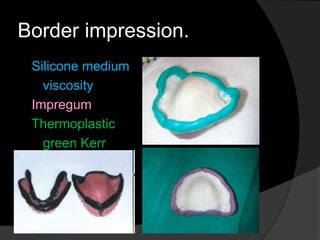
 Border impression is done gradually by 
the thermoplastic green Kerr. Or one 
using the regular elastic material. 
Greene Brothers
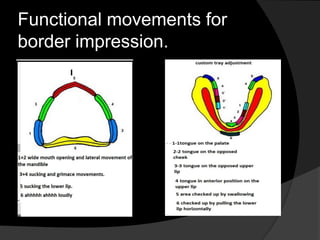
Functional movements for 
border impression.
Border impression. 
Silicone medium 
viscosity 
Impregum 
Thermoplastic 
green Kerr
Final impression 
(compressive). 
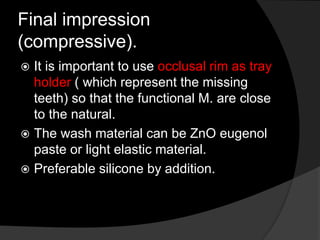
 It is important to use occlusal rim as tray 
holder ( which represent the missing 
teeth) so that the functional M. are close 
to the natural. 
 The wash material can be ZnO eugenol 
paste or light elastic material. 
 Preferable silicone by addition.
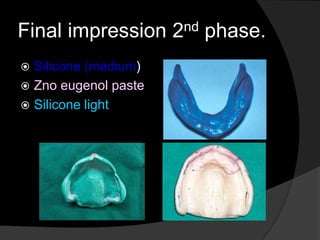
Final impression 2nd phase. 
 Silicone (medium) 
 Zno eugenol paste 
 Silicone light
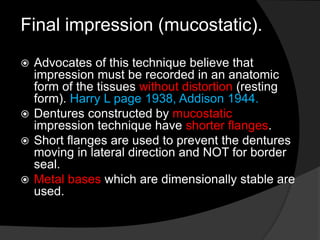
Final impression (mucostatic). 
 Advocates of this technique believe that 
impression must be recorded in an anatomic 
form of the tissues without distortion (resting 
form). Harry L page 1938, Addison 1944. 
 Dentures constructed by mucostatic 
impression technique have shorter flanges. 
 Short flanges are used to prevent the dentures 
moving in lateral direction and NOT for border 
seal. 
 Metal bases which are dimensionally stable are 
used.
Final impression (mucostatic). 
 Dentures do not cover wide area. 
 No border impression. 
 Based on the adhesion, cohesion and surface 
energy but not on the atmospheric pressure 
(border seal). 
 It works only when there is good ridge and 
high alveolar bone. 
 Denture mobility during function (mucous 
depression is 4/10 – 10/10 mm) 
(compressibility of periodontal tissue is 1/10 
mm) .Bone compressibility is related to bone 
quality ( cancellous or cortical ).
Final impression (selective 
pressure). 
 Boucher 1950. 
 Principles of this technique is that 
certain areas of the maxilla and the 
mandible are by nature better adapted 
to withstand extra loads from the forces 
of mastication. 
 Tissues adapted for withstanding extra 
loads are recorded under slight 
placement of pressure while other 
tissues are recorded at rest (mucostatic)
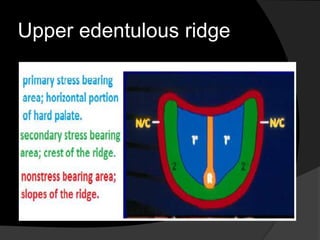
Upper edentulous ridge
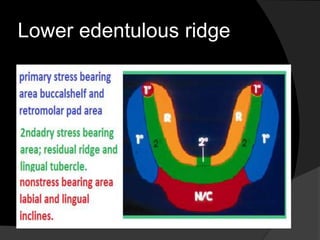
Lower edentulous ridge
Final impression (selective 
pressure). 
 In this way an equilibrium is created between 
– the resilient and 
- non resilient tissues. 
Primary stress bearing areas are recorded under 
pressure; crest of alveolar ridge, horizontal plate of 
palatine bone in the maxillae and buccal shelf area 
in the mandible. 
Areas requiring minimum pressure; mid-palatine 
suture, incisive papilla, crest of mandibular ridge, 
mandibular tori, mental foramina, sharp painful 
edge, flabby tissue, remaining roots in case of 
over-denture and new extraction areas.
Final impression (selective 
pressure). 
 Posterior palatal seal has glandular and 
soft tissues are readily to be displaced for 
maintenance of peripheral seal. 
 Sublingual area has similar tissue structure 
and behaviour as the posterior palatal seal. 
 Border impression includes all the borders 
of the maxilla, but it includes just the buccal 
shelf and the sublingual areas in the 
mandible. (after a good prime impression).
Final impression (selective 
pressure). 
 Sublingual area is molded with the 
tongue in repose. 
 The tray is extended horizontally 
backward over the sublingual glands 
toward the tongue to affect border seal. 
 Pts with old dentures should remove it 
24 hours before the final impression. 
( mucous tissues should be at rest and 
normal situation).
Conclusion. 
 In certain cases, even if all the steps 
are well done mechanical qualities of the 
dentures are spoiled so that patient will 
not arrive to adapt on, these cases are 
confronted in case of lack of saliva and 
paralysis and low tonicity of the muscles 
in relation with the dentures. 
 Helping these Pts. Will be through the 
use of denture adhesive to improve the 
retention and the Pt. ability to adapt on.
Conclusion. 
 Indication of denture adhesive; 
 Xerostomia ( medication, systemic 
diseases, irradiation and disease of 
salivary glands) 
 Neurological disorders; 
 Oro-facial dyskinesia ( muscles of lips, 
cheek, tongue and face ) 
 Medication side effects ( neuroleptic, 
dopamine blocking drugs, pheothiazine 
and GI medications ) .
Thanks for your 
attention 
E mail. ahbahjat@yahoo.fr

Impressions for complete

  • 1.
    IMPRESSIONS FOR CONVENTIONALCOMPLETE DENTURES. Dr. Bahjat Abu Hamdan. Consultant Prosthodontist. DDS, CES, DSO . Damascus – Syria, Paris – France.
  • 2.
    1. Introduction 2.Relevant anatomy and physiology. 3. Patient examination for impressions 4. Impression materials. 5. Classification of impressions -primary impressions -secondary impressions 1.compressive. 2. mucostatic . 3. selective. Conclusion.
  • 3.
    1. Introduction. The purpose of the CD is to restore function, aesthetic, phonation and maintenance of remaining tissues.  To be able to assume these functions, dentures should enjoy the following mechanical qualities:  Retention  Stability  support
  • 4.
    1. Introduction The following anatomical factors play a positive or negative mechanical role; 1.Bone size Height and width 2. Maxillo-mandibular relationship. 3. Position and orientation of the occlusal Plane. 4.Muscle attachment and quality of mucous tissue. 5.Presence of opposed natural teeth to edentulous ridge.
  • 5.
    1.Introduction.  Mechanicalqualities are also related to all the steps of complete denture construction : 1. good impressions. 2. correct JRR 3. correct setting of the artificial teeth 4. well established static and dynamic occlusion 5. Good processing 6. well formed and polished external surfaces of the dentures.
  • 6.
  • 7.
  • 8.
  • 9.
    2.Relevant anatomy and physiology.  Good knowledge of the anatomy, physiology and histology of all the elements in relation with the dentures is mandatory;  Bone and mucous tissues.  Kinetics of the muscles of mastication, facial expression, tongue and floor of the mouth.
  • 10.
    Intra oral drawingof the maxillary arch.
  • 11.
    Neutral zone (freeof muscle insertion and muscle action)
  • 12.
    Intra oral drawingof the mandibular arch.
  • 13.
    The disto-lingual limitsto the denture flange
  • 14.
    Glands in relationwith the lower denture.
  • 15.
  • 16.
  • 17.
    Muscles of facial expression.
  • 18.
    3.Patient examination Its so important to investigate all the elements that may affect the procedure and the quality of the impressions which affect the quality of the dentures.  Medical and dental past.  Extra oral examination.  Intra oral examination.  X ray examination.  Study models.
  • 19.
  • 20.
    Intra oral Exam.  1. Salivary flow.  2. Alveolar ridge resorption chronology.  3. Combination syndrome.  4. Floor mouth posture and tongue position.  5. Neuromuscular control.  6. Oral diseases and oral lesions.  7. Existing dentures.  8. Muscle tonicity.
  • 21.
    Alveolar ridge resorption classification.
  • 22.
    Posterior palatal seal Posterior palatine salivary glands Permits compression of • tissues Improves adaptation of • denture to compensate for shrinkage of resin Glandular tissue Posterior palatal seal
  • 23.
    Different form ofsoft palate
  • 24.
    Measures to slow resorption.
  • 25.
  • 26.
    Floor of themouth and retruded tongue.
  • 27.
  • 28.
  • 29.
  • 30.
    Severe resorbed lowerridge due to combination syndrome.
  • 31.
    Oral diseases andoral lesions.  Long term insulin dependent (diabetes)  Oral lichen planus.  Pemphygoid.  Chronic candidiasis.  Inflammatory fibrous hyperplasia.  Premalgnant lesions leukoplakia,erythroplakia.  Malignant lesion.
  • 32.
    Surgical preparatory treatment.  Augmentation with bone graft.  -frenectomy -tuberosity reduction -tori removal -surgical removal of redundant tissue (epulus fissuratum) -ridge recontouring e.g. flabby ridges and -bony undercuts -removal of remaining teeth and severe undercut.
  • 33.
  • 34.
    Impression Material Usage* Civilian General Dentists  Complete dentures  alginate 58%  vinylpolysiloxane 55%  polyether 27%  Partial dentures  alginate 78%  vinylpolysiloxane 43%  polyether 15% DPR 2002
  • 35.
  • 36.
  • 37.
    Comparison of Properties  Wettability  best to worst ○ hydrocolloids > polyether > hydrophilic addition silicone > polysulfide > hydrophobic addition silicone = condensation silicone  Castability  best to worst ○ hydrocolloids > hydrophilic addition silicone > polyether > polysulfide > hydrophobic addition silicone = condensation silicone
  • 38.
    5. Classification ofimpressions in CD
  • 39.
  • 40.
  • 41.
  • 42.
  • 43.
  • 44.
    Preliminary and primary impression  preliminary impression; 1. Anatomic. 2. Stock tray. 3. Alginate. 4. Surgical preparatory treatment. 5. Occlusal plane adjustment of the remaining teeth.
  • 45.
    Preliminary and primary impression  Primary impression 1. Anatomic. 2. Stock tray. 3. Alginate or plaster. 4. Indicate on the cast the flabby tissue, new extraction area, sharp edge, mental foramina and thin mucous tissue area. 5. Special tray; adapted, spaced or partially spaced.
  • 46.
    Preliminary and primary impression  In the practice;  Choose a stock tray insuring 3-4 mm of space away from the ridge.  Tray should cover the retro-molar pad area and extend to the palatoglosse arch, hamular notch, palatal fovea use the wax to adjust the extension of the tray.  With floating mouth bottom use thicker consistence dental material.
  • 47.
    Preliminary and primary impression  Stock trays.
  • 48.
    Primary impression and custom tray.  L to R plaster Imp. Alg. Imp. Anterior flabby tissue tray and Occ. Rim handle.
  • 49.
    Final impression (compressive).  Factors controlling the pressure applied by the impression;  Type of the custom tray adapted or spaced.  Consistence of the dental material light, regular or putty.  Holes opposed to a concerned area means less pressure.  Border impression is always compressive in functional impression and partially compressive impression. If it is not, impression is mucostatic (anatomic).
  • 50.
    Final impression (compressive).  Custom tray… adapted or spaced.  Borders are 2mm far from the labial and buccal vestibule, 3mm space in the frenum areas (lateral and median).  Tray should cover the vibration line area and hamular notch. Mandibular custom tray; borders are 2mm far from the border in the buccal shelf and anterior sublingual area. Checking up the custom tray is done by pulling the muscles horizontally in the concerned area.
  • 51.
    Final impression (compressive).  Border impression includes all the borders of the maxillae.  It includes just the buccal shelf and the anterior sublingual area.  Muscle M. are done functionally by the Pt.( open widely, suction and lateral M. Swallowing, tongue M. Grimace M.). Muscle M. are done by the dentist in case of low muscle tonicity.
  • 52.
    Final impression (compressive).  Certain extreme muscle M. coincide with the functional M.  Muscle M. (during border impression can be done by the dentist) but the Pt. should functionally move his muscle in the 2nd phase of final impression.  Border impression is done gradually by the thermoplastic green Kerr. Or one using the regular elastic material. Greene Brothers
  • 53.
    Functional movements for border impression.
  • 54.
    Border impression. Siliconemedium viscosity Impregum Thermoplastic green Kerr
  • 55.
    Final impression (compressive).  It is important to use occlusal rim as tray holder ( which represent the missing teeth) so that the functional M. are close to the natural.  The wash material can be ZnO eugenol paste or light elastic material.  Preferable silicone by addition.
  • 56.
    Final impression 2ndphase.  Silicone (medium)  Zno eugenol paste  Silicone light
  • 57.
    Final impression (mucostatic).  Advocates of this technique believe that impression must be recorded in an anatomic form of the tissues without distortion (resting form). Harry L page 1938, Addison 1944.  Dentures constructed by mucostatic impression technique have shorter flanges.  Short flanges are used to prevent the dentures moving in lateral direction and NOT for border seal.  Metal bases which are dimensionally stable are used.
  • 58.
    Final impression (mucostatic).  Dentures do not cover wide area.  No border impression.  Based on the adhesion, cohesion and surface energy but not on the atmospheric pressure (border seal).  It works only when there is good ridge and high alveolar bone.  Denture mobility during function (mucous depression is 4/10 – 10/10 mm) (compressibility of periodontal tissue is 1/10 mm) .Bone compressibility is related to bone quality ( cancellous or cortical ).
  • 59.
    Final impression (selective pressure).  Boucher 1950.  Principles of this technique is that certain areas of the maxilla and the mandible are by nature better adapted to withstand extra loads from the forces of mastication.  Tissues adapted for withstanding extra loads are recorded under slight placement of pressure while other tissues are recorded at rest (mucostatic)
  • 60.
  • 61.
  • 62.
    Final impression (selective pressure).  In this way an equilibrium is created between – the resilient and - non resilient tissues. Primary stress bearing areas are recorded under pressure; crest of alveolar ridge, horizontal plate of palatine bone in the maxillae and buccal shelf area in the mandible. Areas requiring minimum pressure; mid-palatine suture, incisive papilla, crest of mandibular ridge, mandibular tori, mental foramina, sharp painful edge, flabby tissue, remaining roots in case of over-denture and new extraction areas.
  • 63.
    Final impression (selective pressure).  Posterior palatal seal has glandular and soft tissues are readily to be displaced for maintenance of peripheral seal.  Sublingual area has similar tissue structure and behaviour as the posterior palatal seal.  Border impression includes all the borders of the maxilla, but it includes just the buccal shelf and the sublingual areas in the mandible. (after a good prime impression).
  • 64.
    Final impression (selective pressure).  Sublingual area is molded with the tongue in repose.  The tray is extended horizontally backward over the sublingual glands toward the tongue to affect border seal.  Pts with old dentures should remove it 24 hours before the final impression. ( mucous tissues should be at rest and normal situation).
  • 65.
    Conclusion.  Incertain cases, even if all the steps are well done mechanical qualities of the dentures are spoiled so that patient will not arrive to adapt on, these cases are confronted in case of lack of saliva and paralysis and low tonicity of the muscles in relation with the dentures.  Helping these Pts. Will be through the use of denture adhesive to improve the retention and the Pt. ability to adapt on.
  • 66.
    Conclusion.  Indicationof denture adhesive;  Xerostomia ( medication, systemic diseases, irradiation and disease of salivary glands)  Neurological disorders;  Oro-facial dyskinesia ( muscles of lips, cheek, tongue and face )  Medication side effects ( neuroleptic, dopamine blocking drugs, pheothiazine and GI medications ) .
  • 67.
    Thanks for your attention E mail. ahbahjat@yahoo.fr