Good Morning
Problems Of Single Complete
Denture And
Its Management
k.Priyanka,
I MDS
INTRODUCTION
SINGLE COMPLETE DENTURE
COMBINATIONS
PROBLEMS AND SOLUTIONS
ADVANCEMENTS
CONCLUSION
A single complete denture is a denture that occludes
against some or all natural teeth, a fixed restoration,or a
previously constructed removable partial denture or a
complete denture.
“
“ Perpetual Preservation Of That What
Remains Rather Than Meticulous
Replacement Of What Is lost”
Establishment of inter-occlusal distance
Creation of bilateral posterior contacts
Avoidance of adverse tooth contacts
Directing forces along long axis of prosthesis
RETENTION
SUPPORT STABILITY
Condylar guidance
Cuspal inclinationIncisal guidance
Compensatory curve
Orientation of
occlusal plane
Theilemann formula
CG* IG=CI*CC*OP
Principal
challenge
Designing a denture occlusion with
bilateral balanced occlusion.
Occlusal stresses
Position of opposing natural teeth
 Flexure of Denture base material
SINGLE DENTURE SYNDROME
These factors cause “ single denture syndrome”
Loose or tilting denture
Damage to mucosa
Ridge resorption
COMBINATIONS OF SINGLE
COMPLETE DENTURE
Maxillary
CD RPD MANDIBULAR
CD
IMPLANT
SUPPORTED
DENTURE
FPD EXISTING
DENTURE
Malposed , tipped or supra-erupted teeth interfere with balanced occlusion.
The imbalance may produce soreness mucosal changes and ridge resorption
in single denture will tend to get displaced.
SINGLE DENTURE OPPOSING
NATURAL TEETH
Single complete dentures ;Charles W. Ellinger,JPD 1971
The reasons for this are:
( 1) the inclination of the occlusal plane , usually unfavorable,
(2) the individual teeth may be malpositioned and may have assumed
positions that present excessively steep cuspal inclinations, and
(3) the bucco-lingual width of the natural teeth may be too wide.
Failure to alter these conditions will often prevent the development of a
bilateral balanced occlusion in eccentric positions
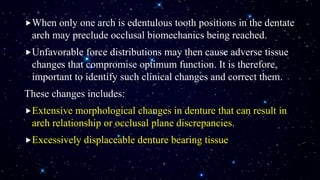
When only one arch is edentulous tooth positions in the dentate
arch may preclude occlusal biomechanics being reached.
Unfavorable force distributions may then cause adverse tissue
changes that compromise optimum function. It is therefore,
important to identify such clinical changes and correct them.
These changes includes:
Extensive morphological changes in denture that can result in
arch relationship or occlusal plane discrepancies.
Excessively displaceable denture bearing tissue
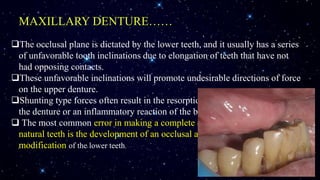
MAXILLARY DENTURE……
The occlusal plane is dictated by the lower teeth, and it usually has a series
of unfavorable tooth inclinations due to elongation of teeth that have not
had opposing contacts.
These unfavorable inclinations will promote undesirable directions of force
on the upper denture.
Shunting type forces often result in the resorption of the bone underlying
the denture or an inflammatory reaction of the basal seat tissues.
 The most common error in making a complete denture against lower
natural teeth is the development of an occlusal arrangement without
modification of the lower teeth.
 .
 The problems must be recognized during the treatment planning
phase by the use of diagnostic casts accurately mounted on an
adjustable articulator.
 An occlusion rim, a face bow transfer, and jaw relation records
should be made. The articulator should be adjusted with eccentric
jaw relation records.
 A preliminary arrangement of the artificial teeth will reveal the
necessary changes to be made on the lower teeth.
 Excessively steep inclinations of the occlusal plane or of
individual teeth should be recognized and modified before the
artificial teeth are arranged
 These charted corrections can be made in the mouth, and the
“educated guess” of tooth modification can be eliminated.
MANDIBULAR DENTURE….
 A smaller basal seat area is available for the support of the lower denture than for an
upper denture.
 Therefore, more stress per unit area will be applied to the lower residual ridge than to the
upper residual ridge.
 The greater amount of stress per unit of area exerted through the natural upper teeth
decreases the retention and stability of the lower denture.
 A rapid loss of supporting bone from the mandible and continual soreness arc often
observed as a result of such a combination and it should be avoided if possible.
 There are, however, some situations in which the construction of a lower denture against
natural teeth is necessary. Health factors that prohibit the removal of teeth may justify this
procedure.
 Once a fixed restoration is placed in a dental arch, the
restored arch can be thought of as natural teeth opposing a
complete denture.
 The construction and placement of fixed restorations can
correct many occlusal disharmonies that may have existed
previously.
 The occlusion between the denture teeth and the fixed
restorations is harmonized on an articulator while the patterns
for the castings are being developed.
SINGLE COMPLETE DENTURE
OPPOSING FIXED RESTORATION
 The denture base should
(1) have an esthetic contour and thickness to adequately support the perioral structures,
(2) be extended to utilize all available supporting tissues: and
(3) be stable and retentive.
 Unfortunately, few existing dentures against which new dentures are to be constructed
fulfill all these criteria.
 Much of denture retention and stability are affected by the placement and occlusion of the
teeth.
 Since the dentist assumes the responsibility for both dentures when he accepts a patient
demanding the construction of a new denture opposed by an existing denture, the prognosis
is poor, and the risk is great.
SINGLE COMPLETE DENTURE OPPOSING
AN EXISTING DENTURE
 Completely edentulous maxillae and partially edentulous mandibles with only
anterior teeth remaining are common situations.
 Almost inevitable degenerative changes develop in the edentulous regions of
wearers of complete upper and partial lower denture.
 This problem might be solved with treatment planning to avoid the combination of
complete upper dentures against distal-extension partial lower dentures.
SINGLE COMPLETE DENTURE OPPOSING
REMOVABLE PARTIAL DENTURE
Ellisworth Kelly, Changes caused by a mandibular removable partial denture opposing a maxillary complete
denture;JPD 2003
 The alternative of complete maxillary and mandibular dentures is not attractive to
patients.
 Preserving posterior teeth to serve as abutments to support lower partial dentures and
to provide a more stable occlusion is a better alternative.
 . Ill-fitting dentures have been blamed for all of the lesions of the edentulous tissues,
yet the most perfect denture will be ill-fitting after bone is lost from the anterior part
of the ridge. Removable dentures need periodic attention at least as often as the
natural teeth
PROBLEMS AND ITS MANAGEMENT
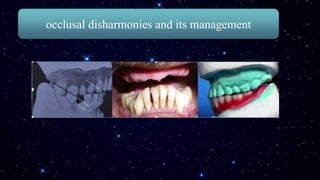
occlusal disharmonies and its management
The following proposed classification system can simplify the identification and
treatment of these patients.
Class 1: patients for whom minor, or no, tooth reduction is all that is needed to obtain
balance
Class 2: patients for whom minor additions to the height of the teeth are needed to
obtain balance
Class 3: patients for whom both reductions and additions to teeth are required to
obtain balance. The treatment of these patients usually involves a change in vertical
dimension of occlusion
Class 4: patients who present with occlusal discrepancies that require addition to the
width of the occluding surface
Class 5: patients who present with combination syndrome as described by Kelly
Extensive morphological change occurring following extraction of teeth
creates horizontal discrepancy between arches anteriorly and posteriorly and
makes it difficult to direct occlusal forces to the denture bearing surfaces.
This can be corrected by placing the tooth in a reverse horizontal overlap or
cross bite arrangements. However, such correction is not possible for anterior
discrepancy due to esthetic impact of such a tooth position
Conditions in opposing arch specially irregular occlusal plane can dispose
problems to patient with single complete denture.
Selective grinding of tooth can be done as a treatment procedure.
Swenson’s technique
Yurkstas technique
Bruce technique
Boucher technique
Broadrick flag technique
Techniques For Occlusal Plane Correction
SWENSON'S TECHNIQUE
Mount maxillary and mandibular casts at an acceptable VD with a CR record.
A maxillary base is made and denture teeth set.
If interferences are there, adjusted on the cast and mark with pencil.
Natural teeth modified with this guide and a new diagnostic cast made and
mounted on the articulator.
If this occlusal modification is sufficient, denture teeth are reset for trial.
Disadvantages:
Time consuming if it needs several impressions and mountings before the
occlusion is finalized.
YURKSTAS TECHNIQUE:
Uses a metal ‘U’ shaped occlusal template
Placed on the occlusal surfaces of the remaining teeth and cusps are adjusted and
identified.
Stone cast is modified to a more acceptable occlusal relationship and the reduced areas
are marked with a pencil.
Necessary alterations done on the natural teeth using the cast as a guide.
BRUCE TECHNIQUE:
The lower diagnostic cast is mounted with the upper with the proper CR record.
Necessary modifications are made on the stone cast.
Acrylic resin template is fabricated on the modified stone cast.
Checked in the patient's mouth for interferences and the interferences are
removed
Process is repeated until the template seats properly.
Han-Kuang Tan;A preparation guide for modifying the mandibular teeth before making a maxillary single
complete Denture;march 1997 The Journal Of Prosthetic Dentistry
•Areas to be modified are marked with pencil on the cast
•Clear acrylic resin template is formed over the corrected cast
•Initial modification done Template coated with Pressure indicating paste & placed
over teeth
•Interferences can be seen through the clear template and can be removed
accordingly. Process repeated till template fits the teeth perfectly
Advantage:
• Produces accurate results
BOUCHER'S TECHNIQUE
 Casts are mounted on a programmed articulator.
 Artificial teeth are arranged to obtain best possible balancing contacts.
 If a natural tooth prevents balancing, interferences are removed by
moving porcelain teeth over the mandibular stone teeth
Areas to be ground are marked on the cast
The denture is processed and will be used as a guide to modify natural
opposing teeth.

BROADRCIK FLAG TECHNIQUE
1. Functional chew in techniques
2. Articulator equilibration techniques
1. FUNCTIONAL CHEW IN TECHNIQUE
Most accurate method of recording occlusal patterns
To obtain functional chew in technique:
Record bases should have good stability
 Patient should have good neuromuscular control
Mental competence to effectively co-operate
METHODS TO ACHIEVE HARMONIOUS BALANCED
OCCLUSION
FUNCTIONAL CHEW IN TECHNIQUE
a. Stansbury technique (1928)
b. Vig's technique (1964)
c. Sharry technique
d. Rudd technique
STANSBURY TECHNIQUE (1928)
• Compound occlusal rim trimmed buccally and lingually so that occlusion is
free in lateral excursions
• Carding wax added buccally and lingually and patient instructed to perform
chewing movements
• Carding wax gets functionally molded whereas the compound rim in the
central fossa maintains the VD.
• The generated occlusal rim is removed from the mouth and stone is vibrated into the
wax path of the cusps and this record is secured to the lower member of the
articulator
The denture teeth are first set to the lower cast of the patient's teeth
• After esthetics approved at try in, lower cast chew in record is secured and all the
interfering spots are ground. Thus in centric and eccentric movements maximus
balanced occlusion is established.

Vig's Technique (1964)
 modified functional chew-in and impression technique
Anterior teeth are set chair side.
Wax occlusal rims posterior to the cuspid teeth are removed.
 Acrylic resin is added and firmly pressed against the occlusal surface of the teeth on the
mandibular cast.
When set, acrylic resin is trimmed so as to leave only a fin of resin falling into the central
grooves of the lower posterior teeth to maintain the vertical dimension.
The base is then inserted into the mouth for cusp and sulcus analysis.
 The fin is then built up with a soft wax and with resilient liner on the tissue side final path is
recorded.
 The teeth are then set against the recorded chew in cast and interferences are ground to obtain
a smooth harmonious occlusion
A MODIFIED CHEW-IN AND FUNCTIONAL IMPRESSION TECHNIQUE
ROBERT G VIG.;J Prosthet Dent 1964
Sharry Technique
Simple technique of using a maxillary rim of softened wax
Lateral and protrusive chewing movements are made so that wax is abraded generating the
final paths of the lower cusps.
Continued until the correct VD is achieved
Rudd Technique
Suggests a technique similar to Stansbury's
But suggests using two maxillary bases, one for recording the generated path and the other
for setting the teeth
Advantage - decreases the number of appointments necessary for the construction of the upper
denture
ARTICULATOR EQUILIBRATION TECHNIQUE
INDICATIONS:
1. The denture base lacks stability.
2. Patient is physically unable to perform a chew-in record..
ARTICULATOR EQUILIBRATION TECHNIQUE
Upper cast mounted on the articulator using a face- bow with an orbitale
pointer
The lower cast is related to the upper by a centric interocclusal record at an
acceptable VD.
The bucco-lingual position of the teeth and their relation to the upper arch is
studied.
Cusp-fossa relationship of the teeth is essential.
At the time of wax try-in, eccentric records made and condylar inclinations
are set and posterior teeth are now balanced.
After denture is processed, then centric holding cusps are achieved by selective
grinding and then eccentric balance is achieved.
However, perfectly balanced occlusion in all eccentric positions may not be possible in
many cases when working with natural teeth in one arch.
Oral mucosal
changes and
its
management
Kelly's Combination Syndrome
 A series of destructive changes occurring in the jaws of the patients wearing a
complete maxillary denture opposed by a mandibular distal extension partial
denture
 It has been described as "combination syndrome" by Kelly in 1972
MAXILLARY
COMPLETE
DENTURE
MANDIBULAR
DISTAL
EXTENSION RPD
ORAL DESTRUCTIVE CHANGES
COMBINATION SYNDROME
 Loss of bone in anterior maxilla and subsequent replacement with flabby fibrous
tissue
 Down growth of the tuberosities
Papillary hyperplasia of the palate
 Lower incisors supra eruption
 Bone loss under the removable prostheses
Saunders et al (1978) added 6 more additional features:
 Loss of vertical dimension
 Occlusal plane discrepancy
 Anterior spatial repositioning of the mandible
 Loss of stability and refabrication of the existing dentures
 Epulis fissuratum
MECHANICS
Kelly - Bone loss in the anterior maxilla is the first to occur
Saunders - Bone loss under the removable prosthesis was the root cause for the
problem
SYSTEMIC AND DENTAL CONSIDERATIONS
a. Systemic factors
Diabetes and osteoporosis increase the rate of resorption of the bone.
b. Dental factors
In case of class III jaw relationships, there will be increased pressure
in the anterior maxilla.
When lower anteriors are retained for a long time, the patient is
accustomed to bite in the anterior region.
Presence of parafunctional habits increases bone resorption.
Type of occlusal scheme also has direct effect on the development of
the syndrome.
Rationale:
Prevention of rapid resorption of the bone under the removable prosthesis
Prevention of excessive load in the anterior region
Providing stable occlusal scheme
Allowing anterior teeth only for phonetics and esthetics
Education of the patient
Treatment planning
Treatment planning plays an important role in the prevention and
management of the combination syndrome.
Prevention :
Retain weaker posterior teeth by using combined endodontic and periodontic
techniques.
Endosseous endodontic implants are used in the posterior mandibular region.
An overlay denture on the lower may avoid the combination syndrome.
Modifications in removable partial denture and complete dentures:
Kelly - advocated covering of retromolar pad to have stability of the lower removable partial
denture
Schumitt - advocated construction of lower removable partial denture first and then to
construct the upper complete denture .
Kelly advocated surgical excision of the maxillary tuberosity fibrous growth to
establish proper occlusion.
Treating the combination syndrome requires recognition of the factors
involved.
Frequent recalls visits and check ups with frequent relining to compensate for
the resorption especially in the lower distal extension prosthesis.
Educating the patient about the possible outcome of the treatment and better
understanding of the syndrome so that patient cooperates with the dentist
DENTURE
FRACTURES AND
MANAGEMENT
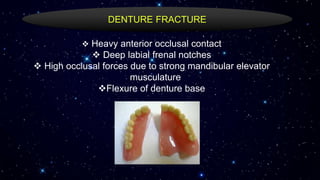
 Heavy anterior occlusal contact
 Deep labial frenal notches
 High occlusal forces due to strong mandibular elevator
musculature
Flexure of denture base
DENTURE FRACTURE
 the significant improvement in fracture toughness of a denture base acrylic material
using glass flake is an extremely promising result.
Franklin P; Reinforcement of poly(methyl methacrylate) denture base with glass flake.
Dent Mater. 2005 Apr;21(4):365-70
 Reinforcement of acrylic denture base resin with high-performance polyethylene fiber in
woven form produced a substantial improvement of stiffness and impact strength, as
well as reducing the sensitivity of the material to notches that mimic anatomic features..
Ladizesky NH Denture base reinforcement using woven polyethylene fiber Int J Prosthodont. 1994 Jul-
Aug;7(4):307-14..
If the clinician is unable to control these factors or the
fracture potential is high, a cast metal base is best used to
resist deformation and fracture.
Advantages:
 Very rigid.
 High thermal conductivity
 High abrasion resistance.
 Less porous than PMMA :and therefore easier to clean.
Disadvantages :
 More difficult to adjust tissue surface than a plastic base.
 More difficult to reline the metal tissue surface.
 Metal not esthetic.
TEETH WEAR AND ITS
MANAGEMENT
ARTIFICIAL OCCLUSAL SURFACES
Three factors condition the rate of wear of occlusal surfaces.:
(1) mechanical characteristics of the occlusal material (i.e., hardness,
resistance to traction, and resilience),
(2) force exerted by the masticator musculature, and
(3) type of diet.
Roberto von Krammer K., Cirujano-Dentista;Artificial Occlusal Surfaces;JPD oct 1971
some are worn away by enamel. and others wear away enamel
Gold occlusals
 Good wear resistance,
 Poor aesthetics,
 Time consuming,
 High manufacturing costs
Acrylic and cobalt chromium
with porcelain
 More aesthetic,
 Good wear resistance,
 Cost effective.
Porcelain
 Good esthetic solution,
 Wear resistance,
 Smooth and glazes surfaces,
 Clicking and impact shock between
surfaces,
 Cannot be used in less interarch space .
Acrylic resin
Low coefficient of friction,
Easily modifiable occlusion,
Solves the occlusal interferences by
abrasion.
Loss of VD
DUNCAN H. WALLACE,
THE USE OF GOLD OCCLUSAL SURFACES IN COMPLETE
AND PARTIAL DENTURES :J PROSTHET DENT 1964
IPN Resin
Consists of an unfilled highly cross-linked, inter penetrating polymer
network
Prevents excessive wearing of artificial teeth
Minimizes the disadvantage of acrylic resin teeth and porcelain
Functionally Generated Amalgam Stops For Single Complete Denture: A Case Report
Pravinkumar G. Patil And Rambhau D. Parkhedkar Dental Research Journal,2009
They are virtually indistinguishable from natural tooth structure and, thus,
provide additional treatment alternatives for patients who desire natural-
appearing posterior teeth.
Etched-porcelain resin-bonded onlays on posterior teeth not only are an
excellent restorative modality for moderately broken-down teeth but also
may be used to bring caries-free teeth into occlusion.
 The latter can be an option for stabilizing occlusion also for some
patients with occlusal discrepencies
J Esthet Dent. 1998;10(6):325-32.
Etched-porcelain resin-bonded onlay technique for posterior teeth.
Yatani H
ADVANCES
Ricardo morandi;Implant-supported maxillary denture retained by a telescopic
abutment system: A clinical report:JPD 2016
SINGLE ARCH DIGITAL COMPLETE DENTURE
Lucio lu rosso ;single arch digital removable complete denture J Prosthet dent 2017
CONCLUSION
The patient who requires a single denture opposing a natural or restored dentition
challenges the clinician even more than the completely edentulous patient does. This
is due to the biomechanical differences in the supporting tissues of the opposing
arches. So a proper evaluation, correction of the existing factors and proper sequence
of denture construction is necessary to give a more stable prosthesis.
REFERENCES
1.Single Dentures. In: Zarb GA, et al, editors. Prosthodontic Treatment for Edentulous
Patients. 12 th ed.
2.Heartwell CM, Rahn AO, editors. Textbook of Complete Dentures. 5th ed
3. Langer Y et al. Modalities of Treatment for the Combination Syndrome. JOP 1995:
4; 76 - 81.
4. Kelly E. Change caused by a mandibular removable partial denture opposing a
maxillary complete denture. J Prosthet Dent 1972: 27; 140 -150.
5. Vig RG. A Modified Chew - In and Functional Impression Technique. J Prosthet
Dent 1964: 14; 214 – 220.
6. Lucio lu rosso ;single arch digital removable complete denture J Prosthet dent 2017.
7.Single complete dentures ;Charles W. Ellinger,JPD 1971

Single complete denture

  • 1.
  • 2.
    Problems Of SingleComplete Denture And Its Management k.Priyanka, I MDS
  • 3.
  • 4.
    A single completedenture is a denture that occludes against some or all natural teeth, a fixed restoration,or a previously constructed removable partial denture or a complete denture.
  • 5.
    “ “ Perpetual PreservationOf That What Remains Rather Than Meticulous Replacement Of What Is lost”
  • 6.
    Establishment of inter-occlusaldistance Creation of bilateral posterior contacts Avoidance of adverse tooth contacts Directing forces along long axis of prosthesis
  • 7.
  • 8.
    Condylar guidance Cuspal inclinationIncisalguidance Compensatory curve Orientation of occlusal plane Theilemann formula CG* IG=CI*CC*OP
  • 9.
    Principal challenge Designing a dentureocclusion with bilateral balanced occlusion.
  • 10.
    Occlusal stresses Position ofopposing natural teeth  Flexure of Denture base material
  • 11.
    SINGLE DENTURE SYNDROME Thesefactors cause “ single denture syndrome” Loose or tilting denture Damage to mucosa Ridge resorption
  • 12.
  • 13.
  • 14.
    Malposed , tippedor supra-erupted teeth interfere with balanced occlusion. The imbalance may produce soreness mucosal changes and ridge resorption in single denture will tend to get displaced. SINGLE DENTURE OPPOSING NATURAL TEETH Single complete dentures ;Charles W. Ellinger,JPD 1971
  • 15.
    The reasons forthis are: ( 1) the inclination of the occlusal plane , usually unfavorable, (2) the individual teeth may be malpositioned and may have assumed positions that present excessively steep cuspal inclinations, and (3) the bucco-lingual width of the natural teeth may be too wide. Failure to alter these conditions will often prevent the development of a bilateral balanced occlusion in eccentric positions
  • 16.
    When only onearch is edentulous tooth positions in the dentate arch may preclude occlusal biomechanics being reached. Unfavorable force distributions may then cause adverse tissue changes that compromise optimum function. It is therefore, important to identify such clinical changes and correct them. These changes includes: Extensive morphological changes in denture that can result in arch relationship or occlusal plane discrepancies. Excessively displaceable denture bearing tissue
  • 17.
    MAXILLARY DENTURE…… The occlusalplane is dictated by the lower teeth, and it usually has a series of unfavorable tooth inclinations due to elongation of teeth that have not had opposing contacts. These unfavorable inclinations will promote undesirable directions of force on the upper denture. Shunting type forces often result in the resorption of the bone underlying the denture or an inflammatory reaction of the basal seat tissues.  The most common error in making a complete denture against lower natural teeth is the development of an occlusal arrangement without modification of the lower teeth.
  • 18.
     .  Theproblems must be recognized during the treatment planning phase by the use of diagnostic casts accurately mounted on an adjustable articulator.  An occlusion rim, a face bow transfer, and jaw relation records should be made. The articulator should be adjusted with eccentric jaw relation records.  A preliminary arrangement of the artificial teeth will reveal the necessary changes to be made on the lower teeth.  Excessively steep inclinations of the occlusal plane or of individual teeth should be recognized and modified before the artificial teeth are arranged  These charted corrections can be made in the mouth, and the “educated guess” of tooth modification can be eliminated.
  • 19.
    MANDIBULAR DENTURE….  Asmaller basal seat area is available for the support of the lower denture than for an upper denture.  Therefore, more stress per unit area will be applied to the lower residual ridge than to the upper residual ridge.  The greater amount of stress per unit of area exerted through the natural upper teeth decreases the retention and stability of the lower denture.  A rapid loss of supporting bone from the mandible and continual soreness arc often observed as a result of such a combination and it should be avoided if possible.  There are, however, some situations in which the construction of a lower denture against natural teeth is necessary. Health factors that prohibit the removal of teeth may justify this procedure.
  • 20.
     Once afixed restoration is placed in a dental arch, the restored arch can be thought of as natural teeth opposing a complete denture.  The construction and placement of fixed restorations can correct many occlusal disharmonies that may have existed previously.  The occlusion between the denture teeth and the fixed restorations is harmonized on an articulator while the patterns for the castings are being developed. SINGLE COMPLETE DENTURE OPPOSING FIXED RESTORATION
  • 21.
     The denturebase should (1) have an esthetic contour and thickness to adequately support the perioral structures, (2) be extended to utilize all available supporting tissues: and (3) be stable and retentive.  Unfortunately, few existing dentures against which new dentures are to be constructed fulfill all these criteria.  Much of denture retention and stability are affected by the placement and occlusion of the teeth.  Since the dentist assumes the responsibility for both dentures when he accepts a patient demanding the construction of a new denture opposed by an existing denture, the prognosis is poor, and the risk is great. SINGLE COMPLETE DENTURE OPPOSING AN EXISTING DENTURE
  • 22.
     Completely edentulousmaxillae and partially edentulous mandibles with only anterior teeth remaining are common situations.  Almost inevitable degenerative changes develop in the edentulous regions of wearers of complete upper and partial lower denture.  This problem might be solved with treatment planning to avoid the combination of complete upper dentures against distal-extension partial lower dentures. SINGLE COMPLETE DENTURE OPPOSING REMOVABLE PARTIAL DENTURE Ellisworth Kelly, Changes caused by a mandibular removable partial denture opposing a maxillary complete denture;JPD 2003
  • 23.
     The alternativeof complete maxillary and mandibular dentures is not attractive to patients.  Preserving posterior teeth to serve as abutments to support lower partial dentures and to provide a more stable occlusion is a better alternative.  . Ill-fitting dentures have been blamed for all of the lesions of the edentulous tissues, yet the most perfect denture will be ill-fitting after bone is lost from the anterior part of the ridge. Removable dentures need periodic attention at least as often as the natural teeth
  • 24.
    PROBLEMS AND ITSMANAGEMENT
  • 25.
  • 26.
    The following proposedclassification system can simplify the identification and treatment of these patients. Class 1: patients for whom minor, or no, tooth reduction is all that is needed to obtain balance Class 2: patients for whom minor additions to the height of the teeth are needed to obtain balance Class 3: patients for whom both reductions and additions to teeth are required to obtain balance. The treatment of these patients usually involves a change in vertical dimension of occlusion Class 4: patients who present with occlusal discrepancies that require addition to the width of the occluding surface Class 5: patients who present with combination syndrome as described by Kelly
  • 27.
    Extensive morphological changeoccurring following extraction of teeth creates horizontal discrepancy between arches anteriorly and posteriorly and makes it difficult to direct occlusal forces to the denture bearing surfaces. This can be corrected by placing the tooth in a reverse horizontal overlap or cross bite arrangements. However, such correction is not possible for anterior discrepancy due to esthetic impact of such a tooth position
  • 28.
    Conditions in opposingarch specially irregular occlusal plane can dispose problems to patient with single complete denture. Selective grinding of tooth can be done as a treatment procedure.
  • 29.
    Swenson’s technique Yurkstas technique Brucetechnique Boucher technique Broadrick flag technique Techniques For Occlusal Plane Correction
  • 30.
    SWENSON'S TECHNIQUE Mount maxillaryand mandibular casts at an acceptable VD with a CR record. A maxillary base is made and denture teeth set. If interferences are there, adjusted on the cast and mark with pencil. Natural teeth modified with this guide and a new diagnostic cast made and mounted on the articulator. If this occlusal modification is sufficient, denture teeth are reset for trial. Disadvantages: Time consuming if it needs several impressions and mountings before the occlusion is finalized.
  • 31.
    YURKSTAS TECHNIQUE: Uses ametal ‘U’ shaped occlusal template Placed on the occlusal surfaces of the remaining teeth and cusps are adjusted and identified. Stone cast is modified to a more acceptable occlusal relationship and the reduced areas are marked with a pencil. Necessary alterations done on the natural teeth using the cast as a guide.
  • 32.
    BRUCE TECHNIQUE: The lowerdiagnostic cast is mounted with the upper with the proper CR record. Necessary modifications are made on the stone cast. Acrylic resin template is fabricated on the modified stone cast. Checked in the patient's mouth for interferences and the interferences are removed Process is repeated until the template seats properly.
  • 33.
    Han-Kuang Tan;A preparationguide for modifying the mandibular teeth before making a maxillary single complete Denture;march 1997 The Journal Of Prosthetic Dentistry
  • 34.
    •Areas to bemodified are marked with pencil on the cast •Clear acrylic resin template is formed over the corrected cast •Initial modification done Template coated with Pressure indicating paste & placed over teeth •Interferences can be seen through the clear template and can be removed accordingly. Process repeated till template fits the teeth perfectly Advantage: • Produces accurate results
  • 35.
    BOUCHER'S TECHNIQUE  Castsare mounted on a programmed articulator.  Artificial teeth are arranged to obtain best possible balancing contacts.  If a natural tooth prevents balancing, interferences are removed by moving porcelain teeth over the mandibular stone teeth Areas to be ground are marked on the cast The denture is processed and will be used as a guide to modify natural opposing teeth.
  • 36.
  • 37.
    1. Functional chewin techniques 2. Articulator equilibration techniques 1. FUNCTIONAL CHEW IN TECHNIQUE Most accurate method of recording occlusal patterns To obtain functional chew in technique: Record bases should have good stability  Patient should have good neuromuscular control Mental competence to effectively co-operate METHODS TO ACHIEVE HARMONIOUS BALANCED OCCLUSION
  • 38.
    FUNCTIONAL CHEW INTECHNIQUE a. Stansbury technique (1928) b. Vig's technique (1964) c. Sharry technique d. Rudd technique
  • 39.
    STANSBURY TECHNIQUE (1928) •Compound occlusal rim trimmed buccally and lingually so that occlusion is free in lateral excursions • Carding wax added buccally and lingually and patient instructed to perform chewing movements • Carding wax gets functionally molded whereas the compound rim in the central fossa maintains the VD.
  • 41.
    • The generatedocclusal rim is removed from the mouth and stone is vibrated into the wax path of the cusps and this record is secured to the lower member of the articulator The denture teeth are first set to the lower cast of the patient's teeth • After esthetics approved at try in, lower cast chew in record is secured and all the interfering spots are ground. Thus in centric and eccentric movements maximus balanced occlusion is established.
  • 42.
    Vig's Technique (1964) modified functional chew-in and impression technique Anterior teeth are set chair side. Wax occlusal rims posterior to the cuspid teeth are removed.  Acrylic resin is added and firmly pressed against the occlusal surface of the teeth on the mandibular cast. When set, acrylic resin is trimmed so as to leave only a fin of resin falling into the central grooves of the lower posterior teeth to maintain the vertical dimension. The base is then inserted into the mouth for cusp and sulcus analysis.  The fin is then built up with a soft wax and with resilient liner on the tissue side final path is recorded.  The teeth are then set against the recorded chew in cast and interferences are ground to obtain a smooth harmonious occlusion
  • 43.
    A MODIFIED CHEW-INAND FUNCTIONAL IMPRESSION TECHNIQUE ROBERT G VIG.;J Prosthet Dent 1964
  • 44.
    Sharry Technique Simple techniqueof using a maxillary rim of softened wax Lateral and protrusive chewing movements are made so that wax is abraded generating the final paths of the lower cusps. Continued until the correct VD is achieved Rudd Technique Suggests a technique similar to Stansbury's But suggests using two maxillary bases, one for recording the generated path and the other for setting the teeth Advantage - decreases the number of appointments necessary for the construction of the upper denture
  • 45.
    ARTICULATOR EQUILIBRATION TECHNIQUE INDICATIONS: 1.The denture base lacks stability. 2. Patient is physically unable to perform a chew-in record..
  • 46.
    ARTICULATOR EQUILIBRATION TECHNIQUE Uppercast mounted on the articulator using a face- bow with an orbitale pointer The lower cast is related to the upper by a centric interocclusal record at an acceptable VD. The bucco-lingual position of the teeth and their relation to the upper arch is studied. Cusp-fossa relationship of the teeth is essential. At the time of wax try-in, eccentric records made and condylar inclinations are set and posterior teeth are now balanced.
  • 47.
    After denture isprocessed, then centric holding cusps are achieved by selective grinding and then eccentric balance is achieved. However, perfectly balanced occlusion in all eccentric positions may not be possible in many cases when working with natural teeth in one arch.
  • 48.
  • 49.
    Kelly's Combination Syndrome A series of destructive changes occurring in the jaws of the patients wearing a complete maxillary denture opposed by a mandibular distal extension partial denture  It has been described as "combination syndrome" by Kelly in 1972 MAXILLARY COMPLETE DENTURE MANDIBULAR DISTAL EXTENSION RPD ORAL DESTRUCTIVE CHANGES COMBINATION SYNDROME
  • 50.
     Loss ofbone in anterior maxilla and subsequent replacement with flabby fibrous tissue  Down growth of the tuberosities Papillary hyperplasia of the palate  Lower incisors supra eruption  Bone loss under the removable prostheses
  • 51.
    Saunders et al(1978) added 6 more additional features:  Loss of vertical dimension  Occlusal plane discrepancy  Anterior spatial repositioning of the mandible  Loss of stability and refabrication of the existing dentures  Epulis fissuratum
  • 55.
    MECHANICS Kelly - Boneloss in the anterior maxilla is the first to occur Saunders - Bone loss under the removable prosthesis was the root cause for the problem SYSTEMIC AND DENTAL CONSIDERATIONS a. Systemic factors Diabetes and osteoporosis increase the rate of resorption of the bone. b. Dental factors In case of class III jaw relationships, there will be increased pressure in the anterior maxilla. When lower anteriors are retained for a long time, the patient is accustomed to bite in the anterior region. Presence of parafunctional habits increases bone resorption. Type of occlusal scheme also has direct effect on the development of the syndrome.
  • 56.
    Rationale: Prevention of rapidresorption of the bone under the removable prosthesis Prevention of excessive load in the anterior region Providing stable occlusal scheme Allowing anterior teeth only for phonetics and esthetics Education of the patient Treatment planning Treatment planning plays an important role in the prevention and management of the combination syndrome.
  • 57.
    Prevention : Retain weakerposterior teeth by using combined endodontic and periodontic techniques. Endosseous endodontic implants are used in the posterior mandibular region. An overlay denture on the lower may avoid the combination syndrome.
  • 58.
    Modifications in removablepartial denture and complete dentures: Kelly - advocated covering of retromolar pad to have stability of the lower removable partial denture Schumitt - advocated construction of lower removable partial denture first and then to construct the upper complete denture . Kelly advocated surgical excision of the maxillary tuberosity fibrous growth to establish proper occlusion. Treating the combination syndrome requires recognition of the factors involved. Frequent recalls visits and check ups with frequent relining to compensate for the resorption especially in the lower distal extension prosthesis. Educating the patient about the possible outcome of the treatment and better understanding of the syndrome so that patient cooperates with the dentist
  • 59.
  • 60.
     Heavy anteriorocclusal contact  Deep labial frenal notches  High occlusal forces due to strong mandibular elevator musculature Flexure of denture base DENTURE FRACTURE
  • 61.
     the significantimprovement in fracture toughness of a denture base acrylic material using glass flake is an extremely promising result. Franklin P; Reinforcement of poly(methyl methacrylate) denture base with glass flake. Dent Mater. 2005 Apr;21(4):365-70  Reinforcement of acrylic denture base resin with high-performance polyethylene fiber in woven form produced a substantial improvement of stiffness and impact strength, as well as reducing the sensitivity of the material to notches that mimic anatomic features.. Ladizesky NH Denture base reinforcement using woven polyethylene fiber Int J Prosthodont. 1994 Jul- Aug;7(4):307-14..
  • 62.
    If the clinicianis unable to control these factors or the fracture potential is high, a cast metal base is best used to resist deformation and fracture. Advantages:  Very rigid.  High thermal conductivity  High abrasion resistance.  Less porous than PMMA :and therefore easier to clean. Disadvantages :  More difficult to adjust tissue surface than a plastic base.  More difficult to reline the metal tissue surface.  Metal not esthetic.
  • 63.
    TEETH WEAR ANDITS MANAGEMENT
  • 64.
    ARTIFICIAL OCCLUSAL SURFACES Threefactors condition the rate of wear of occlusal surfaces.: (1) mechanical characteristics of the occlusal material (i.e., hardness, resistance to traction, and resilience), (2) force exerted by the masticator musculature, and (3) type of diet. Roberto von Krammer K., Cirujano-Dentista;Artificial Occlusal Surfaces;JPD oct 1971 some are worn away by enamel. and others wear away enamel
  • 65.
    Gold occlusals  Goodwear resistance,  Poor aesthetics,  Time consuming,  High manufacturing costs Acrylic and cobalt chromium with porcelain  More aesthetic,  Good wear resistance,  Cost effective. Porcelain  Good esthetic solution,  Wear resistance,  Smooth and glazes surfaces,  Clicking and impact shock between surfaces,  Cannot be used in less interarch space . Acrylic resin Low coefficient of friction, Easily modifiable occlusion, Solves the occlusal interferences by abrasion. Loss of VD DUNCAN H. WALLACE, THE USE OF GOLD OCCLUSAL SURFACES IN COMPLETE AND PARTIAL DENTURES :J PROSTHET DENT 1964
  • 66.
    IPN Resin Consists ofan unfilled highly cross-linked, inter penetrating polymer network Prevents excessive wearing of artificial teeth Minimizes the disadvantage of acrylic resin teeth and porcelain
  • 67.
    Functionally Generated AmalgamStops For Single Complete Denture: A Case Report Pravinkumar G. Patil And Rambhau D. Parkhedkar Dental Research Journal,2009
  • 68.
    They are virtuallyindistinguishable from natural tooth structure and, thus, provide additional treatment alternatives for patients who desire natural- appearing posterior teeth. Etched-porcelain resin-bonded onlays on posterior teeth not only are an excellent restorative modality for moderately broken-down teeth but also may be used to bring caries-free teeth into occlusion.  The latter can be an option for stabilizing occlusion also for some patients with occlusal discrepencies J Esthet Dent. 1998;10(6):325-32. Etched-porcelain resin-bonded onlay technique for posterior teeth. Yatani H
  • 69.
  • 70.
    Ricardo morandi;Implant-supported maxillarydenture retained by a telescopic abutment system: A clinical report:JPD 2016
  • 71.
    SINGLE ARCH DIGITALCOMPLETE DENTURE
  • 72.
    Lucio lu rosso;single arch digital removable complete denture J Prosthet dent 2017
  • 74.
    CONCLUSION The patient whorequires a single denture opposing a natural or restored dentition challenges the clinician even more than the completely edentulous patient does. This is due to the biomechanical differences in the supporting tissues of the opposing arches. So a proper evaluation, correction of the existing factors and proper sequence of denture construction is necessary to give a more stable prosthesis.
  • 75.
    REFERENCES 1.Single Dentures. In:Zarb GA, et al, editors. Prosthodontic Treatment for Edentulous Patients. 12 th ed. 2.Heartwell CM, Rahn AO, editors. Textbook of Complete Dentures. 5th ed 3. Langer Y et al. Modalities of Treatment for the Combination Syndrome. JOP 1995: 4; 76 - 81. 4. Kelly E. Change caused by a mandibular removable partial denture opposing a maxillary complete denture. J Prosthet Dent 1972: 27; 140 -150. 5. Vig RG. A Modified Chew - In and Functional Impression Technique. J Prosthet Dent 1964: 14; 214 – 220. 6. Lucio lu rosso ;single arch digital removable complete denture J Prosthet dent 2017.
  • 76.
    7.Single complete dentures;Charles W. Ellinger,JPD 1971

Editor's Notes

  • #6 This is especially true in terms of completely edentulous jaw opposing natural dentition. Success of complete denture depends on many variables, but three factors stand out in terms of functional success: retention, stability and support. According to Koper occlusal problems and denture base fracture seen in single complete denture are the result of one or all of the following: occlusal stress on maxillary denture and underlying edentulous tissue from teeth and musculature accustomed to opposing natural teeth, the position of the mandibular teeth which may not be properly aligned for the bilateral balance needed for stability and flexure of denture base. The natural teeth which will oppose a complete denture almost always require recontouring to some degree to provide for a harmonious occlusion. The reasons for this are: the inclination of occlusal plane is usually unfavourable, the individual teeth may be malpositioned and may have assumed positions that present excessively steep cuspal inclinations and the buccolingual width of the natural teeth may be too wide. Failure to alter these conditions will often prevent the development of bilateral balance occlusion in eccentric positions
  • #8 Success of complete denture depends on many variables, but three factors stand out in terms of functional success: retention, stability and support. According to Koper occlusal problems and denture base fracture seen in single complete denture are the result of one or all of the following: occlusal stress on maxillary denture and underlying edentulous tissue from teeth and musculature accustomed to opposing natural teeth, the position of the mandibular teeth which may not be properly aligned for the bilateral balance needed for stability and flexure of denture base. The natural teeth which will oppose a complete denture almost always require recontouring to some degree to provide for a harmonious occlusion. The reasons for this are: the inclination of occlusal plane is usually unfavourable, the individual teeth may be malpositioned and may have assumed positions that present excessively steep cuspal inclinations and the buccolingual width of the natural teeth may be too wide. Failure to alter these conditions will often prevent the development of bilateral balance occlusion in eccentric positions Of the three, it generally is agreed thatOf the three, it generally is agreed that stabilitystability is theis the most importantmost important factor.factor. Occlusion that is not balanced in excursiveOcclusion that is not balanced in excursive movements will create instability of the movements will create instability of the denture, loss of retention, and, eventually,denture, loss of retention, and, eventually, frustration to the patient.frustration to the patient.
  • #9 Equilibrium or balance is achieved when the five elements are in harmony A change in any of the five elements requires changes in at least one of the remaining four elements. www.indiandentalacademy.comwww.indiandentalacademy.com 16. For example, if the incisal guidance is increased either a decrease in the condylar guidance or an increase in the compensating curve, cusp height, or occlusal plane must occur to maintain balance. Because the condylar guidance cannot change without surgical intervention, one or more of the three elements to the right of the equation must be adjusted. www.indiandentalacademy.comwww.indiandentalacademy.com 17. ConverselyConversely, if there is an increase in the cusp height there must be either a decrease in theh there must be either a decrease in the compensating curve or the occlusal plane or ancompensating curve or the occlusal plane or an increase in the incisal guidance.increase in the incisal guidance. www.indiandentalacademy.comwww.indiandentalacademy.com 18. When the dentist is faced with fabricating only a single denture. however, control of these elements is limited and may adversely affect the attainment of bilateral balance. * Situations. www.indiandentalacademy.comwww.indiandentalacademy.com
  • #11 .1. Occlusal stressOcclusal stress on the maxillary denture andon the maxillary denture and the underlying edentulous tissue from teeth andthe underlying edentulous tissue from teeth and musculature accustomed to opposing naturalmusculature accustomed to opposing natural teeth.teeth. 2. The2. The position of the mandibular teethposition of the mandibular teeth, which, which may not be properly aligned for the bilateralmay not be properly aligned for the bilateral balance needed for stability.balance needed for stability. 3. Flexure of the denture base. The3. Flexure of the denture base. The use of a metaluse of a metal base to help prevent denture-base fracturebase to help prevent denture-base fracture..
  • #15 The natural teeth which will oppose a complete denture almost always require recontouring to some degree to provide for a harmonious occlusion. The reasons for this are: ( 1) the inclination of the occlusal plane , usually unfavorable, (2) the individual teeth may be malpositioned and may have assumed positions that present excessively steep cuspal inclinations, and (3) the bucco-lingual width of the natural teeth may be too wide. Failure to alter these conditions will often prevent the development of a bilateral balanced occlusion in eccentric positions.
  • #18 The maxillary arch usually is the first arch to become edentulous. The position of the remaining natural teeth in these examples may create interferences in excursive movements of the single complete denture and create instability that would not be a problem in a patient with natural dentition in both arches and with anterior guidance correcting these interferences may be as simple as an occlusal adjustment or as severe as extraction of the offending tooth.
  • #38 A procedure is described that uses a vacuum-formed dear template to facilitate occlusal modifica- tions of natural mandibular teeth opposing a maxillary complete denture. This procedure ensures that the amount of tooth reduction planned on the articulator can be accurately transferred to the mouth and it allows more precise odontoplasty
  • #41 When restorations are added to an existing tooth arrangement characterized by rotated, tipped, or extruded teeth, excursive interferences may be incorporated, resulting in detrimental sequelae. The curve of Spee, which exists in the ideal natural dentition, allows harmony to exist between the anterior tooth and condylar guidance. An instrument called the Broadrick flag has been used to assist in the reproduction of tooth morphology that is commensurate with the curve of Spee when posterior restorations are designed; its use prevents the introduction of protrusive interferences. The Broadrick flag was chosen to assess and, if necessary, redesign the level and orientation of the occlusal plane on the patient’s left side. The anterior guidance and esthetic appearance of the mandibular anterior teeth were assessed clinically and found to be satisfactory. The maxillary cast was removed from the articulator, and the flag was attached to the upper member of the articulator. The anterior survey point (ASP) was chosen on the midpoint of the disto-incisal edge of the mandibular left canine, from which a long arc of 4-inch radius was drawn on the flag with a compass (Fig. 3, A). Because the position of the distal mandibular molar was judged to be acceptable, the posterior survey point (PSP) was located on the distobuccal cusp of this tooth (Fig. 3, B), and a short arc was drawn on the flag to intersect the long arc at the center of the curve of Spee (Fig. 4, A). The point of LYNCH AND McCONNELL THE JOURNAL OF PROSTHETIC DENTISTRY JUNE 2002 595 the compass was placed at the center of the flag, and a 4-inch radius was drawn through the buccal surfaces of the mandibular teeth.
  • #42 It falls into two categories as follows: 1) those that dynamically equilibrate the occlusion by the use of a functionally generated path and 2) those that statistically equilibrate the occlusion using an articulator programmed to simulate the patient’s jaw movement.
  • #52 If the denture teeth appear to be placed too far to buccal when articulated with the lower buccal cusp, they are rest to oppose the lingual cusps. If the denture teeth appear to be placed too far to lingually when articulated with the lower lingual cusp, they are reset to oppose the lower buccal cusps. Occasionally because of tipped and inclined natural teeth the buccal cusp may be used on some and lingual cusps on others.
  • #68  If the clinician is unable to control these factors or the fracture potential is high, a cast metal base is best used to resist deformation and fracture. Fiber Force is a fiberglass mesh composite resin Metal meshwork CARBON FIBRES Carbon fibers can be added to PMMA as loose strands or in woven mat form.
  • #69 There are two reasons for this difficulty. The first is related to firmness and rigidity with which the natural teeth are retained in the bone and the magnitude of the force they can resist or deliver without discomfort or displacement. This force has been recorded Several difficulties are encountered in providing a successful , single complete denture treatment. This case report deals with successful rehabilitation of edentulous maxillary ridge opposing a full complement of natural teeth prosthetically incorporating metal denture base in place of the conventional Poly Methyl Methacrylate material to combat the masticatory forces from natural dentition and improve the longevity of the prosthetic rehabilitation, at the same time improving the strength of the maxillary denture base. Keywords: residual ridge resorption, metal denture base, single complete denture as high as 198lb on a single molar teeth. This is in sharp contrast with the force which a complete denture ,resting simply on the delicate mucosa of the ridge ,can resist or deliver. This force has been established as being a maximum static load of 26 lb 2.
  • #72 When surfaces that rub against each other or against a third element I food or the like) have similar mechanical characteristics, their wear rates are similar. On the other hand: when the mechanical characteristics are different, the surface Ivith inferior characteristics will, in general, wear away at a greater rate than the surface with superior characteristics. In dentistry, problems associated with lvear of occlusal surfaces can be divided into (1) contact of natural surfaces (enamel) Ivith artificial surfaces and f 2) contact artificial surfaces.
  • #78 The presented treatment resulted in the prosthetic restoration of an atrophied edentulous maxilla and improved masticatory function, esthetics, and oral hygiene. The use of this telescopic abutment system in implant-supported complete dentures is a reliable option that is associated with good stability and retention.