WAX
PATTERN
WAX PATTERN
– It is the process of rebuilding the prepared teeth, on the removable die by wax
using direct or indirect technique.
– A pattern of wax that, when invested and burned out or otherwise eliminated,
will produce a mold in which a casting may be made.
– A wax form that is the positive likeness of an object to be fabricated.
– It is used for making the metal portion of all metal and metal veneered with
ceramic or resins.
FABRICATION
DIRECT TECHNIQUE
– The pattern is waxed on the prepared
tooth in the patient’s mouth.
– It is made with type I Inlay wax and can
be adopted for small restorations like
inlays and posts.
– Impossible to make extracoronal
restorations directly as it is cumbersome,
technique sensitive and will take away a
lot of chairside time.
INDIRECT TECHNIQUE
– It is the most commonly used method for
fabricating fixed partial denture.
– Type II inlay wax is used to fabricate.
– The pattern is fabricated on a die made
from an impression of the prepared
tooth. Fabricated in laboratory.
– Allows better visualization.
– Margins can be assessed and finished
better and chairside time is reduced.
IDEAL REQUIREMENTS
– It should soften uniformly.
– The wax colour should be in contrast to that of the die to facilitate proper
finishing of margins.
– It should not flake or chip when carved.
– It should burn out without any residue.
– It should be rigid and dimensionally stable.
– Must not flow at room temperatures.
COMPOSITION
– Paraffin wax (40%-60%) - main ingredient
– Carnauba wax, ceresin, candelilla wax – decreases the flow at mouth
temperature.
– Gum dammar - reduces flaking
– Synthetic waxes - reduces carnauba wax to improve the
working characteristics
– Dyes – give colour.
PROPERTIES
FLOW
 At 45℃ –type I and II
should flow between 70%
and 90%
 At 37℃ –type I should not
flow more than 1%
 At 30℃– type II should not
flow more than 1%
THERMAL PROPERTIES
 Low thermal conductivity –
takes time for them to
heat and cool uniformly.
 High coefficient of thermal
expansion – expand and
contract when heated and
cooled.
PROPERTIES
WAX DISTORTION
 when distortion occurs, the wax is bent and the inner molecules are under
compression and the outer ones are in tension.
 Once the stresses are gradually relieved,the wax tends to straighten and distort.
To minimize distortion :
 wax should be added in melted increments or drops, or by dipping in melted wax.
 Margins must be remade just before investing.
 Wax pattern should be invested as soon as it is completed.
WAXING INSTRUMENTS
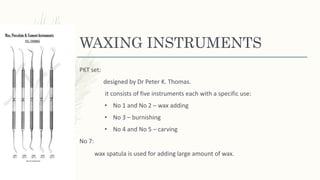
PKT set:
designed by Dr Peter K. Thomas.
it consists of five instruments each with a specific use:
• No 1 and No 2 – wax adding
• No 3 – burnishing
• No 4 and No 5 – carving
No 7:
wax spatula is used for adding large amount of wax.
WAXING INSTRUMENTS
Electric waxing instruments:
They also available for adding wax
Advantage:
 Allows precise temperature control
 Carbon buildup in instruments due to overheating will be minimal.
FABRICATION
POSTERIOR CROWN OR RETAINER
1.coping fabrication
The coping can be made up of or resin. It must reproduce the
retentive features of the restoration.
The die is first coated with a die lubricant to facilitate easy removal
of pattern.
The coping is formed by adding wax with a No 7 wax spatula or
dipping the die into molten wax.
Ensure the previous layer is melted before the addition of new
layer.
This prevents the formation of voids and flow lines.
The proximal areas should be bulk to help removal from die.
FABRICATION
2.Axial contours
This involves fabrication of the proximal, buccal and lingual
surfaces.
Proximal
occulsogingival: occlusal third of the other posterior crown. And
maxillary first and second ,molar in the middle third.
Faciolingual : facial aspect of the middle of the posterior teeth.
And maxillary first and second molar centered faciolingually.
Buccal and Lingual surface: should follow the contour of adjacent teeth.
Height of contour of buccal and lingual surface of maxillary
posterior occurs in the cervical third of the teeth but the mandibular
posterior occurs in middle third.
Emergence profile is the contour of a tooth in relation to the gingival
tissues or below the height of contour. Should be straight or concave.
FABRICATION
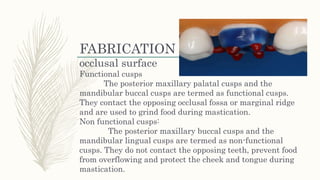
occlusal surface
Functional cusps
The posterior maxillary palatal cusps and the
mandibular buccal cusps are termed as functional cusps.
They contact the opposing occlusal fossa or marginal ridge
and are used to grind food during mastication.
Non functional cusps:
The posterior maxillary buccal cusps and the
mandibular lingual cusps are termed as non-functional
cusps. They do not contact the opposing teeth, prevent food
from overflowing and protect the cheek and tongue during
mastication.
FABRICATION
FABRICATION
Remargination:
to obtain optimum fit, the margins
must be refabricated and finished just before
investing the wax pattern.
Procedure:
The die is lubricated and pattern is reseated.
The entire margin is remelted using a PKT No
1 ensuring that wax is melted through to die.
This results in depression. The depression is
filled with additional wax. The margin is
finished by carving. A sharp instrument
should not be used.
FINISHING AND POLISHING
Cotton pellet held by tweezers and
dipped in die lubricant is used to finish the
occlusal surface. The axial walls are
smoothed and finished using wet silk cloth
and liquid detergent.
REMOVING WAX PATTERN
the pattern is held by thumb and
forefinger of one hand while force in the
opposite direction is applied by holding the
die with thumb and forefinger of other hand.
ANTERIOR CROWN/RETAINER
Coping is fabricated as described for posterior teeth.
For incisors two proximoincisal cones are used and for canine three cone extending
to cusp tip is used.
Wax is placed between the margin and each proximoincisal cone. The pattern with
die is reseated on working cast with the wax still soft. Another rim of wax is placed
between the cones to establish the curvature and thickness of the incisal edge. The
labial surface is contoured with the adjacent teeth. For maxillary incisors, there
should be even contact with opposing incisors during protrusive movements, no
contact during lateral movements and slightly out of contact in maximum
intercuspation.
WAX CUTBACK
All anterior teeth will need to be veneered with resin or ceramic for aesthetics.
Posterior teeth may also need to be veneered. A full contour wax pattern of the
entire crown is first made in wax and then the required space for the resin or
ceramic is cutback.
ADVANTAGE:
valuable aid in determining the form of the final restoration.
Cervical areas are reproduced better. And veneering material is supported
better.
THANK YOU

Wax pattern

  • 1.
  • 2.
    WAX PATTERN – Itis the process of rebuilding the prepared teeth, on the removable die by wax using direct or indirect technique. – A pattern of wax that, when invested and burned out or otherwise eliminated, will produce a mold in which a casting may be made. – A wax form that is the positive likeness of an object to be fabricated. – It is used for making the metal portion of all metal and metal veneered with ceramic or resins.
  • 3.
    FABRICATION DIRECT TECHNIQUE – Thepattern is waxed on the prepared tooth in the patient’s mouth. – It is made with type I Inlay wax and can be adopted for small restorations like inlays and posts. – Impossible to make extracoronal restorations directly as it is cumbersome, technique sensitive and will take away a lot of chairside time. INDIRECT TECHNIQUE – It is the most commonly used method for fabricating fixed partial denture. – Type II inlay wax is used to fabricate. – The pattern is fabricated on a die made from an impression of the prepared tooth. Fabricated in laboratory. – Allows better visualization. – Margins can be assessed and finished better and chairside time is reduced.
  • 4.
    IDEAL REQUIREMENTS – Itshould soften uniformly. – The wax colour should be in contrast to that of the die to facilitate proper finishing of margins. – It should not flake or chip when carved. – It should burn out without any residue. – It should be rigid and dimensionally stable. – Must not flow at room temperatures.
  • 5.
    COMPOSITION – Paraffin wax(40%-60%) - main ingredient – Carnauba wax, ceresin, candelilla wax – decreases the flow at mouth temperature. – Gum dammar - reduces flaking – Synthetic waxes - reduces carnauba wax to improve the working characteristics – Dyes – give colour.
  • 6.
    PROPERTIES FLOW  At 45℃–type I and II should flow between 70% and 90%  At 37℃ –type I should not flow more than 1%  At 30℃– type II should not flow more than 1% THERMAL PROPERTIES  Low thermal conductivity – takes time for them to heat and cool uniformly.  High coefficient of thermal expansion – expand and contract when heated and cooled.
  • 7.
    PROPERTIES WAX DISTORTION  whendistortion occurs, the wax is bent and the inner molecules are under compression and the outer ones are in tension.  Once the stresses are gradually relieved,the wax tends to straighten and distort. To minimize distortion :  wax should be added in melted increments or drops, or by dipping in melted wax.  Margins must be remade just before investing.  Wax pattern should be invested as soon as it is completed.
  • 8.
    WAXING INSTRUMENTS PKT set: designedby Dr Peter K. Thomas. it consists of five instruments each with a specific use: • No 1 and No 2 – wax adding • No 3 – burnishing • No 4 and No 5 – carving No 7: wax spatula is used for adding large amount of wax.
  • 9.
    WAXING INSTRUMENTS Electric waxinginstruments: They also available for adding wax Advantage:  Allows precise temperature control  Carbon buildup in instruments due to overheating will be minimal.
  • 10.
    FABRICATION POSTERIOR CROWN ORRETAINER 1.coping fabrication The coping can be made up of or resin. It must reproduce the retentive features of the restoration. The die is first coated with a die lubricant to facilitate easy removal of pattern. The coping is formed by adding wax with a No 7 wax spatula or dipping the die into molten wax. Ensure the previous layer is melted before the addition of new layer. This prevents the formation of voids and flow lines. The proximal areas should be bulk to help removal from die.
  • 11.
    FABRICATION 2.Axial contours This involvesfabrication of the proximal, buccal and lingual surfaces. Proximal occulsogingival: occlusal third of the other posterior crown. And maxillary first and second ,molar in the middle third. Faciolingual : facial aspect of the middle of the posterior teeth. And maxillary first and second molar centered faciolingually. Buccal and Lingual surface: should follow the contour of adjacent teeth. Height of contour of buccal and lingual surface of maxillary posterior occurs in the cervical third of the teeth but the mandibular posterior occurs in middle third. Emergence profile is the contour of a tooth in relation to the gingival tissues or below the height of contour. Should be straight or concave.
  • 12.
    FABRICATION occlusal surface Functional cusps Theposterior maxillary palatal cusps and the mandibular buccal cusps are termed as functional cusps. They contact the opposing occlusal fossa or marginal ridge and are used to grind food during mastication. Non functional cusps: The posterior maxillary buccal cusps and the mandibular lingual cusps are termed as non-functional cusps. They do not contact the opposing teeth, prevent food from overflowing and protect the cheek and tongue during mastication.
  • 13.
  • 14.
    FABRICATION Remargination: to obtain optimumfit, the margins must be refabricated and finished just before investing the wax pattern. Procedure: The die is lubricated and pattern is reseated. The entire margin is remelted using a PKT No 1 ensuring that wax is melted through to die. This results in depression. The depression is filled with additional wax. The margin is finished by carving. A sharp instrument should not be used. FINISHING AND POLISHING Cotton pellet held by tweezers and dipped in die lubricant is used to finish the occlusal surface. The axial walls are smoothed and finished using wet silk cloth and liquid detergent. REMOVING WAX PATTERN the pattern is held by thumb and forefinger of one hand while force in the opposite direction is applied by holding the die with thumb and forefinger of other hand.
  • 15.
    ANTERIOR CROWN/RETAINER Coping isfabricated as described for posterior teeth. For incisors two proximoincisal cones are used and for canine three cone extending to cusp tip is used. Wax is placed between the margin and each proximoincisal cone. The pattern with die is reseated on working cast with the wax still soft. Another rim of wax is placed between the cones to establish the curvature and thickness of the incisal edge. The labial surface is contoured with the adjacent teeth. For maxillary incisors, there should be even contact with opposing incisors during protrusive movements, no contact during lateral movements and slightly out of contact in maximum intercuspation.
  • 16.
    WAX CUTBACK All anteriorteeth will need to be veneered with resin or ceramic for aesthetics. Posterior teeth may also need to be veneered. A full contour wax pattern of the entire crown is first made in wax and then the required space for the resin or ceramic is cutback. ADVANTAGE: valuable aid in determining the form of the final restoration. Cervical areas are reproduced better. And veneering material is supported better.
  • 17.