








Merck KGaA
Darmstadt, Germany
Implementing a fully single-use,
integrated mAb biosimilars
purification platform for next
generation manufacturing
Josselyn Haas Durr
European Biomanufacturing
Engineer Manager
2
The life science business of
Merck KGaA, Darmstadt, Germany
operates as MilliporeSigma
in the U.S. and Canada.
3
0
0
0
0
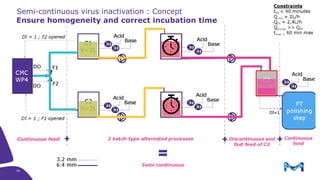
0
0
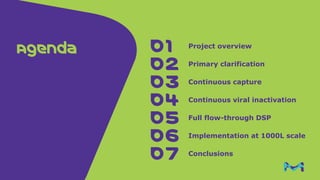
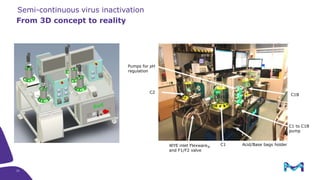
0Agenda Project overview
1
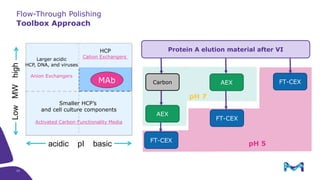
Primary clarification
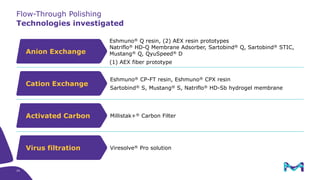
2
Continuous capture
3
Continuous viral inactivation
4
Full flow-through DSP
5
Implementation at 1000L scale
6
Conclusions
7
Project overview
10
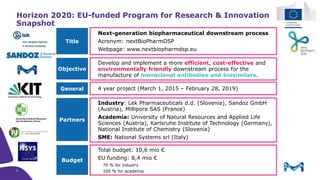
Title
 Next-generation biopharmaceutical downstream process
 Acronym: nextBioPharmDSP
 Webpage: www.nextbiopharmdsp.eu
General  4 year project (March 1, 2015 – February 28, 2019)
Partners
 Industry: Lek Pharmaceuticals d.d. (Slovenia), Sandoz GmbH
(Austria), Millipore SAS (France)
 Academia: University of Natural Resources and Applied Life
Sciences (Austria), Karlsruhe Institute of Technology (Germany),
National Institute of Chemistry (Slovenia)
 SME: National Systems srl (Italy)
Objective
 Develop and implement a more efficient, cost-effective and
environmentally friendly downstream process for the
manufacture of monoclonal antibodies and biosimilars.
Horizon 2020: EU-funded Program for Research & Innovation
Snapshot
5
Budget
 Total budget: 10,6 mio €
 EU funding: 8,4 mio €
 70 % for industry
 100 % for academia
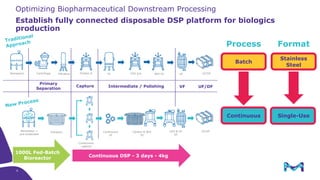
1000L Fed-Batch
Bioreactor
Optimizing Biopharmaceutical Downstream Processing
Establish fully connected disposable DSP platform for biologics
production
Bioreactor Centrifuge Filtration Protein A VI CEX b/e AEX f/t VF UF/DF
Bioreactor +
pre-treatment
Filtration Continuous
VI
Continuous
capture
Carbon & AEX
f/t
CEX & VF
f/t
UF/DF
Continuous DSP - 3 days - 4kg
Capture Intermediate / Polishing VF UF/DF
Primary
Separation
6
Batch
Process
Continuous
Stainless
Steel
Format
Single-Use
Primary
clarification
20
Flocculation followed by depth filtration outperforms
traditional clarification strategies
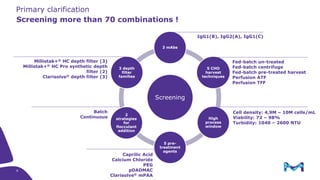
Screening more than 70 combinations !
Screening
3 mAbs
5 CHO
harvest
techniques
High
process
window
5 pre-
treatment
agents
3 depth
filter
families
IgG1(B), IgG2(A), IgG1(C)
Fed-batch un-treated
Fed-batch centrifuge
Fed-batch pre-treated harvest
Perfusion ATF
Perfusion TFF
Caprilic Acid
Calcium Chloride
PEG
pDADMAC
Clarisolve® mPAA
Millistak+® HC depth filter (3)
Millistak+® HC Pro synthetic depth
filter (2)
Clarisolve® depth filter (3)
8
Primary clarification
Cell density: 4,9M – 10M cells/mL
Viability: 72 – 98%
Turbidity: 1040 – 2600 NTU
2
strategies
for
flocculant
addition
Batch
Continuous
5.2
1.9
3.4
0
1
2
3
4
5
6
7
8
9
10
Untreated + Millistak+®
HC D0HC/F0HC depth
filter
pDADMAC + Clarisolve®
40MS synthetic depth
filter
Area(m²)
Minimum Depth Filtration Area
(Fed-Batch, 1000L, 2h)
0.00
0.05
0.10
0.15
0.20
0.25
0.30
0 100 200 300 400 500 600
FilterResistance(psi/L/m².h)
Filtrate Volume (L/m²)
Untreated - Millistak+® HC D0HC/F0HC
Caprilic Acid 0.25% - Clarisolve® 20MS
100mM CaCl2/10mM PO4 - Clarisolve® 20MS
Untreated - Clarisolve® 20MS/Millistak+® HC F0HC
Untreated - Millistak+® HC Pro D0SP/X0SP
PEG 4% - Clarisolve® 40MS
Clarisolve® mPAA 0.05% - Clarisolve® 40MS
pDADMAC 0.0375% - Clarisolve® 40MS
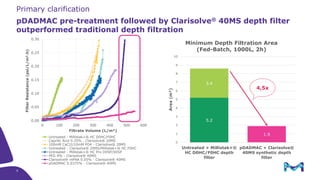
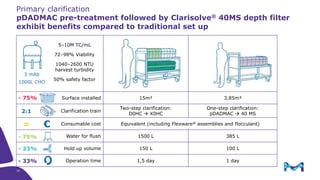
pDADMAC pre-treatment followed by Clarisolve® 40MS depth filter
outperformed traditional depth filtration
4,5x
9
Primary clarification
Surface installed 15m² 3,85m²
Clarification train
Two-step clarification:
D0HC  X0HC
One-step clarification:
pDADMAC  40 MS
Consumable cost Equivalent (including Flexware® assemblies and flocculant)
Water for flush 1500 L 385 L
Hold up volume 150 L 100 L
Operation time 1,5 day 1 day
pDADMAC pre-treatment followed by Clarisolve® 40MS depth filter
exhibit benefits compared to traditional set up
5–10M TC/mL
72–98% Viability
1040–2600 NTU
harvest turbidity
50% safety factor
€
3 mAb
1000L CHO
- 75%
- 75%
- 33%
- 33%
2:1
=
10
Primary clarification
Large scale implementation
11
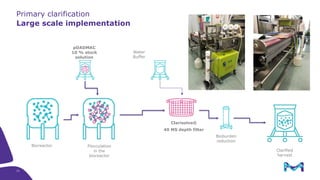
Bioreactor Flocculation
in the
bioreactor
pDADMAC
10 % stock
solution
Water
Buffer
Bioburden
reduction
Clarisolve®
40 MS depth filter
Clarified
harvest
Continuous
capture
30
Continuous Protein-A capture enhances productivity and
provides a constant quality eluate
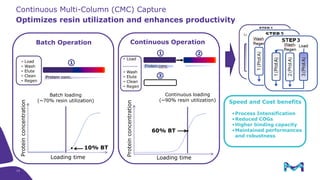
Continuous Multi-Column (CMC) Capture
Batch Operation
10% BT
Batch loading
(~70% resin utilization)
Loading time
Proteinconcentration
• Load
• Wash
• Elute
• Clean
• Regen
1
Protein conc.
Continuous Operation
60% BT
Continuous loading
(~90% resin utilization)
Loading time
Proteinconcentration
1 2
3
• Wash
• Elute
• Clean
• Regen
• Load
Speed and Cost benefits
•Process Intensification
•Reduced COGs
•Higher binding capacity
•Maintained performances
and robustness
13
Load Wash-
Regen
STEP 1
3(ProtA)
2(ProtA)
1(ProtA)
Optimizes resin utilization and enhances productivity
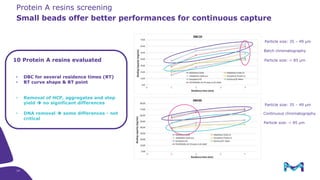
Small beads offer better performances for continuous capture
Particle size: 35 – 49 μm
Particle size: ~ 85 μm
Particle size: 35 – 49 μm
Particle size: ~ 85 μm
Batch chromatography
Continuous chromatography
10 Protein A resins evaluated
• DBC for several residence times (RT)
• BT curve shape & BT point
• Removal of HCP, aggregates and step
yield  no significant differences
• DNA removal  some differences - not
critical
14
Protein A resins screening
®
®
Resin
Resin
Continuous Chromatography
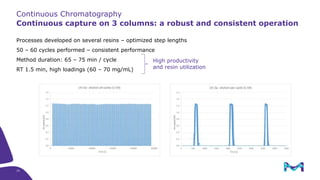
Continuous capture on 3 columns: a robust and consistent operation
15
Processes developed on several resins – optimized step lengths
50 – 60 cycles performed – consistent performance
Method duration: 65 – 75 min / cycle
RT 1.5 min, high loadings (60 – 70 mg/mL)
High productivity
and resin utilization
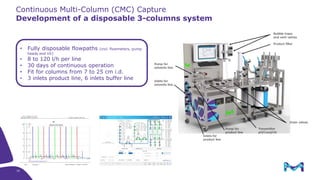
Development of a disposable 3-columns system
• Fully disposable flowpaths (incl. flowmeters, pump
heads and UV)
• 8 to 120 l/h per line
• 30 days of continuous operation
• Fit for columns from 7 to 25 cm i.d.
• 3 inlets product line, 6 inlets buffer line
16
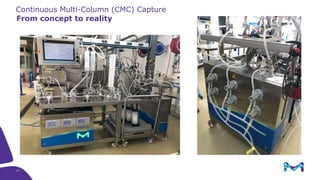
Continuous Multi-Column (CMC) Capture
From concept to reality
17
Continuous Multi-Column (CMC) Capture
Continuous viral
inactivation
40
Fulfill a double challenge: make it single use and
continuous!
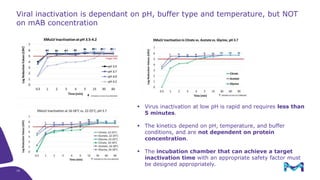
Viral inactivation is dependant on pH, buffer type and temperature, but NOT
on mAB concentration
19
 Virus inactivation at low pH is rapid and requires less than
5 minutes.
 The kinetics depend on pH, temperature, and buffer
conditions, and are not dependent on protein
concentration.
 The incubation chamber that can achieve a target
inactivation time with an appropriate safety factor must
be designed appropriately.
Semi-continuous virus inactivation : Concept
20
Ensure homogeneity and correct incubation time
Continuous feed
20
From 3D concept to reality
21
Semi-continuous virus inactivation
Pumps for pH
regulation
C2
WYE inlet Flexware®
and F1/F2 valve
C1 Acid/Base bags holder
C1 to C1B
pump
C1B
Full flow-through
DSP polishing
50
New technologies
pH 5
Protein A elution material after VI
AEX FT-CEXCarbon
AEX
FT-CEX
FT-CEX
pH 7
MAb
acidic pI basic
LowMWhigh
Larger acidic
HCP, DNA, and viruses
Anion Exchangers
HCP
Cation Exchangers
Smaller HCP’s
and cell culture components
Activated Carbon Functionality Media
23
Toolbox Approach
Flow-Through Polishing
Technologies investigated
24
Virus filtration
Eshmuno® Q resin, (2) AEX resin prototypes
Natriflo® HD-Q Membrane Adsorber, Sartobind® Q, Sartobind® STIC,
Mustang® Q, QyuSpeed® D
(1) AEX fiber prototype
Eshmuno® CP-FT resin, Eshmuno® CPX resin
Sartobind® S, Mustang® S, Natriflo® HD-Sb hydrogel membrane
Millistak+® Carbon Filter
Viresolve® Pro solution
Activated Carbon
Cation Exchange
Anion Exchange
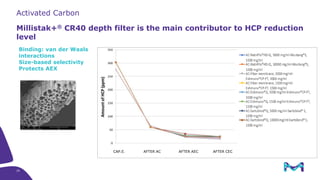
Millistak+® CR40 depth filter is the main contributor to HCP reduction
level
25
Activated Carbon
Binding: van der Waals
interactions
Size-based selectivity
Protects AEX
CAP.E. AFTER AC AFTER AEC AFTER CECCAP.E. AFTER AC AFTER AEC AFTER CEC
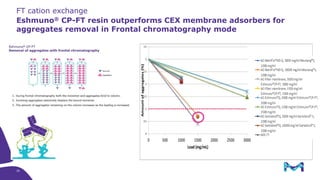
Eshmuno® CP-FT resin outperforms CEX membrane adsorbers for
aggregates removal in Frontal chromatography mode
26
FT cation exchange
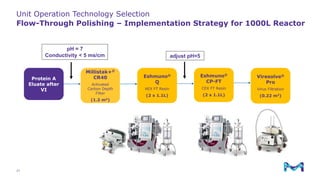
Unit Operation Technology Selection
Flow-Through Polishing – Implementation Strategy for 1000L Reactor
Protein A
Eluate after
VI
Millistak+®
CR40
Activated
Carbon Depth
Filter
(1.2 m2)
Eshmuno®
Q
AEX FT Resin
(2 x 1.1L)
Eshmuno®
CP-FT
CEX FT Resin
(2 x 1.1L)
Viresolve®
Pro
Virus Filtration
(0.22 m2)
adjust pH=5
pH = 7
Conductivity < 5 ms/cm
27
Implementation
at 1000L scale
60
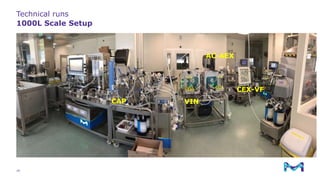
Technical runs
1000L Scale Setup
CAP VIN
AC-AEX
CEX-VF
29
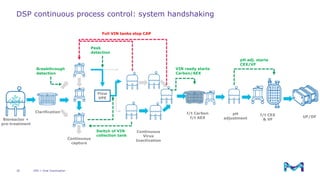
DSP continuous process control: system handshaking
Bioreactor +
pre-treatment
Clarification
Continuous
Virus
Inactivation
Continuous
capture
f/t Carbon
f/t AEX
f/t CEX
& VF
UF/DF
pH
adjustment
Switch of VIN
collection tank
Full VIN tanks stop CAP
VIN ready starts
Carbon/AEX
pH adj. starts
CEX/VF
Breakthrough
detection
Peak
detection
Flow
VPE
VIN = Viral Inactivation30
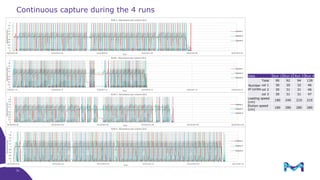
Continuous capture during the 4 runs
Data Run 1 Run 2 Run 3 Run 4
Number
of cycles
Total 90 92 94 139
col 1 30 30 32 46
col 2 30 31 31 46
col 3 30 31 31 47
Loading speed
(cm)
180 240 210 210
Elution speed
(cm)
180 280 280 280
31
32
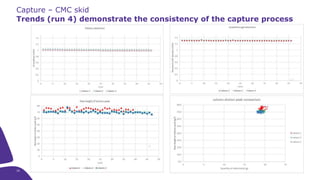
Capture – CMC skid
Trends (run 4) demonstrate the consistency of the capture process
32
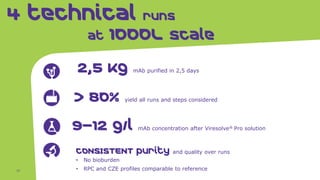
4 technical runs
at 1000L scale
2,5 kg mAb purified in 2,5 days
> 80% yield all runs and steps considered
9–12 g/l mAb concentration after Viresolve® Pro solution
CONSISTENT purity and quality over runs
• No bioburden
• RPC and CZE profiles comparable to reference33
34
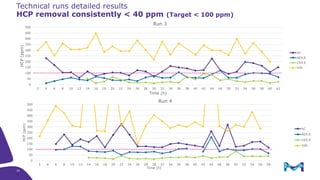
HCP removal consistently < 40 ppm (Target < 100 ppm)
0
50
100
150
200
250
300
350
400
450
500
2 4 6 8 10 12 14 16 18 20 22 24 26 28 30 32 34 36 38 40 42 44 46 50 52 54 56 58 60 62
HCP(ppm)
Time (h)
Run 3
AC
AEX.E
CEX.E
VIN
0
50
100
150
200
250
300
350
400
450
500
2 4 6 8 10 12 14 16 18 20 22 24 26 28 30 32 34 36 38 40 42 44 46 48 50 52 54 56 58
HCP(ppm)
Time (h)
Run 4
AC
AEX.E
CEX.E
VIN
Technical runs detailed results
35
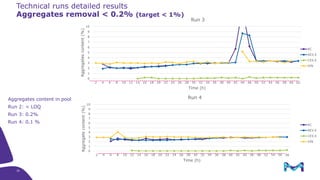
Aggregates removal < 0.2% (target < 1%)
0
1
2
3
4
5
6
7
8
9
10
2 4 6 8 10 12 14 16 18 20 22 24 26 28 30 32 34 36 38 40 42 44 46 48 52 54 56 58
Aggregatecontent(%)
Time (h)
Run 4
AC
AEX.E
CEX.E
VIN
0
1
2
3
4
5
6
7
8
9
10
2 4 6 8 10 12 14 16 18 20 22 24 26 28 30 32 34 36 38 40 42 44 46 50 52 54 56 58 60 62Aggregatescontent(%)
Time (h)
Run 3
AC
AEX.E
CEX.E
VIN
Technical runs detailed results
Aggregates content in pool
Run 2: < LOQ
Run 3: 0.2%
Run 4: 0.1 %
36
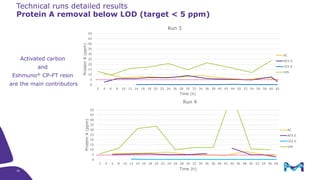
Protein A removal below LOD (target < 5 ppm)
0
5
10
15
20
25
30
35
40
45
50
2 4 6 8 10 12 14 16 18 20 22 24 26 28 30 32 34 36 38 40 42 44 50 52 54 56 58 60 62
ProteinA(ppm)
Time (h)
Run 3
AC
AEX.E
CEX.E
VIN
0
5
10
15
20
25
30
35
40
45
50
2 4 6 8 10 12 14 16 18 20 22 24 26 28 30 32 34 36 38 40 42 44 46 48 50 52 54 56 58
ProteinA(ppm)
Time (h)
Run 4
AC
AEX.E
CEX.E
VIN
Technical runs detailed results
Activated carbon
and
Eshmuno® CP-FT resin
are the main contributors
Conclusions
70
Main benefits
38
€
• Facility investment: 35%
• Running costs: 30%
• Cost of materials: 50%
• CO2 emissions: 25%
• Reduced water, buffer, resins consumption (water 10x)
Productivity
Footprint
Economics
Single-Use
Environmental
• Reduce bioburden risk
• No carry-over issues
• No cleaning, regeneration, steaming
• Rapid change-over
• Complete DSP in 30 m2 (10-15x smaller)
• Elimination of large intermediate hold tanks
• Flexibility (mobile equipment)
• Capable of processing up to 3000L harvest in 24 hours (up 12 kg of mAb)
nextBioPharmDSP project helps to make highly efficient
biopharmaceuticals more accessible to patient
You are invited!
Next Generation Bioprocessing
Forum
October 8-9, 2019
M Lab™ Collaboration Center
Molsheim, France
Trademarks and logos used in this presentation are the property of companies
collaborating in the nextBioPharmDSP project.
Thank you!
www.nextbiopharmdsp.eu
This project has received funding from the European
Union’s Horizon 2020 research and innovation
program under grant agreement No 635557
josselyn.haas@milliporesigma.com
Josselyn Haas
The vibrant M, Eshmuno, Viresolve, Millistak+, Flexware, NatriFlo and BioContinuum are trademarks of Merck KGaA, Darmstadt, Germany or its affiliates. All other
trademarks are the property of their respective owners. Detailed information on trademarks is available via publicly accessible resources.
© 2019 Merck KGaA, Darmstadt, Germany and/or its affiliates. All Rights Reserved.

Implementing a Fully Single-Use, Integrated mAb Biosimilars Purification Platform for Next Generation Manufacturing

  • 1.
    Merck KGaA Darmstadt, Germany Implementinga fully single-use, integrated mAb biosimilars purification platform for next generation manufacturing Josselyn Haas Durr European Biomanufacturing Engineer Manager
  • 2.
    2 The life sciencebusiness of Merck KGaA, Darmstadt, Germany operates as MilliporeSigma in the U.S. and Canada.
  • 3.
    3 0 0 0 0 0 0 0Agenda Project overview 1 Primaryclarification 2 Continuous capture 3 Continuous viral inactivation 4 Full flow-through DSP 5 Implementation at 1000L scale 6 Conclusions 7
  • 4.
  • 5.
    Title  Next-generation biopharmaceuticaldownstream process  Acronym: nextBioPharmDSP  Webpage: www.nextbiopharmdsp.eu General  4 year project (March 1, 2015 – February 28, 2019) Partners  Industry: Lek Pharmaceuticals d.d. (Slovenia), Sandoz GmbH (Austria), Millipore SAS (France)  Academia: University of Natural Resources and Applied Life Sciences (Austria), Karlsruhe Institute of Technology (Germany), National Institute of Chemistry (Slovenia)  SME: National Systems srl (Italy) Objective  Develop and implement a more efficient, cost-effective and environmentally friendly downstream process for the manufacture of monoclonal antibodies and biosimilars. Horizon 2020: EU-funded Program for Research & Innovation Snapshot 5 Budget  Total budget: 10,6 mio €  EU funding: 8,4 mio €  70 % for industry  100 % for academia
  • 6.
    1000L Fed-Batch Bioreactor Optimizing BiopharmaceuticalDownstream Processing Establish fully connected disposable DSP platform for biologics production Bioreactor Centrifuge Filtration Protein A VI CEX b/e AEX f/t VF UF/DF Bioreactor + pre-treatment Filtration Continuous VI Continuous capture Carbon & AEX f/t CEX & VF f/t UF/DF Continuous DSP - 3 days - 4kg Capture Intermediate / Polishing VF UF/DF Primary Separation 6 Batch Process Continuous Stainless Steel Format Single-Use
  • 7.
    Primary clarification 20 Flocculation followed bydepth filtration outperforms traditional clarification strategies
  • 8.
    Screening more than70 combinations ! Screening 3 mAbs 5 CHO harvest techniques High process window 5 pre- treatment agents 3 depth filter families IgG1(B), IgG2(A), IgG1(C) Fed-batch un-treated Fed-batch centrifuge Fed-batch pre-treated harvest Perfusion ATF Perfusion TFF Caprilic Acid Calcium Chloride PEG pDADMAC Clarisolve® mPAA Millistak+® HC depth filter (3) Millistak+® HC Pro synthetic depth filter (2) Clarisolve® depth filter (3) 8 Primary clarification Cell density: 4,9M – 10M cells/mL Viability: 72 – 98% Turbidity: 1040 – 2600 NTU 2 strategies for flocculant addition Batch Continuous
  • 9.
    5.2 1.9 3.4 0 1 2 3 4 5 6 7 8 9 10 Untreated + Millistak+® HCD0HC/F0HC depth filter pDADMAC + Clarisolve® 40MS synthetic depth filter Area(m²) Minimum Depth Filtration Area (Fed-Batch, 1000L, 2h) 0.00 0.05 0.10 0.15 0.20 0.25 0.30 0 100 200 300 400 500 600 FilterResistance(psi/L/m².h) Filtrate Volume (L/m²) Untreated - Millistak+® HC D0HC/F0HC Caprilic Acid 0.25% - Clarisolve® 20MS 100mM CaCl2/10mM PO4 - Clarisolve® 20MS Untreated - Clarisolve® 20MS/Millistak+® HC F0HC Untreated - Millistak+® HC Pro D0SP/X0SP PEG 4% - Clarisolve® 40MS Clarisolve® mPAA 0.05% - Clarisolve® 40MS pDADMAC 0.0375% - Clarisolve® 40MS pDADMAC pre-treatment followed by Clarisolve® 40MS depth filter outperformed traditional depth filtration 4,5x 9 Primary clarification
  • 10.
    Surface installed 15m²3,85m² Clarification train Two-step clarification: D0HC  X0HC One-step clarification: pDADMAC  40 MS Consumable cost Equivalent (including Flexware® assemblies and flocculant) Water for flush 1500 L 385 L Hold up volume 150 L 100 L Operation time 1,5 day 1 day pDADMAC pre-treatment followed by Clarisolve® 40MS depth filter exhibit benefits compared to traditional set up 5–10M TC/mL 72–98% Viability 1040–2600 NTU harvest turbidity 50% safety factor € 3 mAb 1000L CHO - 75% - 75% - 33% - 33% 2:1 = 10 Primary clarification
  • 11.
    Primary clarification Large scaleimplementation 11 Bioreactor Flocculation in the bioreactor pDADMAC 10 % stock solution Water Buffer Bioburden reduction Clarisolve® 40 MS depth filter Clarified harvest
  • 12.
    Continuous capture 30 Continuous Protein-A captureenhances productivity and provides a constant quality eluate
  • 13.
    Continuous Multi-Column (CMC)Capture Batch Operation 10% BT Batch loading (~70% resin utilization) Loading time Proteinconcentration • Load • Wash • Elute • Clean • Regen 1 Protein conc. Continuous Operation 60% BT Continuous loading (~90% resin utilization) Loading time Proteinconcentration 1 2 3 • Wash • Elute • Clean • Regen • Load Speed and Cost benefits •Process Intensification •Reduced COGs •Higher binding capacity •Maintained performances and robustness 13 Load Wash- Regen STEP 1 3(ProtA) 2(ProtA) 1(ProtA) Optimizes resin utilization and enhances productivity
  • 14.
    Small beads offerbetter performances for continuous capture Particle size: 35 – 49 μm Particle size: ~ 85 μm Particle size: 35 – 49 μm Particle size: ~ 85 μm Batch chromatography Continuous chromatography 10 Protein A resins evaluated • DBC for several residence times (RT) • BT curve shape & BT point • Removal of HCP, aggregates and step yield  no significant differences • DNA removal  some differences - not critical 14 Protein A resins screening ® ® Resin Resin
  • 15.
    Continuous Chromatography Continuous captureon 3 columns: a robust and consistent operation 15 Processes developed on several resins – optimized step lengths 50 – 60 cycles performed – consistent performance Method duration: 65 – 75 min / cycle RT 1.5 min, high loadings (60 – 70 mg/mL) High productivity and resin utilization
  • 16.
    Development of adisposable 3-columns system • Fully disposable flowpaths (incl. flowmeters, pump heads and UV) • 8 to 120 l/h per line • 30 days of continuous operation • Fit for columns from 7 to 25 cm i.d. • 3 inlets product line, 6 inlets buffer line 16 Continuous Multi-Column (CMC) Capture
  • 17.
    From concept toreality 17 Continuous Multi-Column (CMC) Capture
  • 18.
    Continuous viral inactivation 40 Fulfill adouble challenge: make it single use and continuous!
  • 19.
    Viral inactivation isdependant on pH, buffer type and temperature, but NOT on mAB concentration 19  Virus inactivation at low pH is rapid and requires less than 5 minutes.  The kinetics depend on pH, temperature, and buffer conditions, and are not dependent on protein concentration.  The incubation chamber that can achieve a target inactivation time with an appropriate safety factor must be designed appropriately.
  • 20.
    Semi-continuous virus inactivation: Concept 20 Ensure homogeneity and correct incubation time Continuous feed 20
  • 21.
    From 3D conceptto reality 21 Semi-continuous virus inactivation Pumps for pH regulation C2 WYE inlet Flexware® and F1/F2 valve C1 Acid/Base bags holder C1 to C1B pump C1B
  • 22.
  • 23.
    pH 5 Protein Aelution material after VI AEX FT-CEXCarbon AEX FT-CEX FT-CEX pH 7 MAb acidic pI basic LowMWhigh Larger acidic HCP, DNA, and viruses Anion Exchangers HCP Cation Exchangers Smaller HCP’s and cell culture components Activated Carbon Functionality Media 23 Toolbox Approach Flow-Through Polishing
  • 24.
    Flow-Through Polishing Technologies investigated 24 Virusfiltration Eshmuno® Q resin, (2) AEX resin prototypes Natriflo® HD-Q Membrane Adsorber, Sartobind® Q, Sartobind® STIC, Mustang® Q, QyuSpeed® D (1) AEX fiber prototype Eshmuno® CP-FT resin, Eshmuno® CPX resin Sartobind® S, Mustang® S, Natriflo® HD-Sb hydrogel membrane Millistak+® Carbon Filter Viresolve® Pro solution Activated Carbon Cation Exchange Anion Exchange
  • 25.
    Millistak+® CR40 depthfilter is the main contributor to HCP reduction level 25 Activated Carbon Binding: van der Waals interactions Size-based selectivity Protects AEX CAP.E. AFTER AC AFTER AEC AFTER CECCAP.E. AFTER AC AFTER AEC AFTER CEC
  • 26.
    Eshmuno® CP-FT resinoutperforms CEX membrane adsorbers for aggregates removal in Frontal chromatography mode 26 FT cation exchange
  • 27.
    Unit Operation TechnologySelection Flow-Through Polishing – Implementation Strategy for 1000L Reactor Protein A Eluate after VI Millistak+® CR40 Activated Carbon Depth Filter (1.2 m2) Eshmuno® Q AEX FT Resin (2 x 1.1L) Eshmuno® CP-FT CEX FT Resin (2 x 1.1L) Viresolve® Pro Virus Filtration (0.22 m2) adjust pH=5 pH = 7 Conductivity < 5 ms/cm 27
  • 28.
  • 29.
    Technical runs 1000L ScaleSetup CAP VIN AC-AEX CEX-VF 29
  • 30.
    DSP continuous processcontrol: system handshaking Bioreactor + pre-treatment Clarification Continuous Virus Inactivation Continuous capture f/t Carbon f/t AEX f/t CEX & VF UF/DF pH adjustment Switch of VIN collection tank Full VIN tanks stop CAP VIN ready starts Carbon/AEX pH adj. starts CEX/VF Breakthrough detection Peak detection Flow VPE VIN = Viral Inactivation30
  • 31.
    Continuous capture duringthe 4 runs Data Run 1 Run 2 Run 3 Run 4 Number of cycles Total 90 92 94 139 col 1 30 30 32 46 col 2 30 31 31 46 col 3 30 31 31 47 Loading speed (cm) 180 240 210 210 Elution speed (cm) 180 280 280 280 31
  • 32.
    32 Capture – CMCskid Trends (run 4) demonstrate the consistency of the capture process 32
  • 33.
    4 technical runs at1000L scale 2,5 kg mAb purified in 2,5 days > 80% yield all runs and steps considered 9–12 g/l mAb concentration after Viresolve® Pro solution CONSISTENT purity and quality over runs • No bioburden • RPC and CZE profiles comparable to reference33
  • 34.
    34 HCP removal consistently< 40 ppm (Target < 100 ppm) 0 50 100 150 200 250 300 350 400 450 500 2 4 6 8 10 12 14 16 18 20 22 24 26 28 30 32 34 36 38 40 42 44 46 50 52 54 56 58 60 62 HCP(ppm) Time (h) Run 3 AC AEX.E CEX.E VIN 0 50 100 150 200 250 300 350 400 450 500 2 4 6 8 10 12 14 16 18 20 22 24 26 28 30 32 34 36 38 40 42 44 46 48 50 52 54 56 58 HCP(ppm) Time (h) Run 4 AC AEX.E CEX.E VIN Technical runs detailed results
  • 35.
    35 Aggregates removal <0.2% (target < 1%) 0 1 2 3 4 5 6 7 8 9 10 2 4 6 8 10 12 14 16 18 20 22 24 26 28 30 32 34 36 38 40 42 44 46 48 52 54 56 58 Aggregatecontent(%) Time (h) Run 4 AC AEX.E CEX.E VIN 0 1 2 3 4 5 6 7 8 9 10 2 4 6 8 10 12 14 16 18 20 22 24 26 28 30 32 34 36 38 40 42 44 46 50 52 54 56 58 60 62Aggregatescontent(%) Time (h) Run 3 AC AEX.E CEX.E VIN Technical runs detailed results Aggregates content in pool Run 2: < LOQ Run 3: 0.2% Run 4: 0.1 %
  • 36.
    36 Protein A removalbelow LOD (target < 5 ppm) 0 5 10 15 20 25 30 35 40 45 50 2 4 6 8 10 12 14 16 18 20 22 24 26 28 30 32 34 36 38 40 42 44 50 52 54 56 58 60 62 ProteinA(ppm) Time (h) Run 3 AC AEX.E CEX.E VIN 0 5 10 15 20 25 30 35 40 45 50 2 4 6 8 10 12 14 16 18 20 22 24 26 28 30 32 34 36 38 40 42 44 46 48 50 52 54 56 58 ProteinA(ppm) Time (h) Run 4 AC AEX.E CEX.E VIN Technical runs detailed results Activated carbon and Eshmuno® CP-FT resin are the main contributors
  • 37.
  • 38.
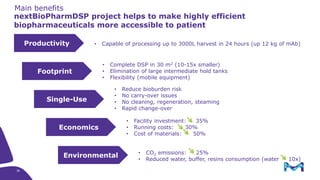
    Main benefits 38 € • Facilityinvestment: 35% • Running costs: 30% • Cost of materials: 50% • CO2 emissions: 25% • Reduced water, buffer, resins consumption (water 10x) Productivity Footprint Economics Single-Use Environmental • Reduce bioburden risk • No carry-over issues • No cleaning, regeneration, steaming • Rapid change-over • Complete DSP in 30 m2 (10-15x smaller) • Elimination of large intermediate hold tanks • Flexibility (mobile equipment) • Capable of processing up to 3000L harvest in 24 hours (up 12 kg of mAb) nextBioPharmDSP project helps to make highly efficient biopharmaceuticals more accessible to patient
  • 39.
    You are invited! NextGeneration Bioprocessing Forum October 8-9, 2019 M Lab™ Collaboration Center Molsheim, France
  • 40.
    Trademarks and logosused in this presentation are the property of companies collaborating in the nextBioPharmDSP project. Thank you! www.nextbiopharmdsp.eu This project has received funding from the European Union’s Horizon 2020 research and innovation program under grant agreement No 635557
  • 41.
    josselyn.haas@milliporesigma.com Josselyn Haas The vibrantM, Eshmuno, Viresolve, Millistak+, Flexware, NatriFlo and BioContinuum are trademarks of Merck KGaA, Darmstadt, Germany or its affiliates. All other trademarks are the property of their respective owners. Detailed information on trademarks is available via publicly accessible resources. © 2019 Merck KGaA, Darmstadt, Germany and/or its affiliates. All Rights Reserved.