Merck KGaA
Darmstadt, Germany
Kimberly Steffen
Technology Manager, Life Sciences
6 December 2018
Find your filter
which aseptic filter is
best for your process?
The life science business of
Merck KGaA, Darmstadt, Germany
operates as MilliporeSigma
in the U.S. and Canada.
2
Agenda
1 Filtration 101
• Sterilizing grade filters
• Bioburden reduction filters
• Prefilters
2 Membranes and devices optimized for
applications
3 Which filter should I use?
• Case Studies
3
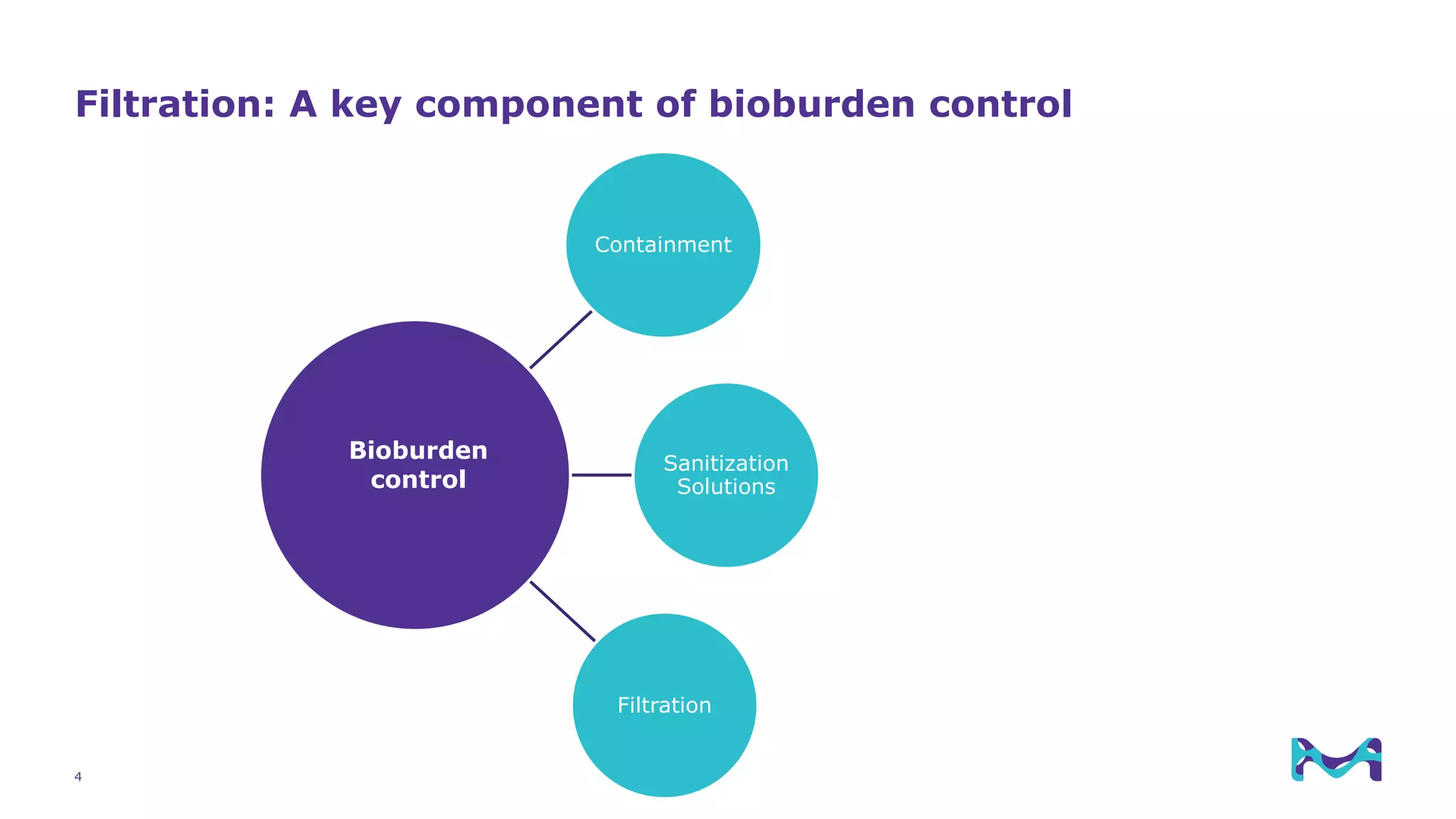
Filtration: A key component of bioburden control
Containment
Sanitization
Solutions
Filtration
Bioburden
control
4
filtration 101
The ideal filter
Not add any unwanted
material to the process
stream
Remove from the process
stream whatever you want to
remove.
Meet the process objectives
in the most economical way
Not remove anything you
don’t want to remove
6
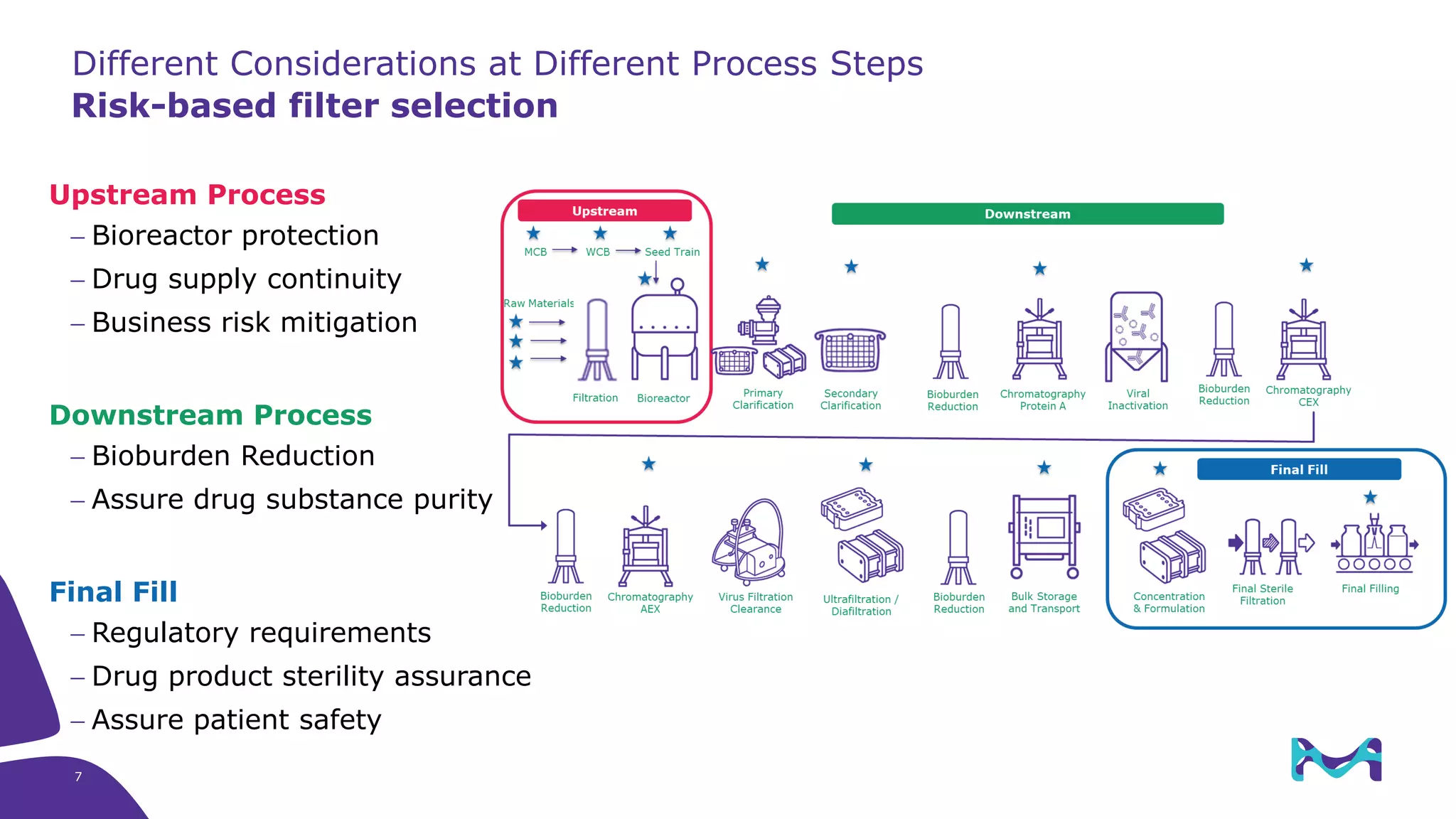
Upstream Process
 Bioreactor protection
 Drug supply continuity
 Business risk mitigation
Downstream Process
 Bioburden Reduction
 Assure drug substance purity
Final Fill
 Regulatory requirements
 Drug product sterility assurance
 Assure patient safety
Risk-based filter selection
Different Considerations at Different Process Steps
7
The Risk Profile Varies from Upstream to Final Fill
Sterilizing-grade vs bioburden reduction
Upstream Downstream Drug Product
Finish and Fill
Operations
Risk
High
Low
Aseptic Aseptic
Bioburden
Controlled
“The level of effort, formality and
documentation of the quality risk
management process should align
with the level of risk”
“The evaluation of risk…should be
based upon scientific knowledge.”
(ICH Q9A)
Courtesy of Michael Payne,
Principal Technical Consultant,
Millipore Sigma
8
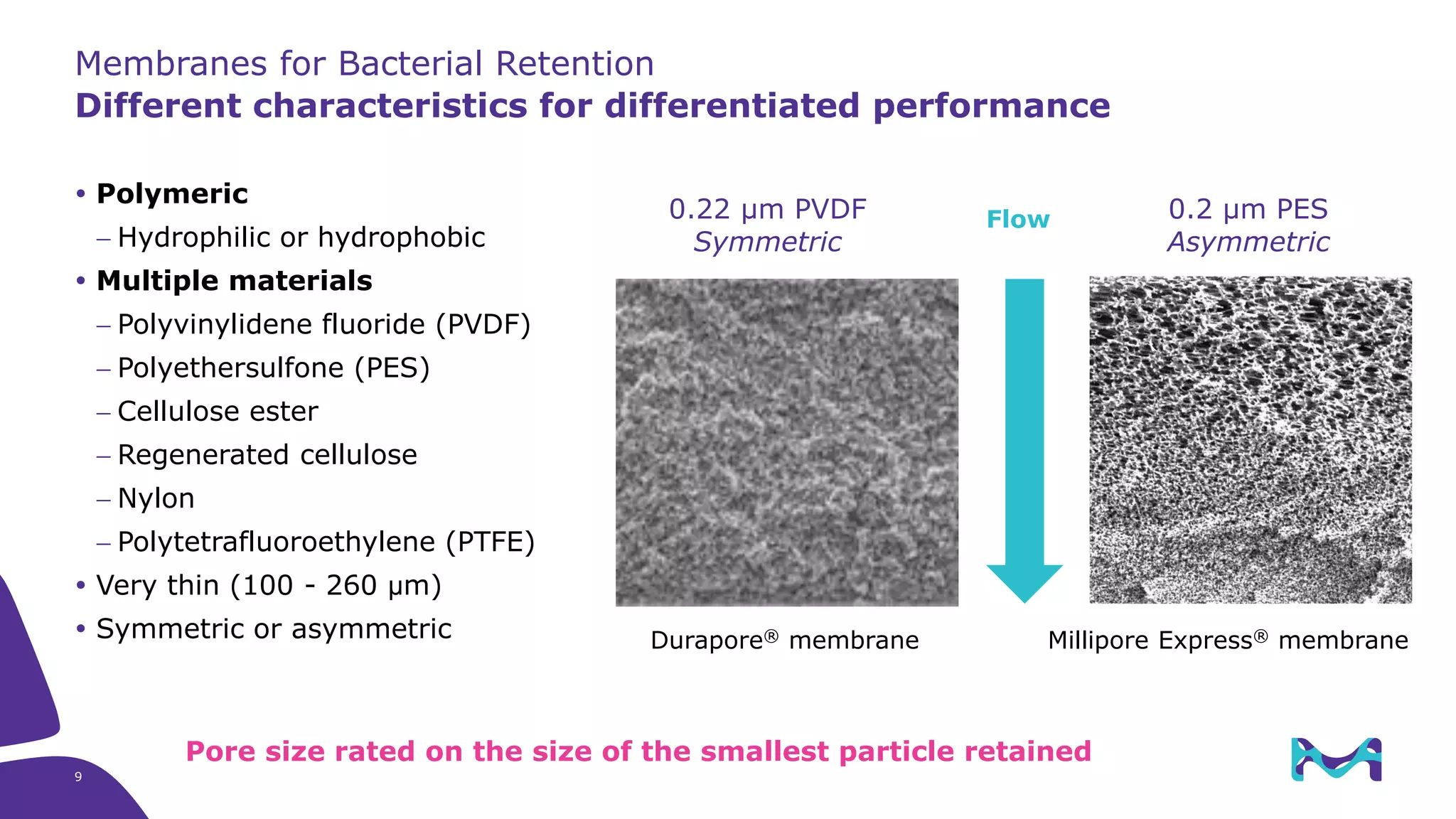
 Polymeric
 Hydrophilic or hydrophobic
 Multiple materials
 Polyvinylidene fluoride (PVDF)
 Polyethersulfone (PES)
 Cellulose ester
 Regenerated cellulose
 Nylon
 Polytetrafluoroethylene (PTFE)
 Very thin (100 - 260 µm)
 Symmetric or asymmetric
Membranes for Bacterial Retention
Different characteristics for differentiated performance
0.22 μm PVDF
Symmetric
Durapore® membrane Millipore Express® membrane
0.2 μm PES
Asymmetric
Pore size rated on the size of the smallest particle retained
Flow
9
What is sterilizing-grade? What is 0.22 µm?
"Sterilizing-grade" designation
“A filter which, when challenged with the bacterium
Brevundimonas diminuta, at a minimum
concentration of 107 cfu per cm2 of filter surface
area, will produce a sterile effluent.”
References
• Standard Test Method ASTM F838-15
Referenced in many documents
• HIMA Document No. 3, Vol. 4, 1982 (obsolete)
• Aseptic Processing Guideline, FDA 2004 (original 1987)
• PDA Technical Report 26 1998
Sterilizing-grade is a functional definition, not pore-size dependent
10
• Typically 0.45 µm or 0.2 µm pore size
• Manufacturers may validate bacterial reduction,
but not sterilizing performance
• Can be used stand-alone for controlling bioburden
➢ Before chromatography columns
➢ Before hold steps or storage
➢ Buffer preparation
Downstream Filtration
What are bioburden reduction filters?
Goal: Minimize in-process bioburden
• No requirement to validate sterility
• Reduce bioburden proliferation
• With other controls, bioburden reduction filters
may be sufficient for some process steps
11
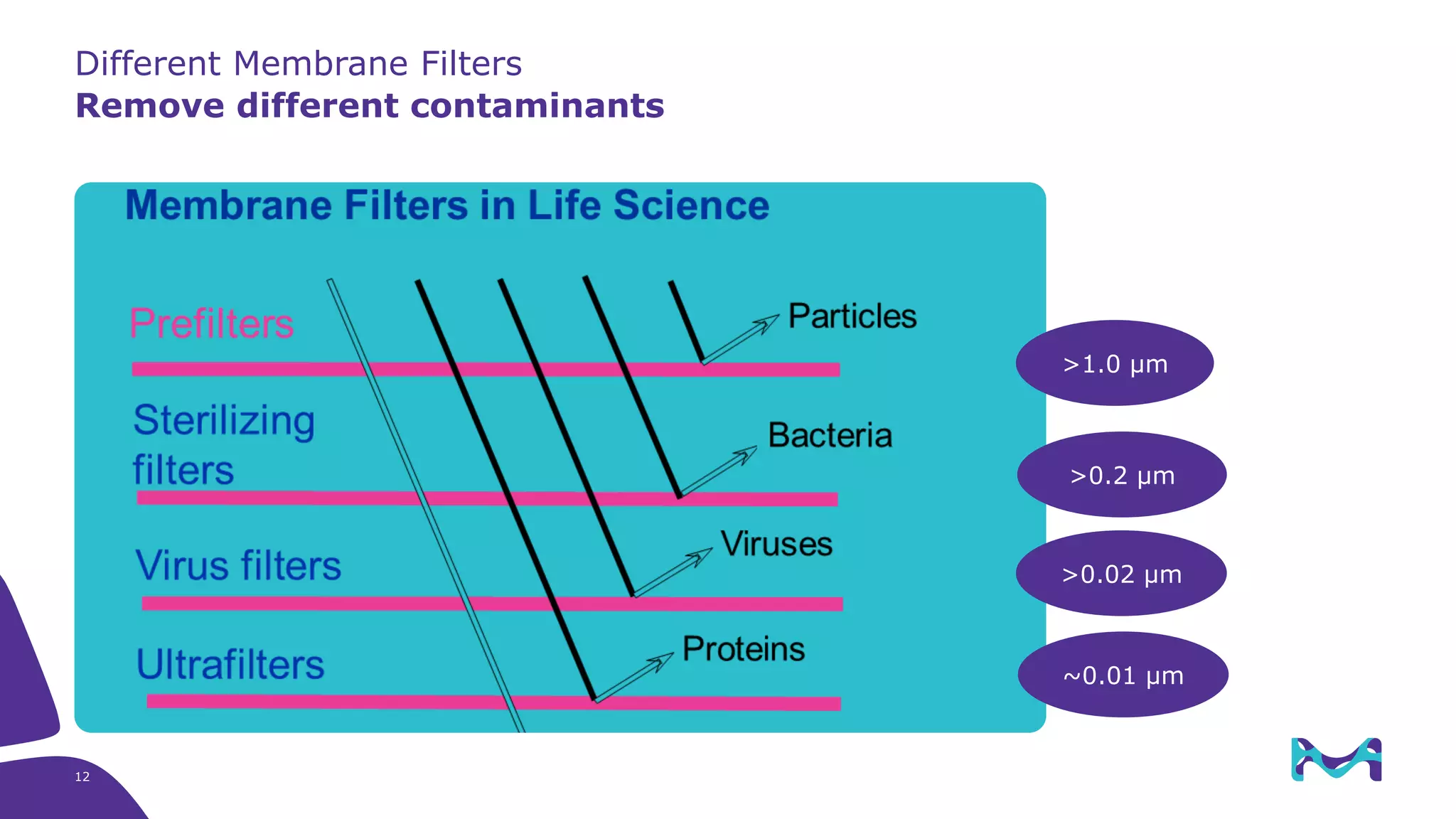
Different Membrane Filters
Remove different contaminants
~0.01 µm
>0.02 µm
>0.2 µm
>1.0 µm
12
Prefilters
Why use them? Process needs
 Manage the variability in process streams
 Remove particulates – increase consistency of fluid streams
 Removal of plugging contaminants
 Increase capacity of sterilizing-grade filters
 Improve process economics
 Increase efficiency of other unit operations (chromatography etc.)
Prefilters can improve process consistency and efficiency
13
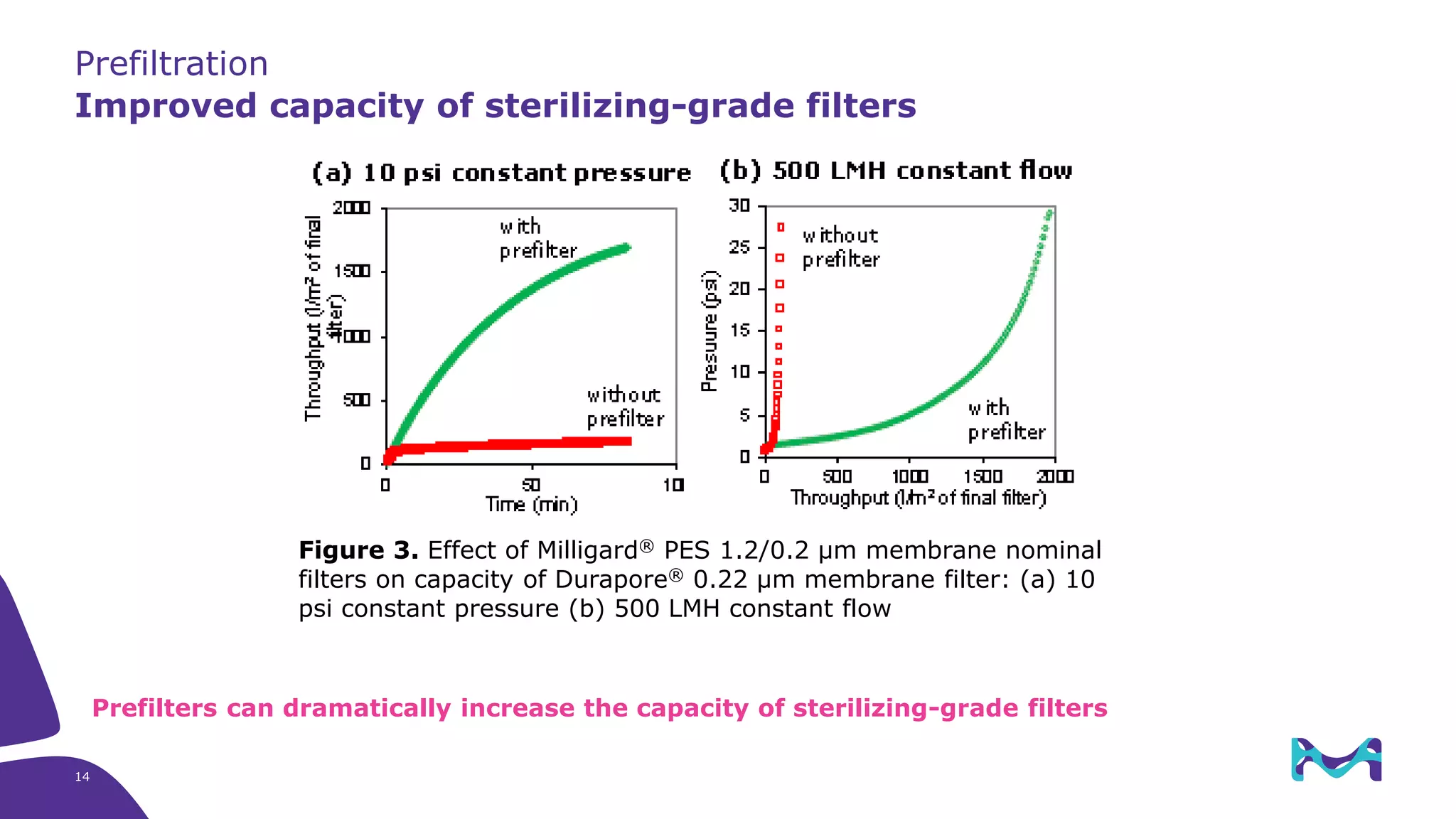
Prefiltration
Improved capacity of sterilizing-grade filters
Prefilters can dramatically increase the capacity of sterilizing-grade filters
Figure 3. Effect of Milligard® PES 1.2/0.2 µm membrane nominal
filters on capacity of Durapore® 0.22 µm membrane filter: (a) 10
psi constant pressure (b) 500 LMH constant flow
14
Membranes for Bacterial Retention
Material comparison
PVDF Structure
-Extreme strength
-Highly consistent pore size
& shape
Hydrophilic Modification
-Lowest protein adsorption
-Limited base compatibility
pH 1 to 10 acceptable
PES Structure
-Capability for multiple
structure variants
-High flow and capacity
Hydrophilic Modification
-Highly hydrophilic
-Broad base compatibility
(>pH14, for 24 hours
High thermal &
gamma
stability
Broad chemical
compatibility
PVDF
Lowest protein binding
Extreme robustness
PES
High flux and capacity
Caustic compatibility15
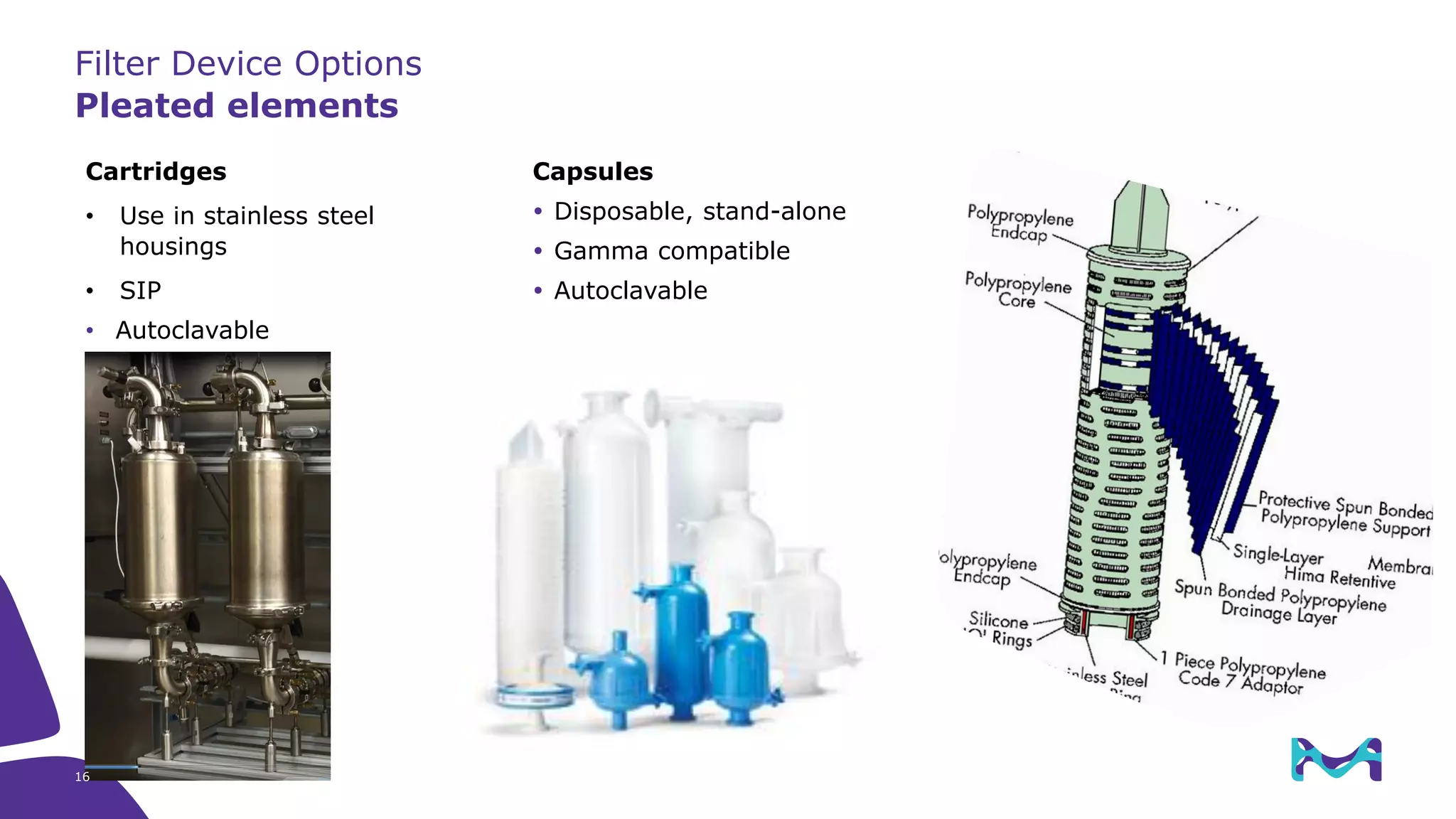
Capsules
 Disposable, stand-alone
 Gamma compatible
 Autoclavable
Pleated elements
Cartridges
• Use in stainless steel
housings
• SIP
• Autoclavable
Filter Device Options
16
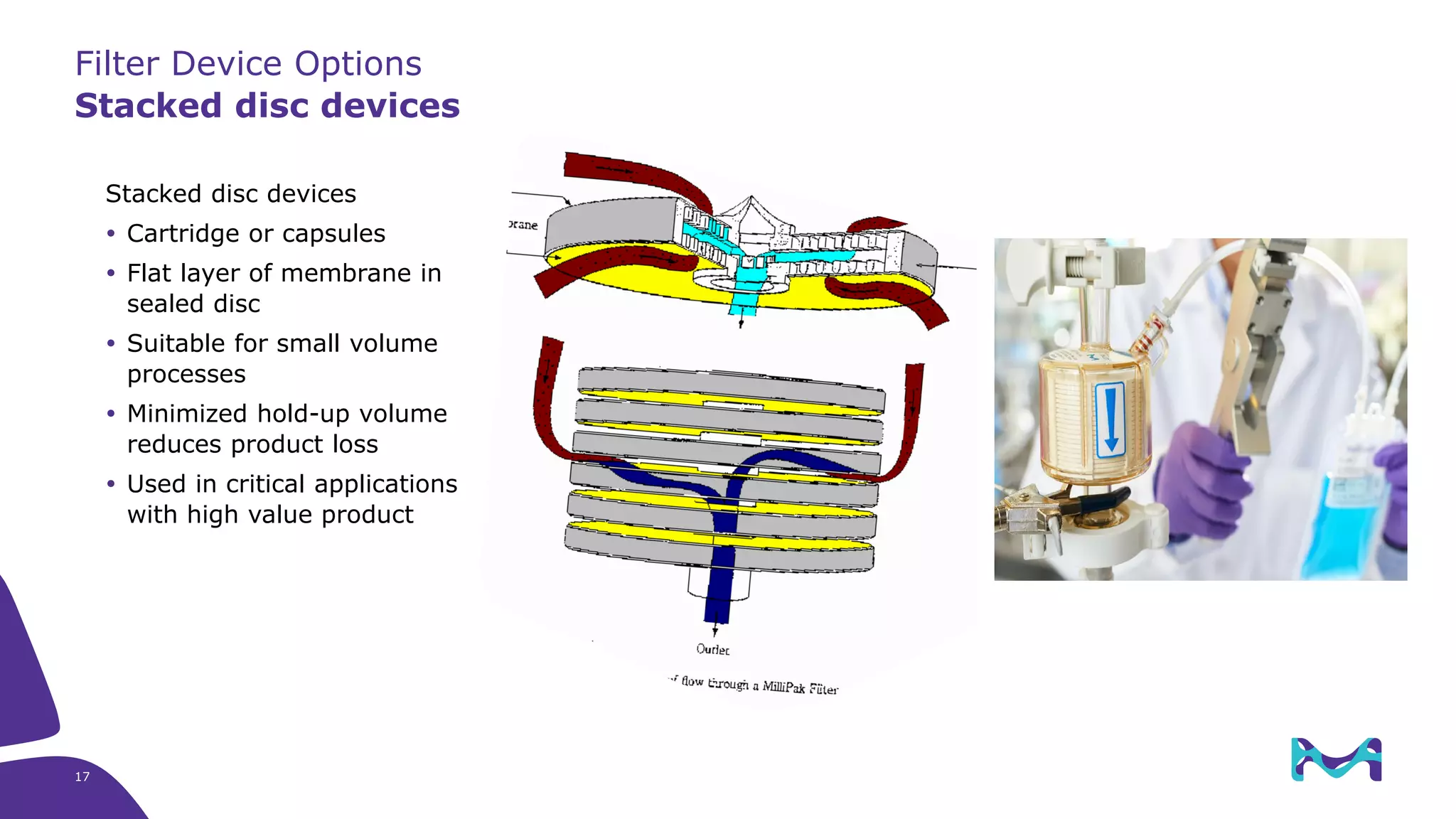
Stacked disc devices
 Cartridge or capsules
 Flat layer of membrane in
sealed disc
 Suitable for small volume
processes
 Minimized hold-up volume
reduces product loss
 Used in critical applications
with high value product
Filter Device Options
Stacked disc devices
17
Bioburden reduction filters
and sterilizing-grade filters
are used in multiple
biopharmaceutical
applications.
 Cell culture media
 Buffer and Prep
 Product intermediates
 Drug product, final fill
Today’s filters
Membranes and devices optimized for applications
18
Membranes
and devices
optimized for
applications
Membranes and Devices optimized for applications
Flux Performance
Standard Area
(~0.5 m2*)
Membrane structure advantages
• Faster flow, up to 2.5x other
membranes
• Composite asymmetric membrane
Device structure advantages
 Standard, open pleat pack
 Wide and open core
 Short pleat height
Sterilizing Layer
Standard
pleat
height
Standard
pleat
structure
Wide &
open core
Superior flux, fast processing
20
Membranes and Devices Optimized for Applications
High area, high capacity filters
Membrane structure advantages
• Superior throughput of feed streams
with high levels of particulates, such
as cell culture media or protein
solutions
• Increased membrane area means
higher filtration capacity
Device structure advantages
• High M pleat density means more
membrane area in reduced device
area
• Narrower core
• Tall pleat height
Superior throughput of feed streams with high levels of particulates21
Retention
• Process buffers - maintain low bioburden
• Formulation buffers – maintain sterility
Capacity
• Low particulates
• Capacity is rarely a concern for buffers made
with reagent grade components and purified
water or WFI
Flow Rate
• Finish fast
• Be efficient
Mobius® MIX mixing systems
Membranes and Devices Optimized for Applications
Buffer preparation
Millipore Express® PHF sterilizing-
grade PES filters for fast, efficient,
economical buffer filtration
• Pre sterilized mixing systems reduce microbial ingress
• Filtration options for claiming sterility or bioburden reduction
• Single layer membranes offer high flux
22
Put in a picture by choosing
“filling”  “picture and text filling”
and choose a picture from your computer
Retention
• Protect cell culture from contamination
• Remove microorganisms:
-Bacteria vs. mycoplasma vs. virus
Capacity
• Finish process without changing filters
• Cell culture media can be highly fouling
• Do not want to remove components important
for cell culture performance
Flow Rate
• Finish in time
Mobius® Power MIX mixing systems
• Different filter pore sizes mitigate different risks
• Dual layer membranes offer high capacity
• High area filters can reduce filter footprint
Viresolve® Barrier capsule filter
Membranes and Devices Optimized for Applications
Cell culture media
23
Put in a picture by choosing
“filling”  “picture and text filling”
and choose a picture from your computer
Retention
• Most critical process requirement
Capacity
• Needs to completely process batch; cannot stop mid
batch
• Generally not capacity limited
o Exceptions include liposomal formulations,
emulsions, vaccines
Flow Rate
• Filter flow rate must keep up with the filler
Product Recovery
• Stacked disc filters minimize hold-up volume
Millipak® Final Fill
• Low binding 0.2 µm sterilizing-grade membranes typically used
• Stacked disc filters maximize product recovery
Membranes and Devices Optimized for Applications
Drug product final sterilizing filtration
24
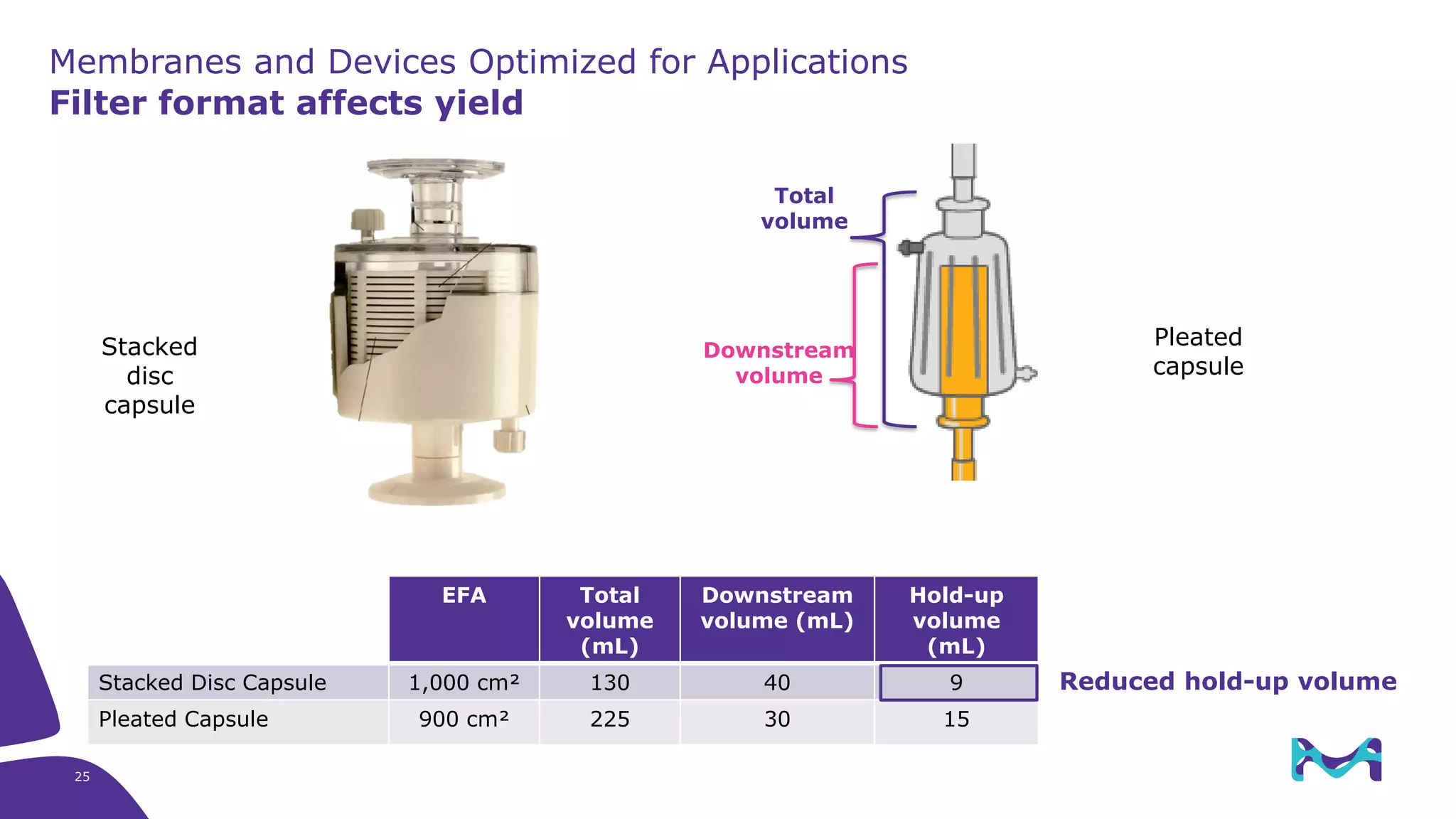
EFA Total
volume
(mL)
Downstream
volume (mL)
Hold-up
volume
(mL)
Stacked Disc Capsule 1,000 cm² 130 40 9
Pleated Capsule 900 cm² 225 30 15
Total
volume
Downstream
volume
Reduced hold-up volume
Membranes and Devices Optimized for Applications
Filter format affects yield
Stacked
disc
capsule
Pleated
capsule
25
Membranes and Devices optimized for Applications
Barrier Filters affect yield
Liquid
Wetting and flushing
fluids evacuate to
drain
Filtration
Millipak®
Barrier
Filter
Vent Bag
Filter Capsule
(Single/Redundant)
Post sterilization integrity testing is
simplified with the Millipak® Barrier
filter, which allows the sterile flow of
liquid and gas
Gas
Air from integrity
test and blowdown
can vent from same
filter26
Final filtration set up
Single - or - dual filtration affects yield
Single Stage
• Minimum hold-up
volume
• Minimum flushing
requirements
• Ease of handling
• Ease of operation
• Lower filter cost
• No back-up in the
event of primary filter
failure
Dual Stage
• Compliance with
regulatory guidance
for <10 cfu/100 ml
• No back-up in the
event of primary filter
failure
• Higher hold up
• Higher cost
• Higher system
complexity
Redundant
•Compliance with
regulatory guidance
for <10 cfu/100 ml
• Potential batch
recovery in the event
one filter fails IT
• Higher hold up
• Higher cost
• Highest system
complexity
Vent Bag
Filter
Capsule
Flush Bag
OR
Millipak®
Barrier
Vent Bag
Filter
Capsule
Flush Bag
OR
Millipak®
Barrier
IT Filter
Vent Bag
Filter
Capsule
Flush Bag
OR
Millipak® Barrier
Sterile Hold
Vessel
Flush Bag
or
Millipak® Barrier
Vent Bag
Filter CapsuleFilter Capsule
27
Which filter
should I use:
Case studies
Throughput Capacity
Cell culture media filtration
Dual layer PES with on-board prefilter increases throughput capacity vs single layer PES
3g/L Soy Peptone in DMEM
10 psi
0
200
400
600
800
1000
1200
1400
1600
1800
2000
Millipore Express® SHC Millipore Express® SHF
Throughput(L/m2)
Cell Culture Media Filtration:
Average Throughput
Millipore Express® SHC Millipore Express® SHF
0.5/0.2 µm 0.2 µm
Dual layer Single layer
29
Water Permeability
PES vs PVDF
• Asymmetric membranes exhibit higher flux vs. symmetric membranes
• For non-plugging streams, prefilter is not needed
0
5
10
15
20
25
30
Millipore Express® SHC Millipore Express® SHF Durapore® 0.22µm
WaterFlux(mL/min-cm2)
Sterilizing-Grade 0.2µm Membranes: Water Flux
Millipore Express® SHC Millipore Express® SHF Durapore® 0.22 µm
0.5/0.2 µm 0 .2 µm 0.22 µm
Asymmetric Asymmetric Symmetric
Room Temp 21-23°C
10 psi
47 mm discs
30
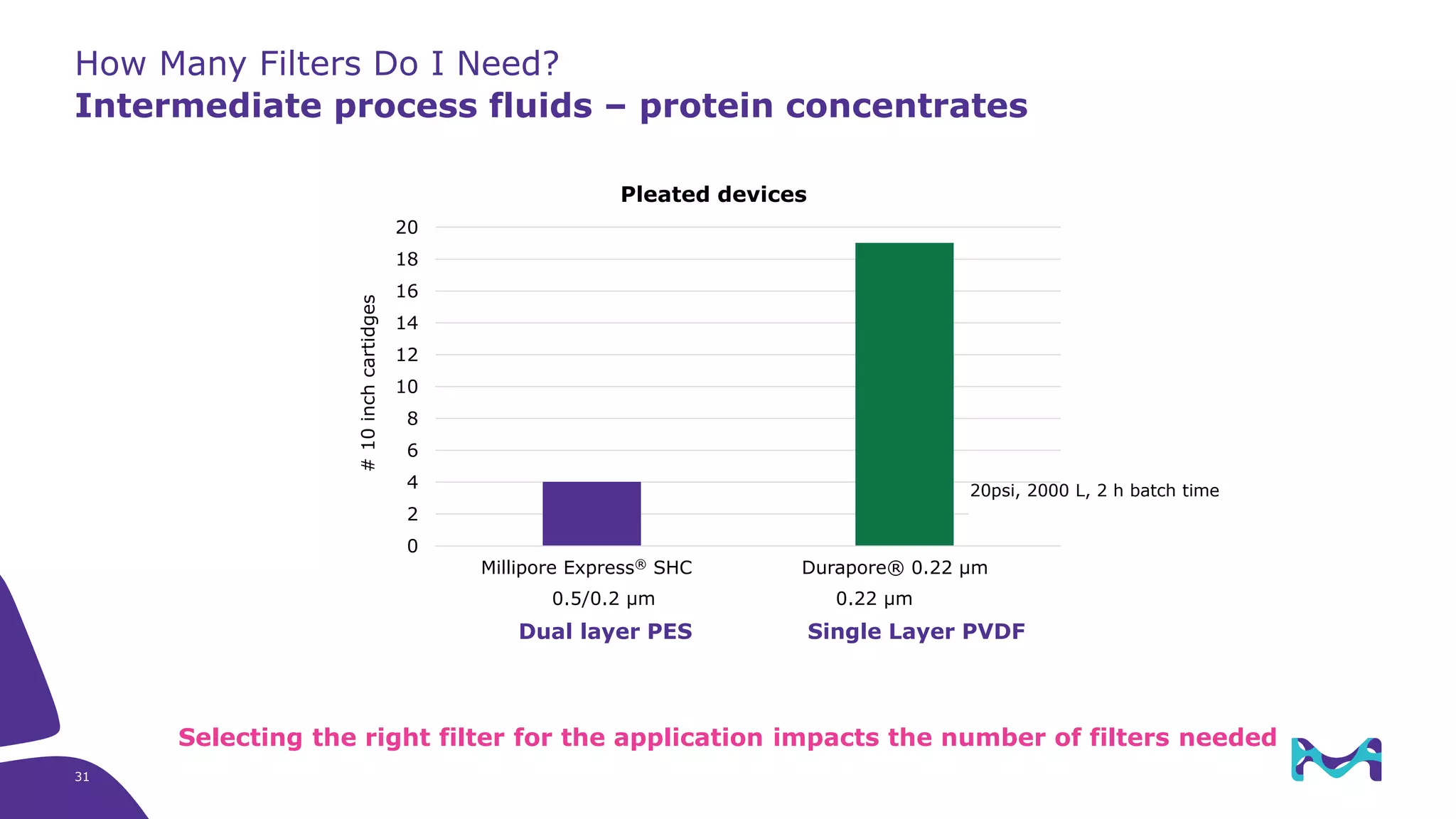
How Many Filters Do I Need?
Intermediate process fluids – protein concentrates
Selecting the right filter for the application impacts the number of filters needed
0
2
4
6
8
10
12
14
16
18
20
Millipore Express® SHC Durapore® 0.22µm
#10inchcartidges
Pleated devices
20psi, 2000 L, 2 h batch time
Millipore Express® SHC Durapore® 0.22 µm
0.5/0.2 µm 0.22 µm
Dual layer PES Single Layer PVDF
31
Are all materials the same?
Membrane Adsorption
32
Background:
Procurement asks filter suppliers for “equivalent” filter
• Result
New vendor chosen. Met all specified requirements
• Within 1 week, filling yield dropped by 2%.
• Investigation showed alternative filter had more rejects
due to lower assays.
Cause
Membrane polymer identical, but hydrophilization
method (used on all PES membrane) is different
resulting in higher binding, longer time for saturation
Final filters & adsorption considerations
“Like for Like” sterilizing final filter change
Current PES filter
Replacement PES filter
• Replacement filter used more product to achieve acceptable concentration
• Consider the effects of surfactant –or- protein adsorption in formulation
33
Final points
Variety of filter options
Depending on your risk level at each unit operation, you can implement bioburden reduction
filters, sterilizing-grade filters, or a combination of both.
Membranes & devices designed for purpose
The industry has evolved from ‘one size fits all’: membranes for filtration are designed with
different pore sizes, materials of construction, different symmetries and so on. These
membranes are available in multiple device formats.
Optimize filtration
When possible, take the opportunity to evaluate new filtration options to improve your
process in terms of capacity, flux (time) and/or economics.
Find your filter
34
• Sherry Ashby-Leon
• Stephanie Ferrante
• Ravin Gami
• Sal Giglia
• Trish Greenhalgh
• Songhua Liu
• Michael Payne
• Kerry Roche-Lentine
Find your filter
Acknowledgements
35
Ashby-Leon, et. al. (2018). Improve Process Efficiency in Bioprocess Streams by Prefiltration Optimization and Bioburden Reduction.
ASTM International. (2005). ASTM F838-05, Standard Test Method for Determining Bacterial Retention of Membrane Filters Utilized for Liquid Filtration. Retrieved
from www.astm.org
EMD Millipore Corporation, a division of Merck KGaA, Damstadt Germany. (2013). Simplified, efficient sizing of sterilizing-grade normal flow filters for buffer
solutions,” Technical Brief TB4462EN00. Retrieved from www.millipore.com
FDA. (2004). Guidance for Industry. Sterile Drug Products Produced by Aseptic Processing — Current Good Manufacturing Practice. Retrieved from
https://www.fda.gov/downloads/Drugs/Guidances/ucm070342.pdf
Mahler, et. al. (2010) Adsorption behavior of a surfactant and a monoclonal antibody to sterilizing-grade filters. Journal of Pharmaceutical Sciences,
Vol. 99, No. 6
Parenteral Drug Association. (2008). Sterilizing filtration of liquids. Technical Report No. 26. Retrieved from www.pda.org
Pitt, Aldo M. (1987). The Nonspecific Protein Binding of Polymeric Microporous Membranes
Roche-Lentine, K. (2018, October). Strategies to address bioburden control in downstream processing [Webinar]. Retrieved
from https://www.emdmillipore.com/US/en/support/webinars-upcoming-and-on-demand/Oimb.qB.l3kAAAFfPXRc27th,nav
Zhou, et. al. (2008). Non-Specific Binding and Saturation of Polysorbate-20 with Aseptic Filter Membranes for Drug Substance and Drug Product during mAb
Production. Journal of Membrane Science
Find Your Filter. What’s best for your process?
Recommended Reading & References
36
Questions?
Kimberly Steffen
Kimberly.steffen@emdmillipore.com

Find your filter. What’s best for your process?

  • 1.
    Merck KGaA Darmstadt, Germany KimberlySteffen Technology Manager, Life Sciences 6 December 2018 Find your filter which aseptic filter is best for your process?
  • 2.
    The life sciencebusiness of Merck KGaA, Darmstadt, Germany operates as MilliporeSigma in the U.S. and Canada. 2
  • 3.
    Agenda 1 Filtration 101 •Sterilizing grade filters • Bioburden reduction filters • Prefilters 2 Membranes and devices optimized for applications 3 Which filter should I use? • Case Studies 3
  • 4.
    Filtration: A keycomponent of bioburden control Containment Sanitization Solutions Filtration Bioburden control 4
  • 5.
  • 6.
    The ideal filter Notadd any unwanted material to the process stream Remove from the process stream whatever you want to remove. Meet the process objectives in the most economical way Not remove anything you don’t want to remove 6
  • 7.
    Upstream Process  Bioreactorprotection  Drug supply continuity  Business risk mitigation Downstream Process  Bioburden Reduction  Assure drug substance purity Final Fill  Regulatory requirements  Drug product sterility assurance  Assure patient safety Risk-based filter selection Different Considerations at Different Process Steps 7
  • 8.
    The Risk ProfileVaries from Upstream to Final Fill Sterilizing-grade vs bioburden reduction Upstream Downstream Drug Product Finish and Fill Operations Risk High Low Aseptic Aseptic Bioburden Controlled “The level of effort, formality and documentation of the quality risk management process should align with the level of risk” “The evaluation of risk…should be based upon scientific knowledge.” (ICH Q9A) Courtesy of Michael Payne, Principal Technical Consultant, Millipore Sigma 8
  • 9.
     Polymeric  Hydrophilicor hydrophobic  Multiple materials  Polyvinylidene fluoride (PVDF)  Polyethersulfone (PES)  Cellulose ester  Regenerated cellulose  Nylon  Polytetrafluoroethylene (PTFE)  Very thin (100 - 260 µm)  Symmetric or asymmetric Membranes for Bacterial Retention Different characteristics for differentiated performance 0.22 μm PVDF Symmetric Durapore® membrane Millipore Express® membrane 0.2 μm PES Asymmetric Pore size rated on the size of the smallest particle retained Flow 9
  • 10.
    What is sterilizing-grade?What is 0.22 µm? "Sterilizing-grade" designation “A filter which, when challenged with the bacterium Brevundimonas diminuta, at a minimum concentration of 107 cfu per cm2 of filter surface area, will produce a sterile effluent.” References • Standard Test Method ASTM F838-15 Referenced in many documents • HIMA Document No. 3, Vol. 4, 1982 (obsolete) • Aseptic Processing Guideline, FDA 2004 (original 1987) • PDA Technical Report 26 1998 Sterilizing-grade is a functional definition, not pore-size dependent 10
  • 11.
    • Typically 0.45µm or 0.2 µm pore size • Manufacturers may validate bacterial reduction, but not sterilizing performance • Can be used stand-alone for controlling bioburden ➢ Before chromatography columns ➢ Before hold steps or storage ➢ Buffer preparation Downstream Filtration What are bioburden reduction filters? Goal: Minimize in-process bioburden • No requirement to validate sterility • Reduce bioburden proliferation • With other controls, bioburden reduction filters may be sufficient for some process steps 11
  • 12.
    Different Membrane Filters Removedifferent contaminants ~0.01 µm >0.02 µm >0.2 µm >1.0 µm 12
  • 13.
    Prefilters Why use them?Process needs  Manage the variability in process streams  Remove particulates – increase consistency of fluid streams  Removal of plugging contaminants  Increase capacity of sterilizing-grade filters  Improve process economics  Increase efficiency of other unit operations (chromatography etc.) Prefilters can improve process consistency and efficiency 13
  • 14.
    Prefiltration Improved capacity ofsterilizing-grade filters Prefilters can dramatically increase the capacity of sterilizing-grade filters Figure 3. Effect of Milligard® PES 1.2/0.2 µm membrane nominal filters on capacity of Durapore® 0.22 µm membrane filter: (a) 10 psi constant pressure (b) 500 LMH constant flow 14
  • 15.
    Membranes for BacterialRetention Material comparison PVDF Structure -Extreme strength -Highly consistent pore size & shape Hydrophilic Modification -Lowest protein adsorption -Limited base compatibility pH 1 to 10 acceptable PES Structure -Capability for multiple structure variants -High flow and capacity Hydrophilic Modification -Highly hydrophilic -Broad base compatibility (>pH14, for 24 hours High thermal & gamma stability Broad chemical compatibility PVDF Lowest protein binding Extreme robustness PES High flux and capacity Caustic compatibility15
  • 16.
    Capsules  Disposable, stand-alone Gamma compatible  Autoclavable Pleated elements Cartridges • Use in stainless steel housings • SIP • Autoclavable Filter Device Options 16
  • 17.
    Stacked disc devices Cartridge or capsules  Flat layer of membrane in sealed disc  Suitable for small volume processes  Minimized hold-up volume reduces product loss  Used in critical applications with high value product Filter Device Options Stacked disc devices 17
  • 18.
    Bioburden reduction filters andsterilizing-grade filters are used in multiple biopharmaceutical applications.  Cell culture media  Buffer and Prep  Product intermediates  Drug product, final fill Today’s filters Membranes and devices optimized for applications 18
  • 19.
  • 20.
    Membranes and Devicesoptimized for applications Flux Performance Standard Area (~0.5 m2*) Membrane structure advantages • Faster flow, up to 2.5x other membranes • Composite asymmetric membrane Device structure advantages  Standard, open pleat pack  Wide and open core  Short pleat height Sterilizing Layer Standard pleat height Standard pleat structure Wide & open core Superior flux, fast processing 20
  • 21.
    Membranes and DevicesOptimized for Applications High area, high capacity filters Membrane structure advantages • Superior throughput of feed streams with high levels of particulates, such as cell culture media or protein solutions • Increased membrane area means higher filtration capacity Device structure advantages • High M pleat density means more membrane area in reduced device area • Narrower core • Tall pleat height Superior throughput of feed streams with high levels of particulates21
  • 22.
    Retention • Process buffers- maintain low bioburden • Formulation buffers – maintain sterility Capacity • Low particulates • Capacity is rarely a concern for buffers made with reagent grade components and purified water or WFI Flow Rate • Finish fast • Be efficient Mobius® MIX mixing systems Membranes and Devices Optimized for Applications Buffer preparation Millipore Express® PHF sterilizing- grade PES filters for fast, efficient, economical buffer filtration • Pre sterilized mixing systems reduce microbial ingress • Filtration options for claiming sterility or bioburden reduction • Single layer membranes offer high flux 22
  • 23.
    Put in apicture by choosing “filling”  “picture and text filling” and choose a picture from your computer Retention • Protect cell culture from contamination • Remove microorganisms: -Bacteria vs. mycoplasma vs. virus Capacity • Finish process without changing filters • Cell culture media can be highly fouling • Do not want to remove components important for cell culture performance Flow Rate • Finish in time Mobius® Power MIX mixing systems • Different filter pore sizes mitigate different risks • Dual layer membranes offer high capacity • High area filters can reduce filter footprint Viresolve® Barrier capsule filter Membranes and Devices Optimized for Applications Cell culture media 23
  • 24.
    Put in apicture by choosing “filling”  “picture and text filling” and choose a picture from your computer Retention • Most critical process requirement Capacity • Needs to completely process batch; cannot stop mid batch • Generally not capacity limited o Exceptions include liposomal formulations, emulsions, vaccines Flow Rate • Filter flow rate must keep up with the filler Product Recovery • Stacked disc filters minimize hold-up volume Millipak® Final Fill • Low binding 0.2 µm sterilizing-grade membranes typically used • Stacked disc filters maximize product recovery Membranes and Devices Optimized for Applications Drug product final sterilizing filtration 24
  • 25.
    EFA Total volume (mL) Downstream volume (mL) Hold-up volume (mL) StackedDisc Capsule 1,000 cm² 130 40 9 Pleated Capsule 900 cm² 225 30 15 Total volume Downstream volume Reduced hold-up volume Membranes and Devices Optimized for Applications Filter format affects yield Stacked disc capsule Pleated capsule 25
  • 26.
    Membranes and Devicesoptimized for Applications Barrier Filters affect yield Liquid Wetting and flushing fluids evacuate to drain Filtration Millipak® Barrier Filter Vent Bag Filter Capsule (Single/Redundant) Post sterilization integrity testing is simplified with the Millipak® Barrier filter, which allows the sterile flow of liquid and gas Gas Air from integrity test and blowdown can vent from same filter26
  • 27.
    Final filtration setup Single - or - dual filtration affects yield Single Stage • Minimum hold-up volume • Minimum flushing requirements • Ease of handling • Ease of operation • Lower filter cost • No back-up in the event of primary filter failure Dual Stage • Compliance with regulatory guidance for <10 cfu/100 ml • No back-up in the event of primary filter failure • Higher hold up • Higher cost • Higher system complexity Redundant •Compliance with regulatory guidance for <10 cfu/100 ml • Potential batch recovery in the event one filter fails IT • Higher hold up • Higher cost • Highest system complexity Vent Bag Filter Capsule Flush Bag OR Millipak® Barrier Vent Bag Filter Capsule Flush Bag OR Millipak® Barrier IT Filter Vent Bag Filter Capsule Flush Bag OR Millipak® Barrier Sterile Hold Vessel Flush Bag or Millipak® Barrier Vent Bag Filter CapsuleFilter Capsule 27
  • 28.
    Which filter should Iuse: Case studies
  • 29.
    Throughput Capacity Cell culturemedia filtration Dual layer PES with on-board prefilter increases throughput capacity vs single layer PES 3g/L Soy Peptone in DMEM 10 psi 0 200 400 600 800 1000 1200 1400 1600 1800 2000 Millipore Express® SHC Millipore Express® SHF Throughput(L/m2) Cell Culture Media Filtration: Average Throughput Millipore Express® SHC Millipore Express® SHF 0.5/0.2 µm 0.2 µm Dual layer Single layer 29
  • 30.
    Water Permeability PES vsPVDF • Asymmetric membranes exhibit higher flux vs. symmetric membranes • For non-plugging streams, prefilter is not needed 0 5 10 15 20 25 30 Millipore Express® SHC Millipore Express® SHF Durapore® 0.22µm WaterFlux(mL/min-cm2) Sterilizing-Grade 0.2µm Membranes: Water Flux Millipore Express® SHC Millipore Express® SHF Durapore® 0.22 µm 0.5/0.2 µm 0 .2 µm 0.22 µm Asymmetric Asymmetric Symmetric Room Temp 21-23°C 10 psi 47 mm discs 30
  • 31.
    How Many FiltersDo I Need? Intermediate process fluids – protein concentrates Selecting the right filter for the application impacts the number of filters needed 0 2 4 6 8 10 12 14 16 18 20 Millipore Express® SHC Durapore® 0.22µm #10inchcartidges Pleated devices 20psi, 2000 L, 2 h batch time Millipore Express® SHC Durapore® 0.22 µm 0.5/0.2 µm 0.22 µm Dual layer PES Single Layer PVDF 31
  • 32.
    Are all materialsthe same? Membrane Adsorption 32
  • 33.
    Background: Procurement asks filtersuppliers for “equivalent” filter • Result New vendor chosen. Met all specified requirements • Within 1 week, filling yield dropped by 2%. • Investigation showed alternative filter had more rejects due to lower assays. Cause Membrane polymer identical, but hydrophilization method (used on all PES membrane) is different resulting in higher binding, longer time for saturation Final filters & adsorption considerations “Like for Like” sterilizing final filter change Current PES filter Replacement PES filter • Replacement filter used more product to achieve acceptable concentration • Consider the effects of surfactant –or- protein adsorption in formulation 33
  • 34.
    Final points Variety offilter options Depending on your risk level at each unit operation, you can implement bioburden reduction filters, sterilizing-grade filters, or a combination of both. Membranes & devices designed for purpose The industry has evolved from ‘one size fits all’: membranes for filtration are designed with different pore sizes, materials of construction, different symmetries and so on. These membranes are available in multiple device formats. Optimize filtration When possible, take the opportunity to evaluate new filtration options to improve your process in terms of capacity, flux (time) and/or economics. Find your filter 34
  • 35.
    • Sherry Ashby-Leon •Stephanie Ferrante • Ravin Gami • Sal Giglia • Trish Greenhalgh • Songhua Liu • Michael Payne • Kerry Roche-Lentine Find your filter Acknowledgements 35
  • 36.
    Ashby-Leon, et. al.(2018). Improve Process Efficiency in Bioprocess Streams by Prefiltration Optimization and Bioburden Reduction. ASTM International. (2005). ASTM F838-05, Standard Test Method for Determining Bacterial Retention of Membrane Filters Utilized for Liquid Filtration. Retrieved from www.astm.org EMD Millipore Corporation, a division of Merck KGaA, Damstadt Germany. (2013). Simplified, efficient sizing of sterilizing-grade normal flow filters for buffer solutions,” Technical Brief TB4462EN00. Retrieved from www.millipore.com FDA. (2004). Guidance for Industry. Sterile Drug Products Produced by Aseptic Processing — Current Good Manufacturing Practice. Retrieved from https://www.fda.gov/downloads/Drugs/Guidances/ucm070342.pdf Mahler, et. al. (2010) Adsorption behavior of a surfactant and a monoclonal antibody to sterilizing-grade filters. Journal of Pharmaceutical Sciences, Vol. 99, No. 6 Parenteral Drug Association. (2008). Sterilizing filtration of liquids. Technical Report No. 26. Retrieved from www.pda.org Pitt, Aldo M. (1987). The Nonspecific Protein Binding of Polymeric Microporous Membranes Roche-Lentine, K. (2018, October). Strategies to address bioburden control in downstream processing [Webinar]. Retrieved from https://www.emdmillipore.com/US/en/support/webinars-upcoming-and-on-demand/Oimb.qB.l3kAAAFfPXRc27th,nav Zhou, et. al. (2008). Non-Specific Binding and Saturation of Polysorbate-20 with Aseptic Filter Membranes for Drug Substance and Drug Product during mAb Production. Journal of Membrane Science Find Your Filter. What’s best for your process? Recommended Reading & References 36
  • 37.