




The life science business of Merck KGaA,
Darmstadt, Germany operates as
MilliporeSigma in the U.S. and Canada.
Risk-Based Qualification of
X-ray Sterilization for Single
Use & Integrated Systems
Monica Cardona and Paul Kilian
May 05, 2022
The life science business
of Merck KGaA, Darmstadt,
Germany operates as
MilliporeSigma in the U.S.
and Canada
Agenda
1
2
3
Background
Qualification Strategy
Data
4 Conclusion
Background
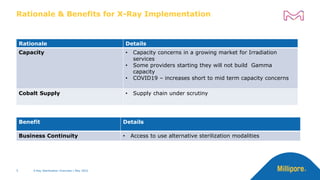
Rationale & Benefits for X-Ray Implementation
X-Ray Sterilization Overview | May 2022
5
Rationale Details
Capacity • Capacity concerns in a growing market for Irradiation
services
• Some providers starting they will not build Gamma
capacity
• COVID19 – increases short to mid term capacity concerns
Cobalt Supply • Supply chain under scrutiny
Benefit Details
Business Continuity • Access to use alternative sterilization modalities
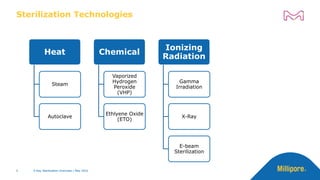
Sterilization Technologies
6
Heat
Steam
Autoclave
Chemical
Vaporized
Hydrogen
Peroxide
(VHP)
Ethlyene Oxide
(ETO)
Ionizing
Radiation
Gamma
Irradiation
X-Ray
E-beam
Sterilization
X-Ray Sterilization Overview | May 2022
Fundamentals of Irradiation Sterilization Modalities
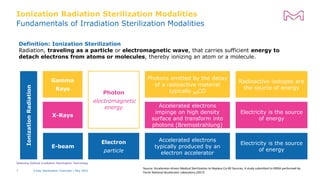
Ionization Radiation Sterilization Modalities
X-Ray Sterilization Overview | May 2022
7
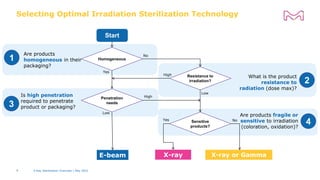
Selecting Optimal Irradiation Sterilization Technology
Definition: Ionization Sterilization
Radiation, traveling as a particle or electromagnetic wave, that carries sufficient energy to
detach electrons from atoms or molecules, thereby ionizing an atom or a molecule.
Ionization
Radiation
Gamma
Rays
X-Rays
E-beam
Photon
electromagnetic
energy
Electron
particle
Accelerated electrons
typically produced by an
electron accelerator
Electricity is the source
of energy
Photons emitted by the decay
of a radioactive material
typically 60CO
Electricity is the source
of energy
Accelerated electrons
impinge on high density
surface and transform into
photons (Bremsstrahlung)
Source: Accelerator-driven Medical Sterilization to Replace Co-60 Sources; A study submitted to NNSA performed by
Fermi National Accelerator Laboratory (2017)
Radioactive isotopes are
the source of energy
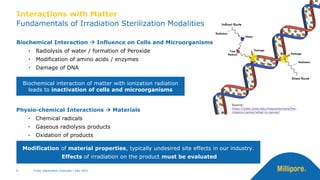
Biochemical interaction of matter with ionization radiation
leads to inactivation of cells and microorganisms
Fundamentals of Irradiation Sterilization Modalities
Interactions with Matter
X-Ray Sterilization Overview | May 2022
8
Source:
https://sites.duke.edu/missiontomars/the-
mission/cancer/what-is-cancer/
Biochemical Interaction → Influence on Cells and Microorganisms
• Radiolysis of water / formation of Peroxide
• Modification of amino acids / enzymes
• Damage of DNA
Physio-chemical Interactions → Materials
• Chemical radicals
• Gaseous radiolysis products
• Oxidation of products
Modification of material properties, typically undesired site effects in our industry.
Effects of irradiation on the product must be evaluated
Selecting Optimal Irradiation Sterilization Technology
X-Ray Sterilization Overview | May 2022
Resistance to
irradiation?
Penetration
needs
E-beam X-ray
Yes
Homogeneous
Sensitive
products?
X-ray or Gamma
Start
High
Low
No
High
Low
Are products
homogeneous in their
packaging?
What is the product
resistance to
radiation (dose max)?
Is high penetration
required to penetrate
product or packaging?
1
2
3
Are products fragile or
sensitive to irradiation
(coloration, oxidation)?
4
Yes No
9
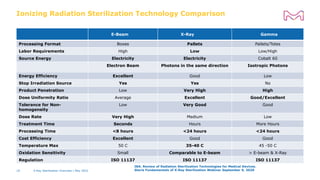
Ionizing Radiation Sterilization Technology Comparison
E-Beam X-Ray Gamma
Processing Format Boxes Pallets Pallets/Totes
Labor Requirements High Low Low/High
Source Energy Electricity Electricity Cobalt 60
Electron Beam Photons in the same direction Isotropic Photons
Energy Efficiency Excellent Good Low
Stop Irradiation Source Yes Yes No
Product Penetration Low Very High High
Dose Uniformity Ratio Average Excellent Good/Excellent
Tolerance for Non-
homogeneity
Low Very Good Good
Dose Rate Very High Medium Low
Treatment Time Seconds Hours More Hours
Processing Time <8 hours <24 hours <24 hours
Cost Efficiency Excellent Good Good
Temperature Max 50 C 35-40 C 45 -50 C
Oxidation Sensitivity Small Comparable to E-beam > E-beam & X-Ray
Regulation ISO 11137 ISO 11137 ISO 11137
IBA. Review of Radiation Sterilization Technologies for Medical Devices.
Steris Fundamentals of X-Ray Sterilization Webinar September 9, 2020
X-Ray Sterilization Overview | May 2022
10
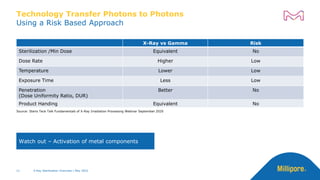
Technology Transfer Photons to Photons
Using a Risk Based Approach
X-Ray vs Gamma Risk
Sterilization /Min Dose Equivalent No
Dose Rate Higher Low
Temperature Lower Low
Exposure Time Less Low
Penetration
(Dose Uniformity Ratio, DUR)
Better No
Product Handing Equivalent No
Source: Steris Teck Talk Fundamentals of X-Ray Irradiation Processing Webinar September 2020
Watch out – Activation of metal components
X-Ray Sterilization Overview | May 2022
11
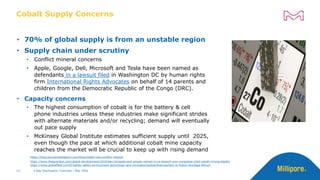
• 70% of global supply is from an unstable region
• Supply chain under scrutiny
• Conflict mineral concerns
• Apple, Google, Dell, Microsoft and Tesla have been named as
defendants in a lawsuit filed in Washington DC by human rights
firm International Rights Advocates on behalf of 14 parents and
children from the Democratic Republic of the Congo (DRC).
• Capacity concerns
• The highest consumption of cobalt is for the battery & cell
phone industries unless these industries make significant strides
with alternate materials and/or recycling; demand will eventually
out pace supply
• McKinsey Global Institute estimates sufficient supply until 2025,
even though the pace at which additional cobalt mine capacity
reaches the market will be crucial to keep up with rising demand
Cobalt Supply Concerns
X-Ray Sterilization Overview | May 2022
12
https://blog.sourceintelligence.com/blog/cobalt-new-conflict-mineral
https://www.theguardian.com/global-development/2019/dec/16/apple-and-google-named-in-us-lawsuit-over-congolese-child-cobalt-mining-deaths
https://www.globalfleet.com/fr/safety-safety-environment-technology-and-innovation/global/features/fact-or-fiction-shortage-lithium
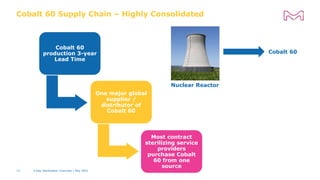
Cobalt 60
production 3-year
Lead Time
One major global
supplier /
distributor of
Cobalt 60
Most contract
sterilizing service
providers
purchase Cobalt
60 from one
source
Cobalt 60 Supply Chain – Highly Consolidated
Nuclear Reactor
Cobalt 60
X-Ray Sterilization Overview | May 2022
13
Qualification
strategy
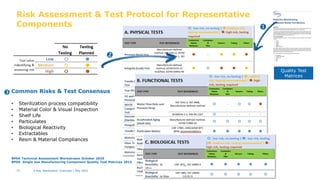
Risk Assessment & Test Protocol for Representative
Components
15
Full Team Review
Common Risks & Test Consensus
• Sterilization process compatibility
• Material Color & Visual Inspection
• Shelf Life
• Particulates
• Biological Reactivity
• Extractables
• Resin & Material Compliances
Quality Test
Matrices



BPSA Technical Assessment Workstream October 2020
BPSA Single Use Manufacturing Component Quality Test Matrices 2015
15
X-Ray Sterilization Overview | May 2022
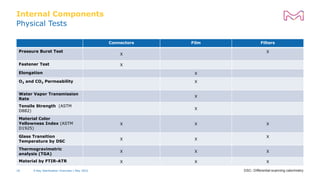
Connectors Film Filters
Pressure Burst Test
X
X
Fastener Test X
Elongation X
O2 and CO2 Permeability X
Water Vapor Transmission
Rate
X
Tensile Strength (ASTM
D882)
X
Material Color
Yellowness Index (ASTM
D1925)
X X X
Glass Transition
Temperature by DSC
X X
X
Thermogravimetric
analysis (TGA)
X X X
Material by FTIR-ATR X X X
Physical Tests
Internal Components
X-Ray Sterilization Overview | May 2022
16 DSC- Differential scanning calorimetry
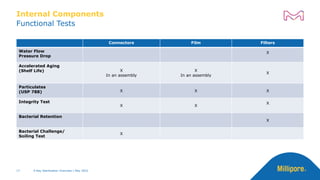
Functional Tests
Internal Components
X-Ray Sterilization Overview | May 2022
17
Connectors Film Filters
Water Flow
Pressure Drop
X
Accelerated Aging
(Shelf Life) X
In an assembly
X
In an assembly
X
Particulates
(USP 788) X X X
Integrity Test
X X
X
Bacterial Retention
X
Bacterial Challenge/
Soiling Test
X
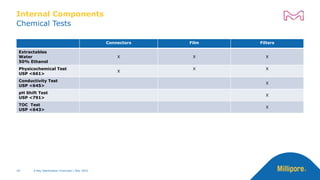
Chemical Tests
Internal Components
X-Ray Sterilization Overview | May 2022
18
Connectors Film Filters
Extractables
Water
50% Ethanol
X X X
Physicochemical Test
USP <661>
X
X X
Conductivity Test
USP <645>
X
pH Shift Test
USP <791>
X
TOC Test
USP <643>
X
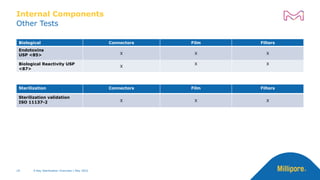
Other Tests
Internal Components
X-Ray Sterilization Overview | May 2022
19
Biological Connectors Film Filters
Endotoxins
USP <85> X X X
Biological Reactivity USP
<87>
X
X X
Sterilization Connectors Film Filters
Sterilization validation
ISO 11137-2 X X X
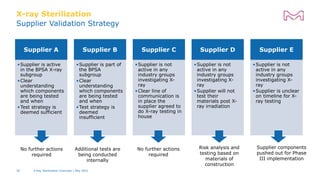
Supplier Validation Strategy
X-ray Sterilization
X-Ray Sterilization Overview | May 2022
20
v
Supplier A
•Supplier is active
in the BPSA X-ray
subgroup
•Clear
understanding
which components
are being tested
and when
•Test strategy is
deemed sufficient
Supplier B
•Supplier is part of
the BPSA
subgroup
•Clear
understanding
which components
are being tested
and when
•Test strategy is
deemed
insufficient
Supplier C
•Supplier is not
active in any
industry groups
investigating X-
ray
•Clear line of
communication is
in place the
supplier agreed to
do X-ray testing in
house
Supplier D
•Supplier is not
active in any
industry groups
investigating X-
ray
•Supplier will not
test their
materials post X-
ray irradiation
Supplier E
•Supplier is not
active in any
industry groups
investigating X-
ray
•Supplier is unclear
on timeline for X-
ray testing
No further actions
required
Risk analysis and
testing based on
materials of
construction
Additional tests are
being conducted
internally
No further actions
required
Supplier components
pushed out for Phase
III implementation
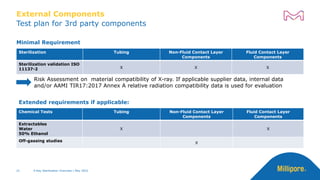
Minimal Requirement
Test plan for 3rd party components
External Components
X-Ray Sterilization Overview | May 2022
21
Chemical Tests Tubing Non-Fluid Contact Layer
Components
Fluid Contact Layer
Components
Extractables
Water
50% Ethanol
X X
Off-gassing studies X
Sterilization Tubing Non-Fluid Contact Layer
Components
Fluid Contact Layer
Components
Sterilization validation ISO
11137-2 X X X
Risk Assessment on material compatibility of X-ray. If applicable supplier data, internal data
and/or AAMI TIR17:2017 Annex A relative radiation compatibility data is used for evaluation
Extended requirements if applicable:
DATA
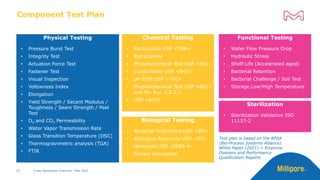
Component Test Plan
23
Physical Testing
• Pressure Burst Test
• Integrity Test
• Actuation Force Test
• Fastener Test
• Visual Inspection
• Yellowness Index
• Elongation
• Yield Strength / Secant Modulus /
Toughness / Seam Strength / Peel
Test
• O2 and CO2 Permeability
• Water Vapor Transmission Rate
• Glass Transition Temperature (DSC)
• Thermogravimetric analysis (TGA)
• FTIR
Functional Testing
• Water Flow Pressure Drop
• Hydraulic Stress
• Shelf-Life (Accelerated aged)
• Bacterial Retention
• Bacterial Challenge / Soil Test
• Storage Low/High Temperature
Chemical Testing
• Particulates USP <788>
• Extractables
• Physicochemical Test USP <661>
• Conductivity USP <645>
• pH Shift USP <791>
• Physicochemical Test USP <661>
and Ph. Eur. 3.2.2.1
• USP <643>
Biological Testing
• Bacterial Endotoxins USP <85>
• Biological Reactivity USP <87>
• Hemolysis ISO 10993-4
• Protein Adsorption
Sterilization
• Sterilization Validation ISO
11137-2
Test plan is based on the BPSA
(Bio-Process Systems Alliance)
White Paper (2021) + Emprove
Dossiers and Performance
Qualification Reports
X-Ray Sterilization Overview | May 2022
24
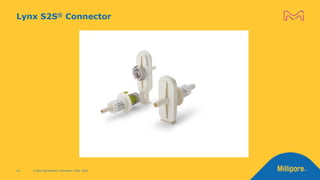
Lynx S2S® Connector
X-Ray Sterilization Overview | May 2022
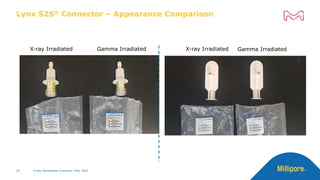
Lynx S2S® Connector – Appearance Comparison
X-Ray Sterilization Overview | May 2022
25
X-ray Irradiated Gamma Irradiated X-ray Irradiated Gamma Irradiated
X-Ray Sterilization Overview | May 2022
26
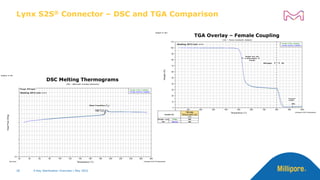
Lynx S2S® Connector – DSC and TGA Comparison
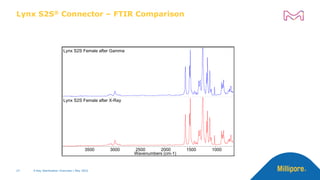
Lynx S2S® Connector – FTIR Comparison
X-Ray Sterilization Overview | May 2022
27
Lynx S2S Female after Gamma
Lynx S2S Female after X-Ray
1000
1500
2000
2500
3000
3500
Wavenumbers (cm-1)
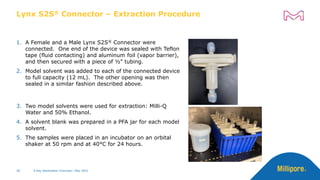
1. A Female and a Male Lynx S2S® Connector were
connected. One end of the device was sealed with Teflon
tape (fluid contacting) and aluminum foil (vapor barrier),
and then secured with a piece of ½” tubing.
2. Model solvent was added to each of the connected device
to full capacity (12 mL). The other opening was then
sealed in a similar fashion described above.
3. Two model solvents were used for extraction: Milli-Q
Water and 50% Ethanol.
4. A solvent blank was prepared in a PFA jar for each model
solvent.
5. The samples were placed in an incubator on an orbital
shaker at 50 rpm and at 40°C for 24 hours.
Lynx S2S® Connector – Extraction Procedure
X-Ray Sterilization Overview | May 2022
28
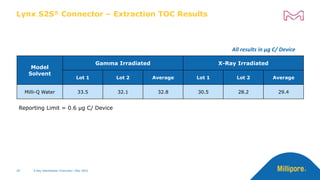
All results in µg C/ Device
Model
Solvent
Gamma Irradiated X-Ray Irradiated
Lot 1 Lot 2 Average Lot 1 Lot 2 Average
Milli-Q Water 33.5 32.1 32.8 30.5 28.2 29.4
Reporting Limit = 0.6 µg C/ Device
Lynx S2S® Connector – Extraction TOC Results
X-Ray Sterilization Overview | May 2022
29
Lynx S2S® Connector – HPLC Chromatograms
214
nm
Absorbance
[AU]
-0.02
0.00
0.02
0.04
0.06
0.08
0.10
0.12
0.14
0.16
0.18
0.20
Time (minutes)
0.00 1.00 2.00 3.00 4.00 5.00 6.00 7.00 8.00 9.00 10.00 11.00 12.00 13.00 14.00 15.00 16.00 17.00 18.00 19.00 20.00
X-Ray Lot 2
X-Ray Lot 1
Gamma Lot 2
Gamma Lot 1
Water Blank
214
nm
Absorbance
[AU]
-0.02
0.00
0.02
0.04
0.06
0.08
0.10
0.12
0.14
0.16
0.18
0.20
Time (minutes)
0.00 1.00 2.00 3.00 4.00 5.00 6.00 7.00 8.00 9.00 10.00 11.00 12.00 13.00 14.00 15.00 16.00 17.00 18.00 19.00 20.00
X-Ray Lot 2
X-Ray Lot 1
Gamma Lot 2
Gamma Lot 1
50% EtOH Blank
Water Extracts
50% Ethanol Extracts
X-Ray Sterilization Overview | May 2022
30
Volatile Organic Compounds
Lynx S2S® Connector – GCMS-HS Chromatograms
Water Extracts
50% Ethanol Extracts
X-Ray Sterilization Overview | May 2022
31
Semi-Volatile Organic Compounds
Lynx S2S® Connector – GCMS-DI Chromatograms
X-Ray Sterilization Overview | May 2022
32
Water Extracts
50% Ethanol Extracts
Lynx S2S® Connector – Results
X-Ray Sterilization Overview | May 2022
33
Lynx S2S® Connector – Summary
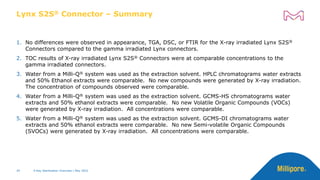
1. No differences were observed in appearance, TGA, DSC, or FTIR for the X-ray irradiated Lynx S2S®
Connectors compared to the gamma irradiated Lynx connectors.
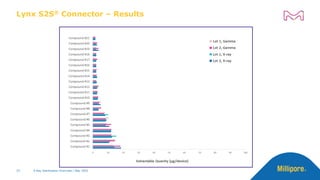
2. TOC results of X-ray irradiated Lynx S2S® Connectors were at comparable concentrations to the
gamma irradiated connectors.
3. Water from a Milli-Q® system was used as the extraction solvent. HPLC chromatograms water extracts
and 50% Ethanol extracts were comparable. No new compounds were generated by X-ray irradiation.
The concentration of compounds observed were comparable.
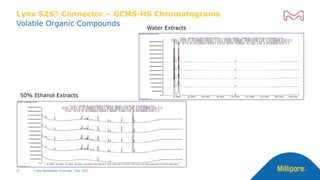
4. Water from a Milli-Q® system was used as the extraction solvent. GCMS-HS chromatograms water
extracts and 50% ethanol extracts were comparable. No new Volatile Organic Compounds (VOCs)
were generated by X-ray irradiation. All concentrations were comparable.
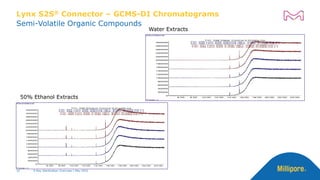
5. Water from a Milli-Q® system was used as the extraction solvent. GCMS-DI chromatograms water
extracts and 50% ethanol extracts were comparable. No new Semi-volatile Organic Compounds
(SVOCs) were generated by X-ray irradiation. All concentrations were comparable.
X-Ray Sterilization Overview | May 2022
34
35
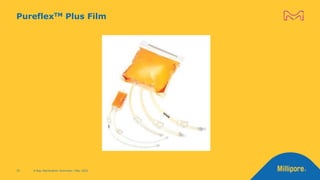
PureflexTM Plus Film
X-Ray Sterilization Overview | May 2022
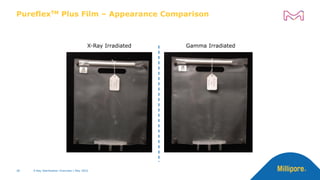
PureflexTM Plus Film – Appearance Comparison
36
X-Ray Irradiated Gamma Irradiated
X-Ray Sterilization Overview | May 2022
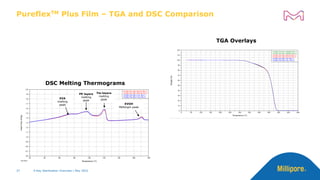
PureflexTM Plus Film – TGA and DSC Comparison
37
TGA Overlays
DSC Melting Thermograms
EVA
melting
peak
PE layers
melting
peak
Tie-layers
melting
peak
EVOH
Meltingm peak
X-Ray Sterilization Overview | May 2022
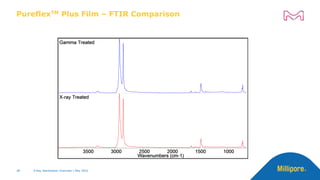
PureflexTM Plus Film – FTIR Comparison
38 X-Ray Sterilization Overview | May 2022
1. The test stands were modified to have a 0.33 cm
gap, providing a 6:1 surface area to volume
extraction ratio.
2. To each bag was added a predetermined amount
of model solvent from the opening. The openings
were sealed with a Male Luer lock and a Press-in
Plug with PTFE tape to minimize evaporation.
3. The samples were extracted in two model
solvents: (i) Milli-Q® Water and (ii) 50% Ethanol
4. Sample extraction were performed in duplicate.
5. Controls of each solvent were prepared in PFA
jars.
6. Extracts were placed in an incubator at 40°C for
24 hours on an orbital shaker at 50 rpm.
PureflexTM Plus Film – Extraction Procedure
39 X-Ray Sterilization Overview | May 2022
X-Ray Sterilization Overview | May 2022
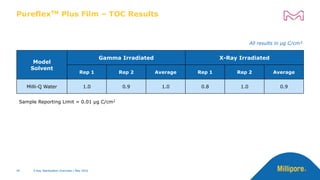
PureflexTM Plus Film – TOC Results
40
All results in µg C/cm²
Sample Reporting Limit = 0.01 µg C/cm2
Model
Solvent
Gamma Irradiated X-Ray Irradiated
Rep 1 Rep 2 Average Rep 1 Rep 2 Average
Milli-Q Water 1.0 0.9 1.0 0.8 1.0 0.9
X-Ray Sterilization Overview | May 2022
214
nm
Absorbance
[AU]
0.0000
0.0096
0.0192
0.0288
0.0384
0.0480
0.0576
0.0672
0.0768
0.0864
0.0960
Time (minutes)
0.00 1.00 2.00 3.00 4.00 5.00 6.00 7.00 8.00 9.00 10.00 11.00 12.00 13.00 14.00 15.00 16.00 17.00 18.00 19.00 20.00
PureflexTM Plus Film – HPLC Chromatograms
41
X-Ray PureFlex Plus Rep-2
X-Ray PureFlex Plus Rep-1
Gamma PureFlex Plus Rep-2
Gamma PureFlex Plus Rep-1
Water Control
214
nm
Absorbance
[AU]
-0.025
0.000
0.025
0.050
0.075
0.100
0.125
0.150
0.175
0.200
0.225
0.250
Time (minutes)
0.00 1.00 2.00 3.00 4.00 5.00 6.00 7.00 8.00 9.00 10.00 11.00 12.00 13.00 14.00 15.00 16.00 17.00 18.00 19.00 20.00
X-Ray PureFlex Plus Rep-2
X-Ray PureFlex Plus Rep-1
Gamma PureFlex Plus Rep-2
Gamma PureFlex Plus Rep-1
50% Ethanol Control
Water Extracts
50% Ethanol Extracts
41 X-Ray Sterilization Overview | May 2022
X-Ray Sterilization Overview | May 2022
Water Extracts
50% Ethanol Extracts
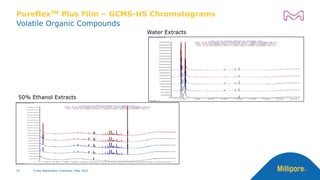
Volatile Organic Compounds
PureflexTM Plus Film – GCMS-HS Chromatograms
42 X-Ray Sterilization Overview | May 2022
Water Extracts
50% Ethanol Extracts
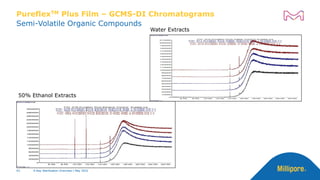
Semi-Volatile Organic Compounds
PureflexTM Plus Film – GCMS-DI Chromatograms
43 X-Ray Sterilization Overview | May 2022
µS/cm
0.00
1.00
2.00
3.00
4.00
5.00
6.00
7.00
8.00
9.00
10.00
Minutes
0.00 2.00 4.00 6.00 8.00 10.00 12.00 14.00 16.00 18.00 20.00 22.00 24.00 26.00 28.00 30.00 32.00 34.00 36.00 38.00 40.00
X-Ray PureFlex Plus Rep-2
X-Ray PureFlex Plus Rep-1
Gamma PureFlex Plus Rep-2
Gamma PureFlex Plus Rep-1
Water Control
7,6 7,0 7,0
0,0
2,0
4,0
6,0
8,0
10,0
12,0
14,0
Control Gamma X-ray
pH Results
Water Extracts
Water Extracts
44 X-Ray Sterilization Overview | May 2022
PureflexTM Plus Film – Ion Chromatography and pH
44 X-Ray Sterilization Overview | May 2022
PureflexTM Plus Film – Results
45 X-Ray Sterilization Overview | May 2022
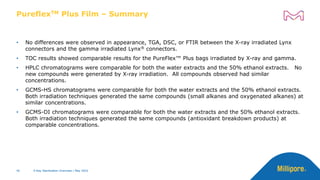
• No differences were observed in appearance, TGA, DSC, or FTIR between the X-ray irradiated Lynx
connectors and the gamma irradiated Lynx® connectors.
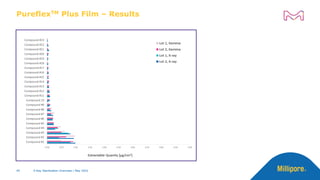
• TOC results showed comparable results for the PureFlex™ Plus bags irradiated by X-ray and gamma.
• HPLC chromatograms were comparable for both the water extracts and the 50% ethanol extracts. No
new compounds were generated by X-ray irradiation. All compounds observed had similar
concentrations.
• GCMS-HS chromatograms were comparable for both the water extracts and the 50% ethanol extracts.
Both irradiation techniques generated the same compounds (small alkanes and oxygenated alkanes) at
similar concentrations.
• GCMS-DI chromatograms were comparable for both the water extracts and the 50% ethanol extracts.
Both irradiation techniques generated the same compounds (antioxidant breakdown products) at
comparable concentrations.
PureflexTM Plus Film – Summary
46 46 X-Ray Sterilization Overview | May 2022
X-Ray Sterilization Overview | May 2022
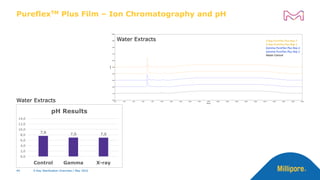
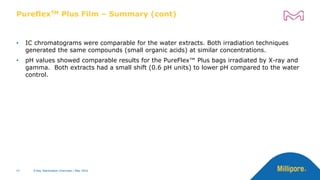
• IC chromatograms were comparable for the water extracts. Both irradiation techniques
generated the same compounds (small organic acids) at similar concentrations.
• pH values showed comparable results for the PureFlex™ Plus bags irradiated by X-ray and
gamma. Both extracts had a small shift (0.6 pH units) to lower pH compared to the water
control.
PureflexTM Plus Film – Summary (cont)
47 47 X-Ray Sterilization Overview | May 2022
X-Ray Sterilization Overview | May 2022
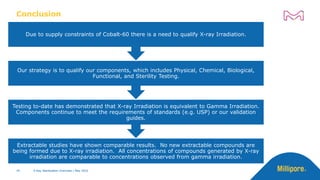
Conclusion
Conclusion
49 49 X-Ray Sterilization Overview | May 2022
Extractable studies have shown comparable results. No new extractable compounds are
being formed due to X-ray irradiation. All concentrations of compounds generated by X-ray
irradiation are comparable to concentrations observed from gamma irradiation.
Testing to-date has demonstrated that X-ray Irradiation is equivalent to Gamma Irradiation.
Components continue to meet the requirements of standards (e.g. USP) or our validation
guides.
Our strategy is to qualify our components, which includes Physical, Chemical, Biological,
Functional, and Sterility Testing.
Due to supply constraints of Cobalt-60 there is a need to qualify X-ray Irradiation.
X-Ray Sterilization Overview | May 2022
The vibrant M, Emprove, Lynx, Pureflex, Milli-Q and Millipore are trademarks of Merck KGaA, Darmstadt, Germany or its affiliates.
All other trademarks are the property of their respective owners. Detailed information on trademarks is available via publicly accessible resources.
© 2022 Merck KGaA, Darmstadt, Germany and/or its affiliates. All Rights Reserved.
The Life Science business of Merck operates as MilliporeSigma in the U.S. and Canada.

Risk-Based Qualification of X-Ray Sterilization for Single-Use Systems

  • 1.
    The life sciencebusiness of Merck KGaA, Darmstadt, Germany operates as MilliporeSigma in the U.S. and Canada. Risk-Based Qualification of X-ray Sterilization for Single Use & Integrated Systems Monica Cardona and Paul Kilian May 05, 2022
  • 2.
    The life sciencebusiness of Merck KGaA, Darmstadt, Germany operates as MilliporeSigma in the U.S. and Canada
  • 3.
  • 4.
  • 5.
    Rationale & Benefitsfor X-Ray Implementation X-Ray Sterilization Overview | May 2022 5 Rationale Details Capacity • Capacity concerns in a growing market for Irradiation services • Some providers starting they will not build Gamma capacity • COVID19 – increases short to mid term capacity concerns Cobalt Supply • Supply chain under scrutiny Benefit Details Business Continuity • Access to use alternative sterilization modalities
  • 6.
  • 7.
    Fundamentals of IrradiationSterilization Modalities Ionization Radiation Sterilization Modalities X-Ray Sterilization Overview | May 2022 7 Selecting Optimal Irradiation Sterilization Technology Definition: Ionization Sterilization Radiation, traveling as a particle or electromagnetic wave, that carries sufficient energy to detach electrons from atoms or molecules, thereby ionizing an atom or a molecule. Ionization Radiation Gamma Rays X-Rays E-beam Photon electromagnetic energy Electron particle Accelerated electrons typically produced by an electron accelerator Electricity is the source of energy Photons emitted by the decay of a radioactive material typically 60CO Electricity is the source of energy Accelerated electrons impinge on high density surface and transform into photons (Bremsstrahlung) Source: Accelerator-driven Medical Sterilization to Replace Co-60 Sources; A study submitted to NNSA performed by Fermi National Accelerator Laboratory (2017) Radioactive isotopes are the source of energy
  • 8.
    Biochemical interaction ofmatter with ionization radiation leads to inactivation of cells and microorganisms Fundamentals of Irradiation Sterilization Modalities Interactions with Matter X-Ray Sterilization Overview | May 2022 8 Source: https://sites.duke.edu/missiontomars/the- mission/cancer/what-is-cancer/ Biochemical Interaction → Influence on Cells and Microorganisms • Radiolysis of water / formation of Peroxide • Modification of amino acids / enzymes • Damage of DNA Physio-chemical Interactions → Materials • Chemical radicals • Gaseous radiolysis products • Oxidation of products Modification of material properties, typically undesired site effects in our industry. Effects of irradiation on the product must be evaluated
  • 9.
    Selecting Optimal IrradiationSterilization Technology X-Ray Sterilization Overview | May 2022 Resistance to irradiation? Penetration needs E-beam X-ray Yes Homogeneous Sensitive products? X-ray or Gamma Start High Low No High Low Are products homogeneous in their packaging? What is the product resistance to radiation (dose max)? Is high penetration required to penetrate product or packaging? 1 2 3 Are products fragile or sensitive to irradiation (coloration, oxidation)? 4 Yes No 9
  • 10.
    Ionizing Radiation SterilizationTechnology Comparison E-Beam X-Ray Gamma Processing Format Boxes Pallets Pallets/Totes Labor Requirements High Low Low/High Source Energy Electricity Electricity Cobalt 60 Electron Beam Photons in the same direction Isotropic Photons Energy Efficiency Excellent Good Low Stop Irradiation Source Yes Yes No Product Penetration Low Very High High Dose Uniformity Ratio Average Excellent Good/Excellent Tolerance for Non- homogeneity Low Very Good Good Dose Rate Very High Medium Low Treatment Time Seconds Hours More Hours Processing Time <8 hours <24 hours <24 hours Cost Efficiency Excellent Good Good Temperature Max 50 C 35-40 C 45 -50 C Oxidation Sensitivity Small Comparable to E-beam > E-beam & X-Ray Regulation ISO 11137 ISO 11137 ISO 11137 IBA. Review of Radiation Sterilization Technologies for Medical Devices. Steris Fundamentals of X-Ray Sterilization Webinar September 9, 2020 X-Ray Sterilization Overview | May 2022 10
  • 11.
    Technology Transfer Photonsto Photons Using a Risk Based Approach X-Ray vs Gamma Risk Sterilization /Min Dose Equivalent No Dose Rate Higher Low Temperature Lower Low Exposure Time Less Low Penetration (Dose Uniformity Ratio, DUR) Better No Product Handing Equivalent No Source: Steris Teck Talk Fundamentals of X-Ray Irradiation Processing Webinar September 2020 Watch out – Activation of metal components X-Ray Sterilization Overview | May 2022 11
  • 12.
    • 70% ofglobal supply is from an unstable region • Supply chain under scrutiny • Conflict mineral concerns • Apple, Google, Dell, Microsoft and Tesla have been named as defendants in a lawsuit filed in Washington DC by human rights firm International Rights Advocates on behalf of 14 parents and children from the Democratic Republic of the Congo (DRC). • Capacity concerns • The highest consumption of cobalt is for the battery & cell phone industries unless these industries make significant strides with alternate materials and/or recycling; demand will eventually out pace supply • McKinsey Global Institute estimates sufficient supply until 2025, even though the pace at which additional cobalt mine capacity reaches the market will be crucial to keep up with rising demand Cobalt Supply Concerns X-Ray Sterilization Overview | May 2022 12 https://blog.sourceintelligence.com/blog/cobalt-new-conflict-mineral https://www.theguardian.com/global-development/2019/dec/16/apple-and-google-named-in-us-lawsuit-over-congolese-child-cobalt-mining-deaths https://www.globalfleet.com/fr/safety-safety-environment-technology-and-innovation/global/features/fact-or-fiction-shortage-lithium
  • 13.
    Cobalt 60 production 3-year LeadTime One major global supplier / distributor of Cobalt 60 Most contract sterilizing service providers purchase Cobalt 60 from one source Cobalt 60 Supply Chain – Highly Consolidated Nuclear Reactor Cobalt 60 X-Ray Sterilization Overview | May 2022 13
  • 14.
  • 15.
    Risk Assessment &Test Protocol for Representative Components 15 Full Team Review Common Risks & Test Consensus • Sterilization process compatibility • Material Color & Visual Inspection • Shelf Life • Particulates • Biological Reactivity • Extractables • Resin & Material Compliances Quality Test Matrices    BPSA Technical Assessment Workstream October 2020 BPSA Single Use Manufacturing Component Quality Test Matrices 2015 15 X-Ray Sterilization Overview | May 2022
  • 16.
    Connectors Film Filters PressureBurst Test X X Fastener Test X Elongation X O2 and CO2 Permeability X Water Vapor Transmission Rate X Tensile Strength (ASTM D882) X Material Color Yellowness Index (ASTM D1925) X X X Glass Transition Temperature by DSC X X X Thermogravimetric analysis (TGA) X X X Material by FTIR-ATR X X X Physical Tests Internal Components X-Ray Sterilization Overview | May 2022 16 DSC- Differential scanning calorimetry
  • 17.
    Functional Tests Internal Components X-RaySterilization Overview | May 2022 17 Connectors Film Filters Water Flow Pressure Drop X Accelerated Aging (Shelf Life) X In an assembly X In an assembly X Particulates (USP 788) X X X Integrity Test X X X Bacterial Retention X Bacterial Challenge/ Soiling Test X
  • 18.
    Chemical Tests Internal Components X-RaySterilization Overview | May 2022 18 Connectors Film Filters Extractables Water 50% Ethanol X X X Physicochemical Test USP <661> X X X Conductivity Test USP <645> X pH Shift Test USP <791> X TOC Test USP <643> X
  • 19.
    Other Tests Internal Components X-RaySterilization Overview | May 2022 19 Biological Connectors Film Filters Endotoxins USP <85> X X X Biological Reactivity USP <87> X X X Sterilization Connectors Film Filters Sterilization validation ISO 11137-2 X X X
  • 20.
    Supplier Validation Strategy X-raySterilization X-Ray Sterilization Overview | May 2022 20 v Supplier A •Supplier is active in the BPSA X-ray subgroup •Clear understanding which components are being tested and when •Test strategy is deemed sufficient Supplier B •Supplier is part of the BPSA subgroup •Clear understanding which components are being tested and when •Test strategy is deemed insufficient Supplier C •Supplier is not active in any industry groups investigating X- ray •Clear line of communication is in place the supplier agreed to do X-ray testing in house Supplier D •Supplier is not active in any industry groups investigating X- ray •Supplier will not test their materials post X- ray irradiation Supplier E •Supplier is not active in any industry groups investigating X- ray •Supplier is unclear on timeline for X- ray testing No further actions required Risk analysis and testing based on materials of construction Additional tests are being conducted internally No further actions required Supplier components pushed out for Phase III implementation
  • 21.
    Minimal Requirement Test planfor 3rd party components External Components X-Ray Sterilization Overview | May 2022 21 Chemical Tests Tubing Non-Fluid Contact Layer Components Fluid Contact Layer Components Extractables Water 50% Ethanol X X Off-gassing studies X Sterilization Tubing Non-Fluid Contact Layer Components Fluid Contact Layer Components Sterilization validation ISO 11137-2 X X X Risk Assessment on material compatibility of X-ray. If applicable supplier data, internal data and/or AAMI TIR17:2017 Annex A relative radiation compatibility data is used for evaluation Extended requirements if applicable:
  • 22.
  • 23.
    Component Test Plan 23 PhysicalTesting • Pressure Burst Test • Integrity Test • Actuation Force Test • Fastener Test • Visual Inspection • Yellowness Index • Elongation • Yield Strength / Secant Modulus / Toughness / Seam Strength / Peel Test • O2 and CO2 Permeability • Water Vapor Transmission Rate • Glass Transition Temperature (DSC) • Thermogravimetric analysis (TGA) • FTIR Functional Testing • Water Flow Pressure Drop • Hydraulic Stress • Shelf-Life (Accelerated aged) • Bacterial Retention • Bacterial Challenge / Soil Test • Storage Low/High Temperature Chemical Testing • Particulates USP <788> • Extractables • Physicochemical Test USP <661> • Conductivity USP <645> • pH Shift USP <791> • Physicochemical Test USP <661> and Ph. Eur. 3.2.2.1 • USP <643> Biological Testing • Bacterial Endotoxins USP <85> • Biological Reactivity USP <87> • Hemolysis ISO 10993-4 • Protein Adsorption Sterilization • Sterilization Validation ISO 11137-2 Test plan is based on the BPSA (Bio-Process Systems Alliance) White Paper (2021) + Emprove Dossiers and Performance Qualification Reports X-Ray Sterilization Overview | May 2022
  • 24.
    24 Lynx S2S® Connector X-RaySterilization Overview | May 2022
  • 25.
    Lynx S2S® Connector– Appearance Comparison X-Ray Sterilization Overview | May 2022 25 X-ray Irradiated Gamma Irradiated X-ray Irradiated Gamma Irradiated
  • 26.
    X-Ray Sterilization Overview| May 2022 26 Lynx S2S® Connector – DSC and TGA Comparison
  • 27.
    Lynx S2S® Connector– FTIR Comparison X-Ray Sterilization Overview | May 2022 27 Lynx S2S Female after Gamma Lynx S2S Female after X-Ray 1000 1500 2000 2500 3000 3500 Wavenumbers (cm-1)
  • 28.
    1. A Femaleand a Male Lynx S2S® Connector were connected. One end of the device was sealed with Teflon tape (fluid contacting) and aluminum foil (vapor barrier), and then secured with a piece of ½” tubing. 2. Model solvent was added to each of the connected device to full capacity (12 mL). The other opening was then sealed in a similar fashion described above. 3. Two model solvents were used for extraction: Milli-Q Water and 50% Ethanol. 4. A solvent blank was prepared in a PFA jar for each model solvent. 5. The samples were placed in an incubator on an orbital shaker at 50 rpm and at 40°C for 24 hours. Lynx S2S® Connector – Extraction Procedure X-Ray Sterilization Overview | May 2022 28
  • 29.
    All results inµg C/ Device Model Solvent Gamma Irradiated X-Ray Irradiated Lot 1 Lot 2 Average Lot 1 Lot 2 Average Milli-Q Water 33.5 32.1 32.8 30.5 28.2 29.4 Reporting Limit = 0.6 µg C/ Device Lynx S2S® Connector – Extraction TOC Results X-Ray Sterilization Overview | May 2022 29
  • 30.
    Lynx S2S® Connector– HPLC Chromatograms 214 nm Absorbance [AU] -0.02 0.00 0.02 0.04 0.06 0.08 0.10 0.12 0.14 0.16 0.18 0.20 Time (minutes) 0.00 1.00 2.00 3.00 4.00 5.00 6.00 7.00 8.00 9.00 10.00 11.00 12.00 13.00 14.00 15.00 16.00 17.00 18.00 19.00 20.00 X-Ray Lot 2 X-Ray Lot 1 Gamma Lot 2 Gamma Lot 1 Water Blank 214 nm Absorbance [AU] -0.02 0.00 0.02 0.04 0.06 0.08 0.10 0.12 0.14 0.16 0.18 0.20 Time (minutes) 0.00 1.00 2.00 3.00 4.00 5.00 6.00 7.00 8.00 9.00 10.00 11.00 12.00 13.00 14.00 15.00 16.00 17.00 18.00 19.00 20.00 X-Ray Lot 2 X-Ray Lot 1 Gamma Lot 2 Gamma Lot 1 50% EtOH Blank Water Extracts 50% Ethanol Extracts X-Ray Sterilization Overview | May 2022 30
  • 31.
    Volatile Organic Compounds LynxS2S® Connector – GCMS-HS Chromatograms Water Extracts 50% Ethanol Extracts X-Ray Sterilization Overview | May 2022 31
  • 32.
    Semi-Volatile Organic Compounds LynxS2S® Connector – GCMS-DI Chromatograms X-Ray Sterilization Overview | May 2022 32 Water Extracts 50% Ethanol Extracts
  • 33.
    Lynx S2S® Connector– Results X-Ray Sterilization Overview | May 2022 33
  • 34.
    Lynx S2S® Connector– Summary 1. No differences were observed in appearance, TGA, DSC, or FTIR for the X-ray irradiated Lynx S2S® Connectors compared to the gamma irradiated Lynx connectors. 2. TOC results of X-ray irradiated Lynx S2S® Connectors were at comparable concentrations to the gamma irradiated connectors. 3. Water from a Milli-Q® system was used as the extraction solvent. HPLC chromatograms water extracts and 50% Ethanol extracts were comparable. No new compounds were generated by X-ray irradiation. The concentration of compounds observed were comparable. 4. Water from a Milli-Q® system was used as the extraction solvent. GCMS-HS chromatograms water extracts and 50% ethanol extracts were comparable. No new Volatile Organic Compounds (VOCs) were generated by X-ray irradiation. All concentrations were comparable. 5. Water from a Milli-Q® system was used as the extraction solvent. GCMS-DI chromatograms water extracts and 50% ethanol extracts were comparable. No new Semi-volatile Organic Compounds (SVOCs) were generated by X-ray irradiation. All concentrations were comparable. X-Ray Sterilization Overview | May 2022 34
  • 35.
    35 PureflexTM Plus Film X-RaySterilization Overview | May 2022
  • 36.
    PureflexTM Plus Film– Appearance Comparison 36 X-Ray Irradiated Gamma Irradiated X-Ray Sterilization Overview | May 2022
  • 37.
    PureflexTM Plus Film– TGA and DSC Comparison 37 TGA Overlays DSC Melting Thermograms EVA melting peak PE layers melting peak Tie-layers melting peak EVOH Meltingm peak X-Ray Sterilization Overview | May 2022
  • 38.
    PureflexTM Plus Film– FTIR Comparison 38 X-Ray Sterilization Overview | May 2022
  • 39.
    1. The teststands were modified to have a 0.33 cm gap, providing a 6:1 surface area to volume extraction ratio. 2. To each bag was added a predetermined amount of model solvent from the opening. The openings were sealed with a Male Luer lock and a Press-in Plug with PTFE tape to minimize evaporation. 3. The samples were extracted in two model solvents: (i) Milli-Q® Water and (ii) 50% Ethanol 4. Sample extraction were performed in duplicate. 5. Controls of each solvent were prepared in PFA jars. 6. Extracts were placed in an incubator at 40°C for 24 hours on an orbital shaker at 50 rpm. PureflexTM Plus Film – Extraction Procedure 39 X-Ray Sterilization Overview | May 2022 X-Ray Sterilization Overview | May 2022
  • 40.
    PureflexTM Plus Film– TOC Results 40 All results in µg C/cm² Sample Reporting Limit = 0.01 µg C/cm2 Model Solvent Gamma Irradiated X-Ray Irradiated Rep 1 Rep 2 Average Rep 1 Rep 2 Average Milli-Q Water 1.0 0.9 1.0 0.8 1.0 0.9 X-Ray Sterilization Overview | May 2022 X-Ray Sterilization Overview | May 2022
  • 41.
    214 nm Absorbance [AU] 0.0000 0.0096 0.0192 0.0288 0.0384 0.0480 0.0576 0.0672 0.0768 0.0864 0.0960 Time (minutes) 0.00 1.002.00 3.00 4.00 5.00 6.00 7.00 8.00 9.00 10.00 11.00 12.00 13.00 14.00 15.00 16.00 17.00 18.00 19.00 20.00 PureflexTM Plus Film – HPLC Chromatograms 41 X-Ray PureFlex Plus Rep-2 X-Ray PureFlex Plus Rep-1 Gamma PureFlex Plus Rep-2 Gamma PureFlex Plus Rep-1 Water Control 214 nm Absorbance [AU] -0.025 0.000 0.025 0.050 0.075 0.100 0.125 0.150 0.175 0.200 0.225 0.250 Time (minutes) 0.00 1.00 2.00 3.00 4.00 5.00 6.00 7.00 8.00 9.00 10.00 11.00 12.00 13.00 14.00 15.00 16.00 17.00 18.00 19.00 20.00 X-Ray PureFlex Plus Rep-2 X-Ray PureFlex Plus Rep-1 Gamma PureFlex Plus Rep-2 Gamma PureFlex Plus Rep-1 50% Ethanol Control Water Extracts 50% Ethanol Extracts 41 X-Ray Sterilization Overview | May 2022 X-Ray Sterilization Overview | May 2022
  • 42.
    Water Extracts 50% EthanolExtracts Volatile Organic Compounds PureflexTM Plus Film – GCMS-HS Chromatograms 42 X-Ray Sterilization Overview | May 2022 42 X-Ray Sterilization Overview | May 2022
  • 43.
    Water Extracts 50% EthanolExtracts Semi-Volatile Organic Compounds PureflexTM Plus Film – GCMS-DI Chromatograms 43 X-Ray Sterilization Overview | May 2022 43 X-Ray Sterilization Overview | May 2022
  • 44.
    µS/cm 0.00 1.00 2.00 3.00 4.00 5.00 6.00 7.00 8.00 9.00 10.00 Minutes 0.00 2.00 4.006.00 8.00 10.00 12.00 14.00 16.00 18.00 20.00 22.00 24.00 26.00 28.00 30.00 32.00 34.00 36.00 38.00 40.00 X-Ray PureFlex Plus Rep-2 X-Ray PureFlex Plus Rep-1 Gamma PureFlex Plus Rep-2 Gamma PureFlex Plus Rep-1 Water Control 7,6 7,0 7,0 0,0 2,0 4,0 6,0 8,0 10,0 12,0 14,0 Control Gamma X-ray pH Results Water Extracts Water Extracts 44 X-Ray Sterilization Overview | May 2022 PureflexTM Plus Film – Ion Chromatography and pH 44 X-Ray Sterilization Overview | May 2022
  • 45.
    PureflexTM Plus Film– Results 45 X-Ray Sterilization Overview | May 2022 45 X-Ray Sterilization Overview | May 2022
  • 46.
    • No differenceswere observed in appearance, TGA, DSC, or FTIR between the X-ray irradiated Lynx connectors and the gamma irradiated Lynx® connectors. • TOC results showed comparable results for the PureFlex™ Plus bags irradiated by X-ray and gamma. • HPLC chromatograms were comparable for both the water extracts and the 50% ethanol extracts. No new compounds were generated by X-ray irradiation. All compounds observed had similar concentrations. • GCMS-HS chromatograms were comparable for both the water extracts and the 50% ethanol extracts. Both irradiation techniques generated the same compounds (small alkanes and oxygenated alkanes) at similar concentrations. • GCMS-DI chromatograms were comparable for both the water extracts and the 50% ethanol extracts. Both irradiation techniques generated the same compounds (antioxidant breakdown products) at comparable concentrations. PureflexTM Plus Film – Summary 46 46 X-Ray Sterilization Overview | May 2022 X-Ray Sterilization Overview | May 2022
  • 47.
    • IC chromatogramswere comparable for the water extracts. Both irradiation techniques generated the same compounds (small organic acids) at similar concentrations. • pH values showed comparable results for the PureFlex™ Plus bags irradiated by X-ray and gamma. Both extracts had a small shift (0.6 pH units) to lower pH compared to the water control. PureflexTM Plus Film – Summary (cont) 47 47 X-Ray Sterilization Overview | May 2022 X-Ray Sterilization Overview | May 2022
  • 48.
  • 49.
    Conclusion 49 49 X-RaySterilization Overview | May 2022 Extractable studies have shown comparable results. No new extractable compounds are being formed due to X-ray irradiation. All concentrations of compounds generated by X-ray irradiation are comparable to concentrations observed from gamma irradiation. Testing to-date has demonstrated that X-ray Irradiation is equivalent to Gamma Irradiation. Components continue to meet the requirements of standards (e.g. USP) or our validation guides. Our strategy is to qualify our components, which includes Physical, Chemical, Biological, Functional, and Sterility Testing. Due to supply constraints of Cobalt-60 there is a need to qualify X-ray Irradiation. X-Ray Sterilization Overview | May 2022
  • 50.
    The vibrant M,Emprove, Lynx, Pureflex, Milli-Q and Millipore are trademarks of Merck KGaA, Darmstadt, Germany or its affiliates. All other trademarks are the property of their respective owners. Detailed information on trademarks is available via publicly accessible resources. © 2022 Merck KGaA, Darmstadt, Germany and/or its affiliates. All Rights Reserved. The Life Science business of Merck operates as MilliporeSigma in the U.S. and Canada.