Merck KGaA
Darmstadt, Germany
Gang Yao, Ph.D. Principal Scientist
Mary Robinette Principal Project Engineer
Kevin Reyer Project Engineer
2
The life science business of
Merck KGaA, Darmstadt, Germany
operates as MilliporeSigma
in the U.S. and Canada.
3
The Future of ADCs
4
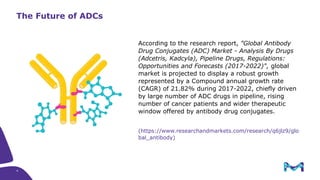
According to the research report, "Global Antibody
Drug Conjugates (ADC) Market - Analysis By Drugs
(Adcetris, Kadcyla), Pipeline Drugs, Regulations:
Opportunities and Forecasts (2017-2022)", global
market is projected to display a robust growth
represented by a Compound annual growth rate
(CAGR) of 21.82% during 2017-2022, chiefly driven
by large number of ADC drugs in pipeline, rising
number of cancer patients and wider therapeutic
window offered by antibody drug conjugates.
(https://www.researchandmarkets.com/research/q6jlz9/glo
bal_antibody)
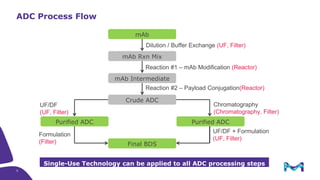
ADC Process Flow
Single-Use Technology can be applied to all ADC processing steps
mAb
mAb Rxn Mix
Final BDS
Crude ADC
Purified ADC
mAb Intermediate
Dilution / Buffer Exchange (UF, Filter)
Reaction #1 – mAb Modification (Reactor)
Reaction #2 – Payload Conjugation(Reactor)
Purified ADC
UF/DF
(UF, Filter)
Chromatography
(Chromatography, Filter)
Formulation
(Filter)
UF/DF + Formulation
(UF, Filter)
5
6
Single-Use Technology: The Benefits
Safe
• Minimizes operator exposure to potent
materials
Integral
• Decreased risk of contamination
• Validation, quality and regulatory
compliance support
Novel
• Process automation enables reproducible
commercial scale quantities
• Highly customized solutions from our
expansive component library
Greater Flexibility
• Closed, sterile sampling system enables
representative samples
• Compact footprint and mobile carrier
construction for enhanced flexibility
Lower Cost
• Single-use flow paths provides maximum
adaptability to your changing operational
needs
• Eliminates cleaning validation
Efficient
• Easy setup and use
• Reduced down-time for cleaning
• Broad working volumes
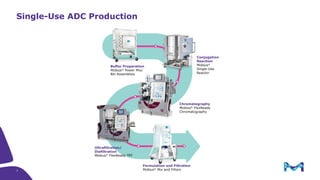
Single-Use ADC Production
7
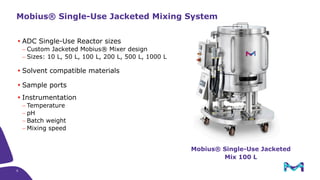
Mobius® Single-Use Jacketed Mixing System
 ADC Single-Use Reactor sizes
 Custom Jacketed Mobius® Mixer design
 Sizes: 10 L, 50 L, 100 L, 200 L, 500 L, 1000 L
 Solvent compatible materials
 Sample ports
 Instrumentation
 Temperature
 pH
 Batch weight
 Mixing speed
Mobius® Single-Use Jacketed
Mix 100 L
8
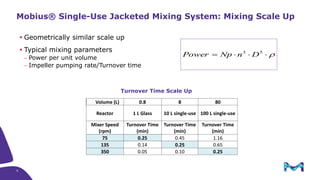
Turnover Time Scale Up
Volume (L) 0.8 8 80
Reactor 1 L Glass 10 L single-use 100 L single-use
Mixer Speed
(rpm)
Turnover Time
(min)
Turnover Time
(min)
Turnover Time
(min)
75 0.25 0.45 1.16
135 0.14 0.25 0.65
350 0.05 0.10 0.25
Mobius® Single-Use Jacketed Mixing System: Mixing Scale Up
 Geometrically similar scale up
 Typical mixing parameters
 Power per unit volume
 Impeller pumping rate/Turnover time
 53
DnNpPower
9
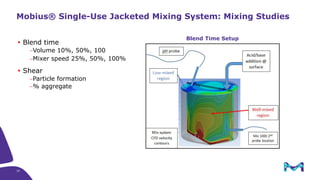
Mobius® Single-Use Jacketed Mixing System: Mixing Studies
Blend Time Setup
 Blend time
Volume 10%, 50%, 100
Mixer speed 25%, 50%, 100%
 Shear
Particle formation
% aggregate
10
Mobius® FlexReady Chromatography: ADC Purification
 Pump cart capability
 Low flow: 0.1 – 2.2 L/min
 High flow: 1.6 to 8 L/min
 Dual pumps: accurate gradient
 Pressure up to 4 bar
 2 x 5 inlets and 4 outlets
11
Mobius® FlexReady Solution with
Smart FlexwareTM Assemblies
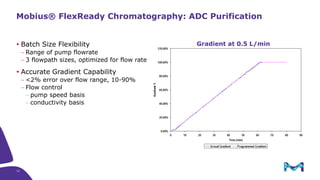
Mobius® FlexReady Chromatography: ADC Purification
 Batch Size Flexibility
 Range of pump flowrate
 3 flowpath sizes, optimized for flow rate
 Accurate Gradient Capability
 <2% error over flow range, 10-90%
 Flow control
 pump speed basis
 conductivity basis
Gradient at 0.5 L/min
12
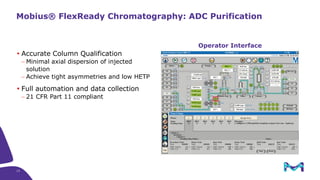
Mobius® FlexReady Chromatography: ADC Purification
Operator Interface
 Accurate Column Qualification
 Minimal axial dispersion of injected
solution
 Achieve tight asymmetries and low HETP
 Full automation and data collection
 21 CFR Part 11 compliant
13
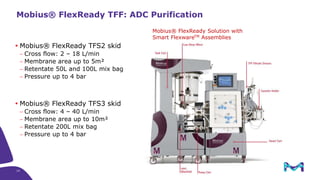
Mobius® FlexReady TFF: ADC Purification
 Mobius® FlexReady TFS2 skid
 Cross flow: 2 – 18 L/min
 Membrane area up to 5m²
 Retentate 50L and 100L mix bag
 Pressure up to 4 bar
 Mobius® FlexReady TFS3 skid
 Cross flow: 4 – 40 L/min
 Membrane area up to 10m²
 Retentate 200L mix bag
 Pressure up to 4 bar
14
Mobius® FlexReady Solution with
Smart FlexwareTM Assemblies
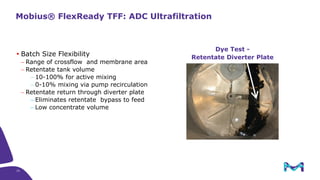
Mobius® FlexReady TFF: ADC Ultrafiltration
 Batch Size Flexibility
 Range of crossflow and membrane area
 Retentate tank volume
 10-100% for active mixing
 0-10% mixing via pump recirculation
 Retentate return through diverter plate
 Eliminates retentate bypass to feed
 Low concentrate volume
Dye Test -
Retentate Diverter Plate
15
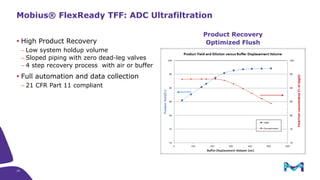
Mobius® FlexReady TFF: ADC Ultrafiltration
 High Product Recovery
 Low system holdup volume
 Sloped piping with zero dead-leg valves
 4 step recovery process with air or buffer
 Full automation and data collection
 21 CFR Part 11 compliant
Product Recovery
Optimized Flush
16
17
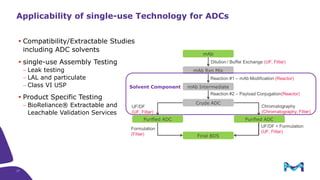
Applicability of single-use Technology for ADCs
 Compatibility/Extractable Studies
including ADC solvents
 single-use Assembly Testing
 Leak testing
 LAL and particulate
 Class VI USP
 Product Specific Testing
 BioReliance® Extractable and
Leachable Validation Services
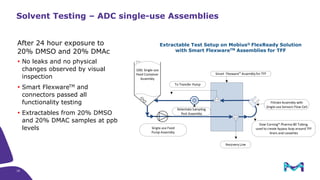
Solvent Component
After 24 hour exposure to
20% DMSO and 20% DMAc
 No leaks and no physical
changes observed by visual
inspection
 Smart FlexwareTM and
connectors passed all
functionality testing
 Extractables from 20% DMSO
and 20% DMAC samples at ppb
levels
Solvent Testing – ADC single-use Assemblies
Recovery Line
To Transfer Pump
Smart Flexware® Assembly for TFF
100L Single-use
Feed Container
Assembly
Filtrate Assembly with
Single-use Sensors Flow Cell
Retentate Sampling
Port Assembly
Dow Corning® Pharma-80 Tubing,
used to create bypass loop around TFF
liners and cassettes
Extractable Test Setup on Mobius® FlexReady Solution
with Smart Flexware® Assemblies for TFF
Single-use Feed
Pump Assembly
18
Extractable Test Setup on Mobius® FlexReady Solution
with Smart FlexwareTM Assemblies for TFF
TM
19
Case Study
• Technology transfer and optimization of bioprocess chemistry and
associated analytical methods to enable the production of antibody-drug
conjugate bulk drug substance ADC-X with 1000 gram antibody under
cGMP.
• This material will be used as an Active Pharmaceutical Ingredient for
human Phase 1 clinical trials.
• The ADC-X construct features a novel IgG1 isotype antibody conjugated
to a new drug-linker.
20
Development Strategy
• The primary goal of the development work was to deliver consistent and
scalable bioprocess chemistry that routinely affords functional ADC-X with
the desired final product specifications in high yield.
• This objective was achieved by performing evidence driven development
campaign resulting in the production of a pilot / toxicology batch, followed
by the technology transfer to cGMP production.
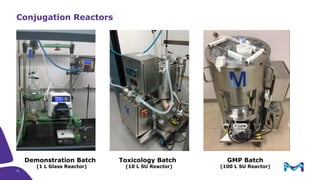
Conjugation Reactors
Demonstration Batch
(1 L Glass Reactor)
Toxicology Batch
(10 L SU Reactor)
GMP Batch
(100 L SU Reactor)
21
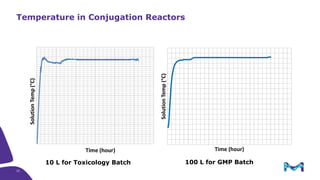
Temperature in Conjugation Reactors
SolutionTemp(°C)
Time (hour)
10 L for Toxicology Batch 100 L for GMP Batch
22
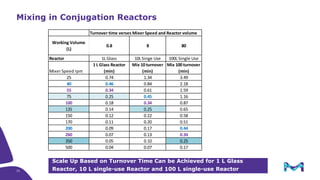
Scale Up Based on Turnover Time Can be Achieved for 1 L Glass
Reactor, 10 L single-use Reactor and 100 L single-use Reactor
Turnover time verses Mixer Speed and Reactor volume
Working Volume
(L)
0.8 8 80
Reactor 1L Glass 10L Singe Use 100L Single Use
Mixer Speed rpm
1 L Glass Reactor
(min)
Mix 10 turnover
(min)
Mix 100 turnover
(min)
25 0.74 1.34 3.49
40 0.46 0.84 2.18
55 0.34 0.61 1.59
75 0.25 0.45 1.16
100 0.18 0.34 0.87
135 0.14 0.25 0.65
150 0.12 0.22 0.58
170 0.11 0.20 0.51
200 0.09 0.17 0.44
260 0.07 0.13 0.34
350 0.05 0.10 0.25
500 0.04 0.07 0.17
Mixing in Conjugation Reactors
23
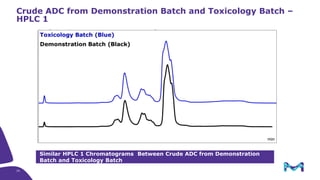
Similar HPLC 1 Chromatograms Between Crude ADC from Demonstration
Batch and Toxicology Batch
Crude ADC from Demonstration Batch and Toxicology Batch –
HPLC 1
24
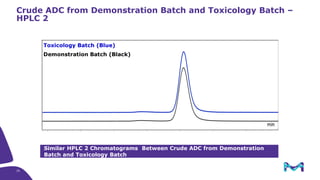
Crude ADC from Demonstration Batch and Toxicology Batch –
HPLC 2
Similar HPLC 2 Chromatograms Between Crude ADC from Demonstration
Batch and Toxicology Batch
25
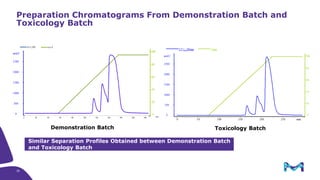
Preparation Chromatograms From Demonstration Batch and
Toxicology Batch
Demonstration Batch Toxicology Batch
Similar Separation Profiles Obtained between Demonstration Batch
and Toxicology Batch
26
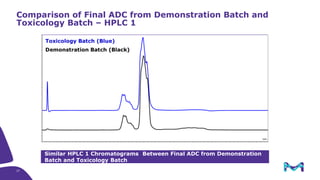
Similar HPLC 1 Chromatograms Between Final ADC from Demonstration
Batch and Toxicology Batch
Comparison of Final ADC from Demonstration Batch and
Toxicology Batch – HPLC 1
27
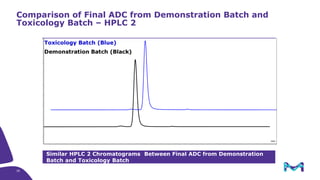
Comparison of Final ADC from Demonstration Batch and
Toxicology Batch – HPLC 2
Similar HPLC 2 Chromatograms Between Final ADC from Demonstration
Batch and Toxicology Batch
28
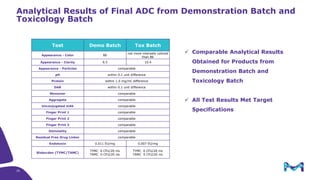
Analytical Results of Final ADC from Demonstration Batch and
Toxicology Batch
Test Demo Batch Tox Batch
Appearance - Color B6
not more intensely colored
than B6
Appearance - Clarity 9.5 10.4
Appearance - Particles comparable
pH within 0.1 unit difference
Protein within 1.0 mg/mL difference
DAR within 0.1 unit difference
Monomer comparable
Aggregate comparable
Unconjugated mAb comparable
Finger Print 1 comparable
Finger Print 2 comparable
Finger Print 3 comparable
Osmolality comparable
Residual Free Drug Linker comparable
Endotoxin 0.011 EU/mg 0.007 EU/mg
Bioburden (TYMC/TAMC)
TYMC 0 CFU/20 mL
TAMC 0 CFU/20 mL
TYMC 0 CFU/20 mL
TAMC 0 CFU/20 mL
 Comparable Analytical Results
Obtained for Products from
Demonstration Batch and
Toxicology Batch
 All Test Results Met Target
Specifications
29
30
Process Evaluation
• Conjugation Process Chemistry scaled up from Demonstration Batch to
Toxicology Batch.
o Excellent agreement of the mass balance and product quality attributes
o Alignment of the product quality attributes with the target values
o Cumulative data on process scalability and consistency
• Provided a decision on proceeding to Technology Transfer to GMP
Manufacturing.
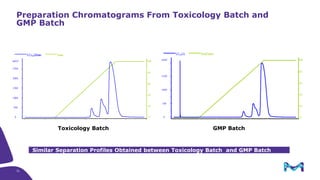
Preparation Chromatograms From Toxicology Batch and
GMP Batch
Toxicology Batch GMP Batch
Similar Separation Profiles Obtained between Toxicology Batch and GMP Batch
31
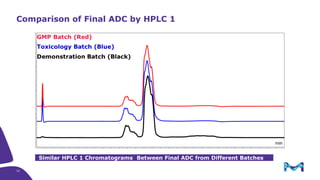
Comparison of Final ADC by HPLC 1
Similar HPLC 1 Chromatograms Between Final ADC from Different Batches
32
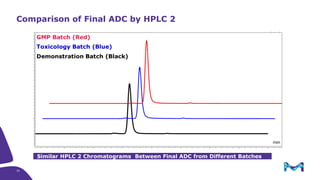
Comparison of Final ADC by HPLC 2
Similar HPLC 2 Chromatograms Between Final ADC from Different Batches
33
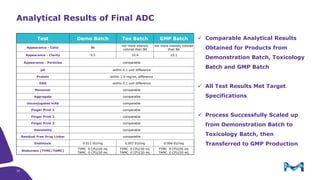
Test Demo Batch Tox Batch GMP Batch
Appearance - Color B6
not more intensly
colored than B6
not more intensly colored
than B6
Appearance - Clarity 9.5 10.4 10.1
Appearance - Particles comparable
pH within 0.1 unit difference
Protein within 1.0 mg/mL difference
DAR within 0.1 unit difference
Monomer comparable
Aggregate comparable
Unconjugated mAb comparable
Finger Print 1 comparable
Finger Print 2 comparable
Finger Print 3 comparable
Osmolality comparable
Residual Free Drug Linker comparable
Endotoxin 0.011 EU/mg 0.007 EU/mg 0.006 EU/mg
Bioburden (TYMC/TAMC)
TYMC 0 CFU/20 mL
TAMC 0 CFU/20 mL
TYMC 0 CFU/20 mL
TAMC 0 CFU/20 mL
TYMC 0 CFU/20 mL
TAMC 0 CFU/20 mL
Analytical Results of Final ADC
 Comparable Analytical Results
Obtained for Products from
Demonstration Batch, Toxicology
Batch and GMP Batch
 All Test Results Met Target
Specifications
 Process Successfully Scaled up
from Demonstration Batch to
Toxicology Batch, then
Transferred to GMP Production
34
Mobius® Technical support
• R&D
• Applications Engineering
• Bioprocessing
Bio-Conjugation Center of Excellence St. Louis
• Global Process & Analytical Development
• ADC Production manufacturing
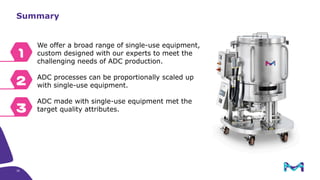
Summary
We offer a broad range of single-use equipment,
custom designed with our experts to meet the
challenging needs of ADC production.
ADC processes can be proportionally scaled up
with single-use equipment.
ADC made with single-use equipment met the
target quality attributes.
36
The Vibrant M is a trademark of Merck KGaA, Darmstadt, Germany or its affiliates. All other trademarks are the property of their respective owners.
Detailed information on trademarks is available via publicly accessible resources. © 2018 Merck KGaA, Darmstadt, Germany and/or its affiliates.
All Rights Reserved.

Complete single-use ADC technology from development through scale-up

  • 1.
    Merck KGaA Darmstadt, Germany GangYao, Ph.D. Principal Scientist Mary Robinette Principal Project Engineer Kevin Reyer Project Engineer
  • 2.
    2 The life sciencebusiness of Merck KGaA, Darmstadt, Germany operates as MilliporeSigma in the U.S. and Canada.
  • 3.
  • 4.
    The Future ofADCs 4 According to the research report, "Global Antibody Drug Conjugates (ADC) Market - Analysis By Drugs (Adcetris, Kadcyla), Pipeline Drugs, Regulations: Opportunities and Forecasts (2017-2022)", global market is projected to display a robust growth represented by a Compound annual growth rate (CAGR) of 21.82% during 2017-2022, chiefly driven by large number of ADC drugs in pipeline, rising number of cancer patients and wider therapeutic window offered by antibody drug conjugates. (https://www.researchandmarkets.com/research/q6jlz9/glo bal_antibody)
  • 5.
    ADC Process Flow Single-UseTechnology can be applied to all ADC processing steps mAb mAb Rxn Mix Final BDS Crude ADC Purified ADC mAb Intermediate Dilution / Buffer Exchange (UF, Filter) Reaction #1 – mAb Modification (Reactor) Reaction #2 – Payload Conjugation(Reactor) Purified ADC UF/DF (UF, Filter) Chromatography (Chromatography, Filter) Formulation (Filter) UF/DF + Formulation (UF, Filter) 5
  • 6.
    6 Single-Use Technology: TheBenefits Safe • Minimizes operator exposure to potent materials Integral • Decreased risk of contamination • Validation, quality and regulatory compliance support Novel • Process automation enables reproducible commercial scale quantities • Highly customized solutions from our expansive component library Greater Flexibility • Closed, sterile sampling system enables representative samples • Compact footprint and mobile carrier construction for enhanced flexibility Lower Cost • Single-use flow paths provides maximum adaptability to your changing operational needs • Eliminates cleaning validation Efficient • Easy setup and use • Reduced down-time for cleaning • Broad working volumes
  • 7.
  • 8.
    Mobius® Single-Use JacketedMixing System  ADC Single-Use Reactor sizes  Custom Jacketed Mobius® Mixer design  Sizes: 10 L, 50 L, 100 L, 200 L, 500 L, 1000 L  Solvent compatible materials  Sample ports  Instrumentation  Temperature  pH  Batch weight  Mixing speed Mobius® Single-Use Jacketed Mix 100 L 8
  • 9.
    Turnover Time ScaleUp Volume (L) 0.8 8 80 Reactor 1 L Glass 10 L single-use 100 L single-use Mixer Speed (rpm) Turnover Time (min) Turnover Time (min) Turnover Time (min) 75 0.25 0.45 1.16 135 0.14 0.25 0.65 350 0.05 0.10 0.25 Mobius® Single-Use Jacketed Mixing System: Mixing Scale Up  Geometrically similar scale up  Typical mixing parameters  Power per unit volume  Impeller pumping rate/Turnover time  53 DnNpPower 9
  • 10.
    Mobius® Single-Use JacketedMixing System: Mixing Studies Blend Time Setup  Blend time Volume 10%, 50%, 100 Mixer speed 25%, 50%, 100%  Shear Particle formation % aggregate 10
  • 11.
    Mobius® FlexReady Chromatography:ADC Purification  Pump cart capability  Low flow: 0.1 – 2.2 L/min  High flow: 1.6 to 8 L/min  Dual pumps: accurate gradient  Pressure up to 4 bar  2 x 5 inlets and 4 outlets 11 Mobius® FlexReady Solution with Smart FlexwareTM Assemblies
  • 12.
    Mobius® FlexReady Chromatography:ADC Purification  Batch Size Flexibility  Range of pump flowrate  3 flowpath sizes, optimized for flow rate  Accurate Gradient Capability  <2% error over flow range, 10-90%  Flow control  pump speed basis  conductivity basis Gradient at 0.5 L/min 12
  • 13.
    Mobius® FlexReady Chromatography:ADC Purification Operator Interface  Accurate Column Qualification  Minimal axial dispersion of injected solution  Achieve tight asymmetries and low HETP  Full automation and data collection  21 CFR Part 11 compliant 13
  • 14.
    Mobius® FlexReady TFF:ADC Purification  Mobius® FlexReady TFS2 skid  Cross flow: 2 – 18 L/min  Membrane area up to 5m²  Retentate 50L and 100L mix bag  Pressure up to 4 bar  Mobius® FlexReady TFS3 skid  Cross flow: 4 – 40 L/min  Membrane area up to 10m²  Retentate 200L mix bag  Pressure up to 4 bar 14 Mobius® FlexReady Solution with Smart FlexwareTM Assemblies
  • 15.
    Mobius® FlexReady TFF:ADC Ultrafiltration  Batch Size Flexibility  Range of crossflow and membrane area  Retentate tank volume  10-100% for active mixing  0-10% mixing via pump recirculation  Retentate return through diverter plate  Eliminates retentate bypass to feed  Low concentrate volume Dye Test - Retentate Diverter Plate 15
  • 16.
    Mobius® FlexReady TFF:ADC Ultrafiltration  High Product Recovery  Low system holdup volume  Sloped piping with zero dead-leg valves  4 step recovery process with air or buffer  Full automation and data collection  21 CFR Part 11 compliant Product Recovery Optimized Flush 16
  • 17.
    17 Applicability of single-useTechnology for ADCs  Compatibility/Extractable Studies including ADC solvents  single-use Assembly Testing  Leak testing  LAL and particulate  Class VI USP  Product Specific Testing  BioReliance® Extractable and Leachable Validation Services Solvent Component
  • 18.
    After 24 hourexposure to 20% DMSO and 20% DMAc  No leaks and no physical changes observed by visual inspection  Smart FlexwareTM and connectors passed all functionality testing  Extractables from 20% DMSO and 20% DMAC samples at ppb levels Solvent Testing – ADC single-use Assemblies Recovery Line To Transfer Pump Smart Flexware® Assembly for TFF 100L Single-use Feed Container Assembly Filtrate Assembly with Single-use Sensors Flow Cell Retentate Sampling Port Assembly Dow Corning® Pharma-80 Tubing, used to create bypass loop around TFF liners and cassettes Extractable Test Setup on Mobius® FlexReady Solution with Smart Flexware® Assemblies for TFF Single-use Feed Pump Assembly 18 Extractable Test Setup on Mobius® FlexReady Solution with Smart FlexwareTM Assemblies for TFF TM
  • 19.
    19 Case Study • Technologytransfer and optimization of bioprocess chemistry and associated analytical methods to enable the production of antibody-drug conjugate bulk drug substance ADC-X with 1000 gram antibody under cGMP. • This material will be used as an Active Pharmaceutical Ingredient for human Phase 1 clinical trials. • The ADC-X construct features a novel IgG1 isotype antibody conjugated to a new drug-linker.
  • 20.
    20 Development Strategy • Theprimary goal of the development work was to deliver consistent and scalable bioprocess chemistry that routinely affords functional ADC-X with the desired final product specifications in high yield. • This objective was achieved by performing evidence driven development campaign resulting in the production of a pilot / toxicology batch, followed by the technology transfer to cGMP production.
  • 21.
    Conjugation Reactors Demonstration Batch (1L Glass Reactor) Toxicology Batch (10 L SU Reactor) GMP Batch (100 L SU Reactor) 21
  • 22.
    Temperature in ConjugationReactors SolutionTemp(°C) Time (hour) 10 L for Toxicology Batch 100 L for GMP Batch 22
  • 23.
    Scale Up Basedon Turnover Time Can be Achieved for 1 L Glass Reactor, 10 L single-use Reactor and 100 L single-use Reactor Turnover time verses Mixer Speed and Reactor volume Working Volume (L) 0.8 8 80 Reactor 1L Glass 10L Singe Use 100L Single Use Mixer Speed rpm 1 L Glass Reactor (min) Mix 10 turnover (min) Mix 100 turnover (min) 25 0.74 1.34 3.49 40 0.46 0.84 2.18 55 0.34 0.61 1.59 75 0.25 0.45 1.16 100 0.18 0.34 0.87 135 0.14 0.25 0.65 150 0.12 0.22 0.58 170 0.11 0.20 0.51 200 0.09 0.17 0.44 260 0.07 0.13 0.34 350 0.05 0.10 0.25 500 0.04 0.07 0.17 Mixing in Conjugation Reactors 23
  • 24.
    Similar HPLC 1Chromatograms Between Crude ADC from Demonstration Batch and Toxicology Batch Crude ADC from Demonstration Batch and Toxicology Batch – HPLC 1 24
  • 25.
    Crude ADC fromDemonstration Batch and Toxicology Batch – HPLC 2 Similar HPLC 2 Chromatograms Between Crude ADC from Demonstration Batch and Toxicology Batch 25
  • 26.
    Preparation Chromatograms FromDemonstration Batch and Toxicology Batch Demonstration Batch Toxicology Batch Similar Separation Profiles Obtained between Demonstration Batch and Toxicology Batch 26
  • 27.
    Similar HPLC 1Chromatograms Between Final ADC from Demonstration Batch and Toxicology Batch Comparison of Final ADC from Demonstration Batch and Toxicology Batch – HPLC 1 27
  • 28.
    Comparison of FinalADC from Demonstration Batch and Toxicology Batch – HPLC 2 Similar HPLC 2 Chromatograms Between Final ADC from Demonstration Batch and Toxicology Batch 28
  • 29.
    Analytical Results ofFinal ADC from Demonstration Batch and Toxicology Batch Test Demo Batch Tox Batch Appearance - Color B6 not more intensely colored than B6 Appearance - Clarity 9.5 10.4 Appearance - Particles comparable pH within 0.1 unit difference Protein within 1.0 mg/mL difference DAR within 0.1 unit difference Monomer comparable Aggregate comparable Unconjugated mAb comparable Finger Print 1 comparable Finger Print 2 comparable Finger Print 3 comparable Osmolality comparable Residual Free Drug Linker comparable Endotoxin 0.011 EU/mg 0.007 EU/mg Bioburden (TYMC/TAMC) TYMC 0 CFU/20 mL TAMC 0 CFU/20 mL TYMC 0 CFU/20 mL TAMC 0 CFU/20 mL  Comparable Analytical Results Obtained for Products from Demonstration Batch and Toxicology Batch  All Test Results Met Target Specifications 29
  • 30.
    30 Process Evaluation • ConjugationProcess Chemistry scaled up from Demonstration Batch to Toxicology Batch. o Excellent agreement of the mass balance and product quality attributes o Alignment of the product quality attributes with the target values o Cumulative data on process scalability and consistency • Provided a decision on proceeding to Technology Transfer to GMP Manufacturing.
  • 31.
    Preparation Chromatograms FromToxicology Batch and GMP Batch Toxicology Batch GMP Batch Similar Separation Profiles Obtained between Toxicology Batch and GMP Batch 31
  • 32.
    Comparison of FinalADC by HPLC 1 Similar HPLC 1 Chromatograms Between Final ADC from Different Batches 32
  • 33.
    Comparison of FinalADC by HPLC 2 Similar HPLC 2 Chromatograms Between Final ADC from Different Batches 33
  • 34.
    Test Demo BatchTox Batch GMP Batch Appearance - Color B6 not more intensly colored than B6 not more intensly colored than B6 Appearance - Clarity 9.5 10.4 10.1 Appearance - Particles comparable pH within 0.1 unit difference Protein within 1.0 mg/mL difference DAR within 0.1 unit difference Monomer comparable Aggregate comparable Unconjugated mAb comparable Finger Print 1 comparable Finger Print 2 comparable Finger Print 3 comparable Osmolality comparable Residual Free Drug Linker comparable Endotoxin 0.011 EU/mg 0.007 EU/mg 0.006 EU/mg Bioburden (TYMC/TAMC) TYMC 0 CFU/20 mL TAMC 0 CFU/20 mL TYMC 0 CFU/20 mL TAMC 0 CFU/20 mL TYMC 0 CFU/20 mL TAMC 0 CFU/20 mL Analytical Results of Final ADC  Comparable Analytical Results Obtained for Products from Demonstration Batch, Toxicology Batch and GMP Batch  All Test Results Met Target Specifications  Process Successfully Scaled up from Demonstration Batch to Toxicology Batch, then Transferred to GMP Production 34
  • 35.
    Mobius® Technical support •R&D • Applications Engineering • Bioprocessing Bio-Conjugation Center of Excellence St. Louis • Global Process & Analytical Development • ADC Production manufacturing
  • 36.
    Summary We offer abroad range of single-use equipment, custom designed with our experts to meet the challenging needs of ADC production. ADC processes can be proportionally scaled up with single-use equipment. ADC made with single-use equipment met the target quality attributes. 36
  • 37.
    The Vibrant Mis a trademark of Merck KGaA, Darmstadt, Germany or its affiliates. All other trademarks are the property of their respective owners. Detailed information on trademarks is available via publicly accessible resources. © 2018 Merck KGaA, Darmstadt, Germany and/or its affiliates. All Rights Reserved.