Merck KGaA
Darmstadt, Germany
Takao Ito, Head of MSAT Japan & Korea
BIO KOREA International Convention
18 April 2019
Considerations for Continuous Processing and
Connected Polishing for mAb
Technology Trends
in Bioprocessing
Purification
01
02
03
04
05
Agenda
2
Market Trends and the Evolution of Next
Generation Processes
Intensified Capture Processing
Continuous Virus Inactivation
Connected Flow-Through Polishing
Summary
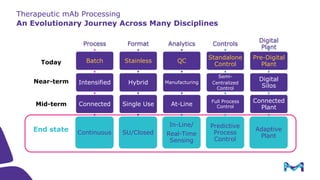
Therapeutic mAb Processing
Market Trends
*http://www.biophorum.com/category/resources/technology-roadmapping-resources/introduction/
1 2 3 4
Therapeutic mAb Processing
Market Trends Require Step Change in Business Driver Performance
70% 10X 90% 90%
5
Therapeutic mAb processing
Factory of the Future
Facility Goals
FACTORY
OF THE
FUTURE
Enablers
Process
Intensification
Single Use Process Analytics
Software &
Automation
Therapeutic mAb Processing
An Evolutionary Journey Across Many Disciplines
6
Today
Near-term
Mid-term
End state
Process
Batch
Intensified
Connected
Continuous
Format
Stainless
Hybrid
Single Use
SU/Closed
Analytics
QC
Manufacturing
At-Line
In-Line/
Real-Time
Sensing
Controls
Standalone
Control
Semi-
Centralized
Control
Full Process
Control
Predictive
Process
Control
Digital
Plant
Pre-Digital
Plant
Digital
Silos
Connected
Plant
Adaptive
Plant
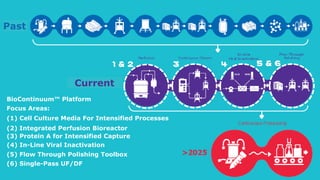
BioContinuum™ Platform
Focus Areas:
(1) Cell Culture Media For Intensified Processes
(2) Integrated Perfusion Bioreactor
1 & 2 3
(3) Protein A for Intensified Capture
4
(4) In-Line Viral Inactivation
5 & 6
(5) Flow Through Polishing Toolbox
(6) Single-Pass UF/DF
Past
Current
Approach of mAb Downstream Process Intensification
Low
pH VI
Pool
CEX
Pool
AEX
Pool
VF
Pool
Traditional
Process
CEX B/E AEX FT VF with
prefiltrationPA B/E
VF
PoolTank Less
CEX B/E
AEX FT
VF with
prefiltration
PA B/E
VF
Pool
Continuous
Capture
(CMC, SMB)
CMC
CEX B/E
VF with
pre-filtration
AEX FT
Tandem
CMC
PA B/E
Connected
Flow-through
(post PA)
Low pH
VI Pool VF Pool
AC + AEX FT CEX + VF
In-line pH
Pro-A+AEX: M. Shamashkin et al.,
Biotechnol Bioeng, 110(10) 2013
Pro-A+CEX+AEX: Neil Soice, et. al.
ACS spring conference 2010
V. Warikoo et al., Biotechnol Bioeng,
109(12), 2012
R. Godawat et al., J Biotechnol. 213,
2015
AEX+HIC: J. Zhang et al., Eng Life
Sci. 17(2) 2017
Depth+AC+AEX: T Yamada et al., J
Chrom B 1061-1062 2017
EP 2574618 A1. 2012
01
02
03
04
05
Agenda
9
Market Trends and the Evolution of Next
Generation Processes
Intensified Capture Processing
Continuous Virus Inactivation
Connected Flow-Through Polishing
Summary
Improved resin utilization
Residence time operation: Higher or lower
What is Continuous Multi-Column Chromatography
Intensified Capture
2 column
Single loading
3 column
Loading in-series
Intensified Capture
What is Continuous Multi-Column Chromatography
▪ Better resin utilization
▪ Higher productivity
▪ Smaller columns
▪ Lower buffer consumption
0.0 0.5 1.0 1.5 2.0 2.5 3.0 3.5
0
10
20
30
40
50
60
70
80
1-Column
(1% BT)
2-Column
(1% BT)
DynamicCapacity(g/L)
Residence Time (min)
Protein conc. in column
3 min RT
1 min RT
0,6 min RT
0,4 min RT
Batch
Continuous
Intensified Capture
Quality and Yield of Continuous Multi-Column Chromatography
3 column continuous results
Total IgG loaded : 325mg (@RT 1min)
Washing : 25mg
Elution : 296mg 91%
Total Operation time: 8.3hr
Used protein A amount: 3ml
Batch results
Total IgG loaded : 480mg (@RT 7.2min)
Elution : 445mg 92%
Total Operation time: 24hr
Used protein A amount: 5ml
Data generated by Chiyoda
TechnoAce Co.,Ltd.
▪ Maintained performance
▪ Same robustness
▪ Comparable process yield
Protein A affinity resin: Eshmuno® A
Is Multi-column Chromatography Productive?
Same operation for resin: B/E
• Same resin
• Same buffer
Batch
Multi Column
Changes:
• Reduction of resin and buffer
• Shorter residence time
• Increase cycle
• Interconnected operation
• Complex flow path for cycling
Intensified Capture
Operational Windows on Productivity
Batch 2-column switching 3-column cycling
Works around 20cm Bed
at 250-350 cm/hr
Productivity:
15-30 g/L/hr
Limitation of flow rate
Bed height at 5-15cm
25-40 g/L/hr
Operation point is determined
by 24hr run (perfusion)
3.5-4.5g/L/hr
2000L (Titer 5.4g/L)
Eshmuno® A resin
Least Squares Fit by response surface
(Predicted by JMP software)
ID 63cm ID 25cm ID 35cm
Different sweet spot of resin utilization
Intensified Capture
Capture Column Strategy for Upstream Processing
Fed-batch bioreactor
2kL, 5.4g/L
Single harvest
Perfusion bioreactor
(30days)
150L, 2.29g/L
Continuous harvest
Concentrated Fed-batch
500L, 21.4g/L
Single harvest
UF
MF
BPOG Next Gen Tech Roadmap Upstream Scenarios
Titers are referenced from Xu, S. et al., Biotechnol. Prog., 33(4) 2017
0%
50%
100%
Intensifie
dFB&
Batch
Intensifie
dFB&
CMC
HD
perfusion
&
Switching
Concentra
tedFB
&CMC
Buffer Total resin
0%
100%
200%
300%
Productivity
x1.7
1/4
x2.2
-97%
-50%
1
2
3
4
16
Intensified Capture
Impact on Long Duration Cycling Run
J. Pollock et al., J. Chromatography A 2013
Continuous
Batch
P
Perfusion Bioreactor
Cell Retention device,
breeding device
Protein A capture
Semi continuous and
continuous manufacturing
Centrifugation, ATF, TFF
Multicolumn cycling
In-line
perfusate
clarification
Limited impurity removal
Significantly more foulants
Steeper loss in DBC
D. Burgstaller et al., J. Chem.
Technol. Biotechnol. 2017
pDADMAC
Millistak® HC ProDesign with enough safety factor
Improved CIP
Additional perfusate clarification
Cycle Number
LossinDBC(%)
-5
0
5
10
15
20
-0.5
0
0.5
1
1.5
2
2.5
0 5 10 15 20 25 30 35 40 45 50 55 60 65
pHorConductivity/4
A280(AU)
Column Volumes
A280
Conductivity / 4
pH
wash
-5
0
5
10
15
20
-0.5
0
0.5
1
1.5
2
2.5
0 5 10 15 20 25 30 35 40 45
pHorConductivity/4
A280(AU)
Column Volumes
A280
Conductivity / 4
pH
Unconcentrated
mAb Harvest
1.3 g/L titer
24 CV load
SPTFF Concentrated
12.4 g/L titer
2.5 CV load
equil load elute re-equil CIP
Load time = 144 min
Cycle time = 4.25 hour
Load time = 14 min
Cycle time = 2 hour
SPTFF feed concentration increased capture step productivity by 115%
(7.2 g/L/hr → 15.5 g/L/hr)
Case Study: 1.6 L Eshmuno® A column for batch mAb capture
Improve Capture Chromatography with SPTFF
Intensified Capture
Flow Rate
Existing resins
The Drive For Higher Productivity Solutions
Residence times is the key
for future
Higher productivity enables:
✓ Increased speed
✓ Smaller footprint
→ Potential for Single Use
→ Manufacturing flexibility
✓ Reduced COGS
3-8 min.
1-3 min.
0.5-1 min.
2-10 sec.
Productivity(g/L/h)
Residence Time (min)
Intensified Capture
18
Conventional Column
Chromatography
Multi-column cycling optimizes resin utilization and enables continuous processing:
• Upstream culture strategy should be considered: Fed-batch or Perfusion
• Harvest type: Single or Continuous
• mAb concentration: SPTFF can boost productivity for Protein A capture
• Design consideration for multi cycling operation for higher loading:
Safety factor, Improved CIP, Additional perfusate clarification
Summary of intensified capture
01
02
03
04
05
Agenda
20
Market Trends and the Evolution of Next
Generation Processes
Intensified Capture Processing
Continuous Virus Inactivation
Connected Flow-Through Polishing
Summary
In-Line Virus Inactivation
ACID
→ Virus inactivation kinetics
→ Efficient incubation chamber design
PROTEIN A
CAPTURE
POLISHING
CHROM.
STEP #1
BATCH
Industry standard: 60 minute hold
Robust inactivation > 4 LRV
2 holding tanks required
Manual process
Continuous pH adjustment with dynamic hold
Eliminates large holding tanks
Automated
Enables continuous operation
60 min
HOLD
BASE
Applicability dependent upon:
CONTINUOUS
0
0.2
0.4
0.6
0.8
1
0 0.5 1 1.5 2 2.5
CumulativeDistribution
V/V50
In-Line Virus Inactivation
Incubation Chamber Design – Flow Distribution Characterization
Straight Tube
Coiled
Serpentine
Early virus
breakthrough
→ Larger safety
factor Long protein
exposure
C. Gillespie et al., Biotechnol J. 2019 Feb;14(2)
Inactivation
Kinetics
Virus type
PRV < XMuLV
Buffer type
acetate  glycine < citrate
Temperature
22ºC < 16ºC
mAb concentration
Minimal impact
In-Line Virus Inactivation
Virus Inactivation Kinetics
Rapid inactivation kinetics (~2-3 min)
C. Gillespie et al., Biotechnol J. 2019 Feb;14(2)
• Virus inactivation at low pH is rapid and requires less than 5 minutes, implying
that this process can be run in continuous mode. The kinetics of inactivation
depend on pH, temperature, and buffer conditions, and are not dependent on
protein concentration.
• Technologies exist to move from batch to continuous virus inactivation. Efficient
incubation chamber design and control offers continuous flow systems shorter
processing times than traditional batch processes.
• Proper implementation could result in equivalent levels of virus inactivation in
batch and in-line systems.
Summary of in-line virus inactivation
01
02
03
04
05
Agenda
25
Market Trends and the Evolution of Next
Generation Processes
Intensified Capture Processing
Continuous Virus Inactivation
Connected Flow-Through Polishing
Summary
Toolbox Approach
Flow-through Polishing
Leached
Protein A
Aggregates
Virus
Host Cell DNA
Host Cell Protein
Others?
(Fragments,
Charge Variants)
Chemistries Matrices Devices
Flow-through Polishing
Existing Toolbox
▪ Eshmuno® CP-FT resin
Flow through aggregate removal at high
loading
5 – 10X buffer reduction
Easy implementation
▪ NatriFlo® HD-Q AEX membrane
Impurity clearance at high loading
High velocity operation (~1 sec RT)
▪ Millistak+® Pod CR40 depth filter
Activated carbon media
Binding: van der Waals interactions
Size-based selectivity
Impurity (MW) Capacity
Insulin 60 g/L
Methotrexate 75 g/L
Pluronic® F68
surfactant
75 g/L
Antifoam C > 16 g/L
Eshmuno® CP-FT resin
Benchmarking
Only Eshmuno® CP-FT resin was efficient for the removal of aggregates in the flow-
through mode under strong binding conditions that favor frontal chromatography
M. Stone et al., J Chrom A, 1599, 2019
Batch vs. Integrated Implementation of Flow-through Technology
Robust Performance with Significant Footprint Reduction
Flow Through Polishing Delivers:
Robust Purification across 8 molecules
 High product yield (83 – 91%)
 Aggregates: < 1%
 Fragments: up to 1 LRV
 HCP clearance: < 10 ppm
Significant Facility Footprint Reduction
 Lower media and buffer requirements
 Eliminate intermediate hold tanks
 Single-skid operation
Low pH
VI Pool
Virus
Filter
Pool
Carbon Depth Filter
+ FT-AEX
FT-CEX
+ Virus Filtration
In-line pH
Low pH
VI Pool
Depth
Filter
Pool
CEX
Pool
AEX
Pool
Virus
Filter
Pool
pH Adjust
& Dilution
Depth Filter Bind & Elute
CEX
FT-AEX Virus
Filtration
Traditional Batch Polishing
Flow Through Polishing
3-step Flow-through Polishing
100
98
96
94
92
3.0
2.5
2.0
1.5
1.0
0.5
0.0
VIA AC Feed FT-AC AEX Feed FT-AEX CEX Feed FT-CEX
HMW1
HMW2
LMW1
LMW2
Monomer
HMW,LMW(%)
Monomer(%)
10000
1000
100
10
1
DNA
DNA(pg/mg),HCP(ng/mg)
HCP3985
1888
27.8
512
0.15
0
0
2.47
0.25
0.01
0.01
0
1.7
0.07
1.57
0.03
1.68
0.03
98.22
94.22
<0.76
<0.25
0.00
FT-AC FTCEXFTAEX
pH5
3mS/cm
Activated carbon shows 3 log10 DNA clearance.
Robust clearance of HCP and DNA by FT-AEX.
Eshmuno® CP-FT reduces mAb-related HMW aggregates (Dimer).
mAb 10.9g/L
pH7
3mS/sm
T. Ichihara et al., mAbs J., 10, 2018
Feed condition:
mAb-A (8.2mg/mL)
Impurities: HCP = 567ng/mg IgG, DNA=7276 pg/mgIgG, HMW1 = 0.78%,
HMW2= 1.65%, Monomer = 96.53%, LMW1=0.93%, LMW2=0.1%.
pH6, 4mS/cm, 0.2mL/min
High Loading : 200mL (1640mg mAb)
Operation system : AKTAexplorer 100
Single equilibrium: 25mM sodium acetate buffer pH6
Single elution: 25mM Sodium acetate buffer pH6 w 1M NaCL
Evaluation: Connected flow-through
1. AEX(1mL) – CEX(0.5mL)
2. AC(0.5mL) – AEX(1mL) –CEX(0.5mL)
Connected Flow-through Purification
Proof of Concept Study from DOE Optimization
AC
CEX
T. Ichihara et al., mAbs J., 10, 2018
T. Ichihara et al., Eng. Life Sci., 19, 2019
(A) AEX - CEX(A) AEX - CEX
(B) AC - AEX - CEX
5
5.5
6
6.5
20 40 60 80 100 120 140 160 180 200 220 240
pH
0
500
1000
1500
2000
2500
3000
3500
0
A280(mAU)
Volume (mL)
5
5.5
6
6.5
7
0
500
1000
1500
2000
2500
3000
3500
0 20 40 60 80 100 120 140 160 180 200 220 240
pH
As80(mAU)
Volume (mL)
7
0
40
80
120
160
200
Conductivity(mS/sm)0
40
80
120
160
200
Conductivity(mS/sm) 0
0.2
0.4
0.6
0.8
1
MPa
0
0.2
0.4
0.6
0.8
1
MPaFigure 1. Typical chromatograms obtained from the in-series, connected flow-through
polishing steps. (A) AEX-CEX, (B) AC-AEX-CEX.
Load
Wash
Elute
Load
Wash
Elute
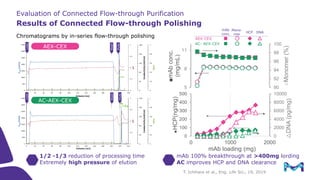
Evaluation of Connected Flow-through Purification
Results of Connected Flow-through Polishing
AEX-CEX
AC-AEX-CEX
Wash
Load
Elute
Wash
Load
Elute
90
92
94
96
98
100
5
8
11
○Monomer(%)
■mAbconc.
(mg/mL)
0
2000
4000
6000
8000
10000
0
100
200
300
400
500
0 1000 2000
△DNA(pg/mg)
◆HCP(ng/mg)
mAb loading (mg)
AEX-CEX
AC- AEX-CEX
mAb
conc.
Mono-
mer
HCP DNA
Chromatograms by in-series flow-through polishing
1/2 -1/3 reduction of processing time
Extremely high pressure of elution
mAb 100% breakthrough at >400mg lording
AC improves HCP and DNA clearance
T. Ichihara et al., Eng. Life Sci., 19, 2019
33
Value Modeling
What Value Does Flow Through Polishing Deliver?
Bioreactor Clarification Affinity
Chromatography
Virus
Inactivation
CEX Bind and
Elute
Flow Through AEX Viral
Clearance
Final
Filtration
Concentration &
Diafiltration
Traditional Batch
(Baseline)
Depth
Filtration
Four polishing steps run continuously without intermediate hold steps
▪ Lower buffer volume
▪ Higher loading on chromatography media and virus filter
▪ Smaller facility footprint for systems, columns, and tanks
Bioreactor Clarification Affinity
Chromatography
Virus
Inactivation
Final
Filtration
Concentration &
Diafiltration
Flow Through
Polishing
Activated Carbon Flow Through
CEX
Flow Through
AEX
Viral
Clearance
Bioreactor: 2k L fed-batch
Titer: 5 g/L Mab
Felo, Holistic Development of Intensified Mab Processes for Higher
Productivity and Improved Economics, BPI Boston, Sep 2018
Assumption Activated
Carbon
AEX FT CEX FT Virus
Filtration
Technology Millistak+®
Carbon
depth filter
Eshmuno® Q
resin
Eshmuno®
CP-FT resin
Viresolve®
Pro filter
Yield 93% 95% 95% 98%
Capacity 1500 g/m2 3000 g/L 1000 g/L 5000 g/m2
# Re-uses Single use 150 150 Single use
# Buffers 1 5 4 0
Activated Carbon Flow Through
CEX
Flow Through
AEX
Viral
Clearance
Value Modeling
Assumptions
Key to Output
• Single skid versus
four
• Yields matched to
baseline process
• Baseline process
assumptions per
BPOG costs &
assumptions
Bioreactor: 2k L fed-batch
Titer: 5 g/L Mab
34 Felo, Holistic Development of Intensified Mab Processes for Higher
Productivity and Improved Economics, BPI Boston, Sep 2018
35
Baseline Scenario vs. Flow Through Polishing
• Most significant savings capital, consumables, and labor
• Buffer reduction due primarily from switching CEX to flow through mode
10% COGS reduction
47% Buffer reduction
43% COGS reduction
87% Buffer reduction
Polishing alone… Total process…
Value Modeling
COGS Savings from Reduced Buffer Use, Intermediate Storage Tanks,
and Process Time/Labor
Bioreactor: 2k L fed-batch
Titer: 5 g/L Mab
Ito BioKorea
2019 | 18-
Apr-2019,
Copyright
Merck 2019 Felo, Holistic Development of Intensified Mab Processes for Higher
Productivity and Improved Economics, BPI Boston, Sep 2018
36
Ito BioKorea
2019 | 18-
Apr-2019,
Copyright
Merck 2019
Pre-concentrate to Boost Eshmuno® Q Resin HCP Clearance
SPTFF with Flow-through Polishing
0
1
2
3
4
5
6
0 20 40 60 80 100 120
Improvementfactorabove
non-SPTFFfeed
mAb feed concentration (mg/mL)
Improvement vs. mAb feed concentration
Mass Loading (g/L resin)
▪SPTFF pre-concentration can boost Eshmuno® Q resin mass loading by a factor of 4x.
▪ Reduced loading at high feed concentrations, possibly due to mAb-HCP interactions.
▪In addition to load improvements, SPTFF concentration reduces process load time,
thus increasing productivity by a factor of 5x.
0
1
2
3
4
5
6
0 20 40 60 80 100 120
Improvementfactorabove
non-SPTFFfeed
mAb feed concentration (mg/mL)
Improvement vs. mAb feed concentration
Mass Loading (g/L resin) Productivity (g/L resin/hr)
Pre-Concentrate
Protein
SPTFF
Pellicon®
AEX
Eshmuno® Q
T Elich et al., ACS conference spring Apr 2017
Continuous diafiltration for buffer exchange
Tank
I
Tank
II
Recovery
Tank To next
process step
From previous
process step
UF
0
1
2
3
4
5
6
7
NormalizedtoBatch
All cases: no UF, 9 diavolumes
■ Batch: 3h process, 6LMM crossflow
■ CDF low area: 19h process, 6LMM crossflow
■ CDF low pump passes: 19h process, 1LMM crossflow
■ ILDF: 19h process
30
35
40
45
0 2 4 6 8 10 12 14 16 18 20 22 24
Cycle Number
Control Chart: DF Cycle Time
Average = 36.9 min, σ = 1.8 min
E. Goodrich et al.,
Recovery of biological
Products, Oct 2018
Comparable performance between the batch purification process and the pool-less
process configuration.
• Simple operation: Single system operation and removal of the intermediate hold tank
• Substantial quality: higher overall mAb yield and impurity clearance
• Small processing: Higher process loading = Process compression, reduced buffer usage
• Shorter process time: Single loading step
• COGS reduction: ~10% across full process
• SPTFF pre-concentration can boost AEX resin mass loading
Summary of Flow-through Polishing
01
02
03
04
05
Agenda
39
Market Trends and the Evolution of Next
Generation Processes
Intensified Capture Processing
Continuous Virus Inactivation
Connected Flow-Through Polishing
Summary
Intensified Downstream Processing
Summary
Industry trends are forcing bio-manufacturers to adopt
a more strategic view of manufacturing
− Process Intensification
− Single Use
− Process Analytical Technologies and controls
Process design and optimization requires an “holistic view”
− Upstream and Downstream
− Tool box for connected impurity clearance
Next generation technologies can support intensification
efforts of existing batch processes while enabling future
connected and continuous processing
Collaborations between academics, industry, and regulatory
agencies are critical for successfully moving the industry
forward in next generation processing
1
2
3
4
Acknowledgements
Christopher Gillespie
Kevin Galipeauc
Yasuhiko Kurisu
Yasuhiro Kawakami
Miyuki Koyama
Prof. Shuichi Yamamoto (Yamaguchi univ.)
Takamitsu Ichihara(Astellas)
Shuhei Kondo (Chiyoda TechnoAce)
Michael Phillips
Romas Skudas
Mikhail Kozlov
Lars Peeck
Ajish Potty
Matthew Stone
Alex Xenopoulos
Renaud Jacquemart
Danny Wu
Thomas Elich
Mochao Zhao
Michael Felo
Joseph Geringer
Elizabeth Goodrich
Schedule an in-person or remote
visit today.
EMDMillipore.com/mlab
The vibrant M, M Lab, BioContinuum, Eshmuno, Millistak+, NatriFlo are trademarks of Merck KGaA, Darmstadt, Germany or its affiliates. All other trademarks
are the property of their respective owners. Detailed information on trademarks is available via publicly accessible resources.
© 2020 Merck KGaA, Darmstadt, Germany and/or its affiliates. All Rights Reserved.

Technology Trends in Bioprocessing Purification

  • 1.
    Merck KGaA Darmstadt, Germany TakaoIto, Head of MSAT Japan & Korea BIO KOREA International Convention 18 April 2019 Considerations for Continuous Processing and Connected Polishing for mAb Technology Trends in Bioprocessing Purification
  • 2.
    01 02 03 04 05 Agenda 2 Market Trends andthe Evolution of Next Generation Processes Intensified Capture Processing Continuous Virus Inactivation Connected Flow-Through Polishing Summary
  • 3.
    Therapeutic mAb Processing MarketTrends *http://www.biophorum.com/category/resources/technology-roadmapping-resources/introduction/ 1 2 3 4
  • 4.
    Therapeutic mAb Processing MarketTrends Require Step Change in Business Driver Performance 70% 10X 90% 90%
  • 5.
    5 Therapeutic mAb processing Factoryof the Future Facility Goals FACTORY OF THE FUTURE Enablers Process Intensification Single Use Process Analytics Software & Automation
  • 6.
    Therapeutic mAb Processing AnEvolutionary Journey Across Many Disciplines 6 Today Near-term Mid-term End state Process Batch Intensified Connected Continuous Format Stainless Hybrid Single Use SU/Closed Analytics QC Manufacturing At-Line In-Line/ Real-Time Sensing Controls Standalone Control Semi- Centralized Control Full Process Control Predictive Process Control Digital Plant Pre-Digital Plant Digital Silos Connected Plant Adaptive Plant
  • 7.
    BioContinuum™ Platform Focus Areas: (1)Cell Culture Media For Intensified Processes (2) Integrated Perfusion Bioreactor 1 & 2 3 (3) Protein A for Intensified Capture 4 (4) In-Line Viral Inactivation 5 & 6 (5) Flow Through Polishing Toolbox (6) Single-Pass UF/DF Past Current
  • 8.
    Approach of mAbDownstream Process Intensification Low pH VI Pool CEX Pool AEX Pool VF Pool Traditional Process CEX B/E AEX FT VF with prefiltrationPA B/E VF PoolTank Less CEX B/E AEX FT VF with prefiltration PA B/E VF Pool Continuous Capture (CMC, SMB) CMC CEX B/E VF with pre-filtration AEX FT Tandem CMC PA B/E Connected Flow-through (post PA) Low pH VI Pool VF Pool AC + AEX FT CEX + VF In-line pH Pro-A+AEX: M. Shamashkin et al., Biotechnol Bioeng, 110(10) 2013 Pro-A+CEX+AEX: Neil Soice, et. al. ACS spring conference 2010 V. Warikoo et al., Biotechnol Bioeng, 109(12), 2012 R. Godawat et al., J Biotechnol. 213, 2015 AEX+HIC: J. Zhang et al., Eng Life Sci. 17(2) 2017 Depth+AC+AEX: T Yamada et al., J Chrom B 1061-1062 2017 EP 2574618 A1. 2012
  • 9.
    01 02 03 04 05 Agenda 9 Market Trends andthe Evolution of Next Generation Processes Intensified Capture Processing Continuous Virus Inactivation Connected Flow-Through Polishing Summary
  • 10.
    Improved resin utilization Residencetime operation: Higher or lower What is Continuous Multi-Column Chromatography Intensified Capture 2 column Single loading 3 column Loading in-series
  • 11.
    Intensified Capture What isContinuous Multi-Column Chromatography ▪ Better resin utilization ▪ Higher productivity ▪ Smaller columns ▪ Lower buffer consumption 0.0 0.5 1.0 1.5 2.0 2.5 3.0 3.5 0 10 20 30 40 50 60 70 80 1-Column (1% BT) 2-Column (1% BT) DynamicCapacity(g/L) Residence Time (min) Protein conc. in column 3 min RT 1 min RT 0,6 min RT 0,4 min RT Batch Continuous
  • 12.
    Intensified Capture Quality andYield of Continuous Multi-Column Chromatography 3 column continuous results Total IgG loaded : 325mg (@RT 1min) Washing : 25mg Elution : 296mg 91% Total Operation time: 8.3hr Used protein A amount: 3ml Batch results Total IgG loaded : 480mg (@RT 7.2min) Elution : 445mg 92% Total Operation time: 24hr Used protein A amount: 5ml Data generated by Chiyoda TechnoAce Co.,Ltd. ▪ Maintained performance ▪ Same robustness ▪ Comparable process yield Protein A affinity resin: Eshmuno® A
  • 13.
    Is Multi-column ChromatographyProductive? Same operation for resin: B/E • Same resin • Same buffer Batch Multi Column Changes: • Reduction of resin and buffer • Shorter residence time • Increase cycle • Interconnected operation • Complex flow path for cycling
  • 14.
    Intensified Capture Operational Windowson Productivity Batch 2-column switching 3-column cycling Works around 20cm Bed at 250-350 cm/hr Productivity: 15-30 g/L/hr Limitation of flow rate Bed height at 5-15cm 25-40 g/L/hr Operation point is determined by 24hr run (perfusion) 3.5-4.5g/L/hr 2000L (Titer 5.4g/L) Eshmuno® A resin Least Squares Fit by response surface (Predicted by JMP software) ID 63cm ID 25cm ID 35cm Different sweet spot of resin utilization
  • 15.
    Intensified Capture Capture ColumnStrategy for Upstream Processing Fed-batch bioreactor 2kL, 5.4g/L Single harvest Perfusion bioreactor (30days) 150L, 2.29g/L Continuous harvest Concentrated Fed-batch 500L, 21.4g/L Single harvest UF MF BPOG Next Gen Tech Roadmap Upstream Scenarios Titers are referenced from Xu, S. et al., Biotechnol. Prog., 33(4) 2017 0% 50% 100% Intensifie dFB& Batch Intensifie dFB& CMC HD perfusion & Switching Concentra tedFB &CMC Buffer Total resin 0% 100% 200% 300% Productivity x1.7 1/4 x2.2 -97% -50% 1 2 3 4
  • 16.
    16 Intensified Capture Impact onLong Duration Cycling Run J. Pollock et al., J. Chromatography A 2013 Continuous Batch P Perfusion Bioreactor Cell Retention device, breeding device Protein A capture Semi continuous and continuous manufacturing Centrifugation, ATF, TFF Multicolumn cycling In-line perfusate clarification Limited impurity removal Significantly more foulants Steeper loss in DBC D. Burgstaller et al., J. Chem. Technol. Biotechnol. 2017 pDADMAC Millistak® HC ProDesign with enough safety factor Improved CIP Additional perfusate clarification Cycle Number LossinDBC(%)
  • 17.
    -5 0 5 10 15 20 -0.5 0 0.5 1 1.5 2 2.5 0 5 1015 20 25 30 35 40 45 50 55 60 65 pHorConductivity/4 A280(AU) Column Volumes A280 Conductivity / 4 pH wash -5 0 5 10 15 20 -0.5 0 0.5 1 1.5 2 2.5 0 5 10 15 20 25 30 35 40 45 pHorConductivity/4 A280(AU) Column Volumes A280 Conductivity / 4 pH Unconcentrated mAb Harvest 1.3 g/L titer 24 CV load SPTFF Concentrated 12.4 g/L titer 2.5 CV load equil load elute re-equil CIP Load time = 144 min Cycle time = 4.25 hour Load time = 14 min Cycle time = 2 hour SPTFF feed concentration increased capture step productivity by 115% (7.2 g/L/hr → 15.5 g/L/hr) Case Study: 1.6 L Eshmuno® A column for batch mAb capture Improve Capture Chromatography with SPTFF Intensified Capture
  • 18.
    Flow Rate Existing resins TheDrive For Higher Productivity Solutions Residence times is the key for future Higher productivity enables: ✓ Increased speed ✓ Smaller footprint → Potential for Single Use → Manufacturing flexibility ✓ Reduced COGS 3-8 min. 1-3 min. 0.5-1 min. 2-10 sec. Productivity(g/L/h) Residence Time (min) Intensified Capture 18 Conventional Column Chromatography
  • 19.
    Multi-column cycling optimizesresin utilization and enables continuous processing: • Upstream culture strategy should be considered: Fed-batch or Perfusion • Harvest type: Single or Continuous • mAb concentration: SPTFF can boost productivity for Protein A capture • Design consideration for multi cycling operation for higher loading: Safety factor, Improved CIP, Additional perfusate clarification Summary of intensified capture
  • 20.
    01 02 03 04 05 Agenda 20 Market Trends andthe Evolution of Next Generation Processes Intensified Capture Processing Continuous Virus Inactivation Connected Flow-Through Polishing Summary
  • 21.
    In-Line Virus Inactivation ACID →Virus inactivation kinetics → Efficient incubation chamber design PROTEIN A CAPTURE POLISHING CHROM. STEP #1 BATCH Industry standard: 60 minute hold Robust inactivation > 4 LRV 2 holding tanks required Manual process Continuous pH adjustment with dynamic hold Eliminates large holding tanks Automated Enables continuous operation 60 min HOLD BASE Applicability dependent upon: CONTINUOUS
  • 22.
    0 0.2 0.4 0.6 0.8 1 0 0.5 11.5 2 2.5 CumulativeDistribution V/V50 In-Line Virus Inactivation Incubation Chamber Design – Flow Distribution Characterization Straight Tube Coiled Serpentine Early virus breakthrough → Larger safety factor Long protein exposure C. Gillespie et al., Biotechnol J. 2019 Feb;14(2)
  • 23.
    Inactivation Kinetics Virus type PRV <XMuLV Buffer type acetate  glycine < citrate Temperature 22ºC < 16ºC mAb concentration Minimal impact In-Line Virus Inactivation Virus Inactivation Kinetics Rapid inactivation kinetics (~2-3 min) C. Gillespie et al., Biotechnol J. 2019 Feb;14(2)
  • 24.
    • Virus inactivationat low pH is rapid and requires less than 5 minutes, implying that this process can be run in continuous mode. The kinetics of inactivation depend on pH, temperature, and buffer conditions, and are not dependent on protein concentration. • Technologies exist to move from batch to continuous virus inactivation. Efficient incubation chamber design and control offers continuous flow systems shorter processing times than traditional batch processes. • Proper implementation could result in equivalent levels of virus inactivation in batch and in-line systems. Summary of in-line virus inactivation
  • 25.
    01 02 03 04 05 Agenda 25 Market Trends andthe Evolution of Next Generation Processes Intensified Capture Processing Continuous Virus Inactivation Connected Flow-Through Polishing Summary
  • 26.
    Toolbox Approach Flow-through Polishing Leached ProteinA Aggregates Virus Host Cell DNA Host Cell Protein Others? (Fragments, Charge Variants) Chemistries Matrices Devices
  • 27.
    Flow-through Polishing Existing Toolbox ▪Eshmuno® CP-FT resin Flow through aggregate removal at high loading 5 – 10X buffer reduction Easy implementation ▪ NatriFlo® HD-Q AEX membrane Impurity clearance at high loading High velocity operation (~1 sec RT) ▪ Millistak+® Pod CR40 depth filter Activated carbon media Binding: van der Waals interactions Size-based selectivity Impurity (MW) Capacity Insulin 60 g/L Methotrexate 75 g/L Pluronic® F68 surfactant 75 g/L Antifoam C > 16 g/L
  • 28.
    Eshmuno® CP-FT resin Benchmarking OnlyEshmuno® CP-FT resin was efficient for the removal of aggregates in the flow- through mode under strong binding conditions that favor frontal chromatography M. Stone et al., J Chrom A, 1599, 2019
  • 29.
    Batch vs. IntegratedImplementation of Flow-through Technology Robust Performance with Significant Footprint Reduction Flow Through Polishing Delivers: Robust Purification across 8 molecules  High product yield (83 – 91%)  Aggregates: < 1%  Fragments: up to 1 LRV  HCP clearance: < 10 ppm Significant Facility Footprint Reduction  Lower media and buffer requirements  Eliminate intermediate hold tanks  Single-skid operation Low pH VI Pool Virus Filter Pool Carbon Depth Filter + FT-AEX FT-CEX + Virus Filtration In-line pH Low pH VI Pool Depth Filter Pool CEX Pool AEX Pool Virus Filter Pool pH Adjust & Dilution Depth Filter Bind & Elute CEX FT-AEX Virus Filtration Traditional Batch Polishing Flow Through Polishing
  • 30.
    3-step Flow-through Polishing 100 98 96 94 92 3.0 2.5 2.0 1.5 1.0 0.5 0.0 VIAAC Feed FT-AC AEX Feed FT-AEX CEX Feed FT-CEX HMW1 HMW2 LMW1 LMW2 Monomer HMW,LMW(%) Monomer(%) 10000 1000 100 10 1 DNA DNA(pg/mg),HCP(ng/mg) HCP3985 1888 27.8 512 0.15 0 0 2.47 0.25 0.01 0.01 0 1.7 0.07 1.57 0.03 1.68 0.03 98.22 94.22 <0.76 <0.25 0.00 FT-AC FTCEXFTAEX pH5 3mS/cm Activated carbon shows 3 log10 DNA clearance. Robust clearance of HCP and DNA by FT-AEX. Eshmuno® CP-FT reduces mAb-related HMW aggregates (Dimer). mAb 10.9g/L pH7 3mS/sm T. Ichihara et al., mAbs J., 10, 2018
  • 31.
    Feed condition: mAb-A (8.2mg/mL) Impurities:HCP = 567ng/mg IgG, DNA=7276 pg/mgIgG, HMW1 = 0.78%, HMW2= 1.65%, Monomer = 96.53%, LMW1=0.93%, LMW2=0.1%. pH6, 4mS/cm, 0.2mL/min High Loading : 200mL (1640mg mAb) Operation system : AKTAexplorer 100 Single equilibrium: 25mM sodium acetate buffer pH6 Single elution: 25mM Sodium acetate buffer pH6 w 1M NaCL Evaluation: Connected flow-through 1. AEX(1mL) – CEX(0.5mL) 2. AC(0.5mL) – AEX(1mL) –CEX(0.5mL) Connected Flow-through Purification Proof of Concept Study from DOE Optimization AC CEX T. Ichihara et al., mAbs J., 10, 2018 T. Ichihara et al., Eng. Life Sci., 19, 2019
  • 32.
    (A) AEX -CEX(A) AEX - CEX (B) AC - AEX - CEX 5 5.5 6 6.5 20 40 60 80 100 120 140 160 180 200 220 240 pH 0 500 1000 1500 2000 2500 3000 3500 0 A280(mAU) Volume (mL) 5 5.5 6 6.5 7 0 500 1000 1500 2000 2500 3000 3500 0 20 40 60 80 100 120 140 160 180 200 220 240 pH As80(mAU) Volume (mL) 7 0 40 80 120 160 200 Conductivity(mS/sm)0 40 80 120 160 200 Conductivity(mS/sm) 0 0.2 0.4 0.6 0.8 1 MPa 0 0.2 0.4 0.6 0.8 1 MPaFigure 1. Typical chromatograms obtained from the in-series, connected flow-through polishing steps. (A) AEX-CEX, (B) AC-AEX-CEX. Load Wash Elute Load Wash Elute Evaluation of Connected Flow-through Purification Results of Connected Flow-through Polishing AEX-CEX AC-AEX-CEX Wash Load Elute Wash Load Elute 90 92 94 96 98 100 5 8 11 ○Monomer(%) ■mAbconc. (mg/mL) 0 2000 4000 6000 8000 10000 0 100 200 300 400 500 0 1000 2000 △DNA(pg/mg) ◆HCP(ng/mg) mAb loading (mg) AEX-CEX AC- AEX-CEX mAb conc. Mono- mer HCP DNA Chromatograms by in-series flow-through polishing 1/2 -1/3 reduction of processing time Extremely high pressure of elution mAb 100% breakthrough at >400mg lording AC improves HCP and DNA clearance T. Ichihara et al., Eng. Life Sci., 19, 2019
  • 33.
    33 Value Modeling What ValueDoes Flow Through Polishing Deliver? Bioreactor Clarification Affinity Chromatography Virus Inactivation CEX Bind and Elute Flow Through AEX Viral Clearance Final Filtration Concentration & Diafiltration Traditional Batch (Baseline) Depth Filtration Four polishing steps run continuously without intermediate hold steps ▪ Lower buffer volume ▪ Higher loading on chromatography media and virus filter ▪ Smaller facility footprint for systems, columns, and tanks Bioreactor Clarification Affinity Chromatography Virus Inactivation Final Filtration Concentration & Diafiltration Flow Through Polishing Activated Carbon Flow Through CEX Flow Through AEX Viral Clearance Bioreactor: 2k L fed-batch Titer: 5 g/L Mab Felo, Holistic Development of Intensified Mab Processes for Higher Productivity and Improved Economics, BPI Boston, Sep 2018
  • 34.
    Assumption Activated Carbon AEX FTCEX FT Virus Filtration Technology Millistak+® Carbon depth filter Eshmuno® Q resin Eshmuno® CP-FT resin Viresolve® Pro filter Yield 93% 95% 95% 98% Capacity 1500 g/m2 3000 g/L 1000 g/L 5000 g/m2 # Re-uses Single use 150 150 Single use # Buffers 1 5 4 0 Activated Carbon Flow Through CEX Flow Through AEX Viral Clearance Value Modeling Assumptions Key to Output • Single skid versus four • Yields matched to baseline process • Baseline process assumptions per BPOG costs & assumptions Bioreactor: 2k L fed-batch Titer: 5 g/L Mab 34 Felo, Holistic Development of Intensified Mab Processes for Higher Productivity and Improved Economics, BPI Boston, Sep 2018
  • 35.
    35 Baseline Scenario vs.Flow Through Polishing • Most significant savings capital, consumables, and labor • Buffer reduction due primarily from switching CEX to flow through mode 10% COGS reduction 47% Buffer reduction 43% COGS reduction 87% Buffer reduction Polishing alone… Total process… Value Modeling COGS Savings from Reduced Buffer Use, Intermediate Storage Tanks, and Process Time/Labor Bioreactor: 2k L fed-batch Titer: 5 g/L Mab Ito BioKorea 2019 | 18- Apr-2019, Copyright Merck 2019 Felo, Holistic Development of Intensified Mab Processes for Higher Productivity and Improved Economics, BPI Boston, Sep 2018
  • 36.
    36 Ito BioKorea 2019 |18- Apr-2019, Copyright Merck 2019 Pre-concentrate to Boost Eshmuno® Q Resin HCP Clearance SPTFF with Flow-through Polishing 0 1 2 3 4 5 6 0 20 40 60 80 100 120 Improvementfactorabove non-SPTFFfeed mAb feed concentration (mg/mL) Improvement vs. mAb feed concentration Mass Loading (g/L resin) ▪SPTFF pre-concentration can boost Eshmuno® Q resin mass loading by a factor of 4x. ▪ Reduced loading at high feed concentrations, possibly due to mAb-HCP interactions. ▪In addition to load improvements, SPTFF concentration reduces process load time, thus increasing productivity by a factor of 5x. 0 1 2 3 4 5 6 0 20 40 60 80 100 120 Improvementfactorabove non-SPTFFfeed mAb feed concentration (mg/mL) Improvement vs. mAb feed concentration Mass Loading (g/L resin) Productivity (g/L resin/hr) Pre-Concentrate Protein SPTFF Pellicon® AEX Eshmuno® Q T Elich et al., ACS conference spring Apr 2017
  • 37.
    Continuous diafiltration forbuffer exchange Tank I Tank II Recovery Tank To next process step From previous process step UF 0 1 2 3 4 5 6 7 NormalizedtoBatch All cases: no UF, 9 diavolumes ■ Batch: 3h process, 6LMM crossflow ■ CDF low area: 19h process, 6LMM crossflow ■ CDF low pump passes: 19h process, 1LMM crossflow ■ ILDF: 19h process 30 35 40 45 0 2 4 6 8 10 12 14 16 18 20 22 24 Cycle Number Control Chart: DF Cycle Time Average = 36.9 min, σ = 1.8 min E. Goodrich et al., Recovery of biological Products, Oct 2018
  • 38.
    Comparable performance betweenthe batch purification process and the pool-less process configuration. • Simple operation: Single system operation and removal of the intermediate hold tank • Substantial quality: higher overall mAb yield and impurity clearance • Small processing: Higher process loading = Process compression, reduced buffer usage • Shorter process time: Single loading step • COGS reduction: ~10% across full process • SPTFF pre-concentration can boost AEX resin mass loading Summary of Flow-through Polishing
  • 39.
    01 02 03 04 05 Agenda 39 Market Trends andthe Evolution of Next Generation Processes Intensified Capture Processing Continuous Virus Inactivation Connected Flow-Through Polishing Summary
  • 40.
    Intensified Downstream Processing Summary Industrytrends are forcing bio-manufacturers to adopt a more strategic view of manufacturing − Process Intensification − Single Use − Process Analytical Technologies and controls Process design and optimization requires an “holistic view” − Upstream and Downstream − Tool box for connected impurity clearance Next generation technologies can support intensification efforts of existing batch processes while enabling future connected and continuous processing Collaborations between academics, industry, and regulatory agencies are critical for successfully moving the industry forward in next generation processing 1 2 3 4
  • 41.
    Acknowledgements Christopher Gillespie Kevin Galipeauc YasuhikoKurisu Yasuhiro Kawakami Miyuki Koyama Prof. Shuichi Yamamoto (Yamaguchi univ.) Takamitsu Ichihara(Astellas) Shuhei Kondo (Chiyoda TechnoAce) Michael Phillips Romas Skudas Mikhail Kozlov Lars Peeck Ajish Potty Matthew Stone Alex Xenopoulos Renaud Jacquemart Danny Wu Thomas Elich Mochao Zhao Michael Felo Joseph Geringer Elizabeth Goodrich
  • 42.
    Schedule an in-personor remote visit today. EMDMillipore.com/mlab
  • 43.
    The vibrant M,M Lab, BioContinuum, Eshmuno, Millistak+, NatriFlo are trademarks of Merck KGaA, Darmstadt, Germany or its affiliates. All other trademarks are the property of their respective owners. Detailed information on trademarks is available via publicly accessible resources. © 2020 Merck KGaA, Darmstadt, Germany and/or its affiliates. All Rights Reserved.