UNIVERSITY OF ZAMBIA
SCHOOL OF MEDICINE
DEPARTMENT OF MEDICAL EDUCATION
IMPLEMENTATION RESEARCH
@2023
ISAAC FWEMBA, PhD
BSc(ZAM), MPH(UK), PhD(GH)
LECTURER
SCHOOL OF MEDICINE
UNIVERSITY OF ZAMBIA
IMPLEMENTATION RESEARCH
Objective
• What is “implementation”?
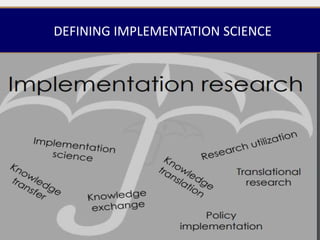
• Defining implementation science
• What determines implementation success?
• Implementation science outcome and strategies
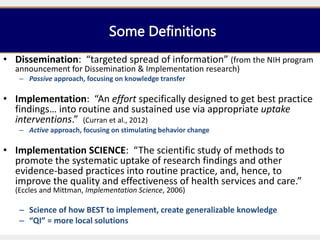
Some Definitions
• Dissemination: “targeted spread of information” (from the NIH program
announcement for Dissemination & Implementation research)
– Passive approach, focusing on knowledge transfer
• Implementation: “An effort specifically designed to get best practice
findings… into routine and sustained use via appropriate uptake
interventions.” (Curran et al., 2012)
– Active approach, focusing on stimulating behavior change
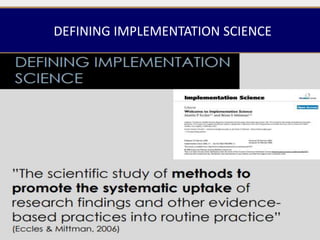
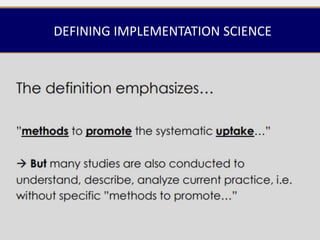
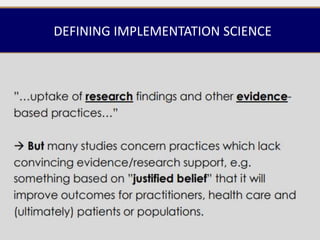
• Implementation SCIENCE: “The scientific study of methods to
promote the systematic uptake of research findings and other
evidence-based practices into routine practice, and, hence, to
improve the quality and effectiveness of health services and care.”
(Eccles and Mittman, Implementation Science, 2006)
– Science of how BEST to implement, create generalizable knowledge
– “QI” = more local solutions
DEFINING IMPLEMENTATION SCIENCE
CLINICAL RESERARCH VS. IMPLEMENTATION
RESEARCH
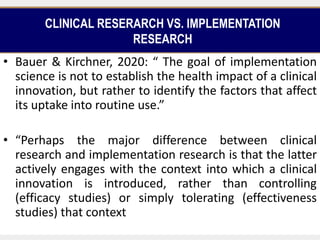
• Bauer & Kirchner, 2020: “ The goal of implementation
science is not to establish the health impact of a clinical
innovation, but rather to identify the factors that affect
its uptake into routine use.”
• “Perhaps the major difference between clinical
research and implementation research is that the latter
actively engages with the context into which a clinical
innovation is introduced, rather than controlling
(efficacy studies) or simply tolerating (effectiveness
studies) that context
CLINICAL RESERARCH VS. IMPLEMENTATION
RESEARCH
• ”This field incorporates a scope broader than
traditional clinical research, focusing not only at the
patient level but also at the provider, organization, and
policy levels of healthcare.”
• ”Accordingly, implementation research requires
transdisciplinary research teams that include members
who are not routinely part of most clinical trials such as
health services researchers; economists; sociologists;
anthropologists; organizational scientists; and
operational partners including administrators, front-line
clinicians, and patients.”
SO, WHY DO WE NEED IMPLEMENTATION
RESEARCH?
 Only ~50% of patients in the US receive recommended/EB care
 Wide variability across conditions and treatment:
 79% of patients receive recommended care for an age-related cataract
 11% of patients receive recommended care for alcohol use disorder
 20–25% patients get care that is not needed or potentially harmful
 So, we also need to DE-implement…
 1.3 million people are injured annually by medication errors
 Most chronic conditions have solid, evidence-based guidelines for
treatment, management, and prevention, but rates of conditions such
diabetes continue to rise
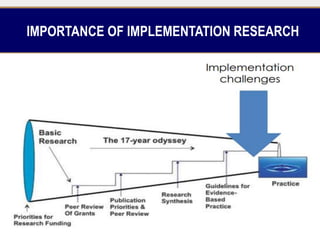
IMPORTANCE OF IMPLEMENTATION RESEARCH
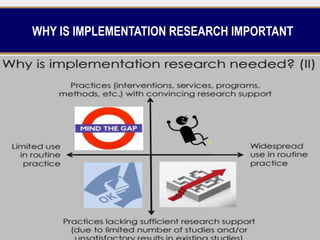
WHY IS IMPLEMENTATION RESEARCH IMPORTANT
MORE… WHY WE NEED THIS
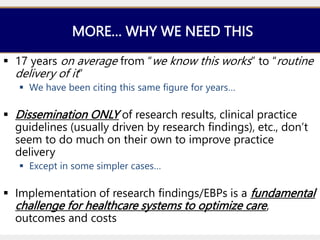
 17 years on average from “we know this works” to “routine
delivery of it”
 We have been citing this same figure for years…
 Dissemination ONLY of research results, clinical practice
guidelines (usually driven by research findings), etc., don’t
seem to do much on their own to improve practice
delivery
 Except in some simpler cases…
 Implementation of research findings/EBPs is a fundamental
challenge for healthcare systems to optimize care,
outcomes and costs
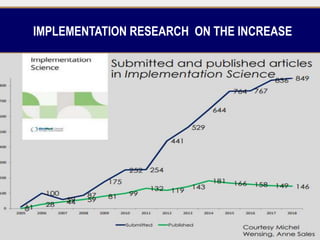
IMPLEMENTATION RESEARCH ON THE INCREASE
WHAT ARE THE OUTCOMES WE CARE ABOUT THEN?
 We are trying to measure changes in the delivery of care
 Did the place/people implement the intervention?
• Did they get started? Did they start and stop?
 Did everyone get it who should have gotten it?
• Was the intervention/practice delivered as much as it should have been?
• Were all indicated patients approached? Given intervention/practice?
 Did they do it right when the were delivering the intervention?
• Did they deliver the intervention as intended… with “fidelity”?
• How close did they get?
 Do we also look at the “effectiveness” of the intervention?
 Among those who got it, did they get better?
 Symptoms, functioning
• If the field does not have “enough” evidence on THE THING, then yes…
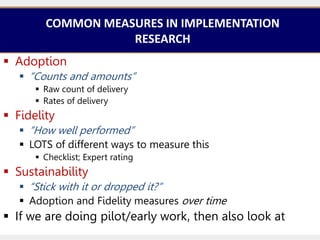
COMMON MEASURES IN IMPLEMENTATION
RESEARCH
 Adoption
 “Counts and amounts”
 Raw count of delivery
 Rates of delivery
 Fidelity
 “How well performed”
 LOTS of different ways to measure this
 Checklist; Expert rating
 Sustainability
 “Stick with it or dropped it?”
 Adoption and Fidelity measures over time
 If we are doing pilot/early work, then also look at
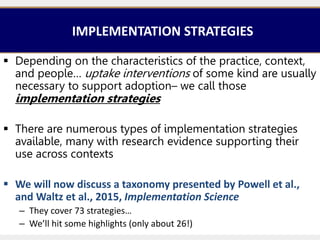
IMPLEMENTATION STRATEGIES
 Depending on the characteristics of the practice, context,
and people… uptake interventions of some kind are usually
necessary to support adoption– we call those
implementation strategies
 There are numerous types of implementation strategies
available, many with research evidence supporting their
use across contexts
 We will now discuss a taxonomy presented by Powell et al.,
and Waltz et al., 2015, Implementation Science
– They cover 73 strategies…
– We’ll hit some highlights (only about 26!)
TAXONOMY OF IMPLEMENTED STRATS
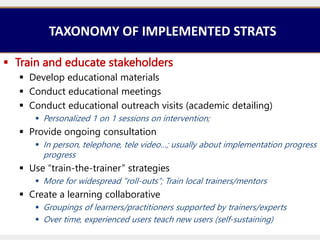
 Train and educate stakeholders
 Develop educational materials
 Conduct educational meetings
 Conduct educational outreach visits (academic detailing)
 Personalized 1 on 1 sessions on intervention;
 Provide ongoing consultation
 In person, telephone, tele video…; usually about implementation progress
progress
 Use “train-the-trainer” strategies
 More for widespread “roll-outs”; Train local trainers/mentors
 Create a learning collaborative
 Groupings of learners/practitioners supported by trainers/experts
 Over time, experienced users teach new users (self-sustaining)
TAXONOMY OF IMPLEMENTED STRATS
 Provide interactive assistance
 Provide clinical supervision
 Expert supervision focused on the intervention/practice being adopted
 Provide local technical assistance
 Needed usually for medical record, dispensing software tools…
 Provide facilitation
 Interactive problem-solving; recommend and supply additional strategies
 Support clinicians
 Remind clinicians
 Electronic reminders in EMR or dispensing software; or manual
 “This patient due for screening…”
 Revise professional roles
 E.g., expand role of pharmacists
 Create new clinical teams
TAXONOMY OF IMPLEMENTED STRATS
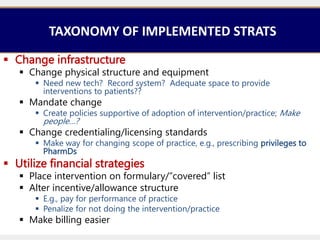
 Change infrastructure
 Change physical structure and equipment
 Need new tech? Record system? Adequate space to provide
interventions to patients??
 Mandate change
 Create policies supportive of adoption of intervention/practice; Make
people…?
 Change credentialing/licensing standards
 Make way for changing scope of practice, e.g., prescribing privileges to
PharmDs
 Utilize financial strategies
 Place intervention on formulary/”covered” list
 Alter incentive/allowance structure
 E.g., pay for performance of practice
 Penalize for not doing the intervention/practice
 Make billing easier
TAXONOMY OF IMPLEMENTED STRATS
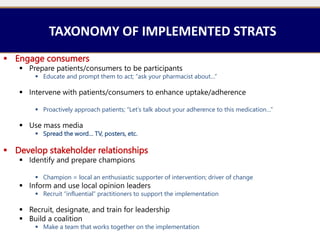
 Engage consumers
 Prepare patients/consumers to be participants
 Educate and prompt them to act; “ask your pharmacist about…”
 Intervene with patients/consumers to enhance uptake/adherence
 Proactively approach patients; “Let’s talk about your adherence to this medication…”
 Use mass media
 Spread the word… TV, posters, etc.
 Develop stakeholder relationships
 Identify and prepare champions
 Champion = local an enthusiastic supporter of intervention; driver of change
 Inform and use local opinion leaders
 Recruit “influential” practitioners to support the implementation
 Recruit, designate, and train for leadership
 Build a coalition
 Make a team that works together on the implementation
TAXONOMY OF IMPLEMENTED STRATS
 Adapt and tailor to context
 Promote adaptability of the intervention
 Adapt intervention to match local needs, but don’t sway from evidence-
based-ness
 Tailor implementation strategies
 Tailor implementation strategies for local needs too
 Use evaluative and iterative strategies
 Audit and feedback
 Measure and feedback performance of practitioners/sites
 Conduct local needs assessment
 Before you start; identify barriers/facilitators to change and target
strategies
 Conduct small cyclical tests of change
 Iterate your change process based on data (Plan/Do/Study/Act anyone?)
STRATEGIES: WHAT DO WE KNOW?
 Disseminating and Training… not so great on their own
 Many work “OK” (5-10% change in adoption)
 Reminders, Audit & Feedback, Academic detailing, Facilitation…
 No combo offers a guarantee of success
 Many studies support the use of multi-component strategies
 But some do not!
 Most multifaceted strategies involve 2 or more of these:
education/training, prompts of some kind, audit and feedback
 Highly regarded, only somewhat supported, is the idea that
strategies work better when matched to barriers/needs
identified through diagnostic analysis
STRATEGIES: WHAT DO WE KNOW?
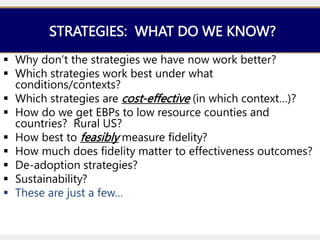
 Why don’t the strategies we have now work better?
 Which strategies work best under what
conditions/contexts?
 Which strategies are cost-effective (in which context…)?
 How do we get EBPs to low resource counties and
countries? Rural US?
 How best to feasibly measure fidelity?
 How much does fidelity matter to effectiveness outcomes?
 De-adoption strategies?
 Sustainability?
 These are just a few…
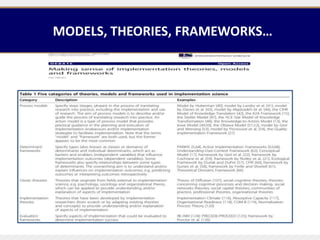
MODELS, THEORIES, FRAMEWORKS…
Yeah, I know…
MODELS, THEORIES, FRAMEWORKS…
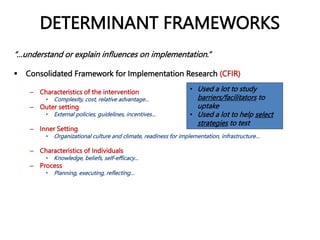
DETERMINANT FRAMEWORKS
“…understand or explain influences on implementation.”
 Consolidated Framework for Implementation Research (CFIR)
– Characteristics of the intervention
• Complexity, cost, relative advantage…
– Outer setting
• External policies, guidelines, incentives...
– Inner Setting
• Organizational culture and climate, readiness for implementation, infrastructure…
– Characteristics of Individuals
• Knowledge, beliefs, self-efficacy…
– Process
• Planning, executing, reflecting…
• Used a lot to study
barriers/facilitators to
uptake
• Used a lot to help select
strategies to test
OK, FEW MORE FRAMEWORKS, THAT’S IT
 Process models
– EPIS: Exploration, Preparation,
Implementation, Sustainment
• Why important: Helps think about what kinds of
strategies you’ll need for each “step”
 Evaluation frameworks
– RE-AIM: Reach, Effectiveness, Adoption,
Implementation, Maintenance
– Proctor framework: See above slides…
• Why important: Helps answer the question, “How
do I show this strategy worked or didn’t?”

Implementation_Research.pptx

  • 1.
    UNIVERSITY OF ZAMBIA SCHOOLOF MEDICINE DEPARTMENT OF MEDICAL EDUCATION IMPLEMENTATION RESEARCH @2023 ISAAC FWEMBA, PhD BSc(ZAM), MPH(UK), PhD(GH) LECTURER SCHOOL OF MEDICINE UNIVERSITY OF ZAMBIA IMPLEMENTATION RESEARCH
  • 2.
    Objective • What is“implementation”? • Defining implementation science • What determines implementation success? • Implementation science outcome and strategies
  • 3.
    Some Definitions • Dissemination:“targeted spread of information” (from the NIH program announcement for Dissemination & Implementation research) – Passive approach, focusing on knowledge transfer • Implementation: “An effort specifically designed to get best practice findings… into routine and sustained use via appropriate uptake interventions.” (Curran et al., 2012) – Active approach, focusing on stimulating behavior change • Implementation SCIENCE: “The scientific study of methods to promote the systematic uptake of research findings and other evidence-based practices into routine practice, and, hence, to improve the quality and effectiveness of health services and care.” (Eccles and Mittman, Implementation Science, 2006) – Science of how BEST to implement, create generalizable knowledge – “QI” = more local solutions
  • 4.
  • 5.
  • 6.
  • 7.
  • 8.
    CLINICAL RESERARCH VS.IMPLEMENTATION RESEARCH • Bauer & Kirchner, 2020: “ The goal of implementation science is not to establish the health impact of a clinical innovation, but rather to identify the factors that affect its uptake into routine use.” • “Perhaps the major difference between clinical research and implementation research is that the latter actively engages with the context into which a clinical innovation is introduced, rather than controlling (efficacy studies) or simply tolerating (effectiveness studies) that context
  • 9.
    CLINICAL RESERARCH VS.IMPLEMENTATION RESEARCH • ”This field incorporates a scope broader than traditional clinical research, focusing not only at the patient level but also at the provider, organization, and policy levels of healthcare.” • ”Accordingly, implementation research requires transdisciplinary research teams that include members who are not routinely part of most clinical trials such as health services researchers; economists; sociologists; anthropologists; organizational scientists; and operational partners including administrators, front-line clinicians, and patients.”
  • 10.
    SO, WHY DOWE NEED IMPLEMENTATION RESEARCH?  Only ~50% of patients in the US receive recommended/EB care  Wide variability across conditions and treatment:  79% of patients receive recommended care for an age-related cataract  11% of patients receive recommended care for alcohol use disorder  20–25% patients get care that is not needed or potentially harmful  So, we also need to DE-implement…  1.3 million people are injured annually by medication errors  Most chronic conditions have solid, evidence-based guidelines for treatment, management, and prevention, but rates of conditions such diabetes continue to rise
  • 11.
  • 12.
    WHY IS IMPLEMENTATIONRESEARCH IMPORTANT
  • 13.
    MORE… WHY WENEED THIS  17 years on average from “we know this works” to “routine delivery of it”  We have been citing this same figure for years…  Dissemination ONLY of research results, clinical practice guidelines (usually driven by research findings), etc., don’t seem to do much on their own to improve practice delivery  Except in some simpler cases…  Implementation of research findings/EBPs is a fundamental challenge for healthcare systems to optimize care, outcomes and costs
  • 14.
  • 15.
  • 16.
    WHAT ARE THEOUTCOMES WE CARE ABOUT THEN?  We are trying to measure changes in the delivery of care  Did the place/people implement the intervention? • Did they get started? Did they start and stop?  Did everyone get it who should have gotten it? • Was the intervention/practice delivered as much as it should have been? • Were all indicated patients approached? Given intervention/practice?  Did they do it right when the were delivering the intervention? • Did they deliver the intervention as intended… with “fidelity”? • How close did they get?  Do we also look at the “effectiveness” of the intervention?  Among those who got it, did they get better?  Symptoms, functioning • If the field does not have “enough” evidence on THE THING, then yes…
  • 17.
    COMMON MEASURES INIMPLEMENTATION RESEARCH  Adoption  “Counts and amounts”  Raw count of delivery  Rates of delivery  Fidelity  “How well performed”  LOTS of different ways to measure this  Checklist; Expert rating  Sustainability  “Stick with it or dropped it?”  Adoption and Fidelity measures over time  If we are doing pilot/early work, then also look at
  • 18.
    IMPLEMENTATION STRATEGIES  Dependingon the characteristics of the practice, context, and people… uptake interventions of some kind are usually necessary to support adoption– we call those implementation strategies  There are numerous types of implementation strategies available, many with research evidence supporting their use across contexts  We will now discuss a taxonomy presented by Powell et al., and Waltz et al., 2015, Implementation Science – They cover 73 strategies… – We’ll hit some highlights (only about 26!)
  • 19.
    TAXONOMY OF IMPLEMENTEDSTRATS  Train and educate stakeholders  Develop educational materials  Conduct educational meetings  Conduct educational outreach visits (academic detailing)  Personalized 1 on 1 sessions on intervention;  Provide ongoing consultation  In person, telephone, tele video…; usually about implementation progress progress  Use “train-the-trainer” strategies  More for widespread “roll-outs”; Train local trainers/mentors  Create a learning collaborative  Groupings of learners/practitioners supported by trainers/experts  Over time, experienced users teach new users (self-sustaining)
  • 20.
    TAXONOMY OF IMPLEMENTEDSTRATS  Provide interactive assistance  Provide clinical supervision  Expert supervision focused on the intervention/practice being adopted  Provide local technical assistance  Needed usually for medical record, dispensing software tools…  Provide facilitation  Interactive problem-solving; recommend and supply additional strategies  Support clinicians  Remind clinicians  Electronic reminders in EMR or dispensing software; or manual  “This patient due for screening…”  Revise professional roles  E.g., expand role of pharmacists  Create new clinical teams
  • 21.
    TAXONOMY OF IMPLEMENTEDSTRATS  Change infrastructure  Change physical structure and equipment  Need new tech? Record system? Adequate space to provide interventions to patients??  Mandate change  Create policies supportive of adoption of intervention/practice; Make people…?  Change credentialing/licensing standards  Make way for changing scope of practice, e.g., prescribing privileges to PharmDs  Utilize financial strategies  Place intervention on formulary/”covered” list  Alter incentive/allowance structure  E.g., pay for performance of practice  Penalize for not doing the intervention/practice  Make billing easier
  • 22.
    TAXONOMY OF IMPLEMENTEDSTRATS  Engage consumers  Prepare patients/consumers to be participants  Educate and prompt them to act; “ask your pharmacist about…”  Intervene with patients/consumers to enhance uptake/adherence  Proactively approach patients; “Let’s talk about your adherence to this medication…”  Use mass media  Spread the word… TV, posters, etc.  Develop stakeholder relationships  Identify and prepare champions  Champion = local an enthusiastic supporter of intervention; driver of change  Inform and use local opinion leaders  Recruit “influential” practitioners to support the implementation  Recruit, designate, and train for leadership  Build a coalition  Make a team that works together on the implementation
  • 23.
    TAXONOMY OF IMPLEMENTEDSTRATS  Adapt and tailor to context  Promote adaptability of the intervention  Adapt intervention to match local needs, but don’t sway from evidence- based-ness  Tailor implementation strategies  Tailor implementation strategies for local needs too  Use evaluative and iterative strategies  Audit and feedback  Measure and feedback performance of practitioners/sites  Conduct local needs assessment  Before you start; identify barriers/facilitators to change and target strategies  Conduct small cyclical tests of change  Iterate your change process based on data (Plan/Do/Study/Act anyone?)
  • 24.
    STRATEGIES: WHAT DOWE KNOW?  Disseminating and Training… not so great on their own  Many work “OK” (5-10% change in adoption)  Reminders, Audit & Feedback, Academic detailing, Facilitation…  No combo offers a guarantee of success  Many studies support the use of multi-component strategies  But some do not!  Most multifaceted strategies involve 2 or more of these: education/training, prompts of some kind, audit and feedback  Highly regarded, only somewhat supported, is the idea that strategies work better when matched to barriers/needs identified through diagnostic analysis
  • 25.
    STRATEGIES: WHAT DOWE KNOW?  Why don’t the strategies we have now work better?  Which strategies work best under what conditions/contexts?  Which strategies are cost-effective (in which context…)?  How do we get EBPs to low resource counties and countries? Rural US?  How best to feasibly measure fidelity?  How much does fidelity matter to effectiveness outcomes?  De-adoption strategies?  Sustainability?  These are just a few…
  • 26.
  • 27.
  • 28.
    DETERMINANT FRAMEWORKS “…understand orexplain influences on implementation.”  Consolidated Framework for Implementation Research (CFIR) – Characteristics of the intervention • Complexity, cost, relative advantage… – Outer setting • External policies, guidelines, incentives... – Inner Setting • Organizational culture and climate, readiness for implementation, infrastructure… – Characteristics of Individuals • Knowledge, beliefs, self-efficacy… – Process • Planning, executing, reflecting… • Used a lot to study barriers/facilitators to uptake • Used a lot to help select strategies to test
  • 29.
    OK, FEW MOREFRAMEWORKS, THAT’S IT  Process models – EPIS: Exploration, Preparation, Implementation, Sustainment • Why important: Helps think about what kinds of strategies you’ll need for each “step”  Evaluation frameworks – RE-AIM: Reach, Effectiveness, Adoption, Implementation, Maintenance – Proctor framework: See above slides… • Why important: Helps answer the question, “How do I show this strategy worked or didn’t?”