Presented by: Anvita Jadhav
M. Pharm (IP)
1
Contraception
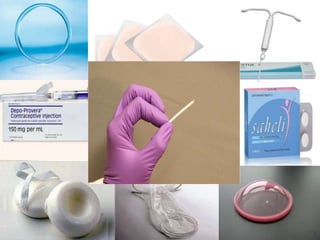
Contraception include various methods or devices used to
Prevent pregnancy
2
3
Contraceptive Subdermal Implants
 This is excellent method of contraception.
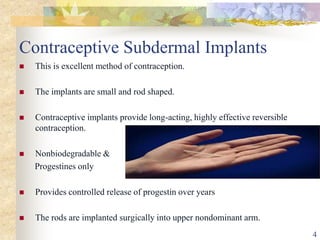
 The implants are small and rod shaped.
 Contraceptive implants provide long-acting, highly effective reversible
contraception.
 Nonbiodegradable &
Progestines only
 Provides controlled release of progestin over years
 The rods are implanted surgically into upper nondominant arm.
4
Types of Contraceptive Implants
• Norplant
• Jadelle
• Sino-implant
(II)
Levonorgestrel
• Implanon
• Nexplanon
Etonogestrel
5
Levonorgestrel (LNG)
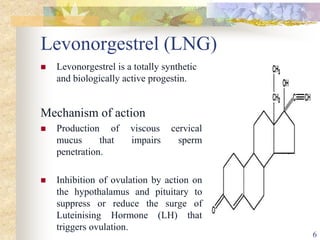
 Levonorgestrel is a totally synthetic
and biologically active progestin.
Mechanism of action
 Production of viscous cervical
mucus that impairs sperm
penetration.
 Inhibition of ovulation by action on
the hypothalamus and pituitary to
suppress or reduce the surge of
Luteinising Hormone (LH) that
triggers ovulation.
6
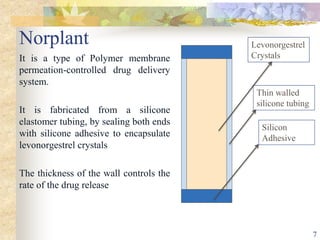
Norplant Levonorgestrel
Crystals
Thin walled
silicone tubing
Silicon
Adhesive
It is a type of Polymer membrane
permeation-controlled drug delivery
system.
It is fabricated from a silicone
elastomer tubing, by sealing both ends
with silicone adhesive to encapsulate
levonorgestrel crystals
The thickness of the wall controls the
rate of the drug release
7
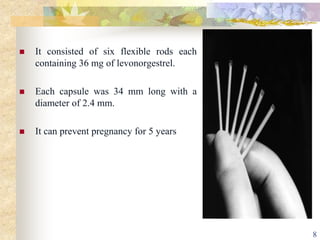
 It consisted of six flexible rods each
containing 36 mg of levonorgestrel.
 Each capsule was 34 mm long with a
diameter of 2.4 mm.
 It can prevent pregnancy for 5 years
8
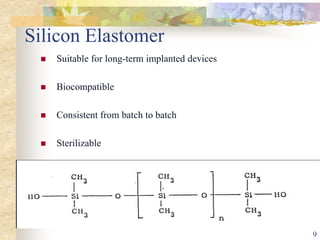
Silicon Elastomer
 Suitable for long-term implanted devices
 Biocompatible
 Consistent from batch to batch
 Sterilizable
9
10
Jadelle
 Jadelle is manufactured by Bayer HealthCare.
 This system consists of two implantable rods (2.5 mm in
diameater & 43 mm in length), each consisting of a drug-
releasing core encased in thin-walled silicone rubber
tubing sealed at both ends.
 The core of each rod consists of 50% by weight of
levonorgestrel (75mg) and 50% of elastomer.
 Prevention of pregnancy for the long-term (up to 5years)
reversible method of contraception. 11
Jadelle Kit
12
Needle
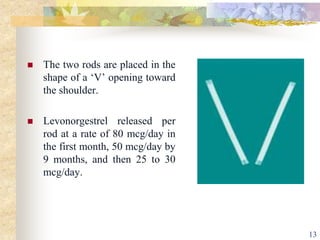
 The two rods are placed in the
shape of a ‘V’ opening toward
the shoulder.
 Levonorgestrel released per
rod at a rate of 80 mcg/day in
the first month, 50 mcg/day by
9 months, and then 25 to 30
mcg/day.
13
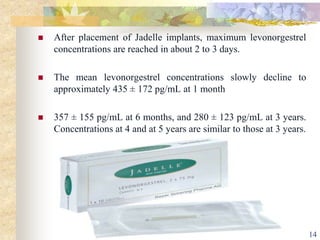
 After placement of Jadelle implants, maximum levonorgestrel
concentrations are reached in about 2 to 3 days.
 The mean levonorgestrel concentrations slowly decline to
approximately 435 ± 172 pg/mL at 1 month
 357 ± 155 pg/mL at 6 months, and 280 ± 123 pg/mL at 3 years.
Concentrations at 4 and at 5 years are similar to those at 3 years.
14
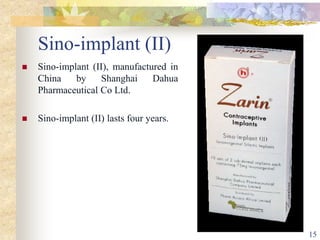
Sino-implant (II)
 Sino-implant (II), manufactured in
China by Shanghai Dahua
Pharmaceutical Co Ltd.
 Sino-implant (II) lasts four years.
15
Insertion
 The LNG implant should be inserted within 1 - 5 days of
menses.
 When switching from LNG-IUD implant can be inserted
after 7 days.
 Implants may be inserted within 5 days of a first trimester
abortion & second trimester abortion.
16
Etonogestrel (ENG)
 Etonogestrel is a synthetic
and biologically active
progestin.
 Mechanism of action:
(a) thickening cervical mucus
which prevents sperm
penetration
(b) preventing ovulation
17
Implanon
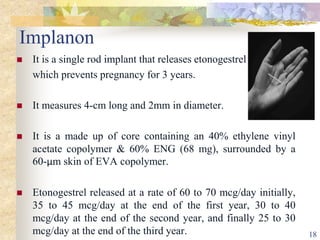
 It is a single rod implant that releases etonogestrel
which prevents pregnancy for 3 years.
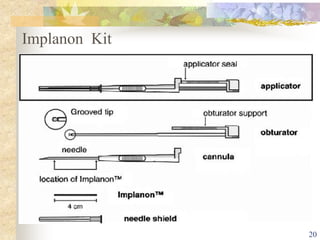
 It measures 4-cm long and 2mm in diameter.
 It is a made up of core containing an 40% ethylene vinyl
acetate copolymer & 60% ENG (68 mg), surrounded by a
60-μm skin of EVA copolymer.
 Etonogestrel released at a rate of 60 to 70 mcg/day initially,
35 to 45 mcg/day at the end of the first year, 30 to 40
mcg/day at the end of the second year, and finally 25 to 30
mcg/day at the end of the third year. 18
 Initially, serum levels of ENG rapidly rise to a mean serum
concentration of 265.9±80.9 pg/mL by 8 hours, a level that
exceeds the 90 pg/mL needed to prevent ovulation.
 Maximum serum concentrations are usually seen by day 4 after
implant insertion.
 ENG levels decrease slightly to a mean serum concentration of
196 pg/mL at 1 year of use and 156 pg/mL by 3 years.
 After removal, serum levels are undetectable (less than 20
pg/mL) by 1 week in the majority of users, with most women
demonstrating ovulation within 6 weeks of implant removal.
19
Implanon Kit
20
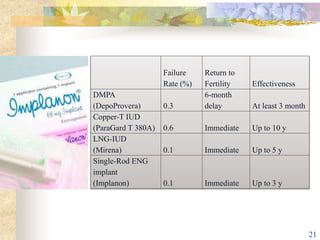
Failure
Rate (%)
Return to
Fertility Effectiveness
DMPA
(DepoProvera) 0.3
6-month
delay At least 3 month
Copper-T IUD
(ParaGard T 380A) 0.6 Immediate Up to 10 y
LNG-IUD
(Mirena) 0.1 Immediate Up to 5 y
Single-Rod ENG
implant
(Implanon) 0.1 Immediate Up to 3 y
21
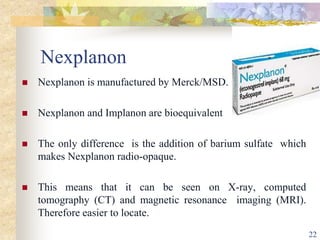
Nexplanon
 Nexplanon is manufactured by Merck/MSD.
 Nexplanon and Implanon are bioequivalent
 The only difference is the addition of barium sulfate which
makes Nexplanon radio-opaque.
 This means that it can be seen on X-ray, computed
tomography (CT) and magnetic resonance imaging (MRI).
Therefore easier to locate.
22
Insertion
 For women without preceding hormone use, the ENG
implant should be inserted within 5 days from the start of
menses.
 When switching from a oral contraceptive pills, insertion
should occur within 7 days of the last active pill.
 Implants may be inserted within 5 days of a first trimester
abortion, within 6 weeks of a second trimester abortion, or
within 6 weeks of childbirth.
23
Difference between LNG & ENG
ENG is more
potent than
LNG
1. Serum ENG
levels shows
less individual
variation over
time as
compared with
LNG levels
2.
24
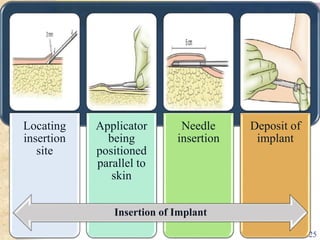
Locating
insertion
site
Applicator
being
positioned
parallel to
skin
Needle
insertion
Deposit of
implant
Insertion of Implant
25
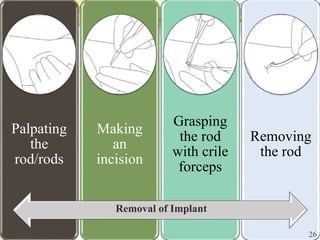
Palpating
the
rod/rods
Making
an
incision
Grasping
the rod
with crile
forceps
Removing
the rod
Removal of Implant
26
 It was developed in Brazil, its active ingredient is nestorone.
 Discontinued due to endometriosis
 It contains 55 mg of nomegestrol acetate that offers
contraceptive efficacy for 1 year.
 It is currently under clinical trials.
Elcometrine
Uniplant
27
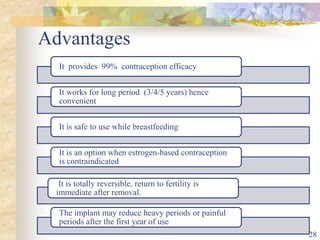
Advantages
It provides 99% contraception efficacy
It works for long period (3/4/5 years) hence
convenient
It is safe to use while breastfeeding
It is an option when estrogen-based contraception
is contraindicated
It is totally reversible, return to fertility is
immediate after removal.
The implant may reduce heavy periods or painful
periods after the first year of use
28
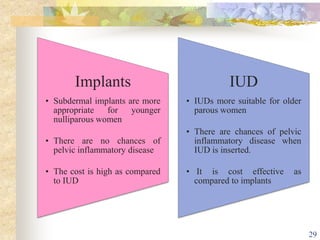
Implants
• Subdermal implants are more
appropriate for younger
nulliparous women
• There are no chances of
pelvic inflammatory disease
• The cost is high as compared
to IUD
IUD
• IUDs more suitable for older
parous women
• There are chances of pelvic
inflammatory disease when
IUD is inserted.
• It is cost effective as
compared to implants
29
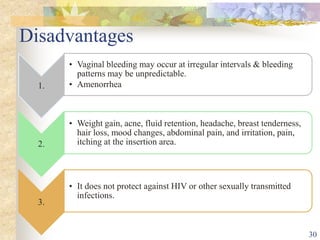
Disadvantages
1.
• Vaginal bleeding may occur at irregular intervals & bleeding
patterns may be unpredictable.
• Amenorrhea
2.
• Weight gain, acne, fluid retention, headache, breast tenderness,
hair loss, mood changes, abdominal pain, and irritation, pain,
itching at the insertion area.
3.
• It does not protect against HIV or other sexually transmitted
infections.
30
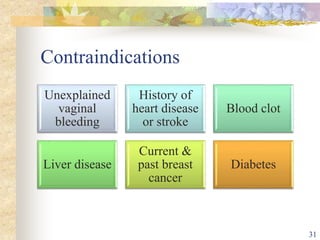
Contraindications
Unexplained
vaginal
bleeding
History of
heart disease
or stroke
Blood clot
Liver disease
Current &
past breast
cancer
Diabetes
31
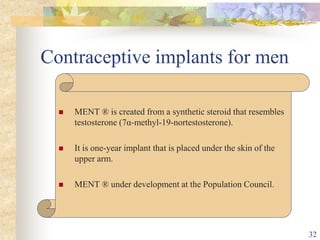
Contraceptive implants for men
 MENT ® is created from a synthetic steroid that resembles
testosterone (7α-methyl-19-nortestosterone).
 It is one-year implant that is placed under the skin of the
upper arm.
 MENT ® under development at the Population Council.
32
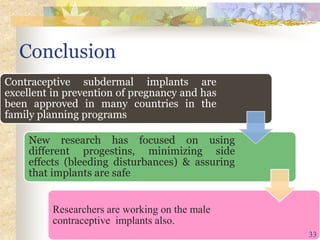
Conclusion
Contraceptive subdermal implants are
excellent in prevention of pregnancy and has
been approved in many countries in the
family planning programs
New research has focused on using
different progestins, minimizing side
effects (bleeding disturbances) & assuring
that implants are safe
Researchers are working on the male
contraceptive implants also.
33
References
 Contraceptive Methods in Focus: IUDs, Implants, and Oral Contraceptives, Outlook,
Path, Vol. 21, No. 1, Pg. No. 1 – 8, 2004.
 Frost and Reich, Chapter 6 Norplant: Access to Contraceptives, Pg. No. 115 – 140,
2009.
 Ione Cristina Barbosa, Hugo Maia Jr., Elsimar Coutinho, Renata Lopes, Antonio C.V.
Lopes, Cristina Noronha and Adelmo Botto, Effects of a single Silastic contraceptive
implant containing nomegestrol acetate (Uniplant) on endometrial morphology and
ovarian function for 1 year, Contraception, Pg. No.492 – 497, 2006.
 Irving Sivin, Harold Nash and Sandra Waldman, Jadelle Levonorgestrel Rod Implants:
A Summary of Scientific Data and Lessons Learned from Programmatic Experience,
The Population Council, Pg. No. 1 – 58, 2002.
 Heather Hohmann and Mitchell D. Creinin, The Contraceptive Implant, Clinical
Obstetrics and Gynecology, Vol. 50, No. 4, Pg. No. 907–917, 2007.
 Population Reports: New Contraceptive Choices, The Info Project, Series M, No.19,
Pg. No. 1 – 25, 2005.
 Power J, French R and Cowan F, Subdermal implantable contraceptives versus other
forms of reversible contraceptives or other implants as effective methods for
preventing pregnancy (Review), The Cochrane Library, Issue 4, Pg. No. 1 – 38, 2008.
34
References
 Robin M. Zavod, Chapter 41 Women’s Health, Foye’s Principles of Medicinal
Chemistry, Ed. 7th , Pg. No. 1386 – 1410, 2013.
 Rebecca L. Callahan, Douglas Taylor, David W. Jenkins, Derek H. Owen, Linan
Cheng, Aida M. Cancel, Laneta J. Dorflinger and Markus J. Steiner, In vivo release of
levonorgestrel from Sino-implant (II) — an innovative comparison of explant data,
Contraception, Pg. No. 1 – 6, 2015.
 Thuong-Thuong Nguyen and Paul D. Blumenthal, Contraceptive Procedures:
Subdermal Contraceptive Implants, A Practical Guide to Office Gynecologic
Procedures, Pg. No. 145 – 154, 2013.
 Woraprapa Laphikanont and Surasak Taneepanichskul, Effects of Jadelle Used in Thai
Women Aged between 20 and 45 Years in King Chulalongkorn Memorial Hospital, J
Med Assoc Thai, Vol. 89 No. 6, Pg. No. 761 – 766, 2006.
 Yie W. Chien and Senshang Lin, Drug Delivery: Controlled Release, Encyclopedia of
Pharmaceutical Technology, Pg. No. 1082 – 1086, 2007.
 http://www.popcouncil.org/research/ment-subdermal-implants-for-men
 http://adisinsight.springer.com/drugs/800008022
 http://www.medicinenet.com/script/main/art.asp?articlekey=53351
35
36

Implants

  • 1.
    Presented by: AnvitaJadhav M. Pharm (IP) 1
  • 2.
    Contraception Contraception include variousmethods or devices used to Prevent pregnancy 2
  • 3.
  • 4.
    Contraceptive Subdermal Implants This is excellent method of contraception.  The implants are small and rod shaped.  Contraceptive implants provide long-acting, highly effective reversible contraception.  Nonbiodegradable & Progestines only  Provides controlled release of progestin over years  The rods are implanted surgically into upper nondominant arm. 4
  • 5.
    Types of ContraceptiveImplants • Norplant • Jadelle • Sino-implant (II) Levonorgestrel • Implanon • Nexplanon Etonogestrel 5
  • 6.
    Levonorgestrel (LNG)  Levonorgestrelis a totally synthetic and biologically active progestin. Mechanism of action  Production of viscous cervical mucus that impairs sperm penetration.  Inhibition of ovulation by action on the hypothalamus and pituitary to suppress or reduce the surge of Luteinising Hormone (LH) that triggers ovulation. 6
  • 7.
    Norplant Levonorgestrel Crystals Thin walled siliconetubing Silicon Adhesive It is a type of Polymer membrane permeation-controlled drug delivery system. It is fabricated from a silicone elastomer tubing, by sealing both ends with silicone adhesive to encapsulate levonorgestrel crystals The thickness of the wall controls the rate of the drug release 7
  • 8.
     It consistedof six flexible rods each containing 36 mg of levonorgestrel.  Each capsule was 34 mm long with a diameter of 2.4 mm.  It can prevent pregnancy for 5 years 8
  • 9.
    Silicon Elastomer  Suitablefor long-term implanted devices  Biocompatible  Consistent from batch to batch  Sterilizable 9
  • 10.
  • 11.
    Jadelle  Jadelle ismanufactured by Bayer HealthCare.  This system consists of two implantable rods (2.5 mm in diameater & 43 mm in length), each consisting of a drug- releasing core encased in thin-walled silicone rubber tubing sealed at both ends.  The core of each rod consists of 50% by weight of levonorgestrel (75mg) and 50% of elastomer.  Prevention of pregnancy for the long-term (up to 5years) reversible method of contraception. 11
  • 12.
  • 13.
     The tworods are placed in the shape of a ‘V’ opening toward the shoulder.  Levonorgestrel released per rod at a rate of 80 mcg/day in the first month, 50 mcg/day by 9 months, and then 25 to 30 mcg/day. 13
  • 14.
     After placementof Jadelle implants, maximum levonorgestrel concentrations are reached in about 2 to 3 days.  The mean levonorgestrel concentrations slowly decline to approximately 435 ± 172 pg/mL at 1 month  357 ± 155 pg/mL at 6 months, and 280 ± 123 pg/mL at 3 years. Concentrations at 4 and at 5 years are similar to those at 3 years. 14
  • 15.
    Sino-implant (II)  Sino-implant(II), manufactured in China by Shanghai Dahua Pharmaceutical Co Ltd.  Sino-implant (II) lasts four years. 15
  • 16.
    Insertion  The LNGimplant should be inserted within 1 - 5 days of menses.  When switching from LNG-IUD implant can be inserted after 7 days.  Implants may be inserted within 5 days of a first trimester abortion & second trimester abortion. 16
  • 17.
    Etonogestrel (ENG)  Etonogestrelis a synthetic and biologically active progestin.  Mechanism of action: (a) thickening cervical mucus which prevents sperm penetration (b) preventing ovulation 17
  • 18.
    Implanon  It isa single rod implant that releases etonogestrel which prevents pregnancy for 3 years.  It measures 4-cm long and 2mm in diameter.  It is a made up of core containing an 40% ethylene vinyl acetate copolymer & 60% ENG (68 mg), surrounded by a 60-μm skin of EVA copolymer.  Etonogestrel released at a rate of 60 to 70 mcg/day initially, 35 to 45 mcg/day at the end of the first year, 30 to 40 mcg/day at the end of the second year, and finally 25 to 30 mcg/day at the end of the third year. 18
  • 19.
     Initially, serumlevels of ENG rapidly rise to a mean serum concentration of 265.9±80.9 pg/mL by 8 hours, a level that exceeds the 90 pg/mL needed to prevent ovulation.  Maximum serum concentrations are usually seen by day 4 after implant insertion.  ENG levels decrease slightly to a mean serum concentration of 196 pg/mL at 1 year of use and 156 pg/mL by 3 years.  After removal, serum levels are undetectable (less than 20 pg/mL) by 1 week in the majority of users, with most women demonstrating ovulation within 6 weeks of implant removal. 19
  • 20.
  • 21.
    Failure Rate (%) Return to FertilityEffectiveness DMPA (DepoProvera) 0.3 6-month delay At least 3 month Copper-T IUD (ParaGard T 380A) 0.6 Immediate Up to 10 y LNG-IUD (Mirena) 0.1 Immediate Up to 5 y Single-Rod ENG implant (Implanon) 0.1 Immediate Up to 3 y 21
  • 22.
    Nexplanon  Nexplanon ismanufactured by Merck/MSD.  Nexplanon and Implanon are bioequivalent  The only difference is the addition of barium sulfate which makes Nexplanon radio-opaque.  This means that it can be seen on X-ray, computed tomography (CT) and magnetic resonance imaging (MRI). Therefore easier to locate. 22
  • 23.
    Insertion  For womenwithout preceding hormone use, the ENG implant should be inserted within 5 days from the start of menses.  When switching from a oral contraceptive pills, insertion should occur within 7 days of the last active pill.  Implants may be inserted within 5 days of a first trimester abortion, within 6 weeks of a second trimester abortion, or within 6 weeks of childbirth. 23
  • 24.
    Difference between LNG& ENG ENG is more potent than LNG 1. Serum ENG levels shows less individual variation over time as compared with LNG levels 2. 24
  • 25.
  • 26.
  • 27.
     It wasdeveloped in Brazil, its active ingredient is nestorone.  Discontinued due to endometriosis  It contains 55 mg of nomegestrol acetate that offers contraceptive efficacy for 1 year.  It is currently under clinical trials. Elcometrine Uniplant 27
  • 28.
    Advantages It provides 99%contraception efficacy It works for long period (3/4/5 years) hence convenient It is safe to use while breastfeeding It is an option when estrogen-based contraception is contraindicated It is totally reversible, return to fertility is immediate after removal. The implant may reduce heavy periods or painful periods after the first year of use 28
  • 29.
    Implants • Subdermal implantsare more appropriate for younger nulliparous women • There are no chances of pelvic inflammatory disease • The cost is high as compared to IUD IUD • IUDs more suitable for older parous women • There are chances of pelvic inflammatory disease when IUD is inserted. • It is cost effective as compared to implants 29
  • 30.
    Disadvantages 1. • Vaginal bleedingmay occur at irregular intervals & bleeding patterns may be unpredictable. • Amenorrhea 2. • Weight gain, acne, fluid retention, headache, breast tenderness, hair loss, mood changes, abdominal pain, and irritation, pain, itching at the insertion area. 3. • It does not protect against HIV or other sexually transmitted infections. 30
  • 31.
    Contraindications Unexplained vaginal bleeding History of heart disease orstroke Blood clot Liver disease Current & past breast cancer Diabetes 31
  • 32.
    Contraceptive implants formen  MENT ® is created from a synthetic steroid that resembles testosterone (7α-methyl-19-nortestosterone).  It is one-year implant that is placed under the skin of the upper arm.  MENT ® under development at the Population Council. 32
  • 33.
    Conclusion Contraceptive subdermal implantsare excellent in prevention of pregnancy and has been approved in many countries in the family planning programs New research has focused on using different progestins, minimizing side effects (bleeding disturbances) & assuring that implants are safe Researchers are working on the male contraceptive implants also. 33
  • 34.
    References  Contraceptive Methodsin Focus: IUDs, Implants, and Oral Contraceptives, Outlook, Path, Vol. 21, No. 1, Pg. No. 1 – 8, 2004.  Frost and Reich, Chapter 6 Norplant: Access to Contraceptives, Pg. No. 115 – 140, 2009.  Ione Cristina Barbosa, Hugo Maia Jr., Elsimar Coutinho, Renata Lopes, Antonio C.V. Lopes, Cristina Noronha and Adelmo Botto, Effects of a single Silastic contraceptive implant containing nomegestrol acetate (Uniplant) on endometrial morphology and ovarian function for 1 year, Contraception, Pg. No.492 – 497, 2006.  Irving Sivin, Harold Nash and Sandra Waldman, Jadelle Levonorgestrel Rod Implants: A Summary of Scientific Data and Lessons Learned from Programmatic Experience, The Population Council, Pg. No. 1 – 58, 2002.  Heather Hohmann and Mitchell D. Creinin, The Contraceptive Implant, Clinical Obstetrics and Gynecology, Vol. 50, No. 4, Pg. No. 907–917, 2007.  Population Reports: New Contraceptive Choices, The Info Project, Series M, No.19, Pg. No. 1 – 25, 2005.  Power J, French R and Cowan F, Subdermal implantable contraceptives versus other forms of reversible contraceptives or other implants as effective methods for preventing pregnancy (Review), The Cochrane Library, Issue 4, Pg. No. 1 – 38, 2008. 34
  • 35.
    References  Robin M.Zavod, Chapter 41 Women’s Health, Foye’s Principles of Medicinal Chemistry, Ed. 7th , Pg. No. 1386 – 1410, 2013.  Rebecca L. Callahan, Douglas Taylor, David W. Jenkins, Derek H. Owen, Linan Cheng, Aida M. Cancel, Laneta J. Dorflinger and Markus J. Steiner, In vivo release of levonorgestrel from Sino-implant (II) — an innovative comparison of explant data, Contraception, Pg. No. 1 – 6, 2015.  Thuong-Thuong Nguyen and Paul D. Blumenthal, Contraceptive Procedures: Subdermal Contraceptive Implants, A Practical Guide to Office Gynecologic Procedures, Pg. No. 145 – 154, 2013.  Woraprapa Laphikanont and Surasak Taneepanichskul, Effects of Jadelle Used in Thai Women Aged between 20 and 45 Years in King Chulalongkorn Memorial Hospital, J Med Assoc Thai, Vol. 89 No. 6, Pg. No. 761 – 766, 2006.  Yie W. Chien and Senshang Lin, Drug Delivery: Controlled Release, Encyclopedia of Pharmaceutical Technology, Pg. No. 1082 – 1086, 2007.  http://www.popcouncil.org/research/ment-subdermal-implants-for-men  http://adisinsight.springer.com/drugs/800008022  http://www.medicinenet.com/script/main/art.asp?articlekey=53351 35
  • 36.