Menstrual Disorders in AdolescentsMenstrual Disorders in Adolescents
Dr Nupur GuptaDr Nupur Gupta
Consultant GynecologistConsultant Gynecologist
Department of Obstetrics & GynecologyDepartment of Obstetrics & Gynecology
Paras Hospital, GurgaonParas Hospital, Gurgaon
IntroductionIntroduction
Menstrual disorders - most frequent
gynecologic complaints
Affects the quality of life of adolescents
and young adult women
DiscussionDiscussion
• Normal menstrual cycle
• Abnormal uterine bleeding
• Amenorrhea
• Dysmenorrhea
Normal Menstrual CycleNormal Menstrual Cycle
There is release of a single mature
oocyte from a pool of hundreds of
thousands of oocytes
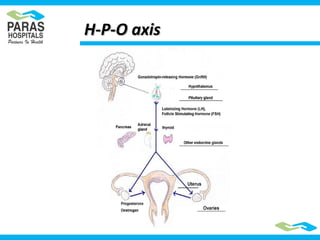
H-P-O axisH-P-O axis
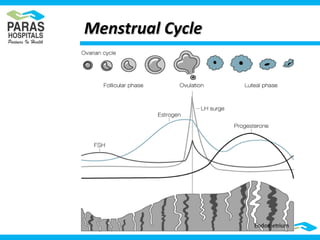
Menstrual CycleMenstrual Cycle
Duration and flowDuration and flow
• The average adult menstrual cycle is 28 days,
(24 to 35 days), and lasts 4-6 days
• The median blood loss during each menstrual
period is 30 mL; the upper limit of normal is
80 mL
Abnormal Uterine BleedingAbnormal Uterine Bleeding
Duration > 8days
Flow > 80 mL/cycle or subjective impression of
heavier-than-normal flow (ie, more than six full
pads or tampons per day)
Cycle length < 24 days or > 38 days
Intermenstrual bleeding or postcoital spotting
Absence of menses
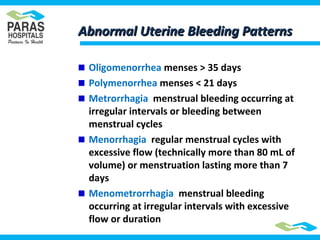
Oligomenorrhea menses > 35 days
Polymenorrhea menses < 21 days
Metrorrhagia menstrual bleeding occurring at
irregular intervals or bleeding between
menstrual cycles
Menorrhagia regular menstrual cycles with
excessive flow (technically more than 80 mL of
volume) or menstruation lasting more than 7
days
Menometrorrhagia menstrual bleeding
occurring at irregular intervals with excessive
flow or duration
Abnormal Uterine Bleeding PatternsAbnormal Uterine Bleeding Patterns
Prevalence and ImpactPrevalence and Impact
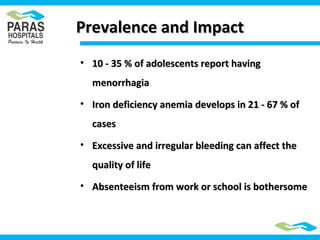
• 10 - 35 % of adolescents report having10 - 35 % of adolescents report having
menorrhagiamenorrhagia
• Iron deficiency anemia develops in 21 - 67 % ofIron deficiency anemia develops in 21 - 67 % of
casescases
• Excessive and irregular bleeding can affect theExcessive and irregular bleeding can affect the
quality of lifequality of life
• Absenteeism from work or school is bothersomeAbsenteeism from work or school is bothersome
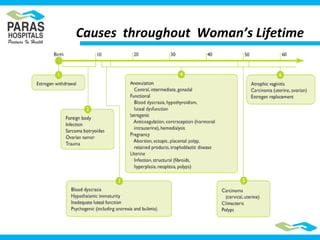
Causes throughout Woman’s Lifetime
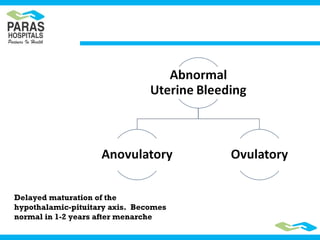
Delayed maturation of the
hypothalamic-pituitary axis. Becomes

normal in 1-2 years after menarche
PathophysiologyPathophysiology
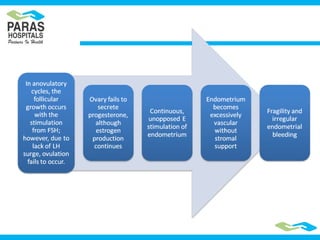
 Estrogen breakthrough bleeding
Anovulatory cycles have no corpus luteal formation.
Progesterone is not produced. The endometrium continues
to proliferate under the influence of unopposed estrogen.
 Estrogen withdrawal bleeding
This frequently occurs in women approaching the end of
reproductive life. Ovarian follicles in these women secrete
less estradiol. Fluctuating estradiol levels might lead to
insufficient endometrial proliferation with irregular
menstrual shedding.
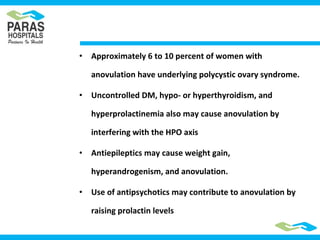
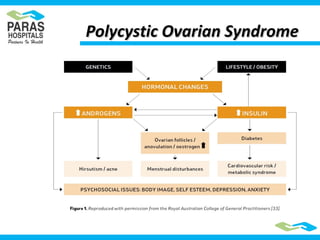
• Approximately 6 to 10 percent of women with
anovulation have underlying polycystic ovary syndrome.
• Uncontrolled DM, hypo- or hyperthyroidism, and
hyperprolactinemia also may cause anovulation by
interfering with the HPO axis
• Antiepileptics may cause weight gain,
hyperandrogenism, and anovulation.
• Use of antipsychotics may contribute to anovulation by
raising prolactin levels
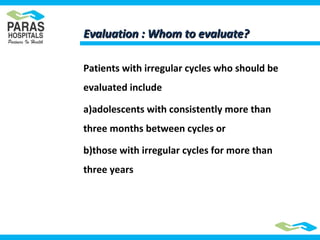
Evaluation : Whom to evaluate?Evaluation : Whom to evaluate?
Patients with irregular cycles who should be
evaluated include
a)adolescents with consistently more than
three months between cycles or
b)those with irregular cycles for more than
three years
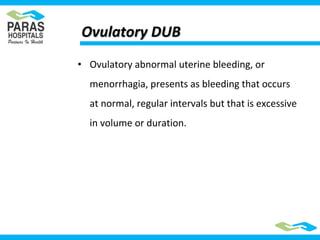
• Ovulatory abnormal uterine bleeding, or
menorrhagia, presents as bleeding that occurs
at normal, regular intervals but that is excessive
in volume or duration.
Ovulatory DUBOvulatory DUB
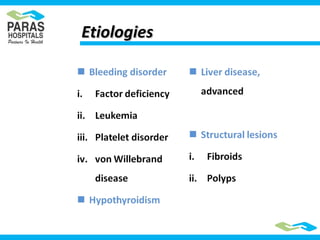
EtiologiesEtiologies
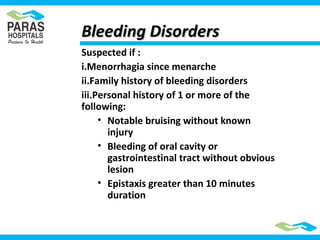
Suspected if :
i.Menorrhagia since menarche
ii.Family history of bleeding disorders
iii.Personal history of 1 or more of the
following:
• Notable bruising without known
injury
• Bleeding of oral cavity or
gastrointestinal tract without obvious
lesion
• Epistaxis greater than 10 minutes
duration
Bleeding DisordersBleeding Disorders
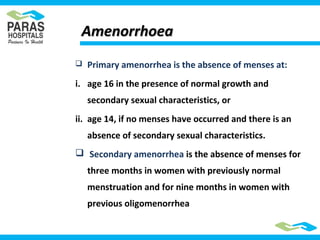
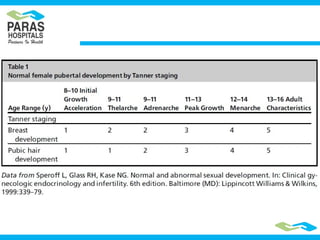
AmenorrhoeaAmenorrhoea
 Primary amenorrhea is the absence of menses at:
i. age 16 in the presence of normal growth and
secondary sexual characteristics, or
ii. age 14, if no menses have occurred and there is an
absence of secondary sexual characteristics.
 Secondary amenorrhea is the absence of menses for
three months in women with previously normal
menstruation and for nine months in women with
previous oligomenorrhea
Polycystic Ovarian SyndromePolycystic Ovarian Syndrome
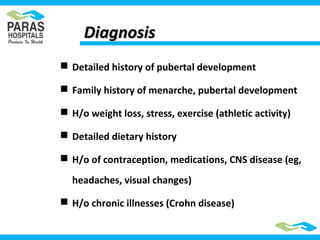
DiagnosisDiagnosis
 Detailed history of pubertal development
 Family history of menarche, pubertal development
 H/o weight loss, stress, exercise (athletic activity)
 Detailed dietary history
 H/o of contraception, medications, CNS disease (eg,
headaches, visual changes)
 H/o chronic illnesses (Crohn disease)
Height, weight, and growth charts
Breast development, pubic hair
Syndromic appearance (eg, short stature,
webbed neck)
Visual fields, thorough neurologic examination,
optic fundi
Evidence of hyperandrogenism (eg, acne,
hirsutism, clitoromegaly)
Evidence of thyroid disease
Evidence of chronic illnesses
Evidence of pregnancy
Physical ExaminationPhysical Examination
Evaluation
Primary amenorrhea is evaluated most
efficiently by focusing on the
a)presence or absence of breast development
b)the presence or absence of the uterus
c)FSH level
Secondary Amenorrhea
Pregnancy
Thyroid
Prolactin
Prolactin ≤ 100 ng per mL
 Altered metabolism
Liver/kidney failure
 Ectopic production
Bronchogenic (e.g.
carcinoma)
Breastfeeding
Prolactin > 100 ng per mL
Empty sella syndrome
Pituitary adenoma
DysmenorrhoeaDysmenorrhoea
Painful menstruation. It is one of the
most common gynecologic complaints
in young women who present to
clinicians
Primary (spasmodic) & Secondary
(congestive)
Primary dysmenorrheaPrimary dysmenorrhea
• Primary dysmenorrhea is defined as menstrual pain that
is not associated with pelvic pathology
• It typically occurs in the first few years after menarche
and affects as many as 50% of postpubertal females
• In an epidemiologic study of an adolescent population
(age range, 12-17 years), reported that dysmenorrhea had
a prevalence of 59.7%
Risk factors
• Early age at menarche (< 12 years)
• Nulliparity
• Heavy or prolonged menstrual flow
• Smoking
• Positive family history
• Obesity
Pathophysiology
• Prostaglandin F2α, a potent myometrial
stimulant and vasoconstrictor, in the
secretory endometrium
TreatmentTreatment
• Treatment is directed at providing relief
from the cramping pelvic pain and
associated symptoms
• Nonsteroidal anti-inflammatory drugs
(NSAIDs) are the best-established initial
therapy for dysmenorrhea. They decrease
menstrual pain by lowering prostaglandin
F2α (PGF2α) levels in menstrual fluid
• Oral Contraceptives also relieve
symptoms, particularly if contraception is
required
Secondary dysmenorrhea
• Less common than primary dysmenorrhea
• It is associated with pelvic pathology
• It tends to occur several years after the
menarche
• The woman may complain of a change in
the timing and intensity of her pain
• The pain may last throughout
menstruation
• The pain may be associated with
discomfort before the onset of
menstruation.
Management
• Treatment of secondary dysmenorrhea
involves correction of the underlying organic
cause
• Specific measures (medical or surgical) may be
required to treat pelvic pathologic conditions
(eg, endometriosis) and to ameliorate the
associated dysmenorrhea
Menstrual disorders in adolescents

Menstrual disorders in adolescents

  • 1.
    Menstrual Disorders inAdolescentsMenstrual Disorders in Adolescents Dr Nupur GuptaDr Nupur Gupta Consultant GynecologistConsultant Gynecologist Department of Obstetrics & GynecologyDepartment of Obstetrics & Gynecology Paras Hospital, GurgaonParas Hospital, Gurgaon
  • 2.
    IntroductionIntroduction Menstrual disorders -most frequent gynecologic complaints Affects the quality of life of adolescents and young adult women
  • 3.
    DiscussionDiscussion • Normal menstrualcycle • Abnormal uterine bleeding • Amenorrhea • Dysmenorrhea
  • 4.
    Normal Menstrual CycleNormalMenstrual Cycle There is release of a single mature oocyte from a pool of hundreds of thousands of oocytes
  • 5.
  • 6.
  • 7.
    Duration and flowDurationand flow • The average adult menstrual cycle is 28 days, (24 to 35 days), and lasts 4-6 days • The median blood loss during each menstrual period is 30 mL; the upper limit of normal is 80 mL
  • 8.
    Abnormal Uterine BleedingAbnormalUterine Bleeding Duration > 8days Flow > 80 mL/cycle or subjective impression of heavier-than-normal flow (ie, more than six full pads or tampons per day) Cycle length < 24 days or > 38 days Intermenstrual bleeding or postcoital spotting Absence of menses
  • 9.
    Oligomenorrhea menses >35 days Polymenorrhea menses < 21 days Metrorrhagia menstrual bleeding occurring at irregular intervals or bleeding between menstrual cycles Menorrhagia regular menstrual cycles with excessive flow (technically more than 80 mL of volume) or menstruation lasting more than 7 days Menometrorrhagia menstrual bleeding occurring at irregular intervals with excessive flow or duration Abnormal Uterine Bleeding PatternsAbnormal Uterine Bleeding Patterns
  • 10.
    Prevalence and ImpactPrevalenceand Impact • 10 - 35 % of adolescents report having10 - 35 % of adolescents report having menorrhagiamenorrhagia • Iron deficiency anemia develops in 21 - 67 % ofIron deficiency anemia develops in 21 - 67 % of casescases • Excessive and irregular bleeding can affect theExcessive and irregular bleeding can affect the quality of lifequality of life • Absenteeism from work or school is bothersomeAbsenteeism from work or school is bothersome
  • 11.
  • 12.
    Delayed maturation ofthe hypothalamic-pituitary axis. Becomes normal in 1-2 years after menarche
  • 13.
    PathophysiologyPathophysiology  Estrogen breakthroughbleeding Anovulatory cycles have no corpus luteal formation. Progesterone is not produced. The endometrium continues to proliferate under the influence of unopposed estrogen.  Estrogen withdrawal bleeding This frequently occurs in women approaching the end of reproductive life. Ovarian follicles in these women secrete less estradiol. Fluctuating estradiol levels might lead to insufficient endometrial proliferation with irregular menstrual shedding.
  • 15.
    • Approximately 6to 10 percent of women with anovulation have underlying polycystic ovary syndrome. • Uncontrolled DM, hypo- or hyperthyroidism, and hyperprolactinemia also may cause anovulation by interfering with the HPO axis • Antiepileptics may cause weight gain, hyperandrogenism, and anovulation. • Use of antipsychotics may contribute to anovulation by raising prolactin levels
  • 16.
    Evaluation : Whomto evaluate?Evaluation : Whom to evaluate? Patients with irregular cycles who should be evaluated include a)adolescents with consistently more than three months between cycles or b)those with irregular cycles for more than three years
  • 18.
    • Ovulatory abnormaluterine bleeding, or menorrhagia, presents as bleeding that occurs at normal, regular intervals but that is excessive in volume or duration. Ovulatory DUBOvulatory DUB
  • 19.
  • 20.
    Suspected if : i.Menorrhagiasince menarche ii.Family history of bleeding disorders iii.Personal history of 1 or more of the following: • Notable bruising without known injury • Bleeding of oral cavity or gastrointestinal tract without obvious lesion • Epistaxis greater than 10 minutes duration Bleeding DisordersBleeding Disorders
  • 21.
    AmenorrhoeaAmenorrhoea  Primary amenorrheais the absence of menses at: i. age 16 in the presence of normal growth and secondary sexual characteristics, or ii. age 14, if no menses have occurred and there is an absence of secondary sexual characteristics.  Secondary amenorrhea is the absence of menses for three months in women with previously normal menstruation and for nine months in women with previous oligomenorrhea
  • 23.
  • 24.
    DiagnosisDiagnosis  Detailed historyof pubertal development  Family history of menarche, pubertal development  H/o weight loss, stress, exercise (athletic activity)  Detailed dietary history  H/o of contraception, medications, CNS disease (eg, headaches, visual changes)  H/o chronic illnesses (Crohn disease)
  • 25.
    Height, weight, andgrowth charts Breast development, pubic hair Syndromic appearance (eg, short stature, webbed neck) Visual fields, thorough neurologic examination, optic fundi Evidence of hyperandrogenism (eg, acne, hirsutism, clitoromegaly) Evidence of thyroid disease Evidence of chronic illnesses Evidence of pregnancy Physical ExaminationPhysical Examination
  • 26.
    Evaluation Primary amenorrhea isevaluated most efficiently by focusing on the a)presence or absence of breast development b)the presence or absence of the uterus c)FSH level
  • 27.
  • 28.
    Prolactin ≤ 100ng per mL  Altered metabolism Liver/kidney failure  Ectopic production Bronchogenic (e.g. carcinoma) Breastfeeding Prolactin > 100 ng per mL Empty sella syndrome Pituitary adenoma
  • 29.
    DysmenorrhoeaDysmenorrhoea Painful menstruation. Itis one of the most common gynecologic complaints in young women who present to clinicians Primary (spasmodic) & Secondary (congestive)
  • 30.
    Primary dysmenorrheaPrimary dysmenorrhea •Primary dysmenorrhea is defined as menstrual pain that is not associated with pelvic pathology • It typically occurs in the first few years after menarche and affects as many as 50% of postpubertal females • In an epidemiologic study of an adolescent population (age range, 12-17 years), reported that dysmenorrhea had a prevalence of 59.7%
  • 31.
    Risk factors • Earlyage at menarche (< 12 years) • Nulliparity • Heavy or prolonged menstrual flow • Smoking • Positive family history • Obesity
  • 32.
    Pathophysiology • Prostaglandin F2α,a potent myometrial stimulant and vasoconstrictor, in the secretory endometrium
  • 33.
    TreatmentTreatment • Treatment isdirected at providing relief from the cramping pelvic pain and associated symptoms • Nonsteroidal anti-inflammatory drugs (NSAIDs) are the best-established initial therapy for dysmenorrhea. They decrease menstrual pain by lowering prostaglandin F2α (PGF2α) levels in menstrual fluid • Oral Contraceptives also relieve symptoms, particularly if contraception is required
  • 34.
    Secondary dysmenorrhea • Lesscommon than primary dysmenorrhea • It is associated with pelvic pathology • It tends to occur several years after the menarche • The woman may complain of a change in the timing and intensity of her pain • The pain may last throughout menstruation • The pain may be associated with discomfort before the onset of menstruation.
  • 35.
    Management • Treatment ofsecondary dysmenorrhea involves correction of the underlying organic cause • Specific measures (medical or surgical) may be required to treat pelvic pathologic conditions (eg, endometriosis) and to ameliorate the associated dysmenorrhea