IMPLANTABLES
(IMPLANT CONTRACEPTIVES)
By: Andualem Gezahegn
Lecturer, SLU
June, 2023
E-mail: andbicha@gmail.com
OBJECTIVES
By the end of the session students will be able to:
 Describe hormonal Implants
 Identify the appropriate users and medical
eligibility criteria for use of implants.
 Demonstrate the standard insertion and removal
procedures for implants
 Identify and manage side effects and complications
INTRODUCTION
DEFINITION:
Implants are progesterone only containing hormonal
contraceptives that are:
o Most effective
o Safest
o Easy to use
o Quickly reversible up on removal and
o Long acting methods
INTRODUCTION…
Implants are :
 Small plastic rods or capsules, each about the size of
a matchstick.
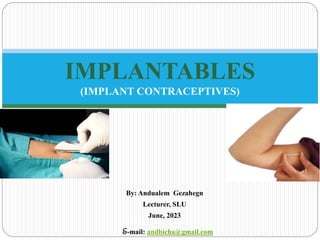
 A specifically trained provider places the implants
under the skin on the inside of a woman’s upper arm.
 Do not contain estrogen, so can be used throughout
breastfeeding and by women who cannot use
methods with estrogen.
INTRO…
 Implants interrupt fertility by:
 Thickening cervical mucus (mechanically preventing
the sperm from accessing the ovum) and
 Through hormonal effects that prevent ovulation in
about half of menstrual cycles.
INTRODUCTION TO IMPLANTS…
Nearly all women can use hormonal implants including:
 Women of any age
 Women who have or have not children
 Married or not married
 Women who wish to space or limit births
 Women who had abortion or miscarriage
 Women who are breast feeding (6 weeks post partum)
 Women who have HIV/AIDS and are on ART
 Implants DON’T protect against HIV/STI
EFFECTIVENESS
Implants are:
 Less than 1 pregnancy per 100 women using implants
over the first year
NOTE:
 Implants start to lose effectiveness sooner for
heavier women (80 kg or more)
 Implants in such women should be replaced after 4
years.
TYPES OF IMPLANTS
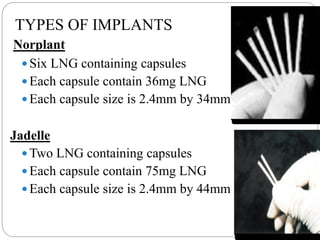
Norplant
 Six LNG containing capsules
 Each capsule contain 36mg LNG
 Each capsule size is 2.4mm by 34mm
Jadelle
 Two LNG containing capsules
 Each capsule contain 75mg LNG
 Each capsule size is 2.4mm by 44mm
TYPES OF IMPLANTS
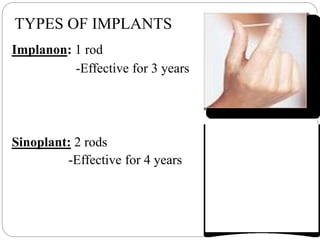
Implanon: 1 rod
-Effective for 3 years
Sinoplant: 2 rods
-Effective for 4 years
FEATURES OF CONTRACEPTIVE IMPLANTS
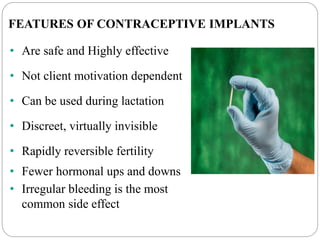
• Are safe and Highly effective
• Not client motivation dependent
• Can be used during lactation
• Discreet, virtually invisible
• Rapidly reversible fertility
• Fewer hormonal ups and downs
• Irregular bleeding is the most
common side effect
FEATURES (Cont…)
• Stable hormone levels
• Extended protection (3 – 5 Years)
• Contain no estrogen
• Does not protect against STIs and HIV
• Requires a minor surgical procedure for insertion
and removal of the rods
• Cannot discontinue the method on one’s own.
NON CONTRACEPTIVE HEALTH BENEFITS
 Help prevent ectopic pregnancy
 Help protect against Symptomatic PID
 Help prevent iron deficiency anaemia
 May prevent endometrial cancer
Implants have no effect on sexual function.
MECHANISM OF ACTION
Mechanisms are:
 Increased thickness of the cervical mucus (within 48-
72 hours after insertion).
 Inhibition of ovulation - in about 50% of menstrual
cycles.
 Suppression of endometrial growth so that it is less
receptive to implantation.
RETURN TO FERTILITY
 There is no delay in return to fertility upon
removal of implants
 implants have no impact upon long-term fertility.
SIDE EFFECTS
 Changes in bleeding patterns (many bleeding
disturbances diminish with continued use)
 Typical changes include:
o Lighter bleeding
o Fewer days of bleeding
o Irregular bleeding that lasts more than eight days
o Infrequent bleeding and
o No monthly bleeding.
DRUG INTERACTION EFFECT ON IMPLANTS
EFFECTIVENESS
 Use of some drugs can induce hepatic enzymes that break
down hormonal contraceptives.
 Implants are likely to be less effective in such clients that may
lead to unintended pregnancy or breakthrough bleeding.
These drugs include:
 Rifampicin
 Griseofulvin
 Phenobarbital, phenytoin, Dilantine....
 Some ARV drugs
APPROPRIATE USERS FOR IMPLANTS
Implants can be used by most women of the reproductive
age who:
 Prefers a long-term method
 Can not remember to take a pill every day.
 Are breastfeeding and after 6 weeks post-partum.
 Is postpartum and not breastfeeding.
 Cannot take estrogen-containing contraceptives
 Is considering sterilization but not ready to make a final
decision.
 Is post-abortal (immediately after) or post partum
(After 6 weeks)
 Has moderate to severe menstrual cramping,
 Smoke
MEDICAL ELIGIBILITY
Nearly all women can use implants safely and effectively,
including women who:
 Have or have not had children
 Are not married
 Are of any age, including adolescents and women
over 40 years old
 Have just had an abortion, miscarriage, or ectopic
pregnancy
 Have anemia now or in the past
 Have varicose veins
 Are infected with HIV, whether or not on
antiretroviral therapy
MEDICAL ELIGIBILITY...
 Implants may not be appropriate for some women.
Therefore, service providers must assess clients
regarding the appropriateness of using implants.
CLIENT ASSESSMENT
 Take history that identifies the clients reproductive
goals, screens for precautions to the use of implant,
and screens for any medical problems.
 Pelvic examination is not recommended unless under
certain circumstances.
 Pregnancy test is not necessary unless indicated
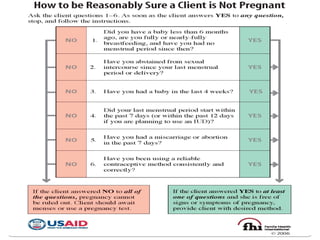
 Rule out pregnancy reasonably using the checklist
before initiation of implants
TIMING OF INSERTION
 During menstruation:
 Days 1-7 of the menstrual cycle
 Post partum:
 After 6 weeks if breastfeeding but not using
Lactational amenorrhea (LAM);
 immediately or within 6 week, if using LAM
 Post abortion:
 Immediately or within the first 7 days)
IF SWITCHING FROM ANOTHER CONTRACEPTIVE
METHOD
 Natural family planning or Barrier:
 First 7 days of the menstrual cycle
 COC:
 During the 7 days after the 21st pill has been taken
 POP
 On the day the last pill in the pack is taken
 Injectable Hormone(s)
 Any time up to the time of the next scheduled injection.
 IUCD:
 anytime, but need to use a backup method of contraception
for 7 days.
 Implant:
 at the same time the implant rods are being removed.
TIMING OF IMPLANT REMOVAL
 At anytime during the menstrual cycle.
 At 5 years of use for Jadelle,
 4 years for sino-plant and
 3 years for Implanon.
 (Implant’s effectiveness drops after the specified years,
increasing the risk of intrauterine and ectopic pregnancy)
 Anytime client requests for removal, (after adequate
counseling)
LIMITATIONS OF CONTRACEPTIVE IMPLANTS
 Can cause irregular bleeding
 Requires clinician visits for insertion and removal
 Does not protect from STDs
 High cost ???
 Misperceptions surrounding implant history
Limitation Cont…
 If removed before 3 yrs of use not economical
 No protection of STI & HIV
 Decrease in effectiveness with the use of some drugs
 Some users may experience side effects
IN CONCLUSION
Implants are:
 Advancement in contraceptive options
 Safe, highly effective, and rapidly reversible
 Offers women additional choice
 Can be used by most reproductive-age women
 Clients are satisfied with them because they are
• Convenient to use,
• Long-lasting and
• Highly effective
• Continuation rates are high
IN CONCLUSION cont…
 Implants provide highly effective, long-acting pregnancy
protection (3 to 5 years)
 Although insertion and removal require a trained
provider, both procedures are done quickly
 Contraceptive protection is immediately reversible upon
implant removal
 Implants have no impact on long term fertility
Implanteable contraception .pdf

Implanteable contraception .pdf

  • 1.
    IMPLANTABLES (IMPLANT CONTRACEPTIVES) By: AndualemGezahegn Lecturer, SLU June, 2023 E-mail: andbicha@gmail.com
  • 2.
    OBJECTIVES By the endof the session students will be able to:  Describe hormonal Implants  Identify the appropriate users and medical eligibility criteria for use of implants.  Demonstrate the standard insertion and removal procedures for implants  Identify and manage side effects and complications
  • 3.
    INTRODUCTION DEFINITION: Implants are progesteroneonly containing hormonal contraceptives that are: o Most effective o Safest o Easy to use o Quickly reversible up on removal and o Long acting methods
  • 4.
    INTRODUCTION… Implants are : Small plastic rods or capsules, each about the size of a matchstick.  A specifically trained provider places the implants under the skin on the inside of a woman’s upper arm.  Do not contain estrogen, so can be used throughout breastfeeding and by women who cannot use methods with estrogen.
  • 5.
    INTRO…  Implants interruptfertility by:  Thickening cervical mucus (mechanically preventing the sperm from accessing the ovum) and  Through hormonal effects that prevent ovulation in about half of menstrual cycles.
  • 6.
    INTRODUCTION TO IMPLANTS… Nearlyall women can use hormonal implants including:  Women of any age  Women who have or have not children  Married or not married  Women who wish to space or limit births  Women who had abortion or miscarriage  Women who are breast feeding (6 weeks post partum)  Women who have HIV/AIDS and are on ART  Implants DON’T protect against HIV/STI
  • 7.
    EFFECTIVENESS Implants are:  Lessthan 1 pregnancy per 100 women using implants over the first year NOTE:  Implants start to lose effectiveness sooner for heavier women (80 kg or more)  Implants in such women should be replaced after 4 years.
  • 8.
    TYPES OF IMPLANTS Norplant Six LNG containing capsules  Each capsule contain 36mg LNG  Each capsule size is 2.4mm by 34mm Jadelle  Two LNG containing capsules  Each capsule contain 75mg LNG  Each capsule size is 2.4mm by 44mm
  • 9.
    TYPES OF IMPLANTS Implanon:1 rod -Effective for 3 years Sinoplant: 2 rods -Effective for 4 years
  • 10.
    FEATURES OF CONTRACEPTIVEIMPLANTS • Are safe and Highly effective • Not client motivation dependent • Can be used during lactation • Discreet, virtually invisible • Rapidly reversible fertility • Fewer hormonal ups and downs • Irregular bleeding is the most common side effect
  • 11.
    FEATURES (Cont…) • Stablehormone levels • Extended protection (3 – 5 Years) • Contain no estrogen • Does not protect against STIs and HIV • Requires a minor surgical procedure for insertion and removal of the rods • Cannot discontinue the method on one’s own.
  • 12.
    NON CONTRACEPTIVE HEALTHBENEFITS  Help prevent ectopic pregnancy  Help protect against Symptomatic PID  Help prevent iron deficiency anaemia  May prevent endometrial cancer Implants have no effect on sexual function.
  • 13.
    MECHANISM OF ACTION Mechanismsare:  Increased thickness of the cervical mucus (within 48- 72 hours after insertion).  Inhibition of ovulation - in about 50% of menstrual cycles.  Suppression of endometrial growth so that it is less receptive to implantation.
  • 14.
    RETURN TO FERTILITY There is no delay in return to fertility upon removal of implants  implants have no impact upon long-term fertility.
  • 15.
    SIDE EFFECTS  Changesin bleeding patterns (many bleeding disturbances diminish with continued use)  Typical changes include: o Lighter bleeding o Fewer days of bleeding o Irregular bleeding that lasts more than eight days o Infrequent bleeding and o No monthly bleeding.
  • 16.
    DRUG INTERACTION EFFECTON IMPLANTS EFFECTIVENESS  Use of some drugs can induce hepatic enzymes that break down hormonal contraceptives.  Implants are likely to be less effective in such clients that may lead to unintended pregnancy or breakthrough bleeding. These drugs include:  Rifampicin  Griseofulvin  Phenobarbital, phenytoin, Dilantine....  Some ARV drugs
  • 17.
    APPROPRIATE USERS FORIMPLANTS Implants can be used by most women of the reproductive age who:  Prefers a long-term method  Can not remember to take a pill every day.  Are breastfeeding and after 6 weeks post-partum.  Is postpartum and not breastfeeding.  Cannot take estrogen-containing contraceptives  Is considering sterilization but not ready to make a final decision.  Is post-abortal (immediately after) or post partum (After 6 weeks)  Has moderate to severe menstrual cramping,  Smoke
  • 18.
    MEDICAL ELIGIBILITY Nearly allwomen can use implants safely and effectively, including women who:  Have or have not had children  Are not married  Are of any age, including adolescents and women over 40 years old  Have just had an abortion, miscarriage, or ectopic pregnancy  Have anemia now or in the past  Have varicose veins  Are infected with HIV, whether or not on antiretroviral therapy
  • 19.
    MEDICAL ELIGIBILITY...  Implantsmay not be appropriate for some women. Therefore, service providers must assess clients regarding the appropriateness of using implants.
  • 20.
    CLIENT ASSESSMENT  Takehistory that identifies the clients reproductive goals, screens for precautions to the use of implant, and screens for any medical problems.  Pelvic examination is not recommended unless under certain circumstances.  Pregnancy test is not necessary unless indicated  Rule out pregnancy reasonably using the checklist before initiation of implants
  • 22.
    TIMING OF INSERTION During menstruation:  Days 1-7 of the menstrual cycle  Post partum:  After 6 weeks if breastfeeding but not using Lactational amenorrhea (LAM);  immediately or within 6 week, if using LAM  Post abortion:  Immediately or within the first 7 days)
  • 23.
    IF SWITCHING FROMANOTHER CONTRACEPTIVE METHOD  Natural family planning or Barrier:  First 7 days of the menstrual cycle  COC:  During the 7 days after the 21st pill has been taken  POP  On the day the last pill in the pack is taken  Injectable Hormone(s)  Any time up to the time of the next scheduled injection.  IUCD:  anytime, but need to use a backup method of contraception for 7 days.  Implant:  at the same time the implant rods are being removed.
  • 24.
    TIMING OF IMPLANTREMOVAL  At anytime during the menstrual cycle.  At 5 years of use for Jadelle,  4 years for sino-plant and  3 years for Implanon.  (Implant’s effectiveness drops after the specified years, increasing the risk of intrauterine and ectopic pregnancy)  Anytime client requests for removal, (after adequate counseling)
  • 25.
    LIMITATIONS OF CONTRACEPTIVEIMPLANTS  Can cause irregular bleeding  Requires clinician visits for insertion and removal  Does not protect from STDs  High cost ???  Misperceptions surrounding implant history
  • 26.
    Limitation Cont…  Ifremoved before 3 yrs of use not economical  No protection of STI & HIV  Decrease in effectiveness with the use of some drugs  Some users may experience side effects
  • 27.
    IN CONCLUSION Implants are: Advancement in contraceptive options  Safe, highly effective, and rapidly reversible  Offers women additional choice  Can be used by most reproductive-age women  Clients are satisfied with them because they are • Convenient to use, • Long-lasting and • Highly effective • Continuation rates are high
  • 28.
    IN CONCLUSION cont… Implants provide highly effective, long-acting pregnancy protection (3 to 5 years)  Although insertion and removal require a trained provider, both procedures are done quickly  Contraceptive protection is immediately reversible upon implant removal  Implants have no impact on long term fertility