DR AKISEKU A.K
 Introduction
 Long acting reversible contraceptives
 Long acting hormonal contraceptives
 There are about 1.2 billion women of reproductive age
world wide
 An estimated 1.5 million unplanned pregnancies
occur in Nigeria every year and about half of these
result in elective abortion.
Bankole A , Oye-Adediran. International Family Planning Perspectives
Volume 32, Number 4, December 2006
 Unexpected or unplanned pregnancy poses a major
public health challenge in women
of reproductive age, especially in developing
countries.
 It has been estimated that of the 210 million
pregnancies that occur annually worldwide, about 80
million(38%) are unplanned, and 46 million (22%) end
in abortion.
 Abortions account for 20%–40% of maternal deaths in
Nigeria.
 Many factors contribute to unwanted pregnancy in Nigeria,
and a very important factor is the low level of contraceptive
use
 Contraception a key strategy for the prevention of
unwanted pregnancy.
Open Access Journal of Contraception 2010: 19–22
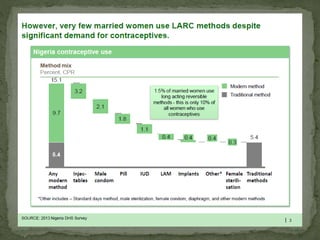
 The current prevalence rate for contraceptive use in
Nigeria is approximately 11%–13%.
 The Nigeria’s family planning commitments is to
achieve a contraceptive prevalence rate of 36% by 2018.
National Strategy and implementation plan (2013-2015)
 The low prevalence of contraceptive use in Nigeria and
indeed in the Sub-Saharan region is due to interplay of
many factors:
 Socio-cultural, economic, political,
 religious, and demographic.
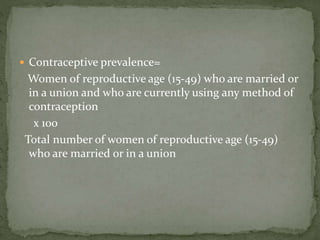
 Contraceptive prevalence=
Women of reproductive age (15-49) who are married or
in a union and who are currently using any method of
contraception
x 100
Total number of women of reproductive age (15-49)
who are married or in a union
 Family planning programs have yielded positive gains
over the past decade
 Like all aspects of medicine, contraception is also
witnessing advances, changes, improvements.
 LARC is defined as contraceptive methods that require
administration less than once per cycle or month.
Included in the category of LARC are:
 copper intrauterine devices
 progestogen-only intrauterine systems
 progestogen-only injectable contraceptives
Nice clinical guideline 30. 2014
 progestogen-only subdermal implants
 Progesterone Vaginal Ring (PVR)
 The uptake of LARC is low in Great Britain, at around
12% of women aged 16–49 in 2008–09, compared with
25% for the oral contraceptive pill and 25% for male
condoms
 Are the most effective reversible methods available
 Have high rates of user satisfaction as indicated by high
continuation rates
 Are set and forget methods that do not require daily
adherence
 Require fewer visits to health services than many other
methods
 Are cheaper than using the pill over 12 months
 Are easily reversible
 Are suitable for women of all ages
 Do not affect fertility after removal
 A lack of familiarity with, or misperceptions about, the methods
 High upfront costs
 Lack of access to insertion services
 Health care providers’ concerns about the safety of IUD use,
especially in nulliparous ,younger women and teenagers
 Patient barriers, including a general lack of awareness of LARC
methods and information about their safety and effectiveness
 progestogen-only intrauterine systems
 progestogen-only subdermal implants
 progestogen-only injectable contraceptives
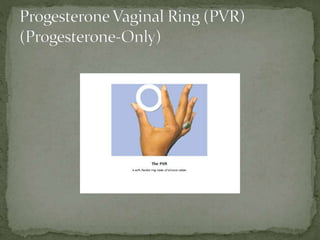
 Progesterone Vaginal Ring (PVR)
 Synthetic progesterone preps for long
acting contraception.
 Adminstered largely as depots, implants,
and as intra-uterine systems.
 Contraceptive efficacy relies on daily
slow release of progestogen
 Mechanisms of action are largely:
Centrally inhibiting ovulation
Thickening of vaginal and cervical
mucus
Thinning of endometrium
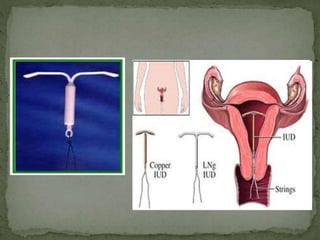
 Is a levonorgestrel-releasing intrauterine device
 Is T-shaped with reservoir on the vertical arm
 Releases progestin levonorgetsrel 20ug daily
 Has 2 monfilament string attached to the vertical arm.
 Life span is 5years
 Thickening of cervical mucus impeding sperm acsent.
 Alteration in uterotubal fluid that interferes with sperm
migration
 Anovulation in 10-15% of cycles.
 Thinning of endometrium to reduce likelihood of
implantation.
FR: 0.1-0.7 preg/100 WYr
Risks
 50% of pregnancy as a result of failure are ectopic preg.
 Irregular bleeding common in the initial 3-4 months of use.
 About 25% of users become amenorrhoeic after the 2nd year
of use
Benefits
 Improvement in dysmenorrhoea.
 Used for Rx of Menorrhagia
 Reduced incidence of PID.
 Reduces risk of endomitral carcinoma
 Progesterone diffuses at a continuous flow of 10mg per
day through the silicone
 Prolongs lactation amenorrhoea
 Used for Postpartum contraception
 After 6 weeks of delivery and for 3 months
 A vaginal ring is inserted at postnatal visit (6 weeks)
 Once inserted, the Ring is worn for 3 months
 At end of 3 months, it is removed and another
replaced
 For now, use is stopped when menstruation returns, or
for a maximum of 1 year
 Meant for breastfeeding women only
Types: Progestin-Only
 Depo Medroxy Progesterone Acetate (DMPA) 150 mg
 Microcrystalline suspension
 3 monthly
 Norethisterone Enanthate (Net-En) 200 mg
 In oil
 2 monthly
 Inhibition of ovulation by suppressing
gonadotropinns.
 Thickening of cervical mucus.
 Thinning of the endometrium.
 During 1 year of use, the perfect use failure rate is 0.3
pregnancies per 100 woman-years, whereas the failure
rate with typical use is 3 pregnancies per 100 woman-
years.
 The risk of ectopic pregnancy is significantly lower
among users compared to women who do not use
contraception.
 The risk of endometrial cancer is reduced by as much
as 80%, an effect that is long term and increases with
duration of use.
 Studies have shown as much as a 70% reduction in the
frequency of sickle cell crises; the mechanism for this
effect is not known.
 Some women with endometriosis have improvement
of symptoms with use of DMPA.
 Decrease in bone mineral density, hence, encourage
calcium intake.
 Irregular bleeding & prolonged menstrual flow
 Amenorrhoea in prolonged users
 Mood swing & Depression.
 ?Wt gain, about 5Ib(2.2kg) in 1 yr of use.
 Delayed return to fertility when discontinued, ≥10
months.
 Depo-subQ Provera (DMPA-SC)
 Contains 104 mg Depo-medroxy progesterone acetate
 In micro-crystalline suspension form
 Now Subcutaneous unlike Intramuscular in DMPA
 Also every 12 weeks
 Should not be used continuously for ˃2 years
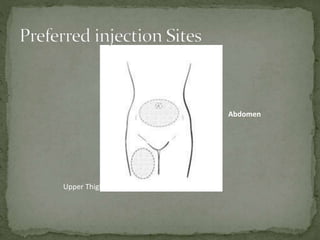
Upper Thigh
Abdomen
 Initially Six Rods, Norplant (now discarded)
 Two rod Jadelle (levonorgestrel) – 5 years
 One rod Implanon (etonogestrel) – 3 years
 Bio-degradable (Capronor) that does not require
removal (2 years) – Developed by Research Triangle
Institute
[Levonorgestrel Implant]
 1st generation of implants
 Consists of 6 rods, each measuring 34mm in length &
2.4mm in diameter
 Each rod contains 36mg levonorgestrel.
 Approximately 80mcg of levonorgestrel is released
daily during the first 6-12 months after insertion.
 Rate of release gradually declines to 30-35ug/day.
 LH surge necessary for ovulation is suppressed in
approximately 50% of cycles
 Are mainly irregular bleeding pattern, which
normalises over long term use.
 Headaches
 Acne, Weight gain/loss, mastalgia, mood cahnge or
depression.
 Hyperpigmentation over site of implant
 Hirsuitism.
 Galactorrhoea.
 Symptomatic functional cyst occasionally occur.
 Insertion is by special troca, subdermally on the inner
surface of the left upper arm under local anaesthesia.
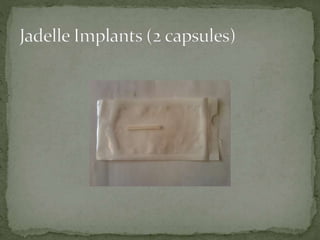
JADELLE [NORPLANT-2]
 Levonorgestrel preparation
 Contains 2 non-biodegradeable silicone elastomer
capsule.
 Each capsule is 43mm in length & 2.5mm in diameter.
 Each capsule contains 75mg Levonorgestrel.
 Insertion is effective for 5yrs.
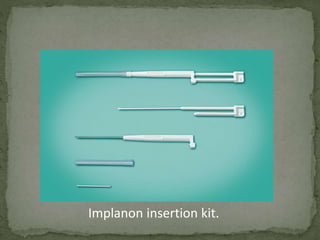
 Implanon: Non biodegradable
 Single rod
 Contain 68mg of etonogestrel active metabolite of
desogestrel.
 The hormone is released at an initial rate of 60mcg per
day decreasing to 30mcg per day after 2years.
 Duration of action is 3years
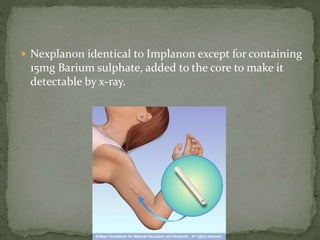
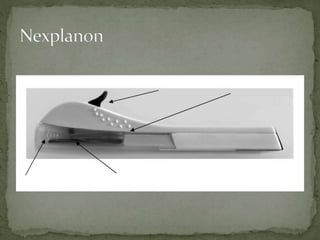
 Nexplanon identical to Implanon except for containing
15mg Barium sulphate, added to the core to make it
detectable by x-ray.
 Rod is 4cm in length & 2mm in diameter.
 Shld be removed after 3yrs, or earlier if preg is
desired .
 When the rod is removed, the return to fertility is
rapid, with the return of ovulation within 3 weeks
 Apart form its effect on cervical mucus, it also
inhibits ovulation.
 Compared with the Norplant system, Implanon is
associated with a higher frequency of amenorrhea and
oligomenorrhea, a decrease in the prevalence of
frequent and prolonged bleeding, and a decrease in
the frequency of adverse effects such as weight gain,
headache, and acne.
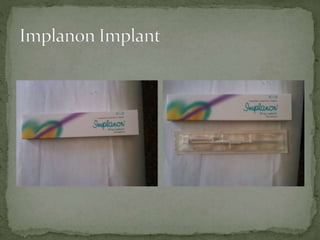
Implanon insertion kit.
 Uniplant is a single implant contraceptive containing
38mg nomegestrel acetate in a 4cm silastic tube with a
100ug per day release rate
 It provide contraception for 1year.
 CAPRONOR, NORETHINDRONE PELLETS
 CAPRONOR: is a single capsule, levonogestrel
releasing subdermal implant
 2.4mm in diameter and 40mm in length
 It provide contraception for 1year.
 Capsule remain intact for the first 12 months allowing
for easy removal then begins to disappear after
12months
 NORETHINDRONE PELLETS or anuelle
 Is injected subdermally and maintain circulating
contraceptive level of progestin for up to 3years.
 This pellet is compose of 10% pure cholesterol and
90% norethindrone
 This method is currently under development.
 Expert clinical opinion is that LARC methods may
have a wider role in contraception and their increased
uptake could help to reduce unintended pregnancy
 Enabling women to make an informed choice about
LARC and addressing women's preferences is an
important objective.
 SH&FPA statement on LARCs: October 2013.
 Nice clinical guideline 30. 2014.
 Long acting reversible contraception (C-Gyn 34) New statement july 2014.
 Increasing access to long acting reversible contraceptives in nigeria:
National strategy and implementation plan (2013-2015)
 Open Access Journal of Contraception 2010:1 9–22
 Kigbu J H, Daniyan A B C. UPDATES ON CONTRACEPTION. Ibom
Medical Journal.2008;3: 4-12
 Current Concepts In Contraception. Text of Presentation at the MDCAN,
OOUTH Sagamu, CPD LECTURE SERIES. By Dr. Peter O. Adefuye.
 Current Diagnosis & Treatment Obstetrics & Gynecology, Eleventh
Edition.2013
THANK
YOU

Long acting hormonal contraceptives

  • 1.
  • 2.
     Introduction  Longacting reversible contraceptives  Long acting hormonal contraceptives
  • 3.
     There areabout 1.2 billion women of reproductive age world wide  An estimated 1.5 million unplanned pregnancies occur in Nigeria every year and about half of these result in elective abortion. Bankole A , Oye-Adediran. International Family Planning Perspectives Volume 32, Number 4, December 2006
  • 4.
     Unexpected orunplanned pregnancy poses a major public health challenge in women of reproductive age, especially in developing countries.  It has been estimated that of the 210 million pregnancies that occur annually worldwide, about 80 million(38%) are unplanned, and 46 million (22%) end in abortion.
  • 5.
     Abortions accountfor 20%–40% of maternal deaths in Nigeria.  Many factors contribute to unwanted pregnancy in Nigeria, and a very important factor is the low level of contraceptive use  Contraception a key strategy for the prevention of unwanted pregnancy. Open Access Journal of Contraception 2010: 19–22
  • 6.
     The currentprevalence rate for contraceptive use in Nigeria is approximately 11%–13%.  The Nigeria’s family planning commitments is to achieve a contraceptive prevalence rate of 36% by 2018. National Strategy and implementation plan (2013-2015)
  • 7.
     The lowprevalence of contraceptive use in Nigeria and indeed in the Sub-Saharan region is due to interplay of many factors:  Socio-cultural, economic, political,  religious, and demographic.
  • 8.
     Contraceptive prevalence= Womenof reproductive age (15-49) who are married or in a union and who are currently using any method of contraception x 100 Total number of women of reproductive age (15-49) who are married or in a union
  • 9.
     Family planningprograms have yielded positive gains over the past decade  Like all aspects of medicine, contraception is also witnessing advances, changes, improvements.
  • 10.
     LARC isdefined as contraceptive methods that require administration less than once per cycle or month. Included in the category of LARC are:  copper intrauterine devices  progestogen-only intrauterine systems  progestogen-only injectable contraceptives Nice clinical guideline 30. 2014
  • 11.
     progestogen-only subdermalimplants  Progesterone Vaginal Ring (PVR)  The uptake of LARC is low in Great Britain, at around 12% of women aged 16–49 in 2008–09, compared with 25% for the oral contraceptive pill and 25% for male condoms
  • 13.
     Are themost effective reversible methods available  Have high rates of user satisfaction as indicated by high continuation rates  Are set and forget methods that do not require daily adherence  Require fewer visits to health services than many other methods  Are cheaper than using the pill over 12 months  Are easily reversible  Are suitable for women of all ages  Do not affect fertility after removal
  • 14.
     A lackof familiarity with, or misperceptions about, the methods  High upfront costs  Lack of access to insertion services  Health care providers’ concerns about the safety of IUD use, especially in nulliparous ,younger women and teenagers  Patient barriers, including a general lack of awareness of LARC methods and information about their safety and effectiveness
  • 15.
     progestogen-only intrauterinesystems  progestogen-only subdermal implants  progestogen-only injectable contraceptives  Progesterone Vaginal Ring (PVR)
  • 16.
     Synthetic progesteronepreps for long acting contraception.  Adminstered largely as depots, implants, and as intra-uterine systems.  Contraceptive efficacy relies on daily slow release of progestogen  Mechanisms of action are largely: Centrally inhibiting ovulation Thickening of vaginal and cervical mucus Thinning of endometrium
  • 17.
     Is alevonorgestrel-releasing intrauterine device  Is T-shaped with reservoir on the vertical arm  Releases progestin levonorgetsrel 20ug daily  Has 2 monfilament string attached to the vertical arm.  Life span is 5years
  • 19.
     Thickening ofcervical mucus impeding sperm acsent.  Alteration in uterotubal fluid that interferes with sperm migration  Anovulation in 10-15% of cycles.  Thinning of endometrium to reduce likelihood of implantation. FR: 0.1-0.7 preg/100 WYr
  • 20.
    Risks  50% ofpregnancy as a result of failure are ectopic preg.  Irregular bleeding common in the initial 3-4 months of use.  About 25% of users become amenorrhoeic after the 2nd year of use Benefits  Improvement in dysmenorrhoea.  Used for Rx of Menorrhagia  Reduced incidence of PID.  Reduces risk of endomitral carcinoma
  • 22.
     Progesterone diffusesat a continuous flow of 10mg per day through the silicone  Prolongs lactation amenorrhoea  Used for Postpartum contraception  After 6 weeks of delivery and for 3 months
  • 23.
     A vaginalring is inserted at postnatal visit (6 weeks)  Once inserted, the Ring is worn for 3 months  At end of 3 months, it is removed and another replaced  For now, use is stopped when menstruation returns, or for a maximum of 1 year  Meant for breastfeeding women only
  • 24.
    Types: Progestin-Only  DepoMedroxy Progesterone Acetate (DMPA) 150 mg  Microcrystalline suspension  3 monthly  Norethisterone Enanthate (Net-En) 200 mg  In oil  2 monthly
  • 25.
     Inhibition ofovulation by suppressing gonadotropinns.  Thickening of cervical mucus.  Thinning of the endometrium.
  • 26.
     During 1year of use, the perfect use failure rate is 0.3 pregnancies per 100 woman-years, whereas the failure rate with typical use is 3 pregnancies per 100 woman- years.
  • 27.
     The riskof ectopic pregnancy is significantly lower among users compared to women who do not use contraception.  The risk of endometrial cancer is reduced by as much as 80%, an effect that is long term and increases with duration of use.  Studies have shown as much as a 70% reduction in the frequency of sickle cell crises; the mechanism for this effect is not known.  Some women with endometriosis have improvement of symptoms with use of DMPA.
  • 28.
     Decrease inbone mineral density, hence, encourage calcium intake.  Irregular bleeding & prolonged menstrual flow  Amenorrhoea in prolonged users  Mood swing & Depression.  ?Wt gain, about 5Ib(2.2kg) in 1 yr of use.  Delayed return to fertility when discontinued, ≥10 months.
  • 29.
     Depo-subQ Provera(DMPA-SC)  Contains 104 mg Depo-medroxy progesterone acetate  In micro-crystalline suspension form  Now Subcutaneous unlike Intramuscular in DMPA  Also every 12 weeks  Should not be used continuously for ˃2 years
  • 30.
  • 31.
     Initially SixRods, Norplant (now discarded)  Two rod Jadelle (levonorgestrel) – 5 years  One rod Implanon (etonogestrel) – 3 years  Bio-degradable (Capronor) that does not require removal (2 years) – Developed by Research Triangle Institute
  • 32.
    [Levonorgestrel Implant]  1stgeneration of implants  Consists of 6 rods, each measuring 34mm in length & 2.4mm in diameter
  • 33.
     Each rodcontains 36mg levonorgestrel.  Approximately 80mcg of levonorgestrel is released daily during the first 6-12 months after insertion.  Rate of release gradually declines to 30-35ug/day.  LH surge necessary for ovulation is suppressed in approximately 50% of cycles
  • 34.
     Are mainlyirregular bleeding pattern, which normalises over long term use.  Headaches  Acne, Weight gain/loss, mastalgia, mood cahnge or depression.  Hyperpigmentation over site of implant  Hirsuitism.  Galactorrhoea.  Symptomatic functional cyst occasionally occur.
  • 35.
     Insertion isby special troca, subdermally on the inner surface of the left upper arm under local anaesthesia.
  • 36.
    JADELLE [NORPLANT-2]  Levonorgestrelpreparation  Contains 2 non-biodegradeable silicone elastomer capsule.  Each capsule is 43mm in length & 2.5mm in diameter.  Each capsule contains 75mg Levonorgestrel.  Insertion is effective for 5yrs.
  • 38.
     Implanon: Nonbiodegradable  Single rod  Contain 68mg of etonogestrel active metabolite of desogestrel.  The hormone is released at an initial rate of 60mcg per day decreasing to 30mcg per day after 2years.  Duration of action is 3years
  • 39.
     Nexplanon identicalto Implanon except for containing 15mg Barium sulphate, added to the core to make it detectable by x-ray.
  • 40.
     Rod is4cm in length & 2mm in diameter.  Shld be removed after 3yrs, or earlier if preg is desired .  When the rod is removed, the return to fertility is rapid, with the return of ovulation within 3 weeks  Apart form its effect on cervical mucus, it also inhibits ovulation.
  • 41.
     Compared withthe Norplant system, Implanon is associated with a higher frequency of amenorrhea and oligomenorrhea, a decrease in the prevalence of frequent and prolonged bleeding, and a decrease in the frequency of adverse effects such as weight gain, headache, and acne.
  • 43.
  • 45.
     Uniplant isa single implant contraceptive containing 38mg nomegestrel acetate in a 4cm silastic tube with a 100ug per day release rate  It provide contraception for 1year.
  • 46.
     CAPRONOR, NORETHINDRONEPELLETS  CAPRONOR: is a single capsule, levonogestrel releasing subdermal implant  2.4mm in diameter and 40mm in length  It provide contraception for 1year.  Capsule remain intact for the first 12 months allowing for easy removal then begins to disappear after 12months
  • 47.
     NORETHINDRONE PELLETSor anuelle  Is injected subdermally and maintain circulating contraceptive level of progestin for up to 3years.  This pellet is compose of 10% pure cholesterol and 90% norethindrone  This method is currently under development.
  • 48.
     Expert clinicalopinion is that LARC methods may have a wider role in contraception and their increased uptake could help to reduce unintended pregnancy  Enabling women to make an informed choice about LARC and addressing women's preferences is an important objective.
  • 49.
     SH&FPA statementon LARCs: October 2013.  Nice clinical guideline 30. 2014.  Long acting reversible contraception (C-Gyn 34) New statement july 2014.  Increasing access to long acting reversible contraceptives in nigeria: National strategy and implementation plan (2013-2015)  Open Access Journal of Contraception 2010:1 9–22  Kigbu J H, Daniyan A B C. UPDATES ON CONTRACEPTION. Ibom Medical Journal.2008;3: 4-12  Current Concepts In Contraception. Text of Presentation at the MDCAN, OOUTH Sagamu, CPD LECTURE SERIES. By Dr. Peter O. Adefuye.  Current Diagnosis & Treatment Obstetrics & Gynecology, Eleventh Edition.2013
  • 50.